
Using Data and Theory in Multistretegy (Mis)Concept(ion) Discovery
Proceedings of the Fifteenth International Joint Conference on Artificial Intelligence. Cognitive Modeling. Pages 274-278.
© 1997 International Joint Conferences on Artificial Intelligence
Abstract
Most conceptual clustering systems rely solely on data to form concepts without supervision; the few that exploit causalities in the background knowledge do so only after the completion of a similarity-based learning phase. In this paper, we describe a multistrategy miconception discovery system, MMD, that utilizes data and theory in a more tightly coupled way. The integration of similarity- and causality- based learning in MMD is shown to be essential for the automatic construction of accurate and meaningful misconceptions that account for errors in novice behavior.
- [Barsalou, 1991] L. Barsalou. Deriving categories to achieve goals. The Psychology of Learning and Moti- vation, 27:1-64, 1991. .
- [Corter and Gluck, 1992] J. Corter and M. Gluck. Ex- plaining basic categories: Feature predictability and information. Psychological Bulletin, 111: 291-303, 1992.
- [Fisher, 1987] D. Fisher. Knowledge acquisition via in- cremental conceptual clustering. Machine learning. 2:139-172, 1987.
- [Flann and Dietterich, 1989] N. Flann and T. Dietterich. A study of explanation-based methods for inductive learning, Machine Learning, 4:187-226, 1989.
- [Gluck and Corter, 1985] M. Gluck and J . Corter. In- formation , uncertainty, and the utility of categories, In Proceedings of the Annual Conference of the Cog- nitive Science Society, pages 283-287.
- Lawrence Erl- baum, 1985. [Komatsu, 1992]
- L. Komatsu. Recent views of con- ceptual structure, Psychological Bulletin, 112(3):500- 526. 1992.
- [Lebowitz, 1986] M. Lebowitz. Integrated learning: Controlling explanation, Cognitive Science, 10:219- 240, 1986.
- [Lebowitz, 1987] M. Lebowitz. Experiments with incre- mental concept formation. Machine Learning, 2:103- 138, 1987.
- [Martin and Billman, 1994] J. Martin and D. Billman. Acquiring and combining overlapping concepts. Ma- chine Learning, 16:121-155, 1994.
- [Michalski and Stepp, 1983] R. Michalski and R. Stepp. Learning from observation: Conceptual clustering. In R. Michalski, .J. Carbonell, and T. Mitchell, ed- itors, Machine Learning: An Artificial Intelligence Approach. Tioga, Palo Alto, CA, 1983.
- [Mooney and Ourston, 1989] R. Mooney and D. Ours- ton. Induction over the unexplained: Integrated learning of concepts with both explainable and con- ventional aspects, In Proceedings of the Sixth Inter- national Workshop on Machine Learning, pages 5-7.
- Morgan Kaufmann, 1989.
- [Muggleton and Feng, 1990] S. Muggleton and C. Feng. Efficient induction of logic programs, In Proceedings of the First Conference on Algorithmic Learning The- ory, Tokyo Ohmsha, 1990.
- [Murphy and Medin, 1985] G. Murphy and D. Medin. The role of theories in conceptual coherence, Psycho- logical R eview, 92(3):289-316, 1985.
- [Pazzani, 1993] M. Pazzani. Learning causal patterns: Making a transition from data-driven to theory- driven learning, Machine Learning, 11(2/3):173-194, 1993.
- [Plotkin, 1970] G. Plotkin. A node on inductive gener- alization, Machine Intelligence , 5:153-163, 1970.
- [Rips and Collins, 1993] L. Rips and A. Collins. Cate- gories and resemblance, Journal of Experimental Psy- chology: General, 122(4):468-486, 1993.
- Sison, 1997].
- R. Sison. Toward the automatic discovery of misconceptions. To appear in Proceedings of the International Joint Conference on Artificial Intelli- gence, 1997. IJCAI
- [Sison and Shimura, 1996a] R. Sison and M. Shimura. Incremental clustering of relational descriptions. Technical Report TR96-0011. Department of Com- puter Science, Tokyo Institute of Technology, 1996.
- [Sison and Shimura, 1996b] R. Sison and M. Shimura. The application of machine learning to student mod- eling: Toward a multistrategic learning student mod- eling system. In Proceedings of the European Con- ference on Artificial Intelligence in Education, pages 87-93, 1996.
- [Sison, Numao and Shimura, 1997] R. Sison, M. Numao and M. Shimura. Discovering misconceptions using multistrategic conceptual clustering. To appear in Proceedings of the World Conference on Artificial In- telligence in Education, 1997.
- [Stepp and Michalski, 1986] R. Stepp and R. Michalski. Conceptual clustering of structured concepts: A goal- oriented approach, Artificial Intelligence, 28:43-69, 1986.
- [Thompson and Langley, 1991] K. Thompson and P. Langley. Concept formation in structured domains. In D. Fisher, M. Pazzani and P. Langley, editors, Concept Formation: Knowledge and Experience in Unsupervised Learning. Morgan Kaufmann, 1991.
- [Tversky, 1977] A. Tversky. Features of similarity, Psy- chological Review, 84(4):327-352, 1977.
- [Wisniewski and Medin, 1994] E. Wisniewski and D. Medin. On the interaction of theory arid data in con- cept learning, Cognitive Science, 18:221-281, 1994.
- [Yoo and Fisher, 1991] J. Yoo and D. Fisher. Concept formation over problem-solving experience. In D. Fisher, M. Pazzani and P. Langley, editors, Concept Formation: Knowledge and Experience in Unsuper- vised Learning. Morgan Kaufmann, 1991.
References were extracted automatically from the PDF and may contain errors.
Full text extracted automatically from the PDF; figures, tables and equations may differ. The PDF is the version of record.
1 Introduction
The primary method for unsupervised concept forma tion in AI is conceptual clustering, which is the grouping of unlabeled objects into categories for which conceptual descriptions (i.e., concepts) are formed. Although con ceptual clusterers differ in the way they address six key dimensions, 1 they largely share the characteristic of re lying solely on data to form concepts, a situation that likewise characterizes concept learning research in cog nitive psychology [Komatsu, 1992]. Recent works (e.g., [Barsalou, 1991; Rips and Collins, 1993; Wisniewski and Medin, 1994]), however, reveal an increasing dissatisfac tion over similarity-based models with their almost ex clusive reliance on data and show an increasing interest in the role of theories and goals in concept formation.
While there may be a couple of AI systems that use data (similarity-based learning (SBL)) and theory (explanation-based learning (EBL)) to form concepts without supervision, these systems treat SBL and EBL as phases that are performed one after the other. The unsupervised learning systems of [Lebowitz, 1986] and
1 These dimensions are: data processing mode (incremen tal or batch), data description (attributio~al or relation.~), concept description (definitional, prototypical or probabilis tic), category organization (hierarchical or flat), ca~eg?ry overlap (overlapping or disjoint), and clustering cntenon (ranging from ad hoc to Bayesian measures).
[Pazzani, 1993], for example, first apply SBL on ob jects to form clusters which are then fed into an EBL or EBL-like component for further processing. The super vised learners of [Flann and Dietterich, 1989], [Mooney and Ourston, 1989] and [Yoo and Fisher, 1991], on the other hand, operate in the reverse fashion: the output of the EBL phase is sent to an SBL component. However, [Wisniewski and Medin, 1994] argue cogently that such loosely coupled approaches to using data and theory, while undoubtedly useful, remain inadequate as models of concept formation.
In this paper, we describe MMD, a multistrategy con cept (or, more specifically, misconception) giscovery sys tem that utilizes data and theory in a more tightly cou pled way than previous systems have. As a system that incrementally constructs and revises a hierarchy of pos sibly overlapping categories of relational descriptions, MMD is also unique in the manner in which it addresses the key dimensions of conceptual clustering earlier men tioned.
Misconception Discovery as a Special Form of Concept Formation Errors in novice behavior, such as bugs in a program written by a novice programmer, can be represented as logic formulas that describe spe cific relations, i.e., discrepancies, between the incorrect behavior and an ideal (Table 1 illustrates). Such sets of discrepancies are analyzed in order to uncover the un derlying misconceptions that cause them. Knowledge of the causes of bugs will enable a tutor to both present a lesson and remediate a student more effectively.
In misconception discovery, therefore, the usual prob lem of concept formation is further complicated by the fact that conceptual descriptions of clusters of discrepan cies can hardly be considered misconceptions - unless causal explanations for them are found.
In what follows, we first present a basic similarity based algorithm for clustering relational descriptions and then describe how causal relationships in the background knowledge can be exploited to construct or correct de scriptions of concepts/misconceptions while they are be ing formed. We then report experimental results show ing that the approach to concept discovery embodied in
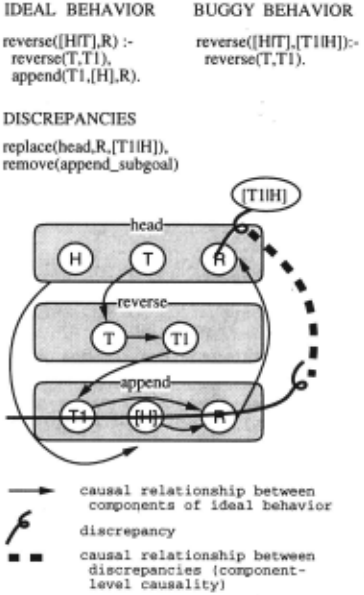
Ideal behavior: reverse([HIT],R) : reverse(T, T1), append(Tl,[H],R). Buggy behavior: reverse([HIT],[T11H]): reverse(T,T1). Discrepancies: replace(head,R,[T11H]), remove(append_subgoal).MMD enables the automatic construction of meaningful misconceptions from theory and data.
2 Incremental Clustering of Relational Descriptions
2.1 Basic Similarity Measure
Basically an object 0 is classified into a category with concept description C with which it has more similari ties than differences. To measure this degree of similar ity /dissimilarity we use as our basis Tversky's contrast model [Tversky, 1977]:
which expresses the similarity between two sets of fea tures (in our case, discrepancies), C and 0 , as a function of the weighted measures of their common ( C n 0) and distinctive ( C - 0, 0 - C) features.
We compute the commonalities between two sets of relational descriptions C and 0 using:
where lgg(x,y) is the least general generalization [Plotkin, 1970; Muggleton and Feng, 1990] of atomic formulas x and y in the function-free first-order logic, and m and n are the number of atoms in C and 0 , respectively.
2.2 Basic Relational Clustering Algorithm
The basic similarity-based clustering algorithm classifies a sequence of objects into a hierarchy which it induc tively revises in the process. The algorithm is incre mental, so it takes one object at a time and classifies this object recursively into the nodes that match it to a certain degree. Each node in the hierarchy denotes a concept, which is either (a) a generalization (intersection or variableization) of the subconcepts below it, or (b) a record of an instance, or both. A counter is used to store the number of instances associated with a node. Table 2 describes the basic · algorithm.
- From the children N1, ... , Nm of a given node N of the concept hierarchy, determine those that match the set of input discrepancies, 0 . The match function computes, for every child node N; :
- the set of commonalities, Com(N;, 0), between a node, N;, and 0, and
- the degree of similarity, Sim(N;, 0), between N; andO
and determines whether Sim exceeds a system thresh old, 'Y·
- If no match is found, place 0 under N. Otherwise, for every N; that matches 0, perform one of the following depending on the value of Com:
- increase the weight counter of N;;
- replace N; with 0 and insert (N; - 0) under 0;
- cluster ( 0- N;) under N; (i.e., repeat the proce dure, this time matching ( 0-N;) with the children of N;);
- create a new node, Com, under N , representing the commonalities of 0 and N;, and place their differences under this node.
- Nodes whose (weight· height) values fall below a system parameter may be discarded on a regular or demand basis.
The above algorithm is similar to UNIMEM [Lebo witz, 1987] and COBWEB [Fisher, 1987], which are both incremental conceptual clusterers. 2 UNIMEM's simi larity measure, however, considers only the differences between two sets of features. Furthermore, UNIMEM retrieves only a set of "potentially relevant" nodes to compare against the new object (rather than examining every child of a given node), and maintains a total of 13 different parameters.
COBWEB, on the other hand, uses a probabilistic concept representation (rather than set theoretic) and a corresponding probabilistic similarity measure ( cate gory utility [Gluck and Corter, 1985; Corter and Gluck, 1992]), and can only produce disjoint clusters (but see the probabilistic clusterer in [Martin and Billman, 1994]). In terms of explaining errors in novice behav ior, disjoint clusters mean that a set of discrepancies can only be classified under one "misconception", though it may well be symptomatic of several.
Both UNIMEM and COBWEB deal only with attribu tional descriptions, though one of COBWEB's variants, Labyrinth [Thompson and Langley, 1991], extends COB WEB to handle structured objects. Like its predecessor, however, Labyrinth can only produce disjoint clusters. We also mention here CLUSTER/S [Stepp and Michal ski, 1986], which is an early algorithm that handles structured descriptions by first transforming these into attribute-value form, then feeding these into an attri butional clusterer (CLUSTER/2 [Michalski and Stepp, 1983]) that is nonincremental.
2 The above algorithm and the Com( C, 0) function are presented in greater detail in [Sison and Shimura, 1996a], where the algorithm is called RC. Said report also provides a more in-depth discussion of the similarities and differences among UNIMEM, COBWEB, and RC.
3 Using Causal Relations to Strengthen Coherence of Concept Descriptions
3.1 Causality in Background Knowledge
Similarity-based clusterers like the ones described or mentioned above form categories on the basis of regu larities (e.g., co-occurrence, frequency) among features in the data, but ignore qualitative relationships among these same features. We argue that the presence of a qualitative, particularly causal relationship between fea tures of a concept serves at least two purposes:
- First, causal relationships strengthen the coherence of a conceptual description, and can warrant the splitting of a concept or an object when some regu larities are coincidental.
- Second, and more important for the problem of mis conception discovery, causal relationships explain the regularities in the data. By examining causal relationships it is possible to gain a better under standing of the causes of raw discrepancies.
3.2 Causality heuristics
Causal relationships between features can be induced or deduced in a variety of ways. Lebowitz [1986], for ex ample, suggests first using the frequency of occurrence of a feature in other concepts as a heuristic indicator of whether the feature is a cause or an effect, and then forward-chaining from the causative features to the other features using heuristic, low-level, causal domain rules. In [Pazzani, 1993], there are only two "kinds" of fea tures, namely, actions and state changes, and actions are always the causative features. Determining which state changes are caused by which actions is achieved by instantiating general causal patterns.
In our case, we use causal relationships among compo nents of the ideal behavior, together with the following heuristics:
- Component-level causality: Causal (or enabling or determination) relationships among the components of the ideal behavior that are present in a set of dis crepancies suggest causal relationships among these discrepancies.
- Concept-level causality: A causal relationship be tween two discrepancies in a generalization node, where one is an intersection generalization and the other a variableization, suggests that the former causes the latter.
- Subconcept-level causality: Causal relationships be tween a parent node and its child suggests that the latter causes the former.
The second and third causality heuristics assume the ex istence of component-level causal relationships, and are used to determine the direction of casuality.
To illustrate the first heuristic, recall the ideal pro gram for reverse/2 in Table 1 (reproduced in Figure 1). The ideal program states that the reverse of a list is the concatenation of the reverse of its tail and its head. Note that this can be viewed as describing relationships among four objects, namely, the head H and the tail T of the list to be reversed, the reversed list R, and a tem porary entity T1 representing the reverse ofT; and the relations reverse/2 and append/3. These relationships are illustrated graphically in Figure 1.
The component-level causality heuristic suggests that if two discrepancies d1 and d2 involve two features /1 and /2, respectively, both of which involve a common object c (i.e., c in /1 causes, enables or determines c in /2, or vice versa), then d1 and d2 are causally re lated. Thus, since both discrepancies in Figure 1 involve the object R (R in the relation in the second discrepancy causes (enables) the R in the first), then the two discrep ancies are, according to this heuristic, causally related; that is, the student's use of the construct [I] is related to the conspicuous absence of the append/3 subgoal in his program. The drawing in Figure 1 illustrates.
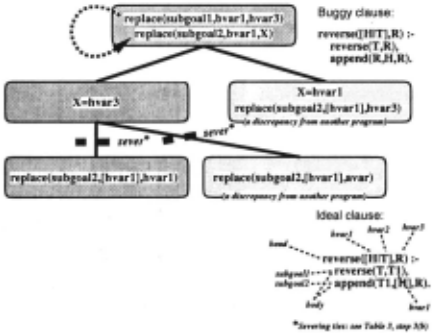
The concept-level causality heuristic suggests that if two discrepancies d1 and d2 are causally related and be long to the same concept/node, and if d1 is an intersec tion generalization and d2, a variableization generaliza tion, then d1 causes d2. This is because the intersection would be the discrepancy that is present together with all the various possible instantiations of the variableization. Thus, for example, students who are not confident in in troducing variables in the body of a clause would omit the variable T1 in the recursive subgoal of reverse/2, and, as a result, use possibly different variables from the head (e.g., R or H) in place of T1 in the append/3 sub goal. Figure 2 illustrates.
Finally, the subconcept-level causality heuristic sug gests that if two discrepancies d1 and d2 are causally related, and d1 is a parent of d2, then d2 is a probable cause of d1, i.e., based on empirical data, the child im plies the parent. This is because a child is more likely to be encountered or seen with its parent, than the par ent with a particular child. For instance, it is possible that the student in the example in Table 1 (and in Fig ure 1) put [Til H] in the head because he/she purposely omitted the append/3 subgoal in the body of his/her clause. This suggests that the student knew about the append/3 relation but decided that using [I] was bet ter, at least in this case. However, it is more likely that the student omitted the append/3 subgoal as a result of putting [Til H] in the head (Figure 3). This means that the student thought, incorrectly, that the [I] con struct could be used to prepend a list to an object, and having dealt with the necessary concatenation, had no further need for a concatenation subgoal in the body of the clause.
3.3 A Similarity- and Causality-Based Clustering Algorithm
Existing approaches (e.g., [Lebowitz, 1986; Pazzani, 1993]) to using data and theory (causality) in concept formation use sepat'ate SBL and EBL components one
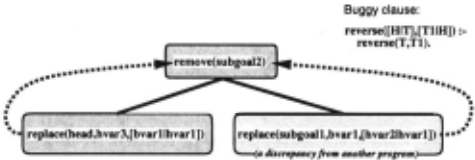
Table 3: Incorporating Causality into Concept Forma tion
- Same as in Table 2, with the addition that causality relationships among discrepancies are to be determined using the component-level heuristic.
- Same as in Table 2.
- For every new node created in (2),
- (a) If concept-level causality exists among discrepan cies in this node, record the direction of causality. If no such causality exists, retain the node never theless. (If the node needs to be split, it will be split by step (2) on another occasion.)
- (b) If subconcept-level causality exists between this node and its parent, record the direction of causal ity. If no such causality exists, sever the link be tween this child and its parent, linking it instead with its grandparent, then recheck for subconcept level causality (i.e., step 3b ).
- Same as step (3) in Table 2.
after the other. In MMD, SBL and EBL are tightly cou pled in the concept formation process. This entails two revisions to the basic algorithm presented in the previous section (rather than a separate algorithm altogether).
- Causal relationships are to be determined using the component-level causality heuristic.
- The directions of causalities are to be deter mined whenever possible using the concept and subconcept-level heuristics. This may lead to the severing of ties between a parent node and its child when the two are in fact unrelated.
These revisions are found in Table 3. Note that step (3b) effectively functions as a reorganization operator that is causality-based. Step (4) likewise reorganizes (prunes) the hierarchy, though it does this based on frequencies. Reorganization operators are especially important for in cremental learners to mitigate ordering effects.
4 Evaluation
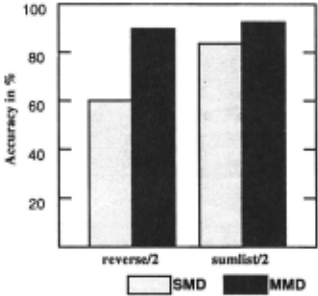
For a preliminary empirical evaluation of the ability of MMD to discover actual misconceptions in real-world behavior, a sufficiently large corpus of incorrect novice behavior, here in the form of buggy Prolog programs, had to be compiled. A total of 64 buggy reverse/2 and 56 buggy sumlist/2 programs (for the naive rever sal of lists and for summing up the elements of a list of numbers, respectively) were obtained from third-year undergraduate students who have learned basic Prolog concepts, and then submitted for expert (teacher) anal ysis of the underlying misconceptions. The discrepan cies between the buggy programs and their associated ideal programs were also computed and then fed into MMD. A point-by-point comparison of the misconcep tion hierarchies generated by the expert and by MMD is presented elsewhere (see [Sison, Numao and Shimura, 1997]); here we compare instead the accuracies of the misconception j classification hierarchies generated by:
- the basic UNIMEM-like similarity-based algorithm in Table 2 3 (called SMD in Figure 4); and
- MMD
given worst-case orderings of the objects in the reverse/2 and sumlist/2 datasets. A misconception or classification generated by MMD or SMD is consid ered accurate if it matches that of the expert.
The results obtained are very encouraging (Figure 4). MMD was able to correctly classify most of the bugs in the student programs. The lower accuracy of the hierar chies generated by SMD were mainly due to incoherent groupings and multiple bugs, which SMD is insensitive to. The bugs which MMD (and of course SMD) was not able to classify correctly were primarily due to dis crepancies which could be transformed to other, "more meaningful" discrepancies. For MMD to classify these bugs correctly, two options are possible. One option would be to give MMD the ability to recognize discrep ancies between discrepancies (i.e., to transform one dis crepancy to another). Alternatively, this task could be given to the preprocessor which computes discrepancies between buggy programs and an ideal. The second op tion is preferable since MMD's primary task is clustering discrepancies rather than transforming them.
5 Concluding Remarks
A similarity-based approach to misconception discovery is important because it reveals regularities in the data, which in turn may indicate the existence of underlying causalities. Moreover, in the absence of feature rela tionships deducible from the background knowledge, an SBL-generated node with high confidence can be learned as a new, though yet unexplainable, misconception. On the other hand, an explanation( causality)-based ap proach is necessary because concepts based solely on reg ularities might not be coherent and because some fea tures in concept descriptions can be irrelevant. Further more a similarity-based learner can only roughly classify an er~oneous program but not specify the cause(s) of its errors.
3 Using (}=a= fJ = 1,-y;::: 0.
The tight integration of similarity- and causality-based learning in the multistrategy unsupervised concept dis covery system MMD has been shown to be useful, if not essential, for the the automatic construction of meaning ful misconceptions that can be used to account for dis crepant behavior in student programs. The applicability of MMD's approach should extend naturally to similar domains, i.e., domains in which causal relationships exist among components of behavior in the background knowl edge. Future work will involve investigating mechanisms for generalizing misconceptions across problems, for us ing domain semantics to articulate causal relationships, and for exploiting and dynamically choosing other qual itative relationships (e.g., goals) that might exist in the background knowledge. MMD is a step toward the au tomatic discovery of (Prolog programming) misconcep tions [Sison, 1997] and their use in multistrategic student modeling [Sison and Shimura, 1996b].
Acknowledgment
The first a.uthor thanks Ethel Chua Joy and Philip Chan for their assistance in compiling and analyzing the pro grams in the reverse/2 and sumlist/2 datasets.
@inproceedings{ijcai1997p41,
  title     = {Using Data and Theory in Multistretegy (Mis)Concept(ion) Discovery},
  author    = {Sison, Rayond and Numao, Masayuki and Shimura, Masamichi},
  booktitle = {Proceedings of the Fifteenth International Joint Conference on
               Artificial Intelligence, {IJCAI-97}},
  publisher = {International Joint Conferences on Artificial Intelligence},
  editor    = {Martha E. Pollack},
  pages     = {274--278},
  year      = {1997},
  note      = {Cognitive Modeling},
  url       = {https://ijcai.org/proceedings/1997/41},
}
TY - CPAPER TI - Using Data and Theory in Multistretegy (Mis)Concept(ion) Discovery AU - Sison, Rayond AU - Numao, Masayuki AU - Shimura, Masamichi T2 - Proceedings of the Fifteenth International Joint Conference on Artificial Intelligence, IJCAI-97 PB - International Joint Conferences on Artificial Intelligence PY - 1997 SP - 274 EP - 278 UR - https://ijcai.org/proceedings/1997/41 ER -Copied
Machine-readable versions of this paper, for tools and AI agents:





