
Aggregating Features and Matching Cases on Vague Linguistic Expressions
Proceedings of the Fifteenth International Joint Conference on Artificial Intelligence. Case-based Reasoning. Pages 252-256.
© 1997 International Joint Conferences on Artificial Intelligence
Abstract
Decision making based on the comparison of multiple criteria of two or more alternatives, is the subject of intensive research. In many decision making situations, a single criterion consists of more than one piece of information, and therefore might be regarded as a Jump of aggregated information . This paper proposes a general method for aggregating information. To accomplish information aggregation we have developed a fuzzy expert system. Results from an application of our approach in the domain of Coronary Heart Disease Risk Assessment (CHDRA) indicate the value of the information aggregation process of the system. We also show in this paper, how a case-based reasoning (CBR) system can greatly benefitin its time performance and ability to manage uncertainty-from the information aggregation method .
- [Bonissone, 1985] Piero P. Bonissone. Editorial : Rea- soning with uncertainty in expert systems. Interna- tional Journal Man-Machine Studies, 22 :241-250, 1985 .
- [Brown, 1992] Mike Brown. Case-Based Reasoning: principles and potential. AI Intelligence, January 1992.
- [Chen and Hwang, 1992] Shu J. Chen and Ching L Hwang. Fuzzy multiple attribute decision making, methods and applications. Springer Verlag, Berlin, Heidelberg, 1992.
- [Dubitzky et al., 1995] Werner Dubitzky, Alfons Schuster, John G. Hughes, and David A. Bell. Con- ceptual distance of numerically specified case fea- tures. In Proceedings of the Second New Zealand In- ternational Two-Stream Conference on Artificial Neural Networks and Expert Systems, pages 210-213, Dunedin, New Zealand, 1995.
- [Gordon et al., 1989] D.J. Gordon, J.L. Probstfield, R.J. Garrison. High density lipoprotein cholesterol and car- diovascular disease. Circulation, 79(8):8-15, 1989.
- [Hall and Kandel, 1992] Lawrence 0 . Hall and Abra- ham Kandel. The evolution from expert systems to fuzzy expert systems. Abraham Kandel, editor. Fuzzy Expert Systems. pages 3-21 , CRC Press, Boca Raton, Florida, 1992.
- [Kinosian et al., 1994] B. Kinosian, H. Glick, G. Garland. Cholesterol and coronary heart disease -predicting risks by levels and ratios. Annals of Internal Medicine, 121(9):641-647, 1994.
- [Kiir and Folger, 1988] George J. Klir and Tina A. Fol- ger. Fuzzy Sets, Uncertainty and Information. Pren- tice Hall, Englewood Cliffs, New Jersey, 1988.
- [Kolodner, 1993] Janet Kolodner. Case-Based Reason- ing. Morgan Kaufmann, San Mateo, California, 1993 [
- [Na and Park, 1996] Selee Na and Seog Park. Manage- ment of fuzzy objects with fuzzy attribute values in a fuzzy object-oriented data model. In Proceedings of Flexible Query-Answering Systems , pages 19-40, Rosklide, Denmark, 1996.
- [Pyorala et al., 1994] Kaveli Pyorala, Guy De Backer, Ian Graham, Philip Poole-Wilson, and Wood David. Prevention of coronary heart disease in clinical prac- tice: Recommendations of the Task Force of the European Society of Cardiology, European Athero- sclerosis Society and European Society of Hyperten- sion. Atherosclerosis, 11 0(2):21-61, 1994
- [Riesbeck and Schank, 1989] Christopher K. Riesbeck and Roger C. Schank. Inside Case-Based Reasoning. Lawrence Erlbaum Associates, Hillsdale, New Jersey , 1989.
- [Schneider and Kandel, 1992] Mordechay Schneider and and Abraham Kandel. General purpose fuzzy ex- pert systems. Abraham Kandel, editor. Fuzzy Expert Systems . pages 23-41, CRC Press, Boca Raton, Flor- ida, 1992 .
- [Siyper, 1994] A.H. Slyper. Low-density-lipoprotein den- sity and atherosclerosis -unravelling the connection. JAMA, 272(4):305-308, 1994.
- [Wilensky, 1986] Robert Wilensky. Knowledge repre- sentation-A critique and a proposal. In J. Kolodner and K. Riesbeck, editors, Experience, Memory, And Reasoning, pages 15-28, Lawrence Erlbaum Associ- ates, Hillsdale, New Jersey, 1986.
- Zadeh, 1973].
- Lotfi A. Zadeh . Outline of a new ap- proach to the analysis of complex systems and deci- sion processes. IEEE Transactions on Systems, Man, and Cybernetics, SMC-3( I ):28-45, January 1973 .
References were extracted automatically from the PDF and may contain errors.
Full text extracted automatically from the PDF; figures, tables and equations may differ. The PDF is the version of record.
1 Introduction
Decision making situations very frequently require an ability to compare multiple criteria of two or more al ternatives [Chen and Hwang, 1992). In many cases a single criterion has a complex structure, but even if the meaning of such a complex criterion can be represented in terms of simpler ones, the need for a higher level entity persists [Wilensky, 1986].
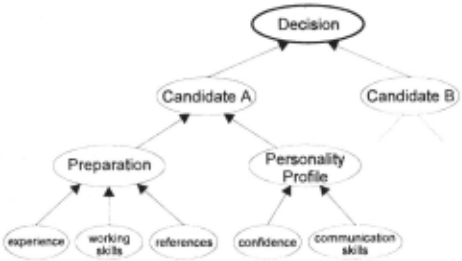
As an example, consider a job application scenario, where a manager is confronted with the decision to choose between two candidates, A and B. Let us sup pose the manager decides to employ candidate A. Then, when asked to explain his decision, he might say that comparing the two candidates, A has better prepared and also showed a better personality profile. A closer look at the applicants' documents will probably show, that candidate A indeed has better references, more ex perience and better working skills than B. Furthermore, asked in more detail about the better personality pro file, the manager might answer that candidate A had better communication skills and was more confident during the interview-therefore his decision was right.
So:
- All information about the candidates is expressed by rather vague or imprecise linguistic terms .
- To explain his decision, the manager uses the lin guistic terms better prepared and better personality profile, rather than details (better references, more experience, better working skills, better communi cation skills, more confidence).
- The manager would possibly have arrived at the same choice (candidate A) if his only information was that candidate A is better prepared and has a better personality profile than candidate B.
Our observations are:
- (I) Many decision making situations require the capa bility to manage and process vague or imprecise information, perhaps via linguistic terms .
- In many decision making situations, information can be crudely but usefully classified as higher level information, and lower level information re spectively.
In CBR for example, complex case features represent higher level information, and primitive case features represent lower level information respectively. Higher level information can be composed of: (a) lower level information, (b) other higher level information, or (c) a mixture of both information types . In our job applica tion scenario, the higher level information better prepa ration aggregates the lower level information better references, more experience and better working skills.
And so:
It is possible to arrive at useful decisions using information at various levels.
A study of this analysis might lead to a hierarchical structure of information as it is shown in Figure I.
The purpose of this paper is to propose a method that aggregates available lower level information to units of higher level information. In many cases, the lower level information will be imprecise or vague, and so the pro posed method should be able to manage uncertainty [Bonissone, 1985] . We therefore have used an expert system shell to develop a fuzzy expert system that ac complishes such aggregation. The applicability and use fulness of this approach was tested in the domain of CHDRA. We show that our fuzzy expert system is able to manage the uncertainty contained in the aggregation process, and that its reasoning process (information aggregation) leads to meaningful, consistent and valu able outcomes . Furthermore, we show how a CBR sys tem can benefit from an implementation of this infor mation aggregation method. For example, we model primitive case features and complex case features via fuzzy sets. This, significantly increases the CBR sys tem's ability to manage uncertainty.
The remainder of this paper is organized as follows : Section 2 briefly describes the advantages that fuzzy primitive and fuzzy complex case features provide for CBR. In Section 3, we describe our fuzzy expert system and the information aggregation process in more detail. The results of applying the approach are outlined in Section 4. Finally, in Section 5, we finish with a discus sion, conclusions and future work.
2 CBR, Fuzzy Primitive Case Features and Fuzzy Complex Case Features
CBR is a problem-solving model that allows reasoning to be performed by using past experience [Brown, 1992; Kolodner, 1993, Riesbeck and Schank, 1989]. Past experience- i.e., knowledge about situations that have been solved in the past-is represented by entities, called cases. These cases are stored and organized in a memory-like construct called a case knowledge base or simply case base. Reasoning in CBR systems is accom plished by retrieving the base case(s) most relevant to a new situation or problem at hand, called the query case, and then adapting the solution(s) to the actual problem. Because the knowledge contained in a case base is basi cally determined by its constituents (the stored base cases) the representation of base cases is an important issue in CBR. We describe cases in a compact, charac teristic fashion by abstract or salient f eatures, here simply referred to as features. There exist two types of features, primitive features and complex features. Com plex features are composites of several (primitive or complex) features .
For example, in the domain of CHDRA the features Smoking and Cholesterol have been identified (among other factors) to be main risk factors for myo cardial infarction and subsequent sudden death. In the assessment process, Smoking is regarded as a primi tive feature, used to indicate the number of cigarettes a person smokes per day, whereas the complex feature Cholesterol is a composite of the three primitive feature cholesterol types: TOTAL cholesterol, LDL cholesterol and HDL cholesterol.
Cholesterol travels in the blood in distinct particles called lipoprotein . The two major types of lipoproteins are low-density lipoproteins (LDL) and high-density lipoproteins (HDL). LDL, often called 'bad' choles terol, delivers the cholesterol to the arterial walls with the ultimate consequence of narrowing the arteries [Slyper, 1994] . HDL, often called 'good' cholesterol , protects against heart disease by removing excess cho lesterol from the blood [Gordon et al., 1989]. In a fast ing blood test, a clinician first finds out what a person 's TOTAL cholesterol level is. If the TOTAL cholesterol level is too high then further measurements of LDL and HDL are required (note: a high HDL value 'compen sates' a high TOTAL cholesterol value, and therefore, a person's cholesterol can be still described as normal). In this paper we use 'cholesterol' when we are discussing generally, and Cholesterol when we talk about a complex case feature ; but they mean the same thing-an aggregate or composite of three cholesterol type values.
Possible instances of Smoking and Cholesterol might be given by [Smoking/<40cigarettes per day>], and [Cholesterol/<TOTAL 4.6 mmol/1 >, <LDL 3.0 mmol/1 >, <HDL 1.0 mmol/1 >].
Frequently, it is not possible to obtain or assess a value of a feature precisely [Dubitzky et al., 1995] . In situations like this, use is often made of linguistic terms. For example, it is not possible to 'measure' a person 's cholesterol value, because it is a composite of three cholesterol type values. But, asked about it, the doctor might describe the person's cholesterol to be simply as normal, rather than state: TOTAL 4.6, LDL 3.0 mmol/1, and HDL 1.0 mmol/1. Even in situations where precise values are obtainable, humans often fall back upon to use vague or imprecise linguistic terms . For example, the doctor might describe a LDL value of 3.0 mmol/1 simply as normal, and one of
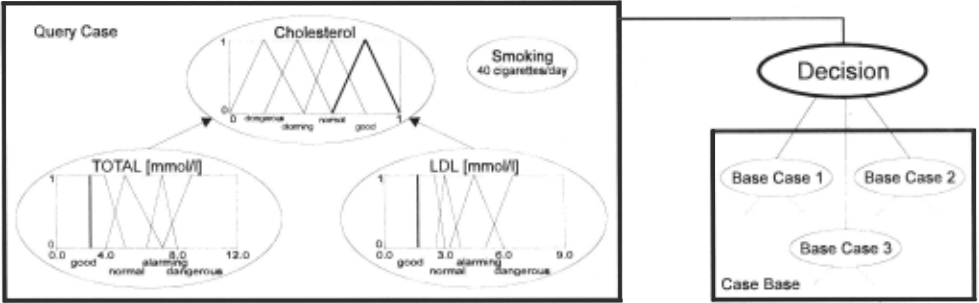
4.5 mmol/1 simply as alarming. Furthermore, there is no exact boundary between a normal and an alarming LDL value; that is, the transition between normal and alarming is gradual or fuzzy, rather than abrupt or crisp [Zadeh, 1973; Klir and Folger, 1988]. In this work we use fuzzy set theory to model primitive features and complex features, and therefore those features will be called fuzzy primitive features, and fuzzy complex features respectively [Na and Park, 1996; Dubitzky et al., 1995]. Figure 2 illustrates the aforementioned CHDRA example in a CBR context. It shows, a query case consisting of the primitive feature Smoking and the fuzzy complex feature Cholesterol , where the fuzzy complex feature Cholesterol is a composite of the fuzzy primitive features Total and LDL (for the sake of simplicity the fuzzy primitive feature HDL is omitted in Figure 2). The cases: Base Case 1, Base Case 2 and Base Case 3 in Figure 2 constitute a simplified case base.
The reasoning process performed should retrieve the base case(s) most relevant to the query case. Therefore, corresponding feature-value pairs for Smoking, To tal and LDL of the query case and the base case(s) have to be compared and to be aggregated to an overall similarity score.
3 Information Aggregation via a Fuzzy Expert System
Instead of performing the reasoning task by comparing each single feature value (Smoking, TOTAL, LDL and HDL) of the query case and the base case(s), our approach allows us to compare features on a fuzzy complex feature level. This means that only the feature values Smoking and Cholesterol of the query case and the base case(s) are used. This reasoning proc ess has two main advantages: firstly, for a very large case base the promise of better performance; secondly, sometimes data at primitive feature level is not avail able, but a description is available on complex feature level. For example, patients may not know the value of each cholesterol type, but possibly remember that dur ing their last health test the cholesterol was normal.
To make information on fuzzy complex feature level available, we have developed an inference process based on fuzzy set theory that maps (aggregates) fuzzy primitive feature values to fuzzy complex feature level. For example, the two fuzzy primitive feature values <Total/3 .0> and <LDL/2.0> in Figure 2, might map on fuzzy complex feature level to <Choles terol/(good)>. Such a mapping (aggregation) should satisfy the following requirements :
- (I) The aggregated values on complex feature level should be intuitively appealing to an expert's un derstanding of the problem in question.
- Using aggregated values on complex feature level in a decision making process should lead to mean ingful, justifiable and consistent results.
To manage the proposed information aggregation process, the normal steps of knowledge acquisition, knowledge representation, and design of an inference engine were realized.
Within the knowledge acquisition process for our ap plication the knowledge engineer and the domain expert were involved to extract the domain knowledge for its use in the fuzzy expert system (e.g., establishing the various fuzzy sets for the different cholesterol types). The basis for the knowledge acquisition was a data set, consisting of 133 records . One record for each person initially held values for TOTAL cholesterol , LDL cho lesterol and HDL cholesterol , as well as the two ratios TOTALIHDL and LDLIHDL. These two ratios are also important because they provide more meaningful indi cators of coronary heart disease risk than TOTAL cho lesterol per se [Kinosian et el. , 1994 ]. The expert was asked to provide expertise for determining each per son 's cholesterol value, and so was asked to indicate one of the fields (dangerous, alarming, normal and good) for each data record as illustrated in Table I.
| Cholesterol Data | Expert's Decision | ||||||||
|---|---|---|---|---|---|---|---|---|---|
| Nr. | Total | LDL | HDL | Total/HDL | LDLIHDL | dangerous | alarming | normal | good |
| 1 | 6.5 | 4.9 | 1.2 | 5.4 | 4.1 | X | |||
| 2 | 6.3 | 4.7 | 1.0 | 6.3 | 4.7 | X | |||
| ... | ... | . .. | ... | ... | . .. | ||||
| 133 | 6.4 | 4.4 | 0.6 | 10.7 | 7.3 | X | |||
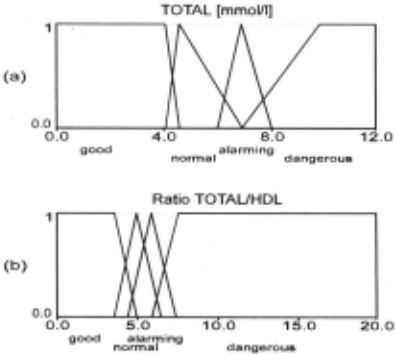
Typically the category that a cholesterol type value or ratio value belongs to is expressed in intervals [Pyorala et al. , 1994]. For example, a TOTALIHDL ratio be tween 4 and 4.5 is considered as good, and one below 4 is regarded to be even better. There is no doubt that such a representation is not intuitive to a human's un derstanding of the problem. In our understanding, the transition from good to better should be gradual, rather than abrupt. To represent such categories, the three dif ferent cholesterol types, and the two ratios are modeled via fuzzy sets. As an example, Figure 3 shows the fuzzy sets for the cholesterol type TOTAL, and for the ratio TOTALIHDL.
The knowledge representation scheme used for the proposed information aggregation process was that of production rules, formulated as if-then statements, where the if-part of a rule (the antecedent) is the input, and the then-part of the rule (the consequent) is the out put of the fuzzy expert system. Here, the rule base con sisted of four rules only. As an example, Figure 4 shows a typical rule used in the fuzzy expert system.
A crucial concept of the proposed fuzzy expert sys tem is, that all rules apply at all times, but some may have more influence than others. This means that if more than one rule is active, the separate responses have to be combined to a composite output. This idea is central to fuzzy logic systems.
If (Total is dangerous) or (LDL is dangerous) or (HDL is dangerous) or (Ratio_Total_HDL is dangerous) or (Ratio_LDL_HDL is dangerous)
Then Cholesterol is dangerous
Figure 4: Example rule.
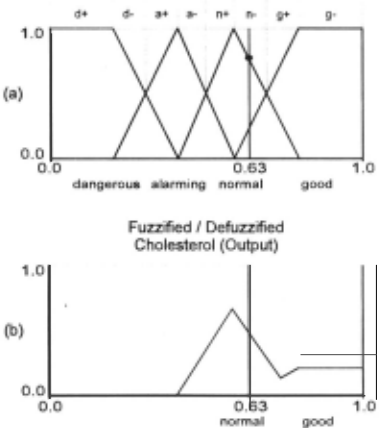
Therefore, the inference process performed by the fuzzy expert system consists of three sub-processes: (a) scal ing of the fuzzy input, (b) combination of the output, and (c) defuzzification of the output. There exist differ ent methods for all three sub-processes, and it is part of the knowledge engineer's work to find the methods ap propriate to the actual problem. Scaling was done via the correlation-product encoding, the combination step via sum combination and finally, for the defuzzification of the output, the center of gravity method is applied. As an example, Figure 5a shows the fuzzy sets for the system's output (cholesterol), and Figure 5b shows a possible output activation.
Cholesterol (Output)
| Cholesterol Data | Ex_Qert's Decision | System Output | |||||||||
|---|---|---|---|---|---|---|---|---|---|---|---|
| Nr. | Total | LDL | HDL | Total/HDL | LDLIHDL | dangerous | alarmin_g_ | normal | _g_ood | COG | Cholesterol |
| 1 | 6.5 | 4.9 | 1.2 | 5.4 | 4.1 | X | 0.63 | a+ | |||
| 2 | 6.3 | 4.7 | 1.0 | 6.3 | 4.7 | X | 0.49 | d- | |||
| ... | ... | ... | ... | ... | .. . | ... | |||||
| 133 | 6.4 | 4.4 | 0.6 | 10.7 | 7.3 | X | 0.28 | d+ | |||
Figure 5b also illustrates that the two fuzzy sets nor mal and good have been activated by the rules, and that the defuzzification of the output via the center of grav ity method results in an output value of 0.63. The loca tion of this value in Figure 5b also shows, that the ag gregated cholesterol should be interpreted as normal 'with a tendency' to good. The tendency of an output is indicated here by a plus (+) or a minus (-) sign, at tached to the corresponding fuzzy set and derived as illustrated in Figure 5a. The output value (0.63) inter sects with the fuzzy sets normal and good. When the value intersects with two or more fuzzy sets like this, we take and qualify by 'tendency' the fuzzy set where the output value intersects with the highest score. In this example, the system's output would look like <Cholesterol/n->, and should be interpreted as: 'The aggregated cholesterol value of the person is normal with a tendency to good'. Such a result is intuitively appealing and close to a human expert's explanation in such a situation. In the next section, we investigate the usefulness, the validity and the consistency of the sys tem's output.
4 Results
After the inference process was accomplished for all 133 data records, the fuzzy expert system output of each record was compared with the expert's judgment of the record in question. Table 2 is similar to Table I , but additionally contains two columns for the system's output. The first column displays the center of the gravity (COG) of the system output, and the second column shows, the system's decision on the cholesterol for the corresponding record.
The results have been evaluated in two steps. In the first step the number of direct matches was computed, and in the second step the number of 'tendency' matches. A direct match was considered to be the case when the expert and the system evaluated the data rec ord belonging to the same category. For example, this is the case for the first and the last record in Table 2. Both the expert and the system evaluated the first record to be alarming and the last record to be dangerous . Record two in Table 2 represents a tendency match. The expert considers the cholesterol of record 2 to be alarming, whereas the system's response is d- , which means dan gerous with a tendency to alarming (see Figure 5a). This is a meaningful result because, as pointed out before, the transition from alarming to dangerous is grad ual.
Our approach led to the following results. A direct match happened 83 times, and a tendency match 34 times. Therefore, the system derived 118 meaningful results, i.e. in 88.7% of the sample. The inference proc ess was not to be expected to establish a direct match of 100% for a number of reasons. Firstly, asked about the same situation or problem twice (e.g. repeated after some weeks), even a single expert's decision-making diverges very often. Secondly, when several experts are available, it is very likely, that they will disagree in some cases. Thirdly, during knowledge acquisition, the expert was enforced to chose one of the four categories (dangerous, alarming, normal, good) for a record in voking one of the weaknesses of a discrete choice; very often it is not possible to express intermediate values .
5 Discussion, Conclusions and Future Work
A general method to aggregate information has been presented. Based on fuzzy set theory and fuzzy logic the aggregation process was implemented in a fuzzy expert system. The aggregated information, derived by the fuzzy expert system is meaningful, valuable and consistent. According to [Hall and Kandel, 1992], the proposed fuzzy expert system displays most of the characteristics of 'class one' expert systems; e.g.: (a) the domain of the problem is limited and very well de fined, (b) an expert was available during the develop ment, (c) the complexity of the problem is not extreme in the eyes of the knowledge engineer, and (d) the un certainty prevailing in the domain was manageable.
We applied this process to a specified problem, but its applicability to similar problems is manifest (e.g. at the moment the approach is tested on a data set of can cer patients), and therefore, its potential is obvious. The integration of the proposed information aggregation method into a CBR environment is very promising be cause the reasoning process in CBR can benefit in two ways: (I) in cases with a lack of data (e.g. unavailable data at the primitive feature level) the higher level in formation, available at the fuzzy complex feature level, can be used in the reasoning process, and so the CBR system's capability to handle uncertainty increases sig nificantly; and (2) CBR systems with a large case base will improve in their performance in the time domain.
record carries data about a patient suffering a cancerous disease. The support the proposed information aggrega tion method can provide to the CBR system will be in vestigated from the point of view of management of uncertainty and performance. There is also work un derway to use the aggregation method in a multiple ex pert scenario and to relate this work with the theory of evidence.
@inproceedings{ijcai1997p38,
  title     = {Aggregating Features and Matching Cases on Vague Linguistic Expressions},
  author    = {Schuster, Alfons and Dubitzky, Werner and Lopes, Philippe and Adamson, Kenneth and Bell, David A. and Hughes, John G. and White, John A.},
  booktitle = {Proceedings of the Fifteenth International Joint Conference on
               Artificial Intelligence, {IJCAI-97}},
  publisher = {International Joint Conferences on Artificial Intelligence},
  editor    = {Martha E. Pollack},
  pages     = {252--256},
  year      = {1997},
  note      = {Case-based Reasoning},
  url       = {https://ijcai.org/proceedings/1997/38},
}
TY - CPAPER TI - Aggregating Features and Matching Cases on Vague Linguistic Expressions AU - Schuster, Alfons AU - Dubitzky, Werner AU - Lopes, Philippe AU - Adamson, Kenneth AU - Bell, David A. AU - Hughes, John G. AU - White, John A. T2 - Proceedings of the Fifteenth International Joint Conference on Artificial Intelligence, IJCAI-97 PB - International Joint Conferences on Artificial Intelligence PY - 1997 SP - 252 EP - 256 UR - https://ijcai.org/proceedings/1997/38 ER -Copied
Machine-readable versions of this paper, for tools and AI agents:





