
Learning Extended Logic Programs
Proceedings of the Fifteenth International Joint Conference on Artificial Intelligence. Automated Reasoning. Pages 176-180.
© 1997 International Joint Conferences on Artificial Intelligence
Abstract
This paper presents a method to generate nonmonotonic rules with exceptions from positive/negative examples and background knowledge in Inductive Logic Programming. We adopt extended logic programs as the form of programs to be learned, where two kinds of negation-negation as failure and classical negation-are effectively used in the presence of incomplete information. While default rules are generated as specialization of general rules that cover positive examples, exceptions to general rules are identified from negative examples and are then generalized to rules for cancellation of defaults. We implemented the learning system LELP based on the proposed method. In LELP, when the numbers of positive and negative examples are very close, either parallel default rules with positive and negative consequents or nondeterministic rules are learned. Moreover, hierarchical defaults can also be learned by recursively calling the exception identification algorithm.
- Michael Bain. Experiments in non-monotonic first- order induction. In: [12], pages 423-436.
- Michael Bain and Ste:phen Muggleton. Non- monotonic learning. In: [12], pages 145-161.
- Chitta Baral and Michael Gelfond. Logic program- ming and knowledge representation. Journal of Logic Programming, 19/20:73-148, 1994.
- Francesco Bergadano and Daniele Gunetti. Induc- tive Logic Programming: From Machine Learning to Software Engineering. MIT Press, 1996.
- F. Bergadano, D. Gunetti, M. Nicosia and G. Ruffo. Learning logic programs with negation as failure. In: Luc De Raedt, editor, Proceedings of ILP-95, pages 33-51, K. U. Leuven, 1995.
- Luc De Raedt and Maurice Bruynooghe. On nega- tion and three-valued logic in interactive concept- learning. In: Proceedings of EGA! '90, pages 207- 212, Pitman, 1990.
- Yannis Dimopoulos and Antonis Kakas. Learning non-monotonic logic programs: learning exceptions. In: Nada Lavrae and Stefan Wrobel, editors, Pro- ceedings of ECML-95, pages 122-137, LNAI 912, Springer, 1995.
- Michael Gelfond and Vladimir Lifschitz. Clas- sical negation in logic programs and disjunctive databases. New Generation Computing, 9(3,4):365- 385, 1991.
- Katsumi Inoue and Yoshimitsu Kudoh. Learning default rules in extended logic programs. Submitted for publication, 1997 (in Japanese) .
- Nada Lavrac and Sa.So Dzeroski. Inductive Logic Programming: Techniques and Applications. Ellis Horwood, 1994.
- Lionel Martin and Christel Vrain. A three-valued framework for the induction of general logic pro- grams. In: Luc De Raedt, editor, Advances in Inductive Logic Programming, pages 219-235, lOS [12] (]
- Stephen Muggleton, editor. Inductive Logic Pro- gramming. Academic Press, London, 1992.
- Stephen Muggleton and Cao Feng. Efficient induc- tion of logic programs. In: [12], pages 281-298.
- Raymond Reiter. A logic for default reasoning. Ar- tificial Intelligence, 13:81-132, 1980.
- Ashwin Srinivasan, Stephen Muggleton and Michael Bain. Distinguishing exceptions from noise in non- monotonic learning. In: Proceedings of ILP-92, ICOT, 1992.
- Stefan Wrobel. On the proper definition of minimal- ity in specialization and theory revision. In: Pavel B. Brazdil, editor, Proceedings of ECML-99, pages 65-82, LNAI 667, Springer, 1993.
References were extracted automatically from the PDF and may contain errors.
Full text extracted automatically from the PDF; figures, tables and equations may differ. The PDF is the version of record.
1 Introduction
Inductive logic programming (ILP) is a research area which provides theoretical frameworks and practical al gorithms for inductive learning of relational descriptions in the form of logic programs [12, 10, 4]. Most previous work on ILP consider definite Horn programs or classi cal clausal programs in the form of logic programs to be learned. However, research work on knowledge represen tation in AI has shown that such monotonic programs are not adequate to represent our commonsense knowl edge including notions of concepts and taxonomies. In this respect, there have been much work on nonmono tonic reasoning in AI. To learn default rules or concepts in taxonomic hierarchy, we thus need a learning mecha nism that can deal with nonmonotonic reasoning.
On the other hand, recent advances on theories of logic programming and nonmonotonic reasoning have revealed that logic programs with negation as failure (NAF) is an
Yoshimitsu K udoh
Division of Electronics and Information Engineering Hokkaido University N-13 W-8, Sapporo 060, . Japan kudo~db.huee.hokudai.ac.jp
appropriate tool for knowledge representation [3]. Nor mal logic programs (NLPs) are the class of programs in which NAF is allowed to appear freely in bodies of rules. NLPs are useful not only to represent default rules or rules with exceptions but also to write shorter and clearer programs than definite programs in many cases [5] . Learning NLPs has recently been considered in such as [2, 15, 5, 11].
While learning NLPs is an important step towards a better learning tool, there is still a limitation as a knowl edge representation tool: NLPs do not allow us to deal directly with incomplete information [8]. NLPs automat ically applies the closed world assumption ( CW A) to all predicates, and any query is answered either yes or no, in which the latter negative answer is the result of CWA. In the context of inductive concept learning, the automatic application of CW A is not appropriate in the presence of both positive and negative examples. Positive examples represent instances of the target concept, while nega tive examples are non-instances. By CWA other objects are assumed non-instances, but then the role of nega tive examples is not clear because it is as if we supply a complete classification of all objects. This causes the paradox pointed out by De Raedt and Bruynooghe [6]: if everything is known, why should we still learn some thing? In the real world, we may not know whether some objects are positive or negative. But such incomplete in formation cannot be represented by NLPs.
To overcome the above problem of NLPs, we propose in this paper a new learning method which can deal with incomplete information in the form of extended logic pro grams (ELPs). ELPs are introduced by Gelfand and Lifschitz [8] to extend the class of NLPs by including classical negation (or explicit negation). The semantics of ELPs is given by the notion of answer sets, and is an extension of the stable model semantics. The answer to a ground query A is either yes, no, or unknown, depending on whether the answer set contains A, -.A, or neither. Using ELPs, the role of negative examples becomes clear, and any object not contained in either positive or nega tive examples is considered unknown unless the learned theory says that it must or must not be in that concept.
In this paper, we present a system, called LELP (Learning ELPs), to learn default rules with exceptions in the form of extended logic programs given incom plete positive and negative examples and background knowledge. LELP first generates candidate rules from positive examples (or negative examples if non-instances are much more than instances) and background knowl edge in an ordinary ILP framework. Exceptions can be identified as negative examples (or positive examples if candidate rules have negative consequents) that are derived from the generated monotonic rules and back ground knowledge. Default rules with NAF are then computed by specializing candidate rules using the open world specialization (OWS) algorithm. This OWS algo rithm is closely related to Bain and Muggleton's CWS algorithm [2), but works better in the three-valued se mantics. Then, default cancellation rules are generated to cover exceptions using an ordinary ILP framework.
In the real world, it is not easy to know that a general default rule should have the positive or negative conse quent. In LELP, it is determined according to the ratio of positive examples. Nevertheless, if it is still hard to know which is more general, LELP can generate nonde terministic rules in the context of the answer set seman tics. Furthermore, by calling the OWS algorithm recur sively, LELP can generate hierarchical default rules.
The rest of this paper is organized as follows. Sec tion 2 outline& how our system LELP produces ELPs to learn simple default rules. Section 3 extends LELP to deal with complex concept structures with hierarchical exceptions. Section 4 presents related work, and Sec tion 5 concludes the paper.
2 Learning Default Rules
This section shows how LELP learns default rules with exceptions. To clarify the underlying idea, we here con sider a simple model that there are general rules and exceptions to them but there are no exceptions to ex ceptions. This model will be extended in Section 3.
The algorithm of LELP is summerized as follows.
Algorithm 2.1 LELPl(E+, E~ , BG, Tl, T2, T3)
Input: positive examples E+, negative examples E - , background knowledge BG
Output: default rules Tl, exception rules T2 U T3
- According to the ratio of E+ or E- to all objects, determine whether the learned general rule is posi tive or negative;
- Given E+ (orE- if a negative rule is to be learned) and BG, generate general rules Tusing an ordinary ILP technique;
- Given T , E+, E- and BG, compute default rules Tl and exceptions AB using the OWS algorithm; Generate rules T2 deriving E- (or E+) from AB at the same time using an ordinary ILP technique;
- Given AB and BG, generate default cancellation rules T3 using an ordinary ILP techniques.
In LELP, the input positive examples are represented as positive literals, and negative examples are denoted as negative literals. We allow rules in the form of ELPs in background knowledge.
2.1 Extended Logic Programs
Extended logic programs (ELPs) were introduced in [8] as a tool for reasoning in the presence of incomplete in formation. They are defined as sets of rules of the form
where Li's (0 $ i $ n ; n ~ m) are literals. Two kinds of negation appear in a program: not is the negation as fail ure operator, and..., is classical negation. Intuitively, the above rule can be read as: if £1, ... , Lm are believed and Lm+l, ... , Ln are not believed then Lo is believed. The semantics of ELPs are defined by the notion of answer sets [8], which are sets of ground literals representing possible beliefs. The class of ELPs are considered as a subset of default logic [14] : each rule of the above form in an ELP can be identified with the default of the form
where L stands for the literal complementary to L. Then, each answer set is the set of atoms in an extension of the default theory. We say that a literal L is entailed by an ELP P if L is contained in every answer set of P. While we adopt the answer set semantics in this pa per, other semantics for ELPs may be applicable to our learning framework with minor modification.
We call a rule having a positive literal in its head pos itive rule, and a rule having a negative literal in its head negative rule. In the following, we denote classical nega tion ..., as - and N AF not as \+ in programs.
The completeness and consistency of concept learn ing (see [10, 4] for instance) can be reformulated in the three-valued setting as follows. Let BG be an ELP as background knowledge, E a set of positive/negative lit erals as positive/negative examples, and R a set of rules as hypotheses. R is complete with respect to BG and E if for every e E E, e is entailed by BG U R (R covers e). R is consistent with BG and E if for any e E E , e is not entailed by BGUR (R does not cover e). Note here that positive examples are not given any higher priority than negative ones. Namely, both positive and negative exam ples are to be covered by the learned rules that are con sistent with background knowledge and examples. Thus, we will learn both positive and negative rules: no CWA is assumed to derive non-instances (see also [6]).
Although both positive and negative rules are gener ated by LELP, each default rule for the target concept should be either positive or negative. In LELP, it is de termined according to the ratio of positive examples to all objects. In the following, we assume that positive rule is learned as a general rule unless otherwise specified.
2.2 Generating General Rules
In Algorithm 2.1, given positive (resp. negative) exam ples E and background knowledge BG, LELP generates general rules T to cover every example in E using an or dinary ILP technique. We denote this part of algorithm as GenRules(E, BG, T). In generating positive (resp.
negative) rules, no negative (resp. positive) example is used to specialize rules. The specialization of general rules is performed in the OWS algorithm (Section 2.3).
We do not assume any particular learning algorithm for the implementation of an "ordinary" ILP technique in GenRules(E, BG, T). This part can be considered as a black box, and this paper is not concerned with the detail. In our real implementation, we used the no tion of Plotkin's RLGG (relative least general general ization) with the bottom-up technique used in GOLEM [13]. When background knowledge contains rules with bodies, the unfold transformation in logic programming is also used to truncate literals in bodies of learned rules.
Example 2.1 Suppose that positive examples E+ are: { flies(1), flies(2), flies(3), flies(4)}, and that background knowledge BG is: {bird(1), bird(2), bird(3), bird(4), bird( c),
(bird(X) :- pen(X)),pen(a),pen(b)}.
Then, GenRules(E+, BG, T) generates:
flies(X) :- bird(X).
2.3 Specializing Rules using NAF
The general rules computed to cover the positive (resp. negative) examples by GenRules(E, BG, T) may also cover the complements of some of negative (resp. pos itive) examples. To specialize general rules, we propose the algorithm of open world specialization (OWS). The OWS algorithm is closely related to Bain and Muggle ton's closed world specialization (CWS) [2]. Like CWS, OWS produce rules with NAF as default rules. Unlike CWS, however, OWS does not apply the closed world as sumption (CWA) to identify non-instances of the target concept. In OWS, exceptions are identified as objects contained in negative examples (or positive examples if the general rule is negative) such that they are proved from the general rule with background knowledge and positive (or negative) examples.
In the following OWS algorithm, we assume here that each general rule in T is positive.
Algorithm 2.2 OWS(T,E+,E-,BG,AB,T')
Input: rules T, positive examples E+, negative examples E-, background knowledge BG
Output: default rules T', set of exceptions AB
Let T' := T; AB := 0;
for each Ci = (H :- B) in T do:
Find a literal L such that L E E- and L is entailed by BG U {Ci} U E+ (we call L an exception to Ci and ci a rule with exceptions);
0 := the answer substitution for Ci in proving L;
- if B contains the literal \+ N then AB :=ABu {NO}
- else N := abi(V1, ... , Vn), where {V1, ... , Vn} is the domain of 0; T' := (T' \ {Ci}) u { (H :- B, \+N) }; AB :=ABu {NO}.
In the real implementation of LELP, we used Prolog's top-down proof is used to get answer 'substitutions.
Example 2.2 (cont. from Example 2.1)
BG, E+: the same as Example 2.1,
T = {(flies(X) :- bird(X))}, E- = {-flies(a) ,-flies(b) ,-flies(c) }. Then, the exceptions to C1 = (flies(X) :- bird(X)) are computed as {flies( a), flies(b), flies( c)}. In this case, substitutions O's are X/ a, X/b, X/ c, and N is ab1 (X). Hence, T' = {(flies(X) :- bird(X), \+ab1(X))},
AB = {ab1(a),ab1(b},ab1(c)}.
2.4 Negative Rules for Exceptions
Since we use OWS, we need rules to derive negative ex amples (or positive examples if the default rule is nega tive). Given negative examples E- (resp. positive exam ples E+) and the set AB of exceptions, LELP generates negative (resp. positive) rules R to derive exceptions as GenRules(E-, AB, R) (resp. GenRules(E+, AB, R)).
In the bird example, such a rule is generated as:
-flies(Y) :- ab1(Y).
2.5 Cancellation Rules
In the OWS algorithm, the set AB of exceptions is out put as a set of ground atoms. However, if exceptions have some common properties, this expression is not in formative and rules about exceptions are useful. These rules work as default cancellation rules.
After applying OWS, each exception is in the form of ground atom whose predicate is abi. Rules about excep tions have such abnormal predicates in their heads and are results of generalizations of some abnormal atoms. When such a common rule cannot be generated or there are some exceptions that cannot be covered by such a rule, those exceptions are left as they are.
Since exceptions are not anticipated in general, rules about exceptions should be used to derive only excep tions. In fact, exceptions are usually minimized in non monotonic reasoning. To this end, we apply a limited form of CWA here. If a rule about exceptions is too gen eral, that is, it derives negative facts more than expected, it should be rejected. This test can be done easily using a bottom-up model generation procedure. The algorithm to generate rules about exceptions is as follows.
Algorithm 2.3 Cancel(AB, BG, R)
Input: set of exceptions AB, background knowledge BG Output: default cancellation rules R
- GenRules(AB,BG,T);
- For each C E T, compute the set L of abi literals that are entailed by BG U { C} U AB;
- if L :::> AB then R := T \ { C} else R := T.
Example 2.3 (cont. from Example 2.2)
BG: the same as Example 2.1,
E = {flies(1), flies(2), flies(3), flies(4)}.
AB = {ab1(a), ab1(b), ab1(c)},Suppose that GenRules outputs T that contains rules (ab1(X) :- pen(X)) and (ab1(Y) :- bird(Y)).
Here, the rule (ab1(Y) :- bird(Y)) enables us to de rive abl(l), ab1(2), ab1(3), ab1(4) besides the set AB, so it is removed by Algorithm 2.3. The atom ab1(c) represents an exception that is not a penguin, and hence cannot be generalized. The final rules are:
R = {(abl(Z) :- pen(Z)) , abl(c)}
While in this section we apply CWA to generate rules about exceptions in LELP, this assumption is not appro priate for exceptions to exceptions. We will extend the framework in this respect in Section 3.2.
2.6 Properties
Given consistent background knowledge BG and positive and negative examples E = E+uE- , let R be the output hypotheses learned by LELP. Then, the next theorem is proved in [9].
Theorem 2.1 R is complete with respect to BG and E , and is consistent with BG and E.
2.7 Example
The LELP program is implemented in Prolog and is called by
lelp(Examples, Background...Knowledge, Result).
In Examples, atoms preceded by + represents positive examples, and those with - are negative examples. In the following example, if the ratio of positive (resp. negative) examples exceeds 50%, positive (resp. negative) rules are generated.
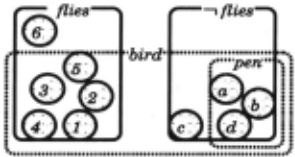
Example 2.4 (Bird Example Summary: Figure 1)
I ?- lelp([+flies(1),+flies(2),+flies(3), +flies(4),+flies(6),+flies(6), -flies(a),-flies(b),-flies(c),-flies(d)], [bird(1),bird(2),bird(3),bird(4),bird(6), bird(c),(bird(X) :- pen(X)), pen(a),pen(b),pen(d)],Rules). RLGG/LL of flies(1) and flies(2) is flies(_4694) :-bird(_4694) Covered examples: flies(1), flies(2), flies(3), flies(4), flies(6) RLGG/LL of -flies(a) and -flies(b) is -flies(_42886):-pen(_42886),bird(_42886) Covered examples : -flies(a), -flies(b), -flies(d) RLGG/LL of ab1(a) and abl(b) is ab1 (_86217) .: -pen(_86217), bird{_86217) Covered examples : ab1(a), abl(b), ab1(d)RLGG/LL of -flies(a) and -flies(b) is -flies(_127680):-ab1(_127680) Covered examples: -flies(a), -flies(b), -flies(c), -flies(d) Unfolding of ab1(_410):-pen(_410),bird(_410) with bird(_410):-pen(_410) is ab1(_410):-pen(_410) Running Time : 280 (msec) Rules · [(flies(!):-bird(!),\+ab1(A)),flies(6), (-flies(B):-abl(B)), (ab1(C):-pen(C)),ab1(c)] ?3 Extension
In this section, we extend LELP to learn more complex concept structures.
3.1 Nondeterministic Rules
When the number of positive examples is close to that of negative examples, it is difficult to judge whether the general rule should be positive or negative. Two solu tions can be considered to this problem: (1) parallel de fault rules, and (2) nondeterministic rules. Parallel de fault rules are generated when exceptions exist for both positive and negative rules in parallel (e.g., mammals normally do not fly except bats, and birds normally fly except penguins) . Nondeterministic rules are generated when some object is proved to be positive and negative by a program such that a contradiction occurs. An ex tension of Algorithm 2.1 is shown in Section 3.2, where hierarchical defaults can also be learned.
In the following example, if the ratio of positive ex amples is between 40% and 60%, parallel default rules or nondeterministic rules are generated.
Example 3.1 (Learning Nondeterministic Rules)
I ?- lelp([+flies(1),+flies(2),+flies(3) ,+flies(4), -flies(6),-flies(6),-flies(7),-flies(8)],
[bird(1),bird(2),bird(3),bird(4), bird(6),bird(6),bird(7),bird(8)],Rules) .Here, the ratio of positive examples is 50%, and hence both positive and negative rules are generated. If we use the previous method, the following rules are computed:
(flies(A) :-bird(A),\+ab1(!)),
(-flies(B) :-abl(B)),
ab1(6),ab1(6),ab1(7),ab1(8),
(-flies(C):-bird(C),\+ab2(C)),
(flies(D):-ab2(D)),
ab2(1),ab2(2),ab2(3),ab2(4)
The above rules look like correct , but the bodies of both rules are the same as bird(X) except the abi literals. Then, ifbird(9) is added to background knowledge, nei ther abl nor ab2 is proved so that a contradiction occurs. In this case, the nondeterministic rules are generated:
(flies(!):-bird(!),\+ab1(!),\+ -flies(!)),
(-flies(B):-ab1(B)),ab1(6),ab1(6),ab1(7),ab1(8),
(-fli es(C):-bird(C),\+ab2(C),\+flies(C)),
(flies(D):-ab2(D)),ab2(1),ab2(2),ab2(3),ab2(4)
This form of nondeterministic rules are shown in [3] to represent default rules in ELPs. For the added ground term 9, the ground instances of general rules are:
flies(9) :- bird(9), \+ab1(9), \+ -flies(9).
-flies(9) :- bird(9), \+ab2(9), \+flies(9).
Hence, for the bird 9, two answer sets exist, one conclud ing flies(9) and the other -flies(9).
Here are two examples of Nixon Diamond.
Example 3.2 (Pacifist Nixon)
- I ?- lelp([+pacifist(c),+pacifist(d),
-pacifist(a),-pacifist(b),+pacifist(nixon)],
[republican(a),republican(b),
republican(nixon),quaker(nixon),
quaker(c),quaker(d)],Rules).
The result shows that parallel rules are generated in which only Nixon is an exception of republicans:
(pacifist(A):-quaker(A)),
(-pacifist(B):-republican(B),\+abl(B)),
abl(nixon)
Example 3.3 (Nixon's Trouble)
I ?- lelp([+pacifist(c),+pacifist(d),
-pacifist(a),-pacifist(b)],
[republican(a),republican(b),
republican(nixon),quaker(nixon),
quaker(c),quaker(d)],Rules).
The result implies two answer sets for Nixon, and neither pacifist (nixon) nor -pacifist (nixon) is entailed:
(pacifist(A):-quaker(A),\+ -pacifist(!)),
(-pacifist(B):-republican(B),\+pacifist(B))
3.2 Hierarchical Defaults
Here, we further extend LELP to deal with hierarchical structures of concepts and exceptions. First, we modify Algorithm 2.3 to generate default cancellation rules.
Algorithm 3.1 Cancel2(AB,BG,R)
Input: set of exceptions AB, background knowledge BG Output: default cancellation rules R
- GenRules(AB, BG, T);
- For each C E T, compute the set L of abi literals that are entailed by BG U { C} U AB; if IL- ABI 2: IABI then R := T \ {C}
else R := T.
The new condition IL- ABI 2: IABI in Step 3 above replaces the CWA condition L ::JAB in Algorithm 2.3, and represents the monotone assumption that "in every level of the hierarchy, the number of exceptions is less than that of instances with default properties".
To learn hierarchical default rules, after removing over-general rules in Algorithm 3.1, we need to call algo rithms of OW Sand Cancel recursively. The procedure stops when there are no more exceptions or no more ob jects to be generalized. The extended algorithm LELP2 is as follows. In the following, we denote sets of opposite examples as E1, E2 instead of positive examples E+ and negative examples E-.
Algorithm 3.2 LELP2(E1,E2,BG,R)
Input: positive examples E 1 , negative examples E2 , background knowledge BG
Output: R := R3 u R4 u Rs u Rs
- According to the ratio of E1 (or E2 ) to all objects, determine to learn either (1) default rules for E1 , (2) default rules for E2 , (3) parallel default rules, or ( 4) nondeterministic rules; In case of (1), perform Steps 2, 4, 7, put R4 = Rs = 0, and return; In case of (2), perform Steps 3, 5, 8, put R3 = R5 = 0, and return;
Otherwise, execute every step after 2 in order;
- GenRules(E1,BG,Rt);
- GenRules(E2, BG, R2);
- OWS(Rl,El,E2,BG,AB1,R3);
- OWS(R2,E2,El,BG,AB2,R4);
- If there are contradictory rules in R1 and R2, transform R3 and R4 into nondeterministic rules, put Rs = Rs = 0, and return;
- if AB1 -=/= 0 then ABs(BG,AB1,E1,E2,R5 ); else R5 := 0;
- if AB2 -=/= 0 then ABs(BG,AB2,E2,E1,Rs); else Rs :=:= 0.
Algorithm 3.3 ABs(BG,AB1,E1,E2,R)
- Cancel2(AB1,BG,Rt);
- OWS(R1, E2, E1, BG, AB2, R2);
- if AB2 -=/= 0 then ABs(BG,AB2,E2,E1,R3); else put R := R1 , and return;
- GenRules(AB2,BG,R4); put R := R2 U R3 U R4 , and return.
Example 3.4 (Learning Hierarchical Defaults)
- I ?- lelp([-flies(1),-flies(2),+flies(3),+flies(4),
+flies(6),-flies(6),-flies(7),-flies(8),
-flies(9),-flies(10),-flies(11),-flies(12)],
[pen(1),pen(2),bird(3),bird(4),bird(6),
(bird(l) :- pen(l)),animal(6),animal(7),
animal(8),animal(9),animal(10),animal(11),
animal(12),(animal(I) :- bird(I))],Rules).
Here, the ratio of positive examples is 25%, and hence the negative rule (-flies (A) :-animal (A)) is firstly generated. Using OWS, the set of exceptions in the first level {ab1(3), ab1(4), ab1(5)} and the default rule (-flies (A) :-animal (A) , \+ abl (A)) are then com puted. This set of exceptions is generalized to the can cellation rule (abl (C): -bird(C)) and the pbsitive rule for exceptions (flies (B) : -abl (B)) are also generated. Nextly, after applying OWS to the cancellation rule, the exceptions in the second level { ab2(1), ab2(2)} and the default rule are computed, and then its cancellation rule and the negative rule for exceptions are generated. At this point, no more exception is left and the algorithm stops. The final Rules are as follows.
(-flies(A):-animal(A),\+abl(A)),
(flies(B):-abl(B)),(ab1(C):-bird(C),\+ab2(C)),
(-flies(D):-ab2(D)),
(ab2(E):-pen(E))
4 Related Work
Bain and Muggleton's CWS algorithm [2] has been ap plied to non-monotonic versions of CIGOL and GOLEM in [1] and a learning al~orithm that can acquire bier. archical programs in [15j . CWS produces default rules with N AF in stratified NLPs. Since CWS is based on CWA in the two-valued setting, it regards every ground atom that is not contained in an intended model as an exception. In LELP, on the other hand, OWS is em ployed instead of CWS, and incomplete information can be represented in ELPs with the three-valued semantics.
TRACYnot by Bergadano et al. [5]learns stratified NLPs using trace information of SLDNF derivations. Since this system needs the hypothesis space in advance, it does not invent a new predicate like abi expressing exceptions, and hence seems more suitable for learning rules with negative knowledge and CWA rather than learning defaults. Martin and Vrain [11] use the three valued semantics for NLPs in their inductive framework. Since they do not adopt ELPs, CWA is still employed and two kinds of negation are not distinguished.
While no previous work adopts full ELPs in the form of learned programs, a limited form of classical negation has been used in [6, 7]. De Raedt and Bruynooghe [6] firstly discussed the importance of the three-valued semantics in ILP. However, since they did not allow NAF, an ex plicit list of exceptions is necessary for each rule, which causes the qualification problem in AI. Wrobel [16] also used exception lists to specialize over-general rules, but their underlying language is monotonic first-order. Di mopoulos and Kakas [7] propose a learning method that can acquire rules with hierarchical exceptions. They also do not use NAF to represent defaults, but adopt their own nonmonotonic logic. Moreover, using the approach of [7], one has to determine whether each negative infor mation should be used in the usual specialization pro cess or in the exception identification process. In our approach, such distinction can be clearly done by an ap propriate usage of NAF and classical negation.
Finally, in any previous work, nondeterministic rules cannot be generated, and hence commonsense knowledge with multiple extensions cannot be learned.
5 Conclusion
This paper proposed new techniques to learn nonmono tonic rules with exceptions, and introduced the learning system LELP. Extended logic programs are adopted as program forms, in which two kinds of negation are ef fectively used· in the presence of incomplete information. Default rules are generated using OWS, and their excep tions are then generalized to cancellation rules. LELP can also learn parallel/nondeterministic rules and hier archical defaults within the three-valued semantics.
In this paper, we treated every explicit negative in formation as an exception to a positive hypothesis. In the real world, however, negative knowledge may often be irrelevant to the concepts to be learned. In this re spect, a method of separation of noise from exceptions has been proposed in [15]. Another approach is that we may add information that each concept can haye excep tions or not or that CWA can be applied or not . These extensions can easily be accommodated within LELP.
@inproceedings{ijcai1997p27,
  title     = {Learning Extended Logic Programs},
  author    = {Inoue, Katsumi and Kudoh, Yoshimitsu},
  booktitle = {Proceedings of the Fifteenth International Joint Conference on
               Artificial Intelligence, {IJCAI-97}},
  publisher = {International Joint Conferences on Artificial Intelligence},
  editor    = {Martha E. Pollack},
  pages     = {176--180},
  year      = {1997},
  note      = {Automated Reasoning},
  url       = {https://ijcai.org/proceedings/1997/27},
}
TY - CPAPER TI - Learning Extended Logic Programs AU - Inoue, Katsumi AU - Kudoh, Yoshimitsu T2 - Proceedings of the Fifteenth International Joint Conference on Artificial Intelligence, IJCAI-97 PB - International Joint Conferences on Artificial Intelligence PY - 1997 SP - 176 EP - 180 UR - https://ijcai.org/proceedings/1997/27 ER -Copied
Machine-readable versions of this paper, for tools and AI agents:





