
A Default Interpretation of Defeasible Network
Proceedings of the Fifteenth International Joint Conference on Artificial Intelligence. Automated Reasoning. Pages 156-160.
© 1997 International Joint Conferences on Artificial Intelligence
Abstract
This paper studies the semantics for the class of all defeasible (inheritance) networks, including cyclic and inconsistent networks using a transformation approach. First we show that defeasible networks can be translated, tractably, to default theories while preserving Horty's pathoff credulous semantics for all consistent networks. Using the existing methods in dealing with the semantics of default logic, we are able to provide a tractable skeptical semantics, the well-founded semantics, and a new credulous semantics, the regular semantics, both of which are defined for any defeasible network. Furthermore, we show that these semantics are based on the same principle of specificity used by Horty in defining his credulous semantics of defeasible networks.
- [Baral and Subrahmanian, 1991] C . Baral and V. Sub- rahmanian . Dualities between alternative semantics for logic programming and nonmonotonic reasoning. In Proc. of the First International Workshop on LP- NMR, pages 69-86. MIT Press, 1991.
- [Dung and Son, 1995] P. Dung and T. Son. Non- monotonic inheritance, argumentation and logic pro- gramming. In Proc. of 3rd International Conference on LPNMR, pages 317-329, 1995.
- [Dung and Son, 1996] P. Dung and T . Son. An argument-theoretic approach to reasoning with speci- ficity . In KR-96, pages 506-528 , 1996.
- [Etherington and Reiter, 1983] D. Etherington and R. Reiter. On inheritance hier- archies with exceptions. In AAAI-83, pages 104-108.
- Morgan Kaufmann, 1983.
- [Gelfand and Przymusinska, 1990] M. Gelfond and H. Przymusinska. Formalization of inheritance reasoning in autoepistemic logic. Funda- mental Informaticae, Xlll:403-443, 1990.
- [Gregorie, 1989] E. Gregorie. Skeptical theories of in- heritance and nonmonotonic logics. Methodologies for Intelligence System, 4:43D-438, 1989.
- [Haugh, 1988] B. Haugh. Tractable theories of multiple defeasible inheritance in ordinary non-monotonic log- ics. In AAAI-88, pages 421-426. AAAI Press, 1988.
- [Horty, 1994] J .F. Horty. Some direct theories of non- monotonic inheritance. In M. Cabbay, C. Hogger, and J . Robinson, editors, Handbook of Logic in Artifi- cial Intelligence and Logic Programming, Vol 3: Non- monotonic Reasoning and Uncertain Reasoning, pages 111-187. Oxford University, 1994.
- [Kautz and Selman, 1991] H. Kautz and B. Selman. Hard problems for simple default logics. Artificial In- telligence, pages 243-279, 1991.
- [Lin, 1991] F. Lin. A study of nonmonotonic reasoning . PhD thesis, Stanford University, 1991.
- [Przymusinska and Przymusinski, 1991] H. Przymusin- ska and T .C. Przymusinski. Stationary default exten- sions. Technical Report, California State Polytechnic and University of California at Riverside, 1991.
- [Reiter and Cirscuolo, 1987] R. Reiter and G . Cirscuolo. On interacting defaults. In Readings in Nonmonotonic • Reasoning, pages 94-100.
- Morgan Kaufmann, 1987.
- [Reiter, 1980] R. Reiter. A logic for default reasoning. Artificial Intelligence, 13:81-132, 1980.
- [Selman and Levesque, 1993] B . Selman and H. Levesque. The complexity of path-based defeasi- ble inheritance. Artificial Intelligence, 62(2):303-340, 1993.
- [Touretzky, 1986] D. Touretzky. The Mathematics of In- heritance Systems. Morgan Kaufmann, 1986.
- [Van Gelder et al., 1991] Van Gelder, A. Ross, and J.S. Schlipf. The well-founded semantics for general logic programs. Journal of the ACM, 38(3):620-650, 1991.
- [You and Yuan, 1995] J . You and L. Yuan. On the equivalence of semantics for normal logic programs. J. Logic Progmmming, 22:212-221, 1995.
References were extracted automatically from the PDF and may contain errors.
Full text extracted automatically from the PDF; figures, tables and equations may differ. The PDF is the version of record.
1 Introduction
Two fundamental problems are to be addressed in this paper. First, the semantics of defeasible networks has previously been studied mainly under the assumption that such a network is acyclic and consistent. There is little understanding of the semantics for the class of all defeasible networks. Researchers in the field have not been able to provide an acceptable semantics for any defeasible networks that may involve cycles and/or that may be inconsistent.
Second, although a significant body of knowledge has been accumulated providing us with a good understand ing of general nonmonotonic formalisms, such as default logic, autoepistemic logic, circumscription, and logic pro.gramming with negation, and their relationships, lit tle 1s known about how path-based reasoning is related to other forms of nonmonotonic reasoning. For this, Horty raised the question of whether it is possible, and if yes, how to specify the consequences of a network by inter preting it in some more standard nonmonotoni"c formal ism [Horty, 1994].
A number of transformations from defeasible network to a more general form of nonmonotonic reasoning have been proposed [Etherington and Reiter, 1983; Gelfond and Przymusinska, 1990; Gregorie, 1989; Haugh, 1988; Lin; 1991; Reiter and Cirscuolo, 1987]. None of these proposed transformations preserves the path-off cred ulous semantics even for consistent, acyclic networks. Only recently there had been some breakthrough. E.g. by transforming consistent and acyclic defeasible net work into an abstract argumentation framework [Dung and Son, 1995], Dung ·and Son argue that the credu lous semantics of consistent and acyclic network can be expressed in Dung's argumentation framework . In the same paper they show that the answer set semantics of extended logic programming can be used to express the credulous semantics of consistent and acyclic networks. However, if a network is cyclic, their transformation could generate an infinite extended logic program. Later, they reformulated a new semantics for default logic based on the idea of path-based defeasible reasoning and pro vided a translation from consistent and acyclic networks to their default logic [Dung and Son, 1996].
Cy:les in a network are indispensable in representing certam concepts.
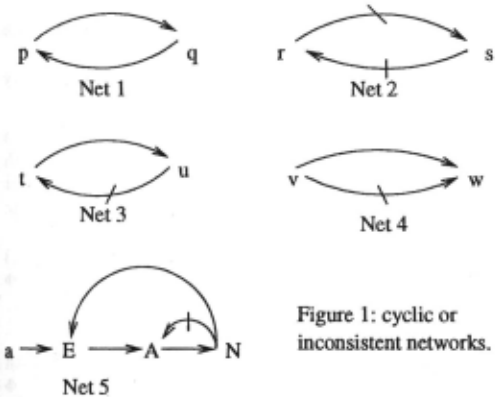
The first three nets in Figure 1 summarize some of the situations where a cycle in a network may be formed. E.g. Net 1 is the case where two properties may lead to each other. In the strict sense, it describes an if and only if relation. A simple case of this relation is that two different names describe the same property. In addition since we are dealing with defeasible networks, a link fro~ p to q could mean, normally the property p leads to the property q. For example, a professor who teaches a course on logic programming usually also teaches a course on AI, and vice versa.
Net 2 is a~out two properties being mutually exclusive; e.g. a male 1s not a female and vice versa.
Net 3 shows a case where one concept leads to another which, usually, leads to the negation of the former. An example is that an Edmontonian is a North American but a North American is usually not an Edmontonian. An extreme example is that every lottery winner is a person but a person is usually not a lottery winner . 1
Note that, if a piece of information (such as, a per son is usually not a lottery winner) is not presented in a network, no derivation is possible. This is because de feasible networks do not directly implement the Closed World Assumption.
Net 4 shows the situation where inconsistency arises in Horty's definition of defeasible inheritability. Such a definition allows an extension to include contradictory conclusions (thus allowing derivations from contradicted information). Alternative definitions could avoid this problem; e.g. Touretzky's [Touretzky, 1986] allows two extensions, in this case, with consistent conclusions.
We stress that it is the cycles, not the inconsistency described above, that causes a network to lose all its extensions: Horty showed that any acyclic network pos sesses at least one credulous extension, but a network involving cycles may not have any credulous extension [Horty, 1994].
The problem that a network has no credulous exten sion is caused by the presence of conflicting information: there is a part of the network, no matter how it is inter preted there is another part that contradicts it.
Net 5 illustrates a cyclic network that has no credu lous extension. This could be understood when a is an individual, E is interpreted as Edmontonian, A as Al bertan, and N as North American. Then, it is correct to say that a North American is usually not an Albertan (N -f+ A) . However, this way of interpretating the net work makes it erroneous to say that a North American is usually also an Edmontonian (N -t E) .
1 Some of these examples can be better represented using both defea$ible and strict links. The work has been extended to networks of mixed links in a forthcoming paper by the authors.
The network could be interpreted differently; e.g. E, A, and N are different names of the same property. Then, it is the link N -ft A that is erroneous.
In many application domains, the presence of only consistent information could be considered an exception rather than the norm. For example, in medical diagno sis, contradictions arise from many forms of knowledge incompleteness, e.g., lack of medical knowledge, lack of individual patient symptoms, and error or misinterpre tation of both collective and individual data.
It has been argued by many authors that inconsistent information should not result in one of the two extremes: anything or nothing. In particular, inconsistent informa tion should be localized. For example, the contradiction out of passing and failing a student should not affect the derivation that Houston is a city in Texas, and should not allow us to derive that Houston is a city in Cali fornia. Though defeasible networks seem to provide a particularly suitable form of reasoning to accommodate a notion of local inconsistency, so far there has been no investigation into this possibility.
When we study the semantics of networks with cy cles, what principle{s) should we follow? An important insight provided by this paper is that no new principle needs to be proposed. All we need is the principle of specificity that has been used all along in defining cred ulous semantics. Net 6 illustrates this principle for an acyclic network: since the property y has conflicting in heritance from the two nodes u and v, the application of the path 1r{x, Tt, v, r 2 , u) blocks the path u -t y.
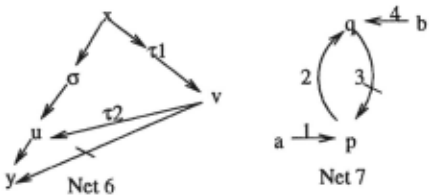
Under this principle, let us consider the network Net 7 of Figure 2. From a conservative point of view, one may not be able to conclude anything from this net, since if we have p(a), then we will get q(a) and thus ·p(a) . However, under the above principle, this net has a conservative extension {1, 12,4,43} which con cludes p(a), q(a), q(b), ·p(b). This is because the path 12 blocks the path 3 on object node a. That is, p(a) is more specific than ·p( a). It would be easy to under stand what the net could mean in a realistic situation if we represent pas Lottery_winner, q as Person, a and b as two individuals.
We choose a transformation approach to the seman tics of all defeasible networks. First, we translate a net work to a default theory and show that the translation preserves Horty's credulous semantics for all consistent networks (even if cyclic). This gives a default interpre tation of defeasible networks. Then, we use the existing methods in dealing with the semantics of default logic to define a conservative, skeptical semantics, called the well-founded semantics, and a new credulous semantics, called the regular semantics, for arbitrary defeasible net works. The two semantics are named after their coun terparts in logic programming [Van Gelder et al., 1991; You and Yuan, 1995].
This paper is organized as follows: the next section describes the transformation from defeasible network to default theory, followed by a section on the new seman tics for defeasible networks.
2 From Network to Default
In this section we give a translation from any defeasi ble network to a default theory and show a one-to-one correspondence between the credulous extensions of a consistent defeasible network [Horty, 1994] and Reiter's extensions of the translated default theory.
To simplify our discussion, we assume that a default theory is a set of defaults. A default d is of the form A:B,, .. . ,B,. where n > 0 and A B· C are formulas of c , - , ,, the underlying language C. We denote A by Pre(d), {B1, ... , Bn} by Just( d), and C by Cons( d). The defini tion of a default extension is standard [Reiter, 1980].
2.1 Defeasible network
A defeasible (inheritance) network r is defined as a finite collection of positive and negative links between nodes. If x, yare nodes then y +- x (resp. y '/- x) represents a positive (resp. negative) linkfrom x toy where xis called the root and y is called the head. Nodes are divided into two disjoint classes: object nodes which are denoted as a, a1, ... , and property nodes which are denoted asp, q, P1, ... . We assume that an object node can only be used as a root node. If a link's root is an object node, then this link is called an obJ'ect link. Two links are said to be in conflict if they have the same head but one is positive and the other is negative. We say that (x1, x2), ... , (xn-1> Xn) (or simply X1···Xn, n ~ 2} is a general path off if for every i = 1, ... , n- 1, (x;, Xi+1) is a link off whose root is x; and whose head is Xi+1· The path above is called a general cycle if x1 = Xn. A network is said to be acyclic if it has no general cycle.
A network r is consistent if there exist no two nodes X, y such that both" y f- X and y 'f- X belong to f.
A path of r is either a link of r or a sequence of f's links x1 --+ x2, ... , Xn--+ Xn+1 (called a positive path), n ~ 1 (resp. x1--+ x2, ... ,Xn-1--+ Xn,Xn-/+ Xn+1> called a negative path) . We simply denote the above positive path by 1r(x1, u, Xn+d and negative path by 1f(x1, u, Xn+d ·
We now give the off-path credulous semantics of Horty [Harty, 1994].
Definition 2.1 (Path constructibility and conflict in a path set) Suppose r is a defeasible network, ell is a path set of r. A path u of r is constructible in a path set ell if 0" is an object link or u = 1r(x1, 0"1, Xn, Xn+1} (resp. 0" = 1f(x1, o-1, Xn, Xn+d) and 1r(x1, 0"1, Xn) E ell.
A path 0" of r is conflicting in ell if 0" = 1r(X!, 0"1, Xn) (resp. 0" = 1f(x1,0"1,xn)) and u' = 1f(x1,u~,xn) E ell (resp. u' = 1r(x1,u~,xn) E ell}. 0
Definition 2.2 (Preemption}
A positive path 1r(x, u, u, y) (resp. negative path 1f(x, u; u, y)) is preempted (see Net 6 of Figure 2} in ell iff there is a node v such that (i} v f+ y E r (resp. v --+ y E f) and (ii) either v = x or there is a path of the form 1r(x, r1, v, r2, u) E ell. 0
Definition 2.3 (Defeasible inheritability)
Path u is defeasible inheritable in ell, written as ell f-d u, iff either u is an object link 2 or u is a compound path, u = 1r(x, r, y) {likewise for negative path) such that
- (i} u is constructible in ell;
- (ii) u is not conflicting in ell; and
- {iii} u is not preempted in ell . 0
Definition 2.4 (Credulous extension)
A set ell of paths is a credulous extension of a net r iff ell={ulellf-du}. 0
Example 2.5 Consider Net 7 of Figure 2. This network allows one credulous extension: ell 1 = {1, 12, 4, 43}. 0
2.2 Translation
For the presentation purpose, we first present a transla tion that is intuitive but not tractable, and then show how to modify it slightly to make it tractable.
Given a network r, a path 11"( u, u, X) is called a sim ple path if there is no path 1r{ u, u', x) such that the set of links in 1r{ u, u', x) is a proper subset of the links in 1r(u, u, x) . We say that a simple path 1r(u, u, x) causes conflict in node r if two links from u to r and from x to r are in conflict in r. We say that a simple path causes conflict if it causes conflict in some node r. E.g. in Net 7, the simple path 12 causes conflict in node p, and it is the only simple path of Net 7 that causes conflict.
We now relate the credulous semantics of a defeasible network with Reiter's extension semantics of its trans lated default theory. First, we transform a network to a default theory. In the following transformation, we use a predicate in1 (a) to mean that link l is in a path from object node a. The role played by in1 (a) is similar to the normality predicate in nonmonotonic reasoning; the link l in a path to conclude a property of a is normally accepted unless there is a reason to reject it .
2 In [Horty, 1994], it is any direct link. The difference, however, is inessential.
Definition 2.6 Let r be an arbitrary defeasible net work. We translate it into a default theory II(f) as:
dt = :~:~: : , for every object link l E r, if l = p +--a, then B = p(a); if l = p ;'-a, then B = ...,p(a);
dt(x) = p(~~~:.~(~~z) for every non-object link l E r,if l = q +-- p, then B = q(x); if l = q ;'-p, then B = ·q(x) ;
d( ( tr u,u,v ,l -un,(z) , path 7r( u, u, v) and link l from v to r such that it conflicts with a link from u tor. 0
) J(x) = ll{in,(z)[IE.,.(u,u,v)}: for every simple
Here, the underlying first order language of II(f) con tains the predicate set of the property nodes of r and the newly introduced predicate int for every link l of r; Its constant se~ is the set of the object nodes of r .
The first two kinds of defaults are translations directly from individual links. Let us denote the set of all these defaults by IIm(f). The last kind of defaults are trans lated from the simple paths that lead to a conflict. We denote it by IIp(f). Clearly, II(f) = IIm(f) U IIp(f) .
We use the following examples to illustrate how a de feasible network is translated into a default theory and their relationships.
Example 2.7 Continue with Net 7 of Figure 2. The translated default theory II(N et 7) is:
IIm(Net 7) =
{ :p a ,in, a p "' :q z ,in2 r q :z: :., z ,in3 z :q(b),in4 (b)} p a llin,(a)' q z)llin2 (z ' .,p(z)llin3 z) 'q(b)llin4 (b) II (Net 7)={in1 r _llin2 r : } P ..,,n3 :e
The defaults in IIm {Net 7) are self-explainable. The default in IIp (Net 7) is due to the fact that links 1 and 3 are in conflict and the simple path 12 is from link 1 's root to link 3's root . This default theory has one R-extension
which corresponds (after removing int (x) literals) to the only credulous extension as given in Example 2.5. 0
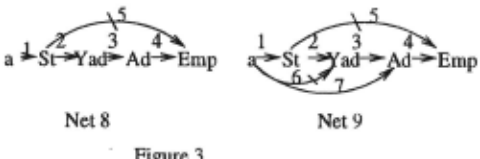
with in1 (a), in2(a), in3(a), ·in4(a), ins( a). It corre sponds to the unique credulous extension of the network.
If we add two more rules 6 : Y ad ;'-a and 7 : Ad +-- a into the network N eLB, the new network, Net 9, has two credulous extensions: ~1 = { 1, 6, 7, 15} and ~2 = {1,6, 7, 74} . When we translate it into a default theory II(N et 9), we get IIm(N et 9) and IIp(N et 9) where
II (Net 9) = { i~, z : in2 r_llin 3 :r : }. P -,sn_. r), ...,'"" :e
II(N et 9) has two extensions, which imply, respectively,
{St(a), ·Yad(a) , Ad(a), ·Emp(a)},
{St(a), ·Yad(a), Ad( a), Emp(a)},
They correspond to the two credulous extensions of Net 9. 0
We now show that the relationship demonstrated above holds for all consistent networks. First we explain some notation.
Let r be a defeasible network, E a first older theory under the language of default theory II(f) , and ~ a path set of the network r. We use E/f to mean the union of set {p(a) I p(a) E E, pis a property node and a is an object node} and set { ·p( a) I·P( a) E E , p is a property node and a is an object node} .
The path set P(E) of r is defined as follows : P(E) = {7r(a, u, p) IV l E rr(a, u, p), in,(a) E E}U{1f(a, u,p) IV l E 1f(a, u,p), int(a) E E}.
The consequence set of path set ~ of the net r is defined by Cons(<ll) = {p(a)l37r(a,u,p) E ~} U {·p(a) l31f(a,u,p) E <11} .
Theorem 2.9 For any consistent network r, ~ is its credulous extension iff II(f) has an R-extension E such that P(E) = ~ and thus E/f =Cons(~) - o
2.3 A note on translation
Clearly, the number of defaults in a translated default theory depends on the number of the simple paths that lead to a conflict in the given network. In the worst case, this number is exponential to the node size. However, this still improves Dung and Son's translation [Dung and Son, 1995] from consistent and acyclic networks to argu mentation frameworks, where the number of arguments could be infinite.
Selman and Levesque [Selman and Levesque, 1993] show that deciding whether a credulous extension ex ists for a defeasible network is NP-complete. Kautz and Selman [Kautz and Selman, 1991] show that the same decision problem for the simple default logic (restricted to literals) is also NP-complete. These results provide strong evidence that an extension preserving, polyno mial transformation exists (note that these results only guarantee the existence of a polynomial transformation such that this same decision problem is preserved).
We now present such a transformation. The key idea is to use a predicate, Cp,q, to represent a positive path from node p to q where all the links on it have been accepted. Therefore, we modify Tip {f) to contain only the following defaults:
int .... (W', where p f- a is a positive link of the network. a,p inq+-p(x),cp',p(x): . . .. cp,,q(x) 1 I.e., Cp,q lS tranSlbVe.
~~ where l is a link from q tor and the network has another link from p tor that conflicts with l.
Clearly, the size of Ilp(r) is polynomial to the node size of r. By encoding the connection relation between any two nodes, we can avoid enumerating all the possible paths that connect the two nodes.
An interesting implication of such a polynomial trans lation is that any decision problem for a defeasible net work based on the credulous semantics is no harder than the corresponding decision problem for the simple de fault logic (cf. [Kautz and Selman, 1991]).
3 Improved Semantics
The default interpretation of defeasible networks pre sented above provides a way to understand, indirectly, the possible semantics of defeasible networks. Namely, any semantics of default logic yields a semantics of de feasible networks. If a semantics is defined for all default theories, then it is defined for all defeasible networks. In this section we propose two of such semantics to address the problems of no extension and inconsistency.
As we know, not every default theory has an extension. This is because an R-extension E of a default theory D is a fixpoint of the following anti-monotonic operator:
Definition 3.1 {Anti-monotonic operator n)
Suppose D is a default theory. For any first order theory E, we define n(E) to be the smallest formula set that satisfies the following conditions:
1. Th(n(E)) = n(E);
2. For every d E D, if Pre(d) E n(E) and for any B E Just(d), -,B rt, E, then Cons( d) E n(E). o
n is anti-monotonic because for any theories E1 and E2 , E1 ~ E2 implies n(E2) ~ n(El) . Thus, n 2 , the operator that applies n twice, is monotonic. It thus has a least fixpoint and maximal fixpoints. Such a fixpoint is called an alternating fixpoint of n.
A number of researchers have proposed to use the tech nique of alternating fixpoints to define partial semantics for default logic and logic programs. [Baral and Subrah manian, 1991; Przymusinska and Przymusinski, 1991].
Definition 3.2 Let D be a default theory. A fixpoint E of n 2 is said to be an alternating extension of D. It is said to be normal if E ~ n(E). ·
The well-founded semantics of Dis defined by the least alternating extension (which is necessarily normal). The regular semantics of D is defined by the set of all maxi mal normal alternating extensions. 0
We call the least normal alternating extension the well founded extension, and a maximal normal alternating extension a regular extension.
However, this is not enough. It is well known that the well-founded extension defined this way is rather weak. Since in classic logic inconsistency is a global phe nomenon, the possibility of deriving contradictory con clusion could nullify other expected conclusions. E.g. the default theory { 7, :~~,';}has a well-founded exten sion Th( {}) and two regular extensions Th( { c, p}) and Th({...,c,p}). Obviously, we need to make pas a conser vative conclusion in the· well-founded semantics. Thus , we modify the definition of closure Th(E) as follows: Th(E) = {p I 3 consistent E' ~ E such that E' F= p} . Under this subtle modification, we can see that the pre ceding default theory has the well-founded extension Th( {p}) and the same regular extensions.
Theorem 3.3 For any network r, its translated default theory II(f) must have a unique, consistent well-founded extension W, and one or more consistent regular exten sion E. Conversely, the well-founded extension and any regular extension of the default theory II(f) must be con sistent. 0
Based on this result, we define the well-founded ex tension of a defeasible network r by P(W) and a regular extension of r by P(E).
3.1 Examples
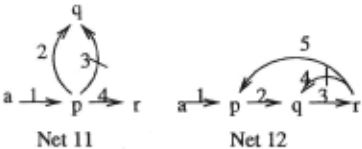
Example 3.4 Consider Net 11 in Fig. 5. Its default translation yields
{ :p a ,int a p X :q X ,in~ X X ;-,q X ,in3 X } p a Ain 1 a ' q x Ain 2 x) ' ..,q x Ain 3 x Its well-founded extension is
W = Th( {p(a), r(a), in1(a), in4(a)}),
and the two regular extensions are
E1 = Th( {p(a), r(a), q(a), in1(a), in4(a), in2(a)}) and
E2 = Th({p(a), r(a), ...,q(a), in1(a), in4(a), in3(a)}).
Thus, Net 11 has the well-founded extension, {1, 14} , and two regular extensions, {1 , 12, 14} and {1 , 13, 14}. 0
Example 3.5 Consider the cyclic network Net 12 of Fig. 5 (same as Net 5 in Fig. 1). Its translated de fault theory is:
3.2 Properties
The most important property is a soundness property for any well,-founded, regular extension of a network r . Essentially, it says that any path constructed from such an extension cannot be preempted.
Theorem 3.6 (Soundness property) Let r be any defea sible network, 4> is the well-founded or regular extension ofr . Then,
1. 4> ~ {u I <I> f-d u};
2. For any path {3 of r I if {3 fl. 4>' and 4> f- d {3, then {uj<l>f-du}fdf3. 0
If a network is consistent and acyclic, the correspon dence between regular extensions and Horty's credulous extensions is one-to-one.
Theorem 3. 7 Suppose r is a consistent and acyclic de feasible network. <I> is a regular extension of r iff 4> is a credulous extension of r. 0
Since the least alternating fixpoint of a simple default theory can be tractably computed, we get
Theorem 3.8 The set of literals that are implied by a network under the well-founded semantics can be com puted tractably. 0
@inproceedings{ijcai1997p24,
  title     = {A Default Interpretation of Defeasible Network},
  author    = {Wang, Xianchang and You, Jia-Huai and Yuan, Li-Yan},
  booktitle = {Proceedings of the Fifteenth International Joint Conference on
               Artificial Intelligence, {IJCAI-97}},
  publisher = {International Joint Conferences on Artificial Intelligence},
  editor    = {Martha E. Pollack},
  pages     = {156--160},
  year      = {1997},
  note      = {Automated Reasoning},
  url       = {https://ijcai.org/proceedings/1997/24},
}
TY - CPAPER TI - A Default Interpretation of Defeasible Network AU - Wang, Xianchang AU - You, Jia-Huai AU - Yuan, Li-Yan T2 - Proceedings of the Fifteenth International Joint Conference on Artificial Intelligence, IJCAI-97 PB - International Joint Conferences on Artificial Intelligence PY - 1997 SP - 156 EP - 160 UR - https://ijcai.org/proceedings/1997/24 ER -Copied
Machine-readable versions of this paper, for tools and AI agents:





