
Reasoning with Incomplete Initial Information and Nondeterminism in Situation Calculus
Proceedings of the Fifteenth International Joint Conference on Artificial Intelligence. Temporal Reasoning. Pages 1434-1439.
© 1997 International Joint Conferences on Artificial Intelligence
Abstract
Situation Calculus is arguably the most widely studied and used formalism for reasoning about action and change. The main reason for its popularity is the ability to reason about different action sequences as explicit objects. In particular, planning can be formulated as an existence problem. This paper shows how these properties break down when incomplete information about the initial state and nondeterministic action effects are introduced, basically due to the fact that this incompleteness is not adequately manifested on the object level. A version of Situation Calculus is presented which adequately models the alternative ways the world can develop relative to a choice of actions.
- [AAAI96, 1996] Proceedings of the Thirteenth National Conference on Artificial Intelligence. AAAI Press, Menlo Park, California, 1996.
- [Baker, 1989] Andrew B. Baker. A simple solution to the Yale shooting problem. In Principles of Knowledge Representation and Reasoning: Proceedings of the First International Conference.
- Morgan Kaufmann, 1989.
- [Davis, 1994] Ernest Davis. Knowledge preconditions for plans. Journal of Logic and Computation, 4(5):721- 766, October 1994.
- [Doherty, 1994] Patrick Doherty. Reasoning about ac- tion and change using occlusion. In Proceedings of the Eleventh European Conference on Artificial Intel- ligence. John Wiley & Sons, 1994.
- [Fikes and Nilsson, 1971] Richard E. Fikes and Nils J. Nilsson. STRIPS: A new approach to the application of theorem proving to problem solving. Artificial In- telligence, 2:189-208, 1971. IJCAI
- [Kowalski and Sergot, 1986] R. A. Kowalski and M. Ser- got. A logic-based calculus of events. New Generation Computing, 4:67-95, 1986.
- [Levesque, 1996] Hector J. Levesque. What is planning in the presence of sensing? In AAAI96 [1996].
- [Lifschitz, 1985] Vladimir Lifschitz. Computing circum- scription. In Proceedings of the Ninth International Joint Conference on Artificial Intelligence, pages 121- 127.
- Morgan Kaufmann, 1985.
- [Lifschitz, 1988] Vladimir Lifschitz. Pointwise circum- scription. In M. Ginsberg, editor, Readings in Non- monotonic Reasoning.
- Morgan-Kauffmann, 1988.
- [Lin, 1996] Fangzhen Lin. Embracing causality in speci- fying the indeterminate effects of actions. In AAAI96 [1996].
- [Manna and Waldinger, 1987] Zohar Manna and Richard Waldinger. A theory of plans. In M.P. Georgeff and A.L. Lansky, editors, Reason- ing about Actions and Plans: Proceedings of the 1986 Workshop. Morgan Kaufmann, 1987.
- [McCarthy and Hayes, 1969] John McCarthy and Patrick J. Hayes. Some philosophical problems from the standpoint of artificial intelligence. Machine Intelligence, 4:463-502, 1969.
- [McCarthy, 1979] John McCarthy. First order theories of individual concepts and propositions. Machine In- telligence, 9, 1979. 1440
- T EMPORAL R EASO NIN G [Moore, 1985]
- Robert C. Moore. A formal theory of knowledge and action. In J.R. Hobbs and R.C. Moore, editors, Formal Theories of the Commonsense World, chapter 9. Ablex, Norwood, New Jersey, 1985.
- [Peot and Smith, 1992] M. Peot and D. Smith. Con- ditional nonlinear planning. In Proceedings of the First International Conference on Artificial Intelli- gence Planning Systems. Morgan Kaufmann, 1992.
- [Pratt, 1976] V. Pratt. Semantical considerations on Floyd-Hoare logic. In Proceedings of the 17th IEEE Symposium on Foundations of Computer Science, 1976.
- [Reiter, 1991] Ray Reiter. The frame problem in the situation calculus: A simple solution (sometimes) and a completeness result for goal regression. In V. Lifs- chitz, editor, Artificial Intelligence and Mathematical Theory of Computation: Papers in Honor of John Mc- carthy, pages 359-360. Academic Press, 1991.
- [Reiter, 1996] Ray Reiter. Natural actions, concurrency and continuous time in the situation calculus. In Principles of Know ledge Representation and Reason- ing: Proceedings of the Fifth International Confer- ence. Morgan Kaufmann, 1996.
- [Rosenschein, 1981] Stanley J. Rosenschein. Plan syn- thesis: A logical perspective. In Proceedings of the Seventh International Joint Conference on Artificial Intelligence, pages 331-37. IJCAI
- Morgan Kaufmann, 1981.
- [Sandewall, 1994] Erik Sandewall. Features and Fluents. Oxford Press, 1994.
References were extracted automatically from the PDF and may contain errors.
Full text extracted automatically from the PDF; figures, tables and equations may differ. The PDF is the version of record.
1 Introduction
The contribution of this paper is to highlight some prob lems that arise in Situation Calculus when incomplete initial information or nondeterministic actions are con sidered, in particular when reasoning about plans .. A new version of Situation Calculus is proposed that avo1ds these problems by containing incompleteness and non determinism within individual logical models just like different choices of actions are.
Situation Calculus [McCarthy and Hayes, 1969; Re iter, 1991) is a formalism for reasoning about action and change that has been widely studied and applied to a broad range of problems. Its major strength relative to other formalisms is the possibility to do a large extent of reasoning on the object level. Object-level reason ing occurs completely within the object language and within one single theory as opposed to meta-level rea soning which involves reasoning about theories. The ad vantage of object-level reasoning is that it is completely supported by the deductive system of the logic in use. Problem solving is equivalent to finding logical proofs.
There are variations between different formalisms for action and change in how much reasoning can be done on the object level. On one extreme, there are STRIPS style formalisms [Fikes and Nilsson, 1971), where even the state transition resulting from the application of an action is specified on the meta-level, namely as adding and deleting sentences to/from a state description. In the middle there are narrative-based formalisms such as Event Calculus [Kowalski and Sergot, 1986] and Sande wall's logics [Sandewall, 1994], where each theory r rep resents a specific choice of actions. At the other end of the scale there are branching formalisms such as Situ ation Calculus. The use of a branching time structure implies that different courses of actions can be contained within the same theory. ·
In Situation Calculus, henceforth referred to as SC, the time-structure is built up by successive applications of actions, starting from the initial situation So. Each action application results in a new situation. Situations have names specifying via what sequence of actions they are reached, for instance do( Load, So), do( Fire, So) and do( Fire, do( Load, S0 )). The fact that a fluent f .holds in a situation s is expressed as H olds(f, s ), for mstance -,H olds(alive, do( Fire, do( Load, So))). The effects of actions are specified using axioms such as the following. 1
The predicate Poss( a, s) denotes the conditions un der which a is possible to execute, for instance Poss(Fire, s) = H olds(has_gun, s ). The stren~h of this representation is that given a SC theory r With ac tion effect axioms, all possible different action sequences and their effects are contained within r. Situations are first-order objects, and thus reasoning about different situations (i.e. different action sequences) can be done on the object level, deductively. In particular, a planning problem can be straight-forwardly represented as an ex istence problem, whereas in narrative-based formalisms planning has to be formulated as an abductive, and thus metalogical, problem. Let r be a SC theory after the appropriate nonmonotonic preprocessing for minimizing change (for instance use of the explanation closure techniques in [Reiter, 1991]), and let G(s) be a goal. In ad dition, let Exec( s) represent the fact that the situation s is reachable from the initial situation via a sequence of executable actions. Formally expressed, Exec(s) = [s = S0 V3a,s'.s = do(a,s')t\Poss(a,s')t\Exec(s')]. Then the problem of finding a plan that achieves the goal is equivalent to proving the following.
1 For notational convenience, any variable occurring free in a formula is assumed to be universally quantified. For instance in the axiom for Fire there is an implicit quantifier V s prefudng the formula.
The binding of the s that satisfies G( s) t\ Exec( s) is the plan. For instance, if one assumes a proper theory r for loading and shooting, a solution to the problem
is found in the bindings= do(Fire, do(Load, S0 )).
The fact that action sequences (situations) are objects in SC, which makes it possible to perform reasoning tasks like planning purely deductively, has been emphasized as the major advantage of SC relative to narrative-based formalisms (see for instance [Reiter, 1996]). This has motivated a substantial amount of work attempting to incorporate reasoning about metric time and temporal relations into SC (see [Reiter, 1996] again), which is one of the strong points of narrative-based formalisms. Un fortunately, the advantage of SC breaks down when the implicit assumptions of information completeness and determinism are abandoned. Section 2 demonstrates this problem. Section 3 presents a version of SC which deals correctly with incomplete information and nondetermin ism on the level of individual actions, and section 4 in troduces constructs for action composition. Section 5 presents some conclusions and comparisons.
2 Problems with incomplete information
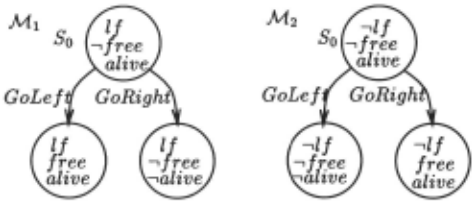
There is a strong assumption regarding complete infor mation of the initial situation in the traditional SC for mulation of the planning problem. To see why this is the case, consider the following scenario where an agent has to choose between two doors. One of the doors leads to freedom (free), whereas one leads to death ( ·alive) in the shape of a vicious cobra. Let lf denote that the left door leads to freedom, and assume that H olds(alive, So) t\ ·H olds(free, So) but lf is unspeci fied at So. There are two actions GoLeft and GoRight defined as follows:
The following inference is correct (again, r is the theory after the appropriate nonmonotonic preprocessing)
In the case where Holds(lf,So), the binding s = do(GoLejt, S0 ) proves the existential, and in the case where ·Holds(lf,S0 ), s = do(GoRight,So) proves the existential (Fig. 1). However, neither of these can be considered a plan. The problem is that different initial situations are realised in different models, whereas the statement 3s. [H olds(free, s) t\ Exec(s )] should be true in each individual model. Thus, it suffices to find one plan for each model; the plans can be different in dif ferent models. Eq. (2) states that "for each possible initial situation one should find a plan that leads to the goal". The correct formulation should be "find a plan that leads to the goal for each possible initial situation". Unfortunately, the latter is not possible to express in SC. Even quantifying over initial situations like in
just repeats the same erroneous formulation as above (Exec( so, s) denotes that there is a sequence of exe cutable actions from s0 to s ). The dual problem of negative plan existence gives rise to similar difficulties. ·3s.[Holds(free,s)t\Exec(s)] is clearly an inadequate formulation of negative plan existence for the two-doors scenario. Notice that it contradicts (6). Similar counter examples can be constructed where incompleteness is due to an action with nondeterministic effects. As the action, due to the do function, just has one resulting sit uation in each model, it suffices to find one plan for each model.
In summary, when the implicit assumptions of com plete initial information and determinism are aban doned, severe problems arise for SC. The reasons are the identification of plans with situations and, in the case of nondeterminism, the use of a do function. Thus, the critique presented here applies to all versions of SC that have any of these two features. As a consequence, it is not possible to express properties such as positive and negative plan existence on the object level, and this severely limits the usefulness of SC as a tool for analysis and specification of higher-level reasoning.
3 Actions and their effects
In this and the following sections, we will introduce a new version of SC. It is a state-based approach, where the frame problem is solved in a way similar to the PMON logic by Sandewall [Sandewall, 1994; Doherty, 1994]. PMON is a narrative-based logic with integer time and has been formally assessed correct for sequential worlds with actions with context-dependent and nondeterministic effects.
The following types are used: S for situations, :F for fluents, 0 for objects in the domain and A for primitive actions. The two predicates H olds(f, s) and Occl(f, a, s) respectively denote that fluent f is true in situation s, and that if action a is executed in s, then f might be changed in the next state. Occl stands for "occluded" and denotes an explicit exception to the general principle of no-change. Notice that Occl represents a potential to change, not a necessity. .
An essential feature of the logic is that the do( a, s) function representing the result of doing a is replaced by a predicate Res( s, a, s'). This inakes it possible to represent nondeterminism within individual models; if a behaves nondeterministically in situation s then there are more than ones' such that Res(s, a, s'). In previous approaches to nondeterminism in SC (e.g. [Lin, 1996]), do( a, s) has denoted different situations in different mod els.
3.1 Elements of a theory
A theory consists of a set of axioms for unique names of objects, fluents and actions {UNA), and the following axioms.
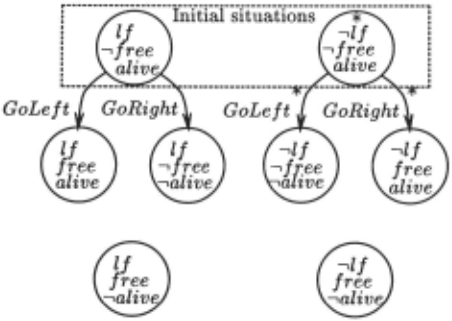
Situation existence (sE). A second-order situation existence axiom ( SE) defines the space of situations. In Baker's state-based approach [Baker, 1989], a situation existence axiom was used to obtain a correct minimiza tion of change. In the approach presented here, there are no do terms denoting situations. Thus, without SE there might be models where some relevant situations are missing or even where the situation space is com pletely empty (an example of the former is given later in Fig. 2). SE states that for each possible state, that is to say each truth assignment ~ over the set of fluents, there is a corresponding situations. In addition, all situations are unique.
H the set of fluents is finite, a first-order SE is possible [Baker, 1989].
Action effects {LAW). To get a compact representa tion of action effects, a Cause macro is used. Cause involves both a statement that a fluent is allowed to change, and a statement of the result of this change.
The effects of actions are specified in a set LAW. The normal form of an effect law for an action a is as follows.
The formulae ai(s) should only contain Holds expres sions relating to s, and Vijk E { F, T}. The consequents are disjunctions of conjunctions, where each conjunction represents one possible nondeterministic outcome of the action. In each such disjunction, all conjunctions should contain the same set of fluents.
The following is an example of an action with a non deterministic outcome.
No-change {NCH). H a fluent is not explicitly influ~ enced by an action (that is appears in a Cause state ment) it is assumed not to change. This is realised with the no-change axiom {NCH), which only allows fluents that are occluded to change. NCH states that if s' is a situation resulting from doing a in s then only those flu ents explicitly influenced by the action a (that is to say Occl(f, a, s)) may change. The fluents that are not oc cluded must have the same truth values after a as they had before a. NCH is as follows.
Possibility to execute actions (POSS and EXE). Rules for when actions are possible to execute (Poss) are written on the form Poss(a, s) => a(s ). There is also a condition that s' is a resulting situation only if a is possible to execute in s (EXE).
3.2 Reasoning with a theory
In order to obtain a theory suitable for reasoning, a step of nonmonotonic processing is required. In the two-doors scenario, the possibility conditions (Poss) and effect laws (LAW) for the two actions of going through the left door and the right door can be defined as follows.
(H alds(lf, s) => Cause(s, GaRight, s', alive, F)) 1\ (·Halds(lf,s) => Cause(s, GaRight, s', free, T))Using the definition of Cause in (10), (11) on the state ments (17) and (19) results in (20) and (21) respectively.
Halds(lf,s) => [Occl(alive,GaRight,s)/\ (21) (Res( s, GaRight, s') => --,fl alds( alive, s'))] 1\ ·H alds(lf, s) => [Occl(free, GaRight, s) 1\ (Res(s, GaRight, s') => Halds(free, s'))]This in turn can be rewritten as follows, separating the Occl (22) and Res (23) parts.
The nonmonotonic step consists of turning the respec tive sums of conditions for Pass, Occl and Res into bi conditionals. The conditions for Pass are all contained in POSS and give the following sentence, which character izes exactly when specific actions are possible to execute.
The Ocd predicate should hold only when explicitly stated in LAW. Thus, the conditions in LAW for Ocd (22) give the following sentence, which characterizes ex actly under what conditions specific fluents may change.
Conditions for Res are contained in NCH (14), EXE (15) and LAW (23). Together they give the following comple-
Observe that Res is determined by Pass and Ocd. In formally, this means that first one decides when action . are possible to execute and in what circumstances flu ents are allowed to change. After that , and with these constraints in mind, the result relation is generated.
The completion of Res implies that the extension of Res is maximized. Why this is important be comes clear if one considers a nondeterministic ac tion, such as the coin flipping action (13). From a situation s such that H alds(has-coin, s ), FlipCoin should be able to lead both to a situation s~ such that ·H alds( heads-up, sD and to another situation s~ such that H alds(heads-up, s~). That is to say, both Res(s, FlipCoin, sD and Res(s, FlipCoin, s~) should hold. In order to guarantee this, Res is maximized. If Res was not maximized, there would be models where either ·Res(s, FlipCoin, sD or ·Res(s, FlipCoin, s~) is true, and in those models FlipCoin would not be non deterministic. Even worse, there might be models where both ·Res(s, FlipCoin, sD and ·Res(s, FlipCoin, s~) are true, and thus FlipCoin would not be possible to execute. In short, maximizing Res implies that there is one resulting situation for each possible outcome of an action in a given situation.
The completions of the three predicates, that is (24), (25) and (26), contain all relevant information regard ing the effects of actions, and can be used for theorem proving together with SE and UNA. Figure 2 shows one model. One can notice that there are only arcs start ing from the upper two situations, as these are the only ones that satisfy Pass (24). Furthermore, observe that all arcs result in fluent changes that are sanctioned by Occl (25).
To summarize, the process of generating the comple tions of Occl, Pass and Res is as follows. (a) The exten sion of Occl is minimized relative to LAW, where it only occurs positively. (b) The extension of Pass is maxi mized relative to POSS, where it only occurs negatively. (c) The extension of Res is maximized relative to NCH, EXE and LAW, where it only occurs negatively. This pro cess can be automated with second-order circumscrip tion [Lifschitz, 1985], as follows.
The expression Circ[r; ·P] denotes that the extension of the predicate P is maximized. Although the result of this circumscription is a second-order formula, two results by Lifschitz [Lifschitz, 1988) and the fact that Occl, ·Pass and ·Res only occur positively within the theories relative to which they are circumscribed imply that it is equivalent to a first-order formula. Thus, the circumscribed parts of the theory are completely first order. However, this is not (always) the case for the situation existence axiom, or for the induction axiom mentioned in the next section.
4 Action composition
With the use of a Res predicate above, a sequence of actions is no longer represented as a term of nested do's. Instead, a type .N for composite actions is introduced together with a predicate Res*(s, n, s'). It is assumed that this type is supported by a (second-order) induc tion axiom (IND ). Constructs for primitive actions and sequences are defined as follows.
A Poss* predicate for composite actions can be defined in terms of Res* and Pass.
Notice that this definition implies that all the primitive actions along any path described by seq(n1, n2 ) must be possible to execute.
Now, the positive (negative) plan existence problem can be formulated as follows (let I( s) describe the initial conditions).
·
For instance, consider the two-doors scenario again. It is obvious that for neither n = do(GoLeft) nor n = do(GoRight) (Fig. 2), it holds that
Also observe the importance of the situation existence (sE) axiom. If there are models where situations are missing, one might fail to conclude that there is no plan (Fig 2).
When planning with an incompletely specified initial situation and nondeterminism, the concept of a plan as a sequence appears to be insufficient. What one would like is the possibility to take different courses of actions depending on the circumstances. This is the approach taken in contingency planning or conditional planning [Peot and Smith, 1992). In order to demonstrate the feasibility of representing plans as complex terms, it is important to address the problem of conditional con structs. The following is a definition for Res* and Pass· for a conditional construct (the predicate Holds' denotes that a condition holds).
In order to let one of the conditional branches be empty, a noop action is introduced.
The definition of cond raises a question re garding the status of the condition component c. One possibility is that c is a fluent, like in cond(loaded,noop,do(Load)). In [Levesque, 1996), cis a sensing action that returns either 0 (for false) or 1 (for true): cond( check .1 oaded, noop, do( Load)).
A more general approach, following a proposal by Mc Carthy [McCarthy, 1979) (also see [Moore, 1985)), is to represent complex conditions as terms as follows. First, there is a type V for object designators, which are ei ther used as variables xi (short for x(i) where i E N), or as constants; the latter are formed with the func tion@ : 0 ---+ V. A function V : V ---+ 0 maps ob ject designators to objects. In particular, V(@(x)) = x. For instance, @(fred) (or @fred) denotes a name that via V refers to the object fred. Then there is a type C for complex conditions. It includes refer ences to the different fluents in the domain, like alive or in(@robot, @room1), and constructs equivalent to the standard logical connectives and quantifiers and equality, like V: C x C---+ C (or or to retain a term-like syntax). A predicate Holds' : C x S is used for complex conditions like Holds is used for single fluents. Holds' is defined in terms of Holds. For instance, Holds' (loadedV alive, s) = Holds( loaded, s) V Holds( alive, s).
The following axioms define the Holds' predicate. For each fluent designator symbol fi corresponding to a fluent symbol/i, there is an axiom as follows.
The reified equality relation= and the reified connectives -:::;-, C E {7\, V, ~. =} and quantifiers Q E {3, V} are defined as follows.
The substitution functions sb : V x V x 1J -+ 1J and sb : C x V x V -+ C are defined in the obvious way. Finally, a set of unique name axioms are supplied for the conditions. Essentially, two distinct terms of types 1) or C always denote two distinct objects, even if they refer to the same object via the V function or have the same truth value via the Holds' predicate. Conditions and designators are considered syntactical entities, and equality is based on syntactical identity, not reference.
Now it is possible to construct conditional plans such as
which is a solution to the two-doors-problem. It is straight-forward to show that n satisfies (33).
A final remark: the condition in the plan above refers to the actual state of the world. Preferably, such decisions should be based on the knowledge of the agent. That requires a theory that explicitly rep resents the agent's knowledge or beliefs [Moore, 1985; Levesque, 1996]. This is compatible with the technique presented in this section.
5 Conclusions
Situation Calculus is a formalism for reasoning about action and change that supports reasoning about alter native courses of action on the object level. However, it fails to provide adequate object-level support for rea soning about the different ways the world can develop relative to a specific choice of actions. This results in anomalies when Situation Calculus is used for higher level reasoning such as planning, as illustrated by the two-doors scenario. This paper has presented a modified version of SC that deals with this problem. It allows mul tiple initial situations and multiple alternative results of actions within individual models of an SC theory. In fact, the approach presented here can be considered a "modalization" of SC - it is possible to reason about possible and necessary results of a course of actions - although no explicit modal operators have been intro duced. Three important technical considerations are the use of a Res relation instead of a do function (for nonde terminism, which is central to the paper), a situation ex istence axiom (as there are no terms denoting individual situations) and a type for composite actions, more suit able than individual situations for representing plans. Also observe the simple circumscription policy employed (27), which does not involve any prioritizing or varying of predicates. This policy is a variant of Sandewall's PMON policy [Sandewall, 1994], originally for an inte ger time structure, which has been altered to fit the new temporal structure.
The motivating example of this paper is analogous to an example from [Manna and Waldinger, 1987] with a monkey and two boxes, one of which contains a ba nana and one of which contains a bomb. In their SC based approach, the synthesis of plans is supported by a deductive-tableau inference system. The point the authors make with the example is that the proofs for generating a plan should be constructive. Manna's and Waldinger's plan theory introduces plans as explicit ob jects. The application of an action or a plan to a state is modeled as a function yielding a new state, which im plies determinism. Although their motives are similar, the approach of Manna and Waldinger is substantially different from the work presented in this paper; in par ticular, the authors are not concerned with axiomatic solutions to the frame problem.
There are also similarities to work on planning with sensory actions by (among others) Levesque [Levesque, 1996] and Davis [Davis, 1994], which involve explicit the ories of knowledge. Levesque introduces complex action terms with sequential and conditional composition. Fur thermore, a plan is required to lead to the goal from all situations that are compatible with the agent's knowl edge of the initial situation, and not just the initial sit uation. However, the purpose is not to deal with the problems addressed in this paper. In particular, actions are assumed to be deterministic. Actually, as Levesque uses a do function, the agent will "know" that actions are deterministic, even if they are specified not to be. Also Davis provides a type for plans, and in addition a Result relation. The purpose with the relation is to let plans have unspecified results, and not to model nonde terminism. Davis mentions nondeterminism as a future problem.
Dynamic logic [Pratt, 1976] is a polymodal formal ism that has been applied to reasoning about action and change and to planning [Rosenschein, 1981]. In dynamic logic semantics, a relation defines the possible next states when an action is executed in a state, in a manner similar to the Res(s, a, s') relation in this paper.
To conclude, the essential novelty of this paper is that it combines plans as explicit objects with not only in complete initial information but also nondeterministic effects. This is done in classical logic, with the aid of a relatively simple circumscriptive policy based on a com pact yet powerful solution to the frame problem. Re garding future work, an interesting project would be to combine nondeterminism and knowledge operators.
Acknowledgments
I would like to thank Silvia Coradeschi, Patrick Do herty, Marcus Bjareland and the anonymous referees for their comments on previous versions of this paper. This research has been supported by the Swedish Research Council for Engineering Sciences (TFR) grant 96-728.
@inproceedings{ijcai1997p206,
  title     = {Reasoning with Incomplete Initial Information and Nondeterminism in Situation Calculus},
  author    = {Karlsson, Lars},
  booktitle = {Proceedings of the Fifteenth International Joint Conference on
               Artificial Intelligence, {IJCAI-97}},
  publisher = {International Joint Conferences on Artificial Intelligence},
  editor    = {Martha E. Pollack},
  pages     = {1434--1439},
  year      = {1997},
  note      = {Temporal Reasoning},
  url       = {https://ijcai.org/proceedings/1997/206},
}
TY - CPAPER TI - Reasoning with Incomplete Initial Information and Nondeterminism in Situation Calculus AU - Karlsson, Lars T2 - Proceedings of the Fifteenth International Joint Conference on Artificial Intelligence, IJCAI-97 PB - International Joint Conferences on Artificial Intelligence PY - 1997 SP - 1434 EP - 1439 UR - https://ijcai.org/proceedings/1997/206 ER -Copied
Machine-readable versions of this paper, for tools and AI agents:





