
Active Diagnosis by Self-Organization: An Approach by The Immune Network Metaphor
Proceedings of the Fifteenth International Joint Conference on Artificial Intelligence. Neural Networks. Pages 1084-1090.
© 1997 International Joint Conferences on Artificial Intelligence
Abstract
We propose a concept of active diagnosis that differs from the conventional passive (i.e. event-driven) diagnosis in temporal (diagnosis is carried out by always monitoring normal condition as opposed to identifying faulty only when abnormal condition is detected) sense as well as spatial {diagnosis is carried out by agents distributed in the sensor network) sense. As one way of realizing active diagnosis, we present immunity-based agents approach based on the self creating, monitoring, and maintaining feature of immune systems. We apply the approach to process diagnosis where the agents are defined on the sensor network. Each agent corresponding to sensor or process constraint evaluates a kind of reliability by communicating other agents. System level recognition of sensor/process fault can be attained by continuously and mutually monitoring and maintaining consistency among sensor values and process constraints.
- M. Iri, K. Aoki, E. O'shima, and H. Mat- suyama 1980. J. Operations Research Soc. Japan, Vol. 23: 295.
- Ishida, Y. 1988. Integrating Model-Based and Syndrome-Based Processing Plant Diagnosis. Eng. Appl. of AI, 1(1): 11-15.
- Ishida, Y. 1990. Fully Distributed Diagno- sis by PDP Learning Algorithm: Towards Immune Network PDP Model. In Proc. of International Joint Conference on Neural Networks,: 777-782.
- Wooldridge et al. 94
- Wooldridge M.J.; Jennings, N.R. 1994. Agent Theories, Architecutures, and Lan- guages: A Survey," in M.J. Wooldridge and N.R. Jennings Eds., Intelligent Agents, Lecture Notes in Artificial Intelligence, Springer-Verlag.
- A.I. Tauber, Immunology Today, 1994.
- Hopfield, J.J. 1982. Neural Network and Physical Systems with Emergent Collective Com- putational Abilities. In Proc. Natl. Acad. Sci. USA, 81(April): 3088-3092.
- Cohen & Grossberg 83]
- Cohen, M. A.; Grossberg, S. 1983. Absolute Stability of Global Pattern Forma- tion and Parallel Storage by Competitive Neural Networks. IEEE Trans Sys. Man Cybern., SMC-13: 815-826
- Jerne, N. K. 1973. The Immune System. Sci. Am. 229(1): 52-60.
- Grossman, Z. 1989. The Concept of !clio- typic Network: Deficient or Premature? in Theories of Immune Networks, H. Atlan and I.R.Cohen Eds, Springer-Verlag, 38-52.
- Farmer et al. 86
- Farmer, J. D.; Packard, N. H.; Perel- son, A. S. 1986. The Immune Systems, Adaptation, and Machine Learning. Physica, 22D: 187.
- Preparata et al. 67
- Preparata, F. P. ; Metze, G.; Chien, R. T. 1967. On the Connection Assignment Problem of Diagnosable Systems. IEEE Trans. Comput., EC-16: 848-854.
- & Mizessyn 92
- Ishida, Y.; Mizessyn, F. 1992. Learning Algorithms on Immune Network Model: Application to Sensor Diagnosis. In Proc. Interna- tional Joint Conference on Neural Networks, : 33- 38.
- & Tokimasa] Y. Ishida and Y. Tokimasa, 1996. "Diagnosis by a Dynamic Network inspire d by Immune Network, " in Proc. of World Congress of Neural Networks (WCNN'96), San Diego, CA, September 15-18, : 508-511.
- Pearl, J. 1986. Fusion, Propagation and Structuring in Belief Networks, Artificial Intelli- gence, 29(3): 241-288.
- Pearl, J . 1987. Distributed Revision of Com- posite Belief Networks. Artificial Intelligence, 33( 2): 173-215.
- Toja & Biegler 91]
- Toja B.; Biegler, L.T. 1991. Simul- taneous strategies for data reconciliation and gross error detection of nonlinear systems. Computers chem. Engng, 15(10): 679-690.
- Liebman et al. 92
- Liebman,M.J.; Edgar, T.F.; Lasdon, L.S. 1992. Efficient Data Reconciliation and Esti- mation for Dynamic Process Using Nonlinear Pro- gramming Techniques. Computers chem . Engng, 16(10/11): 963-986.
- Narasimhan & Harikumar 93a] Narasimhan, S.; Harikumar, P. 1993. A Method to Incorporate Bounds in Data Reconciliation and Gross Error De- tection I: The Bounded Data Reconciliation Prob- lem. Computers chem. Engng, 17(11): 1115-1120.
- & Tokimasa 96
- Ishida, Y.; Tokimasa, Y. 1996. Data Reconciliation Combined with Data Eval- uation by Sensor Networks with Immune Net Metaphor. In Proceedings of the 35th IEEE Con- ference on Decision and Control (CDC '96 ), CD- ROM(ISBN 0-7803-3593-7.
References were extracted automatically from the PDF and may contain errors.
Full text extracted automatically from the PDF; figures, tables and equations may differ. The PDF is the version of record.
1 Introduction
Diagnosis based on qualitative constraints (expressed by graphically {e.g. [Iri et al. 80; Ishida 88]) or logically ) have been studied extensively in several communities. One of the important aspect of diagnosis for dynamical systems (such as processing plants) would be that the abnormal state propagate rapidly through many parts, hence results in the pattern {normal/high/low; oscilla tion; stick etc.) of a large number of sensors (syndrome). The first thing to do may be filtering out unimportant sensor pattern and focusing on the key sensor pattern. We used qualitative reasoning to explain one sensor pat tern from the other sensor pattern. In the qualitative diagnosis, by checking the consistency among sensor pat terns, the sensor pattern that cannot be explained by the other sensor pattern will be focused. as in [Ishida 88].
There already has been proposed using the consis tency monitoring and maintenance in the qualitative constraints among sensor values and process knowledge based on the metaphor of immune system [Ishida 90].
The main point of using the immune system metaphor is using agents {corresponding to immune related cells) that interact mutually, continuously, and dynamically. The immunity-based approach, thereby makes the con sistency monitoring and maintenance possible in the dynamic environment where on-line data from sensors arrives dynamically. Another important aspect of the immunity-based approach is that it agrees with the con cept of active diagnosis presented in this paper and hence it would be one way of realizing the active diagnosis.
The concept of active diagnosis may be briefly stated as: diagnosis that is attained by actively and contin uously monitoring consistency among the current state and normal state for reference. Technologically, active diagnosis may be possible supported by the recent tech nological development in three fields: active sensing in the sensor technology, active agent in the network tech nology, and active data base in the data base technology. Diagnostic system may be divided into three subsystems: knowledge data base for diagnosis; sensor system that is interface between diagnostic system and target system for diagnosis; and inference system that diagnose tar get system based on the knowledge data base and sensor system. Innovation of active sensing, acti:ve agent, and active data base can support sensor system, inference system and knowledge data base, respectively.
2 Active Diagnosis and Immunity-Based Approach
Diagnosis, in general, is basically considered an event driven task that is triggered by the event of fault and also it is based on the information in the pattern of ab normal {syndrome). However, as target system becomes information-intensive, the conventional event- driven ap proach may not be sufficient. We propose a concept of active diagnosis as opposed to the conventional passive diagnosis (event- driven diagnosis) . The concept of ac tive diagnosis is motivated by self-identification process of immune system; by recent argument of pro-activeness as an important element of agents [Wooldridge et al. 94]; by the concept of active data base; and by the recent technological development of active sensing.
Active diagnosis may be characterized by the following requirements:
- Temporal requirement: Self monitoring must be car ried out all the time, as opposed to only when some fault is detected.
- Spatial requirement: Monitoring/diagnosis is done by the agents working in a distributed manner in the sensor network.
- Functional requirement: It is biased relatively more to monitoring normal condition rather than to de tecting abnormal condition.
- Consistency requirement: Consistency among data must be monitored, similarly to active data base. (But not like active data base, not only consistency among the knowledge in the knowledge data base for diagnosis but also consistency among the on line data from the sensor and the knowledge must be monitored.)
Thus, active diagnosis may require more resources for computation and communication than the conven tional passive diagnosis. Active diagnosis may be im plemented based on the three technologies developed in dependently; active sensing for the instrumentation sys tem of target system, active data base for the knowledge data base of diagnosis, and active agents on the sen sor network. The technology of active sensing can be used for the temporal and functional requirement of ac tive diagnosis; that of active agents for the spatial and functional requirement; and that of active data base for the consistency requirement. There may be many ways to realize the above active diagnosis. One way would be the immunity-based approach. Immune system is considered the self-identification process that continu ously monitor self, discriminate self/non-self, and main tain identity materially [Tauber 94]. This essence of im mune system agrees with the concept of active diagnosis that extends diagnosis from the event-driven task. Im mune network (idiotypic network) theory was proposed by Jerne [Jerne 73] . Further, learning model based on the idea of immune network has been studied [Farmer et al. 86]. Learning model based on the neural net work has been studied extensively (e.g. [Hopfield 82; Cohen & Grossberg 83]). Features of immune network we have tried to use may be summarized as follows.
- Recognition is done by distributed agents which dy namically interacts with each other in parallel. The agents carry redundant information.
- Each agent reacts based only on its own knowledge.
- Memory is realized as stable equilibrium points of the dynamical network. Recognition of the network is done by changing the state of the network from one stable equilibrium to another by disturbances on the network.
3 Dynamic Interaction Among Agents
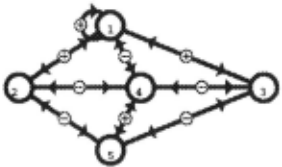
Figure 1 shows the evaluation chain of five agents. Each agent tries to identify the identity (faulty /normal for diagnosis) other agents. State variable ( r i and its normal ization Ri) indicating the identity of agents are assigned to each agent. Dynamical system is constructed by as sociating the time derivative of the state variable with state variables of other agents connected by the evalua tion chain.
The continuous value Ri between 0 and 1, indicating faulty and normal of the agent respectively, is assigned to each agent. We call the value Ri calculated by the diagnostic models the reliability measure to distinguish it from probabilistic concept of reliability.
When the agents 4 and 5 are faulty, we have the test result as shown in Figure 1. A possible association corre sponding to the evaluation chain would be the following dynamical system:
The concept of self-diagnosable model consisting of agents capable of testing other units is not new [Preparata et al. 67]. Simple voting at each agent does not work, since three agents 2, 3 and 5 are all evaluated as faulty by two other agents and hence cannot be ranked in terms of the possibility of faulty. The significant fea ture of our model is that it can correctly diagnose the above case when the agents 4 and 5 are faulty by dynam ically and continuously propagating evaluation through agents. The bottom line is that propagating and sharing information really counts, although instantaneous and local voting does not work.
We first assign the value between 0 and 1 (the initial value of the reliability measure) to each agent. Then, the reliability measures R; follows by the next dynamical model.
and Tij in this model is as follows:
This model is the modified version of black and white model [Ishida 90; Ishida & Mizessyn 92] so that it keeps the information of ambiguous state of sensor reliability measure (the model (1) called gray model).
4 Agents on the Sensor Network
In this section, we relate the agents (that interact based on the dynamics presented in the previous section) to the sensor network for the application to process diagnosis. Agents will be elaborated gradually from a simple one for sensor diagnosis to a complex one for process diagnosis for the convenience of presentation.
4.1 Agents for sensor self-diagnosis
In process diagnosis, it is often the case that measure ments such as temperature, pressure, flows, measured independently are related with each other. In other words, some of these measurements are redundant. Us ing the dependencies, many relations among sensors can be constructed. In the sensor network proposed in this section, each agent (corresponding to sensor) evaluates other agents using these relations, rather than just mea suring the process values [Ishida & Mizessyn 92].
In our approach, the agents of the network naturally correspond to the sensors (processes originated at sen sors), and the relations are obtained from simple process knowledge. These relations between the values of the sensors have the following form:
Value of Variable A > Value of Variable B
From such a relation, we can build a link between the sensor monitoring the value A and that monitoring the value B, and say that agents of the previous sensors can evaluate with each other.
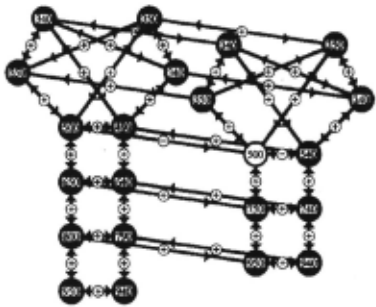
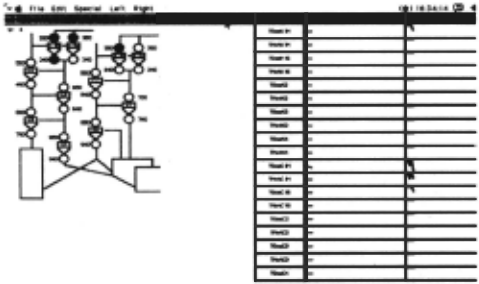
Figure 2 shows the sensor network of these twenty-two sensors. Sensors connected by bi-directional arc have mutually evaluating via above relations. Figure 3 shows a sensor diagnosis system for the preheating process of a cement plant. More relations (arcs) among sensor values, higher diagnostic performance is obtained. In construct ing the sensor net, not only process knowledge but the experimental knowledge among sensor values is used to obtain enough relations for diagnosis. Further, in our implementation of sensor net builder, not only inequali ties but equations with many funcitons can be used for the relations. In other application to a blast furnace of steal plant, about five hundred sensors (thermometers) are involved. By setting the relation more sensitive, the sensor net is known to be useful not only diagnosis but also monitoring global conditon of furnace.
4.2 Agents for process diagnosis
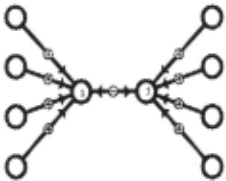
In this section, we review natural extension based on the insight that the knowledge of normal process is em bedded in the constraints among sensors. Thus, when process faults occurs, it amount to violation of the con straints. In fact , when process fault occurs, reliability measures of many sensors related to the constraints be come low simultaneously 1 . In other words, when sensor values do not satisfy the constraint among these val ues , then it would imply that sensors or process corre sponding to the constraint may be faulty. Figure 4 il lustrates the situation when process fault corresponding to the constraint between the sensor i and j occurs. In the sensor net , when sensors are faulty few agents corre sponding to the faulty sensors show low reliability mea sure. However, when process fault occurs, many agents show low reliability measure simultaneously, since pro cess fault amounts to the violation of constraints among sensors.
Therefore, one natural way of detecting process fault by sensor net is to introduce agent and reliability mea sure for testing relation. (Another avenue may be using virtual sensors that would virtually monitor events and state which are not directly measured by the real sen sors [Ishida & Tokimasa] ) Let RT;; denote the reliability measure of the test Tji· Then the dynamical model (1) becomes as follows:
The equation 2 is a modification naturally resulted by considering the effect of the reliability measure of the test Tji· The change rate of the agent i; dri(t)jdt should reflect all the opinions of other agents weighted not only with the reliability of these other agents but with those of their evaluations. The equation 3 comes from the fact that the evaluating relation is considered unreliable only when Tji , Rj(t) and Ri(t) are contradictory; Tji = -l,Rj(t) = 1 and Ri(t) = 1.
4.3 Agents with multiple testings
Constraints among process variables may be expressed by the vector equation: f(y·, t) = 0 where y · is the true values of process variables. The testing results for multiple relations (constraints) can be defined as:
where y is the measured values (i .e. sensor values). Let s = {si, .. . , sn} be set of all the sensors and let sk be the subset involved in the constraint fk. When there are more than three variables in fk, the model 2 and 3 can be modified as follows :
1 This is somewhat similar to the immune response where activation is propagated through huge amount of immune related cells when antigen is presented to the immune system.
where Tt = nkTk , nk = ISkl: the number of the sensor involved in the constraint fk ·
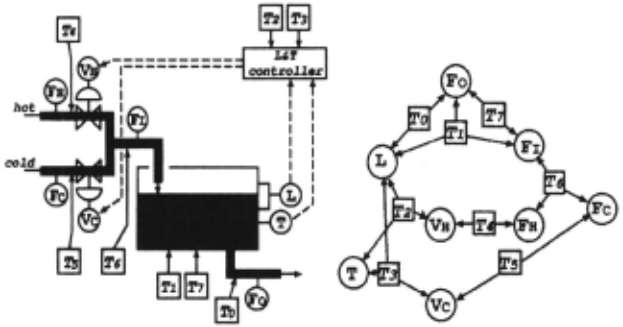
As an illustrative example, consider the process of keeping the level and temperature in a tank as shown in the left of Figure 5. The right of Figure 5 shows the sensor network of this process consisting of eight sensors and eight relations among the sensors. The model of this sensor network follows:
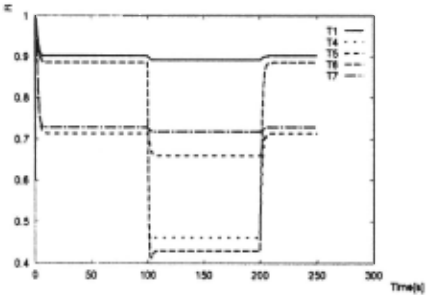
Figure 6 shows the time evolution of the reliability mea sures of sensors and those of testing relations when there is a leakage in the pipe between Fr and Fs or between Fr and Fe. In this case, the constraint F1 = Fs + Fc(i.e. the testing relation T6 ) will be violated.
It can be seen that there is a significant decrease of the reliability measure of the testing relation Ts. Thus, the process fault will be known.
5 Related Work and Discussions
The continuous monitoring and maitaining consistency among agents by dynamic interactions may be compa rable to the probabilistic reasoning [Pearl 86; Pearl 87] discussed in AI community. The main difference of the approach from the probabilistic reasoning is that it is for evaluating the reliability of the agent where each agent is capable of evaluating other agents, as opposed to evaluating simple event. It is possible to describe the event dependency of the reliability of agents by Bayesian network, however, the network would be cyclic hence preventing the usual probabilistic approach. Since the model can be simulated by a continuous differential equation, the method fits in the dynamic environment such as processing plants where the target system can be described by a differential equation. One demerit of our method is that we do not consider the axioms of probability. In fact, dynamics of reliability of each agent depends on the reliabilities of other adjacent agents, and unreliability does not appear in the dynamics. The dy namics of both reliability and unreliability of agents sat isfying the constraint that their sum must be one would be a complicated differential equation. Another inter esting problem is to recast the probabilistic reasoning on Bayesian network to the continuous differential equa tions, which would make simulation as well as stability analysis easier.
Data reconciliation studied in the control theory com munity also focus on finding a consistent interpretation among data from senosrs. Data reconciliation has been extensively studied for estimating the state of process fil tering out noise by the state estimate methods [Toja & Biegler 91; Liebman et al. 92]. However, when there are gross errors such as process/sensor faults, the techniques does not apply, since the constraints used for estimation changes due to these gross errors. Some researches have been made for modifying the data reconciliation so that it will work even when gross errors may exist [Toja & Biegler 91; Narasimhan & Harikumar 93a]. Extension of the immunity-based agent approach for process diag nosis so that it will work with measurement error by incorporating the data reconciliation has been proposed [Ishida & Tokimasa 96] .
The characteristic of the approach to process diagnosis is that it admits only relative relation between process values without referring (although possible) to the abso lute value of the process values. One merit is that the approach does not suffer from the shifting of all the pro cess values (which occurs depending on the load to the process or the change of environment such as seasonal change), since the method only focuses ·on the consis tency among sensor values and the process knowledge. Further, the change of some knowledge (embodiedy by agents) does not propagate to the other parts, since the relation among process values are rather independent from each other. When the model is implemented in a distributed processing environment, the evaluation of the reliability measure can be done in a fully distributed and autonomous manner in the sensor network.
The main difficulty of the approach discussed in this paper is to find enough relations between agents. Gen erally speaking, such relations could be obtained from physical theories (mass or heat balances, thermodynamical principles, etc.), mathematics (the value of a flow is always a positive value, a ratio is comprised between 0 and 1, ... ) , or by experimentations. More the sensors values are redundant, more there are testing relations. The performance of the diagnosis depends on the qual ity of the relations involved; the diagnosability depends on the number of distinct relations, and the reliability of the diagnosis depends on the reliability of the relations involved.
So far we have discussed under the assumption that interactions among agents are determined beforehand. In the future, more adaptive and flexible system should be aimed where these interactions are generated by the active agents themselves.
6 Conclusion
We have proposed active diagnosis as a new diagnos tic paradigm which may be realizable using the recent development of active sensing, active data base and ac tive agents. We extracted an immunity-based agent ap proach from self identifying/defining/maintaining fea ture of immune systems. Since the nature of immune system agrees with the concept of active diagnosis well, we point out that the approach would be one candidate for realizing an active diagnosis. As an immunity-based agent approach, on-line sensor-based diagnosis for pro cess plant has been discussed by defining agent on the sensor network.
Acknowledgments
This work has been supported in part by the Asahi Glass Foundation. I owe some simulations in this paper to Dr. F. Mizessyn and Mr. Y. Tokimasa.
@inproceedings{ijcai1997p157,
  title     = {Active Diagnosis by Self-Organization: An Approach by The Immune Network Metaphor},
  author    = {Ishida, Yoshiteru},
  booktitle = {Proceedings of the Fifteenth International Joint Conference on
               Artificial Intelligence, {IJCAI-97}},
  publisher = {International Joint Conferences on Artificial Intelligence},
  editor    = {Martha E. Pollack},
  pages     = {1084--1090},
  year      = {1997},
  note      = {Neural Networks},
  url       = {https://ijcai.org/proceedings/1997/157},
}
TY - CPAPER TI - Active Diagnosis by Self-Organization: An Approach by The Immune Network Metaphor AU - Ishida, Yoshiteru T2 - Proceedings of the Fifteenth International Joint Conference on Artificial Intelligence, IJCAI-97 PB - International Joint Conferences on Artificial Intelligence PY - 1997 SP - 1084 EP - 1090 UR - https://ijcai.org/proceedings/1997/157 ER -Copied
Machine-readable versions of this paper, for tools and AI agents:





