
On the Role of Hierarchy for Neural Network Interpretation
Proceedings of the Fifteenth International Joint Conference on Artificial Intelligence. Neural Networks. Pages 1072-1076.
© 1997 International Joint Conferences on Artificial Intelligence
Abstract
In this paper, we concentrate on the expressive power of hierarchical structures in neural networks. Recently, the so-called SplitNet model was introduced. It develops a dynamic network structure based on growing and splitting Kohonen chains and it belongs to the class of topology preserving networks. We briefly introduce the basics of this model and explain the different sources of information built up during the training phase, namely the neuron distribution, the final topology of the network, and the emerging hierarchical structure. In contrast to most other neural models in which the structure is only a means to get desired results, in SplitNet the structure itself is part of the aim . Our focus then lies on the interpretation of the hierarchy produced by the training algorithm and we relate our findings to a common data analysis method, the hierarchical cluster analysis. We illustrate the results of network application to a real medical diagnosis and monitoring task in the domain of nerve lesions of the human hand.
- [Breiman et al. , 1984] L. Breiman, J.H. Friedman, R.A . Olsen, and C.J . Stone. Classification and Regression Trees. Belmont , CA, Wadsworth, 1984.
- [Duda and Hart, 1973] R.O. Duda and P.E. Hart. Pattern Classification and Scene Analysis. Wiley, 1973.
- [Fritzke, 1993] .
- B. Fritzke. Growing cell structures -a self- organizing network for unsupervised and supervised learn- ing. Technical Report TR-93-026, ICSI, 1993.
- [Gray, 1984] R. M. Gray. Vector quantization. IEEE ASSP Magazine, pages 4-29, April 1984.
- [Kohonen, 1990] T . Kohonen. The self-organizing map. Pro- ceedings of the IEEE, 78(9) :1464-1480, 1990.
- [Lampinnen and Oja, 1989] J. Lampinnen and E. Oja. Fast self-organization by the probing algorithm . In Proc . of the IJCNN, Washington, 1989. [Martinetz and Schulten, 1994] Th. Martinetz and K. Schul- ten. Topology representing networks . Neural Networks, 7(2), 1994.
- [Quinlan, 1993] J .R. Quinlan. C4.5: Programs for Machine Learning. Morgan Kaufman, 1993. [Rahmel and Villmann, 1996]
- J . Rahmel and T . Villmann. Interpreting Topology Preserving Networks. Technical Re- port LSA-96-01E, University of Kaiserslautern, 1996.
- [Rahmel, 1996a] J. Rahmel. On the Role of Topology for Neural Network Interpretation. In W. Wahlster, editor, Proc . of the EGA!, 1996.
- [Rahmel, 1996b] J . Rahmel. SplitNet: Learning of Hierar- chical Kohonen Chains. In Proc. of the ICNN '96, Wash- ington, 1996.
- [Rahmel, 1997] J. Rahmel. Topology Preserving Neural Net- works -Connectionist Learning of Structured Knowledge. PhD thesis, University of Kaiserslautern, April 1997.
- [Ritter et al., 1992] H. Ritter, Th. Martinetz, and K. Schul- ten. Neural Computation and Self-Organizing Maps. Ad- dison Wesley, 2nd edition, 1992.
- [Villmann et al., 1996] Th. Villmann, R. Der, M. Herrmann, and Th. Martinetz. Topology preservation in self- organizing feature maps: Exact definition and measure- ment. IEEE Transactions on Neural Networks, 1996. To appear.
References were extracted automatically from the PDF and may contain errors.
Full text extracted automatically from the PDF; figures, tables and equations may differ. The PDF is the version of record.
1 Introduction
Existing approaches to hierarchical clustering and clas sification neglect the spatial relations of clusters or par tial solution spaces. A particular class of neural network models has the potential to overcome this problem. Re garding the mapping from the input space onto the space spanned by the neighborhood relations of the neurons in the network, the property of certain neural network mod els to keep track of neighborhood relationships of clus ters of data even in cases of reduction of dimensionality is called topology preservation. The degree of topology preservation can be determined by the observation, how well neighborhood relationships in one space are pre served by the mapping onto the other space. Thus , one question is: for two input vectors that are close in input space, are their best matching units close 1 in the network topology? The other question is: for two neurons that are neighbors in the network topology, are their associ ated weight vectors close in the input space? These ques tions led to the development of the topographic function [Villmann et al., 1996], that effectively quantifies the topology preservation in topographic maps. We call lo cations, where those maps are not continuous topological defects. Topology preserving models are, among others, the Self-Organizing Map (SOM) [Kohonen, 1990], the Growing Cell Structures (GCS) [Fritzke, 1993] and the Topology Representing Network (TRN) [Martinetz and Schulten, 1994] as well as several descandants of these examples. But all those models lack the ability of hi erarchically structuring the training set . Depending on the reduction of dimensionality performed by the mod els, there is a principal difference in degree of topology preservation each model can achieve. If the dimension of the network structure is limited, as it is the case for the SOM and the GCS, the real dimensionality of the data space may necessarily invoke topological defects.
1 As different input vectors may be mapped onto the same neuron, in this informal explanation, the closeness of neurons
The SplitNet model for the first time succeeded in de veloping a hierarchical structure over the training set. It is an unsupervised learning method and in some sense comparable to the hierarchical cluster analysis (see e.g. [Duda and Hart , 1973]). For static models, like e.g. the Self-Organizing Map, the task of the network ap plication determines the desired interpretability of the network and thus controls such parameters of network design as number and connectivity of neurons. In dy namically growing networks, the approach is necessarily different . The incremental construction of the network up to its final size and topology is in general controlled by specific performance criteria. The training result is a network, where not only the weights contain relevant information. Additionally, the size of the network, the distribution of neurons and the emerged connectivity in side the network implicitly encode information on the trained sample set. Compared to the above-mentioned topology preserving models, the tree-structured organi zation of topologically connected parts of the SplitNet network adds a completely new dimension to the inter pretability of the network model. The hierarchy offers structured knowledge on various levels of abstraction and generalization as well as optimized access to samples of the training population.
includes also the identity of those neurons.
The rest of the paper is organized as follows . In the next section, we will outline the basic methods related to the neural model used in our approach. Section 3 will present the principle of the SplitNet model and in Sec. 4 the role of the emerging hierarchical structure is explained. We then present results of the application of the SplitNet model in the medical domain of finger movement pattern analysis. A summary and final re marks will conclude the paper.
2 Related Work
The hierarchical cluster analysis, either the divisive or the agglomerative approaches, are methods that pro gressively split or link clusters of data. The result of the analysis can be visualized as a dendrogram (see Fig. 1) , which is a two-dimensional tree structure that shows the order of linkage (for the agglomerative case) and the distance or similarity at which this linkage of clusters was performed. Thus, this method is able to display the clustering of data, whereby the result depends on the distance measure that determines the closeness of clus ters and/or samples. Specific variants of agglomerative versions of the hierarchical cluster analysis are e.g. the single linkage and complete linkage methods, which min imize the minimum or maximum distance of cluster ele ments, respectively, during each merger of two clusters. For the comparison intended in this paper (cf. Sec. 5), we will use the centroid method, which selects those clusters with the minimum distance between their means.
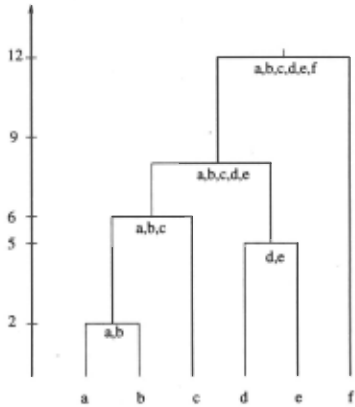
Because of the explicit distance information contained in the dendrogram for each linkage of clusters, hierarchi cal clustering is a flexible way of detecting the resulting number of clusters given a certain threshold value. How ever, it is not possible to reason from the real spatial relationship of the observed pattern. There is no simi larity information other than the one for linked clusters. Similar statements are true of course for divisive meth ods. So the hierarchical clustering methods are useful tools for a preliminary analysis of the data, but they do not provide additional ways for explanation of the clus tering results and do not enable reasoning on alternative solutions based on neighborhood observations.
Such inspection of neighboring clusters and samples can be performed by topology preserving networks. As indicated above , several models like the GCS or the TRN already exist for topology preserving representation of a training set . The Growing Cell Structures (GCS) are a dynamic vector quantization model. Different crite ria, e.g. the quantization error, determine the insertion position of a new neuron. Removal strategies yield an adaptive quantizer that is superior to the original SOM, but the GCS model also uses an a priori specified di mensionality (through the choice of simplices) and thus is prone to the appearance of topological defects for high dimensional data spaces. The TRN algorithm also ap . proximates the distribution of input data and constructs topology preserving connections between its neurons. In the limit, it is able to find the Delaunay triangulation of a data set, thus it generates, by virtue of not being fixed to a given dimensionality, a nearly perfectly topology preserving map. But both neural models only provide data analysis on a flat level. They cannot provide views on the data at different granularities, and thus lack the advantages of methods like the hierarchical cluster anal ysis.
3 The SplitNet Model
SplitNet is a topology preserving, dynamically growing model for unsupervised learning and hierarchical struc turing of data lRahmel, 1996b]. Starting with a single, small Kohonen chain [Kohonen, 1990], localized inser tion and deletion criteria enable an efficient quantiza tion of the data space. The hierarchy in the architecture grows, if one of the following splitting criteria is satisfied:
- detection of topological defects
- deletion of neurons by an aging mechanism
- significant local variances in quantization errors or
- significant local variances in edge lengths.
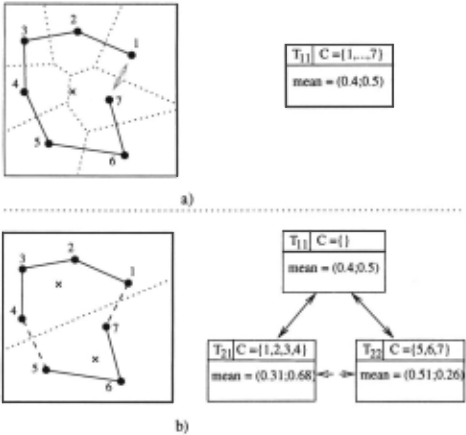
Those criteria are checked several times during progress of training. If a criterion is satisfied, the affected chain is split into two or more subchains which are added to the network at one level lower in the hierarchy. The node in the hierarchy that formerly represented the unsplit chain now serves as a generalized description and access structure for the new son nodes. Figure 2 illustrates this basic mechanism. If a topological defect is found (e.g. between neurons 1 and 7, which are close in input space but distant in the chain of neurons), the chain is split and nodes representing the fragments are added as descen dants to the tree. Path decisions in the so constructed hierarchy will be made according to the mean of the weight vectors of the neurons in the chain, therefore the mean is also indicated in the figure . The topology pre serving construction of the network structure provides local neighborhood information that is necessary for in cremental retrieval of nearest neighbor to a given input vector. The dashed lines in Fig. 2 indicate this type of knowledge. The neighborhood relations are kept as lateral connections defining the topology of the network space. They are responsible for the high degree of topol ogy preservation in SplitNet and enable a fast and in cremental search for a set of nearest neighbors. A more rigorous and exhaustive treatment of these aspects and retrieval results can be found in [Rahmel and Villmann, 1996] . The purpose of such a set of nearest neighbors is e.g. to serve as the basis for the k-nearest-neighbor rule in decision making processes ( cf. Sec. 5).
Since unsupervised learning methods provide no direct classification, the training result has to be interpreted in the context given by the training data. For the SplitNet model , we observe three containers of knowledge that can be used for the tasks in applications like the one described in this paper:
- Neuron distribution: The insertion criterion deter mines the error function to be minimized. Quan tization of the data set allows local estimation of sample density.
Topology: The connections between neighboring neu rons provide information on where to find simi lar cases. Measuring topological defects yields the search depth for incremental retrieval of nearest neighbors to a given query.
Hierarchy: The hierarchical structure of the network contains different levels of generalization and ab straction. It allows a fast tree search for best matches and insightful visualization of the data structure for the domain expert.
The utility of the neuron distribution is comparable to reference vector placement in quantization algorithms [Gray, 1984]. The neuron positions thus minimize the average reconstruction error for all elements of the data set . Interpretation of the network topology is described e.g. in [Rahmel, 1996a] . It can be shown that Split Net produces networks with only small topological de fects, indicated by low values of the topographic function [Villmann et al., 1996]. This specific property limits the search effort for procedures like the probing algorithm [Lampinnen and Oja, 1989], which conquers local neigh borhoods of neurons in order to find a better match to a given input. In the following, we illustrate the semantics of the hierarchical structure developed by methods like SplitNet.
4 Interpretation of Hierarchy
Hierarchical organizations offer additional properties to make use of in data analysis and structure utilization. One rather general aspect is the fact that a hierarchical structure - like any search tree - provides fast access to the terminal nodes. For neural networks like SplitNet, this results in accelerated training runs since the search for the best matching unit is supported by the hierar chical network structure. This determination of the best match can be summarized as follows :
- tree search for a candidate unit using the means of chain vectors for descending the hierarchy, and then
- local search through topological connections for a possibly better match.
The local search costs additional time, but since it is strictly local and depending on the degree of topol ogy preservation in the network, it could demonstrated that the improved topology preservation of the SplitNet model considerably increased the speed of best match ing unit access [Rahmel, 1997]. In addition, the larger the network, the less the influence of the additional local search procedure in comparison to the savings due to the hierarchical arrangement .
The hierarchies produced by classification or decision trees [Breiman et al., 1984] [Quinlan, 1993] yield sim ple, crisp, and explicit tests as path decisions in nodes at the expense of flexibility of the decision regions. The orientation of hyperplanes generated by those tests is limited to the dimensionality of the respective test. Un fortunately, higher dimensionality of the test yields both higher flexibility and massively growing computational effort for determination of optimal tests. Therefore, in practical applications, tests are often one- or two- di mensional and the corresponding hyperplanes separat ing subspaces of the sample space are orthogonal to the coordinate axes or depending on only two of the possi ble vector components. In contrast to this, the SplitNet structure offers implicit tests that cover the whole infor mation contained in the description of a sample. The decision regions of SplitNet approximate the Voronoi re gions given by the sample population and thus minimize quantization errors imposed by generalization inside the regwns.
Classification or decision trees select the tests for path decisions according to the gain criterion for classification of samples. In an unsupervised setting where class in formation is not available, efficient sample localization plays the most important role. In order to minimize the search effort, we need a test that maximizes the infor mation about the location of the nearest sample. The Kohonen model provides a solution for this task. As demonstrated in [Ritter et al. , 1992], the weight adapta tion of the algorithm leads to a discrete approximation of principal curves by Kohonen chains. If we divide the sample population according to the placement of neurons and recursively repeat this subset construction, we get a hierarchic structure that on every level optimizes the in formation on sample locations. Thus, for an average test sample, we have an efficient access to the best match of the training population. In this respect, the tree is inter pretable as a decision tree, regarding the optimization of spatial information, but still trainable and adpatable to slight changes in the training data set. It thus combines interpretability and flexibility of symbolic and connec tionist machine learning methods, respectively.
The interpretation of a hierarchical structure like the one generated by SplitNet combines the knowledge on the above-mentioned property of the Kohonen algorithm with the splitting reasons of the SplitNet model, which deviate from this principle. Path decisions in the Split Net tree have definite semantics to be used when de scending the tree and relating accessed clusters with oth ers that are reachable through the topology of the net work.
5 Diagnosis and Monitoring of Ulnaris lesions
We now briefly present an application of the SplitNet model in the domain of nerve lesions of the human hand. We will outline the general problem and describe the results obtained by using the hierarchical neural model.
The human hand is provided with the radial, median and ulnar nerve. The ulnar nerve provides sensory func tion for the small and ring finger and innervates the in trinsic muscles of the hand. These muscles are crucial in balancing and coordinating the flexor and extensor mus cles, rendering possible fine movement such as grip and pinch. While assessing sensory function is feasible, ob jective analysis of motor function is quite difficult . Clin ical investigation includes grip force measurement and recording of active and passive range of motion. Besides these factors, ulnar nerve dysfunction causes changes in coordination of the movement which cannot be measured by instruments.
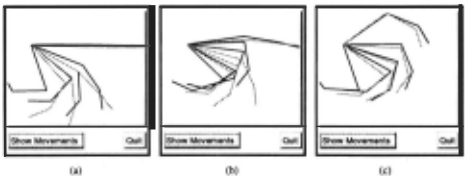
In contrast to a normal, physiological movement pat tern (Fig. 3(a)), the dynamic disorder 'rolling' describes the pathological flexion of the finger . This movement re sembles the rolling of a carpet (Fig. 3(b)). As an effect , patients are not able to grasp an object because their fingers push it out of the palm. The dynamic disorder 'clawing' describes the hyperextension of the MP joint with flexion of the PIP and DIP joint 2 while the fin ger is in resting position (Fig. 3( c)). These descriptions are based on the experience of the examiner. Changes in quality and especially improvement of fine motor ac tivities after nerve repair are difficult to detect and to quantify. If nerve repair fails, there are different opera tions to rebuild the movement pattern. In these cases, the outcome of surgery also cannot be quantified. Until now, there was no convenient measurement system to distinguish finger movement patterns.
Based on kinematic research we established a mea surement system to get real-time data of human finger movement. Attempts to analyze these data with clas sical mathematical methods like discriminant analysis failed to distinguish between normal and pathological movement. Statistical clustering provides a good first insight into the structuring of the data but is not able to support the specific needs in this application like, for example, retrieval of samples and their comparison to a group of similar data, as it is required for diagnostic ap plications. For demonstration purposes, figure 4 shows an example of a tree structure generated with a small fraction of the available data. Despite the fact that our preprocessing generates high-dimensional training vec tors, we used no further dimension reduction method. The reason is the necessity to display the hierarchy with the neuron weights retranslated into finger positions. By this, physicians can evaluate the position of a newly en countered data vector in the tree. In Fig. 4, the upper part of the tree contains roughly the patterns for 'claw ing', while the bottom part corresponds to physiological movement and 'rolling'.
2 The MP, PIP and DIP joints are the three finger joints ordered from the base joint between hand and finger to the tip.
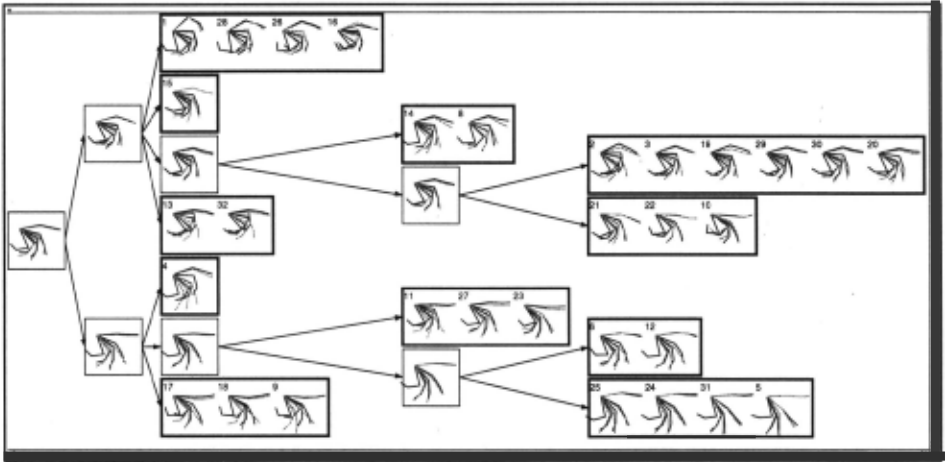
Since we use unsupervised learning and therefore pro vide no class information for the training pattern, the re sulting tree is obviously not a classification tree. The full information is here contained in the hierarchical struc ture and the topological connections of the nodes (which are not shown in the figure) . Pattern # 4, the only 'clawing'-data in the lower subtree, is an example of the case that the division of the data space by the path de cisions of the tree is suboptimal with respect to path decisions alone. Presentation of an input vector that closely matches the vector corresponding to pattern # 4 would cause the tree search (based on the vector means) to descend into the upper half of the tree in Fig. 4. Fur ther path decisions would then yield pattern #14 as best match candidate. But the topological information that is accessible for the interpretation component of the net work will show that this pattern is connected to pattern #4 in the lower subtree and local, topological search will identify the correct best match.
Similarly, further analysis of branches and subtrees reveals the full organization of the hierarchy. The se quence of generalizing non-terminal nodes supports the physician in understanding relative positions of different patient vectors. At each non-terminal node, the rea son for branching - outlier splitting, topological defect, etc. - is accessible, so a reasonable interpretation of the emerging hierarchy, supported by the local topological connections (not shown in the figure), is rendered feasi ble.
We currently have more than 600 pattern of 55 pa tients with different forms of lesions and at various stages of motion recovery. Healing progress as well as success of surgery can be monitored in our network that is trained with all available data. A sequence of pattern repre senting the recovery process of a patient can be mapped onto the fully trained network. The interpretation com ponent provides the physician with comparable cases for each pattern and so, by relating current data to previ ous cases, an evaluation of the actual healing process is possible.
A comparison of the results obtained by SplitNet with those of a hierarchical cluster analysis clarifies the strength of the neural model. We performed a run of the clustering process and examined a subgraph of the den drogram with about as many terminal nodes as the Split Net tree described above. The result was not surprising. The clustering produced nearly the same groups of data represented by leaf nodes, thus supporting the clustering abilities of the SplitNet model. However, despite the fact that distance information is available for the merging level of two clusters, interpretation of the dendrogram from a medical point of view was possible only in a very limited way. Whereas the neuron chains representing the terminal nodes in SplitNet arrange themselves in a direction that best reflects the largest variation in the associated movement pattern (the intrinsic property of the underlying Kohonen model), such information is not available in the cluster analysis. Moreover, the dendro gram provides information on the order of the cluster linkages, yet it does not contain explicit or implicit in formation on the spatial relationships of clusters. This is a crucial property for a reliable diagnosis of new cases which are not contained in the center of existing clus ters. In order to compare those with nearest neighbors, reliable information on cluster connectivity is necessary.
The lateral connections between neurons in the SplitNet model facilitate reasoning for class assignment based on neighborhood considerations . We can use the retrieval properties of the topology preserving network structure for the enumeration of the nearest nei~hbors and appli cation of the k-nearest-neighbor rule lDuda and Hart , 1973] yields a majority vote, if training samples can be associated with classification information.
6 Summary and Outlook
We briefly presented a recent neural network model which differs from existing models in the hierarchical structure that it creates by the training algorithm. The resulting network provides different sources of knowledge for network interpretation and we focused our discussion on the use of the hierarchy. We illustrated properties and advantages of the flexible tree structure. The ap plicability of the network model to real world tasks is shown with the example of a diagnosis system for ulnar nerve lesions. Our approach for the first time applies pattern recognition by a neural net approach to human finger movement . Besides simple clustering abilities, the applied SplitNet model provides support for the inter pretation of both the learning processes which have oc curred and the emerged hierarchical structure. Thus, in our case, interpretation of the images, which are retrans lations of neuron weights into the semantics of training vectors, enhances our knowledge of the finger movement pattern.
So far, from the medical point of view, we do not know if we portray the whole spectrum of ulnar nerve dys function . More data have to be recorded and our aim is to build up a neural net containing all types of normal and pathological movement . Then we are able to repre sent all ulnar nerve lesions by recording finger movement and classify the new movement pattern by observing the mapping performed by the neural net onto a certain lo cation in the tree, for which clinical diagnosis is already accessible. ·
@inproceedings{ijcai1997p155,
  title     = {On the Role of Hierarchy for Neural Network Interpretation},
  author    = {Rahmel, Jürgen and Blum, Christian and Hahn, Peter},
  booktitle = {Proceedings of the Fifteenth International Joint Conference on
               Artificial Intelligence, {IJCAI-97}},
  publisher = {International Joint Conferences on Artificial Intelligence},
  editor    = {Martha E. Pollack},
  pages     = {1072--1076},
  year      = {1997},
  note      = {Neural Networks},
  url       = {https://ijcai.org/proceedings/1997/155},
}
TY - CPAPER TI - On the Role of Hierarchy for Neural Network Interpretation AU - Rahmel, Jürgen AU - Blum, Christian AU - Hahn, Peter T2 - Proceedings of the Fifteenth International Joint Conference on Artificial Intelligence, IJCAI-97 PB - International Joint Conferences on Artificial Intelligence PY - 1997 SP - 1072 EP - 1076 UR - https://ijcai.org/proceedings/1997/155 ER -Copied
Machine-readable versions of this paper, for tools and AI agents:





