
Content Ordering in the Generation of Persuasive Discourse
Proceedings of the Fifteenth International Joint Conference on Artificial Intelligence. Natural-language Processing and Graphical Presentation. Pages 1022-1028.
© 1997 International Joint Conferences on Artificial Intelligence
Abstract
A framework is summarized which supports the planning of natural language argument structure. One key aspect of natural argument is the order in which components are presented. This is in part responsible for both the coherency and persuasive effect of an argument. One means of effecting such ordering is proposed, and an overview is provided of the various classes of ordering heuristics. These heuristics are based upon Insights offered by rhetoric texts •. psychlogical research, and a corpus study. Fmally, It is demonstrated that such an approach can also contribute to the generation of surface textual features including formatting, punctuation and clue words.
- [Bacchus and Yang, 1992] Fahiem Bacchus and Qiang Yang. The expected value of hierarchical problem- solving. In Proceedings of the National Conference on Artificial Intelligence, pages 369-374,1992.
- [Blair, 1838] Hugh Blair. Lectures on Rhetoric and Belles Lettres. Charles Daly, London, 1838.
- [Cohen, 1987] Robin Cohen. Analyzing the Structure of Argumentative Discourse. Computational Linguistics 13(1):11-24, 1987.
- [Fox and Das, 1996] John Fox and Subrata Das. A Uni- fied Framework for Hypothetical and Practical Reason- ing (2) -Lessons from Medical Applications, In Dov Gabbay and Hans-Ji.irgen Ohlbach, editors, Practical Reasoning, Springer Verlag, Berlin, pages 73-92, 1996.
- [Fox and Long, 1995] Maria Fox and Derek Long. Hier- archical Planning using Abstraction. lEE Proc on Con- trol Theory and Applications 142(3):197-210, 1995.
- [Freeman, 1991] James B. Freeman. Dialectics and the Macrostructure of Arguments. Foris, Berlin, 1991.
- [Grice, 1975] H.P. Grice. Logic and Conversation. In P.Cole and J.L. Morgan, editors, Syntax and Semantics 1/1: Speech Acts, pp 41-58, Academic Press, NY, 1975.
- [Grosz and Sidner, 1986] Barbara J. Grosz and Candace L. Sidner. Attention, Intentions and the Structure of Discourse. Computational Linguistics 12(3): 175-204, 1986.
- [Hovy, 1990] Eduard Hovy. Pragmatics and Natural Language Generation. Artificial Intelligence 43:153- 197, 1990.
- [Hovy, 1993] Eduard Hovy. Automated Discourse Gen- eration Using Discourse Structure Relations. Artificial Intelligence 63:341-385, 1993.
- [Marcu, 1996] Daniel Marcu. • The Conceptual and Lin- guistic Facets of Persuasive Arguments. Proceedings of the ECA/'96 Workshop on Planning and Natural Lan- guage Generation, pages 43-46, Budapest, Aug. 1996.
- [Mann and Thompson, 1987] William C. Mann and Sandra A. Thompson. Rhetorical structure theory: de- scription and construction of text structures. In G. Kem- pen, editor, Natural Language Generation: New Results in Artificial Intelligence, Psychology and Linguistics. Martinus Nijhoff, pages 85-95, 1987.
- [Maybury, 1993] Mark T. Maybury. Communicative Acts for Generating Natural Language Arguments. Pro- ceedings of the lith National Conference on Artificial Intelligence, pages 357-364, 1993.
- [McConachy and Zukerman, 1996] Richard McConachy and Ingrid Zukerman. Using Argument Graphs to Gen- erate Arguments. Proceedings of the 12th European Conference on Artificial Intelligence, pages 592-596, Budapest, August 1996.
- [McGuire, 1968] W.J. McGuire. The nature of attitudes and attitude change. In G. Lindzey and E. Aronson , editors, The Handbook of Social Psychology Volume 3, pages 136-314, Addison Wesley, 1968.
- [Moser and Moore, 1996] Megan Moser and Johanna D. Moore. Towards a Synthesis of Two Accounts of Dis- course Structure. Computational Linguistics 22(3):409- 419, 1996.
- [Moore and Paris, 1994] Johanna D. Moore, and Cecile L. Paris. Planning Text for Advisory Dialogues: Captur- ing Intentional and Rhetorical Information. Computa- tional Linguistics 20( 4):651-694, 1994. [Paris, 1991]
- Cecile L. Paris. Generation and Explana- tion: Building an Explanation Facility for the Explain- able Expert System Framework.
- Cecile L. Paris, W.R. Swartout, and William C. Mann , editors, Natural Lan- guage Generation in Artificial Intelligence and Compu- tational Linguistics. Kluwer, pages 49-82, 1991.
- [Rankin, 1993] Ivan Rankin. Natural language genera- tion in critiquing. Knowledge Engineering Review 8(4):329-347, 1993.
- [Reed et al., 1996] Chris Reed, Derek Long, and Maria Fox. An Architecture for Argumentative Discourse Planning. In Dov Gabbay and Hans-Ji.irgen Ohlbach, editors, Practical Reasoning, Springer Verlag, Berlin, pages 555--566, 1996.
- [Reed et al., 1997a] Chris Reed, Derek Long, Maria Fox, and Max Garagnani. Persuasion as a Form of Inter- Agent Negotiation. Proceedings vf the 2nd Australian Workshop on DAI, Springer Verlag, Berlin, 1997.
- [Reed et al., 1997b] Chris Reed, Derek Long, and Maria Fox. Context and Focusing in Argumentative Discourse Planning. Proceedings of the International Conference on Context, Rio de Janeiro, Brazil, February 1997.
- [Sacerdoti, 1977] E.D. Sacerdoti . A Structure for Plans and Behaviour, Elsevier, Amsterdam, 1977.
- [Smith et al., 1994] Mark H. Smith, Roberto Garigliano, and Richard G. Morgan . Generation in the LOUT A System: An Engineering Approach. Proceedings of the 7th International Workshop on NLG, Kennebunkport, Maine, 1994.
- [Wilson, 1986] Barrie A. Wilson. The Anatomy of Ar- gument (Revised Edition) . University Press of America.
- Lanham, MD, 1986.
- [Young and Moore, 1994] Richard M. Young and Jo- hanna D. Moore. DPOCL: A principled approach to discourse planning. Proceedings of the 7th International Workshop on NLG, Kennebunkport, Maine, pages 13- 20, 1994.
- REED & LONG 1027
References were extracted automatically from the PDF and may contain errors.
Full text extracted automatically from the PDF; figures, tables and equations may differ. The PDF is the version of record.
1 Introduction
Generating arguments in natural language is of key im portance in producing cogent justification in expert systems [Paris, 1991], critiquing user decisions [Rankin, 1993], explaining reasoning in logic-based systems [Fox and Das, 1996], tailoring medical advice [Marcu, 1996], etc. Argument is often more structured than other. for~s of natural language, and this fact can be explOited m designing a system for the generation of persuasive dis course. This paper is based upon the work of Reed et al. [ 1996], in which a hierarchical framework is proposed which reflects the natural structuring of argument.
At the highest level of abstraction, the Argument Structure (AS) level is responsible for the logical form of the argument, i.e. the deductive, inductive and falla cial relationships holding between premises and con clusions. The operators which are available at the AS level are thus conceptually similar to a subset of those presented in [Maybury, 1993]. Below the AS I.ev.el, the Eloquence Generation (EG) level effects stylistic and rhetorical refinements, based upon contextual and hearer-dependent parameters. The EG level d?e~ not alter the plan produced by the AS level; rather, It mtro duces structurally redundant rhetorical statements, marks stylistic preference (voice, mood, formalit~, e~c . ), inserts lexical information for subsequent realizatiOn, and so on.
Crucial to the interaction between the AS and EG
Derek Long
Department of Computer Science University of Durham, South Road Durham DHl 3LE England
D.P.Long@dur.ac.uk
levels is the notion of salience. The structure planned by the AS level does not explicitly employ linguistic goals: rather, it uses goals expressing the salience of facts. to the hearer. It is the task of the EG level to determine how information should be made salient to the hearer - often, items need not be uttered for them to be salient, resulting in enthymematic argument.
Below the AS and EG levels, the inter-clause struc ture is resolved (employing relations similar to those of Rhetorical Structure Theory [Mann and Thompson, 1987]), and finally the grammatical, syntactic and mor phological realization is ·performed through interface with the LOLITA system [Smith et al., 1994].
The current work employs a concept of argument based upon the study of a corpus of natural argu~e~ts drawn from scientific papers, advertisements, editonal commentary and 'letters to the editor'. It is similar to that referred to as the "standard approach" in argumen tation theory [Freeman, 1991], in which an argument is seen as comprising one or more premises contributing to one or more conclusions. Each premise can in turn be supported by a subargument, with the conclusion of the subargument acting as premise to the superargum~nt. Finally, groups of premises contribute to a conclusiOn either independently (disjunct support) or in combi~a tion (conjunct support). This distinction is of crucial importance when attempting to determine the validity of an argument, [Freeman, 1991], and it is therefore sur prising to find the distinction eschewed in many gen eration systems (e.g. [McConachy and Zukerman, 1996]).
2 Planning
The task of generating persuasive discourse is see~ in this work, as in much of NLG, as one of pla~nmg. NOAH [Sacerdoti, 1977] is frequently employed m text generation [Hovy, 1993], but is hampered by the fact that abstract operator bodies are primarily composed of operators. These operators are applied immediate!y the abstract operator is selected: the latter are thus actmg as schema-like 'recipes', and systems are liable to suffer from reduced flexibility as a consequence. In contrast, the current work makes use of AbNLP [Fox and Long, 1995], a hierarchical planner based upon the concept of encapsulation, whereby the body of an abstract operator contains goals rather than operators, and further , that the body of an operator is not opened up until an entire abstract plan has been completed (i.e. there are no goals left unfulfilled at that level of abstraction). On comple tion of an abstract plan (which can be seen, in discourse planning, as a skeletal outline of what is to be commu nicated), the refinement operation opens up all the ab stract operator bodies, such that the structure and con straints determined at one level of abstraction are propagated to the next level down . As a consequence, many choices which might have been considered during planning of an argument at the detailed level can be pruned as they become inconsistent with the abstract plan. Such an approach has the potential to considerably improve upon the performance of a classical planner, [Bacchus and Yang, 1992]. The use of AbNLP in a framework for argumentative discourse planning is dis cussed in more detail in [Reed et al., 1996].
The initial state in planning a persuasive text is de scribed by two goals. Firstly, BEL (H, P), which rep resents the intention for the hearer, H, to believe some proposition, P. Thus it carries intentional rather than informational content [Young and Moore, 1994] and is classified as a communicative goal [Moore and Paris, 1994] . Secondly, the initial state also includes the goal IS_SALIENT (H, P, _),also a communicative goal. This represents the fact that the hearer must not just believe P, but that P must be salient to him (in the gen eral discourse context, '_'- the use of this context pa rameter is discussed in more detail in [Reed et al., 1997b]). In normal communication (i.e. communication which obeys Grice's maxims of cooperation, [Grice, 1975], and is therefore truthful and honest), every BEL goal will have a corresponding IS_SALIENT goal. It is the BEL goals which are planned for at the AS level: ultimately, the argumentation will have to reach beliefs which the speaker assumes the hearer either believes or will accept without further support. The I s_SALIENT goals, however, are usually satisfied by the MAKE_SALIENT operator which represents a primitive action at the AS level, and expresses the goal of making a proposition salient to the hearer (how this is achieved is determined by the EG level: some pieces of informa tion in an argument are obvious and can be left implicit; others must be realized explicitly, in varying degrees of detail) . The BEL goals are satisfied by the deductive, inductive and fallacial operators available to the AS level. Argument components are frequently linked by support relations which can be characterized by a Mo dus Ponens operator, in which the inference between antecedent and consequent is weaker than that of strict deduction. The MP operator is given below, in Figure 1 (note that similar operators are available for situations in which the hearer believes -P, as opposed to those in which the hearer has no opinion on P).
In addition to the BEL and IS_SALIENT goals cor responding to two premises of Modus Ponens, the body of the operator also contains the topic manipulation goals, PUSH_TOPIC and POP_TOPIC. These are typi cally satisfied by primitive operators (of the same name, for convenience), which represent actions to be per formed on a topic stack similar that proposed by [Grosz and Sidner, 1986]. The explicit operationalization of topic manipulation (rather than seeing focus as a con straint active over the planning process) offers a number of advantages in generating persuasive discourse. There is a close relationship between the position of topic manipulators and the occurrence of clue-words, which have been shown to be vital in ensuring the coherency of an argument [Cohen, 1987]. Similarly, at other levels of abstraction, topic manipulators co-occur with various punctuation and formatting (for example, three or four successive POP _TOPIC actions may warrant a paragraph break).
MP (H, P)
Shell:
Add:
Body: Goals:
Precond:
:3x: (X -t P)
-BEL (H, X)
BEL (H, X)
tO: PUSH - TOPIC (P)
tl: BEL (H, X)
t2: IS_SALIENT (H, X, P)
t3: BEL (H, X -t P)
t4: IS_SALIENT (H, X-tP, P)
t5: POP_TOPIC (P)
Figure I. Modus Ponens operator
Seeing PUSH_TOPIC and POP _TOPIC as goals sug gests that it may also be appropriate to subdivide the class of communicative goals proposed by [Moore and Paris, 1994] into those which are intentional and those which are attentional (such an approach would also seem to be consistent with Moser and Moore's [1996] attempt to reconcile [Grosz and Sidner, 1986] with RST, [Mann and Thompson, 1987]).
The planning conducted at the AS level thus results in a highly parsimonious plan, in that it employs just three operators representing primitive actions at this level of abstraction: IS_SALIENT, PUSH_TOPIC and POP _TOPIC. For example, the goals in Figure 2 repre sents the abstract aim of persuading the hearer of a.
Figure 2. Initial goals
If a could be supported by a single Modus Ponens argument, the BEL goal would be fulfilled by the MP operator, and the IS_SALIENT goa) by MAKE_SALIENT, producing the abstract plan in Figure 3.
Figure 3. First complete abstract plan
During refinement, the MP body is opened up, from where the BEL goals are satisfied by matching those in the hearer model, the IS_SALIENT goals by MAKE_SALIENT operators and the topic manipulators by corresponding primitives. Thus the final plan of the AS level is as shown in Figure 4.
PUSH_TOPIC (a) MAKE_SALIENT (h, b, a) MAKE_SALIENT (h, b ~ a, a) POP_TOPIC (a) MAKE_SALIENT (h, a, _)However, although such a plan might convince a quite dispassionate audience (and may therefore suffice for inter-agent persuasion in a non-cooperative, multi agent domain, [Reed et al., 1997a]), it may very well fail to be persuasive- or even coherent - simply because the order in which the information is presented is inap propriate.
3 Generating Order
Even within the coherency constraints imposed by the topic stack, ordering can still make the difference be tween coherent and incoherent-and at the very least, can improve the coherency of an argument (given th&t coherency seems to be a scalar attribute). Through analysis of arguments in the corpus, it was possible to determine structure, and then to modify that structure through permissible re-orderings, and finally to retrans late the structure back into text, and compare with the original. The results of re-ordering were often incoher ent (see [Cohen, 1987] for examples of such incoher ency) and almost always less persuasive than the origi nal.
The fact that content ordering has an impact on the persuasive effect of an argument has also been demon strated in psychology. McGuire [1968], for example, discusses how subarguments should be presented in cli max order, i.e. with better supports coming later. Marcu [1996] provides a survey of how ordering and other techniques such as lexical choice affect the persuasive effect of arguments in the medical domain.
However, the most significant evidence of the impor tance of ordering comes from rhetoric, where heuristics are suggested for improving arguments so as to maxi mize their persuasive impact. Typical of such texts is [Blair, 1838], wherein are presented rules governing all aspects of public speaking, and in particular, a list of heuristics for determining an optimal ordering of subar guments. For these various heuristics to be imple mented, it is first necessary to identify how the substrate of ordering is determined, i.e. given the structure of plans produced by the framework proposed in §2, over which components should any given ordering have scope.
Ordering occurs in two distinct phases in the plan ning process, corresponding to the two subtly different types of ordering necessary.
The first occurs with the fulfillment of BEL goals. The communicative goal BEL represents a problem for the classical planning framework, since it is inappropriate to consider it simply as an achievement goal (one which can be satisfied by a single operator). For a BEL is often best satisfied by several operators, i.e. by multiple subarguments (which have been shown to occur with great frequency in natural language, [Freeman, 1991]). However, it is also inappropriate to consider BEL a maintenance goal, such as the stylistic goals in Hovy's [1990] system, PAULINE. For it is not the case that BEL goals remain unsatisfied; rather, they are satisfied a number of times and are then considered fulfilled in the classical sense. This iteration problem in planning has generally been approached through the use of some 'for all' operation. Maybury [1993], for example, makes explicit use of V in his operator descriptions, and Moore and Paris [1994] introduce a FORALL clause. In both papers, however, it is noted that the approach requires explicit, unprincipled modification of the plan language. In the absence of a principled solution, the current work employs a similarly pragmatic notion of universal quantification, to produce a maximal set of support by which to fulfill a BEL goal. This set of subarguments, in addition to the IS_SALIENT goal associated with the BEL (such as that in Figure 2), forms the substrate for a possible re-ordering. For example, pre-order (conclusion preceding premises) is generated by shifting the IS_SALIENT ahead of all the subarguments. Simi larly, post-order (all premises preceding the conclusion) and hybrid order are also effected at this phase.
However, despite the fact that most re-ordering can be accomplished during goal fulfillment, a separate phase is required to resolve ordering between operator body components. For example, the Modus Ponens operator presented in Figure 1 has two contributory parts in its body: X and X ~ P. The order between these (i.e. be tween the two pairs tl-t2 and t3-t4) can only occur with refinement, and not with goal fulfillment.
These two forms of ordering are demonstrated in the example below, in which an argument has the structure shown in Figure 5, with a conclusion a supported by three premises (b, c and d), two of which are supported by further premises (e and f) (this example has been taken, with minor modification, from the corpus).
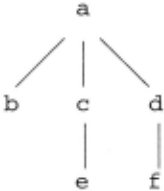
From the initial goals in Figure 2, the BEL ( h, a) is fulfilled by three Modus Ponens arguments, as shown in Figure 6a. This structure then undergoes ordering, to produce Figure 6b (as discussed below, the ordering is the result of a persuasion-oriented heuristic due to the weakness of the conclusion, a) .
| (a) | (b) |
|---|---|
| MP (h, a) X=b MP (h, a) X=c MP (h, a) X=d MAKE _SALIENT | MP (h, a) X=b |
| MAKE _SALIENT (h, a, ) | |
| MP (h, a) X=c | |
| (h,a,_) MP (h, a) X=d |
The three Modus Ponens subarguments are then opened up during refinement. The position of the primitives in the abstract plan (in this case, only one - the MAKE_SALIENT) remains the same at the next level of abstraction, and similarly, the arrangement of the subargument units is also preserved. This produces the situation in Figure 7a. However, the coherency of the plan in Figure 7a is compromised, due to the (relatively) large subargument which intervenes between the ex pression of the conclusion, a, and the support leant to it by the third subargument, d. One means of repairing the coherency is to reverse the order of the components in the final subargument such that (d ~ a) is expressed before d itself, thus indicating to the hearer the rele vance of d to the conclusion. This reordering is effected in Figure 7b.
| (a) PUSH_TOPIC (a) BEL (h, b) IS_SALIENT (h, b, a) BEL (h, b~a , a) IS_SALIENT (h,b~a,a) POP _TOPIC (a) | (b) PUSH_TOPIC (a) BEL (h, b) IS_SALIENT (h, b, a) BEL (h, b~a, a) IS_SALIENT (h, b~a, a) POP_TOPIC (a) |
| MAKE_SALIENT (h,a,_) | MAKE_SALIENT (h,a,_) |
| PUSH_TOPIC (a) BEL (h, c) IS_SALIENT (h , c, a) BEL (h, c~a, a) IS_SALIENT (h,c~a,a) POP_TOPIC (a) | PUSH_TOPIC (a) BEL (h, c) IS_SALIENT (h, c, a) BEL (h, c~a, a) IS_SALIENT (h,c~a,a) POP_TOPIC (a) |
| PUSH_TOPIC (a) BEL (h, d) IS_SALIENT (h, d, a) BEL (h, d~a, a) IS_SALIENT (h, d~a, a) POP_TOPIC (a) | PUSH_TOPIC (a) BEL (h, d~a) IS SALIENT (h,d~a,a) BEL (h, d, a) IS_SALIENT (h , d ,a) POP_TOPIC (a) |
The argument is then completed with another round of planning (to plan the supports e and f), followed by refinement (to open up the bodies of the e and f subar guments), and finally, planning again (to resolve the remaining IS_SALIENT and topic manipulation goals).
Clearly, however, the ordering depicted in Figure 7 is achieved through knowledge of the fact that the subar gument for c is relatively large, inasmuch as it has a supporting subsubargument, e. This knowledge is not directly available at this level, since subargument c has not yet been planned. In order to account for this phe nomenon, and others based upon information regarding planning at lower levels of abstraction, AbNLP offers the concept of resource estimation. This process heuris tically allocates resources to particular parts of an ab stract plan, based upon contextual and hearer-model knowledge.
Estimates of subargument size are not the only de terminants of ordering. Most other features are directly available at the current level of abstraction: structural features (such as inductive operators having precedence over fallacial operators); the surrounding structure (such as that causing the reordering in Figure 7); the source of the support (speaker beliefs, beliefs the speaker knows the hearer to hold, or beliefs grounded in an authority - grounding is discussed in [Reed et al., 1997a]). Perhaps the single most important feature to determine ordering is argument strength. Following [Freeman, 1991). strength is subdivided into inferential force and per suasive force: the former is purely a matter of determin ing the validity of the inference, whilst the latter is de termined by assessing how the inference would be ac cepted by the hearer based on the speaker's models of his beliefs, competence, bias, scepticism, etc.
Persuasion-oriented ordering heuristics, in particular, make frequent use of this hearer-dependent facet of ar gument strength. Blair's [ 1838] dicta suggest that ar guments should increase in strength (which accords with the psychological results of [McGuire, 1968]. mentioned above), unless the hearer is particularly sceptical (in which case, a strong argument should come first, so that the hearer should attend to what follows), or if there is one weak argument amongst many strong (in which case it may be appropriate to hide it in the midst of the others). Furthermore, that if one argument is particularly strong it should be dwelt upon-and con versely, that many weak arguments should be grouped together (this is resolved as an issue of resource alloca tion).
Often at odds with those of persuasion, the coherency oriented heuristics aim to keep the argument as simple as possible, minimizing the amount and length of in formation employed. When persuasion heuristics intro duce or order information which could produce poorly coherent results, re-orderings are available to repair the structure, such as the reversal of antecedent and infer ence in an operator body (as in Figure 7). Persuasion ordering heuristics are not limited to planning phase ordering, nor are coherency ordering heuristics limited to refinement phase ordering. For example, the con junction operator CONJ, has two conjuncts in its body, and these are subject to the same persuasion heuristics (such as climax ordering) as disjunct multiple subargu ments. Equally, if the persuasion heuristics had not sug gested the hybrid order in Figure 7, coherency heuristics would have restricted the ordering such that the conclusion was immediately adjacent to the final subargument.
The AS and EG levels can thus be seen as mediating between heuristics of persuasion and coherency. How ever, both coherency and persuasive effect can be im proved at subsequent levels in the framework, employ ing the results of the ordering process. In particular, the positioning of the topic manipulators, PUSH_TOPIC and POP _TOPIC, can be used in the generation of a number of surface features, including punctuation, clue words and formatting.
4 Effects of Ordering
As suggested in [Cohen, 1987], clue words can be used to repair text which is weakly coherent, or even in some cases, completely incoherent. The EG level can in this way effect repair on a plan produced by the AS level which is less than optimally coherent (due, for example, to persuasion-oriented ordering heuristics). The original plan is not altered during this process; rather, clues are introduced into the plan to explicate its structure, and thus improve its overall coherence.
Cohen [1987] distinguished two groups of clues: re directive and connective. Clues of re-direction refer back to earlier pieces of information. For example, in a complex argument where a deeply nested subargument marks the end of several of its 'parent' superarguments, a clue phrase is often required to indicate which su perargument is being returned to (e.g. To return to the question of). When the result of such an ordering is en countered by the EG level, the multiple consecutive POP _TOPIC operations which characterize the scenario cause the insertion of a re-direction clue. In natural lan guage, however, clues of re-direction are often avoided, since they seem to indicate a lack of clear underlying structure. Correspondingly, many orderings are prohib ited by the AS level -Cohen's parallel evidence order ing1, for example, simply cannot be generated (due to incontrovertible coherency constraints). As a result, re directive clues are required infrequently.
Connective clues, in contrast, are used frequently in natural language to make explicit the relationship holding between adjacent components of an argument. Cohen identifies six categories of connective clues-a full exposition of how each category can be accounted for within the proposed framework is beyond the scope of this paper, but by way of example, the generation of inference, detail and parallel clues is considered below.
Inference clues occur between a premise and the con clusion to which it lends support-these are frequently employed in analyses in argumentation theory (e.g. the conclusion locators of [Wilson, 1986]). Inference clues (so, therefore, etc.) can be generated on locating a POP _TOPIC action immediately preceding the conclu sion in an argument exhibiting pre-order.
1 Parallel evidence ordering, Cohen claims, would, in the ex ample in Figure 7, permit expressing items in the order c, d, e,f. Such ordering requires significant clue word repair, and in the current work is simply considered incoherent. This can be justified on the grounds that the apparent occurrence of parallel evidence in natural language may in fact be the re sult of a summary preceding an argument proper-in Co hen's [1987] example, the conclusions are then left implicit in the argument for reasons of proximity to the summary.
Similarly, detail clues (since, which follows from, etc.) occur between a conclusion and its first supporting premise. These are the result of a PUSH_TOPIC action which immediately follows a conclusion in hybrid or post-order.
The relationship between subarguments at the same level of abstraction contributing to a single conclusion is termed parallel by Cohen. This is characterized in the plan produced by the AS level by repeated occurrences of POP_TOPIC (X) followed immediately by PUSH_TOPIC ( x) (see Figure 7). In the simplest case, the co-occurrence can lead to the insertion of the lexeme and. However, the EG level has available information regarding scope, due to the PUSH_TOPIC and POP _TOPIC 'end-stops', from which the hierarchical structure can be determined. This enables more complex lexical realization such as numbering of subarguments.
Indeed, parallel clues are not just expressed lexically. Depending upon the level of abstraction, parallel struc ture can also be indicated through the use of formatting conventions (such as paragraph breaks and section numbering), and through the use of punctuation (particularly semi-colons between weak and briefly ex pressed subarguments).
The generation of clues is thus dependent upon the ordering determined at the AS level, and is also a means of repairing coherency which has been sacrificed in fa vour of persuasive effect.
5 Conclusion
The problem of generating a persuasive argument in natural language depends upon determining a good bal ance between coherency on the one hand and purely persuasive aspects on the other. Both these factors rely on a process of resolving appropriate ordering of con tent. Heuristics from a number of sources can be brought to bear upon this process, including those prescribed in rhetoric texts, those derived from empirical cbservations in psychology, and those inferred through the study of a corpus.
A hierarchical planning framework employing a par simonious set of abstract primitives has been shown to be capable of generating the coarse-grained structure of an argument in an intuitive way. Furthermore, the ap proach affords the opportunity for clear, principled ap plication of ordering rules. Finally, it has been demon strated that this representation facilitates the subsequent realization of structure into text, and in particular, the generation of clue words which are known to be cru cially important in argument comprehension.
@inproceedings{ijcai1997p148,
  title     = {Content Ordering in the Generation of Persuasive Discourse},
  author    = {Reed, Chris and Long, Derek},
  booktitle = {Proceedings of the Fifteenth International Joint Conference on
               Artificial Intelligence, {IJCAI-97}},
  publisher = {International Joint Conferences on Artificial Intelligence},
  editor    = {Martha E. Pollack},
  pages     = {1022--1028},
  year      = {1997},
  note      = {Natural-language Processing and Graphical Presentation},
  url       = {https://ijcai.org/proceedings/1997/148},
}
TY - CPAPER TI - Content Ordering in the Generation of Persuasive Discourse AU - Reed, Chris AU - Long, Derek T2 - Proceedings of the Fifteenth International Joint Conference on Artificial Intelligence, IJCAI-97 PB - International Joint Conferences on Artificial Intelligence PY - 1997 SP - 1022 EP - 1028 UR - https://ijcai.org/proceedings/1997/148 ER -Copied
Machine-readable versions of this paper, for tools and AI agents:





