
"Tall", "Good", "High" - Compared to What?
Proceedings of the Fifteenth International Joint Conference on Artificial Intelligence. Natural-language Processing and Graphical Presentation. Pages 996-1000.
© 1997 International Joint Conferences on Artificial Intelligence
Abstract
We specify a model for the conceptual interpretation of positive gradable adjectives. Building on a classification-based terminological reasoning approach we define comparison classes and class norms and specify how a degree is related to its corresponding class norm.
- Bierwisch, 1989
- M. Bierwisch. The semantics of gradation. In M. Bierwisch and E. Lang, editors, Dimensional Adjectives, pages 71-261. Springer, Berlin, 1989.
- [Kamei and Muraki, 1994] S. Kamei and K. Muraki. A discrete model of degree concept in natural language. In Proc. of COL/NG-94, volume 2, pages 775-781, 1994.
- [Klein, 1979] E. Klein. On formalizing the referential/attributive distinction. Journal of Philosophical Logic, 8:333-337, 1979.
- [Klein, 1980] E. Klein. A semantics for positive and comparative adjectives. Linguistics & Philosophy, 4(1):1-45, 1980.
- [Klein, 1991] E. Klein. Comparatives. In A. von Stechow and D. Wunderlich, editors, Semantics, pages 674-691.
- W. de Gruy- ter, Berlin, 1991.
- [Kyburg and Morreau, 1997] A. Kyburg and M. Morreau. Vague ut- terances and context change. In Proc. of the 2nd Intern. Workshop on Computational Semantics, pages 135-155. Tilburg University, The Netherlands, 1997.
- [Pinkal, 1995] M. Pinkal. Logic and Lexicon. Kluwer, Dordrecht, 1995.
- [Schwartz, 1989] D. G. Schwartz. Outline of a naive semantics for reasoning with qualitative linguistic information. In Proc. of the /JCAI-89, pages 1068-1073, 1989. IJCAI
- [Simmons, 1993] G. Simmons. A tradeoff between compositional- ity and complexity in the semantics of dimensional adjectives. In Proc. of the EACL-93, pages 348-357, 1993.
- [Staab and Hahn, 1997a] S. Staab and U. Hahn. Comparatives in context. In Proc. of the AAAI-97, 1997.
- [Staab and Hahn, 1997b] S. Staab and U. Hahn. Dimensional rea- soning with qualitative and quantitative distances. In Proc. of the AAAI-97 Workshop on Spatial and Temporal Reasoning, 1997.
- [Woods and Schmolze, 1992] W. A. Woods and J. G. Schmo1ze. The KL-ONE family. Computers & Mathematics with Applica- tions, 23(2-5): 133-177, 1992.
- [Zadeh, 1978] L. A. Zadeh. PRUF-a meaning representation language for natural languages. International Journal on Man- Machine Studies, 10:395-460, 1978.
References were extracted automatically from the PDF and may contain errors.
Full text extracted automatically from the PDF; figures, tables and equations may differ. The PDF is the version of record.
1 Introduction
There is a wide-spread consensus in the linguistic community that the semantics of positive adjectives like "tall" is captured by a binary predicate relating a degree to a comparison class (cf., e.g. , [Klein, 1980; Bierwisch, 1989]). Hence, "Peter" in (lb) should not be referred to as "tall" in a general sense, but as "tall in comparison to a class C", where C is constrained by the context in which "tall" occurs. This becomes evident considering the full version of example (1), where the utter ance (la) crucially determines the valid comparison class for "tall(Peter,C)", C being the class of "4-year-old-boys".
(1) a. Peter is 4 years old. b. Peter is tall.
From a computational point of view, two questions arise. First, how are degree expressions - positive gradable adjec tives, in particular- represented? And, second, how are valid comparison classes for positive adjectives determined? The representation problem has already been tackled from a quan titative perspective employing interval representations [Sim mons, 1993] and fuzzy logic [Zadeh, 1978], but also quali tative approaches have been considered [Kamei and Muraki, 1994; Schwartz, 1989]. While both schools have notorious difficulties in incorporating the corresponding complemen tary methodology, in addition, they both fail to treat ordi nal information appropriately such as for transitive reason ing on comparative constructions. As an alternative, we pro pose a qualitative representation and commonsense inferenc ing scheme that overcomes these deficits (cf. Section 2).
Until now, only [Bierwisch, 1989] has touched on the prob lems how to determine comparison classes, though in a rather sketchy way. Hence, our algorithm in Section 3 constitutes the first attempt at providing an explicit computation proce dure for the conceptual interpretation of positive gradable ad jectives in terms of finding its proper comparison class.
2 The Degree Calculus
A general representation and inferencing scheme for natu ral language degree expressions must account for several re quirements simultaneously. First, it must allow for different forms of degree expressions, esp. comparatives and positive adjectives. Second, it must allow for a basically qualitative representation, since many expressions cannot be attributed any numbers at all , or only in an ad hoc way. Third, it must allow for transitive inferences, since these are the most basic reasoning patterns for degrees. Fourth, at least for technical domains, measure phrases must be incorporated, too. None of the approaches mentioned in Section 1 are able to cope with these criteria, while the Degree Calculus we sketch below of fers a synthesis of these four requirements.
2.1 Degree Representation
Following a widely acknowledged proposal, we describe the meaning of positive gradable adjectives (as in (2a)) by a com parison to a norm degree, N c, of a comparison class C ( cf. (2b), where H denotes the function Height).
- Peter is tall.
( 2 ) b. H(Peter) >-.6.(o) Nc .
In order to account for degree modifiers, too, qualitative labels are introduced that may modify such comparisons. These modifier labels are (partially) ordered according to their "strength" (cf. (3)).
(3) C>.(much) > C>.(slightly) > 6.(0) 1\
6.( very) > C>.(slightly) > 6.(0) 1\ ...
6.(0) renders the comparison relation ">- .6.(o)" roughly equivalent to the common relation">". But other labels mod ifying the comparison relation require more than a certain distance (given by the label, e.g., C>.(very)) between there spective degrees to render the comparison valid (cf. (4b)).
- Peter is very tall.
- ( 4 ) b. H(Peter) >-.6.(very) Nc .
Furthermore, a negative label as in (5b), technically speak ing, leaves open the interpretation whether Mary is taller than Peter or Peter is less than C>.(slightly) taller than Mary. Since "slightly taller" describes a twofold restriction - Peter be ing taller than Mary but not that much- the expression (5c) must be conjoined with (5b) to properly denote (Sa).
- a Peter is slightly taller than Mary.
- b. H(Mary) >- -t:.(slightly)H(Peter) 1\
- H(Peter) >-t:.(o) H(Mary). c.
The approach we have just sketched provides a valid repre sentation framework for positives, comparatives, equatives, and superlatives (as all-quantified comparatives). In addi tion, it may easily account for measure phrases as in (6) by augmenting the ordering on the modifier labels (3) in terms of scale-specific ordering relations for measure phrase modi fiers, such as ~ ( 5 inches) > ~ (much).
(6) a.
- Peter is more than 5 inches taller than Paul.
- H(Peter) >- t:.(5 inches) H(Paul).
2.2 Rules of Inference for Degrees
As far as measure phrase modifiers are concerned (cf. exam ple (6)), a calculus can be supplied the axioms of which are stated in Table 1. 1
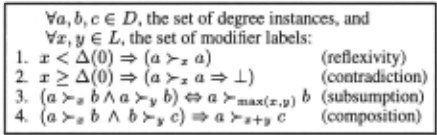
However, we may also adapt this calculus to inferencing with qualitative labels. While the axioms 1-3 can be applied directly, the composition axiom can be used to infer mini mal assertions, at least. As an example, consider the infer ence step in (7), the formal description of which is given in (8). Considering the axioms only, no value can be computed for ~(very)+ (-~(slightly)). Including the ordering in (3), however, allows one to conclude that this value subsumes the less restrictive >- t:.(o).
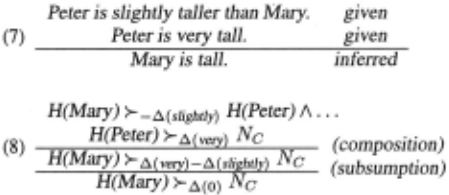
This way of reasoning already incorporates simpler types of transitive reasoning, like "Peter is taller than Paul and Paul is taller than John." implies "Peter is taller than John." Nev ertheless, the addition of scale-specific constraints, such as ~(slightly) < ~(2 inches) on the scale for persons' heights, can still further augment the system's inference capabilities.
1 In our complete axiomatization, we also use the operator"!:". Extensions like "-<x ", "equal with tolerance x", etc. are often useful and convenient. They can be easily defined with the help of">-," and"!:,", cf. [Staab and Hahn, 1997b].
3 Comparison Classes
In this section, we specify an algorithm that relates the degree described by a positive gradable adjective a to a class norm. 2 This class norm is a degree of the same type (e.g., HEIGHT) as the one described by the adjective (e.g., "tall"). The class norm belongs to a comparison class, (e.g., the set of 4-year old-boys) which is a set of individuals or- in terminological terms - a concept C with instances o;. If the degree of such an instance o; of C exceeds the class norm, then it can be as serted that "o; is a for C". At the core of the algorithm lies knowledge of interrelations which must be available for infer encing and will subsequently be considered in more detail.
3.1 Representation of Comparison Classes
Sentence (9) contains an occurrence of a positive gradable adjective. Computing its comparison class is common part of the determination of the conceptual interpretation of that utterance, since it is explicitly given by the underlined phrase.
(9) The Xll offers very good quality for a laser printer that costs $800.
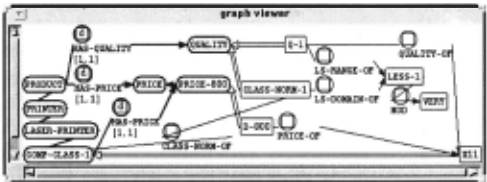
Considering this example, we focus on how the declarative representation of a comparison class is dynamically created from the utterance and the concepts given in a domain knowl edge base. The terminological system we use ( cf. [Woods and Schmolze, 1992] for a survey) allows to define a comparison class COMP-CLASS-1 (cf. Fig. 1) on the fly, by restricting the object class, LASER-PRINTER, to a certain price, PRICE800,3 which is a subconcept of PRICE (COMP-CLASS-1 :::::: LASER-PRINTER n VHAS-PRICE.PRICE-800). As a neces sary result, the printer X 11 is classified as belonging not only to LASER-PRINTER but also to COMP-CLASS-1. If this were not the case, either the comparison class definition or the ut terance itself would be invalid. In a metarelation (CLASS NORM-OF) the comparison class is associated with the class norm for quality, CLASS-NORM-I, which is related to the quality of the printer X 11 by the predicate LESS-1.
2 The reasons why we focus on the interpretation of positive ad jectives are twofold. First, the analytic mechanisms they require are entirely different from other kinds of degree expressions, and, second, they constitute the overwhelming proportion of degree ex pressions. In our corpus, e.g., we found 120 adjectives among the 4,300 words (2.8%) we considered. In [Staab and Hahn, 1997a], we analyzed comparative constructions and found approximately 150 comparatives among 30,000 words (0.5%).
3 For reasons of simplicity of the description of the algorithm in Section 3.3, we here assume the comparison class to denote a single valued price, rather than a more reasonable price interval.
3.2 Knowledge about Interrelations
In a discourse setting, a multitude of possibilities exist to fix the comparison class for a given adjective.
- Paul is 4 years old. He is tall.
- Paul celebrated his 4th birthday, yesterday. He is tall.
- Paul is tall for a 4 year old boy.
The examples (10), (11) and (12) indicate that purely linguistic restrictions are not sufficient for restricting the comparison class of an adjective. Similarly, knowledge based computations that rely on static knowledge only, fail to determine the proper interpretations (e.g., if comparison classes cannot be created dynamically but must be prede fined) . Therefore, we use ( meta)knowledge of interrelations that describes how a class subhierarchy may influence the re lations of class norm instances on a scale or how two degrees of a given concept are interrelated. As examples, consider the sentences (13) and (14). In both of these the compari son classes are stated explicitly, and, thus, elucidate the dis tinction between a proper comparison class restriction and an improper one:
- Peter is tall for a gymnast.
- ? Peter is tall for a flute player.
The interrelation that exists between "hasHeight" and "conductsExercises" describes gymnasts to be usually smaller than the average people. So, being tall for a gym nast does not necessarily imply being tall for the comparison class of all people. It is exactly the absence of correspond ing interrelations between "hasHeight" and "playsFiute" that renders the restriction of the comparison class to flute players awkward. Two things become evident here. First, knowledge about interrelations is everyday knowledge; it constitutes a common part of human knowledge. Second, these interrela tions need not be symmetrical. 4
In order to exploit the kind of knowledge just described we use a description logics notation (as for the representa tion of the comparison classes mentioned before). This no tation has the advantage that it combines formal explicit ness with algorithmic convenience. The interrelations have in common that they describe local restriction classes that will later be combined to define the comparison class. We distinguish two basic types of interrelations which are illus trated by the examples (15)- (17) (the relevant comparison classes are underlined). Sentence (15) is a simple example where a degree-hierarchy interrelation is important (for a de scription of the relevant relations in the knowledge base (KB ), cf. Fig. 2). In this example, the relevant comparison class (LASER-PRINTER) is the concept NOISE-LEVEL is directly
4 Commonsense knowledge tells us that though gymnasts tend to be smaller than the average people, small people do not tend to do gymnastics very much. Assume that a population consists of 50% small and 50% tall people, respectively, 1% being gymnasts, and 90% of the gymnasts being small people. Then the probability that a gymnast is small is 90%. However, the probability that a small person is a gymnast is only 1.8%. Thus, restricting a comparison class from all people to gymnasts, in fact, decreases the class norm for height considerably, while the reverse is not true.
- Degree-hierarchy interrelation (with distance 1): The noise level of the 300dpi laser printer Xll is high for a laser printer.
- Degree-hierarchy interrelation (with distance 2): The test picture of the Xll has a good quality for the test picture of a 300dpi laser printer.
- Degree-degree interrelation (with distance 2): The Xll offers very good quality for a laser printer that costs $800.
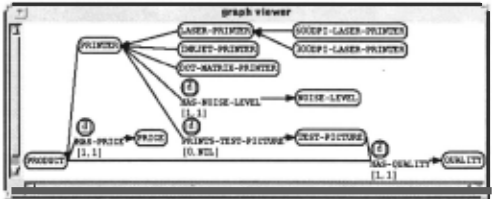
associated with (assuming property inheritance). Therefore, the path from the relevant degree NOISE-LEVEL to the rele vant restriction class LASER-PRINTER has the unit length 1 (inheritance links are not counted). ( 16) refers to the same type of interrelation, but differs in the length of the distance (two relations have to be passed) between one of the rele vant restrictions, 300DPI-LASER-PRINTER, and the degree QUALITY (of the test picture).
In order to represent the above-mentioned interrelations knowledge must be available about which relations (in the last example: QUALITY-OF and PRINTED-BY 5 ) lie between the restricting hierarchy (here, the subhierarchy of PRINTERs) and the interrelated degree (here, QUALITY). Moreover, it must be known which subclasses of PRINTER have a norm at tached relating to noise level, which is either below or above the class norm associated with their direct superdass. 6 In our example, LASER-PRINTER, INKJET-PRINTER and 600DPI LASER-PRINTER belong to the set of classes that are associ ated with class norms above that of their superclass, while DOT-MATRIX-PRINTER and 300DPI-LASER-PRINTER re late to corresponding lower class norms.
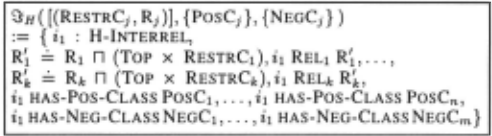
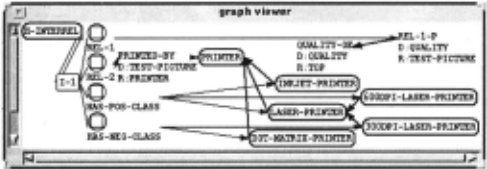
For degree-hierarchy interrelations we define the operator r::JH as in Table 2 to represent this knowledge. This opera tor r::JH takes a list of pairs of restriction classes (RESTRCj) and relations (Rj ). The relations, Rj, are furthermore re stricted to Rj in order to allow the definition of more con strained interrelations. This is especially necessary if the do main of a relation is not specific enough to ensure an ad equate interrelation representation (e.g., cf. Fig. 3, where QUALITY-OF is restricted to REL-1 -P, which can be de scribed as "quality-of of a test picture"). Furthermore, the operator takes sets of concepts that are associated with class norms above and below the class norm of their direct super class, respectively ( {PosCj} vs. {NEGCj} ). ';} H maps them onto assertions of a degree-hierarchy interrelation instance (i1 : H-INTERREL). These assertions are propositions about the relations in the T-Box, and, thus, they form an indepen dent level of assertional metaknowledge. The knowledge re quired for the processing of example (16) can be recorded as in the terminological structures from Fig. 3.
5 For each relation (e.g., HAS-QUALITY, PRINTS-TEST PICTURE) and relation instance we always assume the existence of its inverse which is then referred to by an intuitively plausible name such as QUALITY-OF or PRINTED-BY.
6 We here abstract from the consideration of multihierarchies.
For degree-degree interrelations (such as needed for (17)) a similar operator, ';} D, has to be defined. Its definition requires simpler constructs. Just like ';SH it takes restriction classes and relations, but instead of positive or negative subclass rela tions (HAS-POS-CLASS,HAS-NEG-CLASS) its specification only includes whether an interrelation is a positive or nega tive correlation.
3.3 Computing Comparison Classes
Most often positive gradable adjectives refer to comparison classes that are only implicitly available (cf. (10) and (11)). In this subsection we will give an algorithm that computes implicit comparison classes by making use of semantic rela tions, of the knowledge of interrelations described in Section 3.2, of text-specific and world knowledge, and of the mecha nism for computing explicitly given comparison classes from Section 3.1. We here assume the completion of a full seman tic interpretation, including anaphora resolution.
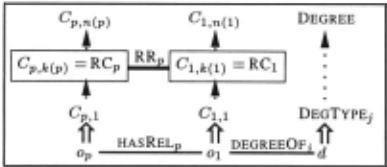
The basic idea of the algorithm for computing comparison classes is expressed in Fig. 4: A positive adjective a denotes a degree d in the current text fragment (at present, this in cludes the current and the previous utterance). This degree d is related to an object o1, which itself is related to another object op. Of course, there might be no object or several ob jects related to o1, and op itself might have other relations as well. Each object Oi has a most specific type Ci ,1· The goal of the algoriilim is to select all objects oi that are relevant for the computation of the correct comparison class. Further more, for each object oi it must select its correct intermediate superconcept ci ,k( i)' which does neither restrict the com parison class too narrowly (as Ci ,1 might do) nor too widely (as ci,n(i) might do). This goal is achieved by matching the available knowledge on interrelations against ilie semantic structures of the current text fragment. Finally, a comparison class is (recursively) computed by combining all the gathered restrictions. In Fig. 4, iliis means that the new comparison class is defined by restricting RC1 to a new class where the role RRp is restricted to the range RCP"
The algorithm starts with a set of relations Dn represent ing the semantic interpretation of the current text fragment in which the relevant adjective a occurs.
1. Input:
- (a) A positive gradable adjective a denotes the degree d.
- (b) A set of unary and binary relations representing the meaning of ilie current text fragment in a Neo Davidsonian style:
Dn = {DEGTYPEi(d) , C1,1 (o1), DEGREE0Fj(d, ol) , Cp,1 (op) , HASRELp(o1, op) , .. . }
Then the comparison class, COMPCLASS, is computed by applying ilie recursive function "ComputeRestriction".
- (COMPCLASS, RR) =
ComputeRestriction((ol], [DEGREEOFj])
The main function "ComputeRestriction" takes a list of objects ObjL and a list of relations RelL. The objects and relations describe the path to the degree under consideration. Thus, in the first call to "ComputeRestriction" ObjL will al ways be (o1], and RelL will be (DEGREEOFj].
- Parameters given to the function:
ObjL = [om, . .. , ol], RelL = [rm, ... , r1]
First, "ComputeRestriction" tries to match 7 a piece of in terrelation knowledge against ilie semantic structures repre sented by ObjL and RelL (step 2). If the interrelation I that has been found is a degree-degree interrelation then a sin gleton concept is returned (step 3). For instance, in (18),
(18) The laser printer Xll costs $800. It offers very good quality.
when the recursion finds the degree-degree interrelation be tween PRICE and QUALITY this recursion branch will return RC = {$800} as a singleton concept.
7 Degree-degree interrelations have the type D-INTERREL. INSTOF, !SA, RANGE and HASROLE denote the common termino logical relations. As mentioned before the relevant part of our KB is a simple hierarchy, thus there is only a single path from a concept to the topmost concept and "min" and "max" applied to a (possibly empty) subset of concepts of such a path are, therefore, partial and single-valued.
- (I, RR) := t(ik, Rm,k) : IRelLI = m 1\ INSTOF(ik, INTERREL) 1\ RELm(ik, Rm,k) 1\ -,3Rm+l,k(RELm+l(ik,Rm+l,k)] 1\ Vi E (1, m] : INSTOF(ri, Ri ,k)
- IF INSTOF(l, D-INTERREL) THEN RETURN ({om},Rm,k)
If a degree-hierarchy interrelation has been found then it is used to select the most specific class that fits Om - that class is either mentioned in the degree-hierarchy interrelation or it is the maximal concept which is also defined by an inverse superrelation, R;;. 1 , of the current relation, rm (step 4).
- RC := minck{CkjiNSTOF(om,Ck) 1\ Ck E {CtJHASPosC(ik, Ct) V HASNEGC(ik, C1)} U {maxc 1 {CtjiNSTOF(om, Ct) 1\ HASROLE(Ct, R;;., 1 ) 1\ INSTOF(rm, Rm)}}}
- IF RR =.l THEN RR := LRm : INSTOF(rm, Rm) 1\ HASROLE(RC, H;;,i)
For instance, in the first recursion for (18), LASER-PRINTER is the most specific concept of X 11 that is interrelated with QUALITY and is therefore chosen as RC (the relevant inter relation is not defined here). If no interrelation were known, then PRODUCT would have been chosen, since this is the maximal concept where HAS-QUALITY is defined as a role (cf. Fig. 2 for KB definitions).
If no interrelation could be found then RC and RR must be defined in a way that renders them neutral up to the point where they themselves might become further restricted (steps 4 and 5). This is, e.g., necessary, if there are no known in terrelations with relation length 1 but ones with length 2. In this case, RC must be defined "neutrally" first, and is further restricted by RC n RR' .RC' afterwards. Finally, "ComputeRestriction" is applied recursively (step 6a), and each new restriction RC' narrows down the current restric tion class RC with the terminological operation (step 6b). For instance, in the first recursion for (18) we have RC = LASER-PRINTER, RR' =HAS-PRICE, and RC' = {$800}.
- Vp: HASRELp(om, op) 1\ Op f/:. ObjL DO
- (a) (RC', RR') := ComputeRestriction([ov-ObjL], (HASRELp-RelL]); (where"[ . ]" denotes a list constructing operation)
- (b) RC := RC n RR'.RC'
- RETURN (RC,RR)
The recursion stops when it finds a degree-degree interrela tion or when the given semantic structures have been searched exhaustively.
3.4 Empirical Data
In an empirical evaluation we compared the algorithm pre sented in the previous section (henceforth, c3) against two simpler, naive approaches. The first of these, nl, uses the most specific concept of the object conjoined with the respec tive degree. The second one, n2, does not select this most spe cific concept, but its immediate superconcept. Interestingly, both approaches constitute somewhat of a lower bottom line for our approach, since it can switch back to one of these sim pler approaches if it is unable to identify selective restrictions.
We chose a text which contained 226 sentences with about 4,300 words. 121 positive gradable adjectives were screened for which a reasonable semantic representation could be de termined in 72 cases - and only these were evaluated. The remaining 59 occurrences graded idiomatic expressions, con cepts that are hard to model (e.g., "a good idea"), or entailed other problems that were not directly related to finding the correct comparison classes. Under the assumption of com plete knowledge, c3 achieved a high success rate (60 cases (83%) were correctly analyzed). nl and n2 performed much worse, as they were only able to properly determine 20 and 15 valid comparison classes (28% vs. 21% ), respectively.
nl and n2 are equivalent to the procedures [Bierwisch, 1989] proposes for adjectives related with generic and non generic nouns, respectively (e.g., in "towers are high" there lated noun "towers" is generic, while in "this tower is high" it is not). An oracle that tells whether an adjective is related to a generic object and, depending on the result, changes the strategy from nl to n2 would render a mechanism close to the one Bierwisch proposes. However, it would not add much benefit. Since none of the 72 considered adjectives are related to generic nouns, the positive cases of n2 are not due to any generic use. Our results are interesting still, even though we restricted our approach to distance-] and distance-2 interre lations to keep the modelling problem manageable.
3.5 Relations between Comparison Classes
Once the text understanding system has read a text and learned about properties of several objects, it will often be desirable to relate two degrees. Considerably often, these two degrees will not be related to each other but only to class norms of different comparison classes. Here, the interaction between the Degree Calculus and the determination of com parison classes comes into play.
Consider, e.g., a laser printer U 13 which has been assigned a good quality comparing it to 600dpi laser printers and a laser printer V 14 which has been assigned a bad quality re ferring to the more general class of laser printers (cf. (19)). The distance-! interrelation describes that the quality class norm for 600dpi laser printers is higher than the one for laser printers. This statement is equivalent to an assertion like (20).
These pieces of information are combined by the Degree Calculus to yield the desired result, viz. (21).
A similar scheme can be given for composed comparison classes like "laser printers that cost $800" and degree-degree interdependencies. Thus, knowledge about correlations does not only help to determine comparison classes; together with the representation and reasoning schemata of the Degree Cal culus it even allows to bridge different comparison classes.
4 Related Work
Though comparison classes are referred to by many authors (e.g. [Klein, 1980; 1991 ; Simmons, 1993]), only [Bierwisch, 1989] sketches a procedure for the determination of com parison classes for gradable adjectives. However, his model is too weak to infer complex comparison classes like "pic ture printed by laser printer". [Kyburg and Morreau, 1997] present an "extension stretching" approach that may treat ref erentially used adjectives, but fails to account for attribu tive ones which are in the focus of this paper and occur at a much higher frequency (cf. [Klein, 1979] for the referen tial/attributive distinction) .
Inference models for degree representations usually distin guish between two major approaches. In qualitative models, such as those proposed by [Schwartz, 1989] and [Kamei and Muraki, 1994], inferences are drawn on fixed sets of two to seven ordered qualitative labels that represent degree expres sions. However, while their representation schemata success fully handle several particular problems, they do not allow for the representation of comparatives and inferences like (7) or even simpler transitive inferences.
Quantitative models, on the other hand, face the princi pal problem that they must assign functions to lexical entries which map comparison classes to numbers. Since this assign ment is highly controversial, it is usually not even done for simple examples. As mentioned before, a quantitative inter val approach as proposed by [Simmons, 1993] for the linguis tic description given by [Bierwisch, 1989] is unable to draw transitive inferences. The often cited advantage of interval approaches, their ability to reason with factor phrases when the input is inexact, does neither seem to be cognitively very plausible nor very important for text understanding systems. Fuzzy logic [Zadeh, 1978] faces similar problems and has been rejected with convincing arguments concerning natural language processing by [Pinkal, 1995]. However, the alter native Pinkal proposes, a supervaluation approach, though it is extremely handsome for theoretical reasons, can hardly be applied to real-world text understanding systems due to com plexity considerations.
5 Conclusion
In this paper, we have defined the Degree Calculus the basic constructs of which (class norms, modifier labels, inference rules) are general enough to account for natural language de gree expressions of a wide variety, viz. positives, compara tives, equatives and superlatives (in their all-quantified read ings as comparatives). Furthermore, we have formulated an interpretation methodology for natural language degree ex pressions. Our proposal covers declarative issues of repre senting comparison classes and their associated class norms, as well as procedural aspects of how to determine the appro priate one for a particular adjective. The homogeneous for mal treatment we give within a terminological specification framework is unique as is the provision of a comprehensive algorithm for computing comparison classes at all.
The approach we propose is based on a deep knowledge model of natural language understanding. We consider this a feasibility study which explores the possible limits of the terminological knowledge representation approach for an ex tremely demanding natural language understanding task. The empirical results we have gathered convey some good news. When we supply sufficient knowledge the approach works as tonishingly well (as it outperforms naive approaches in a sig nificant way). When we do not supply sufficient knowledge it degrades, but still produces reasonable (though suboptimal) results. We stipulate that non-knowledge-based approaches are entirely inadequate to cope with this problem at all.
Though our treatment of comparison classes is far from be ing complete, it is the first comprehensive treatment of com parison classes we know of. Coupled with the Degree Calcu lus it offers far more benefits than competing approaches.
Acknowledgements. S. Staab is a member of the Graduate Pro gram "Human aru1 Machine Intelligence" at Freiburg University, which is funded by DFG. We thank our colleagues, Martin Ro macker and Susanne Schacht in particular, for their comments.
@inproceedings{ijcai1997p144,
  title     = {"Tall", "Good", "High" - Compared to What?},
  author    = {Staab, Steffen and Hahn, Udo},
  booktitle = {Proceedings of the Fifteenth International Joint Conference on
               Artificial Intelligence, {IJCAI-97}},
  publisher = {International Joint Conferences on Artificial Intelligence},
  editor    = {Martha E. Pollack},
  pages     = {996--1000},
  year      = {1997},
  note      = {Natural-language Processing and Graphical Presentation},
  url       = {https://ijcai.org/proceedings/1997/144},
}
TY - CPAPER TI - "Tall", "Good", "High" - Compared to What? AU - Staab, Steffen AU - Hahn, Udo T2 - Proceedings of the Fifteenth International Joint Conference on Artificial Intelligence, IJCAI-97 PB - International Joint Conferences on Artificial Intelligence PY - 1997 SP - 996 EP - 1000 UR - https://ijcai.org/proceedings/1997/144 ER -Copied
Machine-readable versions of this paper, for tools and AI agents:





