
A Hybrid Fuzzy-Neural Expert System for Diagnosis
Proceedings of the Fourteenth International Joint Conference on Artificial Intelligence. Connectionist Models. Pages 494-500.
© 1995 International Joint Conferences on Artificial Intelligence
Abstract
Fuzzy Logic, a neural network and an expert system are combined to build a hybrid diagnosis system. With this system we introduce a new approach to the acquisition of knowledge bases. Our system consists of a fuzzy expert system with a dual source knowledge base. Two sets of rules are acquired, inductively from given examples and deductively formulated by a physician. A fuzzy neural network serves to learn from sample data and allows to extract fuzzy rules for the knowledge base. The diagnosis of electroencephalograms by interpretation of graphoelements serves as visualization for our approach . Preliminary results demonstrate the promising possibilities offered by our method.
- [Artificial Intelligence Section, 1993] Artificial In- telligence Section. CLIPS Reference Guide. NASA, 1993.
- [Bibel, 1993] W . Bibel. Wissensreprasentation und In- f erenz. Vieweg , 1993.
- Buchanan and Shortliffe, 1985) B.G. Buchanan and E.H. Shortliffe. Rule-based ezpert systems. Addison Wesley, 1985.
- Halgamuge and Glesner, 1993)
- S. K. Halgamuge and M. Glesner. The fuzzy neural controller FuNe II with a new adaptive defuzzification strategy based on CBAD distributions. In European Congress on Fuzzy and Intelligent Technologies, pages 852-855. Verlag der Augustinus-Buchhandlung, 1993.
- Halgamuge et al., 1993)
- S.K. Halgamuge, W. Pochmiiller, S. Ting, M. Hohn, and M. Glesner. Identification of underwater sonar images using fuzzy-neural architecture FuN el. In In- ternational Conference on Artificial Neural Networks, pages 922-925. Springer, 1993.
- Hall et al., 1992) L.O. Hall, A.M. Bensaid, L.P. Clarke, R.P. Velthuizen, M.S. Silbiger, and J .C. Bezdek. A comparison of neural network and fuzzy clustering techniques in segmenting magnetic images of the brain. IEEE transactions on neural networks, 3(5) , 1992.
- Beckerman, 1986)
- D. Beckerman. Probabilistic inter- pretatioin for mycin's certainty factors. In [Kanal and Lemmer, 1986]. 1986.
- Herrmann, 1995a) C.S. Herrmann. Fuzzy logic as inter- facing technique in hybrid ai-systems. In A.L. Ralescu, editor, Fuzzy Logic in Artificial Intelligence. IJCAI Workshop, 1995. to appear.
- Herrmann, 1995b) C.S. Herrmann. A fuzzy neural net- work for detecting graphoelements in EEGs. In Super- computers in Brain Research. World Scientific Pub- lishing Company, 1995.
- Holland, 1986)
- J .H. Holland. Escaping brittleness: The possibilities of general-purpose learning algorithms to parallel rule-based systems. In R.S. Michalski, J.G. Carbonell, and T .M. Mitchell, editors, Machine Learning, volume 2, chapter 20, pages 593-623.
- Mor- gan Kaufmann, 1986.
- Jand6 et al., 1993)
- G. Jand6, R.M. Siegel, Z. Horvath, and G. Buzsaki. Pattern recognition of the electroen- cephalogram by artificial neural networks. Electroen- cephalography and Clinical Neurophysiology, 86:100- 109, 1993.
- Kanal and Lemmer, 1986) L.N . Kanal and J .F . Lem- mer, editors. Uncertainty in Atrtificial Intelligence. North-Holland, 1986.
- Klement and Slany, 1993) E.P. Klement and W. Slany, editors. Fuzzy logic in artificial intelligence. 8th Aus- trian Artificial Intelligence Conference, LNAI 695, Springer, 1993.
- Knowledge Systems Laboratory, 1994) Knowledge Sys- tems Laboratory. FuzzyCLIPS User's Guide Version 6.02A. National Research Council Canada, 1994.
- Kuncheva et al., 1993) L.I. Kuncheva, R .Z. Zlatev, S.N. Neshkova, and H. Gamper. A combination scheme of artificial intelligence and fuzzy pattern recognition in medical diagnosis. In [Klement and Slany, 1993], pages 157-164, 1993.
- Kuncheva, 1991)
- L.I. Kuncheva. Evaluation of comput- erized medical diagnostic decisions via fuzzy sets. In- ternational Journal on Biomedical Computing, 28:91- 100, 1991.
- LeCun et al., 1990) Y . LeCun, J. S. Denker, and S. A. Solla. Optimal brain damage. In . D. S. Touretzky, editor, NIPS, volume 2, pages 598-605, 1990.
- Mamelak et al., 1991) A.N . Mamelak, J.J. Quattrochi, and J .A. Hobson. Automated staging of sleep in cats using neural networks. Electroencephalography and Clinical Neurophysiology, 79:52-61, 1991.
- Michalski, 1983)
- R .S. Michalski. A theory and method- ology of inductive learning. In R .S. Michalski, J.G. Carbonell, and T.M. Mitchell, editors, Machine Learning, chapter 4, pages 83-134.
- Tioga, 1983.
- Minton et al., 1990) S. Minton, J.G. Carbonell, C.A. Knoblock, D .R. Kuokka, 0. Etzioni, and Y. Gil. Explanation-based learning: A problem solving per- spective. In J.G. Carbonell, editor, Machine Learning: Paradigms and Methods , pages 63-118 . MIT/Elsevier, 1990.
- Niedermeyer and Lopes da Silva, 1993) E. Niedermeyer and F . Lopes da Silva. Electroen- cephalography, Basic Principles, Clinical Application! and Related Fields. William & Wilkins, 1993.
- Nishimura et al., 1991) H. Nishimura, M. Kambe, Fu- tagami, K. K. Morishita, and Tsubokura T . Fuzzy realization in clinical test database system. Interna- tional Journal on Biomedical Computing, 28:289-296, 1991.
- Orsier et al, 1994) B. Orsier, I. Iordanova, V. Rialle, A. Giacometti, and A. Villa. Hybrid systems for ex- pertise modeling: From concepts to a medical appli- cation in electromyography. Computers and Artificial Intelligence, 13(5):423-440, 1994.
- Ourston and Mooney, 1994)
- D. Ourston and R. J . Mooney. Theory refinement combining analytical and empirical methods. Artifi- cial Intelligence Journal, 66 :273-309, 1994.
- Rumelhart and Me Clelland, 1986) D.E. Rumelhart and J .L. Me Clelland. Parallel Distributed Process- ing: Ezplorations in the Microstructure of Cognition. MIT Press, 1986.
- Shortliffe, 1976)
- E. H. Shortliffe. Computer-based med- ical consultation: MYCIN. American Elsevier, 1976.
- Thrun and Mitchell, 1993)
- S. Thrun and T.M. Mitchell. Integrating inductive neural network learning and explanation-based learn- ing. In Proceedings IJCAI-93, pages 930-936. IJCAI
- Morgan Kaufmann , 1993.
- Zadeh, 1965)
- L.A. Zadeh. Fuzzy sets. Information and Control, 8:338-353, 1965.
- Zadeh, 1993)
- L.A. Zadeh. The role of fuzzy logic and soft computing in the conception and design of intel- ligent systems. In [Klement and Slany, 1993], page 1, 1993.
References were extracted automatically from the PDF and may contain errors.
Full text extracted automatically from the PDF; figures, tables and equations may differ. The PDF is the version of record.
1 Introduction
Repetitively applied cognitive tasks of recognizing and evaluating certain phenomena, called diagnostic tasks, are among the main applications for Artificial Intelli gence (AI). As there exists a vast variety of such diag nostic tasks in medicine, it has always belonged to the spectrum of potential users of Artificial Intelligence.
Most popular among AI methods in medicine are knowledge based systems [Buchanan and Shortliffe, 1985], modeling the diagnostic behaviour of experts. A variety of such expert systems is being used in everyday practice of physicians since Shortliffe introduced MYCIN [Shortliffe, 1976], an expert system designed to diagnose infections of the human blood. One of the greatest diffi culties in designing a convenient expert system is acquir ing the knowledge base. We introduce a new approach where a dual source knowledge base is generated by de ductive and inductive learning.
Neural networks have also made their way into di agnosis. They are able to learn relationships between data sets by simply having sample data represented to their input and output layers. In the field of pattern recognition in medical data, neural network based ap proaches have led to quite remarkable results, for example in processing MRI pictures [Hall et al., 1992] or EEG traces [Mamelak et al., 1991; Jand6 et al., 1993]. For the task of acquiring knowledge bases, which is a part of our hybrid approach, neural networks have been proposed recently [Thrun and Mitchell, 1993].
· also affiliated with Mainz University Clinic, Depart ment of Neurology, Reisingerweg, D-55101 Mainz, Germany
Fuzzy logic [Zadeh, 1965] also makes its appearance in medicine, dealing with the uncertainty of verbal expres sions [Kuncheva, 1991; Nishimura et al., 1991] .. Terms like many, few or probably are hard to model with con ventional logic. The linguistic variables offered by fuzzy representations allow pseudo-verbal descriptions close to natural human expressions.
All of the above methods bear advantages as well as disadvantages as will be seen in Section 2. Com bining these methods not only sums up the advan tages but also avoids some of the disadvantages. Up to now, only few approaches in medical diagnosis com bine multiple methods of Artificial Intelligence, although good results have been made by these means, model ing a physician's decision process [Kuncheva et al., 1993; Orsier et al., 1994].
Here we will describe a hybrid system consisting of a fuzz; expert system for rule-based reasoning with a fuzzy neural network for acquiring case-based knowledge in addition to the explanation-based knowledge from an expert (Section 3) . The automatic acquisition ofrule~ by the network is implemented in parallel to the classical formulation of expert rules. Two modes of processing result for the hybrid system: A learning mode to feed the knowledge base and an execution mode diagnosing patient data. All components ofthe system are based. on a fuzzy representation, serving as an interface notatiOn between the components and making a fuzzification of input data necessary.
In Subsection 3.2, a very effective mapping technique will be introduced, transforming fuzzy variables into a neural representation.
To visualize the processing of real medical data in such a system, we chose the diagnosis of electroencephalo grams (EEGs) for demonstration. This type of medical data, measured and stored electronically, is very well suited for automatic processing since it need not be con verted to an electronic representation any more. Other types of data will also be appropriate for diagnosis in our system. We will describe our sytem apart from the application as far as possible and propose related topics that offer similar processing.
With our preliminary results (Section 4) we demon strate how the automatic system outperforms the accu racy of a human in one topic of EEG diagnosis. In addi tion, we found out that the inductive acquisition of rules by learning from examples generates not only quantita tively more rules but also rules with qualitatively higher precision than the deductive method of formulating ex pert rules.
2 Comparing and Combining
In this section we will compare the mentioned methods, expert systems, neural networks and fuzzy logic, with respect to medical diagnosis and show the prospects of a combination that overcomes some of the major disad vantages of its components.
2.1 Expert Systems
Two of the advantages of using expert systems m the context of medical diagnosis are:
- The knowledge can be represented in simple 'IF premise THEN conclusion' type rules [Bibel, 1993). Since physicians use similar descriptions for their medical decision process, this makes the formula tion of the rule base simple.
- In case of malfunction, faulty rules can easily be changed by a human knowledge engineer, due to the adequate representation.
The following disadvantages may arise from expert system usage:
- Usually the initially acquired set of rules does not fully satisfy the processing of empiric data and needs refinement [Ourston and Mooney, 1994). This is avoided in our hybrid system by splitting the rule base into two parts, one formulated by a human ex pert, and another one generated by machine learn ing. A fuzzy neural network with the possibility of extracting knowledge in the form of rules achieves the automatic acquisition.
- Classical expert systems approach the imprecision of human expressions solely by means of assigning probabilities to rules, so-called certainty factors 1 lBuchanan and Shortliffe, 1985). If the verbal ex pression of a rule-premise already contains vague ness, these systems fail to model the given problem. The fuzzy expert system we use can handle those problems by applying linguistic fuzzy variables.
Among these disadvantages, the first one is of great importance for rule-based systems, while the second one touches uncertainty of human reasoning, both of them being of particular interest for diagnosis.
1 Even though MYCIN's certainty factor model has proven inconsistent, the system outperforms a human expert and performs nearly unaffected by minor changes to the certainty factors (Heckerman, 1986].
2.2 Neural Networks
Neural networks have been applied successfully to pat tern recognition in medical data [Hall et al., 1992; Jand6 et al., 1993; Mamelak et al., 1991), being asubtask of our diagnosis, and offer the following advantages:
- The network learns to solve a given classification task autonomously. If the physician knows how to label a given data sample but cannot describe his reasons for doing so, a neural net can learn to assign the same labels without explicit rules.
- Neural networks are very fault tolerant with respect to noisy data. Little change of input causes only lit tle change of output, since the data has topographic characteristics. This is important for medical pat tern recognition, since the net is trained with a fi nite number of patient samples. New patients may have slightly differing phenomena but an identical diagnose.
When neural networks are applied without the hy brid combination shown here, the following disadvan tages arise:
- After completed training, the network serves its pur pose but it remains hidden how it does so (black box phenomenon). Our fuzzy neural net is easily inter pretable due to a limited but logically defined ar chitecture. Of course this is bought with a decrease of generalization ability.
- It is usually impossible to interact with the learning process of the network. There is no possibility of interfering with its activity except for new training. Since every neuron in our network represents the premise of a rule, it is possible to weaken, strengthen or freeze a premise or a whole rule.
- For the purpose of supervised learning, which is re quired for our application, a teacher is needed to la bel the data. Application specific, this implies high effort in labeling EEG traces.
2.3 Fuzzy Logic
Fuzzy logic is an excellent means to combine Artificial Intelligence methods [Zadeh, 1993). The advantages of fuzziness dealing with imprecision fit ideally into medical diagnosis:
- The vagueness and uncertainty of human expres sions is well modeled in the fuzzy sets, and a pseudo verbal representation, similar to an expert's formu lation, can be achieved.
- Fuzzy logic avoids the abrupt change from one discrete output state to another when the input is changed only marginally. This is achieved by a quantization of variables into membership func tions.
Fuzzy logic also has some disadvantages that have to be taken care of:
- High accuracy is needed in tuning the membership values in order to get plausible results. For this reason we oriented our membership design on actual medical parameters rather than creating own ones.
- Compared to classical expert systems, fuzzy ones require higher computational effort, due to the com plex inference mechanisms needed. We 'solved' this problem by taking a SUN workstation to crack the diagnosis nut , resulting in reasonable run times.
3 Hybrid Combination
In order to combine the advantages and overcome some of the disadvantages, as sketched above, we designed a hybrid system of all three approaches. In Figure 1 the order of processing is visualized.
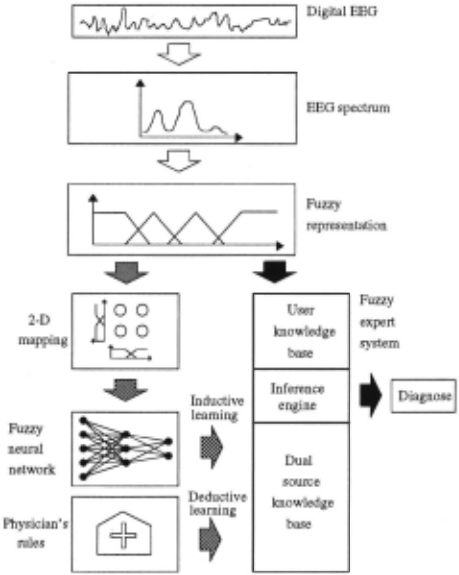
The first two preprocessing steps are application spe cific (light arrows) and serve as a basis for the extraction of fuzzy features. The hybrid system itself is the ser ial/parallel combination of the lower components where grey arrows indicate a learning or knowledge acquisition phase and the black arrow indicates the execution phase. During the learning phase two sets of rules are merged to form the dual source knowledge base of the fuzzy expert system. On the one hand rules are gathered from physi cians and on the other hand rules are extracted from the fuzzy neural network. For the latter purpose the net is at first trained to perform the physician's diagnosis task on sample data [Herrmann, 1995b]. After completed train ing, rules describing the diagnosis process are extracted from the net . When the acquisition of knowledge is fin ished, the executing phase can be run, actually diagnos ing medical data. To achieve this, the execution path is switched from the grey to the solid arrows. Now the fuzzy features of a sample (e.g. EEG trace) are com pared to the formerly acquired knowledge base via the inference engine. The fuzzy expert system then comes up with a diagnose.
The following three sections describe the implemen tation of the components of the hybrid system in more detail and show the advantages and avoidance of disad vantages.
3.1 Fuzzy Representation
It is important for our hybrid approach that all compo nents are able to deal with fuzzy representations, since that is the interface between the components. For this reason, data has to be transformed into a fuzzy repre sentation before it can be diagnosed by our system. This process depends on the type of data and shall be demon strated via our EEG example.
In order to obtain a fuzzy description of EEG patterns, some preprocessing has to be carried out with the EEG traces. First , the brain currents are digitized to allow computerized manipulation (see figure 1, 'Digital EEG'). In the next step the discrete signal is transformed from the time domain into the frequency domain (see Figure 1, 'EEG spectrum'). In its frequency domain represen tation each point of an EEG spectrum consists of two dimensions, namely frequency and amplitude .
The frequency axis is divided into four terms of the fuzzy variable frequency. Those four terms delta, theta, alpha and beta correspond to the medical standard of classifying EEG frequencies [Niedermeyer and Lopes da Silva, 1993]. In the same manner the amplitude is fuzzi fied into the terms zero, low, mid, and high of the fuzzy variable amplitude. It is now possible to formulate de scriptions like a wave with beta frequency and low ampli tude. This pseudo-linguistic description is very close to how signal experts or physicians would classify certain graphoelements in EEGs.
3.2 Mapping Fuzzy Variables to Neural Networks
In order to learn the diagnosis process in a neural net work, the fuzzy features have to be mapped into the in put layer of the net. Here, we demonstrate a new method of two-dimensional mapping, minimizing the amount of neurons in the network and keeping their number con stant .
All terms of the two fuzzy variables frequency and amplitude must be mapped into the input layer neu rons of our neural net . In a straight-forward manner each out of eight neurons would be assigned the mem bership value of one of the eight fuzzy terms. This would allow the representation of exactly one spectral phenomenon. But, in every EEG time-slice there ex ist various different phenomena. For example, the main rhythm should be present in any healthy subject, de scribed as a wave with an alpha frequency and a mid amplitude. Also, there might exist artifacts at the same time-mostly bulbus artifacts resulting from eye move ments, being waves with delta frequency and high am plitude. If more than one feature were encoded in eight neurons one could no longer decide which amplitude be longs to which frequency (binding problem [Rumelhart and Me Clelland, 1986]). Therefore, to represent multi ple phenomena eight neurons would be required for each phenomenon. Since the number of features contained in every time-slice varies through the EEG (not every sample is deranged by an artifact) a representation is needed which is capable of coding multiple phenomena in a constant number of neurons.
We have developed a mapping scheme that brings two fuzzy variables into a network suited representation by calculating the cross product, which is described in de tail in (Herrmann, 1995a]. The two four-term fuzzy vari ables result in 16 neurons Njrequeneyxamplitude {see fig ure 2). Each neuron represents the conjunction of two fuzzy terms of each variable, thus overcoming the bind ing problem. The activation value of a neuron is calcu lated via the algebraic product of the two represented membership functions :
Ndeltaxzero = /-ldelta * /-lzero = 0.6 * 0.6 = 0.36 The sum of activation, resulting from one spectral phe nomenon always sums up to 1 for sake of reinterpretabil ity of the rules learned by the network.
3.3 Fuzzy Neural Network
The fuzzy features, presented to the neural network by the two-dimensional mapping method, are then trained to be detected by the net. In order to extract the ac quired knowledge, a fuzzy-neural network, called FuN e [Halgamuge and Glesner, 1993; Halgamuge et al., 1993], IS used in our three layer network. The special multi layer perceptron architecture is trained with a gradient descent algorithm. There exist three types of neurons in the middle layer grouped together topographically. One group of neurons can perform only the or function of multiple inputs while another group only performs the and function. As there may as well be unary rules, composed of simple one-term-premises, there is a third group of neurons having single inputs and single outputs. The output neuron simply acts as an or function of all middle neurons. In the initial state the fully intercon nected network represents all possible logical functions of or premises, and premises, and the 16 unary premises. During the learning process all connections below a cer tain threshold are eliminated. This pruning method has been proposed by Le Cun in 1990 [LeCun et al., 1990] in order to increase learning speed-but, it is also useful for limiting the number of resulting rules. This is of special interest to us, because we will extract exactly these rules after the training and want to avoid rules with negligible rule strength.
A net trained to detect bulbus artifacts is shown in its final state in Figure 2. As an example, the pattern at the input neurons represents a bulbus artifact (ba) in a simplified manner 2 . The delta frequency component is high while all other frequency components are low. The artifact is detected in the output neuron, shown by its activation of 1. . Some of the inputs no longer contribute to the detection task at all, since their low weight connections have been pruned.
2 For the sake of simplicity we used only values 0 and 1, although they will not occur in reality.
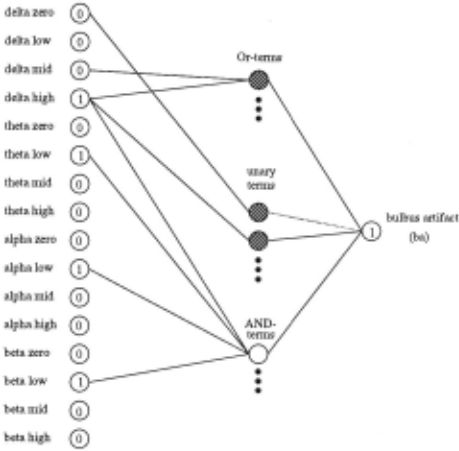
Rules { 1) to { 3) are extracted from the three shaded neurons of the network and build up part of the knowl edge base for the fuzzy expert system.
| {1) IF | delta mid OR delta high | THEN | ba |
| {2) IF | delta zero | THEN | NOT ba |
| (3) IF | delta high | THEN | ba |
These rules do not all contribute to the result in the same way, which is expressed by different rule strengths. The strength of a rule is computed from the weight of the connection between the neuron representing the rule and the output neuron. Rule {2) has a negative strength indicating a negation of the conclusion (dashed line in Figure 2).
3.4 Fuzzy Expert System
The heart of our hybrid system is a fuzzy expert sys tem, called FuzzyCLIPS (Knowledge Systems Labora tory, 1994], derived from CLIPS [Artificial Intelligence Section, 1993]. This expert system consists mainly of three components (see Figure 1, 'Fuzzy expert system'), the dual source knowledge base containing the combined rule sets from inductive and deductive learning, the user knowledge base where the actual phenomena of a patient are entered, and the inference mechanism concluding a diagnosis from the comparison of the knowledge base.
When acquiring rules for the knowledge base of an ex pert system two major learning paradigms apply: deduc tive learning and inductive learning. Deductive learn ing mostly is carried out by explanation-based learn ing [Minton et al., 1990], meaning that the system is tought which rules lead to the desired decision capa bility. Inductive learning is applied when this knowl edge is incomplete but examples may serve as a teacher for machine learning techniques [Michalski, 1983]. Our knowledge base consists of two seperately acquired sets of rules. The first one is acquired deductively from an expert by explanation-based learning. The second one is acquired inductively by machine learning in a neural network. The resulting dual source knowledge base in tegrates two autonomous rule sets. They might contain rules that are equal in premises and conclusion but dif ferent in the degree of certainty, which results in contra diction in the worst case. Like Holland proposed in 1986 [Holland, 1986], we do allow these contradictory rules, postulating it as a natural feature of decision processes and thus being well suited to model those. The following example might shed some light upon this matter:
Wife rule: IF evening THEN go home
Boss rule: IF evening THEN stay in office
If one equally obeys to wife and boss (equal rule strengths) one certainly needs a third rule to make a decision, like
IJCAI rule: IF deadline close THEN stay in office which contributes to one of the former conclusions. The same is supposed for our dual source knowledge base. There may very well be phenomena that exist in sample data but are described differently in the expert rules. In this case the resulting uncertainty has to be solved by different rule strengths or a further rule, manifesting one of the possible conclusions.
Besides an explanation component it is also important for this medical application that a don't know conclusion exists, telling the user if abnormal phenomena were de tected but could not be interpreted.
4 Preliminary Results
When talking about results in medical diagnosis, we would first like to mention one major point in where to put the main focus . Other than in common detec tion tasks it is not sufficient to simply watch the overall performance of the system in means of average error, like it would be appropriate for character recognition, for instance. The diagnosis performance must be split into the missing of phenomena, called false negatives, and the accidental finding of phenomena which are not actually present, called false positives. With these two measures it is possible to decide whether the two can be kept apart or will be overlapping. For certain diagnosis types, it is very important to have absolutely no false positives whereas a few false negatives were still accept able, like in diagnosing cerebral death. Vice versa, in other cases it is important to have no false negatives, like in diagnosing epileptic seizures for emergency pur poses. (Both examples were chosen from the class of EEG diagnosis tasks.)
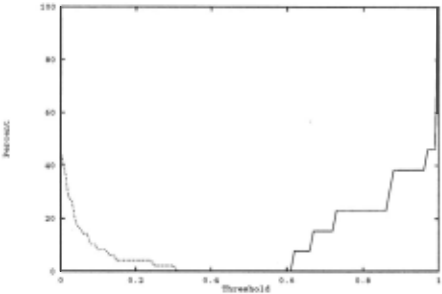
Figure 3 shows a typical diagram illustrating false pos itives (dashed line) versus false negatives (solid line) as a function of the threshold E (FP /FN-diagram) for the detection of bulbus artifacts (BAs). Since we apply fuzzy logic, we get fuzzy results rather than discrete ones. (We do not use standard defuzzification.) The example shows the diagnosis of bulbus artifacts in EEGs. The decision of the system, whether it is a bulbus artifact or not, is represented by an analog value in the range from 0 to 1. For a binary decision a threshold is needed, above which a BA is assumed. In Figure 3 there is a wide gap between false positives and false negatives (0.3 - 0.6). A thresh old centered in this gap will assure a high probability for neither diagnosing false positives nor false negatives.
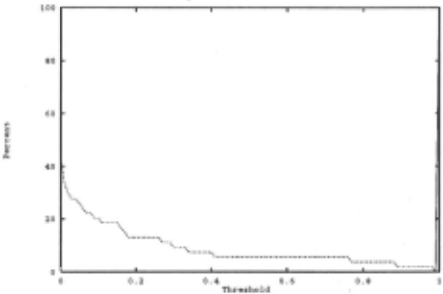
The example of Figure 4 nicely demonstrates the de gree of accuracy of the system. The diagram shows only a narrow gap for the threshold, proposing possible misses in future data. The system can correctly diagnose all existing bulbus artifacts in the patient record with ease, shown in the narrow band of false negatives (rightmost peak in Figure 4) . Nevertheless, the wide scope of false positives gives rise to the assumption that the diagnosis performance is of minor quality, since with a threshold of E = 0.5, 10% diagnosed BAs would not actually be such. Retrospectively examined, it showed that those false positives were indeed BAs, but of minimal ampli tude and thus overlooked in the visual diagnosis. Only the 1.8% false positives that remained up to a threshold of E = 0.94 were not BAs but electrode artifacts, be ing graphoelements that are somewhat related to BAs in terms of frequency and amplitude and can only be kept apart due to their shape. Thus, without explicitely comparing the system and a human expert yet , we showed with these preliminary results that the system's precision is of competing accuracy.
The comparison of the two rule sets, serving as ba sis for the dual source knowledge base, brought up two interesting results.
- The inductively generated rule set, extracted from the network, contained more rules than the one de ductively acquired from the expert. These extra rules seem redundant at first glance, because the expert can easily distinguish between different phe nomena on the basis of more obvious criteria. But for the electronic system, designed to diagnose a vast variety of phenomena, it may very well be of great importance to 'know' every extra description neglected by the expert.
- The extracted rules were more precise in their de gree of fuzzy membership, since they were actually calculated from examples.
For our example of the bulbus artifact , the physician formulated the rule:
- IF frequency=delta and amplitude=high THEN ba
The automatically generated rule base contained a whole group of rules with different rule strengths. The premises, conClusions and rule strengths are shown in the following table (compare to the network connections in figure 2) . Only the rules with rule strenghts (RS) above 1.0 are listed, while rules with lower rule strengths were pruned.
| PREMISE | CONCLUSION | RS |
|---|---|---|
| delta mid OR delta high | ba | 1.75 |
| delta zero | NOT ba | 1.51 |
| delta high | ba | 2.73 |
This detailed rule base is the reason, why the system was able to detect 10% low-amplitude artifacts (see figure 4) . This would not have been possible with the mere expert rule (4).
5 Discussion
By combining three major methods of Artificial Intelli gence into a single hybrid system we managed to combine most of their advantages, avoiding some of their disad vantages at the same time.
The hybrid system, described in this article, intro duces the following new paradigms of modeling the cog nitive task of d.iagnosis:
- Instead of either acquiring the whole knowledge base automatically from examples, bein~ an induc tive learning method [Michalski, 1983J, or refin ing a rough knowledge base [Ourston and Mooney, 1994], being an enhanced explanation-based learn ing method [Minton et al. , 1990], we are using a dual source knowledge base. This knowledge base consists of tvvo sets of rules, coexisting with equal importance, one generated deductively from rules formulated by an expert and another one generated inductively by machine learning in a neural network.
This offers the full range of benefits from neural net work learning. Additionally, the automatically ac quired rules can be supervised and adapted in the expert system, eliminating the black box problem (see Subsection 2.2) .
- The coexistence of the two resulting rule bases, with the possibility of competing knowledge, is not only permitted but desired. The competition ofrules and the mechanism of taking further rules into account is part of the cognitive decision task.
Besides the integration of the existing fuzzy neural network and fuzzy expert system, some intelligent inter facing techniques are introduced, that might as well be used for different applications:
- A two-dimensional mapping technique, used to as sign the membership values of linguistic variable terms to input layer neurons of a network. By this means, it is possible to input existing fuzzy representations into neural networks in order to autonomously acquire case-based knowledge from sample data (see Subsection 3.2).
- An application-specific fuzzification of spectral EEG data that will work for most other multidimensional data, especially other frequency domain data, like voice spectra in speech recognition, as well as all kinds of medical images (see Subsection 3.1).
Our preliminary results (see Section 4) point out some promising features :
- We proved the possible precision of our system, be ing more accurate than the human expert, when applied to the task of diagnosing bulbus artifacts in EEGs.
- Comparing the two rule sets of our dual source knowledge base it showed that the inductively ac quired set was more extensive and of higher preci sion than the one deductively acquired.
In future we plan to investigate the interference ef fects of a dual source knowledge base. They occur when the two bases contain contradictory or similar rules with different rule strengths. For the case of perfect contra diction of two rules, possibly resulting in no conclusion, a third rule could be generated by a supervising mech anism to indicate to the user that such a contradiction occurred.
6 Acknowledgements
The author wishes to thank Andre de Waal for his last polish of the English, as well as Fran~ Reine and Michael Thielscher for their valuable comments on an earlier ver sion of the paper.
@inproceedings{ijcai1995p65,
  title     = {A Hybrid Fuzzy-Neural Expert System for Diagnosis},
  author    = {Herrmann, Christoph S.},
  booktitle = {Proceedings of the Fourteenth International Joint Conference on
               Artificial Intelligence, {IJCAI-95}},
  publisher = {International Joint Conferences on Artificial Intelligence},
  editor    = {Chris S. Mellish},
  pages     = {494--500},
  year      = {1995},
  note      = {Connectionist Models},
  url       = {https://ijcai.org/proceedings/1995/65},
}
TY - CPAPER TI - A Hybrid Fuzzy-Neural Expert System for Diagnosis AU - Herrmann, Christoph S. T2 - Proceedings of the Fourteenth International Joint Conference on Artificial Intelligence, IJCAI-95 PB - International Joint Conferences on Artificial Intelligence PY - 1995 SP - 494 EP - 500 UR - https://ijcai.org/proceedings/1995/65 ER -Copied
Machine-readable versions of this paper, for tools and AI agents:





