
Understanding Neural Networks via Rule Extraction
Proceedings of the Fourteenth International Joint Conference on Artificial Intelligence. Connectionist Models. Pages 480-486.
© 1995 International Joint Conferences on Artificial Intelligence
Abstract
Although backpropagation neural networks generally predict better than decision trees do for pattern classification problems, they are often regarded as bla~k boxes, i.e., their predictions are not as interpretable as those of decision trees. This paper argues that this is because there has been no proper technique that enables us to do so. With an algorithm that can extract rules 1 , by drawing parallels with those of decision trees, we show that the predictions of a network can be explained via rules extracted from it, thereby, the network can be understood. Experiments demonstrate that rules extracted from neural networks are comparable with those of decision trees in terms of predictive accuracy, number of rules and average number of conditions for a rule; they preserve high predictive accuracy of original networks.
- [Cheng et al., 1988] J . Cheng, U.M. Fayyad, K.B . Irani, and Z Qian. Improved decision trees: A generalized version of id3 . In Proceedings of the Fifth Interna- tional Conference on Machine Learning, pages 100- 106.
- Morgan Kaufman, 1988.
- [Dietterich et al., 1990] T.G . Dietterich, H. Hild, and G . Bakiri. A comparative study of id3 and backprop- agation for english text-to-speech mapping. In Ma- chine Learning: Proceedings of the Seventh Interna- tional Conference. University of Texas, Austin, Texas, 1990.
- [Fisher, 1936] R.A . Fisher. The use of multiple mea- surements in taxonomic problems. Ann. Eugenics, 7(2):179-188, 1936.
- [Fu, 1994] L. Fu . Neuml Networks in Computer Intelli- gence. McGraw-Hill, 1994.
- [Kerber, 1992] R. Kerber. Chimerge: Discretization of numeric attributes. In AAAI-92, Proceedings Ninth National Conference on Artificial Intelligence, pages 123-128. AAAI Press/The MIT Press, 1992.
- [Liu, 1995] H. Liu. Generating perfect rules. Technical report, Department of Info Sys and Comp Sci, Na- tional University of Singapore, February 1995.
- [Noordewieer et al., 1991] M.O. Noordewieer, G .G . Towell, and J .W . Shavlik. Training knowledge-based neural networks to recognize genes in dna sequences. In Advances in neuml information processing systems, volume 3, pages 530-536.
- Morgan Kaufmann, 1991.
- [Quinlan, 1993] J .R. Quinlan . C.{5: Programs forMa- chine Learning. Morgan Kaufmann, 1993.
- [Quinlan, 1994] J .R. Quinlan . Comparing connection- ist and symbolic learning methods. In S.J. Hanson, G.A. Drastall, and R.L . Rivest, editors, Computa- tional Learning Therory and Natural Learning Sys- tems, volume 1, pages 445-456.
- A Bradford Book, The MIT Press, 1994.
- [Saito and Nakano, 1988] K. Saito and R Nakano. Med- ical diagnostic expert system based on pdp model. In Proceedings of IEEE International Conference on Neural Networks, volume 1, pages 255-262. IEEE, 1988.
- [Setiono, 1995] R. Setiono. A penalty function approach for pruning feedforward neural networks. Techni- cal Report, DISCS, National University of Singapore, 1995.
- [Shavlik et al., 1991] J .W. Shavlik, R.J . Mooney, and G .G . Towell . Symbolic and neural learning algo- rithms: An experimental comparison. Machine Learn- ing, 6(2) :111-143, 1991.
- [Smith, 1993] M. Smith. Neuml networks for Statistical Modeling. Van Nostrand Reinhold, 1993.
- [Towell and Shavlik, 1993] G .G . Towell and J.W. Shav- lik. Extracting refined rules from knowledge-based neural networks. Machine Learning, 13(1) :71-101, 1993.
References were extracted automatically from the PDF and may contain errors.
Full text extracted automatically from the PDF; figures, tables and equations may differ. The PDF is the version of record.
1 Introduction
Researchers [Dietterich et al., 1990; Quinlan, 1994; Shav lik et al., 1991] have compared experimentally the perfor mance of learning algorithms of decision trees and neural networks (NNs). A general picture of these comparisons is that: (1) Backpropagation (an NN learning method) usually requires a great deal more computation; (2) the predictive accuracy of both approaches is roughly the same, with backpropagation often slightly more accu rate [Quinlan, 1994]; and (3) symbolic learning (decision trees induction) can produce interpretable rules while networks of weights are harder to interpret [Shavlik et al., 1991]. In effect, a neural network is widely regarded as a black box due to the fact that little is known about how its prediction is made.
Our view is that this is because we are not equipped with proper techniques to know more about how a neu ral network makes a prediction. If we can extract rules from neural networks as generating rules from de cision trees, we can certainly understand better how a prediction is made. In addition, rules . are a form of knowledge that can be easily verified by experts, passed on and expanded. Some recent works [Fu, 1994; Saito and Nakano, 1988; Towell and Shavlik, 1993] have shown that rules can be extracted from networks. These algorithms are search-based methods that have exponen tial complexity. Subsets of incoming weights that ex ceed the bias on a unit are searched. Such sets are then rewritten as rules. To simplify the search process, some assumptions are made. One assumption is that the acti vation of a unit is either very close to 1 or very close to 0. This can restrict the capability of the network since when the sigmoid transfer function is used as the the ac tivation function, the activation of a unit can have any value in the interval (0,1).
1 Rules are in forms of "if x, = v(xl) and X2 = v(x2) ... and Xn = v(xn) then C/' where Xi's are the inputs to the network, v(x;)'s are one of the values Xi can have, and C; is the network's prediction.
In this paper, a novel way to understand a neural network is proposed. Understanding a neural network is achieved by extracting rules with a three-phase algo rithm: first, a weight-decay backpropagation network is built so that important connections are reflected by their bigger weights; second, the network is pruned such that insignificant connections are deleted while its predictive accuracy is still maintained; and last, rules are extracted by recursively discretizing the hidden unit activation val ues. By drawing parallels with the rules generated from decision trees, we show that networks can be interpreted by the extracted rules; the rules in general preserve the accuracy of the networks; and they also explain how a prediction is made.
2 A Three-Phase Algorithm
A standard three layer feedforward network is the base of the algorithm. Weight decay is implemented while back propagation is carried out. After the network is pruned, its hidden units activation values are discretized. Rules are extracted by examining the discretized activation values of the hidden units. The algorithm is described in steps below.
2.1 Backpropagation with Weight Decay
The basic structure of the neural network in this work is a standard three-layer feedforward network, which con sists of an input layer, I, a hidden layer, H, and an output layer, 0. The number of input units corr~spon?s to the dimensionality of the examples of a classificatiOn problem. The number of output units is determined by the number of classes in the data. The number of hidden units depends on the problem in hand. Two approaches to determine a suitable number of hidden units have been described in the literature. The first approach begins with a minimal number of hidden units, one or two, and more hidden units are added as they are needed to in crease the accuracy of the network. The second approach begins with an oversized network and removes redundant connections in the network by pruning. In the process, hidden units that are not connected to any input units or/and output units can be removed as well. We adopt the second approach since we are also interested in re moving irrelevant input units.
Given ann-dimensional example xi, i E {1,2, ... ,k} as input, let wj be the weight for the connection from input unit l, l E {1,2, .. . ,n} to hidden unit m, mE {1,2, ... ,h} and v; be the weight from hidden unit m to output unit p, p E {1,2, ... ,o}, the pth output of the network for example xi is obtained by computing
The target output for an example xi that belongs to class Cj is an a-dimensional vector ti, where t~ = 0 if p f. j and t~ = 1, j,p = 1, 2, .. . o. The backpropagation algorithm is applied to update the weights (w, v) and minimize the following function:
where F( w, v) is the cross entropy function:
and P( w, v) is a penalty term used for weight decay:
Using this penalty function, we have been able to ob tain networks with less number of connections than the previously reported for many learning problems. Details of the comparison and the choice of the parameter values (ft, f2, and .B) are given in [Setiono, 1995).
2.2 Network Pruning
A network pruning algorithm is briefly described below.
Neural network pruning algorithm
- Let 111 and 112 be positive scalars such that 111 + 112 < 0.5.
- Pick a fully connected network. Train this network until a predetermined accuracy rate is achieved and for each correctly classified example the condition
where 111 E [0, 0.5), is satisfied.
- Let (w, v) be the weights of this network. For each · wl', if
then remove wr from the network
- For each vm, if
then remove v; from the network
- If no weight satisfies condition ( 4) or condition (5), then remove wl' with the smallest product maXp lv;;'wl'l·
- Retrain the network. If classification rate of the network falls below an acceptable level, then stop. Otherwise, go to Step 3.
This pruning algorithm removes the connections of the network according to the magnitudes of their weights ( 4 and 5). As our eventual goal is to get a set of simple rules that describe the classification process, it is important that all unnecessary connections be removed. In order to remove as many connections as possible, it is therefore imperative that the weights be prevented from taking values that are too large. At the same time, weights of irrelevant connections should be encouraged to converge to zero.
2.3 Rule Extraction
When network pruning is completed, the network con tains only those salient connections. Nevertheless, rules are not readily extractable because the hidden unit acti vation values are continuous. The discretization of these values paves the way for rule extraction. The following algorithm discretizes the activation values (many clus tering algorithms can be used for this purpose).
Discretizing Hidden Unit Activation Values by Clustering
For each hidden unit,
- Let f E (0, 1),
- Start with activation value a 0 of the first example in the training set,
- Cluster activation values (a;) for the remaining ex amples if Ia;- a01 < f,
- Represent this cluster's activation value by the av erage of the activation values in the cluster;
- Select next ao, repeat 3 and 4 for clustering until all activation values are clustered.
When the clustering is done, the network's accuracy is checked to see if it drops or not. A very small f. can guarantee that the network with discretized activation values is as accurate as the original network with contin uous activation values. So if it's accuracy does not drop and there are still many discrete values, clustering can be performed again with a larger f.. Otherwise, f. should be reduced to a smaller value.
After network pruning and activation value discretiza tion, rules can be extracted by examining the possible combinations in the network outputs (explained in detail in Section 3.2) . The actual rule extraction is done by an algorithm that generates 100% accurate rules [Liu, 1995]. However, when there are still too many connections (e.g., more than 7) between a hidden unit and input units, the extracted rules may not be easy to understand. Another three layer feedforward subnetwork may be employed to simplify rule extraction for the hidden unit. This sub network is trained in the same ways as is the original net work, but in a reduced scale: the number of output units is the number of discrete values of the hidden unit, while the input units are those connected to the hidden unit in the original network. Examples are grouped according to their discretized activation values. Given d discrete activation values D1 , D2 , ... , Dd, all examples with ac tivation values equal to Dj are given a d-dimensional target value of all zeros except for one 1 in position j. A new hidden layer is introduced for this subnetwork and it is then trained, pruned, and the activation values of its hidden units are discretized for rule extraction. If neces sary, another subnetwork is created until the number of connection is small enough or the new subnetwork can not simplify the connections between the inputs and the hidden unit at the higher level. The creation of subnet works is rarely needed. For example, in our experiments, it was only used for the Splice-junction problem.
3 Experiments and Results
In this section, we describe the datasets and representa tions used in experiments. A detailed example is given to show how the three-phase algorithm is applied to ex tracting rules. Summary of the results on all datasets are given with a comparison to those produced by the decision tree induction methods. Understanding a neu ral network is achieved by being able to explain, based on the rules, how each prediction is made in parallel with understanding a decision tree by having rules generated from it [Quinlan, 1993].
3.1 Datasets and Representations
Three datasets used are: 1. Iris - a classic dataset intro duced by R.A. Fisher [1936]; 2. Breast Cancer- a widely tested real-world dataset for the Wisconsin Breast Can cer diagnosis; and 3. Splice-junction - a dataset used in splice-junction determination originally described by No ordewier et a! [1991]. The datasets are obtainable from the University of California Irvine data repository for machine learning (via anonymous ftp from ics.uci.edu) . The summary of these datasets, their representations, and how each dataset is used in experiments are given below.
- Iris - the dataset contains 50 examples each of the classes Iris setosa, Iris versicolor, and Iris virginica (species of iris). Each example is described using four numeric attributes (A1 , A2 , A3 and A4) : sepal length, sepal-width, petal-length, and petal-width. Since each attribute takes a continuous value 1 the ChiMerge algorithm proposed by Kerber [1992] was reimplemented to discretize attribute values. The thermometer code [Smith, 1993] is used to binarize the discretized values; 16, 9, 7, and 6 inputs (dis crete values) for At,A2, A3, and A4, respectively. With 1 input for bias, there are total 39 inputs and three outputs. Examples in odd positions in the original dataset form the training set and the rest are for testing as was done in [Fu, 1994].
- Breast Cancer - the dataset consists of 699 exam ples, of which 458 examples are classified as benign, and 241 are malignant . 50% examples of each class were randomly selected (i.e., 229 benign and 121 malignant examples) for training, the rest for test ing in the experiments. Each example is described by 9 attributes, each attribute takes an ordinal in teger from 1 to 10 (10 values) . Due to the ordinal nature, the thermometer code is used again to code each attribute value . . Ten inputs correspond to 10 values of each attribute with all 10 inputs on rep resenting value 10, the rightmost input on for value 1, and the two rightmost inputs on for value 2, etc.
- Splice-junction - the data set contains 3175 examples 2 , approximately 25% are exon/intron boundaries (EI), 25% are intron/exon boundaries (IE), and remaining 50% are neither (N). Each example consists of a 60-nucleotide-long DNA se quence categorized with EI, IE or N. Each of these 60 attributes takes one of the four values: G, T, Cor A that are coded as 1000, 0100, 0010, and 0001 , re spectively. The class values (EI, IE, N) are similarly coded as 100, 010, and 001, respectively.For there sults presented here, the training data set consists of 1006 examples while the testing data set consists of all 3175 examples.
3.2 A Detailed Example - Iris Data Classification
This example shows in detail how rules are extracted from a pruned network. In the experiment, 100 fully connected neural networks were used as the starting net works. Each of these networks consists of 39 input units, 3 hidden units and 3 output units. These networks were trained with initial weights that had been randomly gen erated in the interval [ -1, 1]. Each of the trained net works was pruned until its accuracy on the training data dropped below 95%. The weights and topology of net works with the smallest number of connections and an accuracy rate of more than 97% were saved for possi ble rule extraction. The results of these experiments are summarized in Table 1 in which we list the average number of connections in the pruned networks and their average accuracy rates on the training data and the test ing data. Statistics in the second column of this table were obtained from 100 pruned networks, all of which have accuracy rates on the training data of at least 95 %. In the third column, the figures were obtained from 100 pruned networks with accuracy of at least 97 % on the training data.
2 Another 15 examples in the original dataset contain in valid values so these examples are not included in experiment.
| Min. network ace. | 95% | 97% |
|---|---|---|
| No. connectiOns | 9 .26p . 3~). | 10.66 J3.06)~ |
| Ace. on train data | 97.20 (1.45) % | 99.03 (0.84) % |
| Ace. on test data | 92.32 (2.49) % | 94.55 (2.03) % |
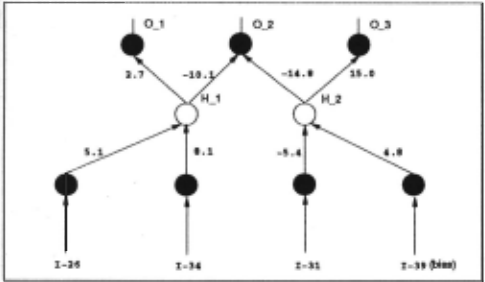
One of the smallest pruned networks is depicted in Figure 1. It has only 2 hidden units and a total of 8 con nections with 98.67% accuracy on the training set and 97.33% on the testing set. We ran the clustering algo rithm of Section 2.3 on this network and found only 2 discrete values are needed at each of the two hidden units to maintain the same level of accuracy on the training data. At hidden unit 1, 48 of 75 training examples have activation values equal to 0 and the remaining 27 have activation values equal to 1. At hidden unit 2, the acti vation value of 25 examples is 1 and the activation value of the remaining 50 examples is -0.5. Since we have two activation values at each of the two hidden units, four different outcomes at the output units are possible (Ta ble 2). From this table, it is clear that an example will be classified as Iris setosa as long as its activation value at the second hidden unit is equal to 1. Otherwise, the example is classified as Iris versicolor provided that its first hidden unit activation value H_1 = 0. The default class will then be Iris virginica.
As seen in Figure 1, only two inputs, L31 and L39, de termine the activation values of the second hidden unit, H_2. However, since L39 is 1 for all the training data, H_2 is effectively determined by L31. Since the weights of the arcs connecting input units 31 and 39 to the second hidden unit are -5.4 and 4.8 respectively, it is easy to conclude that if L31 = 0, then H_2 is 1, otherwise, H_2 is -0.52. This implies that an example will be classified as Iris setosa only if L31 is 0 (hence H_2 is 1) .
| Activations | Pred. output I I | Class | |||
|---|---|---|---|---|---|
| H_l | H_2 | I I o_I | 0_2 | I 0_3 I | |
| 0 | 1 | 0.5 | 0 | 1 | setosa setosa |
| 0 | -0.5 | 0.5 | 1 | 0 | versicolor |
| 1 | 1 | 0.9 | 0 | 1 | |
| 1 | -0.5 | 0.9 | 0 | 0 | vargmtca |
| QT 1u¥s | ||||
|---|---|---|---|---|
| Trammg | estmg II | |||
| setosa | 25/25 | 25/25 | 25/25 | 25/25 |
| versicolor .. | 24 25 | 23/25 | 24 25 | 24 25 |
| mrgmaca | 25 25 | 25/25 | 24 25 | 22 25 |
| Overall | 74 75 | 73{75 | 73 75 | 71~ 75 |
| 98.67% | 97.33% | 97.33% | 94.67% | |
The activation value of the first hidden unit, H_1, de pends only on L26 and L34. The weights of the arcs connecting input units 26 and 34 to the first hidden unit are 5.1 and 8.1, respectively, hence H_1 is 0 if and only if L26 = L34 = 0. Other input combinations will yield value 1 for H_l. Hence, an example with L31 = 1, L26 = L34 = 0 will be classified as Iris versicolor.
With the thermometer coding scheme used for the in put, a complete set of rules can be easily obtained in terms of the original attributes of the iris data set. The accuracy of this rule set is summarized in Table 3:
NN Rules 3
Rule 1: If Petal-length :S 1.9 then Iris setosa
Rule 2: If Petal-length :S 4.9 and Petal-width $ 1.6 then Iris versicolor
Default Rule: Iris virginica.
For reference, the rule set (DT Rules) generated by C4.5rules (based on a decision tree method but generate more concise rules than the tree itself) is included here:
DT Rules
Rule 1: If Petal-length :S 1.9 then Iris setosa Rule 2: If Petal-length > 1.9 and Petal-width :S 1.6 then Iris versicolor Rule 3: If Petal-width > 1.6 then Iris virginica Default Rule: Iris setosa.
3.3 Comparisons
In this section, parallels are drawn between rules ex tracted from both neural networks and decision trees
3 The rules are fired in a top-down and left-to-right fashion.
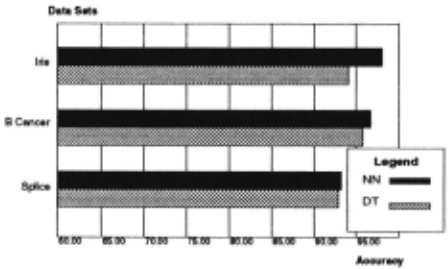
(NN rules vs. DT rules). Understandability is partly defined as being explicable in the sense that a prediction can be explained in terms of inputs (or attribute values). Choosing to compare NN rules with DT rules is due to the fact that DT rules are considered best understand able among the available choices. A rule in discussion consists of two parts: the if-part is made of a conjunc tion of conditions, and the then-part specifies a class value. The conditions of a rule are in forms of "Ai=V/', i.e., attribute Ai takes value Vj. When a rule is fired, a prediction is given that the example under consideration belongs to class C1c . By examining the fired rule, it can be explained how the prediction is attained. If necessary, the intermediate process can also be explicitly explained.
C4.5 and C4.5rules [Quinlan, 1993] were run on the above three datasets to generate DT rules. Briefly, C4.5 generates a decision tree which C4.5rules gener alizes to rules. Since researchers [Cheng et al., 1988; Shavlik et al., 1991] observed that mapping many-valued variables to two-valued variables results in decision trees with higher classification accuracy 4 , the same binary coded data for neural networks were used for C4.5 and C4.5rules.
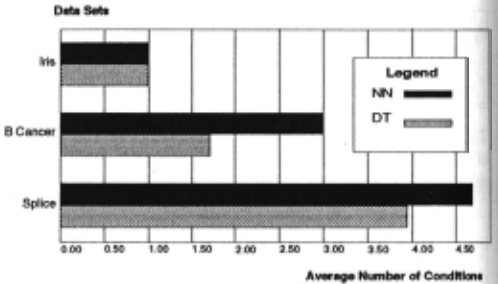
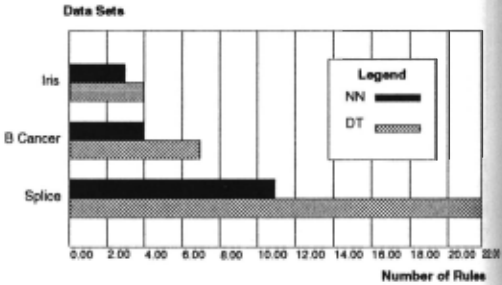
Being explicable is only one aspect of understandabil ity. A rule with many conditions is harder to understand than a rule with fewer conditions. Too many rules also hinder humans understanding of the data under exami nation. In addition to understandability, rules without generalization (i.e., high accuracy on testing data) are not much of use. Hence, the comparison is performed along three dimensions: 1. predictive accuracy; 2. av erage number of conditions of a rule; and 3. number of rules (see Figures 2-4).
The reasoning behind the comparisons is that if NN rules are comparable with DT rules, since the latter are admittedly interpretable, so should the former . Now that each prediction can be explained in light of some rule, and those rules have direct links to the neural net work, it can be concluded that the network's behavior can be understood via those rules.
4 1t's true indeed for the three datasets in our experiments.
4 Discussion
The comparisons made in Figures 2-4 indicate that NN rules are comparable with, if not better than, DT rules in terms of our understanding measures. The average number of conditions in NN rules is higher than that of DT for 2 of the 3 problems tested, however, the total number of NN rules is less than DT rules for all the 3 problems. These observations are consistent with the nature of each learning algorithm, i.e., parallel vs. se quential. Other issues of interests are:
- The training time. It takes much longer time to train a neural network than to learn a decision tree. This is also true for NN rules and DT rules extrac tion. Due to the existence of sequential and parallel data types, and decision trees and neural networks are best suited to one type only [Quinlan, 1994], the two approaches are expected to coexist . When time is really scarce, the decision tree approach should be taken. Otherwise, it is worthwhile trying both be cause of backpropagation 's other advantages (gener alizing better on a smaller dataset, predicting better in general, etc. [Towell and Shavlik, 1993]) .
- Average performance of NN rules. Because of neural networks' nondeterministic nature, it is not uncom mon that many runs of networks are needed with
- different initial weights. As was shown in Table 1, the average performance for 100 pruned networks is very impressive (94.55%). This displays the robust ness of the presented algorithm.
- Accumcy of neuml networks and NN rules. There is a trade-off between the accuracy of the the rules ex tracted from the network and the complexity of the rules. A network can be further pruned and simpler rules obtained at the cost of sacrificing its accuracy. A notable feature of our rule extraction algorithm is that while it allows us to extract rules with the same accuracy level as that of the pruned network, it is also possible to simplify the rules by considering a smaller number of hidden unit activation values.
- Understandinfl the weights of connections. Unlike M-of-N rules [Towell and Shavlik, 1993], NN rules here reflect precisely how the network works. NN rules given here are actually the merge of the two sets: 1. from the input layer to the hidden layer; and 2. from the hidden layer to the output layer. NN rules cover all the possible combinations of the connections with various input values and discrete activation values of hidden units. This is a signifi cant improvement over search-based methods [Tow ell and Shavlik, 1993; Fu, 1994] where all possible in put combinations are searched for subsets that will exceed the bias on a unit . To reduce the cost of searching, they normally limit the number of an tecedents in extracted rules. Our algorithm imposes no such limit.
- Consistency between NN and DT rules. Consistency checking is not an easy task. In general, the possible rule space is very large since the training data is only a sample of the world under consideration. It is not surprising that there exist many equally good rule sets. Using the binary code for the Iris data, for example, the possible size of the rule space is 2 38 , but there are only 75 examples for training. However, for simple problem like the Iris problem, the rules extracted by NN. and the rules generated by DT are remarkably similar.
5 Conclusion
Neural networks have been considered black boxes. In this paper, we propose to understand a network by rules extracted from it. We describe a three-phase algorithm that can extract rules from a standard feedforward neu ral network. Network training and pruning is done via the simple and widely-used backpropagation method. No restriction is imposed on the activation values of the hidden units or output units. Extracted rules are a one to-one mapping of the network. They are compact and comprehensible, and do not involve any weight values. The accuracy of the rules from a pruned network is as high as the accuracy of the network. Experiments show that NN rules and DT rules are quite comparable. Since DT rules are regarded as explicit and understandable, we conclude that NN rules are likewise. With the rules ex tracted by the method introduced here, neural networks should no longer be regarded as black boxes.
@inproceedings{ijcai1995p63,
  title     = {Understanding Neural Networks via Rule Extraction},
  author    = {Setiono, Rudy and Liu, Huan},
  booktitle = {Proceedings of the Fourteenth International Joint Conference on
               Artificial Intelligence, {IJCAI-95}},
  publisher = {International Joint Conferences on Artificial Intelligence},
  editor    = {Chris S. Mellish},
  pages     = {480--486},
  year      = {1995},
  note      = {Connectionist Models},
  url       = {https://ijcai.org/proceedings/1995/63},
}
TY - CPAPER TI - Understanding Neural Networks via Rule Extraction AU - Setiono, Rudy AU - Liu, Huan T2 - Proceedings of the Fourteenth International Joint Conference on Artificial Intelligence, IJCAI-95 PB - International Joint Conferences on Artificial Intelligence PY - 1995 SP - 480 EP - 486 UR - https://ijcai.org/proceedings/1995/63 ER -Copied
Machine-readable versions of this paper, for tools and AI agents:





