
Using Information Content to Evaluate Semantic Similarity in a Taxonomy
Proceedings of the Fourteenth International Joint Conference on Artificial Intelligence. Cognitive Modelling. Pages 448-452.
© 1995 International Joint Conferences on Artificial Intelligence
Abstract
This paper presents a new measure of semantic similarity in an IS-A taxonomy, based on the notion of information content. Experimental evaluation suggests that the measure performs encouragingly well (a correlation of r = 0.79 with a benchmark set of human similarity judgments , with an upper bound of r = 0.90 for human subjects performing the same task), and significantly better than the traditional edge counting approach (r = 0.66) .
- [Collins and Loftus, 1975] A. Collins and E. Loftus. A spreading activation theory of semantic processmg. Psychological Review, 82:407-428, 1975.
- [Francis and Kucera, 1982] W . N. Francis and H. Kucera. Frequency Analysis of English Usage: Lexicon and Grammar. Houghton Mifflin, 1982.
- [Leacock and Chodorow, 1994] Claudia Leacock and Martin Chodorow. Filling in a sparse training space for word sense identification. ms., March 1994.
- [Lee et al., 1993] Joon Ho Lee, Myoung Ho Kim, and Yoon Joon Lee. Information retrieval based on con- ceptual distance in IS-A hierarchies. Journal of Doc- umentation, 49(2):188-;:207, June 1993. 4112 COGNITIVE MODELLING [Lesk, 1986] Michael Lesk. Automatic sense disambigua- tion using machine readable dictionaries: how to tell a pine cone from an ice cream cone. In Proceedings of the 1986 SIGDOC Conference, pages 24-26, 1986.
- [Miller and Charles, 1991] George A. Miller and Wal- ter G. Charles. Contextual correlates of semantic sim- ilarity. Language and Cognitive Processes, 6(1):1-28, 1991.
- [Miller, 1990] George Miller. WordNet: An on-line lex- ical database. International Journal of Lexicography, 3(4), 1990. (Special Issue).
- [Quillian, 1968] M. Ross Quillian. Semantic memory. In M. Minsky, editor, Semantic Information Processing. MIT Press , Cambridge, MA, 1968.
- [Rada and Bicknell, 1989] Roy Rada and Ellen Bick- nell. Ranking documents with a thesaurus . JASIS, 40(5):304-310, September 1989.
- [Rada et al., 1989] Roy Rada, Hafedh Mili, Ellen Bick- nell, and Maria Blettner. Development and applica- tion of a metric on semantic nets. IEEE Transac- tion on Systems, Man, and Cybernetics, 19(1) :17-30, February 1989.
- [Resnik, 1993a] Philip Resnik. Selection and Informa- tion: A Class-Based Approach to Lexical Relation- ships. PhD thesis, University of Pennsylvania, De- cember 1993.
- [Resnik, 1993b] Philip Resnik. Semantic classes and syntactic ambiguity. In Proceedings of the 1999 ARPA Human Language Technology Workshop . Mor- gan Kaufmann, March 1993.
- [Resnik, 1995] Philip Resnik. Disambiguating noun groupings with respect to WordNet senses. In Third Workshop on Very Large Corpora . Association for Computational Linguistics, 1995.
- [Ross, 1976] Sheldon Ross. A First Course in Probabil- ity. Macmillan, 1976.
- [Rubenstein and Goodenough, 1965] Herbert Rubenstein and John Goodenough. Contextual cor- relates of synonymy. CACM, 8(10):627-633, October 1965.
- John Sinclair (ed.). COB UILD English Language Dictionary. London, 1987.
- Collins Collins: [Sussna, 1993]
- Michael Sussna. Word sense disambigua- tion for free-text indexing using a massive semantic network. In Proceedings of the Second International Conference on Information and Knowledge Manage- ment (CIKM-93), Arlington, Virginia, 1993.
- [Tversky, 1977] A. Tversky. Features of similarity. Psy- chological Review, 84:327-352 , 1977.
- [Weiss and Kulikowski, 1991] Sholom M. Weiss and Casimir A. Kulikowski. Computer systems that learn: classification and prediction methods from statistics, neural nets, machine learning, and expert systems.
- Morgan Kaufmann, San Mateo, CA, 1991.
References were extracted automatically from the PDF and may contain errors.
Full text extracted automatically from the PDF; figures, tables and equations may differ. The PDF is the version of record.
1 Introduction
Evaluating semantic relatedness using network represen tations is a problem with a long history in artificial in telligence and psychology, dating back to the spreading activation approach of Quillian [1968] and Collins and Loftus [1975] . Semantic similarity represents a special case of semantic relatedness: for example, cars and gaso line would seem to be more closely related than, say, cars and bicycles, but the latter pair are certainly more sim ilar. Rada et al. [1989] suggest that the assessment of similarity in semantic networks can in fact be thought of as involving just taxonomic (Is-A) links, to the exclusion of other link types; that view will also be taken here, although admittedly it excludes some potentially useful information.
A natural way to evaluate semantic similarity in a tax onomy is to evaluate the distance between the nodes cor responding to the items being compared - the shorter the path from one node to another, the more similar they are. Given multiple paths, one takes the length of the shortest one [Lee et a/. , 1993; Rada and Bicknell, 1989; Rada et a/., 1989].
A widely acknowledged problem with this approach, however , is that it relies on the notion that links in the taxonomy represent uniform distances. Unfortu nately, this is difficult to define, much less to contr?l. In real taxonomies, there is wide variability in the "dis tance" covered by a single taxonomic link, particularly when certain sub-taxonomies (e.g. biological categories) are much denser than others. For example, in Word Net [Miller, 1990], a broad-coverage semantic network for English constructed by George Miller and colleagues at Princeton, it is not at all difficult to find links that cover an intuitively narrow distance (RABBIT EARS IS-A TELEVISION ANTENNA) or an intuitively wide one (PHY TOPLANKTON IS-A LIVING THING) . The same kinds of exam.rles can be found in the Collins COBUILD Dictio nary lSinclair (ed.), 1987], which identifies superordinate terms for many words (e.g. SAFETY VALVE IS-A VALVE seems a lot narrower than KNITTING MACHINE IS-A MA CHINE) .
*Parts of this research were done at the University of Pennsylvania with the support of an IBM Graduate Fellow ship and grants ARO DAAL 03-89-C-0031, DARPA N0001490-J-1863, NSF IRI 90-16592, and Ben Franklin 91S.3078C-l.
In this paper, I describe an alternative way to evaluate semantic similarity in a taxonomy, based on the notion of information content. Like the edge counting method, it is conceptually quite simple. However, it is not sen sitive to the problem of varying link distances. In addi tion, by combining a taxonomic structure with emp~ri cal probability estimates, it provides a way of adaptmg a static knowledge structure to multiple contexts. Sec tion 2 sets up the probabilistic framework and defines the measure of semantic similarity in information-theoretic terms; Section 3 presents an evaluation of the similarity measure against human similarity judgments, using the simple edge-counting method as a baseline; and Section 4 discusses related work.
2 Similarity and Information Content
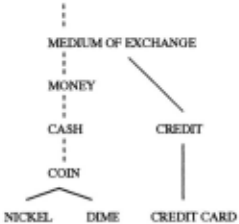
Let C be the set of concepts in an IS-A taxonomy, permit ting multiple inheritance. Intuitively, one key to the sim ilarity of two concepts is the extent to which they share information in common, indicated in an IS-A taxonomy by a highly specific concept that subsumes them both. The edge counting method captures this indirectly, sin~e if the minimal path of IS-A links between two nodes lS long, that means it is necessary to go high in the tax onomy, to more abstract concepts, in order to find a least upper bound. For example, in WordNet, NICKEL and DIME are both subsumed by COIN , whereas the most specific superclass that NICKEL and CREDIT CARD share is MEDIUM OF EXCHANGE. 1 (See Figure 1.)
1 In a feature-based setting (e.g. [Tversky, 1977]), this would be reflected by explicit shared features: nickels and
By associating probabilities with concepts in the tax onomy, it is possible to capture the same idea, but avoid ing the unreliability of edge distances. Let the taxonomy be augmented with a function p : C --+ [0, 1], such that for any c E C, p( c) is the probability of encountering an instance of concept c. This implies that p is mono tonic as one moves up the taxonomy: if c1 IS-A c2, then p(c1) :::; p(c2). Moreover, if the taxonomy has a unique top node then its probability is 1.
Following the standard argumentation of information theory [Ross, 1976], the information content of a con cept c can be quantified as negative the log likelihood, -logp(c) . Notice that quantifying information content in this way makes intuitive sense in this setting: as prob ability increases, informativeness decreases, so the more abstract a concept, the lower its information content. Moreover, if there is a unique top concept, its informa tion content is 0.
This quantitative characterization of information pro vides a new way to measure semantic similarity. The more information two concepts share in common, the more similar they are, and the information shared by two concepts is indicated by the information content of the concepts that subsume them in the taxonomy. For mally, define
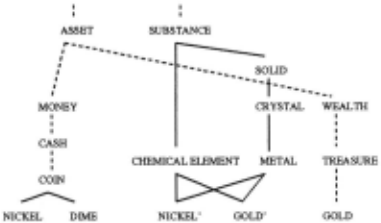
where S( c1, c2) is the set of concepts that subsume both c1 and c2. Notice that although similarity is computed by considering all upper bounds for the two concepts, the information measure has the effect of identifying minimal upper bounds, since no class is less informa tive than its superordinates. For example, in Figure 1, COIN, CASH, etc. are all members of S(NICKEL, DIME), but the con·cept that is structurally the minimal upper bound, COIN, will also be the most informative. This can make a difference in cases of multiple inheritance; for example, in Figure 2, METAL and CHEMICAL ELEMENT are not structurally distinguishable as upper bounds of NICKEL' and GOLD', but their information content may in fact be quite different.
In practice, one often needs to measure word similar-
dimes are both small, round, metallic, and so on. These fea tures are captured implicitly by the taxonomy in categorizing NICKEL and DIME as subordinates of COIN.
.. -------- F
ity, rather than concept similarity. Using s( w) to repre sent the set of concepts in the taxonomy that are senses of word w, define
where c1 ranges over s(w1) and c2 ranges over s(w2). This is consistent with Rada et al.'s [1989] treatment of "disjunctive concepts" using edge counting: they de fine the distance between two disjunctive sets of con cepts as the minimum path length from any element of the first set to any element of the second. Here, the word similarity is judged by taking the maximal infor mation content over all concepts of which both words could be an instance. For example, Figure 2 illustrates how the similarity of words nickel and gold would be computed: the information content would be computed for all classes subsuming any pair in the cross product of {NICKEL,NICKEL'} and {GOLD,GOLD'}, and the infor mation content of the most informative class used to quantify the similarity of the two words.
3 Evaluation
3.1 Implementation
The work reported here used WordNet's (50,000-node) taxonomy of concepts represented by nouns (and com pound nominals) in English. 2 Frequencies of concepts in the taxonomy were estimated using noun frequencies from the Brown Corpus of American English [Francis and Kucera, 1982], a large (1,000 ,000 word) collection of text across genres ranging from news articles to sci ence fiction. Each noun that occurred in the corpus was counted as an occurrence of each taxonomic class con taining it . 3 For example, in Figure 1, an occurrence of the noun dime would be counted toward the frequency of DIME, COIN, and so forth . Formally,
where words( c) is the set of words subsumed by concept c. Concept probabilities were computed simply as rela tive frequency :
2 Concept as used here refers to what Miller et al. [1990] call a synset, essentially a node in the taxonomy.
3 Plural nouns counted as instances of their singular forms.
where N was the total number of nouns observed (ex cluding those not subsumed by any WordNet class, of course).
3.2 Task
Although there is no standard way to evaluate compu tational measures of semantic similarity, one reasonable way to judge would seem to be agreement with human similarity ratings. This can be assessed by using a com putational similarity measure to rate the similarity of a set of word pairs, and looking at how well its ratings correlate with human ratings of the same pairs.
An experiment by Miller and Charles [1991] provided appropriate human subject data for the task. / In their study, 38 undergraduate subjects were given 30 pairs of nouns that were chosen to cover high, intermediate, and low levels of similarity (as determined using a previous study [Rubenstein and Goodenough, 1965]) , and asked to rate "similarity of meaning" for each pair on a scale from 0 (no similarity) to 4 (perfect synonymy) . The av erage rating for each pair thus represents a good estimate of how similar the two words are, according to human judgments.
In order to get a baseline for comparison, I replicated Miller and Charles's experiment, giving ten subjects the same 30 noun pairs. The subjects were all computer science graduate students or postdocs at the University of Pennsylvania, and the instructions were exactly the same as used by Miller and Charles, the main difference being that in this replication the subjects completed the questionnaire by electronic mail (though they were in structed to complete the whole thing in a single uninter rupted sitting). Five subjects received the list of word pairs in a random order, and the other five received the list in the reverse order. The correlation between the Miller and Charles mean ratings and the mean ratings in my replication was .96, quite close to the .97 corre lation that Miller and Charles obtained between their results and the ratings determined by the earlier study.
For each subject in my replication, I computed how well his or her ratings correlated with the Miller and Charles ratings. The average correlation over the 10 subjects was r = 0.8848, with a standard deviation of 0.08. 4 This value represents an upper bound on what one should expect from a computational attempt to per form the same task.
For purposes of evaluation, three computational sim ilarity measures were used. The first is the similarity measurement using information content proposed in the previous section. The second is a variant on the edge counting method, converting it from distance to similar ity by subtracting the path length from the maximum possible path length:
where c1 ranges over s(w1), c2 ranges over s(w2), MAX is the maximum depth of the taxonomy, and len(c1, c2)
4 Inter-subject correlation in the replication, estimated us ing leaving-one-out resampling [Weiss and Kulikowski, 1991], was r = .9026, stdev = 0.07.
| Similarity method | Correlation |
|---|---|
| Human judgments (replication) | r = .9015 |
| InformatiOn content | r = .7911 |
| Probability | r = .6671 |
| Edge counting | r = .6645 |
is the length of the shortest path from c1 to c2 . (Recall that s( w) denotes the set of concepts in the taxonomy that represent senses of word w.) Note that the con version from a distance to a similarity can be viewed as an expository convenience, and does not affect the eval uation: although the sign of the correlation coefficient changes from positive to negative, its magnitude turns out to be just the same regardless of whether or not the minimum path length is subtracted from (2 x MAX) .
The third point of comparison is a measure that sim ply uses the probability of a concept, rather than the information content:
where c1 ranges over s( wl) and c2 ranges over s( w2 ) in (7) . Again, the difference between maximizing 1-p(c) and minimizing p(c) turns out not to affect the magni tude of the correlation. It simply ensures that the value can be interpreted as a similarity value, with high values indicating similar words.
3.3 Results
Table 1 summarizes the experimental results, giving the correlation between the similarity ratings and the mean ratings reported by Miller and Charles. Note that, owing to a noun missing from the WordNet taxonomy, it was only possible to obtain computational similarity ratings for 28 of the 30 noun pairs; hence the proper point of comparison for human judgments is not the correlation over all 30 items (r = .8848), but rather the correlation over the 28 included pairs (r = .9015). The similarity ratings by item are given in Table 3.
3.4 Discussion
The experimental results in the previous section suggest that measuring semantic similarity using information content provides quite reasonable results, significantly better than the traditional method of simply counting the number of intervening IS-A links.
The measure is not without its problems, however. One problem is that, like simple edge counting, the mea sure sometimes produces spuriously high similarity mea sures for words on the basis of inappropriate word senses. For example, Table 2 shows the word similarity for sev eral words with tobacco. Tobacco and alcohol are similar, both being drugs, and tobacco and sugar are less simi lar , though not entirely dissimilar, since both can be classified as substances. The problem arises, however, in the similarity rating for tobacco with horse: the word horse can be used as a slang term for heroin, and as a result information-based similarity is maximized, and path length minimized, when the two words are both categorized as narcotics. This is contrary to intuition.
| n1 | n2 | sim(n1,n2) | class |
|---|---|---|---|
| tobacco | alcohol | 7.63 | DRUG |
| tobacco | sugar | 3.56. | SUBSTANCE |
| tobacco | horse | 8.26 | NARCOTIC |
Cases like this are probably relatively rare. However, the example illustrates a more general concern: in mea suring similarity between words, it is really the relation ship among word senses that matters, and a similarity measure should be able to take this into account.
In the absence of a reliable algorithm for choosing the appropriate word senses, the most straightforward way to do so in the information-based setting is to consider all concepts to which both nouns belong rather than taking just the single maximally informative class. This suggests redefining similarity as follows:
where { c;} is the set of concepts dominating both c1 and c2, as before, and L ; a(c;) = 1. This measure of similarity takes more information into account than the previous one: rather than relying on the single concept with maximum information content, it allows each class to contribute information content according to the value of a(c;). Intuitively, these a values measure relevance for example, a( NARCOTIC) might be low in general usage but high in the context of a newspaper article about drug dealers. In work on resolving syntactic ambiguity using semantic information [Resnik, 1993b], I have found that local syntactic information can be used successfully to set values for the a.
4 Related Work
Although the counting of edges in IS-A taxonomies seems to be something many people have tried, there seem to be few published descriptions of attempts to directly eval uate the effectiveness of this method. A number of re searchers have attempted to make use of conceptual dis tance in information retrieval. For example, Rada et al. [1989; 1989] and Lee et al. [1993] report experiments using conceptual distance, implemented using the edge counting metric, as the basis for ranking documents by their similarity to a query. Sussna [1993] uses semantic relatedness measured with WordNet in word sense dis ambiguation, defining a measure of distance that weights different types of links and also explicitly takes depth in the taxonomy into account .
The most relevant related work appears in an un published manuscript by Leacock and Chodorow [1994] . They have defined a measure resembling information content, but using the normalized path length between the two concepts being compared rather than the prob ability of a subsuming concept. Specifically, they define
(The notation above is the same as for equation (5).) In addition to this definition, they also include several special cases, most notably to avoid infinite similarity when c1 and c2 are exact synonyms and thus have a path length of 0. Leacock and Chodorow have experimented with this measure and the information content measure described here in the context of word sense disambigua tion, and found that they yield roughly similar results .. More significantly, I recently implemented their method and tested it on the task reported in the previous section, and found that it actually outperforms the information based measure. This led me to do a followup experiment using a different and larger set of noun pairs, and in the followup study the information-based measure per formed better. 5 The relationship between the two algo rithms will thus require further study. For now, however, what seems most significant is that both approaches take the form of a log-based (and hence information-like) measure, as originally proposed in [Resnik, 1993a] .
Finally, in the context of current research in compu tational linguistics, the approach to semantic similarity taken here can be viewed as a hybrid, combining corpus based statistical methods with knowledge-based taxo nomic information. The use of corpus statistics alone in evaluating word similarity - without prior taxonomic knowledge- is currently an active area of research in the natural language community. This is largely a reaction to sparse data problems in training statistical language models: it is difficult to come up with an accurate statis tical characterization of the behavior of words that have been encountered few times or not at all . Word similarity appears to be one promising way to solve the problem: the behavior of a word is approximated by smoothing its observed behavior together with the behavior of words to which it is similar . For example, a speech recognizer that has never seen the phrase ate a peach can still con clude that John ate a peach is a reasonable sequence of words in English if it has seen other sentences like Mary ate a pear and knows that peach and pear have similar behavior.
The literature on corpus-based determination of word similarity has recently been growing by leaps and bounds, and is too extensive to discuss in detail here (for a review, see [Resnik, 1993a]), but most approaches to the problem share a common assumption: semanti cally similar words have similar distributional behavior in a corpus. Using this assumption, it is common to treat the words that co-occur near a word as constitut ing features, and to compute word similarity in terms of how similar their feature sets are. As in information retrieval, the "feature" representation of a word often takes the form of a vector, with the similarity computa tion amounting to a computation of distance in a highly multidimensional space. Given a distance measure, it is not uncommon to derive word classes by hierarchical clustering. A difficulty with most distributional meth ods, however, is how the measure of similarity (or dis tance) is to be interpreted. Although word classes result ing from distributional clustering are often described as "semantic," they often capture syntactic, pragmatic, or stylistic factors as well.
5 In the followup study, I used netnews archives to gather highly frequent nouns within related topic areas, and then selected noun pairings at random, in order to avoid biasing the followup study in favor of either algorithm.
5 Conclusions
This paper has presented a new measure of semantic similarity in an IS-A taxonomy, based on the notion of information content. Experimental evaluation was per formed using a large, independently constructed corpus, an independently constructed taxonomy, and previously existing human subject data. The results suggest that the measure performs encouragingly well (a correlation of r = 0.79 with a benchmark set of human similar ity judgments, against an upper bound of r = 0.90 for human subjects performing the same task), and signif icantly better than the traditional edge counting ap proach (r = 0.66).
In ongoing work, I am currently exploring the appli cation of taxonomically-based semantic similarity in the disambiguation of word senses [Resnik, 1995]. The idea behind the approach is that when polysemous words ap pear together, the appropriate word senses to assign are often those that share elements of meaning. Thus doctor can refer to either a Ph.D. or an M.D., and nurse can signify either a health professional or someone who takes care of small children; but when doctor and nurse are seen together, the Ph.D. sense and the childcare sense go by the wayside. In a widely known paper, Lesk [1986] ex ploits dictionary definitions to identify shared elements of meaning - for example, in the Collins COBUILD Dictionary [Sinclair (ed.), 1987], the word ill can be found in the definitions of the correct senses. More re cently, Sussna [1993] has explored using similarity of word senses based on WordNet for the same purpose. The work I am pursuing is similar in spirit to Sussna's approach, although the disambiguation algorithm and the similarity measure differ substantially.
@inproceedings{ijcai1995p59,
  title     = {Using Information Content to Evaluate Semantic Similarity in a Taxonomy},
  author    = {Resnik, Philip},
  booktitle = {Proceedings of the Fourteenth International Joint Conference on
               Artificial Intelligence, {IJCAI-95}},
  publisher = {International Joint Conferences on Artificial Intelligence},
  editor    = {Chris S. Mellish},
  pages     = {448--452},
  year      = {1995},
  note      = {Cognitive Modelling},
  url       = {https://ijcai.org/proceedings/1995/59},
}
TY - CPAPER TI - Using Information Content to Evaluate Semantic Similarity in a Taxonomy AU - Resnik, Philip T2 - Proceedings of the Fourteenth International Joint Conference on Artificial Intelligence, IJCAI-95 PB - International Joint Conferences on Artificial Intelligence PY - 1995 SP - 448 EP - 452 UR - https://ijcai.org/proceedings/1995/59 ER -Copied
Machine-readable versions of this paper, for tools and AI agents:





