
A Microfeature Based Approach Towards Metaphor Interpretation
Proceedings of the Fourteenth International Joint Conference on Artificial Intelligence. Cognitive Modelling. Pages 424-430.
© 1995 International Joint Conferences on Artificial Intelligence
Abstract
This paper advocates a microfeature based approach towards developing computational models for metaphor interpretation . It is argued that the existing models based on semantic networks and mappings of complex symbolic structures are insufficient and inappropriate for modeling metaphors. A connectionist model of metaphor interpretation based on microfeatures is presented, which tries to take into account some important issues, such as accurate capturing of similarity, automatic formation of features , contextual effects, elimination of long paths in conceptual hierarchies, salience imbalance , and feature enhancement . Some of these issues have broad implications in cognitive modeling.
- L. Barsalou, (1989). Intraconcept similarity and its im- plications. in Similarity and Analogical Reasoning, Cam- bridge U. Press.
- M. Black, (1955). Metaphor. Proc.of the Aristotelian Society.
- T. Eskridge, (1992). A hybrid model of continuous ana- logical reasoning. In Advances in Connectionist and Neural Computation Theory II. Ablex D. Fass, (1991) . Met: A method for metonymy and metaphor. Computational Linguistics, 17(1)
- G. Lakoff and M. Johnson, (1980). The metaphoric structure of human conceptual system. Cognitive Sci- ence, 4, 193-208.
- T. Lange and C. Wharton, (1992). REMIND: retrieval from episodic memory. Advances in Connectionist and Neural Computation Theory II. Ablex E. R. MacCormac, (1988). A Cognitive Theory of Metaphor. MIT Press.
- J. Martin, (1988). A Computational Theory of Metaphor. Ph.D Thesis, University of California, Berke- ley.
- A. Ortony, (1979). Beyond literal similarity. Psycholog- ical Review. 86(1), 161-180.
- R. Schank, (1977). Scripts, Plans and Goals. LEA.
- R. Sun, (1992). On variable binding. Connection Sci- ence. 2, 93-124.
- R. Sun, (1993) . An efficient feature-based connectionist inheritance scheme, IEEE Transaction on SMC, 23(2).
- R . Sun, (1995). Robust reasoning. Artificial Intelli- gence. June.
- R. Tourangeau and R. Sternberg, (1982). Understanding and appreciating metaphors. Cognition. 11, 203-244.
- T. Veale and M. Keane, (1992). Conceptual scaffolding. Computational Intelligence, 8(3) 494-519.
References were extracted automatically from the PDF and may contain errors.
Full text extracted automatically from the PDF; figures, tables and equations may differ. The PDF is the version of record.
1 Introduction
Metaphor is an important cognitive phenomenon,. and. it is of great interest to AI, philosophy, psychology, hngms tics and literary studies. In fact there has been a surge of i~terests in the past few decades in the philosophy and linguistics communities in the nature and the pro cess of metaphor interpretation; more recently, there are also increasingly more interests in the AI community in non-literal language and analogical reasoning, in both of which metaphor occupies a prominent place. Among the voluminous studies of metaphor, computational models are relatively few. Most existing computational models of metaphor are based on semantic networks and map pings of complex symbolic structures, or in other words, based entirely on the traditional symbolic AI methods. I would like to argue that such symbolic models are in sufficient and inappropriate for modeling metaphor in general , on the basis of a number of important consider ations. I will instead propose a microfeature based (con nectionist) approach towards developing computational models for metaphor interpretation.
2 Semantic Network Based Approaches
Most existing models of metaphor interpretation take semantic network based approaches: they represent the requisite linguistic (and world) knowledge in some kinds of semantic networks with hierarchically struc tured concepts, and metaphor interpretation is acc~m plished through traversing and mappi.ng.th~ ~ierarchical conceptual structures in some ways. Similanties of words and other linguistic entities are computed from struc tural relations among entities within a hierarchy. Such models (especially, for example, Martin 1988 and F~ 1991) achieved certain successes within limited domams and/or strictly controlled environments. However, there are many valid questions and objections to these models.
Let us look into some representative existing models. Martin (1988) presents a system for dealing with con ventional metaphors, i.e., metaphors that reflect a core set of correspondences that can manifest in various ways (Lakoff and Johnson 1980). For example, "How can I enter Emacs?" or "I am in Lisp", where a computer pro gram is uniformly viewed as an enclosure. His syste~ consists of large semantic networks with conceptual hi erarchies and a set of procedures that operate on them. When a verb (e.g. enter) is found to be incompatible with (violating some constraints of) the object (e.~. Emacs), a procedure is called to find a coherent ~appmg bet~een the domain of the verb and the domam of the obJect, from a core set of conventional metaphors stored in the system; once such a mapping is found, the .verb in the source domain is mapped into a correspondmg concept in the target domain (i.e., a concept suitable for the ob ject, e.g. invoke Emacs) . New variations of known con ventional metaphors can also be handled, through de tecting their similarity to existing ones by finding a p~th through the conceptual hierarchy between the new In stance and the known instances. For example, once the system knows "I am in Lisp", it can a~so make sense. of "I am in Emacs" by finding the relatwn between Lisp and Emacs in the hierarchy (the sibling relation in this case since they are both computer programs) .
V~ale and Keane (1992) deal also with conventional metaphors. They divide the interpretation process into two steps: first a scaffold of core (semantic network) structures is constructed in accordance with some con ventional metaphors which is already known and stored in the system; then the structure is fleshed out with de tails, from general world knowledge and/or the c~ntext. What attributes to transfer from the source domam (e.g. physical enclosures) to the target domain (e.g. comput~r programs) and their respective pre-conditions for vahd transfers are specified a priori.
Fass (1991) views metaphor as the existence of con straint violation as well as a set of correspondences be tween a source domain and a target domain. The repre sentation is based on a kind of semantic network, where graph search algorithms find different types of paths be tween different concepts represented in "semantic vec tors", which include constraints and preferences that are used to keep mappings coherent.
The shortcomings of these models are as follows:
- In semantic networks, conceptual hierarchies require hand-coding, In any domain of realistic sizes, this poses a serious problem for practical reasons - the difficulty of knowledge acquisition in system build ing.
- A more serious problem is that such semantic net works are often made up of ad hoc concepts and hierarchies, that is , hierarchies specifically designed for one particular kind of circumstance or only for the purpose of getting one particular result (in the current context, for generating plausible interpreta tions of test examples of metaphors) .
- A related problem is the fixedness of such hier archies. Conceptual hierarchies are explicitly and manually constructed a priori . However, in cogni tion, at least. some concepts (if not all) can be more flexible; that is, they can have one or the other superordinate concept, depending on (1) the cur rent context (e.g., contextual priming; cf. Barsalou 1989) , (2) the current goals (cf. Schank 1977), and (3) even personal , idiosyncratic connections (i.e., individual differences; cf. Barsalou 1989). Thus a more flexible representation is required.
It may be argued that this problem can be remedied by introducing some new components to a semantic network that can modify the connections on the fly in accordance with various factors. Although this is theoretical possible, semantic networks are noto riously complex and difficult to modify, even stati cally, let alone dynamically. Therefore, it seems that some fundamentally different approaches are called for .
- With semantic networks, it may also be difficult to find certain information, and complex search algo rithms are required. Such algorithms typically trace links in various ways. One ramification of this is that time required to process the relations between two concepts is proportional to the length( s) of the path(s) petween the two concepts, which does not seem plausible cognitively. This is especially troubl some, considering the ad hoc-ness of the conceptual hierarchies as mentioned before.
There are some more specific issues that are directly re lated to metaphor interpretation:
- Similarity in these models, which is necessary for determining the relation between two concepts, is determined mainly from the sibling relation between the concepts involved. This may not be flexible enough. For example, whales are closer in a con ceptual hierarchy to bears (both can be represented
as siblings, with mammals as their parent), but in a metaphor whales may be closer to sharks instead, based on some of their attributes prominent in the context . In other words, similarities in metaphor may not reflect , or be restricted to, conceptual hier archical structures , especially when such structures are artificially and inflexibly constructed.
- Another way of capturing similarities is to have ex plicit links in semantic networks that directly indi cate pair-wise similarities ( cf. Eskridge 1993). The problem with such an approach is the complexity of representation: everything is somehow similar to ev erything else in some ways, and therefore there may need to be pair-wise connections between (almost) every pair of concepts. The number of similarity links is thus 2 * c~ = n * (n- 1), where n is the to tal number of concepts. This is much too complex representationally, and is even more so dynamically (for search algorithms to go through) .
- Most importantly, metaphor cannot be simplisti cally construed as constraint violation, structural mapping, or selective inference - there is more to it. In interpreting metaphors, certain subtle senses are brought up from metaphoric interaction (Black 1955) . Such senses are not apparent from mapping structures across domains; consequently they are not dealt with in many existing models. An example will help to illustrate the issue: in Martin's model, the metaphoric use of the word enter as in "How can I enter Emacs?" is mapped to invoke based on the structural correspondence of [agent of entering = agent of invoking] and [the place to enter = the program to invoke]. However, what is missing is the sense inherent in the metaphor of getting into an enclosure of some sort , and therefore the model also misses the sense that an agent is now able to access everything inside but is insulated somewhat from everything outside. These senses are strong in the word enter, but not in the word invoke. Through metaphor, a new sense is added (transferred) to the target domain, from the interaction with the source domain.
An even more illustrative example is from Ortony (1989): "Billboards are warts." In this metaphor, one of the prominent features in the source domain, the ugliness of warts, is transferred to the target domain to achieve the effect of "billboards are as ugly as warts". And in this process, the ugliness of warts is becoming even more prominent in the source domain.
3 A Microfeature Based Approach
Now I want to argue that a radically different approach, a microfeature based approach, can better deal with these problems, and can thus produce better computa tional models of metaphor interpretation.
Let us look into microfeatures. Many connectionist models emphasize "distributed" representation that em ploys fine-grained meaning elements, microfeatures, for capturing the meaning/semantics of concepts, in addition to, or instead of, explicit conceptual links. Such microfeatures can either be extracted manually from (macro-level) domain theories, such as in Sun (1995), or acquired through applying learning algorithms that automatically develop a fine-grained internal (uninter pretable) representation.
Representations with microfeatures have some inter esting properties that are especially relevant in the cur rent context. Firstly, with such representations, we do not have some of the ad hoc-ness of hand-coded hierar chies, because we no longer make arbitrary design de cisions. Secondly, because the representation is "flat tened" (i.e. there is no path to trace), the problem of the complexity of search algorithms and the time needed to traverse links is no longer existent. Thirdly, microfea ture representations tend to be more context sensitive, and are thus more flexible. Fourthly, similarities are easy to compute with microfeature representations; vari ous similarity measures can be implemented with slightly different node activation functions and link weights (see Sun 1995 for details), without either explicit similarity links or explicit conceptual hierarchies. Lastly, although there is no explicit hierarchies, hierarchies can neverthe less be embodied in microfeatures and used in inference, as demonstrated by Sun (1993).
The question now is exactly how we use microfeature based representations for metaphor interpretation in a computational architecture. One possible candidate ar chitecture is CONSYDERR (Sun 1995), a connectionist architecture that utilizes both localist and distributed representation and embodies all of the aforementioned properties of microfeature based representation. It is meant to be a comprehensive model of robust common sense reasoning, and as such, it should be able to handle metaphor and non-literal language as well.
The most important idea behind CONSYDERR is the two-level dual-representation scheme, that is, there are two parts (levels) in the model: one is localist, repre senting concepts as individual nodes, and the other is dis tributed, representing concepts as microfeatures (hence the dual representation). There are two-way connec tions between each pair of corresponding representations across levels. The working of the model is divided into three phases. In the top-down phase, the computation is as follows:
where ai is any node in the top level (the concept level, or CL) and x; is its microfeature (in the microfeature level, or CD). In the settling phase, the computation is as follows:
and
where Wk 's and Wk 's are intra-level links weights, and Ik 's and ik 's are the activations of related nodes. 1 In
1 This phase will not be used in the present work.
the bottom-up phase, the computation is as follows:
where ai is any node in the concept level, Fai is its mi crofeature set, and IF a; I is the size of the m1crofeature set. Through the interaction of the two levels, many difficult patterns in commonsense reasoning can emerge naturally (Sun 1995).
Now the question is as follows: How can we utilize this model to implement a microfeature-based computational model of metaphor? There are some existing theories that we may draw upon regarding detailed metaphoric interaction. 2 Ortony (1979) posited a theory of metaphor based on salience imbalance and attribute en hancement: as touched upon before, a metaphor en hances, or highlights, some attributes in the target do main that are highly salient in the source domain but are far less salient in the target domain; therefore something new will be produced in the target domain as a result of the metaphor (so in some sense, we can say that some highly salient attributes get transferred from the source domain to the target domain).
There are, however, many unanswered questions and unspecified details that need to be looked into. For one thing, the idea of "attributes" needs to be better char acterized: What constitutes an attribute? How can we ascertain if a concept has a certain attribute or not? What is the proper granularity of such attributes? and so on. Another related question is how attributes of different concepts are compared: How corresponding at tributes are found (Tourangeau & Sternberg 1982), and how similarities between these attributed are determined (as touched upon in Ortony 1979 under the ru~ric of at tribute inequality), since slightly different attnbutes can be matched, or one can be converted into another asap propriate when transfers occur. If we start to allow cer tain structures among attributes in order to handle such matches then we open the door back to the full-fledged semanti~ networks, which has already been shown as in appropriate.
Another particularly important issue in relation to this theory is what attributes should or should not get transferred from the source domain to the target do main, since surely not all the highly salient attributes in the source domain can be transferred. So the ques tion is how the selection can be done. One question that I raised earlier in relation to semantic network based approaches is also relevant here and is not dealt with in Ortony's theory: How does the context affect the salience of attributes of a concept and thus affect the outcome of metaphoric interaction? Certainly the claim that the salience of each attribute will stay the same always, re gardless of circumstances, is an indefensible position.
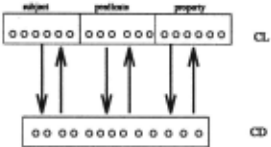
The solution below, albeit a little simplistic, captures the basic ideas discussed above. In CONSYDERR, a Note that there are three separate segments of nodes for the subject and the predicate of an input sentence and for the properties.
2 The interaction of the two semantic domains of the two terms involved is hypothesized by Black (1955) to be the main factor underlying metaphor interpretation. This work is based on the belief that the process can be captured in micorfeatures.
tation
layer of nodes ( CL) is established for representing con cepts in a domain, including physical objects and their properties (e.g., big, billboard, etc. as in "the billboards are big" ), and another layer (CD) is established for rep resenting microfeatures that may be needed in processing the meaning of metaphoric (and non-metaphoric) state ments. The weight on a link from a concept node to a microfeature node represents the salience of that mi crofeature in relation to the concept. What we want to achieve is the following: When a predicate metaphor, such as "Billboards are warts", is presented to the con cept layer by the activation of the nodes for "billboard" and "wart" , these activated nodes in turn activate the re lated microfeature nodes in CD, and then, through non linear interaction in the microfeature layer, a proper in terpretation emerges in the form of proper activations (that is, those and only those microfeatures involved in the final interpretation remain activated); these ac tivated microfeatures will then go back up to activate the proper nodes in the concept layer that represent the proper interpretation of the metaphor ("ugly" in this case) . See Figure 1 for a sketch of the model.
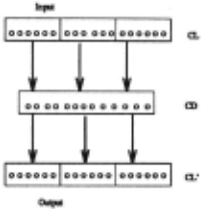
I will start tabula rasa, without hand-coding any a pri ori knowledge of microfeatures and concepts. Thus the knowledge must be acquired through learning. I first fully connect the two layers with small random initial weights, in order for them to develop proper connectiv ity patterns through data presentation using connection ist learning procedures. Although there is apparently no readily applicable learning algorithm for such a two-layer three-phase model, we can "unfold" the model to come up with an equivalent three-layer model by duplicating the concept layer and having the duplicated layer carry the bottom-up weights (while the original concept layer retain its top-down weights) . The input activations in the training data will be applied to the original concept layer and the output activation representing the right interpretation of the input will be applied to the dupli cated concept layer. See Figure 2. Since the metaphoric interaction is rather complex (Ortony 1979, Black 1955) a linear combination operation may be insufficient . To improve the processing power , I adopt a sigmoidal acti vation function instead of the operations specified ear lier. Now the backpropagation algorithm can be ap plied directly to update the two sets of weights, until the correct interpretation is obtained for each training case. Proper microfeatures are developed in the meantime. The weights acquired in the end represent the salience of the respective microfeatures formed in the CD layer.
An example test domain is as follows. There are two sets of concepts: one set includes five facial objects and the other includes four land objects (see Figure 3). Each object has a number of properties, which should be acti vated properly upon the presentation of a corresponding objects. All the properties together form another set of concepts. Each of the above three sets is represented by a corresponding collection of concept nodes in the CL layer of the model. The interpretation of the meaning of each object concept is based on the properties listed in Figure 4. Metaphoric statements are constructed sys tematically from applying a concept from one set of ob jects to another concept from the other set, such as
Billboards are warts
Warts are billboards
Noses are gates
Gates are noses
including all the possible combinations (there are 2 * 4 * 5 = 80 of them) . A subset of these constructed state ments is used for training, and the rest for testing. With the resulting network, given the sentence "Billboards are warts" , the node in the subject segment of the concept layer representing "billboard" is activated and the node in the predicate segment representing "wart" is also acti vated; with these input activations, during the top-down phase, some of the microfeatures in the bottom layer are activated in response to the top-down activation flow; then in the bottom-up phase, those activated microfea tures in turn activate the proper nodes in the property segment of the top layer, which in this case include, most prominently, "ugly". Therefore the resulting interpre tation is "billboards are ugly", among some other less prominent properties. See Figure 5 for more examples of metaphor interpretation.
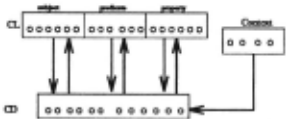
There is another issue that is worth mentioning. Con text can force changes in feature salience; that is, a mi crofeature that is very prominent in one context can be negligible in another. I need a way to modulate microfea ture salience (i.e., weights), which can be accomplished by including an extra set of nodes (a context module) in the concept layer, which receives inputs and sends out signals that change the weights on the link connecting concepts and their corresponding microfeatures. In other words, these signals are used to manipulate or modu late microfeatures on the fly (Sun 1995). This change (or modulation) is done by higher-order links (three-way connections) of concepts and microfeatures; that is, the link weight between a concept and a microfeature is:
| big man-made ill ugly facial breathing flat standing-up protective obvious non-sense | medmm natural healthy beautiful on-ground smelling protrusive surrounding advertising making-sense | small hearing covering entering |
| Billboards are warts | ugly |
| Warts are bill boards | obvious |
| Ears are gates | entrance |
| Gates are ears | hearing |
where We is a modulation signal from the context mod ule. See Figure 6. The same idea in developing training procedures is again applied, by unfolding the architec ture into multiple layers and by handling the updating of high-order weights (details omitted) .
4 Further Steps
This model produces the desired outcomes, through han dling the metaphoric interaction by two sets of non-linear (sigmoidal) operations successively applied, which have been shown to be able to approximate any measurable function and are thus sufficient for the purpose. How ever, we may want a more linear and more precise char acterization.
In the interest of specifying the detailed operations of metaphoric interaction, I propose to use a process that involves enhancement. That is, we selectively enhance the links between the target concept and some of its microfeatures (this is similar in a way to "slippage" as proposed by Hofstadter) . In accordance with the the ory of salience imbalance (Ortony 1979), these micro features selected to be enhanced are among those that have strong links with the source concept (i .e., highly salient for the source concept) but weak links with the target concept . After the enhancement, there will be some highly salient microfeatures shared by both the source concept and the target concept (so these micro features have been transferred), which is not the case before the enhancement (provided that the statement to be interpreted is metaphoric; Ortony 1979) . 3
To perform enhancement, let us go back to the original CONSYDERR architecture: without the sigmoidal op erations, the concepts/microfeatures relations are once again transparent . Enhancement can then be accom plished by setting up links with high weights between the target concept and the microfeatures that have strong connections with the source concept, with each weight proportional to (a function of) the corresponding weight between the microfeature and the source concept and the original weight between the microfeature and the target concept. That is,
when wjk and wj; are of the same sign, where n, a, {31, and fJ2 are parameters, i is the currently activated tar get concept, k is the currently activated source concept, and j is the microfeature in question. These parameters can be chosen in such a way that ( 1) the first fraction will have a steep slope (when {31 is large), because only those microfeatures of the source concept that are highly salient can get transferred, and (2) the second fraction will have a gentle and low slope (when fJ2 is small and n is used to compress its range) , because we want the amount of transfer to correspond, to a small degree, to the original weight between the target concept and the microfeature in question since that weight represents a propensity of the target concept to obtain that micro feature. (Therefore, we have fJ1 > > fJ2.)
With this update rule, if the source weight (w}k) and the target weight ( wj 1 ) are both high, then the target weight will basically remain the same, as it should be in case the statement is a literal comparison; if both are low, there will be very little enhancement as expected; if the target weight is high and the source weight is low, there will be little enhancement; if the source weight is high and the target weight is low, there will be significant enhancement; in this last case, however, the higher the target weight the more enhancement there will be (up to a certain limit).
With the enhanced top-down links from the target concept (and without the source concept) , the three phases of CONSYDERR are reenacted. From this three-phase cycle, some properties representing possible interpretations will be activated, in the end, in the prop erty segment of the CL layer. We then use the most strongly activated properties as the interpretation of the metaphor .
3 According to Ortony (1979), if the source concept and the target concept originally share some highly salient fea tures, then the statement will not be metaphoric, but a sim ple literal comparison. Metaphors occur when none of those highly salient features of the source domain are highly salient features of the target domain.
5 Discussions
Going back to the issues raised earlier, we see that the model fare well in all of these aspects:
- First of all, with the microfeature based approach there is no need for complex search algorithms and the time needed to reach a conclusion is not depen dent on the path length between them. Simple mi crofeature transformation generates the equivalent of complex search behavior without actually per forming the search (see Sun 1993 for more details).
- There is no hand-coding that creates arbitrary con ceptual hierarchies; rather, conceptual structures are embedded in microfeature representation and, more importantly, are extracted from data.
- The microfeatures themselves are not arbitrar ily chosen either; they are formed automatically through learning correct mappings.
- Because such automatic formation of microfeatures, they naturally capture the similarity of concepts, as demonstrated by the resulting correct interpre tations in the experiments.
- Because of automatic formation of microfeatures, attribute inequality is avoided, since there will be automatic decomposition of attributes to micro features that capture similarities among attributes through distributed representation.
- The models are capable of highlighting certain as pects of the target domain by transferring highly salient features from the source domain in metaphor interpretation. Thus, metaphors are not simply con straint violation, mapping between domains, or se lective inference (although these are all integral part of metaphor interpretation and are embodied in the model).
- The effect of context is taken into consideration in the model; with microfeature, this effect can be re alized by context modules and high order links.
There exist other related connectionist models (see, e.g. , Eskridge 1993, Lange and Wharton 1993). These models are mostly localist, and as such, they are more akin to semantic network based approaches than to the microfeature based approach proposed in the present work. These models, however, do have some noteworthy features; for example, they allow very complex struc tures in their representations and they compute and uti lize complex structural correspondences (e.g., Eskridge 1993). They are also capable of explicitly expressing goals and plans , I should note that these representa tions are possible in CONSYDERR, since it has a lo calist level ( CL) that can readily implement the afore mentioned structures (as in Sun 1992).
One advantage of the models proposed is that they em ploy the same mechanism for both metaphoric or literal statements. Metaphors are not viewed as an extrane ous process serving only ornamental purposes. Since the model presented here is a variation of CONSYDERR, which is a unified model of various kinds of common sense reasoning, ranging from inheritance reasoning (Sun 1993) to evidential causal reasoning (Sun 1995) and to similarity-based induction (Sun 1995), the model is in tegrative and not ad hoc. Some of the issues addressed in this work are also applicable to other areas.
Moreover, because of the possibility of incorporat ing structural correspondences and structural similari ties into CONSYDERR, it is possible to extend the proposed models of metaphor interpretation to deal with more sophisticated kind of analogy and analogical rea soning (involving complex relations). Some work is cur rently being carried out in this direction.
Acknowledgements
I thank John Barnden and Larry Bookman.
@inproceedings{ijcai1995p56,
  title     = {A Microfeature Based Approach Towards Metaphor Interpretation},
  author    = {Sun, Ron},
  booktitle = {Proceedings of the Fourteenth International Joint Conference on
               Artificial Intelligence, {IJCAI-95}},
  publisher = {International Joint Conferences on Artificial Intelligence},
  editor    = {Chris S. Mellish},
  pages     = {424--430},
  year      = {1995},
  note      = {Cognitive Modelling},
  url       = {https://ijcai.org/proceedings/1995/56},
}
TY - CPAPER TI - A Microfeature Based Approach Towards Metaphor Interpretation AU - Sun, Ron T2 - Proceedings of the Fourteenth International Joint Conference on Artificial Intelligence, IJCAI-95 PB - International Joint Conferences on Artificial Intelligence PY - 1995 SP - 424 EP - 430 UR - https://ijcai.org/proceedings/1995/56 ER -Copied
Machine-readable versions of this paper, for tools and AI agents:





