
Hierarchical Plan Merging with Application to Process Planning
Proceedings of the Fourteenth International Joint Conference on Artificial Intelligence. Planning. Pages 1677-1684.
© 1995 International Joint Conferences on Artificial Intelligence
Abstract
We have developed a domain-independent systematic methodology for plan merging at the various levels of plan abstraction. This method manifests itself in the hierarchical plan graph where each level contains a complete, partially merged plan. The principle advantage of this approach is that, once external interactions between nodes on a given level have been estab.lished, the continued merging of ~he plan fragments in one node can take place zndependently of plan fragments in other nodes on that level. This provides a decomposition or divide-andconquer approach to plan merging. Another advantage to this decomposition approach is that replanning effort is minimized in the presence of the selection of alternative actions at some level of the hierarchical plan graph. Only those plan fragments which are in the same branch as the alternative selection need be considered for replanning. Also, an algorithm is proposed which takes a bilateral approach to breaking cyclic dependencies between nodes in the hierarchical plan graph. We demonstrate the utility of this hierarchical approach to plan merging through examples in .the process planning domain.
- [Britanik and Marefat, 1995] J . Britanik and M. Mare- fat. Case-based manufacturing process planning with knowledge sharing support . Submitted for journal pub- lication, 1995.
- [Britanik, 1994] John Britanik. Hierarchical plan merg- ing. Technical report, Intelligent Systems Laboratory, Department of Electrical and Computer Engineering, University of Arizona, 1994.
- [Foulser et a/., 1992] David E . Foulser , Ming Li, and Qiang Yang. Theory and algorithms for plan merg- ing. Artificial Intelligence, 57:143-181, 1992.
- [Hayes, 1989] Caroline Clarke Hayes. A model of plan- ning for plan efficiency: Taking advantage of operator overlap. In International Joint Conference on Artifi- cial Intelligence, pages 949-953 , 1989. IJCAI
- [Karinthi et a/., 1992] Raghu Karinthi, Dana Nau, and Qiang Yang. Handling feature interactions in process- planning. Applied Artificial Intelligence, 6:389-415 , 1992.
- [Mantyla and Opas, 1988] Martti Mantyla and Jussi Opas. HUTCAPP -a machining operations plan- ner. ln Robotics and Manufacturing, pages 901-910 . ASME, November 1988.
- [Marefat and Kashyap, 1992] M. Marefat and R.L . Kashyap. Automatic construction of process plans from solid model representations. IEEE Transactions on Systems; Man, and Cybernetics, 22(5):1097-1115, September/October 1992.
- [Yang et a/., 1992] Qiang Yang, Dana S. Nau, and James Hendler. Merging seperately generated plans with restricted interactions. Computational Intelli- gence, 8( 4) :648-676 , 1992.
References were extracted automatically from the PDF and may contain errors.
Full text extracted automatically from the PDF; figures, tables and equations may differ. The PDF is the version of record.
1 Introduction
A common approach to planning is to make the lin ear assumption by decomposing the problem into sub problems and planning for each subproblem indepen dently. The resulting subplans are combined into the final plan via plan merging techniques [Hayes,1989; Karinthi et al. ,1992]. Plan merging consists of uni fying separately generated plans into one global plan while obeying the constraints due to interactions within and between the individual plans. Merging is typ ically done in a complex manner such that all ac tions of all the subplans are considered simultaneously in their lowest-level representation [Foulser et al.,1992; Karinthi et al.,1992].
· email: britanik@ece.arizona.edu
t email: marefat@ece.arizona.edu
'The support <;if this work by the NSF under grant DDM9210018 to Dr. Marefat is gratefully appreciated.
Our approach involves a hierarchical plan graph whi~h we use to develop a domain-independent systematic methodology for plan merging at different levels of plan abstraction. The hierarchical plan graph is broken into levels where each level contains a partially merged plan called a subplan sequencing graph . This approach de composes the plan merging problem in that, once ex ternal interactions between nodes on a given level have been established, the continued merging of the plan frag ments in one node can take place independently of plan fragments in other nodes on that level. In the presence of the selection of alternative actions at some level of the hierarchical plan graph, this decomposition approach minimizes replanning effort . Only those plan fragments which are in the same branch as the alternative selection need be considered for replanning. We also develop a method for breaking cyclic dependencies between nodes in the subplan sequencing graph.
We demonstrate the utility of this hierarchical ap proach to plan merging through examples in the pro cess planning domain. The planning system consists. of two major components: 1) a case-based planner wh1ch generates feature subplans [Britanik a~d M~refat,~995], and 2) a plan merging component wh1ch hierarchical~y merges the feature subplans into a global pl~n . We .w1ll not discuss the case-based planner here. It 1s suffic1ent to note that the case-based planner generates process plans for each feature in the part, along with a list of in teractions between the individual feature plans and plan fragments. The hierarchical plan merging component is the subject of the remainder of this paper .
1.1 Definitions
Before discussing hierarchical plan merging (HPM), we need to discuss what a plan is and define our notion of plan merging.
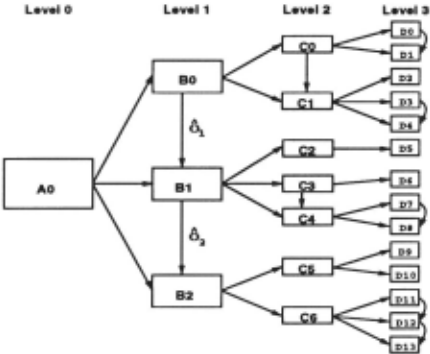
A hierarchical plan graph (HPG) is a directed graph of plans such that each level represents a plan at some level of abstraction. Figure 1 shows a generic hierarchi cal plan graph. Each node at a given level of the HPG represents a subplan of the plan at that level. The root node represents the initial set of individual plans. The leaf nodes represent the fully merged plan. A directed arc is drawn from node X on level i to node Y on level i + 1 if node Y contains a component from node X . A directed arc is drawn from node M to node N on the same level if there is a constraint between a component of node M and a component of node N that can be re solved by sequencing node M before node N. Nodes at subsequent levels of the HPG must obey the orderings in troduced at the previous levels. The key property of the hierarchical plan graph representation is that the merg ing of the components of a node takes place in a manner independent of the other nodes on the same level.
At any level of abstraction, we view a plan, P, as a set of actions, A, along with a set of orderings, 0, which sequence the actions in A. Thus P = {A, 0} and A= {a1,a2, ... ,an} where a, are actions (possibly abstract actions), and 0 = { 01, o2, ... ,om} such that o, = ( ai -< ak) which represents the fact that action ai must precede action ak in the plan.
In our approach, the goal of plan merging is to combine the separate subplans into a global plan while minimiz ing the cost of the global plan. We reduce cost during the merging operation by eliminating redundant actions. Let M denote the set of actions in all plans that can be merged into one action a', and let P, = {A,, Os} = {ail , a12, ... , a,n; 011,012, ... ,Dim}, then P' ={A', 0'} such that A'= [lJ?=1 A,]-{M}+a', and 0' ~ [Uj=1 o,] U6
where 6 are called external orderings since they repre sent the orderings between actions in different subplans. Likewise, the O, are called internal orderings since they represent the orderings between actions in the same sub plan at a given level.
1.2 Guide to the paper
To emphasize that our methodology is domain independent, we first present the general theory in sec tion 2. Then we show how this theory can be applied through a detailed process planning example in section 4. Section 3 briefly discusses how our approach can yield savings in replanning cost. Section 5 reviews directly re lated work, and section 6 concludes the paper.
2 High-Level Merging Algorithm
At each merging level of the hierarchical plan graph, the same high-level merging algorithm is used to generate the next level in the graph. The algorithm involves two primary steps: 1) building a minimal subplan sequenc ing graph, and 2) removing any cycles from the subplan sequencing graph. ·
2.1 Generating a minimal subplan sequencing graph
A subplan sequencing graph is a directed graph, G = (N, E) , where each node, n, E N is a subplan which contains the result of merging two or more actions from the preceding node on the previous level. A directed edge e, E E is drawn from node ni to node nk if there is an external ordering 6, such that some component in ni must be completed before some component in nk . An example of a subplan sequencing graph is shown in Ievell of figure 1. BO, B1, and B2 are subplans which are sequenced by the orderings 61 = (ano -< aBl) and 62 = (aBl -< aB2) where am is an action in node Bi.
The generation of the nodes in the sub plan sequencing graph is dependent on the domain in two ways. First, domain-specific information is used to determine the ac tions to be merged at the graph level of interest. Second, the criteria to determine whether two actions are merge able are also domain specific. Assuming we have such information, we can use the following 3-step algorithm for generating a near-minimal number of nodes in the subplan sequencing graph: 1) generate a set of maximal nodes that cover all possible mergings of actions from the previous level in the HPG, 2) produce a near min imal covering of the actions from the previous level, 3) generate edges which correspond to external orderings between nodes.
To generate the set of maximal nodes, first a new node is created for each action type or mergeability type to be considered at this level. Next, components or plan fragments from the previous level are placed in each node, provided they are mergeable with that node's ac tion type.
We now have a set of nodes, each of which contains plan fragments that can be merged together. A greedy approach is used to find the near-minimal covering of plan fragments in the maximal nodes 1 . First the largest node (ie: the node which contains the largest number of plan fragments) is chosen. Each plan fragment contained in the largest node is removed from all other nodes. Then the next largest node is chosen, and so on until there are no non-empty nodes remaining unselected (until a cov ering is achieved by all of the selected nodes) . Figure 2 shows the algorithm to generate a minimal covering from the set of maximal nodes using this greedy approach.
We can improve the above greedy algorithm by check ing for the case where all of the plan fragments in a node are mergeable with other nodes in the minimal covering. We take advantage of the following lemma.
1 In [Britanik,l994], we compare this approach with two optimal approaches. This greedy approach was found to be efficient and near-optimal.
Greedy-FindMinimalCover
S +-- set of maximal nodes MIN+-- 0 While S :f; 0 do : \( f.JELARGEST[ \r' ··· es [ if f E s then s +-- s - f endif if s = 0 then S = S - s endif ]] LARGEST +-- a : a E S and V'.,.es( lal ~ lsi] S +-- S- LARGEST MIN+-- MIN+ LARGEST end WhileLemma 1 If there exists a case where all of the plan fragments in a node, N, are mergeable with other nodes, {ON}, in a minimal covering generated by the algorithm of figure 2, then INI > lnl, Vn [n E {ON}]. Proof: The proof is contained in [Britanik,1994J.
The result of the lemma is that we only need to check those nodes that have cardinality less than the cardi nality of the node of interest. This can be done for all nodes, n;, in 0( n 2 ) time.
In the subplan sequencing graph, a directed edge is drawn from node N to node M if node N contains a fragment that must be sequenced before a fragment con tained in node M. If an edge already exists between the two nodes, then the ordering is added to the ordering list for that edge (the ordering list is the edge label) . If one maintains an explicit list of orderings of plan frag ments, then the edges could be generated in O(K) time where K is the total number of orderings. After generat ing edges in the subplan sequencing graph, it is possible that cycles may exist in the graph.
2.2 Removing cycles from a subplan sequencing graph
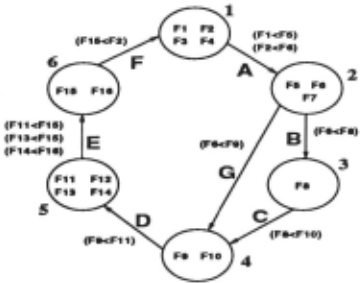
Cycles prevent us from determining an ordering between plan fragments ; therefore, they must be removed. But before cycles can be removed, they must first be detected and enumerated. The cycle enumeration algorithm is a straight-forward depth-first search algorithm which ex plores each edge of the subplan sequencing graph and reports cycles when it encounters a node more than once along a path. This algorithm runs in O(E) time, where E is the number of edges (external orderings) in the graph, since every edge in the graph is explored exactly once. Once we have found all of the cycles in the subplan se quencing graph, we need to remove them by deleting or relocating specific edges in the graph. This is done by moving plan fragments from one node to another node. The choice of which edge to break in a cycle depends on three factors: 1) the number of cycles to which the edge belongs, 2) the number of plan fragment moves required to remove the edge, and 3) the number of references to the plan fragment that would be moved. A reference to a plan fragment is simply the appearance of that frag ment in the label of another edge in the graph. Consider the example subplan sequencing graph of figure 3. We define a break set as a set of plan fragments that when moved will break an edge. Edge E in the graph is labeled with three fragment pairs. These correspond to the three orderings between fragments in nodes 5 and 6. Let us call the first member of an ordering the source fragment or S-fragment, and let us call the second member of an ordering the destination fragment or D-fragment. The following is a list of all of the possible break sets for the edge E: (Fll F13 F14), (Fll F13 F16), (F14 F15), and (F15 F16).
We weight each break set of each edge in the cycle to be broken br the following evaluation function:
F(breakset) = ( #cycles..contained_in)
- ( # fragments_to_move)
- E( #ref s_per -fragmenLto.be_moved)
The edge break set which has the largest value of this function is the one most favorable to break. Breaking an edge requires that fragments be moved from the nodes involved to other nodes, but it may be the case that a fragment cannot be merged with any other node. An other problem that would prevent one from breaking an edge is if moving a fragment to another node induces a new cycle in the graph.
In summary, the following must be true for each frag ment to be moved to an alternate node in the subplan sequencing graph to break an edge: 1) the fragment (and any fragments which have an identical-merge-action in teraction with this fragment 2 ) must be mergeable into the new node; that is, it is contained in that node's cor responding maximal node, 2) moving the fragment (and any fragments which have an identical-merge-action in teraction with this fragment) to the new node does not induce a new cycle in the subplan sequencing graph, and 3) the fragment must not have been placed in the new node in a previous attempt to break the edge (avoids infinite loops) . If it is the case that a cycle can not be broken by moving fragments to alternate nodes in the subplan sequencing graph, then there are two other approaches to removing the cycle: 1) use an alternate minimal covering, and 2) add additional nodes to the original graph.
2 Two fragments have an identical-merge-action interac tion if they must be merged in the same node at some level of the hierarchical plan graph.
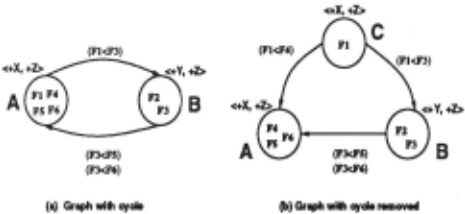
A cycle in the subplan sequencing graph can be bro ken by adding one node to the graph if the following are true: 1) there exists a break set, B, which contains all S-fragments or all D-fragments, and 2) all fragments in B can be moved to the new node. To break a cycle by adding a single node to the subplan sequencing graph, it is first necessary to find a break set that meets the above enumerated criteria. This can be done by scan ning the break sets in order of cost (see section 2.2). Let E represent the edge being removed and B represent the break set being used. A new node, N', is created with the same mergeability type as the source node of E if B contains all S-fragments, or the destination node of E if B contains all D-fragments. All of the fragments in B are then moved from their original node to N'. Fi nally, the edges are updated by removing all edges from the graph and rebuilding them incorporating N'. Fig ure 4a shows a subplan sequencing graph which contains a cycle. A list of the break sets is as follows, ranked left to right: {Fl}, {F3}, {F5, F6}, {F2, F3}. And the following are the orderings among the plan fragments: (Fl --< F3), (Fl --< F4), {Fl --< F5), {F4--< F5), (F3--< F5), (F2 --< F3), (F2 --< F6), and (F3 --< F6). Each of the frag ments in the nodes of the graph can be contained only in their current node. For example, fragment F1 can not be moved to node B to break the cycle. Since none of the fragments can be moved to another node currently in the graph, a new node must be added. {Fl} is an eligible break set; hence a new node, C, is created which has the same mergeability type as node A. F1 is placed in node C and the edges of the graph are regenerated to yield figure 4b, and the cycle has been broken.
If breaking the cycle by adding one node to the graph is not possible, then it may be possible to break the cycle by adding two nodes. Note that if it is possible to break a given cycle, then that cycle can be broken by the addition of at most two nodes to the graph 3 . We can simply duplicate the two nodes at the ends of an edge in the cycle and move the fragments inducing the edge. This is a similar process to that of adding one node to the graph as discussed above.
If the cycle can not be broken by creating one or two new nodes in the subplan sequencing graph or by moving fragments to alternate existing nodes in the graph, then an alternate minimal covering may need to be generated and/or replanning may have to be done.
3 Proof of this is presented in [Britanik, 1994].
3 Replanning with Alternate Choices
From time to time it is necessary to replan some portion of the overall plan to compensate for changing criteria or to satisfy interactive user preferences. We consider replanning in the hierarchical plan graph (HPG) on a level-by-level basis. The following will demonstrate how the decomposition approach of hierarchical plan merging reduces the amount of rework necessary due to replan ning of a specific plan component.
We approach replanning as follows. Replanning at level i of the HPG implies that one or more of the nodes at level i contain plan fragments that were reworked. All of the nodes that are successors of those that were replanned must also be replanned (or remerged). We consider separately the following two cases: 1) only one node on a branch oflevel i contains replanned fragments, and 2) more than one node on a branch of level i contain replanned fragments. A branch of a level is the group of nodes which have a common parent at the previous level of the HPG. Consider figure 1. At level 2, {CO,C1}, {C2,C3,C4}, and {C5,C6} are the three branches.
When one node on a branch of a level is replanned, say R, then two actions will result: 1) it may be nec essary to reorder the nodes within that branch, and 2) it is necessary to replan or remerge all successors of R. However, it is not necessary to replan other nodes in the same branch or in other branches on the same level. It is only necessary to replan the successors of the node that was replanned. This is a direct result of our decompo sition approach in hierarchical plan merging. Consider node Cl in figure 1. Replanning in node Cl will require the consideration of only nodes Cl, 02, D3, and 04. A planner which does not use this approach may have to replan at least all of level 2 and all of level 3. If we coarsely approximate the amount of replan work in each node as one unit, then our approach would yield a 17/21 or 80% savings in replan work, since only four nodes out of 21 would need to be reworked.
It is sometimes the case that replanning affects more than one node of a branch in the HPG. This would occur in situations where plan fragments were moved from one node to another in the course of replanning. In this case, · it would be necessary to replan the entire branch of the level that was affected. This is due to the fact that the minimal covering set of nodes may have changed due to the relocation of plan fragments. Consider the second branch of level 2 in figure 1 which consists of nodes C2, C3, and C4. All the nodes of this branch as well as their successors would have to be replanned; however, the ef fect of replanning this branch is still decoupled from the other branches in level 2. Using the same cost assump tions as above, this decoupling yields a savings of 14/21 or 66% over a planner that would reconsider all of the nodes on level 2 and level 3.
If nodes in more than one branch of a level are affected by replanning, then each branch of that level can be considered as one of the two cases enumerated above, and replanning can propagate on a branch-by-branch basis.
4 Hierarchical Process Plan Merging
In this section we demonstrate an application of hier archical plan merging in the domain of process plan ning. As previously discussed, we assume the availabil ity of a process planner which will generate subplans for the individual features of a part. The output of such a planner is a set of feature subplans and a set of or derings between the subplans. Examples of this type of planner can be found in [Marefat and Kashyap,1992; Britanik and Marefat,1995].
4.1 Approach
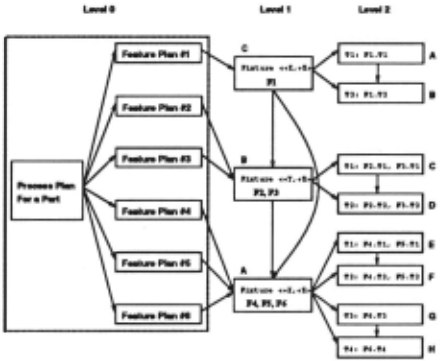
Our approach to hierarchical process plan merging is a three level approach as shown in figure 5. Level 0 is the output of the planner, a sequenced list of feature sub plans. Level 1 is the grouping of feature subplans into common fixtures. Each mergeability type {node) at this level is a unique fixture specification. Each feature sub plan which is a member of a given node in level 1 can be executed in the fixturing setup specified by that par ticular node. Directed edges between nodes implies that the fixtures represented by the source nodes of the edges must be sequenced before the fixtures represented by the destination nodes of the edges. Level 1 establishes a min imal set of fixturings and their appropriate sequence for executing the global plan. Each fixturing naturally de composes into a set of toolings for that fixture. Level 2 is the grouping of feature subplan fragments into com mon tooling groups. Each mergeability type at level 2 is a unique tooling for the branch {fixturing parent from level 1) the node is in. Each subplan action that is a member of a node in level 2 can be executed using the tooling specified by that particular node. Directed edges between nodes in level 2 (toolings) implies that certain toolings must be executed before other toolings in the current fixturing setup. Level 2 establishes a minimal set of toolings necessary to execute the plan fragments in the particular parent fixturing.
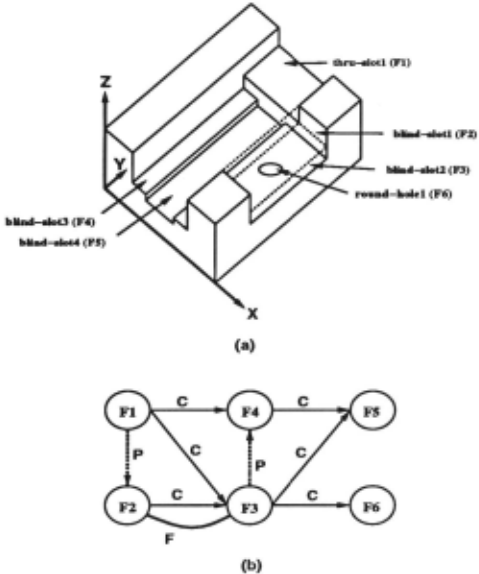
Figure 6b shows an interaction graph for the object in figure 6a.
For our planner, we will focus on generating fixture po sitions for a parallel vise-clamp type fixture . However, the hierarchical plan merging mechanism is not limited to the simplified fixture model we will present . We use this simple model to facilitate clear exposition of the process planning domain application. Along with the clamp-type fixture, we will assume a vertical-type ma chine; that is, the tool chuck approaches the part from above the fixture. Given this physical description, we can model a fixture setting as a two-tuple < CA, 0 >, where CA is the clamping axis and 0 is the orientation of the part about the clamping axis. TheCA is specified as the direction parallel to the principle normal (in the part's local coordinates) of the faces to which the clamp is applied. 0 is the direction of the principle normal of the part surface that is facing up towards the tool chuck.
4.2 Process Plan Merging
We will now discuss our application of hierarchical plan merging to process planning. First we describe the sub plan sequencing graph at the fixturing level, then at the tooling level.
Fixturing Level
Once we know from which fixtures a feature can bema chined, we can construct the fixture subplan sequencing graph. First we build a list of features applicable to each fixture. We call these lists common fixture sets (CFS). The common fixture sets for the part in figure 6a are shown in figure 7. Notice that a feature may appear in more than one CFS, demonstrating alternative fixtures from which the feature may be machined. Also note that common fixture sets correspond directly to the set of maximal nodes as discussed in section 2.1.
| F<+X1+Z>:{F1 1F41F51F6} | F<-l 1+Z>:{F1 1F41F51F6} |
| F<+Y1+Z>:{F2 1F3 1F6} | F<-Y1+Z>:{F21F31F6} |
| F<+X1-Z>:{F6} | F<-I 1-Z>:{F6} |
| F<+Y1-Z>:{F6} | F<-Y1-Z>:{F6} |
The next step in building the fixture subplan sequenc ing graph is to generate a minimal covering of nodes; that is, a minimum set of fixturings. This corresponds directly to our desire to minimize the number of fixture changes while machining the part. The minimal covering for the example part consists of the two nodes: F<+X 1 +Z> = {F1 1F41F51F6} andF<+Y1+Z> = {F21F3}.
Since our minimal covering algorithm really only gen erates a near-minimal covering, we next check to see if we can can remove any unnecessary nodes as described in section 2.1. By observing the minimal covering and figure 7, we see that there are no redundant nodes which can be subsumed by nodes of lesser cardinality.
With this minimal set of fixtures, we now determine the sequence by which the fixtures are used in machin ing the part. This sequence is constrained by the str~ng interactions between features in different fixtures. Usmg the interaction graph in figure 6b, we have an explicit list of orderings (strong interactions), and can generate the edges for the fixture subplan sequencing graph as discussed in section 2.1. We simply examine each strong interaction (represented by solid arrows in figure 6b), and include it in the fixture subplan sequencing graph as an edge if its source and destination features are in different fixture nodes (ie: it represents an external or dering). The fixture subplan sequencing graph a~ter edge generation is shown in figure 4a. Note that this graph has a cycle; hence, cycle removal is necessary. The list of break sets is as follows, ranked left to right: {F1} 1 {F3} 1 {FS 1 F6}, and {F2 1 F3} The first approach of moving one or more plan fragments (feature subplans) to other nodes in the graph would be unsuccessful since only F6 can be moved to another node in the graph (this can be seen by observing the common fixture sets in figure 7), but there is no break set which contains only F6. Hence, the second approach of node addition to the graph will be attempted. By observing the ranked list of break sets, we see that all of the break sets contain nodes that are either all S-fragments or all D-fragments. If it is pos sible to break the cycle, it can be done by adding only one node to the fixture subplan sequencing graph. Break set {F1} has the highest ranking and is an eligible break set; hence node A of figure 4a is duplicated with the fragment F1 as its contents. Using the interaction graph of figure 6b, the edges of the fixture subplan sequencing graph are regenerated incorporating the new node. The resulting cycle-free fixture subplan sequencing graph is shown in figure 4b.
Now that the fixturing subplan sequencing graph, that is the fixturing level of the hierarchical process plan g;aph, is complete, it is necessary to build the tooling level by generating tooling subplan sequencing graphs for each fixture node in the fixturing level.
Tooling Level
To proceed with plan merging at the tooling level, we need to refine our definition of a plan fragment for this level. For the purposes of our example, we consider each feature subplan to consist of an ordered set of tool ap plications, one for each process used to machine the fea ture. We represent the application of tool T1 in feature subplan Fl as Fl. Tl. If Fl consists of applying tool T1 followed by applying tool T2, then Fl contains two plan fragments, namely Fl. Tl ~. Fl. T2. It is these. plan fra~ ments that will be merged mto common toohng sets m the tooling subplan sequencing graph. Since the pris matic features in figure 6a (features Fl through FS) are relatively similar, we assume that they all use the same rough cut tool, Tl, and finishing cut tool, T2. The round hole (feature F6) uses tool T3 as its rough c~t tool and T4 as its finishing cut tool. Note that there IS a strong constraint which sequences tool Tl before tool T2 in each of the first five feature subplans, and T3 is sequenced be fore T4 in F6. This ordering is due to the common sense fact that the rough cut must precede the finishing cut. With this information, we are now ready to generate the tooling subplan sequencing graph for node A in figure 5. The generation of the tooling sub plan sequencing graphs for the other nodes of level 1 in the hierarchical process plan graph is a similar process and will not be shown explicitly.
First we need to generate the set of maximal nodes. One node is generated for each specific tool used in the feature subplans. The following is the set of maximal nodes for the tooling subplan sequenc ing graph: (Tl :F4. T1 1FS. Tl) 1 (T2:F4. T21FS . T2), (T3:F6.T3), and (T4:F6.T4). Since all fragments in all nodes are unique, the set of maximal nodes is also the minimal covering in this case. Also, there are no re dundant nodes which can be removed from the minimal covering. To generate the edges in the tooling subplan sequencing graph, we utilize the orderings in the interac tion graph in figure 6b as well the orderings . implied by the specification that rough cuts precede finishing cuts. The result of adding the appropriate edges is the cycle free tooling subplan sequencing graph shown in level2 of figure 5, which is the final hierarchical process plan graph.
Now that the hierarchical process plan graph is com plete, we can generate an outline of the ~nal plan (i~ is an outline in the sense that we do not mclude specific motions and dimensional data etc.). The plan is shown below with the execution sequence from top to bottom and then left to right:
setup fixture <+1 1+Z> setup tool Tl { do actions }
setup fixture <+I1+Z> setup tool Tl { do actions }
| setup tool T2 { do actions } setup fixture <+Y,+Z> setup tool T1 { do actions } setup tool T2 { do actions } | setup tool T3 { do actions } setup tool T2 { do actions } setup tool T4 { do actions } |
5 Related Work
Our work is somewhat complementary to that of Karinthi et al. [Karinthi et a/.,1992]. Their interest ing work focuses on generating an optimal global plan from all possible alternatives of feature subplans in pro cess planning via state-space search. Our focus has been on merging one specific set of feature sub plans such that replanning effort is minimized when alternatives are se lected. However, in a sense we also consider many alter native plans during the merging process at the fixturing level.
The work of Foulser et al. [Foulser et a/.,1992] presents a formal treatment of the complexity of domain independent plan merging using STRIPS-style opera tors. An optimal algorithm for plan merging utilizing dy namic programming methods has been developed. Since practical implementation of the optimal algorithm is in feasible for larger inputs, several greedy-based approxi mate (near optimal) algorithms are also developed along with their worst-case and average-case complexities for large inputs. It is also empirically shown that the ap proximate algorithms performed well for larger inputs. Yang et al. [Yang et a/.,1992] generalizes some of these algorithms to handle a wider range of interaction types.
Hayes [Hayes,1989] has developed the Machinist sys tem which considers operator overlap in process plan ning. The approach uses "cues" in the problem specifi cation to search for mergeable operators. Like our near minimal covering algorithm, Machinist uses a greedy type algorithm to group operators into a near-minimal number of set-ups (fixturings) .
HUTCAPP [Mantyla and Opas,1988] is a generative process planner for prismatic parts. A lattice algebra is used to find a minimal covering of work directions to machine all features in the part. This work inspired our lattice algebra approach to generating an optimal minimum covering from the set of maximal nodes. This algorithm and another optimal algorithm are analyzed in [Britanik,1994].
6 Conclusions
We have developed a systematic methodology for uni form plan merging at the various levels of plan abstrac tion. This method manifests itself in the hierarchical plan graph where each level contains a complete, par tially merged plan. The principle advantage of this ap proach is that, once external interactions between nodes on a given level have been established, the continued merging of the plan fragments in one node can take place independently of plan fragments in other nodes on that level. This provides a decomposition or divide-and conquer approach to plan merging. Another advantage to this decomposition approach is that replanning effort is minimized in the presence of the selection of alterna tive actions at some level of the hierarchical plan graph. Only those plan fragments which are in the same branch as the alternative selection need be considered for re planning.
Rather than considering mergings which result in cyclic dependencies to be infeasible, an algorithm is pro posed which takes a bilateral approach to breaking cyclic dependencies between nodes in the subplan sequencing graph. The first approach is to maintain the same num ber of nodes and remove the edge of the cycle by relo cating plan fragments to other nodes. If this approach fails or is inappropriate according to the priorities of the planner, then a second approach which considers adding at most two nodes to the subplan sequencing graph may be used. If these two approaches have failed, then the merging which resulted in the cyclic dependency will be considered infeasible and replanning will be necessary.
We have demonstrated the utility of this hierarchical approach to plan merging through examples in the pro cess planning domain. It was shown that the merging of fixtures (fixture level) and the merging of tools (tooling level) can be done in a systematic and uniform fashion .
@inproceedings{ijcai1995p216,
  title     = {Hierarchical Plan Merging with Application to Process Planning},
  author    = {Britanik, J. M. and Marefat, Michael M.},
  booktitle = {Proceedings of the Fourteenth International Joint Conference on
               Artificial Intelligence, {IJCAI-95}},
  publisher = {International Joint Conferences on Artificial Intelligence},
  editor    = {Chris S. Mellish},
  pages     = {1677--1684},
  year      = {1995},
  note      = {Planning},
  url       = {https://ijcai.org/proceedings/1995/216},
}
TY - CPAPER TI - Hierarchical Plan Merging with Application to Process Planning AU - Britanik, J. M. AU - Marefat, Michael M. T2 - Proceedings of the Fourteenth International Joint Conference on Artificial Intelligence, IJCAI-95 PB - International Joint Conferences on Artificial Intelligence PY - 1995 SP - 1677 EP - 1684 UR - https://ijcai.org/proceedings/1995/216 ER -Copied
Machine-readable versions of this paper, for tools and AI agents:





