
Integrating Gricean and Attentional Constraints
Proceedings of the Fourteenth International Joint Conference on Artificial Intelligence. Natural Language. Pages 1267-1274.
© 1995 International Joint Conferences on Artificial Intelligence
Abstract
This paper concerns how to generate and understand discourse anaphoric noun phrases. I present the results of an analysis of all discourse anaphoric noun phrases (N=1,233) in a corpus of ten narrative monologues, where the choice between a definite pronoun or phrasal NP conforms largely to Gricean constraints on informativeness. I discuss Dale & Reiter's [To appear] recent model and show how it can be augmented for understanding as well as generating the range of data presented here. I argue that integrating centering [Grosz et a/., 1983] [Kameyama, 1985] with this model can be applied uniformly to discourse anaphoric pronouns and phrasal NPs. I conclude with a hypothesis for addressing the interaction between local and global discourse processing.
- Chafe, 1980
- W. L. Chafe. The Pear Stories. Ablex Pub- lishing Corporation, Norwood, NJ, 1980.
- [Cochran, 1950] W. G. Cochran. The comparison of percent- ages in matched samples. Biometrika, 37:256-266, 1950.
- Dale and Reiter, To appear] R. Dale and E. Reiter. Com- putational interpretations of the gricean maxims in the generation of referring expressions. To appear in Cogni- tive Science.
- [Dale, 1989] R. Dale. Cooking up references. In Proceedings of the 27th ACL, 1989.
- [Dale, 1992] R. Dale. Generating Referring Expressions. MIT Press, Cambridge, MA, 1992.
- [Grice, 1975] H. P. Grice. Logic and conversation. In Syntax and Semantics, Vol. 3: Speech Acts, pages 41-58 . Aca- demic Press, New York, 1975.
- [Grosz and Sidner, 1986] B. J. Grosz and C. L. Sidner. At- tention, intentions and the structure of discourse. Compu- tational Linguistics, 12:175-2 04, 1986.
- [Grosz et al., 1983] B. J. Grosz, A. K. Joshi, and S. Wein- stein. Providing a unified account of definite noun phrases in discourse. In Proceedings of the 21st A CL, 1983.
- [Grosz et al., 1986] B. J. Grosz, A. K. Joshi, and S. Wein- stein. Towards a computational theory of discourse inter- pretation, 1986. Ms.
- [Kameyama et al., 1993] M. Kameyama, R. Passonneau, and M. Poesio. Temporal centering. In Proceedings of the 31st ACL, 1993.
- [Kameyama, 1985] M. Kameyama. Zero Anaphora: The Case of Japanese. PhD thesis, Stanford University, 1985.
- [Kameyama, 1986] M. Kameyama. A property-sharing con- straint in centering. In Proceedings of the 24th ACL, New York, 1986.
- [Litman and Passonneau, 1995a] D. Litman and R. Passon- neau. Combining multiple knowledge sources for discourse segmentation. In Proceedings of the 33rd ACL, 1995.
- [Litman and Passonneau, 1995b] D. Litman and R. Passon- neau. Developing algorithms for discourse segmentation. In AAAI Spring Symposium Series on Empirical Methods in Discourse Interpretation and Generation, 1995.
- [Passonneau and Litman, 1993] R. J. Passonneau and D. Litman. Intention-based segmentation: Reliability and correlation with linguistic cues. In Proceedings of the 31st ACL, 1993.
- Passonneau and Litman, To appear] R. J. Passonneau and D. Litman. Empirical analysis of three dimensions of spo- ken discourse: Segmentation, coherence and linguistic de- vices. In E. Hovy and D. Scott, editors, Burning Issues in Discourse. Springer Verlag, Berlin, To appear.
- [Passonneau, 1989] R. J. Passonneau. Getting at discourse referents. In Proceedings of the 27th ACL, 1989.
- [Passonneau, 1994] R. J . Passonneau. Protocol for coding discourse referential noun phrases and their antecedents. Technical report, Columbia Univer- sity, 1994.
- [Passonneau, 1994] R. J. Passonneau. Frame shifts: Perlocu- tionary meaning and discourse reference. In Conference on Focus and Natural Language Processing, Kassel, Germany, 1994.
- [Passonneau, To appear] R. J. Passonneau. Interaction of the segmental structure of discourse with explicitness of discourse anaphora. In E. Prince, A. Joshi, and M. Walker, editors, Proceedings of the Workshop on Centering The- ory in Naturally Occurring Discourse. Oxford University Press, To appear.
- [Reichman, 1985] R. Reichman. Getting Computers to Talk Like You and Me. MIT Press, Cambridge, Massachusetts, 1985.
- [Reiter, 1990] E. Reiter. Generating appropriate natural lan- guage object descriptions. PhD thesis, Harvard University, 1990.
- [Sidner, 1979] C. L. Sidner. Towards a computational theory of definite anaphora comprehension in English discourse. Technical report, MIT AI Lab, 1979.
- [Webber, 1978] B. Webber. A formal approach to discourse anaphora. Technical Report 3761, Bolt Beranek and New- man Inc., 1978.
References were extracted automatically from the PDF and may contain errors.
Full text extracted automatically from the PDF; figures, tables and equations may differ. The PDF is the version of record.
1 Introduction
This paper concerns how to generate and understand dis course anaphoric noun phrases, or noun phrases (NPs) that evoke a discourse entity already in the discourse model (Webber [1978]). Dale [1989] [1992] impleme_nts Gricean constraints on informativeness for generatmg discourse anaphoric NPs. However, his model fol lows the tradition of assuming that distinct constraints govern pronouns versus phrasal NPs ( cf. [Reichman, 1985] [Grosz and Sidner, 1986]). Centering [1983] [1985], a model of local attentional state [1979], has been applied primarily to definite pronouns. I argue that Gricean con straints should be applied equally to discourse anaphoric pronouns and phrasal NPs, and that integrating center ing and informational constraints covers a broader range of cases. In §2, I present an analysis of all discourse anaphoric NPs (N=1,233) in a corpus of ten narratives showing that semantic explicitness depends largely on informational constraints. Discourse anaphoric NPs al most never provide new information, and are rarely more informative than necessary. In §3, I show how Dale & Reiter's [To appear] generation model can be augmented to apply uniformly to pronouns and phrasal NPs for both generation and understanding. While centering has been used to account for informationally under-specified pro nouns, I argue that centering also accounts for certain over-specified phrasal NPs. In §4, I integrate centering with the augmented Gricean model and discuss the ex tended coverage. Results in §2 include a one-way correla tion of overly informative discourse anaphoric NPs with shifts in global discourse structure. In the conclusion, I discuss directions for extending the integrated model in ways that might indirectly account for this correlation.
*The work reported here was not supported by Bellcore.
2 Analysis of a Coded Corpus
In this section, I present the results of an analysis of all discourse anaphoric NPs in a corpus of spoken narratives directed at the question of how informative NPs are, rel ative to their contexts of occurrence. The first subsection describes the corpus and coding features. The next sub section presents results showing that discourse anaphoric NPs in the corpus, whether pronominal or phrasal, are rarely more informative than necessary, and if so, tend to occur at shifts in global discourse structure.
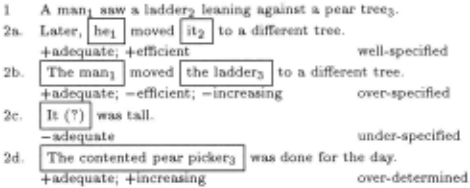
Fig. 1 identifies four possibilities regarding the se mantic informativeness of an NP relative to its context. Three of them pertain to the following Gricean princi ples, referred to by Dale [1989] as informational ade quacy and efficiency: the speaker should be sufficiently informative to unambiguously identify the intended ref erent (adequacy), and the speaker should be no more informative than necessary (efficiency). The boxed pro nouns in (2a) of Fig. 1 are both adequate and efficient (well-specified): it is clear what the pronouns refer to; less informative forms (zero pronouns) would be ungram matical. The phrasal NPs in (2b) are adequate but not efficient (over-specified). The pronominal NP in (2c) is inadequate (under-specified; efficiency does not apply to inadequate NPs): "if' could refer either to the ladder or the tree. A fourth possibility is that an NP may per form two functions, to identify the referent and to add information about it, as in (2d) (over-determined). In Fig. 1, the feature +/-increasing distinguishes between over-determined and over-specified NPs.
2.1 Data Coding
The corpus consists of ten narrations from Chafe's Pear stories [1980]. Chafe recorded and transcribed subjects who had been asked to view the same movie and describe it to a second person. The movie contained seven sequen tial episodes about a man picking pears. It had a vivid sound track, bu.t no language. As part of a long term study of the relationship between linguistic features and discourse structure [Passonneau and Litman, 1993] [Lit man and Passonneau, 1995b] [Litman and Passonneau, 1995a], discourse anaphoric NPs in the corpus had al ready been coded for coreference relations and location. Location of an NP is represented here in terms of the containing sentential utterance and discourse segment, as described below. Fig. 2 illustrates an excerpt.
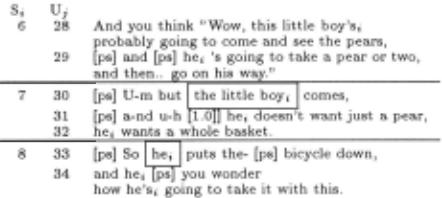
Chafe [1980] identified three types of prosodic phrases from graphic displays of intonation contours. A period indicates a phrase terminated by a pitch fall, a question mark indicates final level or rising pitch, and a comma indicates phrase final-not sentence-final-intonation. The transcriptions here show all repeated and incom plete words and phrases, non-lexical articulations such as "uh, urn, tsk", and vowel lengthening as indicated by '- '. Pause locations are shown as '[ps] '.
Sentential utterances are defined be a non-overlapping sequence of units that completely covers the discourse. Briefly, a new sentential utterance begins with a func tionally independent clause (FIC) if it is immediately adjacent to the preceding FIC. Otherwise it begins at the onset of the prosodic phrase where the next FIC begins. An FIC is a tensed clause that is not a verb argument, a restrictive relative clause, or one of a set of formulaic "interjection" clauses (e.g., "You know' with no clausal argument; for full details cf. [Passonneau, 1994]). Mate rial between clauses includes sentence or word fragments, and non-lexical articulations (e.g., "urn"). Locations and sequence numbers of the seven sentential utterances in Fig. 2 are shown in column 2.
The global context is structured into sequential seg ments, multi-utterance units whose utterances are pre sumed to be more related to one another semantically and pragmatically than to other utterances. The seg ments numbered 6-8 (col. 1 of Fig. 2) were derived from an empirical study described in [Passonneau and Lit man, 1993]. Each narrative was segmented by 7 new, untrained subjects. Subjects were instructed to place segment boundaries in transcripts whenever the narra tor had finished one communicative task and begun a new one. They were restricted to placing boundaries be tween prosodic phrases. To focus their attention on the criterion, subjects' were also instructed to label segments with a brief description of the speaker's intention.
The size and number of segments per subject per narrative varied widely, from a rate of 5.5% to 41.3% (Avg.=16%), with segment widths ranging from 1 to 49 phrases (Avg.=5.9). Despite this variation, the num ber of times 4 to 7 subjects assigned boundaries in the same place was extremely significant (usin~ Cochran's Q [1950] ; cf. [Passonneau and Litman, 1993J). We took agreement among at least 4 subjects as the threshold for empirically validated boundaries.
A surface constituent is considered to be a discourse anaphoric NP if it occurs in free variation with syntac tically prototypical NPs, and corefers with a preceding NP ( cf. [Passonneau, 1994]). One type of empty category is also included, namely ze.ro pronoun subjects of FICs conjoined by ",", "and", etc. In Fig. 2, the sequence of coreferential NPs used to refer to the little boy are coin dexed. Segments 7 and 8 in Fig. 2 both begin with an utterance containing an NP referring to the boy. At the onset of segment 7, a phrasal NP is used to refer to him (U3o) whereas at the onset of segment 8 (U33), a definite pronoun is used. But a pronoun could have replaced the phrasal NP in U3o with no loss of information. So the phrasal NP is over-specified but not over-determined; the attributes "boy'' and "little" were already mentioned in U28 . The pronoun subject in U33 is locally well-specified because the boy is the only animate entity mentioned in U 32; it is globally well-specified because the boy is the only entity in the discourse with a bicycle.
2.2 Analysis of Informational Constraints
The goal of the analysis is to determine whether rela tive informativeness of NPs correlates with global dis course structure ( cf. [Reichman, 1985] [Grosz and Sid ner, 1986]). Any phrasal NP that is discourse anaphoric is potentially over-specified, whereas a definite pro noun will only be over-specified if a zero pronoun could have been used. I first sorted the discourse anaphoric NPs in the corpus (N=1,233) into the three categories of phrasal NPs (PhrNPs; N=563), explicit pronouns (PROs: definite, indefinite, demonstrative; N =544), and zero pronominals (ZPs; N=126). Then I identi fied all pairs of coindexed NPs where NP2 was more ex plicit than NP1 . This procedure identified 128 discourse anaphoric NPs in the corpus that were potentially over specified or over-determined. The sole over-determined NP, illustrated in Fig. 3, occurs relatively late in the narrative (U85); it seems mainly to provide contrast (cf. "that old man" vs. those little boys").
Potentially over-specified NPs were sorted into four mutually exclusive categories-well-specified, segment
84 (ps] You just know that those little boys are going to go back, (ps] to where the pear tree was,
85 and you just know I that old man l·s going to see (ps] these little boys coming and say "Ha .. you're the ones who stole the pears."
Figure 3: Over-determined NP
onset, attentional shift, and reiterative. A potentially over-specified NP is well-specified if a less explicit form would have been ambiguous or unclear. The containing utterance is included in the context since the proposition expressed in an utterance can disambiguate a referring expression. A potentially over-specified NP that is not well-specified, but which occurs in the first utterance of a new segment, is classified as a segment onset. The seg ments in the coded Pear corpus arguably contain intra segmental shifts of attention associated with changes in temporal aspect, or shifts in discourse reference time (for definitions assumed here, cf. [Kameyama et al., 1993)). The third category, attentional shift, consists of these cases. A fourth catch-all category includes, e.g., repeti tions, repairs, contrastive NPs and unexplained cases.
Table 1 indicates that most potentially over-specified NPs (N=127) were either well-specified (46%) or occur at an empirically verified segment onset (16%) or a hy pothesized attentional shift (23%) . Of the 69 NPs whose nearest antecedent was in a distinct segment, 29% oc curred at a segment onset. Over a third (36%) of the NPs whose antecedent was in the same segment, and 12% of those whose antecedent was in a distinct segment occurred at an intra-segmental attentional shift. In sum, in the coded Pear corpus, NPs that re-evoke existing en tities seem to be rarely over-specified (68/1233, or 5.5%) or over-determined (1/1233). Of the 68 over-specified cases (columns 2-5) , 20 (30%) correlate with segment onsets independently identified by naive subjects, and 29 (42%) appear to correlate with intra-segmental atten tional shifts. Thus, an over-specified NP is more likely than not to correlate with an attentional shift (72%) . Note however , that the reverse implication does not hold, that is, it is not the case that a segment shift is likely to be signalled by an over-specified NP.
2.3 Focused Attribute Sets
To account for the choice of modifiers in phrasal dis course anaphoric NPs, it is necessary to determine how attributes are selected from the information known about a discourse entity. According to Grice's [1975) maxim of quality, speakers should be relevant. With respect to discourse anaphoric NPs in the Pear stories, NP modifiers are derived from what I refer to as focussed attribute sets, independent of whether the NP is over specified. Focussed attribute sets comprise the following three categories of relevance. First , an attribute set can be in focus because it was mentioned in the most recent phrasal NP. For example, in Fig. 2, the boy is referred to in U3o as "the little boy," repeating attributes mentioned in the last phrasal NP referring to the boy (in U28).
| Antecedent Segment | Well- Specified | Segment Onset | At t en. Shift | Other | Total |
|---|---|---|---|---|---|
| Same % | 22 38% | - - | 21 36% | 15 26% | 58 100% |
| Prev % | 37 53% | 20 29% | 10 12% | 4 6% | 69 100% |
| Totals % | 59 . 46% | 20 16% | 29 23% | 19 15% | 127 100% |
Second, the focussed attribute set may specify the most recently mentioned location of an entity. The sub ject NP in U17 of Fig. 5 (§3.2) refers to one man as "the man up in the tree" to distinguish him from the second man who came by with a goat . The tree is the last mutu ally known location of the former. Finally, an attribute set can be in focus because it pertains to a key narrative event that the entity has been an agent of. Intuitively, an event is more central to a narrative the more diffi cult it is to describe the narrative without mentioning that event. Operationally, key events occur more fre quently than others both within and across narratives. For example, the main adult character is often described as "the pear picker," or as "the man who was picking pears" (see U 1os of Fig. 6, §4), and so on; the other main character is often described as "the thief," "the boy who stole the pears," "the boy with the pears," and so on.
How to order the focussed attribute sets for a given discourse entity is a topic for further investigation. Here, I simply assume that the three types of attribute sets mentioned above-where applicable-are in focus. I also assume that the focussed attribute sets of an en tity (FAV e) are updated as the discourse progresses.
3 Modelling Informativeness of NPs
The data reported abov~ indicates that in the Pear cor pus, definite pronouns and phrasal NPs are rarely over specified or over-determined. In this section, I describe a processing model to account for this observation. In the next section, I discuss how centering can be integrated with this model to account for under-specified pronouns, and certain over-specified phrasal NPs. First, I briefly review Dale's [1989) [1992) model, including his more re cent work with Reiter [To appear). Then I modify this model to apply to understanding as well as generation; to include the current utterance in the context of eval uation; to apply informational constraints uniformly to pronouns and phrasal NPs; and to select modifiers on the basis of focused attribute-value pairs.
3.1 Distinguishing Descriptions
Dale [1989) generates anaphoric pronouns and phrasal NPs by distinct means. In EPICURE [1989), a system for generating recipes, a definite pronoun is always gen erated to refer to the 'discourse center', which is anal ogous to the backward-looking center of [Grosz et a/., 1983) [Kameyama, 1985), but is domain specific. It is the entity that results from the next recipe operation. For example, rice1 will be the center after an utterance of Stir the rice1 .
Dale [1989) requires phrasal NPs to be distinguishing descriptions. As in Webber [1978), Dale assumes that the discourse model represents the discourse entities that have already been evoked, and the attribute-value pairs describing them. For any set of entities U, Dale [1989] defines a distinguishing description of an entity e in U to be a set of attribute-value pairs that are true of e, and of no other members of U. This enforces adequacy. He defines a minimal distinguishing description to be one where the cardinality of the attribute-value pairs cannot be reduced. This addresses efficiency. 1
Dale [1989] defines the discriminatory power (F) of an attribute-value pair <A, V> that is true of a discourse entity e in a universe of entities U in terms of the cardi nality N of U, and the total number n of entities in U that <A, V> is true of:
F ranges in value from 0 to 1. If< A, V > is true of only one of the entities in the set U, then F<A, V> is 1, and < A, V > is a distinguishing description of the entity.
Dale's [1989] algorithm for constructing a distinguish ing description of e in U, given a set P of attribute-value pairs that are true of e, briefly works as follows. First compute F for each member of P. If all values ofF are 0, no unique description can be constructed. Otherwise, select the attribute-value pair with the highest value to add to the description, and reset U to be only those en tities in the initial U that the selected attribute-value pair is true of. Repeat this process, terminating when an attribute-value pair with a discriminatory power of 1 has been selected. The selected attribute-value pairs constitute the input description for a surface NP.
In recent work, Dale & Reiter [To appear] enforce a range of Gricean constraints using an algorithm based on human behavior that is simpler and faster than their previous algorithms [Dale, 1989] [Reiter, 1990]. It per forms less length-oriented optimization, thus balancing brevity against lexical preference. The output NPs are not guaranteed to be maximally short because humans occasionally use unnecessary modifiers. The 5.5% rate of over-specified discourse anaphoric NPs in the Pear data also supports the relaxation of brevity, but is partly con ditioned by attentional factors ( cf. § §4-5).
3.2 C_describe
In this section I illustrate the role of c_describe in pro cessing definite pronouns and phrasal NPs. C_describe is a 4-place relation among a discourse entity E, a sur face NP, the current utterance context >.U, and the dis course context C that requires >.N P >.U to be a distin guishing description of E relative to C. For generation, NP is solved for given an instantiation of the remaining three arguments, whereas E is solved for during under standing (assuming Prolog's control structure).
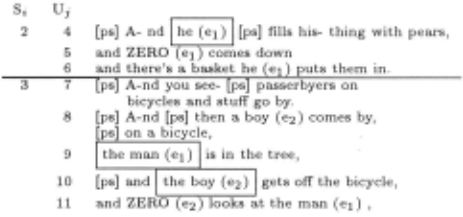
A definite pronoun that is a distinguishing description is also a minimal distinguishing description because its length is 1. In generation, C_describe attempts first to find a definite pronoun to satisfy the uninstantiated NP argument, succeeding if the pronoun is a distinguishing description. For generating the pronoun "he" in U4 of Fig. 4, the arguments of c_describe are:
1 Cf. Reiter [1990] for a discussion of problems in gener ating maximally efficient NPs using Dale's framework, and Dale & Reiter [To appear] for an argument that maximal efficiency is psychologically implausible.
The utterance context is assumed to be a feature struc ture co-indexed with any relevant discourse entities other than the uninstantiated variable E. 2 By using the utter ance as part of the input in solving for NP, given infor mation that appears anywhere in the current utterance can filter entities from the discourse context, following Dale's [1989] algorithm. New information about an en tity in the utterance is not mutually known, and has no discriminatory power [Dale, 1989].
For present purposes, the last argument of c_describe is first instantiated to the most recent focus space, and in turn to other focus spaces until a solution is found. Dale [1989] takes the universe of discourse to be parti tioned into focus spaces (cf. [Grosz and Sidner, 1986]), with the most recent focus space being the most acces sible, and making no assumptions regarding relative ac cessibility of earlier focus spaces. Similar assumptions are made here. I assume that segment boundaries in the Pear corpus correspond to focus spaces, and that some focus spaces may be composed of others. I assume the existence of an inference mechanism that constrains how focus spaces are signalled during generation, and how fo cus spaces are inferred during understanding. In recent work, for example, Litman and I report on algorithmic methods for identifying segment boundaries in the Pear corpus using features of prosody, cue words and referen tial NPs [Litman and Passonneau, 1995a]. Given such a mechanism, a new focus space would be added to the dis course model after a segment onset has been processed.
In (1), FS1 appears as the initial context argument of c_describe . The only animate entity in FS1 is e1 , pre viously described as a man picking pears in a pear tree who looks like a farmer, is plump, has a mustache, and is wearing a white apron (utterances 1-3, not shown here). The feature structures corresponding to all but one of the definite pronouns "he, she, if' or "they' will be re jected as a description of e1 because e1 is neither plural, non-animate or female. 3 The pronoun "he", represented as the attribute-value pairs (<type: human>, <gender: male> , <cardinality: 1>), not only describes e1 , it is also a minimal distinguishing description.
2 For simplicity, the utterance context represents certain semantic arguments as quoted strings.
3 For simplicity, I am ignoring the difference between gram matical gender and sex.
| S; | Uj 13 |
| 4 | 14 15 16 |
| 5 | 17 |
An analogous process applies to understanding the same pronoun in U4, with the entity variable E unin stantiated, NP instantiated to "he", and the utterance and discourse context instantiated as above. Given a dis tinguishing description, there is guaranteed to be exactly one solution to E. However, the search problem increases with the size of the context. Partitioning the search space into focus spaces controls the search through the discourse model to some degree. (Integrating centering with c_describe as described below guides the search even further.) For present purposes, c_describe returns E in stantiated to e1 after searching through the entities in FS1. The remaining NPs exemplified here are under stood in a similar fashion.
Given a context where there is no definite pronoun solution to NP, c_describe will attempt to construct a phrasal NP, preferably with no modifiers. In Fig. 4, a new, singular, male, human entity is added to the con text at Us: a boy who comes by on a bicycle (e2). Subse quent references to the boy or the man must discriminate between them. The utterance context for the subject NP of U9-.X X in'(X, "the tree")-does not identify e1 be cause U5- "he comes down" - leads to the inference that the man is no longer in the tree. However, e1 is a male adult and e1 is a male child , a distinction encoded by the common nouns "man" versus "boy'. Since "man" is what Dale & Reiter [To appear] refer to as a basic at tribute, "man" will be selected as the head noun. The determiner will be definite because the entity is already in the context (but cf. [Passonneau, 1994]). The result ing NP the man is a minimal distinguishing description because no pronoun is a distinguishing description.
Fig. 5 illustrates a context where a phrasal NP without modifiers could not both have a head noun that specifies a basic attribute, and be a distinguishing description. It also illustrates the problematic nature of relations among distinct focus spaces. In generating the subject NP in U 17, the last . argument of c_describe is first instantiated to FS4. The pears referred to in U 15 of segment 4 are some pears that e1 picked, so in order to interpret U 15 , e1 must be brought into focus. This side-effect of re solving the reference to the pears could be implemented by adding e1 to FS4, or by resetting the current focus space to a more encompassing focus structure that in cludes FS3 and FS4 . I believe further empirical work is needed to resolve such issues. In any case, I assume that the context for generating U 17 includes both e1 and e2 . Because these two entities are the same type, a distin guishing description of e1 must contain discriminatory modifiers. Features for generating the modifiers are se lected from FAV e, , which here contains only two sets of salient attributes. Since e1 's location is the most recently evoked, it is used in generating the NP.
Above, I noted that centering can add structure to the search space for understanding discourse anaphoric NPs. Fig. 4 illustrates another reason to integrate centering with c_describe. In U10 of Fig. 4, the subject NP ("the boy') is not a pronoun even though the utterance context is a distinguishing description of e2. The boy ( e2) is mu tually known to have been on a bicycle at the time of the event mentioned in utterance Us. Temporal processing ( cf. [Kameyama et a/., 1993]) would lead to the infer ence that the boy is still on the bicycle after U 9 . Thus a definite pronoun is presumably well-specified, and the model presented so far would generate "he". However, a pronoun would produce a garden path effect in this context; i.e., it would be interpreted as referring to the man until "bicycle" has been processed.
4 Centering and Informativeness
The c_describe relation has three limitations that center ing can compensate for. First, c_describe constrains the semantic content of a discourse anaphoric NP, but not its grammatical role. Second, as noted below, centering predicts that a pronoun can be under-specified. Third, an explanation is needed for the over-specified NP the boy in U 10 of Fig. 2. In this section, I indicate how cen tering is interleaved with c_describe. Centering is a more local process so it applies first.
4.1 Centering
Centering is a model of local focus of attention that constrains the use of definite pronouns [Grosz et a/., 1983] [Kameyama, 1985]. One of the discourse enti ties [Webber , 1978] evoked by an NP in an utterance U; may be the backward-looking center (CB) [Grosz et a/., 1983] of U;, the current local focus of attention. Al ternatively, the CB of U; (CBu.) might not be explic itly mentioned (realized) in the utterance [Grosz et a/., 1983] . The discourse entities mentioned in U; comprise the forward looking centers (CFs), ordered by increasing obliqueness of grammatical role [Kameyama, 1985] [Pas sonneau, 1989] to represent the likelihood that they will be mentioned in the subsequent utterance. The center ing principle [Grosz et a/. , 1983] predicts that if CBu, and CBu,_, are the same entity, then the NP evoking CBu, will be a third person, definite pronoun.
- a. Carmellaj went to the bookstore.
- Afterwards, shej gave Rachelk a new book.
- Shej 's a true bibliophile.
Example (2) illustrates that where the semantics ofthe utterance and commonsense reasoning do not discrimi nate among possible referents for an ambiguous pronoun, there is an independent effect of local attentional con straints. Centering predicts that the preferred interpre tation of the pronoun in (2c) is Carmella. But in this context , neither the pronoun alone nor the utterance is a distinguishing description of anyone, so the pronoun is under-specified.
- a. Carmellaj went to the bookstore.
- On her way home, shej saw Rachelk.
- Shek looked pale.
Kameyama [1985] used examples like (3) to illustrate how commonsense reasoning and lexical semantics can override the default centering predictions for pronoun interpretation. Centering would predict that 'Carmella' is the backward-looking center of (3b), and that the de fault interpretation of the pronoun in (3c) would thus be 'Carmella'. Instead, (3c) is interpreted as a continu ation of the description of the perceptual event in (3b) . Kameyama [1986] posits property sharing of features of adjacent utterances as a constraint on CB, where the shared property can be subject (or non-subject) gram matical role (cf. [Passonneau, 1989]), as in (2), or what she refers to as empathy, as in (3). Note that because 'Rachel' is already known to be the object of the per ceptual event in (3b), the utterance context in (3c) is a distinguishing description of 'Rachel.'
4.2 Integrated Model
Fig. 6 shows all of one segment and part of another one where the subject pronouns of all the utterances are coreferential. On the one hand, the CB of the seg ment initial utterance U 108 is the same as the CB of U 1o7, conflicting with the idea expressed in [Grosz et al., 1986] that centering transitions reflect global discourse coherence ( cf. [Passonneau, To appear]). On the other hand, integrating centering and c_describe can account for both NPs in U 1o8 and support inferences consistent with a global focus shift .
Earlier in the narrative excerpted in Fig. 6, three boys helped the pear thief after he had fallen off of his bicy cle, and were rewarded with three pears. Segment 21 describes their adventures after the pear thief leaves. In generating utterance U 108, the input to the generator will be a representation of an event in which the boys eat their pears. The set of three boys is designated as the new CB. Because CBu 108 is the same as CBu, 0 , it should be realized as a pronoun [Grosz et al., 1983), and by property sharing [Kameyama, 1985] [Passonneau, 1989], it should be realized as the subject of the current utterance. Centering and Gricean constraints coincide here in that the definite pronoun "they" is also a mini mal distinguishing description.
To generate the phrasal NP object in U 1o8, the process is analogous to that discussed above for generating "the man up in the tree" in Fig. 5. The context argument of c_describe is first set to Cfu 107 · Since neither Cfu 107 nor the most accessible focus space (FS21 ) contains a repre sentation of e2, the context argument will be reset until e2 is in a focus space on the focus stack. Focussed at tribute sets are then used to generate the relative clause.
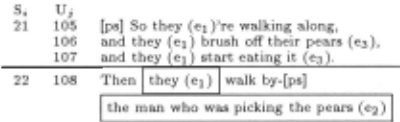
For understanding the subject NP in U 108 , recall that centering applies before c_describe. The subject pronoun will be assumed to realize the CB of the utterance, and will be assigned the default interpretation of e1. Applica tion of c_describe leads to the recognition that "they' is also a distinguishing description of e1 relative to CFu 107 · In this fashion, centering prunes the search space to the single entity satisfying the informational constraints im posed by c_describe . In understanding the object NP, the context argument must be instantiated to a more in clusive focus space, since neither the previous utterance nor the previous segment contains any entities described by this NP.
The integrated model also accounts for the problem atic phrasal NP in Fig. 4, discussed above. We saw that for U 9 and U 10, repeated below, the phrasal subject of U9 was well-specified, but the phrasal subject of U10 was over-specified, and a pronoun would be generated instead. But as noted above, a pronoun subject would have a garden path effect .
U9: the man (et) is in the tree (ea), U 1o: and the boy (e2) getsoff the bicycle (e4 ),
Kameyama's version of centering [1986] differs from [Grosz et al. , 1983] in allowing an utterance to have a null CB. U 10 would have a null CB because there is no definite pronoun constrained by property sharing that corefers with an NP in the previous utterance; in fact no NPs in U 1o refer to entities mentioned in U 9. A definite pronoun subject in U 10 would be assumed to be CBu 10 and would be inferred to refer to e1. This accounts for the garden path effect. Consequently, a pronoun must. be blocked. Because no entity in U9 is referred to in U10 , the input for generating U 1o will be annotated as having a NULL CB. This imposes output constraints requiring the subject and object NPs to be other than definite pronouns. As a consequence, c_describe will not try to find a pronoun solution to the uninstantiated NP argu ment. In the first phrasal NP solution, the head would denote a basic category and the NP would have no mod ifiers, thus generating the existing phrase "the boy'. In sum, centering relaxes the constraint otherwise imposed by c_describe that an NP cannot be over-specified.
5 Conclusion
I have presented an analysis of discourse anaphoric phrasal NPs in a corpus of narrative monologues showing that pronouns and phrasal NPs are rarely over-specified. Future research should indicate to what degree this generalization applies to other genres and modalities. Centering predicts conditions under which an under specified pronoun can be used, but says little about the interpretation of phrasal NPs. I have outlined a process ing model that integrates the attentional constraints of centering with aspects of Grice's maxims of quantity and quality. For enforcing the maxim of quantity, I rely on Dale's algorithm for constructing distinguishing descrip tions [1989] [1992], which I apply uniformly to pronouns and phrasal NPs for both generation and understanding.
For enforcing the maxim of quality, I combine aspects of Dale & Reiter's [To appear) preferred attributes with the construct of focussed attribute sets derived from the cor pus analysis. In contrast to Dale & Reiter [To appear], distinguishing descriptions are evaluated using the cur rent utterance context as a filter, and by instantiating the discourse context successively to the Cf list of the preceding utterance, then the current focus space, then other focus spaces, until a solution is found.
Centering provides one mechanism for relaxing the re quirement that an NP (either pronominal or phrasal) should be a distinguishing description. Another mecha nism would be needed to relax informational constraints at shifts in focus structure, so as to account for the one way implication of over-specified NPs with global shifts of attention (Table 1). However, further investigation is needed to determine how to integrate local and global discourse processing. When neither the Cf list nor the current focus space is the appropriate context for under standing or generating a discourse anaphoric NP, I have assumed that either an earlier focus space or a more inclusive one must be accessed. Some of the examples presented here suggest that the contextual dependencies captured by the use offocused attributes might constrain the relation of each new utterance to the global discourse model. For example, the segment onset in Fig. 6 (U 108) contains two NPs, one of which is the same as the CB of the preceding utterance. Maintaining the same CB re lates U108 and its focus space (FS22) to the most recent focus space FS21 . But the object NP expresses attributes last mentioned in segment 17, thus relating U 108 to the earlier focus space FS17. If the global structure is a tree, the relation of U 107 to both segments 21 and 17 might indicate how high up in the tree to locate the new focus space. Alternatively, an investigation of such relations might provide evidence about the nature of global struc ture, such as whether it is a tree or a lattice.
Acknowledgements
This work was partly supported by NSF grant IRI-9113064. Thanks to Robert Dale, Ehud Reiter, and Megumi Kameyama for valuable comments on ideas presented here.
@inproceedings{ijcai1995p163,
  title     = {Integrating Gricean and Attentional Constraints},
  author    = {Passonneau, Rebecca J.},
  booktitle = {Proceedings of the Fourteenth International Joint Conference on
               Artificial Intelligence, {IJCAI-95}},
  publisher = {International Joint Conferences on Artificial Intelligence},
  editor    = {Chris S. Mellish},
  pages     = {1267--1274},
  year      = {1995},
  note      = {Natural Language},
  url       = {https://ijcai.org/proceedings/1995/163},
}
TY - CPAPER TI - Integrating Gricean and Attentional Constraints AU - Passonneau, Rebecca J. T2 - Proceedings of the Fourteenth International Joint Conference on Artificial Intelligence, IJCAI-95 PB - International Joint Conferences on Artificial Intelligence PY - 1995 SP - 1267 EP - 1274 UR - https://ijcai.org/proceedings/1995/163 ER -Copied
Machine-readable versions of this paper, for tools and AI agents:





