
Using Decision Trees for Coreference Resolution
Proceedings of the Fourteenth International Joint Conference on Artificial Intelligence. Learning. Pages 1050-1054.
© 1995 International Joint Conferences on Artificial Intelligence
Abstract
This paper describes RESOLVE, a system that uses decision trees to learn how to classify coreferent phrases in the domain of business joint ventures. An experiment is presented in which the performance of RESOLVE is compared to the performance of a manually engineered set of rules for the same task. The results show that decision trees achieve higher performance than the rules in two of three evaluation metrics developed for the coreference task. In addition to achieving better performance than the rules, RESOLVE provides a framework that facilitates the exploration of the types of knowledge that are useful for solving the coreference problem.
- [Aberdeen et al., 1992] J. Aberdeen, J. Burger, D. Connolly, S. Roberts, and M. Vilain. MITRE-Bedford ALEM- BIC: MUC-4 test results and analysis. In ProceedingJ of the Fourth Meuage UnderJtanding Conference (MUC-4}, pages 116-123, 1992.
- [Appelt et al., 1992] D. E. Appelt, J. Bear, J. R. Hobbs, D. Israel, and M. Tyson. SRI lntemational FASTUS sys- tem: MUC-4 test results and analysis. In ProceedingJ of the Fourth Menage UnderJtanding Conference (MUC-4), pages 143-147, 1992.
- [Ayuso et al., 1992] D. Ayuso, S. Boisen, H . Fox, H. Gish, R . Ingria, and R. Weischedel. BBN: Description of the PLUM system as used in MUC-4. In ProceedingJ of the Fourth Meuage UnderJtanding Conference (MUC-4}, pages 169_:_176, 1992.
- [Burger et al., 1994] J. Burger, M . Vilain, J. Aberdeen, D. Connolly, and L. Hirschman. A model-theoretic coref- erence scoring scheme. Technical report, The MITRE Cor- poration, Bedford, MA, 1994.
- [Chinchor and Sundheim, 1993] N. Chinchor and B. Sund- heim. MUC-5 evaluation metrics. In Proceeding6 of the Fifth Message Understanding Conference (MUC-5), pages 22-29, 1993.
- [Chinchor, 1991] N. Chinchor. MUC-3 evaluation metrics. In Proceedings of the Third Meuage Understanding Confer- ence (MUC-3), pages 17-24, 1991.
- [Chinchor, 1992] N. Chinchor. MUC-4 evaluation metrics. In Proceedings of the Fourth Meuage Understanding Confer- ence (MUC-4}, pages 22-29, 1992.
- [Grosz et al., 1983] B. J. Grosz, A. K. Joshi, and S. Wein- stein. Providing a unified account of definite noun phrases in discourse. In Proceedings of the 21st Annual Meeting of the A CL, pages 44-50, 1983.
- [Iwanska et al., 1992] L. lwanska, D. Appelt, D. Ayuso, K. Dahlgren, B. Glover Stalls, R. Grishman, G. Krupka, C. Montgomery, and E. Riloff. Computational aspects of discourse in the context of MUC-3. In Proceedings of the Third Meuage Understanding Conference (MUC-3), pages 256-282, 1992.
- [Lehnert et al., 1991] W. Lehnert, C. Cardie, D. Fisher, E. Riloff, and R. Williams. University of Massachusetts: Description of the CIRCUS system as used for MUC-3. In Proceedings of the Third Meuage Understanding Confer- ence (MUC-3}, pages 223-233, 1991.
- [Lehnert et al., 1992] W. Lehnert, C. Cardie, D. Fisher, J. McCarthy, E. Riloff, and S. Soderland. University of Massachusetts: Description of the CIRCUS system as used for MUC-4. In Proceedings of the Fourth Message Under- standing Conference {MUC-4}, pages 282-288, 1992.
- [Lehnert et al., 1993] W. Lehnert, J. McCarthy, S. Soder- land, E. Riloff, C. Cardie, J . Peterson, F. Feng, C. Dolan, and S. Goldman. University of Massachusetts/Hughes: Description of the CIRCUS system as used for MUC-5. In Proceedings of the Fifth Meuage Understanding Con- ference (MUC-5), pages 277-290, 1993.
- [Lehnert, 1991] W. Lehnert. Symbolic/subsymbolic sentence analysis: Exploiting the best of two worlds. In J. Bam- den and J. Pollack, editors, Advances in Connectionist and Neural Computation Theory, Vol. 1, pages 135-164. Ablex Publishers, Norwood, NJ, 1991.
- Merchant, 1993
- R. H. Merchant. Tipster program overview. In Proceedings of the TIPSTER Text Program {Phase I), pages 1-2, 1993.
- [Moldovan et al., 1992] D. Moldovan, S. Cha, M. Chung, K. Hendrickson, J. Kim, and S. Kowalski. USC: MUC-4 test results and analysis. In Proceedings of the Fourth M es- sage Understanding Conference (MUC-4}, pages 164-166, 1992.
- [Quinlan, 1993] J . R . Quinlan. C4.5: Programs for Machine Learning. Morgan Kaufmann, San Mateo, CA, 1993.
- [Sidner, 1979] C. L. Sidner. Towards a computational theory of definite anaphora comprehension in English discourse. TR 537, M.I.T. Artificial Intelligence Laboratory, 1979.
- [Sundheim, 1991] B. M. Sundheim. Overview of the third message understanding evaluation and conference. In Pro- ceedings of the Third Message Understanding Conference (MUC-3), pages 3-16, 1991.
- [Sundheim, 1992] B. M. Sundheim. Overview of the fourth message understanding evaluation and conference. In Pro- ceedings of the Fourth Meuage Understanding Conference {MUC-4}, pages 3-21, 1992.
- [Sundheim, 1993] B. M. Sundheim. TIPSTER/MUC-5 infor- mation extraction system evaluation. In Proceeding11 of the Fifth Meuage Under11tanding Conference (MUC-5), pages 27-44, 1993.
- [van Rijsbergen, 1979] C. J. van Rijsbergen. Information Re- trieval. Butterworths, London, 1979.
- [Weir and Fritzson, 1993] C. Weir and R. Fritzson. UNISYS: Description of the CBAS system used for MUC-5. In Pro- ceedingll of the Fifth Meuage Under11tanding Conference {MUC-5}, pages 249-261, 1993.
References were extracted automatically from the PDF and may contain errors.
Full text extracted automatically from the PDF; figures, tables and equations may differ. The PDF is the version of record.
1 Introduction
The goal of an Information Extraction (IE) system is to identify information of interest from a collection of texts. Within a particular text, objects of interest are often ref erenced in different places and in different ways. One of the many challenges facing an IE system is to determine which references refer to which objects. This problem can be recast as a classification problem: given two ref erences, do they refer to the same object or different objects.
The Message Understanding Conferences (MUCs) [Sundheim, 1991; 1992; 1993] and the Tipster Project [Merchant, 1993] helped both to define the information extraction task and to push the technology of IE sys tems. Each of these evaluation efforts provided a corpus of news articles about a domain, a specification of the relevant information that was to be extracted from each article, the output representation of that information, and a set of key templates representing the information extracted from each article by human readers. 1 For the final evaluations, participating systems were given a set of blind texts and their output was scored against the key templates to determine how much of the relevant information they were able to extract.
·This research was supported by NSF Grant no. EEC9209623, State/Industry /University Cooperative Research on Intelligent Information Retrieval, Digital Equipment Cor poration and the National Center for Automated Information Research.
1 The MUC-5 evaluation actually included 4 different do mains, but most participants were required to select only one.
The sentence analyzers used in many of these systems have shown significant improvement over the past several years. However, the discourse processing capabilities. of these systems, particularly the_ir coreference resolutw~ components, have often been cited as weak areas [Weir and Fritzson, 1993; Moldovan et al., 1992; Aberdeen et al., 1992]. .
The IE systems developed at UMass [Lehnert et al., 1991; 1992; 1993] also displayed weak coreference reso lution capabilities. Each of these systems used a set of manually engineered rules to resolve some obvious types of coreference, but they tended to be very conse~vative, i.e., they only considered phrases to be coreferent If there was overwhelming evidence in support of that hypothe sis. One of the problems with these coreference resolu tion components was figuring out which features of the phrases to look at when determining coreference. An other, related set of problems was determining how to combine positive and negative evidence into individual rules and then how to order the rule set. A third problem area was the accumulation of errors at that late stage of processing, e.g., from incorrectly delimited sentences, in correct part-of-speech tags, and other sentence analysis errors.
In an effort to address these problems, a new approach to coreference resolution was begun after the MUC-5 evaluation: a system named RESOLVE was created to build decision trees that can be used to classify pairs of phrases as coreferent or not coreferent. The errors gener ated by the sentence analyzer were eliminated by using a special tool - the Coreference Marking Interface, or CMI - to extract a set of phrases from the MUC-5 En glish Joint Venture (EJV) corpus. 2 In order to minimize the difficulties involved with creating and maintaining complex sets of rules, a machine learning approach was adopted, in which a decision tree determines the order and relative weight of different pieces of evidence.
2 The MUC-5 EJV corpus is a collection of news articles, written in English, that describe business joint ventures, i.e., associations of two or more entities (companies, governments or people) created for the purpose of owning and/ or develop ing a project together.
RESOLVE used the C4.5 decision tree system [Quinlan, 1993] to learn how to classify coreferent phrases for the experiments reported in this paper. C4.5 was chosen pri marily due to its ease of use and its widespread accep tance; however, RESOLVE can use any learning system that uses feature vectors composed of attribute-value pa1rs.
2 Decision Trees vs. Rules
An experiment was conducted to compare the perfor mance of the decision trees generated by RESOLVE with the performance of manually engineered rules used for coreference classification in the UMass/Hughes MUC-5 IE system. A set ofreferences, along with the coreference links among these, were extracted from a group of texts via CMI. All possible pairings ofreferences from each text were generated, and these pairings were used to create a set of feature vectors used by RESOLVE. The pair ings that contained coreferent phrases formed positive instances, while those that contained two non-coreferent phrases formed negative instances. RESOLVE was then iteratively trained and tested on different partitions of this set of feature vectors.
The data structure used in discourse processing by the TJMass/ Hughes MUC-5 IE system was the memory to ken, which converted the case frame output from the CIRCUS sentence analyzer [Lehnert, 1991) into a more system-independent representation. Prior to corefer ence processing, each memory token contained one noun phrase, one or more lexical patterns encompassing that phrase, part-of-speech tags, semantic features, and infor mation that was inferred from either the phrase or the context in which the phrase was found. This inferred information included the type of object referenced by the phrase, any name or location substring contained in the phrase, and some domain-specific information such as whether the phrase was a joint venture parent (one of the entities who formed a joint venture) or joint venture child (the joint venture company itself). The references marked via CMI were converted into a memory token representation in order to test the performance of the MUC-5 system's coreference module.
2.1 Data
The articles in the EJV corpus describe business joint ventures among two or more entities (companies, govern ments and/ or people). The task definition provided for MUC-5 required IE systems to extract information about the entities involved, the relationships among these enti ties, the facilities associated with the joint venture, the products or services offered by the joint venture, its capi talization and revenue projections, and a variety of other related information. Since the entities involved in these joint ventures were the main focus of most of these ar ticles, references to entities were much more numerous than references to other types of object classes, e.g., peo ple. Therefore, entity references were selected as the focus of the experiments reported in this paper.
CMI is a graphical user interface that permits the user to mark phrases in a text; for each phrase, the user can indicate the object(s) with which the phrase is coreferent and some additional information about the phrase that can be inferred either from the phrase itself or its local context. This additional information is parameterized and can be modified easily for use in different domains. The data used in this experiment was based on a set of phrases extracted using CMI.
As an example, consider the following sentence, from text 0970 from the MUC-5 EJV corpus:
FAMILYMART CO. OF SEIBU SAISON GROUP WILL OPEN A CONVENIENCE STORE IN TAIPEI FRIDAY IN A JOINT VENTURE WITH TAIWAN'S LARGEST CAR DEALER, THE COMPANY SAID WEDNESDAY.The phrases underlined in this sentence contain rel evant information that must be extracted by an IE system. 3 The phrases in boldface refer to entity ob jects that are important to the MUC-5 task. As an ex ample of the types of information collected about each phrase, consider the first phrase in the sentence:
(:string "FAMILYMART CO." :slots (ENTITY (name "FAMILYMART CO.") (type COMPANY) (relationship JV-PARENT CHILD)))Information collected about each phrase includes the string itself, the character position of the string in the source text (not shown), the index of the sentence within which the string is found (also not shown), and some slot information that can be inferred from either the string itself or its local context - the same kind of informa tion that was contained in the memory tokens used by the MUC-5 system. In this example, the name of the entity and the fact that it is a company entity can both be inferred from the string itself. The fact that Fam ilymart Company plans to open a store in "A JOINT VENTURE" with another entity is considered adequate evidence that the company is the parent of a joint ven ture (j v-parent); the fact that the sentence contains the pattern "company-name-1 OF company-name-2" is evidence that company-name-1, in this case Familymart Co., is a subsidiary (child) of company-name-2, in this case Seibu Saison Group.
A second example of output from CMI can be seen be low, where nationality information has been extracted from the reference to the car dealer:
(:string "TAIWAN'S LARGEST CAR DEALER" :slots (ENTITY (type COMPANY) (relationship JV-PARENT) (nationality "Taiwan (COUNTRY)")))3 Note that the phrase "THE COMPANY" in the last clause of the sentence is not considered relevant, since it con tributes no information required for the MUC-5 task - the determination of who is announcing a joint venture or when the announcement was made are not relevant pieces of infor mation. Therefore, this phrase was not marked for use in the experiment.
In principle, much of the information gathered about a particular string could be found automatically: there are numerous proper name recognizer programs, pro grams that extract location information, and sentence analyzers that can infer relationship information - any system that exhibited good performance in MUC-5 must be good at inferring such relationships.
For the purposes of our experiment, however, this in formation was specified by a user via CMI. The primary motivation for this was to minimize the noise in the data; coreference resolution often occurs at a late processing stage in an IE system, and earlier errors such as incor rect part-of-speech tags, incorrectly delimited sentences and semantic tagging errors can create significant noise for a coreference classifier.
CMI was used to mark references to a variety of relevant object types (entity, facility, person and product-or-service) in 50 randomly selected texts. 4 Since references to entity objects were most numerous, this was the object class chosen for the experiment. In the 50 texts, 472 references to a total of 205 entity ob jects were marked using CMI.
Some phrases are multireferent, i.e., they refer to more than one object. These multireferent phrases pose diffi culties for classification, since it means that some phrases will be coreferent with other phrases in the text that have distinct referents. Thus for a set of phrase pairs which share a given phrase, more than one pair would be classified as a positive instance of coreference. Further complications are created for evaluating the performance of a coreference system when multireferent phrases are included in the data (see Section 2.4) . To simplify the initial experiments reported here, multireferent phrases were excluded from the data set. The capability to han dle such phrases will be incorporated in a later version of RESOLVE.
2.2 Rules used in the MUC-5 System
The coreference module of the UMass/Hughes MUC-5 IE system was designed to minimize false positives, i.e., minimize the likelihood that two phrases that were not coreferent would be labeled coreferent. This design de cision was based on the assumption that false posi tive errors, resulting in the merging of non-coreferent phrases in the final system output, would harm sys tem performance more than false negative errors, which would result in coreferent phrases showing up in dis tinct objects in the system output. This rather conser vative approach to coreference was shared by a num ber of MUC system developers [Appelt et al., 1992; Ayuso et al., 1992], though not all [Iwanska et al., 1992].
Another factor influencing the coreference module was the short time allotted to developing and testing this sys tem component. Since coreference resolution was a late stage in processing, upstream components had to be sta bilized before serious development could take place on coreference. Several late-stage components were being developed in parallel, so it is difficult to assess the time devoted exclusively to developing the coreference mod ule, but we estimate it was two person-weeks.
4 ln order to make things manageable for CMI annotator, the size of the texts was limited to 2KB, however the majority of texts in the EJV domain fall into this category.
| IF THEN | both tokens come from the same trigger family they are not coreferent. |
| IF THEN | each token comes from a different partition they are not coreferent. |
| IF THEN | both tokens contain a common phrase they are coreferent. |
| IF THEN | both tokens refer to joint ventures they are coreferent. |
| IF THEN | both tokens contain the same company name they are coreferent. |
| IF THEN | one token contains an alias of the other they are coreferent. |
| IF THEN | only one token refers to a joint venture they are not coreferent. |
| IF THEN | each token contains different company names they are not coreferent. |
The rules used to determine whether two phrases (represented as memory tokens) were coreferent in the MUC-5 system are shown in Table 1. Following the pol icy of minimizing false positives, whenever none of the rules fired, the system classified the pair of tokens as not coreferent.
The UMass/Hughes MUC-5 IE system used a vari ety of mechanisms to identify phrases referring to joint ventures (the entity formed by two or more parent en tities for some particular business purpose), to identify company names within a phrase (if they exist), and to determine whether one phrase was an alias (an abbrevia tion or shortened form), as well as the ability to identify trigger families 5 and partitions 6 in the text .
One of the many difficulties in developing the rule set for coreference classification was in ordering the rules. Several different orderings were tested during the de velopment period, and the order shown above was the ordering of the rule set used for final evaluation. This difficulty in rule ordering was one of the motivations be hind using a machine learning approach - we wanted to develop a system that could learn how to combine the positive and negative evidence.
2.3 Features Used By RESOLVE
A decision tree requires data to be represented by feature vectors, i.e., vectors of attribute/value pairs. For the task of coreference classification, references were paired up, and features were extracted from the pair of ref erences as well as from the individual references them selves. Since this experiment involved a comparison be tween RESOLVE and a manually engineered rule set, the features used in this experiment were based on the an tecedents of the coreference rules used in the UMass/ Hughes MUC-5 IE system.
5 A trigger family is a set of phrases all triggered off the same word, e.g., a subject and direct object joined by the same verb phrase.
6 A partition is a portion of the text that is focusing on the same main topic. For the MUC-5 system, distinct partitions were recognized only for texts that had bulleted items, as one might see in a news summary of the days headlines. Most texts thus had a single partition.
| Individual Phrases | Pair of Phrases | ||
|---|---|---|---|
| Attribute | Value | Attribute | Value |
| NAME-1 | YES | ALIAS | NO |
| JV-CHILD-1 | NO | BOTH-JV -CHILD | NO |
| NAME-2 | YES | COMMON-NP | NO |
| JV-CHILD-2 | NO | SAME-SENTENCE | NO |
For example, Table 2 shows a feature vector that rep resents the pairing of the phrases "FAMILYMART CO." and "TAIWAN'S LARGEST CAR DEALER" . Since the two phrases are not coreferent, this represents a negative instance.
Of the 8 features used in this experiment, two focus on the first reference, two focus on the second reference and four are based on the pair of references. The following is a brief description of the features that focus on individual phrases, where i E {1, 2}.
- NAME-i: Does reference i contain a name? Possible values: {YES, NO}.
- JV-CHILD-i: Does reference i refer to a joint venture child, i.e., a company formed as the result of a tie up among two or more entities? Possible values: {YES , NO, UNKNOWN}.
The last four features focus on the pair of references.
- ALIAS: Does one reference contain an alias of the other, i.e., does each reference contain a name and is one name a substring of the other name? 7 Possible values: {YES, NO} .
- BOTH-JV-CHILD: Do both references refer to a joint
- venture child? This feature is defined as yes when Vi, JV-CHILD-i = YES no when Vi, JV-CHILD-i = NO
unknown otherwise.
- COMMON-NP: Do the references share a common noun phrase? Some references contain non-simple noun phrases, e.g., appositions and relative clauses. This feature compares the simple constituent noun phrases of each reference. Possible values: {YES, NO}.
- SAME-SENTENCE:
Do the references come from the same sentence? RESOLVE does not use CIRCUS output, and thus has no notion of a trigger family as it was used in the MUC-5 system; the SAME-SENTENCE feature is a very weak attempt to extract this sort of informa tion. Possible values: {YES, NO}.
7 Note that some texts contain more than one entity for which a given name might be an alias under this definition, e.g., "SUMITOMO" is a substring of both "SUMITOMO CORP." and "SUMITOMO ELECTRICAL INDUSTRIES LTD.", so this feature is not always a reliable indicator of coreference.
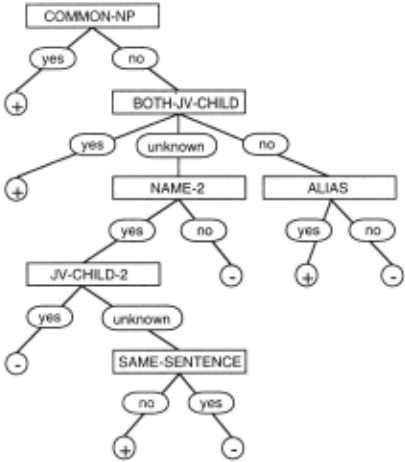
1230 feature vectors, or instances, were created from the entity references marked in the 50 texts. Of these, 322 (26%) were positive ("+") instances - pairs of phrases that were coreferent - and 908 (74%) were negative ( "-") instances - pairs of phrases that were not coreferent. Figure 1 shows a pruned C4.5 decision tree trained on all the instances.
2.4 Evaluation Methodology
Coreference is a symmetrical and transitive relation that holds among a set of two or more references, e.g., if we know that A is coreferent with B, and B is coreferent with C, then there is an implicit coreference "link" be tween A and C. 8 Any coreference classification for two references has implications beyond the determination of whether that particular classification was correct or in correct. For example, if A and Bare correctly classified as coreferent, but B and Care incorrectly classified as not coreferent, a system may also incorrectly conclude that A and C are not coreferent . Thus, simply measur ing the accuracy of a coreference classifier is inadequate for evaluating how well the classifier performs its task.
Two metrics that have been used to evaluate the per formance of IE systems are recall and precision [Chin chor, 1991; 1992; Chinchor and Sundheim, 1993]. Recall is the percentage of information in a text that is correctly extracted by a system; precision is the percentage of in formation extracted by a system that is correct. For ex ample, if a text contains four relevant items (represented by {A, B, C, D} in an answer key), and a system cor rectly extracts the three items {A, B, C} but incorrectly extracts the two additional items {E, F} (represented by {A, B, C, E, F} in a system response), then its recall would be 75% and its precision would be 60%.
8 As was noted earlier, some references are multireferent, i.e., they have more than one referent. Thus, if B is multiref erent, we cannot conclude that A is coreferent with C; for example, if A = Sneezy, B = the dwarfs and C = Grumpy, we don't want to infer that Sneezy= Grumpy. We can ig nore such complications in this paper since the experiments reported herein exclude multireferent phrases.
A function to combine recall and precision into a sin gle measure of performance was incorporated into the Fourth Message Understanding Evaluation and Confer ence [Chinchor, 1992] . The F-measure, a metric used to evaluate Information Retrieval (IR) system perfor mance [van Rijsbergen, 1979], combines recall and pre cision scores into a single number using the formula
where Pis the precision score, R is the recall score and f3 is the relative weight given to recall over precision. For example, a f3 value of 1.0 gives equal weight to recall and preclSlon; a value of 2.0 gives recall twice the weight of precision; a value of 0.5 gives recall half the weight of prec1s10n.
An evaluation methodology for the coreference task is being developed for the upcoming Sixth Message Under standing Evaluation and Conference (MUC-6). The met rics used for evaluating overall IE system performance are bein& adapted for use on this subtask ( cf. [Burger et al., 1994J), where the answer key for each text contains a set of phrases and the coreference links among them. However, evaluation of coreference performance is com plicated by the need to take into account the implicit coreference links among phrases. Thus, transitive clo sures are taken for both the answer key (the key closure) and the system response (the response closure). Recall is measured by the percentage of explicit coreference links in the key that are also found in the response closure, i.e., what fraction of correct coreference links is implied by the transitive closure of the coreference links in the system response. Precision is measured by the percent age of explicit coreference links in the response that are also found in the key closure, i.e., what fraction of coref erence links in the response is implied by the transitive closure of the coreference links in the key.
2.5 Results
One experiment was run using RESOLVE. In this ex periment, for each set of instances taken from the 50 texts, one set was selected for testing purposes and the remaining sets were used to train a new decision tree. This process was iterated over all 50 sets of instances. The results shown in Table 3 represent the average of these iterations: the first row shows the recall, precision and F-measure (/3 = 1.0) scores for unpruned decision trees; the second row shows the results for pruned deci sion trees. 9
The third row in Table 3 shows the results from a second experiment, in which the rule set from the coref erence module of the UMass/Hughes MUC-5 IE system was applied to the memory token pairs generated from the references marked using CMI.
9 Default settings for all C4.5 parameters were used throughout this experiment (see [Quinlan, 1993], Chapter 9, for more information about C4.5 parameters) .
| I System | Recall | Precision | F-measure |
|---|---|---|---|
| RESOLVE (unpruned) | 85.4% | 87.6% | 86.5% |
| RESOLVE (pruned) | 80.1% | 92.4% | 85.8% |
| MUC-5 rule set | 67.7% | 94.4% | 78.9% |
| I System | 1 f3 = 2.o | 1 f3 = 1.o | 1 f3 = o.5 |
|---|---|---|---|
| RESOLVE (unpruned) | 85.8% | 86.5% | 87.1% |
| RESOLVE (pruned) | 82.3% | 85.8% | 89.6% |
| MUC-5 rule set | 71.8% | 78.9% | 87.5'7o |
2.6 Discussion
When we first began applying decision trees to the coref erence resolution problem, we were hoping to achieve performance that was comparable to the manually engi neered rules we had used in MUC-5. We were greatly en couraged to discover that we could achieve performance that surpassed the performance of the rules from our MUC-5 system in both recall and F-measure scores.
As was noted earlier, the MUC-5 coreference rules were designed to minimize false positives. The effect of this bias can be seen in the higher precision score achieved by the rule set in comparison with both the unpruned and pruned decision trees. The difference in precision scores between the unpruned and pruned ver sions of the decision trees might be explained by the prevalence of negative instances (74%) in the data set, which may lead to a stronger bias to classify pairs of phrases as not coreferent in the smaller trees.
The comparative effects of false positives and false negatives in coreference classification on overall IE sys tem performance remains an open question. However , while the precision scores achieved by the decision trees and the rule-base are rather close, especially for the pruned version of the trees, there is a large difference between their recall scores. Until we can ascertain the relative importance of high recall vs. high precision in overall IE system performance, the F-measure score that gives equal weight to recall and precision may be the best indicator of overall performance on the coreference res olution task. However, as can be seen in Table 4, when RESOLVE uses pruning, its performance surpasses that of the rule set even when the recall score is given twice the weight of precision score or when the recall score is given half the weight of precision score. 10
3 Conclusions
One of the original goals of this new approach was to de velop a system that achieved good performance in resolv ing references - performance that was at least as good as the performance achieved using manually engineered rules in our MUC-5 system. However, as we continue to pursue this approach, we find that there is another advantage to using decision trees: they allow us to focus on determining which features work well for resolving references.
10 The pruned decision trees yield higher F-measure scores than the MUC-5 rule set unless the recall score is given less than one-third the weight of the precision score.
We are encouraged by the performance of the decision trees on the coreference resolution problem. The fea tures we have used in the experiment described above are not considered comprehensive by any means. While they have proved sufficient for attaining a certain level of performance, an examination of specific errors made by the trees shows that additional features will be needed to attain higher levels.
One area we will develop further is a set of features that incorporate syntactic knowledge. We don't have any features that identify the various syntactic con stituents of a sentence, e.g., subject or direct object, nor do we have any features that identify clause boundaries (only sentence boundaries). These features will be in corporated in future experiments. Features based on fo cus of attention [Sidner, 1979; Grosz et al., 1983], which presuppose knowledge about syntactic constituents may also prove useful. Our experiment used a feature set that was largely semantic in nature: it is interesting to see how well semantic features work as a basis for coref erence resolution . . . and it is not surprising to see that they are also insufficient.
Ultimately, we hope to understand better which fea tures are important for coreference classification, across different objects and different domains. Such an under standing would benefit people involved with IE system development, and should be of interest to people outside the IE community as well. We think that decision trees are an important tool in a systematic study of corefer ence resolution.
@inproceedings{ijcai1995p136,
  title     = {Using Decision Trees for Coreference Resolution},
  author    = {McCarthy, Joseph F. and Lehnert, Wendy G.},
  booktitle = {Proceedings of the Fourteenth International Joint Conference on
               Artificial Intelligence, {IJCAI-95}},
  publisher = {International Joint Conferences on Artificial Intelligence},
  editor    = {Chris S. Mellish},
  pages     = {1050--1054},
  year      = {1995},
  note      = {Learning},
  url       = {https://ijcai.org/proceedings/1995/136},
}
TY - CPAPER TI - Using Decision Trees for Coreference Resolution AU - McCarthy, Joseph F. AU - Lehnert, Wendy G. T2 - Proceedings of the Fourteenth International Joint Conference on Artificial Intelligence, IJCAI-95 PB - International Joint Conferences on Artificial Intelligence PY - 1995 SP - 1050 EP - 1054 UR - https://ijcai.org/proceedings/1995/136 ER -Copied
Machine-readable versions of this paper, for tools and AI agents:





