
Rationality and Intelligence
Proceedings of the Fourteenth International Joint Conference on Artificial Intelligence. Awards. Pages 950-959.
© 1995 International Joint Conferences on Artificial Intelligence
Abstract
The long-term goal of our field is the creation and understanding of intelligence. Productive research in AI, both practical and theoretical, benefits from a notion of intelligence that is precise enough to allow the cumulative development of robust systems and general results. This paper outlines a gradual evolution in our formal conception of intelligence that brings it closer to our informal conception and simultaneously reduces the gap between theory and practice.
- [Agre and Chapman, 1987] Philip E. Agre and David Chapman. Pengi: an implementation of a theory of activity. In Proceedings of the Tenth International Joint Conference on Artificial Intel- ligence (IJCAI-87), pages 268-272, Milan, Italy, August 1987.
- Morgan Kaufmann. [Breese and Fehling, 1990] J. S. Breese and M. R. Fehling. Con- trol of problem-solving: Principles and architecture. In R. D. Shachter, T. Levitt, L. Kana!, and J. Lemmer, editors, Uncertainty in Artificial Intelligence 4 . Elsevier/North-Holland, Amsterdam, London, New York, 1990.
- Brooks, 1989
- R. A. Brooks. Engineering approach to building complete, intelligent beings. Proceedings of the SPIE-The Inter- national Society for Optical Engineering, 1002:618-625, 1989.
- [Carnap, 1950] RudolfCarnap. Logical Foundations of Probability. University of Chicago Press, Chicago, Illinois, 1950.
- [Cherniak, 1986] C. Cherniak. Minimal Rationality. MIT Press, Cambridge, Massachusetts, 1986.
- [Davis, 1980] Randall Davis. Meta-rules: reasoning about control. Artificial Intelligence, 15(3): 179-222, December 1980.
- [Dean and Boddy, 1988] Thomas Dean and Mark Boddy. An anal- ysis of time-dependent planning. In Proceedings of the Seventh National Conference on Artificial Intelligence (AAAI-88), pages 49-54, St. Paul, Minnesota, 21-26 August 1988.
- Morgan Kauf- mann.
- [Dean and Kanazawa, 1989] Thomas Dean and Keiji Kanazawa. A model for reasoning about persistence and causation. Computa- tional Intelligence, 5(3): 142-150, 1989.
- [Dean et al., 1995] Thomas L. Dean, John Aloimonos, and James F. Allen. Artificial Intelligence: Theory and Practice. Ben- jamin/Cummings, Redwood City, California, 1995.
- [Dennett, 1986] Daniel C. Dennett. The moral first aid manual. Tanner lectures on human values, University of Michigan, 1986.
- [Forbes et al., 1995] Jeff Forbes, Tim Huang, Keiji Kanazawa, and Stuart Russell. The BATmobile: Towards a Bayesian automated taxi. Submitted to IJCAI-95, 1995. IJCAI
- [Harman, 1983] Gilbert H. Harman. Change in View: Principles of Reasoning. MIT Press, Cambridge, Massachusetts, 1983.
- [Horvitz, 1987] E. J. Horvitz. Problem-solving design: Reasoning about computational value, trade-offs, and resources. In Proceed- ings of the Second Annual NASA Research Forum, pages 26-43,
- Moffett Field, California, 1987. NASA Ames Research Center.
- [Howard, 1966] Ronald A. Howard. Information value theory. IEEE Transactions on Systems Science and Cybernetics, SSC-2:22-26, 1966.
- [Kalman, 1960] R. E. Kalman. A new approach to linear filtering and prediction problems. Journal of Basic Engineering, pages 35-46, March 1960.
- [Kearns et al., 1992] M. Kearns, R. Schapire, , and L. Sellie. Toward efficient agnostic learning. In Proceedings of the Fifth Annual ACM Workshop on Computational Learning Theory (COLT-92), Pittsburgh, Pennsylvania, July 1992. ACM Press.
- [Keeney and Raiffa, 1976] Ralph L. Keeney and Howard Raiffa. Decisions with Multiple Objectives: Preferences and Value Tradeoffs. Wiley, New York, 1976.
- [Lauritzen, 1995] S. L. Lauritzen. The EM algorithm for graphical association models with missing data. Computational Statistics and Data Analysis, 19:191-201, 1995.
- [Matheson, 1968] J. E. Matheson. The economic value of analysis and computation. IEEE Transactions on Systems Science and Cybernetics, SSC-4(3):325-332, 1968.
- [Megiddo and Wigderson, 1986] N. Megiddo and A. Wigderson. On play by means of computing machines. In Joseph Y. Halpern, editor, Theoretical Aspects of Reasoning about Knowledge: Pro- ceedings of the 1986 Conference (TARK-86), pages 259-274, Monterey, California, March 19-22 1986. ffiM and AAAI, Mor- gan Kaufmann. [Newell, 1982] Allen Newell. The knowledge level. Artificial In- telligence, 18(1):82-127, 1982.
- [Papadimitriou and Yannakakis, 1994] C. H. Papadimitriou and M. Yannakakis. On complexity as bounded rationality. In Sym- posium on Theory of Computation (STOC-94 ), 1994.
- [Parr and Russell, 1995] Ronald Parr and Stuart Russell. Approx- imating optimal policies for partially observable stochastic do- mains. Submitted to IJCAI-95, 1995. IJCAI
- [Russell and Norvig, 1995] Stuart J. Russell and Peter Norvig. Ar- tificial Intelligence: A Modern Approach. Prentice-Hall, Engle- wood Cliffs, New Jersey, 1995.
- [Russell and Subramanian, 1995] Stuart J. Russell and Devika Sub- ramanian. Provably bounded-optimal agents. Journal of Artificial Intelligence Research, 3, May 1995. IJCAI
- [Russell and Wefald, 1989] Stuart J. Russell and Eric H. Wefald. On optimal game-tree search using rational meta-reasoning. In Pro- ceedings of the Eleventh International Joint Conference on Arti- ficial Intelligence (IJCAJ-89), pages 334-340, Detroit, Michigan, August 1989. IJCAI
- Morgan Kaufmann.
- [Russell and Wefald, 1991a] Stuart J. Russell and Eric H. Wefald. Do the Right Thing: Studies in Limited Rationality. MIT Press, Cambridge, Massachusetts, 1991 .
- [Russell and Wefald, 1991b] Stuart J. Russell and Eric H. Wefald. Principles of metareasoning. Artificial Intelligence, 49(1-3):361- 395, May 1991.
- [Russell and Zilberstein, 1991] S. Russell and S. Zilberstein. Com- posing real-time systems. In Proceedings of the Twelfth Inter- national Joint Conference on Artificial Intelligence ( IJCAI-91 ), Sydney, August 1991. IJCAI
- Morgan Kaufmann. [Russell et al., 1995]
- Stuart Russell, John Binder, Daphne Koller, and Keiji Kanazawa. Local learning in probabilistic networks with hidden variables. In Proceedings of the Fourteenth International Joint Conference on Artificial Intelligence (IJCAI-95 ), Montreal, Canada, August 1995. IJCAI
- Morgan Kaufmann.
- [Simon, 1955] Herbert A. Simon. A behavioral model of rational choice. Quarterly Journal of Economics, 69:99-118, 1955.
- [Simon, 1958] Herbert A. Simon. Rational choice and the structure of the environment. In Models of Bounded Rationality, volume 2. MIT Press, Cambridge, Massachusetts, 1958.
- [Sondik, 1971] E. J. Sondik. The Optimal Control of Partially Ob- servable Markov Decision Processes. PhD thesis, Stanford Uni- versity, Stanford, California, 1971.
- [Tash and Russell, 1994] Jonathan K. Tash and Stuart J. Russell. Control strategies for a stochastic planner. In Proceedings of the Twelfth National Conference on Artificial Intelligence (AAAI-94 ), Seattle, Washington, August 1994. AAAI Press.
- [Wellman, 1985] Michael P. Wellman. Reasoning about prefer- ence models. Technical Report MIT/LCSffR-340, Laboratory for Computer Science, MIT, Cambridge, Massachusetts, 1985.
- [Zilberstein and Russell, 1995] Shlomo Zilberstein and Stuart Rus- sell. Optimal composition of real-time systems. Artificial Intelli- gence, 79(2), 1995.
References were extracted automatically from the PDF and may contain errors.
Full text extracted automatically from the PDF; figures, tables and equations may differ. The PDF is the version of record.
1 Artificial Intelligence
AI is a field in which the ultimate goal has often been some what ill-defined and subject to dispute. Some researchers aim to emulate human cognition, others aim at the creation of intelligence without concern for h~man c~aracteristics, and still others aim to create useful artifacts without concern for abstract notions of intelligence.
This variety is not necessarily a bad thing, since each ap proach uncovers new ideas and provides fertilization to the others. But one can argue that, since philosophers abhor a definitional vacuum, many of the damaging and ill-informed debates about the feasibility of AI have been about definitions of AI to which we as AI researchers do not subscribe.
My own motivation for studying AI is to create and under stand intelligence as a general property of systems, rather than as a specific attribute of humans. I beli~ve thi~ to ~e an appro priate goal for the field as a whole, and It certamly mcludes the creation of useful artifacts-both as a spin-off and as a focus and driving force for technological development. The diffi culty with this "creation of intelligence" vi~w, ho~ever, is that it presupposes that we have some productive notion of what intelligence is. Cognitive scientists can say "Lo?k, my model correctly predicted this experimental observation of human cognition," and artifact developers can say "Look, my ~ystem is saving lives/megabucks," but few of us are happy with pa pers saying "Look, my system is intelligent.". This diffic~lty is compounded further by the need for the~rettcal scaffoldmg to allow us to design complex systems with confidence and to build on the results of others. "Intelligent" must be given a definition that can be related directly to the system's input, structure, and output. 1
1 Such a definition must also be general. Otherwise, AI sub-
In this paper, I shall outline the development of such defi nitions over the history of AI and related disciplines. 2 I shall examine each definition as a predicate P that can be applied, supposedly, to characterize systems that are intelligent. For each P, I shall discuss whether the statement "Look, my sys tem is P'' is interesting and at least sometimes true, and the sort of research and technological development to which the study of P-systems leads.
I shall begin with the idea that intelligence is strongly re lated to the capacity for successful behaviour-the so-calle? "agent-based" view of AI. The candidates for formal defim tions of intelligence are as follows:
- P1: Perfect rationality, or the capacity to generate maxi mally successful behaviour given the available informa tion.
- P2: Calculative rationality, or the in-principle capac ity to compute the perfectly rational decision given the initially available information.
- P3: Metalevel rationality,orthe capacity to select the.op timal combination of computation-sequence-plus-actiOn, under the constraint that the action must be selected by the computation.
- P4: Bounded optimality, or the capacity to generate max imally successful behaviour given the available informa tion and computational resources.
All four definitions will be fleshed out in detail, and I will de scribe some results that have been obtained so far along these lines. Then I will describe ongoing and future work under the headings of calculative rationality and bounded optimality.
I shall be arguing that, of these candidates, bounded op timality comes closest to meeting the needs of AI research. There is always a danger, in this sort of claim, that its accep tance can lead to "premature mathematization," a conditi.on characterized by increasingly technical results that have In creasingly little to do with the original problem-in the case of AI, the problem of creating intelligence. Is research ?n bounded optimality a suitable stand-in for resear.ch ~n I~ telligence? I hope to show that P4, bounded optimality,. IS closer than P1 through P3 because it is a real problem with real and desirable solutions, and also because it satisfies some essential intuitions about the nature of intelligence. Some im portant questions about intelligence can only be formulated and answered within the framework of bounded optimality or some relative thereof. Only time will tell, however, whether bounded optimality research, perhaps with additional refine ments, can generate enough theoretical scaffolding to support significant practical progress in AI.
sides into a smorgasbord of fields-intelligence as ch~ss pla~ing, intelligence as vehicle control, intelligence as medical diagnosis.
2 In doing so I shall draw heavily on previous work with Eric We fald [Russell and Wefald, 1991a] and Devika Subramanian [Russell and Subramanian, 1995]. The latter paper contains a much more rigorous analysis of the concepts presented here.
2 Agents
Until fairly recently, it was common to define AI as the compu tational study of "mental faculties" or "intelligent systems," catalogue various kinds, and leave it at that. This doesn't provide much guidance. Instead, one can define AI as the problem of designing systems that do the right thing. Now we just need a definition for "right."
This approach involves considering the intelligent entity as an agent, that is to say a system that senses its envi ronment and acts upon it. Formally speaking, an agent is defined by the mapping from percept sequences to actions that the agent instantiates. Let 0 be the set of percepts that the agent can observe at any instant, and A be the set of possible actions the agent can carry out in the external world. Thus the agent function f : 0* -+ A defines how an agent behaves under all circumstances (including those where it does nothing). What counts in the first instance is what the agent does, not necessarily what it thinks, or even whether it thinks at all. This initial refusal to con sider further constraints on the internal workings of the agent (such as that it should reason logically, for example) helps in three ways: first, it allows us to view such "cognitive facul ties" as planning and reasoning as occurring in the service of finding the right thing to do; second, it encompasses rather than excludes the position that systems can do the right thing without such cognitive faculties [Agre and Chapman, 1987; Brooks, 1989]; third, it allows more freedom to consider var ious specifications, boundaries, and interconnections of sub systems.
The agent-based view of AI has moved quickly from work shops on "situatedness" and "embeddedness" to mainstream textbooks [Russell and Norvig, 1995; Dean et al., 1995] and buzzwords in Newsweek. Rational agents, loosely speaking, are agents whose actions make sense from the point of view of the information possessed by the agent and its goals (or, the task for which it was designed). Rationality is a property of actions and does not specify-although it does constrain the process by which the actions are selected. This was a point emphasized by Simon [1958], who coined the terms substantive rationality and procedural rationality to describe the difference between the question of what decision to make and the question of how to make it. That Rod Brooks's 1991 Computers and Thought lecture was titled "Intelligence with out Reason~· emphasizes the fact that reasoning is (perhaps) a derived property of agents that might, or might not, be a good implementation scheme to achieve rational behaviour. The justification of cognitive structures that many AI researchers take for granted is not an easy problem.
One other consequence of the agent-based view of intelli gence is that it opens AI up to competition from other fields that have traditionally looked on the embedded agent as a nat ural topic of study. Control theory is foremost among these, but evolutionary programming and indeed evolutionary biol ogy itself also have ideas to contribute. 3 The prevalence of the agent view has also helped the field move towards solving real problems, avoiding what Brooks calls the "hallucina tion" problem that arises when the fragility of a subsystem is masked by having an intelligent human providing input to it and interpreting its outputs.
3 1 view this as a very positive development. AI is a field defined
3 Perfect Rationality
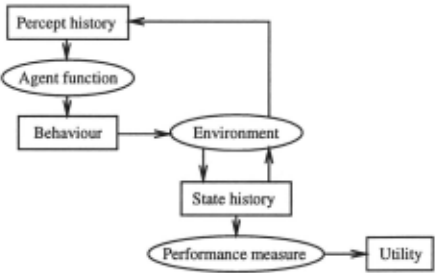
Perfect rationality constrains an agent's actions to provide the maximum expectation of success given the information available. We can expand this notion as follows (see Figure 1). The fundamental inputs to the definition are the environment class E in which the agent is to operate and the performance measure U which evaluates the sequence of states through which the agent drives the actual environment. Let V(j, E, U) denote the expected value according to U obtained by an agent function/ in environment E. Then a perfectly rational agent is defined by an agent function/opt such that
This is just a fancy way of saying that the best agent does the best it can. The point is that perfectly rational behaviour is a well-defined function of E and U, which I will call the task environment. The problem of computing this function is addressed below.
The theoretical role of perfect rationality within AI is well described by Newell's paper on the Knowledge Level [Newell, 1982]. Knowledge-level analysis of AI systems relies on an assumption of perfect rationality. It can be used to establish an upper bound on the performance of any possible system, by establishing what a perfectly rational agent would do given the same knowledge.
The question oflearning in perfectly rational agents is much less well-understood than the question of action selection, yet it is equally essential in the specification of perfectly ratio nal behaviour since it determines the agent's expectations. In the logical view of rationality, learning has received almost no attention-indeed, Newell's analysis precludes learning at the
by its problems, not its methods. Its principal insights-among them the learning, use, and compilation of explicit knowledge in the service of decision making-can certainly withstand the influx of new methods from other fields . This is especially true when other fields are simultaneously embracing the insights derived within AI.
knowledge level. In the decision-theoretic view, Bayesian up dating provides a model for rational learning, but this pushes the question back to the prior [Carnap, 19501. The question of rational priors remains unsettled.
Another aspect of perfect rationality that is lacking is the development of a suitable body of techniques for the specifi cation of utility functions. In economics, many results have been derived on the decomposition of overall utility into at tributes that can be combined in various ways [Keeney and Raiffa, 1976], yet such methods have made few inroads into AI (but see [Wellman, 1985]). We also have little idea how to specify utility over time, and although the question has been raised often, we do not have a satisfactory understanding of the relationship between goals and utility.
The good thing about perfectly rational agents is that if you have one handy, you prefer it to any other agent. Furthermore, if you are an economist you can prove nice results about economies populated by them. The bad thing is that the theory of perfect rationality does not provide for the analysis of the internal design of the agent: one perfectly rational agent is as good as another. The really bad thing, as pointed out by Simon, is that perfectly rational agents do not exist. Physical mechanisms take time to process information and select actions, hence the behaviour of real agents includes long sequences of inaction. Unless the environment is static (see below), inaction is suboptimal.
4 Calculative Rationality
Before discussing calculative rationality, it is necessary to introduce a distinction between the agent function and the agent program. In AI, an agent is implemented as a program, which I shall call l, running on a machine, which I shall call M. An agent program receives as input the current percept, but also has internal state that reflects, in some form, the previous percepts. It outputs actions when they have been selected. From the outside, the behaviour of the agent consists of the selected actions interspersed with inaction (or whatever default actions the machine generates).
Calculative rationality is displayed by programs that, if executed infinitely fast, would result in perfectly rational be haviour. Unlike perfect rationality, calculative rationality is a requirement that can be fulfilled by many real programs. Also unlike perfect rationality, calculative rationality is not necessarily a desirable property. For example, a calculatively rational chess program will choose the "right" move, but may take 10 50 times too long to do so.
The pursuit of calculative rationality has nonetheless been the main activity of theoretically well-founded research in AI. In the early stages of the field, it was important to concentrate on "epistemological adequacy" before "heuristic adequacy" -that is, capability in principle rather than in practice. The methodology that has resulted involves designing programs that exhibit calculative rationality, and then using various speedup techniques and approximations in the hope of getting as close as possible to perfect rationality. Another common aspect of the methodology is the imposition of restrictions on the task environment to render decision problems tractable.
This methodology has been pursued in both the logical and the decision-theoretic traditions. In the logical tradi tion, the performance measure accepts behaviours that achieve the specified goal in all cases and rejects any others. Thus Newell [1982J defines rational actions as those that are guar anteed to achieve one of the agent's goals. Logical planning systems, such as theorem-provers using situation cal culus, satisfy the conditions of calculative rationality under this definition. In the decision-theoretic tradition, the design of calculatively rational agents has largely gone on outside Al-for example, in stochastic optimal control theory. Rep resentations have usually been very impoverished (state-based rather than sentential) and solvable problems have been either very small or very specialized. Within AI, the development of probabilistic networks or belief networks has opened up many new possibilities for agent design. Systems based on influence diagrams (probabilistic networks with action and value nodes added) satisfy the decision-theoretic version of calculative rationality.
AI has also developed a very powerful armoury of meth ods for reducing complexity, including the decomposition of state representations into sentential form; sparse -representa tions of environment models (as in STRIPS operators); so lution decomposition methods such as partial-order planning and abstraction; approximate, parameterized representations of value functions for reinforcement learning; compilation (chunking, macro-operators, EBL etc.); and the application of metalevel control. Although some of these methods can retain guarantees of optimality and are effective for moder ately large problems that are well structured, it is inevitable that intelligent agents will be unable to act rationally in all cir cumstances. This observation has been a commonplace since the very beginning of AI. There are two common responses: one can rule out sources of exponential complexity in the representations and reasoning tasks addressed (as described in two fascinating Computers and Thought lectures, by Hec tor Levesque in 1985 and Henry Kautz in 1989); or one can design systems that select suboptimal actions. Suboptimal methods fall outside calculative rationality per se, however, and we need a better theory to understand them.
5 Metalevel Rationality
Metalevel rationality, also called Type II rationality by I. J. Good, is based on the idea of finding an optimal tradeoff between computational costs and decision quality.· Although Good never made his concept of Type II rationality precise, it is clear that the aim was to take advantage of some sort of metalevel architecture to implement this tradeoff. Metalevel architecture is a design philosophy for intelligent agents that divides the agent into two (or more) notional parts. The object level carries out computations concerned with the applica tion domain-for example, projecting the results of physical actions, computing the utility of certain states, and so on. The metalevel is a second decision-making process whose application domain consists of the object-level computations themselves and the computational objects and states that they affect. Metareasoning has a long history in AI, going back at least to the early 1970s. TEIRESIAS [Davis, 1980] established the idea that explicit, domain-specific metaknowledge was an important aspect of expert system creation.
The theory of rational metareasoning provides an alter native to the view that metaknowledge is a sort of "extra" domain knowledge, over and above the object-level domain knowledge, that one has to add to an AI system to get it to work well. The basic idea is that object-level computations are actions with costs (the passage of time) and benefits (im provements in decision quality). A rational metalevel selects computations according to their expected utility. The im portant thing is that the metatheory describing the effects of computations is domain-independent. In principle, no addi tional domain knowledge is needed to assess the benefits of a computation, although in practice the results of metalevel analysis for particular domains can be compiled into domain specific metaknowledge. Thus, there is an interesting sense in which algorithms are not a necessary part of AI systems. In stead, one can imagine a general process of rationally guided computation interacting with properties of the environment to produce more and more efficient decision making. To my mind, this way of thinking finesses one major puzzle of AI: if what is required for AI is incredibly devious and superbly efficient algorithms far surpassing the best efforts of computer scientists, how did evolution (and how will machine learning) ever get there?
Rational metareasoning has as a precursor the theory of information value [Howard, 1966]-the notion that one can calculate the decision-theoretic value of acquiring an addi tional piece of information by simulating the decision pro cess that would be followed given each possible outcome of the information request, thereby estimating the expected improvement in decision quality averaged over those out comes. The application to computational processes, by analogy to information-gathering, seems to have originated with Matheson [1968]. In AI, Horvitz [1987], Breese and Fehling [1990], and Russell and Wefald [1989; 1991a; 1991 b] all showed how the idea of value of computation could solve the basic problems of real-time decision making.
The work done with Eric Wefald was aimed especially at revising the traditional notion of algorithms. We looked in particular at search algorithms, in which the object-level com putations extend projections of the results of various courses of actions further into the future. For example, in chess pro grams, each object-level computation expands a leaf node of the game tree. The metalevel problem is then to select nodes for expansion and to terminate search at the appro priate point. The principal problem with metareasoning in such systems is that the local effects of the computations do not directly translate into improved decisions, because there is also a complex process of propagating the local effects at the leaf back to the root and the move choice. It turns out that a general formula for the value of computation can be found in terms of the "local effects" and the "propagation function," such that the formula can be instantiated for any particular object-level system (such as minimax propagation), compiled, and executed efficiently at runtime. This method was implemented for two-player games, two-player games with chance nodes, and single-agent search. In each case, the same general metareasoning scheme resulted in efficiency im provements of roughly an order of magnitude over traditional, highly-engineered algorithms.
Another general class of metareasoning problems arises with anytime [Dean and Boddy, 1988] or flexible [Horvitz, 1987] algorithms, which are algorithms designed to return re sults whose quality varies with the amount of time allocated to computation. The simplest type of metareasoning trades off the expected increase in decision quality for a single al gorithm, as measured by a performance profile, against the cost of time [Simon, 1955]. A greedy termination condition is optimal if the second derivative of the performance profile is negative. More complex problems arise if one wishes to build complex real-time systems from anytime components. First, one has to ensure the interruptibility of the composed system-that is, to ensure that the system as a whole can respond robustly to immediate demands for output. The solu tion is to interleave the execution of all the components, alloeating time to each component so that the total time for each complete iterative improvement cycle of the system doubles at each iteration. In this way, we can construct a complex system that can handle arbitrary and unexpected real-time demands exactly as if it knew the exact time available in advance, with just a small(~ 4) constant factor penalty in speed [Russell and Zilberstein, 1991]. Second, one has to allocate the available computation optimally among the components to maximize the total output quality. Although this is NP-hard for the gen eral case, it can be solved in time linear in program size when the call graph of the components is tree-structured [Zilberstein and Russell, 1995]. Thus, although these results are derived in the relatively clean context of anytime algorithms with well defined performance profiles, there is reason to expect that the general problem of robust real-time decision-making in complex systems can be handled in practice.
Significant open problems remain in the area of rational metareasoning. One obvious difficulty is that almost all systems to date have adopted a myopic strategy-a greedy, depth-one search at the metalevel. Obviously, the problem of optimal selection of computation sequences is at least as intractable as the underlying object-level problem. Nonethe less, sequences must be considered because in some cases the value of a computation may not be apparent as an im provement in decision quality until further computations have been done. This suggests that techniques from reinforcement learning could be effective, especially as the "reward func tion" for computation-that is, the improvement in decision quality-is easily available to the metalevel post hoc. Other possible areas for research include the creation of effective metalevel controllers for more complex systems such as ab straction hierarchy planners, hybrid architectures, and so on.
Although rational metareasoning seems to be a useful tool in coping with complexity, the concept of metalevel rationality as a formal framework for resource-bounded agents does not seem to hold water. The reason is that, since metareasoning is expensive, it cannot be carried out optimally. Within the framework of metalevel rationality, there is no way to under stand the appropriate tradeoff of time for metalevel decision quality. Any attempt to do so via a metametalevel simply results in a conceptual regress. Furthermore, it is entirely possible that in some environments, the most effective agent design will do no metareasoning at all, but simply to respond to circumstances. These considerations suggest that the right approach is to step outside the agent, as it were; to refrain from micromanaging the individual decisions made by the agent. This is the approach taken in bounded optimality.
6 Bounded Optimality
The difficulties with perfect rationality and metalevel rational ity arise from the imposition of constraints on things (actions, computations) that the agent designer does not directly con trol. Specifying that actions or computations be rational is of no use if no real agents can fulfill the specification. The designer controls the program. In [Russell and Subramanian, 1995], the notion of feasibility for a given machine is intro duced to describe the set of all agent functions that can be im plemented by some agent program running on that machine. This is somewhat analogous to the idea of computability, but is much stricter because it relates the operation of a program on a formal machine model with finite speed to the actual temporal behaviour generated by the agent.
Given this view, one is led immediately to the idea that optimal feasible behaviour is an interesting notion, and to the idea of finding the program that generates it. Suppose we define Agent(l, M) to be the agent function implemented by the program l running on machine M. Then the bounded optimal program lopt is defined by
where £M is the finite set of all programs that Can be run On M. This is P4, bounded optimality. 4
Similar ideas have also surfaced recently in game theory, where there has been a shift from consideration of optimal decisions in games to a consideration of optimal decision making programs. This leads to different results because it limits the ability of each agent to do unlimited simulation of the other, who is also doing unlimited simulation of the first, and so on. Even the requirement of computability makes a sig nificant difference [Megiddo and Wigderson, 1986]. Bounds on the complexity of players have also become a tofic of intense interest. Papadimitriou and Yannakakis [1994 have shown that a collaborative equilibrium exists for the iterated Prisoner's Dilemma game if each agent is a finite automaton with a number of states that is less than exponential in the number of rounds. This is essentially a bounded optimal ity result, where the bound is on space rather than speed of computation.
Philosophy has also seen a gradual evolution in the defini tion of rationality. There has been a shift from consideration of act utilitarianism-the rationality of individual acts-to rule utilitarianism, or the rationality of general policies for acting. The requirement that policies be feasible for lim ited agents was discussed extensively by Cherniak [1986] and Harman [1983]. A philosophical proposal generally consis tent with the notion of bounded optimality can be found in the "Moral First Aid Manual" [Dennett, 1986]. Dennett ex plicitly discusses the idea of reaching an optimum within the space of feasible decision procedures, using as an example the Ph.D. admissions procedure of a philosophy department.
In work with Devika Subramanian, the general idea of bounded optimality has been placed in a formal setting so that one can begin to derive rigorous results on bounded optimal programs. This involves setting up completely specified rela tionships among agents, programs, machines, environments, and time. We found this to be a very valuable exercise in itself. For example, the "folk AI" notions of "real-time en vironments" and "deadlines" ended up with definitions rather different than those we had initially imagined. From this foundation, a very simple machine architecture was investi gated in which the program consists of decision procedures of fixed execution time and decision quality. In a "stochastic deadline" environment, it turns out that the utility attained by running several procedures in sequence until interrupted is often higher than that attainable by any single decision pro cedure. That is, it is often better first to prepare a "quick and dirty" answer before embarking on more involved calculations in case the latter do not finish in time.
The interesting aspect of these results, beyond their value as a demonstration of nontrivial proofs of bounded optimality, is that they exhibit in a simple way what I believe to be a major feature of bounded optimal agents: the fact that the pressure towards optimality within a finite machine results in more complex program structures. Intuitively, efficient decision making in a complex environment requires a software archi tecture that offers a wide variety of possible computational options, so that in most situations the agent has at least some computations available that provide a significant increase in decision quality.
4 In AI, the the idea of bounded optimality seems to have been floating around among several discussion groups interested in the general topic of resource-bounded rationality in the late 1980s, par ticularly those at Rockwell (organized by Michael Fehling) and Stan ford (organized by Michael Bratman). The term "bounded optimal ity" seems to have been originated by Eric Horvitz.
One possible objection to the basic model of bounded op timality outlined above is that solutions are not robust with respect to small variations in the environment or the machine. This in turn would lead to difficulties in analysing complex system designs. Theoretical computer science faced the same problem in describing the running time of algorithms, because counting steps and describing instruction sets exactly gives the same kind of fragile results on optimal algorithms. The 0() notation provided a much more robust, relatively machine independent way to describe complexity and allowed results to develop cumulatively. In [Russell and Subramanian, 1995], the corresponding notion is asymptotic bounded optimality (ABO). As with classical complexity, we can define both average-case and worst-case ABO, where "case" here means the environment. For example, worst-case ABO is defined as follows:
Definition 1 Worst-case asymptotic bounded optimality: an agent program lis timewise (or spacewise) worst-case ABO inE onM iff
where kM denotes a version of M speeded up by a factor k (or withk times more memory) and V*(j,E, U,n) is the minimum value ofV(j, E, U) for all E in E of complexity n.
In English, this means that the program is basically along the right lines if it just needs a faster (larger) machine to have worst-case behaviour as good as that of any other program in all environments.
It can be shown easily that worst-case ABO is a general ization of asymptotically optimal algorithms, simply by con structing a "classical environment" in which classical algo rithms operate and in which the utility of the algorithm's behaviour is a decreasing positive function of runtime if the output is correct and zero otherwise. Agents in more general environments may need to trade off output quality for time, generate multiple outputs over time, and so on. As an illus tration of how ABO is a useful abstraction, one can show that under certain restrictions one can construct universal ABO programs which are ABO for any time variation in the utility function, using the iteration construction from [Russell and Zilberstein, 1991]. Further directions for bounded optimality research are discussed below.
7 What Is To Be Done?
This section describes some of the research activities that will, I hope, help to turn bounded optimality into a creative tool for AI system design. First, however, I shall describe work on calculatively rational systems that needs to be done in order to enrich the space of agent programs.
7.1 Components for Calculative Rationality
As mentioned above, the correct design for a rational agent de pends on the task environment-the "physical" environment and the performance measure on environment histories. It is possible to define some basic properties of task environments that, together with the complexity of the problem, lead to identifiable requirements on the corresponding rational agent designs [Russell and Norvig, 1995, Ch. 2]. The principal properties are whether the environment is fully observable or partially observable, whether it is deterministic or stochastic, whether it is static (i.e., does not change except when the agent acts) or dynamic, and whether it is discrete or continu ous. While crude, these distinctions serve to lay out an agenda for basic research in AI. By analysing and solving each sub case and producing calculatively rational mechanisms with the required properties, theoreticians can produce the AI equiv alent of bricks, beams, and mortar with which AI architects can build the equivalent of cathedrals. Unfortunately, many of the basic components are currently missing. Others are so fragile and non-scalable as to be barely able to support their own weight. This presents many opportunities for research of far-reaching impact.
The logicist tradition of goal-based agent design, based on the creation and execution of guaranteed plans, is firmly anchored in fully observable, deterministic, static, and discrete task environments. (Furthermore, tasks are usually specified as logically defined goals rather than general utility functions.) This means that agents need keep no internal state and can even execute plans without the use of perception.
The theory of optimal action in stochastic, partially ob servable environments goes under the heading of POMDPs (Partially Observable Markov Decision Problems), a class of problems first addressed in the work of Sondik [1971] but al most completely unknown in AI until recently. Similarly, very little work of a fundamental nature has been done in AI on dynamic environments, which require real-time decision mak ing, or on continuous environments, which have been largely the province of geometry-based robotics. Since most real world applications are partially observable, nondeterministic, dynamic, and continuous, the lack of emphasis is somewhat surprising.
There are, however, several new bricks under construc tion. For example, dynamic probabilistic networks [Dean and Kanazawa, 1989] provide a mechanism to maintain be liefs about the current state of a dynamic, partially ob servable, nondeterministic environment, and to project for ward the effects of actions. ·Also, the rapid improvement in the speed and accuracy of computer vision systems has made interfacing with continuous physical environments more practical. In particular, the application of Kalman filter ing [Kalman, 1960], a widely used technique in control theory, allows robust and efficient tracking of moving objects. Re inforcement learning, together with inductive learning meth ods for continuous function representations such as neural networks, allow learning from delayed rewards in continu ous, nondeterministic environments. Recently, Parr and Rus sell [1995], among others, have had some success in adapt ing reinforcement learning to partially observable environ ments. Finally, learning methods for static and dynamic probabilistic networks with hidden variables (i.e., for par tially observable environments) may make it possible to ac quire the necessary environment models [Lauritzen, 1995; Russell et al., 1995].
The Bayesian Automated Taxi (a.k.a. BATmobile) project [Forbes et al., 1995] is an attempt to combine all these new bricks to solve an interesting application problem, namely driving a car on a freeway. Technically, this can be viewed as a POMDP because the environment contains rele vant variables (such as whether or not the Volvo beside you is intending to change lanes to the left or right) that are not observable, and because the behaviour of other vehicles and the effects of ones own actions are not exactly predictable. In a POMDP, the optimal decision depends on the joint proba bility distribution over the entire set of state variables. It turns out that a combination of real-time vision algorithms, Kalman filtering, and dynamic probabilistic networks can maintain the required distribution when observing a stream of traffic on a freeway. The BATmobile currently uses a hand-coded deci sion tree to make decisions on this basis, and is a fairly safe driver (although probably far from optimal) on our simulator. We are currently experimenting with lookahead methods to make approximately rational decisions, as well as supervised learning and reinforcement learning methods.
As well as extending the scope of AI applications, new bricks for planning under uncertainty significantly increase the opportunity for metareasoning to make a difference. With logical planners, a plan either does or does not work; it has proved very difficult to find heuristics to measure the "good ness" of a logical plan that does not guarantee success, or to estimate the likelihood that an abstract logical plan will have a successful concrete instance. This means that it is very hard to identify plan elaboration steps that are likely to have high value. In contrast, planners designed to handle uncertainty and utility have built-in information about the likelihood of success and there is a continuum from hopeless to perfect plans. Getting metareasoning to work for such systems is a high priority. It is also important to apply those methods such as partial-order planning and abstraction that have been so effective in extending the reach of classical planners.
7.2 Directions for Bounded Optimality
Ongoing research on bounded optimality aims to extend the initial results of [Russell and Subramanian, 1995] to more interesting agent designs. The general idea is that the space of agent designs can be divided up into "architectural classes" such that in each class the structural variation is sufficiently limited. Then ABO results can be obtained either by analytical optimization within the class or by showing that an empirical adaptation process results in an approximately ABO design. Once this is done, it should be possible to compare architecture classes directly, perhaps to establish asymptotic dominance of one class over another. For example, it might be the case that the inclusion of an appropriate "macro-operator formation" or "greedy metareasoning" capability in a given architecture will result in an improvement in behaviour in the limit of very complex environments-that is, one cannot compensate for the exclusion of the capability by increasing the machine speed by a constant factor.
Work by Tash and Russell [1994] can be seen as a step in this direction, although the ABO results have not yet been established. The basic architecture investigated is a decision theoretic planner based on applying policy iteration within a limited "envelope" of states around the current state. The agent can either extend the envelope and recompute the locally optimal policy or act based on the current policy. When an approximately rational metareasoning component was added, the agent was able to do a much better job of selecting states to add to the envelope. It also exhibited some basic behaviours appropriate to a real-time environment: reducing the amount of deliberation in response to an increase in time pressure or a decrease in predictability. Addition of a simple met alevel reinforcement learning mechanism (see above) led to a significant improvement in performance. When a "reflective" capability was added that took into consideration the amount of computation already expended in ascertaining the desirability of a given state, the agent exhibited beaten paths behaviour-that is, it often preferred to follow paths within the environment with which it was familiar even if this meant taking a long detour around unfamiliar territory.
Showing that these agent designs will converge to ABO configurations within each class involves showing that the adaptation mechanism is in approximate equilibrium if and only if the agent is in an ABO configuration. In this sense, the notion of bounded optimality helps to distinguish correct from incorrect adaptation mechanisms. One can imagine that such mechanisms could become quite complex, especially when they include inductive learning methods for improving the agent's knowledge of the environment as well as reinforce ment learning methods for improving the utility function at the object level and metalevel. It is to be expected that the topic of agnostic learning [Kearns et al., 1992], which analy ses the convergence of inductive learning algorithms working in arbitrary environments within a fixed hypothesis language, will be an important adjunct to the theory of bounded optimal agent design.
Besides inductive and reinforcement learning, probably the most important mechanisms for adaptation are the compi lation of the results of decision-making into more efficiently executable forms and the formation of new abstractions within abstraction-based planners. Getting all these architectural de vices to work together smoothly is an important unsolved problem in AI and must be addressed before we can make progress on understanding bounded optimality within these more complex architectural classes. Extending these devices to the decision-theoretic context is also a vital task.
It has been noted that this gradual accumulation of performance-enhancing and scope-enhancing devices such as abstraction, partial ordering, first -order expressiveness, and so on would lead to the emergence of the LAP, or Long Acronym Problem-the spectre of systems with names such as FO PLBMLDTHTNIPEMUCPOPMEA (interpretation left to the reader). This is an inevitable result of one of the intuitions behind bounded optimality, namely that complex system de signs are needed to overcome computational complexity. As mentioned above, the complexity of the design is needed to ensure that high-value computations are available to the agent whenever possible. If the notion of "architectural device" can be made sufficiently concrete, then AI may eventually develop a grammar for agent designs, describing the devices and their interrelations. As the grammar develops, so should the accompanying ABO dominance results.
The above discussion of adaptation in ABO agents makes the simplifying assumption that the adaptation process it self is not subject to the requirement of asymptotic bounded optimality-the results that would be obtained are "eventu ally converges to ABO" results. When the architectural class within which optimization takes place includes the learning mechanism, some very interesting questions arise. For exam ple, one can imagine that the appropriate initial design for an agent will depend on the relationship between the degree of variability to be expected in the environment and the size of the agent's memory. It is possible that the best strategy is for the agent to retain very little in the way of declarative knowl edge, but to continually compile its experience into reactive policies that are expected to be appropriate only in the medium term. As the environment changes, the agent might effectively rewrite its entire internal state to fit the new world order, re taining only the basic structure needed to repeat the process in the future. With Devika Subramanian, I am planning to inves tigate the possible paths followed by such an agent viewed as a dynamical system with internal state in the form of various amounts of compiled and uncompiled knowledge and internal processes of inductive learning and compilation.
My hope is that with these kinds of investigations, it will eventually be possible to develop the conceptual and math ematical tools to answer some basic questions about intel ligence. For example, why do complex intelligent systems (appear to) have declarative knowledge structures over which they reason explicitly? This has been a fundamental assump tion that distinguishes AI from other disciplines for agent design, yet the answer is still unknown. Indeed, Rod Brooks, Hubert Dreyfus, and others flatly deny the assumption. What is clear is that it will need something like a theory of bounded optimal agent design to answer this question.
Most of the agent design features that I have discussed here, including the use of declarative knowledge, have been conceived within the standard methodology of "first build calculative rationality and then speed it up." Yet one can legitimately doubt that this methodology will enable the AI community to discover all the design features needed for gen eral intelligence. The reason is that no conceivable computer will ever be remotely close to approximating perfect rational ity for even moderately complex environments. It may well be the case that agents based on improvements to calculatively rational designs are not even close to achieving the level of performance that is potentially achievable given the under lying computational resources. For this reason, I believe it is imperative not to dismiss ideas for agent designs that do not seem at first glance to fit into the "classical" calculatively rational framework. Instead, one must attempt to understand the potential of the bounded optimal configurations within the corresponding architectural class, and to see if one can de sign the appropriate adaptation mechanisms that might help in realizing these configurations.
8 Summary
I have outlined some directions for formally grounded AI re search based on bounded optimality as the desired property of AI systems. I have suggested that such an approach should allow synergy between theoretical and practical AI research of a kind not afforded by other formal frameworks. In the same vein, I believe it is a satisfactory formal counterpart of the informal goal of creating intelligence. In particular, it is entirely consistent with our intuitions about the need for complex structure in real intelligent agents, the importance of the resource limitations faced by relatively tiny minds in large worlds, and the operation of evolution as a design optimization process. One can also argue that bounded optimality research is likely to satisfy better the needs of those who wish to em ulate human intelligence, because it takes into account the limitations on computational resources that are presumably responsible for most of the deviation from perfect rationality exhibited by humans.
Bounded optimality and its asymptotic cousin are, of course, nothing but formally defined properties that one may want systems to satisfy. It is too early to tell whether ABO will do the same kind of work for AI that 0() complexity has done for theoretical computer science. Creativity in design is still the prerogative of AI researchers, but it may be possible to systematize the design process somewhat and to automate the process of adapting a system to its computational resources and the demands of the environment. The concept of bounded
- optimality provides a way to make sure the adaptation process is "correct."
As mentioned in the previous section, there is still plenty of work to do in the area of making more general and more robust "bricks" from which to construct AI systems for more realistic environments, and such work will provide added scope for the achievement of bounded optimality. In a sense, under this conception AI research is the same now as it always should have been.
@inproceedings{ijcai1995p123,
  title     = {Rationality and Intelligence},
  author    = {Russell, Stuart J.},
  booktitle = {Proceedings of the Fourteenth International Joint Conference on
               Artificial Intelligence, {IJCAI-95}},
  publisher = {International Joint Conferences on Artificial Intelligence},
  editor    = {Chris S. Mellish},
  pages     = {950--959},
  year      = {1995},
  note      = {Awards},
  url       = {https://ijcai.org/proceedings/1995/123},
}
TY - CPAPER TI - Rationality and Intelligence AU - Russell, Stuart J. T2 - Proceedings of the Fourteenth International Joint Conference on Artificial Intelligence, IJCAI-95 PB - International Joint Conferences on Artificial Intelligence PY - 1995 SP - 950 EP - 959 UR - https://ijcai.org/proceedings/1995/123 ER -Copied
Machine-readable versions of this paper, for tools and AI agents:





