
An Architecture for Vision and Action
Proceedings of the Fourteenth International Joint Conference on Artificial Intelligence. Action and Perception. Pages 72-80.
© 1995 International Joint Conferences on Artificial Intelligence
Abstract
Vision systems that have successfully supported nontrivial tasks have invariably taken advantage of constraints derived from the task and environment to increase reliability and lower the complexity of perception. We propose that it is possible to build a general purpose vision system, that is, one that can support a wide variety of tasks, and take advantage of such constraints. The central idea within our proposed architecture is the reactive skill. Skills are concurrent control routines assembled at run time using instructions from a symbolic execution system. Visual modules are used as resources in the construction of these skills. Skills control the agent as continuous feedback loops but are constructed using discrete, symbolic instructions. The key to general-purpose vision is the ability to parametrize the primitive elements of the vision system and to compose visual and control routines in a variety of ways. We demonstrate the architecture in the context of an implemented example task of a robot collecting trash off a floor and depositing it in a garbage can.
- [Agre and Chapman, 1987] Philip E. Agre and David Chap- man. Pengi: An implementation of a theory of activity. In Sixth National Conference on Artificial Intelligence, Seat- tle, WA, July 1987. AAAI.
- [Aloimonos, 1990] John Aloimonos. Purposive and qualita- tive active vision. In International Conf erence on Pattern Recognition, pages 346-360, 1990.
- [Aloimonos, 1994] Yiannis Aloimonos. What I have learned. CVGIP: Image Understanding, 60:74-85, 1994.
- [Bajcsy, 1988] R. Bajcsy. Active perception. Proceedings of the IEEE, 76:996-1005, 1988.
- [Brooks, 1986] Rodney A. Brooks. A robust layered control system for a mobile robot. IEEE Journal of Robotics and Automation, RA-2:14-23, 1986.
- [Brown, 1994] Christopher M. Brown. Toward general vi- sion. CVGIP: Image Understanding, 60:89-91, 1994.
- [Dickmanns and Graefe, 1988] Ernst Dieter Dickmanns and Volker Graefe. Dynamic monocular machine vision. Ma- chine Vision and Applications, 1:223-240, 1988.
- [Firby et al., 1995] R. James Firby, Peter N. Prokopowicz, and Michael J. Swain. Plan representations for picking up trash. Technical report, Department of Computer Science, University of Chicago, 1995.
- [Firby, 1987] R. James Firby. An investigation into reac- tive planning in complex domains. In Sixth National Con- ference on Artificial Intelligence, Seattle, WA, July 1987.
- A A AI.
- [Firby, 1989a] R. James Firby. Adaptive execution in com- plex dynamic worlds. Technical Report YALEU/CSD/RR 672, Department of Computer Science, Yale University, 1989.
- [Firby, 1989b] R. James Firby. Adaptive execution in com- plex dynamic worlds. Technical Report YALEU / CSD /RR #672, Computer Science Department, Yale University, January 1989.
- [Firby, 1994] R. James Firby. Task networks for controlling continuous processes. In Proceedings of the Second Inter- national Conference on AI Planning Systems, pages 49-54, 1994.
- [Horswill, 1993] Ian D. Horswill. Specialization of Perceptual Processes. PhD thesis, Dept. of EE & CS, Massachusetts Institute of Technology, 1993.
- [Huttenlocher and Rucklidge, 1992] Daniel P. Huttenlocher and William J. Rucklidge. A multi-resolution technique for comparing images using the hausdorff distance. Tech- nical Report CUCS TR 92-1321, Department of Computer Science, Cornell University, 1992.
- [Kahn et al., 1994] Roger E. Kahn, R. James Firby, and Michael J. Swain. The message hub. Animate Agent Project Working Note 4, University of Chicago, April1994.
- [Kahn, 1993] Ari Kahn. Using the datacube client class. The University of Chicago, Computer Science Department, 1993.
- [Kosecka and Bajcsy, 1993] Jana Kosecka and Ruzena Ba- jcsy. Cooperation of visually guided behaviors. In IEEE International Conf erence on Computer Vision, pages 502- 506, 1993.
- [Marr, 1982] D.C. Marr. Vision. Freeman, 1982.
- [Nelson, 1989] R. C. Nelson. Using flow field divergence for obstacle avoidance in visual navigation. IEEE Trans- actions on Pattern Analysis and Machine Intelligence, 11:1102-1106, 1989.
- [Prokopowicz et al., 1994] Peter N. Prokopowicz, Michael J. Swain, and Roger E . Kahn. Task and environment- sensitive tracking. In Proceedings of the !APR/ IEEE Workshop on Visual Behaviors, 1994.
- [Slack, 1990] Marc G. Slack. Situationally driven local nav- igation for mobile robots. Technical Report JPL Publica- tion 90-17, Jet Propulsion Laboratory, April1990.
- [Slack, 1992] M .G . Slack. Sequencing formally defined reac- tions for robotic activity: Integrating raps and gapps. In Vol. 1828 Sensor Fusion V: Simple Sensing for Complex Action, Boston, MA, November 1992. SPIE.
- [Swain and Ballard, 1991] Michael J. Swain and Dana H. Ballard. Color indexing. International Journal of Com- puter Vision, 7:11-32, 1991.
- [Tarr and Black, 1994] Michael J. Tarr and Michael J. Black. A computational and evolutionary perspective on the role ofrepresentation in vision. CVGIP: Image Understanding, 60:65-73, 1994.
- [Ullman, 1984] Shimon Ullman. Visual routines. Cognition, 18:97-159, 1984.
References were extracted automatically from the PDF and may contain errors.
Full text extracted automatically from the PDF; figures, tables and equations may differ. The PDF is the version of record.
1 Introduction
A longstanding goal in computer vision has been to de velop general vision that can support a wide variety of goals, and inform the observer of the relevant ways in which the world does not meet its expectations [Marr, 1982; Tarr and Black, 1994; Brown, 1994]. On the other hand, it is advantageous for working systems to make as much use of the task and domain constraints as possible; vision systems that have successfully supported nontriv ial tasks have invariably done so (see e.g. [Horswill, 1993] [Dickmanns and Graefe, 1988]). Our goal is to build a system that is able to take advantage of task and en vironmental constraints, and yet is flexible enough to respond to dangerous situations and failed expectations, and can be quickly reprogrammed to do a different task or work in a different environment. The key to doing so is to build re-usable components that can be assembled in a task and environment specific way.
*This work was supported in part by ONR contract N00014-93-1-0332, ARPA contract N00014-93-1-1394 and NSF Grant No. IRI-9210763-AOl.
We call our proposal the Animate Agent Architecture. In the Animate Agent Architecture, visual processing is encapsulated in modules called visual routines (af ter [Ullman, 1984]) that can be invoked as needed, and which are in turn composed of combinations of primitives called visual operators. At run-time, visual routines are paired with action routines designed to run in a tight servo loop with perceptual routines to meet the real-time constraints of the task. The resulting process is termed a reactive skill [Slack, 1990; Firby, 1994]. Skills are in voked and can be terminated by a higher level system, that has access to the agent's knowledge of the task and environment, and is therefore well-suited to selecting the appropriate set of control and perceptual routines. For this component, we use the RAP system [Firby, 1989a; 1994]. In contrast to the tight link between the control routines and visual routines, the RAP system commu nicates with the skills via a relatively low bandwidth message-passing interface; we call the messages signals. We illustrate the architecture in the context of a trash collection task- one of the tasks ofthe 1994 AAAI robot competition.
Our design seeks to take advantage of as many con straints as possible in any given situation and encode the constraints that change from situation to situation at a high level, where they are easily changed. These constraints allow us to sidestep many of the difficulties that increase the complexity and lower the accuracy of computer vision algorithms. For example, when looking for a trash can, the robot is able to avoid searching over all possible views (or, alternatively, using only features that are independent of perspective) because we have a good idea of the view from which the robot will see the trash can (assuming it is sitting upright on the floor). We are also able to limit the search to only locations in the scene consistent with an object sitting on the floor, and to combine the results of different algorithms to in crease the speed and reliability of the search.
Within this framework, not all sensing is task-driven. For instance, a visual operator monitoring possibly ap proaching objects to warn of possible collisions (such as Nelson's directional divergence operator [Nelson, 1989]) can raise a signal if it senses motion that appears danger ous. If the taking avoidance action is of higher priority than the ongoing task, the RAP system will interrupt the ongoing task to respond to the danger. If the response is known by the RAP system not to conflict with the on going task, it is possible to run the processes in parallel. While the current implementation does not implement Nelson's algorithm, it does have equivalent signals raised by the sonar sensors.
The entire trash collection task is described below, af ter a description of the proposed architecture and the robot that accomplishes the task.
2 The Animate Agent Architecture
The overall system design for the Animate Agent Archi tecture consists of two components: the RAP reactive plan executor, and a control system based on reactive skills. The executor executes sketchy plans, that is, plans that leave many steps to be chosen as the actual situa tion unfolds. It makes these choices at run time when the true state of the world can be sensed. The output from the executor is a detailed set of instructions for con figuring the skills that make use of the agent's sensors and effectors.
2.1 The RAP Execution System
The RAP system expands vague plan steps into detailed instructions at run time by choosing an appropriate method for the next step from a preexisting library. By waiting until run time, knowledge of the situation will be direct rather than predicted and much of the uncer tainty and incompleteness plaguing the planner will have disappeared. However, some uncertainty will always re main and incorrect methods will sometimes be chosen. The RAP system copes with these problems by checking to make sure that each method achieves its intended goal and, if it doesn't, choosing another method and trying again.
In the RAP system a task is described by a Reactive Action Package (RAP) which is effectively a context sen sitive program for carrying out the task. The RAP can also be thought of as describing a variety of plans for achieving the task in different situation.
The RAP system [Firby, 1987; 1989b] carries out tasks using the following algorithm. First, a task is selected for execution .and if it represents a primitive action, it is executed directly, otherwise its corresponding RAP is looked up in the library. Next, that RAP's check for success is used as a query to the situation description and, if satisfied, the task is considered complete and the next task can be run. However, if the task has not yet been satisfied, its method-applicability tests are checked and one of the methods with a satisfied test is selected. Finally, the subtasks of the chosen method are queued for execution in place of the task being executed, and that task is suspended until the chosen method is complete. When all subtasks in the method have been executed, the task is reactivated and its completion test is checked again. If all went well the completion condition will now be satisfied and execution can proceed to the next task. If not, method selection is repeated and another method is attempted.
2.2 Reactive Skills
The RAP system refines tasks into detailed discrete ac tions at run time. However, one of the primary lessons of both recent AI research into robot control [Agre and Chapman, 1987] and recent vision research into ac tive perception [Bajcsy, 1988] is that actions must be dynamic processes tolerant of sensor error and chang ing surroundings: they must be reactive. It is not useful for a planning system to control a robot with steps like "move forward 10 feet" because the loca tion of the robot may not be known exactly, the world model may be inaccurate, or an obstacle such as a person may suddenly appear, and so on. Instead the goal must be given relative to something that can be sensed in the environment, and flexibility must be built in to the action in order to avoid unanticipated unde sirable states. Experience also shows that a fruitful way to think of such a control system is as a collec tion of concurrent, independent behaviors [Brooks, 1986; Slack, 1992]. Such behaviors can be enabled in sets that correspond to the notion of discrete "primitive steps" that will reliably carry out an action in the world over some period of time. The RAP system produces goal directed behavior using this idea by refining abstract plan steps into a sequence of different configurations for a process-based control system.
The resulting interface between reactive execution and continuous control is illustrated in Figure 1. It consists of instructions to enable, disable, and set the parame ters of individual routines. Thus, the RAP system sim ply configures the control system and cannot change the routines available or the attributes that connect them.
Control routines communicate with the RAP system by sending signals. Signals are typically low bandwidth messages such as "I've reached the position I was sup posed to get to" or "I haven't made any progress in a while." Each routine will have a set of signals it sends under various circumstances. Since routines do not typ ically know the reason they have been enabled (i .e., the goal enabling the routine is known to the RAP system but not the control system), the messages they send carry very little information when taken out of context. It is up to the RAP system to interpret these messages in light of the goals it is pursuing and the routines it has enabled. For example, "I cannot move forward", might mean failure because there is an obstacle in the way if the robot is trying to cross a room; on the other hand, the same signal might mean success if the robot is sup posed to move down a long hallway until it reaches the end. The task expansion structure built up by the RAP system during execution is ideal for this interpretation.
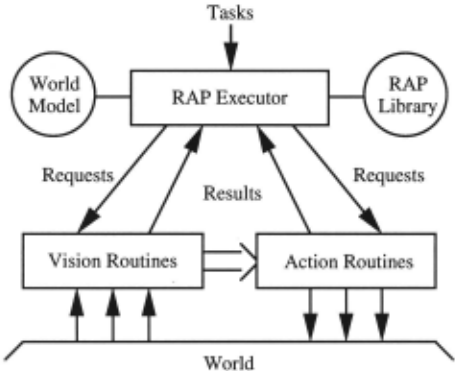
For example, suppose the next routine to be carried out is to move to a trash can. This routine can be imple mented using the fairly generic action routine "move in a given direction while avoiding obstacles." The argument to this routine is the direction to move and that can be updated in real time by an active sensing routine that continually tracks the direction to the can. Possible rou tines might track the trash can's shape, color, or motion, depending on the situation. It is up to the RAP system to choose which is appropriate at run time. Once the action and tracking routines have been enabled, the control sys tem will move the robot towards the can whatever gets in the way. This control state will last indefinitely with out further intervention as long as the tracked feature stays in view and the path toward it stays reasonably clear.
2.3 Visual Routines
The visual system is based on a modular set of task specific modules, termed visual routines, designed to sense the information required by the reactive skills. These modules are in turn composed of a sequence of primitive visual processing steps called visual operators. The operators and routines are designed with re-use in mind. The intermediate representations passed between operators are designed to be as generic as possible, so that they may be shared by multiple operators. With a common language of intermediate representations, it is posssible to compose many different routines with a much smaller number ofprimitive operators. While the routines are designed to be task-specific, as much as pos sible the task constraints are input as parameters, rather than being coded into the routine.
The base representation generated by the early visual system provided to the routines is a three-band (R,G,B) color Gaussian pyramid. Visual routines may access a rectangular subset of any level of the pyramid. All fur ther representations are created on demand by visual operators.
3 CHIP
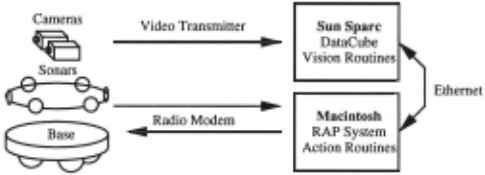
The robot we have constructed as a testbed for our ideas is shown schematically in Figure 2. It uses a three-wheeled omni-directional mobile base built by Real World Interface (RWI). Stereo color cameras are mounted on top of the robot on a two degree of freedom computer-controlled pan-tilt platform. Video signals are processed off-board by Datacube image processing hard ware attached to a host Sun SparcStation. The robot sensors also include sonar sensors and infrared proxim ity sensors. The sonars can be turned to face the surface nearest the robot to minimize problems due to specular reflection. The infrared sensors are well equipped for de tecting obstacles near the robot (their signal drops off quickly after about ten centimeters), and have failure modes that are complementary to the sonar sensors. For manipulation, CHIP is equipped with a Heathkit Hero arm and manipulator. Force and contact sensors on the gripper provide tactile feedback.
Microprocessors mounted on the robot run the sensors, do initial processing of the data they create, and skills that do not require visual processing, which is done off board. The microprocessors share a small amount of memory to allow communication and synchronization. The on-board microprocessors talk via radio modem to a Macintosh computer, which runs some control routines and the reactive planner.
The robot can be run in either a tethered mode or a non-tethered mode in which the cameras transmit video to the Datacube and the Macintosh workstation com municates with the on-board microprocessors via a radio link.
The robot has enough freedom of movement to allow it to navigate through a considerable area within the Computer Science Department. Because people work within the robot's range of movement, the robot's world is always changing.
CHIP's vision processing is distributed over a Sun Sparc-20 workstation and a DataCube MV-200 image processing computer with a DigiColor digitizer. The DataCube is a pipelined processor that can perform many operations including convolutions and histogram ming in real-time. The DataCube Server [Kahn, 1993] al lows multiple processes to access the DataCube simulta neously from any machine on the network. The Server al lows us to implement our visual routines as separate pro cesses potentially distributed across multiple machines while still allowing each visual routine to access data from the DataCube.
There is a set of low-level visual operations that are widely used among the visual routines and/or are time critical and so have been implemented on the DataCube. These operations include the creation of color Gaussian and Laplacian pyramids, extracting subregions from a level of one of the pyramids, convolution, and histogram ruing, color histogram backprojection and motion detec tion. Visual routines may access a rectangular subset of any level of the pyramid. All further representations are created on demand by visual operators.
During each visual routine's initialization a socket con nection with the DataCube Server is established. When a visual routine requires a computation to be performed on the DataCube it sends requests to the DataCube Server. The DataCube Server performs the requested operation and returns the output. The programming in terface to the DataCube Server makes all server requests look like normal function calls. Using this interface we are able to write visual routines that use the DataCube without worrying about its internals.
Visual routines communicate with the rest of the sys tem through a mechanism called the Message Hub [Kahn et al., 1994]. The message hub provides a reliable socket based communication link between processes with a sim ple programming interface.
4 Experiment: The Trash Collection Task
In one of the 1994 AAAI events, robots competed to tidy up an office area littered with soda cans, styrofoam cups, and paper wads, collecting and depositing them in any nearby trash can. Although CHIP did not win the event, it was the only robot to actually pick up a piece of trash and put it in a trash can. The RAP system made it easy to decompose the task into a set of simpler vision, navigation, and manipulation goals, and to add new context-qependent methods for achieving them. At the top level, CHIP's goal in this example is "put-trash in-can". To an outside observer, the behavior looks like the sequence:
(sequence
- (t1 (scan-for-object trash))
(t2 (go-to-object trash 80))
(t3 (orient-to-object trash 40))
(t4 (pickup-object trash))
(t5 (scan-for-object trash-can))
(t6 (go-to-object trash-can 120))
(t7 (orient-to-object trash-can 70))
(t8 (drop-held-object))))))
Figure 3: Method for achieving the top-level goal put trash-in-can. The numbers indicate distances from the denoted objects (in em).
find trash nearby - move to trash - align with trash - pick up trash - find trash can - travel to trash can - align with trash can - dump trash in can - turn back toward where trash was found - repeat
The method for achieving this goal is the sequence of subgoals in Figure 3. All these goals lead to further subgoals; ultimately, primitive goals enable the robot's perceptual and behavioral routines. In total, there are 55 RAPs, five of which are specific to the trash collection task. The RAPs invoke a total of 20 reactive skills, five of which involve visual processing. The visual processing is made specific to the task by the models that are passed to the routines. The RAPs are described in more detail in [Firby et al., 1995].
We'll examine two steps of the method to demonstrate CHIP's visual routines, and cooperative on-board/off board perceptual and motor processes. For the subgoal scan-for-object, CHIP identifies and locates a nearby ob ject that can be segmented from the floor. The subgoal orient-to-object consists of precisely lining up with it to grab it.
When searching, CHIP alternates simple exploratory movements (e.g., scanning its head) with calls to a visual routine, the small object finder, which finds and classi fies small objects lying on surfaces with only fine {high spatial frequency) texture or none at all. The routine uses the DataCube to grab an image, smooth it, and ex tract edges. The edges are closed into segments, which are then classified with a set of thresholds on size, as pect ratio, edge density, and gray-scale brightness. The process typically takes under four seconds for a high res olution image of a cluttered seen~. Accuracy is currently at 95 percent on a database of challenging test images, and almost perfect in actual runs of the task.
The distance and bearing of the object are computed from a single image using triangulation from the robot's known height and assuming that the object is on the floor. This calibration is cached for particular tilt angles of the camera.
For the goal orient-to-object, CHIP aligns itself di rectly in front of the target, at a distance of less than one meter. A visual tracking routine locates a piece trash re peatedly and generates a target location with which to align. The results are time-averaged to provide a stable and accurate reference point with which CHIP can align.
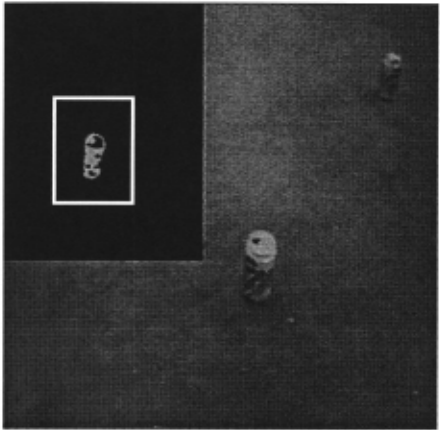
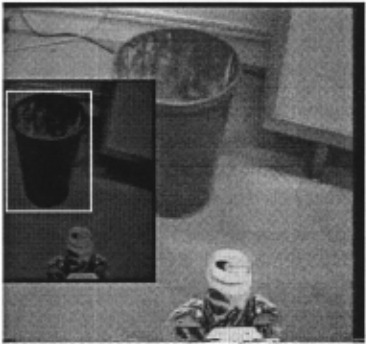
The tracking routine operates exactly like the object finder described above, except that the identification procedure operates only on a much smaller window (Fig ure 5), at greater than one update per second. The 2D frame-to-frame image displacements of the tracked ob ject's centroid are fitted to a model of smooth image motion that determines placement of the next process ing window [Prokopowicz et al., 1994]. If the object is not in the window, the entire scene is searched. The pri mary advantage of tracking in this situation is to avoid confused behavior that can result from identifying dif ferent items at different stages of the routine.
When the RAP system encouters the goal orient-to object, it selects a method for achieving the goal accord ing to whether the object involved is a piece of trash or a trash can. The method for orienting to a piece of trash expands into two parallel goals: primitive-track-small object and primitive-orient-to-goal. The RAP method for primitive-orient-to-goal enables a routine to watch for violations of a safety zone in front of the robot (us ing sonars) and a routine to orient the robot's position according to an input goal location. The method for primitive-track-small-object enables the trash-tracking visual routine to update that goal location continuously. The routines enabled for these goals run as separate processes. The orient-to-goal routines run on-board the robot using odometry to drive and turn to a certain distance and direction from the goal location. The trash tracking visual routine runs off-board and repeatedly computes a relative distance to the target which is turned into a new goal location and passed to the on-board orient-to-goal routine. To orient to the trash can, a dif ferent method is chosen by orient-to-object: enabling the same action routines used for orienting to trash but a dif ferent visual routine for updating the goal location using visual operators better for finding trash cans.
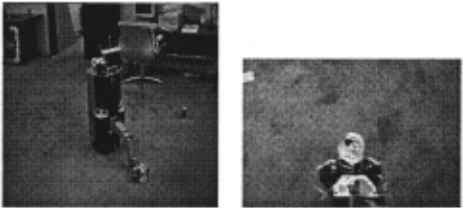
Figure 6: left: CHIP rolls forward after aligning with the can; right: CHIP's view as it picks up a can.
Once CHIP has lined up with the object to be picked up, it rolls forward blindly until the LED beam between its fingers is broken by an object, or nothing is encoun tered within a meter. CHIP is able to align itself and roll forward accurately enough to pick up trash almost every time (Figure 6). Failures are noticed and retried.
The trash finder is designed to find easily-segmented objects known only by their class membership (e.g. pop cans of all types, crumpled paper of various shapes). We have developed a different routine for locating and tracking known objects that cannot necessarily be segmented from their background. We have had some success in this direction using a Hausdorff model-matcher developed at Cornell [Huttenlocher and Rucklidge, 1992].
We assume:
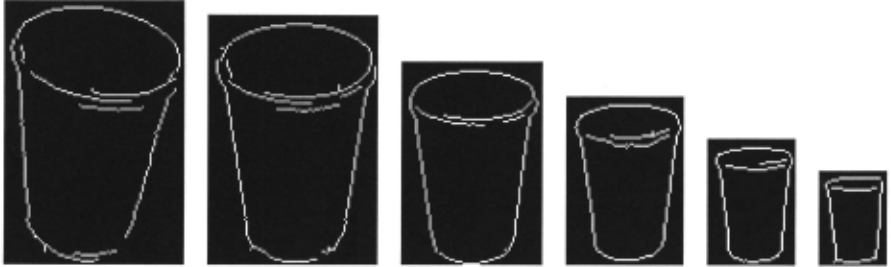
- color and edge models ofthe object from likely views (Figure 7)
- the object sits upright on the floor, and is shorter than the robot
- the floor is flat
- the robot's view of the the object suffers at most minor occlusion
This last assumption is less limiting than one might ex pect, since the robot is free to roam about the room in search of the object.
Using this approach, we are able to avoid searching over all possible views. We search locations in the scene consistent with an object sitting on the floor, and we combine the results of different algorithms to speed the search.
The solution is as follows:
- Using RAPs, scan the room from left to right, changing view enough to leave a reasonable overlap between views
- For each view, enable a visual routine that:
- (a) Finds all regions of interest using color [Swain and Ballard, 1991]
- (b) Runs a Hausdorff edge matcher [Huttenlocher and Rucklidge, 1992] in each region of interest
The robot takes advantage of the assumption that the object is on the floor by restricting the region searched vertically, according to the height of the object and the distance to the nearest model in the set. It also takes ad vantage of this assumption to restrict the range of scale searched by the edge matcher within each region of in terest returned by the color matcher. Doing so relies on the distance calibration over the image for the floor at the angle of view of the camera during the search.
The Hausdorff metric allows one to measure the match of a template to an image, allowing minor deformations. The Cornell software searches efficiently over all trans lations and scalings of the template (within controllable limits) to find the best fit. We have found that the pro cess works somewhat more reliably if the range of scales is limited (to between 100 and 75 percent, in our case) and more models are used to span the scales actually encountered. We have had good results with match cri teria that at least 80 percent of the scaled and translated model points lie within one pixel (across or diagonally) of some image point. A reverse match criteria that at least half the image edge points covered by the model lie within one pixel of some model point reduces false matches in dense parts of the edge image.
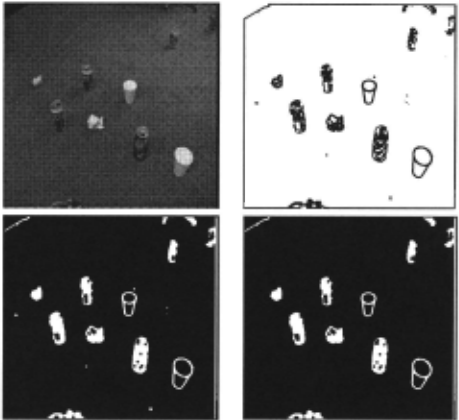
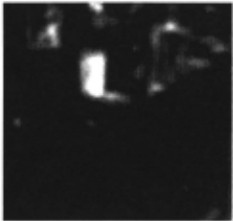
As efficient as the Cornell software is, we have found it too slow over large, cluttered scenes, except at very low resolutions or with unrealistically tight match crite ria. The relatively high complexity of the edge matching motivated our use of color, to screen possible locations prior to edge matching. The histogram back-projection technique assigns to each color pixel a rating accord ing to how well it indicates the presence of the model. The histogram is computed in an 8 bit hue, saturation, value color space, with 3 bits resolution of hue and sat uration, and 2 of value. The pixel saliency ratings are then averaged over 4x4 neighborhoods, and the peaks above a threshold are found. An area around the peak is cropped until the smoothed saliency value falls under 10 percent of the peak value. Most of the image has values at or near zero (figure 81), so the edge match ing phase is greatly speeded up. The back-projection and edge-detection is computed on the DataCube, and region cropping is done on the workstation, taking to gether less than 0.2 seconds. In a typical scene as shown here, matching against all models of a target (we use up to six) takes about 0.5 seconds.
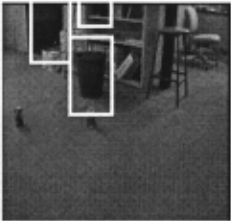
In Table 1 the search times and results are given as the task constraints are added one by one. In all cases, the trash can was correctly identified, but with fewer con straints the search took longer and resulted in more false positives. The technique is reliable, requires only modest computing resources, and can be extended to arbitrary objects - provided the task constraints hold, which are that the object is of restricted size, and sits on the floor in one of a small number of possible orientations.
| Constraints | Time | False Positives |
|---|---|---|
| Search entire room below horizon | 520 | 4 |
| + Use color region of interest | 25 | 1 |
| + Constrain model scale by floor- based distance to region of interest | 17 | 1 |
| + Verify matched scale against floor-based distance to target | 17 | 0 |
The distance to an object found with the Hausdorff matcher can be easily computed using the known dis tance to the original picture of the model and the scale at which the model matched the image. We compare this distance to the triangulated distance judged from the location of the model in the image, assuming that the object is on the floor with the robot. Matches whose distances don't agree within 25 percent are rejected.
The robot has successfully found, picked up, and thrown away hundreds of pieces of trash, at rate of about 12 pieces per hour. We have been able to demonstrate increasing if not perfect reliability. One major impedi ment to high reliability in our current system is its rudi mentary navigation abilities. CHIP does not try to re member where trash has been seen before and ignores small objects on the floor while moving around. These capabilities are being added now.
5 Related Work
Kosecka and Bajcsy [Kosecka and Bajcsy, 1993] have studied synthesizing complex behaviors from simpler components. They model their components using Dis crete Events Systems (DES) theory, which allows them to predict the controllability of composite behaviors, that is, whether or not it is possible to reach a goal state from a given state in the system. We leave the decision of how to combine multiple concurrent skills to the pro grammer, and instead concentrate on languages to con veniently express which skills should be run in sequence or in parallel, and to build natural interfaces that allow visual operators and control routines to be parametrized and composed to perform a variety of tasks. Aloimonos [Aloimonos, 1990; 1994] has been an outspoken advo cate of what he calls the purposive approach to achiev ing general-purpose vision, which is generally consistent with the approach we have taken here.
6 Conclusion and Future Work
This paper describes the design of an implemented archi tecture that both enables the use of context from the task and environment to simplify vision problems, and allows the components (visual operators and control routines) to be reconfigured to solve a variety of tasks with mini mal reprogramming. It provides a framework for build ing vision systems that are robust and timely, and can be utilized for a variety of tasks. We have demonstrated an implemented system (important parts of which are available to others) that works on a trash collection task in an office environment, and have explained why the components can be re-used in another task or environ ment.
We are using the architecture to encode a number of different robot skills, including fetching tools and other objects under human guidance, and delivering items to people's desks. But one of the first tasks is to prepare for the next robot competition, in which the task will be to expanded to sorting recyclables from the trash. Reprogramming CHIP to perform this task will involve merely acquiring models for the recycling bin, and mod ifying the put-trash-in-can RAP to choose a destination depending on the identity of the object picked up.
@inproceedings{ijcai1995p10,
  title     = {An Architecture for Vision and Action},
  author    = {Firby, R. James and Kahn, Roger E. and Prokopowicz, Peter N. and Swain, Michael J.},
  booktitle = {Proceedings of the Fourteenth International Joint Conference on
               Artificial Intelligence, {IJCAI-95}},
  publisher = {International Joint Conferences on Artificial Intelligence},
  editor    = {Chris S. Mellish},
  pages     = {72--80},
  year      = {1995},
  note      = {Action and Perception},
  url       = {https://ijcai.org/proceedings/1995/10},
}
TY - CPAPER TI - An Architecture for Vision and Action AU - Firby, R. James AU - Kahn, Roger E. AU - Prokopowicz, Peter N. AU - Swain, Michael J. T2 - Proceedings of the Fourteenth International Joint Conference on Artificial Intelligence, IJCAI-95 PB - International Joint Conferences on Artificial Intelligence PY - 1995 SP - 72 EP - 80 UR - https://ijcai.org/proceedings/1995/10 ER -Copied
Machine-readable versions of this paper, for tools and AI agents:





