
Quantifying Beliefs by Belief Functions: An Axiomatic Justification
Proceedings of the Thirteenth International Joint Conference on Artificial Intelligence. Knowledge Representation. Pages 598-604.
© 1993 International Joint Conferences on Artificial Intelligence
Abstract
We present a set of axioms that justify the use of belief functions to quantify the beliefs held by an agent Y at time t and based on Y's evidential corpus. It is essentially postulated that degrees of belief are quantified by a function in [0,1] that give the same degrees of beliefs to subsets that represent the same propositions according to Y's evidential corpus. We derive the impact of the coarsening and the refinement of the frame on which the beliefs are expressed. The conditioning process is also derived. We propose a closure axiom that asserts that any measure of beliefs can be derived from other measures of beliefs defined on less specific frames.
- BRADLEY R. and SWARTZ N. (1979) Possible worlds. Basil Blackwell, Oxford, UK.
- CARNAP R. (1956) Meaning and Necessity. University of Chicago Press, Chicago, lllinois.
- CARNAP R. (1962) Logical Foundations of Probability. University of Chicago Press, Chicago, Illinois.
- DEGROOT M.H. (1970) Optimal statistical decisions. McGraw-Hill, New York.
- GARDENFORS P. (1988) Knowledge in flux. Modelling the dynamics of epistcmuic states. MIT Press, Cambridge, Mass.
- KENNES R.(l991) Evidential Reasoning in a Categorial Perspective : Conjunction and Disjunction of Belief Functions. in D'Ambrosio B.D., Smcts P., and Bonissone P.P. eds, Uncertainty in AI 9l,Morgan Kaufmann, San Mateo, Ca, USA, 1991, pg. l74-181
- KLAWONN F. and SCHWECKE E. (1992) On the axiomatic justification of Dempster's rule of combination. Int. J. Intel. Systems 7 :469-478.
- KLA WONN F. and SMETS Ph. (1992) The dynammic of belief in the transferable belief model and specialization-generalization matrices . in Dubois D., Wellman M.P., d'Ambrosio B. and Smcts P. Uncertainty in AI 92. Morgan Kaufmann, San Mateo, Ca , USA , 1992, pg.l30-137.
- KYBURG H. (1987a) Objective probabilities. UCAI-87, 902-904.
- RUSPINI E.H. (1986) The logical foundations of evidential reasoning. Technical note 408, SRI International, Menlo Parle , Ca.
- SHAFER G. (1976) A mathematical theory of evidence. Princeton Univ. Press.
- SMETS P. (1986) Combining non distinct pieces of evidence. Proc.NAAP86, New Orleans, 544-548.
- SMETS P. (1988) Belief functions. in SMETS Ph, MAMDANI A., DUBOIS D. and PRADE H. ed. Non standard logics for automated reasoning. Academic Press, London pg 253-286.
- SMETS P. (1990a) The combination of evidence in the transferable belief model. IEEE-Pattern analysis and Machine Intelligence, 12:447-458.
- SMETS P. (1990b) Constructing the pignistic probability function in a context of uncertainty. Uncertainty in Artificial Intelligence 5, Henrion M., Shachter R.D., Kana! L.N. and Lemmer J.F. eds, North Holland, Amsterdam, , 29-40.
- SMETS P. (1992a) The nature of the unnormalized beliefs encountered in the transferable belief model. in Dubois D., Wellman M.P., d' Ambrosio B. and Smcts P. Uncertainty in AI 92. Morgan Kaufmann, San Mateo, Ca, USA , 1992, pg.292- 297 .
- SMETS P. (1992b) An axiomatic justifiaction for the use of belief function to quantify beliefs. IRIDIA-TR-92.
- SMETS P. (1992c) The concept of distinct evidence. IPMU 92 Proceedings.pg. 789 -794.
- SMETS P. and KENNES R. (1990) The transferable belief model. IRIDIA-TR-90- 14/2, to be published by Artificila Intelligence.
- SMITH C.A .B. (1961) Consistency in statistical inference and decision. J. Roy. Statist. Soc. B23:1-37.
- SMITH P. and JONES O.R. (1986) The philosophy of mind, an introduction. Cambridge University Press, Cambridge.
References were extracted automatically from the PDF and may contain errors.
Full text extracted automatically from the PDF; figures, tables and equations may differ. The PDF is the version of record.
1. Introduction.
Uncertainty induces beliefs 2 , i.e. dispositions that guide our behaviour. It sounds natural to try and quantify them on a numerical scale. These quantified beliefs manifest themselves at two levels: the credal level where beliefs are entertained and the pignistic level where beliefs are used to take decisions (pignus = a bet in Latin, Smith 1961). Usually these two levels are not distinguished and probability functions are used to quantify beliefs at both levels. The justification is usually linked to "rational" agent behaviour within betting and decision contexts (DeGroot 1970). The Bayesians have convincingly showed that if decisions must be "coherent", our beliefs over the various possible outcomes must be quantified by a probability function. This result is accepted here, except that such probability functions quantify our beliefs only when a decision is really involved. That beliefs are necessary ingredients for our decisions does not mean that beliefs cannot be entertained without any revealing behaviour manifestations (Smith and Jones, p.147).
In this paper, we present a set of axioms that must be satisfied by the function that should be used to quantify the beliefs held at the credal level. We call that function a credibility function. It will be shown that the credibility function is a belief function. The resulting model is the transferable belief model (Smets and Kennes, 1990, Smets, 1990a, Smets, 1988).We accept all over that degrees of beliefs at both the credal and the pignistic levels are pointwise defined, degrees of beliefs satisfying a total order. All beliefs entertained by an agent Y at time t and their degrees are defined relative to a given evidential corpus ( EC() i.e., the set of pieces of evidence in Y's mind at time t. Our approach is normative, the agent Y is an ideal rational agent, the evidential corpus is deductively closed and it induces unique degrees of belief. One source of modification in EC( is updating: it results from the adjunction to the corpus of a new piece of evidence assumed to be true and compatible with EC(. The updating is similar to the expansion process considered in Gardenfors (1988). Only one agent Y is considered in this paper, and time t is unique except when updating will be studied.
1 Research work has been partly supported by the Belgian National incentive-program for fundamental research in AI and the ESPRIT II, Basic research Action 3085 (DRUMS) funded by a grant from the Commission of the European Communities.
2 A belief is a proposition which you could doubt. Here, it is endowed by a strength.
This paper summarizes the major results. Details and proofs are presented in Smets (1992b). We present successively the propositional space on which credibility functions ared defined (section 2), the principle axioms characterizing the credibility functions (section 3), the dynamic of the credibility functions after non-informative coarsening (section 4) and refinement (section 5) of the frame of discernment and adfter updating of the evidential corpus by an expansion process (section 6). A closure property is presented that implies that credibility functions are belief functions (section 7).
Lengthy discussions about the use and appropriateness of the belief functions to quantify beliefs can be found in two special issues of the International Journal of Approximate Reasoning (volumes 4(5): 1990 and 6(3): 1992). These problems are not tackled here. We only try to find axioms that justify the use of belief functions for quantifying beliefs.
2. The Propositional Space.
This section defines the domain on which the agent Y will express his beliefs at time t. These beliefs are quantified by a function Cr that we derive in this paper.
Our presentation is based on possible worlds (Carnap, 1956, 1962, Ruspini, 1986, Bradley and Swartz, 1979). Let L be a finite propositional language. Let Q = {O>J, 0>2, ... ron) be the set of worlds that correspond to the interpretations of L. We call n the frame of discernment (the frame for short). Propositions identify the subsets of n. Let T be the tautology and .l be the contradiction. For any proposition X, let RXD~n be the set of worlds identified by X. Let A be a subset of n, then/A is any proposition that identifies A. So A=R!AI, 0=1 .lD and O=RTJ. The domain of Cr are sets of worlds in n. By definition the actual world m is an element of n. VA~ n, Cr(A) quantifies Y's beliefs at time t that me A.
In L, two propositions A and B are logically equivalent, denoted A=B, iff R AD=RBD. Beside the logical properties, there is another concept of equivalence related to the evidential corpus Ecr of Y at time t. This property is qualified as doxastic in order to contrast it from its logical counterparts. Let I EC( D represents the set of worlds where all propositions deduced on n from Ecr are true. All the worlds in n not in R Ecr I are accepted as 'impossible' for Y at time t. Two propositions A and B are said to be doxastically equivalent for Y at time t, denoted A=B, if( EC(DnRAD = R EcrnnRBD. For A~n. A denotes the set of worlds in IT Ecr D not in A, hence A =I EC( DniT -fAD·
Let n be a partition of n. Given the elements of the partition n, we build ~, the Boolean algebra of the subsets of n based on n. Each set of worlds in n that is an elements of the partition n on which the algebra ~ is based is called an atom of~. Given ~.the number of atoms in a set Ae ~ is the number of atoms of ~ that are included in A. We call the pair (Q, ~) a propositional space.
3. The Credibility Function.
Let Y be an agent. Let Ecr be Y's evidential corpus at time t. Let Q be the frame of discernment on which Y entertains his beliefs concerning the answer m to a question of interest, i.e. Y allocates his beliefs at time t to the elements of~. an algebra defined on n. It is postulated that the beliefs held by Y are quantified by a point-valued "credibility" function Cr which maps ~ into [0, 1], is uniquely defined by ( Ecr ,Y, t), is monotonic for inclusion, reaches its lower limit for 0 and its upper limit for n. The triple (Q, ~, Cr) is called a credibility space. The index in (Q, ~. Cr) Eq denotes the evidential corpus on which Cr is based.
The first axiom assumes that propositiOns that are doxasticaly equivalent for Y at time t receive the same beliefs (Kyburg, 1987a).
Axiom Al: Equi-credibility of doxasticaly equivalent propositions.
Suppose two credibility spaces (Q, ~i. Cfj), i=l,2 induced by EC(. Let AtE~l. A2e~2 LetfAJ andfA2 be any proposition that identifies At and A2. LetfA{=!A 2 . Then Cq(At) = Cr2(A2).
Next, in Smets (1990b) we prove that the set of credibility functions defined on a propositional space (Q, ~) is a convex set, i.e., if Cq and Cr2 are two credibility functions defined on ~. then a.Cq + (1-a).Cr2. ae [0,1], is also a credibility function on ~. We also derive the pignistic transformation, i.e., the transformation that permits the construction of the probability function needed for decision making. We prove that probability functions are credibility functions (Smets 1992b).
4. Coarsening.
We study the impact that would result on Y's beliefs from a change of the algebra on which Cr is initially defined. These changes of algebra are said 'uninformative' in that they do not induce a change in the evidential corpus Ecr on which Y's beliefs at t were based. Two types of change are considered: the coarsening and the refinement (see section 5). Intuitively the first corresponds to a grouping together of the atoms of ~ whereas the second corresponds to a splitting of the atoms of~.
Let (Q, ~. Cr) be the credibility space induced by Ecr. Let C be a mapping from ~ to ~ ', an algebra defined on the same frame n, such that one to several atoms of ~ are mapped into one atom of ~· and each atom of~ is mapped into one and only one atom of~·. Let C(ro) be the atom of
~· on which the atom w of~ is mapped, and 'V Ae ~. C(A) = (uC(ro) : roe A). The mapping Cis called a coarsening. For A'e ~·. c-l(A') is the union of the atoms of~ which are mapped by C onto an atom of A'. Let Cr' be the credibility function induced on ~' from Ecr . The same evidential corpus EC( induces both Cr and Cr', the only difference being in the granularity of the algebras. Hence Cr and Cr' are strongly related. That relation between Cr and Cr' is immediate thanks to axiom Al.
Theorem l. Let the credibility space (Q, ~·. Cr') Eq be derived from (Q, ~, Cr) ECi through the uninformative coarsening C. Then for A'e ~·: Cr'(A') = Cr(C-l(A')).
Thanks to theorem 1, the granularity of n in (Q, ~ , Cr) becomes essentially irrelevant. The only constraint induced by ~ on n is that each element of n is included in one atom of ~ and each atom of ~ contains at least one element of n. So one has full freedom to change n provided n is compatible with ~ (i.e. satisfy the constraints induced by ~).
5. Refinement.
Let (Q, ~) be a propositional space. Suppose a mapping R from (Q, ~) to another propositional space (Q', ~·)where ~· is an algebra such that each atom of~ is mapped into one or several atoms of~· and each atom of~· is derived from one and only one atom of ~. The structure of the frames of discernment n and n· is not important for our presentation provided they are compatible with 9t'. Therefore n and Q' can both be re-defined such that they are equal (and denoted Q*) and their elements correspond to the atoms of 9t'. Let R(A) be the image of AE 9t in 9t', and let R(0)=0. The mapping R is called a refinement.
Let (Q, 9t, Cr) Eq be a credibility space based on EC( and let (Q*, 9t') be the propositional space derived from (Q, 9t) by the uninformative refinement R. Adapt Q of the first credibility space into Q*, so both credibility spaces (the ones before and after refinement) share the same Q*. We must determine what is the credibility function Cr' induced on 9t' by EC(, i.e. by Cr. As 'V AE 9t,fA:fR(A)· then Cr'(R(A)) = Cr(A) by axiom AI. But Cr' is not defined on the elements of 9t' that are not the image of some elements of 9t under R. Thus we must define the credibility Cr' on 9t' for these elements of 9t' given the credibility Cr on 9t and the uninformative refinement R.
In order to explain the construction of Cr', consider the following illustrative example. Let rn be Paul's age, Q = [0, oo), and ffil = [0,20), W2 = [20, 40), W3 = [40, oo) be the three atoms of 9t. Let Cr quantifies Y's beliefs on 9t based on EC(. Let PI, P2 and P3 be three propositions. Y does not know what are these three propositions, he only knows that one and only one of them is true. Let a refinement R from 9t to 9t' with R(wl) =WI, R(w2) = W2, and R(w3) ={XI, X2. X3} where Xi= 'w3 and Pj'.
The problem is to determine Cr' given the evidential corpus EC( that leads to the construction of Cr on 9t and the knowledge of the refinement R. Consider the value of Cr'(wl uXj). The uninformativeness of R is tanslated into the requirement:
Suppose now that one uses another uninformative refinement R" from (Q*, 9t) to (Q*, 9t") such that R"(wl) =rot. R"(w2) = W2, and R"(w3) = {YI. Y2} wherefr 1 =/x 1 ./r 2 =/x 2 ux 3 · The credibility Cr" over 9t" is such that:
Cr"(Wl uY I)= Cr"(w1 uY 2). By axiom A1: Cr"(ro1 uY I) = Cr'(ro1 uX I). Cr"(ro1 uY2) = Cr'(W1 uX2uX3).
Therefore one obtains: Cr'( w 1 u X 2) = Cr'( w 1 u X 1) = Cr"(w1 uY1) = Cr"(w1uY2) = Cr'(w1uX2uX3). So Cr'(w1 uX) is equal for all XcR(ro3) (where XcY means that X~ Y but X;t:Y). The impact of an uninformative refinement is formalized by axiom R1 where we must only postulate the equalities on the atoms, as the other equalities are deduced from axiom A1 and the same argument as the one just presented.
Axiom R 1: Let (Q, 9t, Cr) ECi be a credibility space and let R be a refinement from (Q, 9t) to (Q', 9t'). Let w be a given atom of 9t and BE 9t' where BnR(w) = 0. Let Xi:
i=1, 2 ... n be the atoms of 9t' included in R(w). Let (Q', 9t', Cr) ECi be the credibility space induced from (Q, 9t, Cr) ECi byRon (Q', 9t'). Then:
The next theorem just formalize the intuitive proof detailled before introducing axiom Rl.
Theorem 2: Under axiom Rl conditions, for any WE Q, any BE 9t' and with BnR(w)=0, Cr'(BuX) is constant for all XcR(w).
The property represents a serious departure from what is encountered in classical probability theory. That departure reflects the difficulty for probability theory to deal with states of total ignorance as those encountered with the Pi's. In fact, in probability theory, one cannot accept simultaneously axiom Rl for any uninformative refinement Rand axiom AI. In probability theory, the introduciton of a uninformative refinement is accompanied by the introduction in EC( of the information that tells for each atoms w of 9t how the probability given to w is distributed among the new atoms of R(w ). Often an equidistribution of the probability given to w among the atoms of R( w) is assumed, but any distribution is acceptable. The information about that distribution is linked to the refinement, therefore EC( is updated, and thus the refinement is not uninformative as required. The uninformative refinements we consider in axiom R 1 are those that correspond only to a change in the granularity of the algebra on which our credibility function is build, without changing the evidential corpus EC( on which Y's beliefs are based.
Another axiom must be assumed to determine Cr' after uninformative refinement. Let AE 9t and let n distinct atoms w i, i= 1, 2 ... n of 9t, none being included in A. Let XicR(wi), i=l, 2 ... n. We postulate that Cr'(R(A)uX 1 uX2 ... uXn) depends only on the beliefs Cr(AuB) given to the union of A with each subset B of (1)1 U (1)2U .. UWn·
Axiom R2: Let (Q, 9t, Cr) ECi be the credibility space based on EC(. Let R be a uninformative refinement from (Q, 9t) to (Q', 9t'). Let (Q', 9t', Cr') ECi be the credibility space induced from (Q, 9t, Cr) ECi by R on (Q', 9t'). Let AE 9t . Let wi: i=1,2 ... n, be n different atoms of 9t with Anwi = 0. Let Xi be any element of 9t' strictly included in R(wi): i=1,2 ... n. Then there is a g function such that:
Cr'(R(A)uX l···uXn) = g( { Cr(AuB): BE 9t, B~wl··Uffin})
In fact, axiom R2 could be simplified by requiring only that Cr'(R(A)uX 1 uX2 ... uXn) does not depend on Cr(X) when Xn(Auw1u ro2u .. uwn) = 0. Intuitively that property is of the same nature as the one underlying Axiom Al: irrelevant credibilities should not interfere with the other credibilities. Given that requirement, axiom AI permits to deduce axiom R2. The gain is not worth the needed proof.
From axioms Rl and R2, it is possible to prove that Cr'
must satisfy one of the following three relations: Cr'(R(A)uX 1 uX2 ... uXn) = Cr(A) Cr'(R(A)uX 1 uX2 ... uXn) = Cr(Aurol u ~u .. uron) Cr'(R(A)uX 1 uX2 ... uXn) = max(Cr(A), Cr(rot), .. Cr(rou)) The first solution is the one encountered when Cr is a belief function, and the second is the one encountered when Cr is a plausibilty function. The third solution will not satisfy the conditioning axioms (but find an application in possibility theory).
6. Updating.
Let EC7 be the evidential corpus held by Y at time t and let (0, 9t, Cr) Eq be the credibility space characterizing Y's beliefs at time t about which subsets of worlds of 0 among those in 9t include the actual world m. Suppose Y expends EC7 by adding the evidence EvA compatible with Ecr that implies that all worlds in A ~0 are impossible, i.e. that the actual world m is not in A, or equivalently that fA'= T. How does Y update his beliefs given the addition of EvA to EC{? Let CrAbe the conditional credibility function that results from the addition of EvA to EC{. It is postulated in axiom Ml that CrA is derived from the credibility function Cr based on EC7.
Axiom Ml: Let (0, 9t Cr) Eq be a credibility space based on EC7 . Let EvA be an evidence compatible with EC{ that implies thatfA::T. Let (0, 9t, CrA) Equ{EvA) be the credibility space based on Ecru{EvA)· Then CrA depends only on Cr and A.
To derive the conditioning process, we will use the idea of iterated conditioning. For A,B~O. letfA.fB andfAnB be the propositions that denotes the sets of worlds A, B and AnB. Suppose you learn 1) thatfA=T and then thatfB::T, or 2) thatfB=T and then thatfA::T, or 3) directly that fAnB=T. The final conditional belief should be the same in these three cases. This requirerment introduces enough constraints to derive the mathematical structure of the updating process.
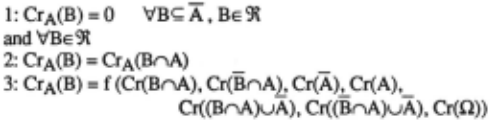
We prove that the conditional credibility function CrA(B) depends only on some of the elements of 9t.
Theorem 3: Let (0, 9t Cr) Eq be a credibility space based on Ecr . For Ae 9t , let EvA be an evidence compatible with EC{ that implies that fA=T. Let (0, 9t, CrA) ECiu{EvA) be the credibility space based on EC{ u {EvA) . Then there is a f function such that Cr A satisfies:
The following theorem formalizes the idea that refining one atom ro of 9t into two new atoms ro 1 and ro2 in 9t' and conditioning then on ffi2 will leave the credibility function unchanged (except the algebra has changed). To illustrate the underlying idea, consider the following example dealing with Paul's age m. Consider Y's beliefs about m, im particular Crm<4o(m<20). Then consider a refinement R from (0, 9t) to (0', 9t ') with R([0,20)) = [0,20), R([20,40)) = { ([20,40),Q), ([20,40),--,Q)}, R([40,oo)) = [40,oo), where Q is a proposition unknown to Y (like the Pi's propositions of section 5). Y builds his credibility function Cr' on 9t'. Than Y learns that Q is true. What is Y's beliefs about m<20 given ((m<20) or (2~m<40 and Q)). We feel it has to be equal to Y's previous belief Crm<40(m<20) about m<20 given (m<20 or 2~m<40). Indeed the Q story becomes irrelevant to Y's beliefs on m, and this is what theorem 4 confirms. Formally one has:
Theorem 4: Let (0, 9t, Cr) ECi be the credibility space based on Ecr . Let a uninformative refinement R from (il, 9t) to (0', 9t') such that each atom of 9t is mapped onto itself in 9t', except one atom roof 9t that is refined into ro1 and ro2 by R. Let Cr' be the credibility function derived from Cr on 9t' by R. Suppose the conditioning of Cr' on C.02, then 'v' Ae 9t Cr'c.o 2 (R(A)n C.02) = Cr(A)
We introduce two other axioms. The first (M2) eliminates degenerated solutions. The second (M3) says that if fotr X,YE 9t, X,Y~Ae9t, XnY=0, Cr(XuY) = Cr(X) + Cr(Y) then the conditional crfedibiulkty function CrA obeys CrA(XuY) = CrA(X) + CrA(Y) (just as in probability theory). We do not require that normalization is preserved, as it will correspond to a particular case of our conditioning operator. The axioms Ml, M2 and M3 combined with the axioms about refinement are sufficient to derive the explicit ·structure of the conditional credibility functions.
Axiom M2: Non-degenerated solutions. CrA(B) is not constant for all Ae 9t.
Axiom M3: Additivity preservation. Let (il, 9t ,Cr) be a credibility space. If the credibility function Cr is additive, then additivity is preserved after conditioning.
Theorem 5. Let (0, 9t, Cr) ECi be the credibility space based on EC{. Let {rot, ro2, ... ron} be the set of atoms of 9t. Let a uninformative refinement R from (0, 9t) to (0', 9t '). Let (0', 9t ', Cr') ECi be the credibility space derived from (0, 9t, Cr)Eq by R. Let I~ {1,2, ... n}. For iei, let XicR(roi)· Let Ae 9t and roinA=0, 'Vie I. The refinement and the conditioning process admit only two solutions: The minimal solution is:
The qualification of the solutions as minimal and maximal results from the fact they correspond to the extremal solutions among the possible solutions. Indeed the following inequalities are required by the monotonicity for inclusions and axiom A1:
The minimal and the maximal solutions of theorem 5 are in fact dual. We define the co-credibility function CoCr on 9t induced by a credibility functio_!! Cr on 9t by:
If the credibility function satisfies the minimal solution, its related cocredibility function satisfies the maximal solution, and vice versa. Therefore there is in practice only one credibility function, as the other solution is always its dual. That duality relation is the one encountered between the belief functions and the plausibilty functions.
The solutions for CrA(B) depend on the value of CrA(A). Three particular cases merit consideration.
Cr A (A) = I: the solutions are those obtained by the normalized Dempster's rule of conditioning, i.e. the solutions described in the transferable belief model under closed-world assumption.
Cr A (A) = Cr(Q) - Cr( A) in the minimal solution and CrA(A) = Cr(A) in the maximal solution: the solutions are those obtained by he unnormalized Dempster's rule of conditioning as described in the transferable belief model under open-world assumption.
CrA(A) = Cr(Q): the solutions corresponds to those obtained by a partially renormalized Dempster's rule of conditioning. It fits with the idea that the belief initially given to Q is preserved by proportionaly reallocating the belief given initially to A . The nature of such a solution is nevertheless not very clear to us except if Cr(il)=l in which case it is equivalent to the first solution.
If initially the belief is quantified by a probability function, and if one accepts CrA(A) = 1, then both the maximal and the minimal solutions of theorem 5 are identical and correspond to the conditioning rule encountered in probability theory.
GID-denfors (1988) proposed two compelling properties for probabilistic revision functions, that are not simultaneously satisfiable in probability theory. In the context of the minimal solution, they translate into:
Homomorphisme is satisfied only by the unnormalized Dempster's rule of conditioning. It fails whenever a normalization factor is introduced through a division.
Preservation is satisfied by both solution for conditioning. One could have considered that CrA(B) = Cr(Q) would be required by the preservation. But in order to satisfy both homomorphisme and preservation, one would have to require that: CrA(B) = CrA(A) = Cr(Q)- Cr( A). These equlities are satisfied in the transferable belief model for quantified beliefs where conditioning is performed by the unnormalized Dempster's rule of conditioning (Smets and Kennes, 1990). In that case, the prerequisite Cr(A)<Cr(Q) can even be relaxed, but if Cr( A)=Cr(Q), then CrA(B)=O 'VBe 9t, so even CrA(il)=O, a belief _that describes a state of complete contradiction not dissimilar to the one encountered in logic when one simultaneously knows something and its contrary. This problem is studied in Smets (1992).
7. Credibility and Belief Functions.
The aim of this paper was to determine which properties are required in order to justify that beliefs should be quantified by belief functions. Up to here the credibility functions are not restricted to being belief functions. To achieve our aims, we introduce a closure property that reduces the credibility functions to belief functions.
Let a propositional space (Q, 9t ). The only relevant information in 9t to define the set of all credibility functions defined on 9t is the number r of atoms in 9t (r = 19tl) so we write Wr for the set of credibility functions defined on an algebra with r atoms and that satisfy to the minimal solutions of theorem 5. Let In be the 'vacuous' credibility function on (Q, 9t) where ln(X)=O 'f/Xkil, X;tQ, and In(il)=L
Let $r be the set of belief functions defined on an algebra with r atoms. $r is closed under conditioning. Furthermore all elements of $ r can be generated from the vacuous credibility function lne Wr by appropriate conditioning and simplex combinations (a simplex combination is a convex combination except that the sum of the weights may be in [0, 1] instead of being 1).
Let..9Sr be the set of refinements Ri, i=1, 2 ... , from (Q, 9t) to (Q', 9t') where 19tl =rand 19t'l = r+1, i.e. one and only one atom of 9t has been refined into two atoms of 9t '. For Cre Wr, Rie ..9S r· let Rj(Cr)e Wr+ 1 be the credibility function defined on 9t' after aplying the refinement Ri by using the minimal solution given in theorem 5.
Let ExtWr) be the set of credibility functions on 9t' that can be obtained by convex combinations of the credibility functions generated on 9t' by the application of the refmement operators in .9Br on the credibility functions in ~- Let!W(Ext(Wr)) be the closure of ExtWr) that contains all the credibility functions that can be obatined from those in ExtWr) through conditioning (by the minimal solution of theorem 5) and simplex combinations. Formally:
The problem is to decide if Wr+l =!W(Ext(Wr)) or not? We cannot prove it, but we feel it can be postulated. We feel reasonable to assume that any credibility function in Wr+ 1 could be derived from some credibility functions in Wr through refinement, conditioning and simplex combinations.
This axiom has the immediate consequence that $r = Wr. i.e. every credibility function in Wr is a belief function.
Theorem 6.
2: credibility functions that satisfy the minimal solution for conditioning and refinement are belief functions.
3: credibility functions that satisfy the maximal solution for conditioning and refinement are plausibilty functions.
8. Conclusions.
We have shown under which conditions beliefs are quantified by belief functions at the credal level, i.e. where beliefs are entertained. These conditions seem acceptable, and therefore they provide a justification for the transferable belief model to quantify some one's beliefs (Smets and Kennes, 1990).
One might be tempted to consider some of the axioms as unreasonable. It happens most if not all that the axioms are satisfied in probability theory (except for the simultaneous satisfaction of the homomorphism and the preservation properties). Therefore the rejection of our axioms might lead to a simultaneous rejection of probability theory! In fact probability functions are special cases of normalized belief functions.
The nature and use of the transferable belief model is detailed in Smets and Kennes (1990). In Smets (1990b) we show and explain what is the probability function that must be used to make decisions given the beliefs entertained at the credal level. In Smets (1990a) we show what is the justification of the Dempster's rule of combination (see also Klawonn and Schwecke, 1992, Klawonn and Smets, 1992). The concept of distinctness is described in Smets (1992c). The meaning of Cr(Q)<1 is analysed in Smets (1992a). The combination of the belief functions induced by two non distinct pieces of evidence are already tackled in Kennes (1991) and Smets (1986).
References.
BRADLEY R. and SWARTZ N. (1979) Possible worlds. Basil Blackwell, Oxford, UK.
CARNAP R. (1956) Meaning and Necessity. University of Chicago Press, Chicago, lllinois.
CARNAP R. (1962) Logical Foundations of Probability. University of Chicago Press, Chicago, Illinois.
DEGROOT M.H. (1970) Optimal statistical decisions. McGraw-Hill, New York. GARDENFORS P. (1988) Knowledge in flux. Modelling the dynamics of epistcmuic states. MIT Press, Cambridge, Mass.
KENNES R.(l991) Evidential Reasoning in a Categorial Perspective : Conjunction and Disjunction of Belief Functions. in D'Ambrosio B.D., Smcts P., and Bonissone P.P. eds, Uncertainty in AI 9l,Morgan Kaufmann, San Mateo, Ca, USA, 1991, pg. l74-181
KLAWONN F. and SCHWECKE E. (1992) On the axiomatic justification of Dempster's rule of combination. Int. J. Intel. Systems 7:469-478.
KLA WONN F. and SMETS Ph. (1992) The dynammic of belief in the transferable belief model and specialization-generalization matrices. in Dubois D., Wellman M.P., d'Ambrosio B. and Smcts P. Uncertainty in AI 92. Morgan Kaufmann, San Mateo, Ca, USA, 1992, pg.l30-137.
KYBURG H. (1987a) Objective probabilities. UCAI-87, 902-904.
RUSPINI E.H. (1986) The logical foundations of evidential reasoning. Technical note 408, SRI International, Menlo Parle, Ca.
SHAFER G. (1976) A mathematical theory of evidence. Princeton Univ. Press. Princeton, NJ.
SMETS P. (1986) Combining non distinct pieces of evidence. Proc.NAAP86, New Orleans, 544-548.
SMETS P. (1988) Belief functions. in SMETS Ph, MAMDANI A., DUBOIS D. and PRADE H. ed. Non standard logics for automated reasoning. Academic Press, London pg 253-286.
SMETS P. (1990a) The combination of evidence in the transferable belief model. IEEE-Pattern analysis and Machine Intelligence, 12:447-458.
SMETS P. (1990b) Constructing the pignistic probability function in a context of uncertainty. Uncertainty in Artificial Intelligence 5, Henrion M., Shachter R.D., Kana! L.N. and Lemmer J.F. eds, North Holland, Amsterdam, , 29-40.
SMETS P. (1992a) The nature of the unnormalized beliefs encountered in the transferable belief model. in Dubois D., Wellman M.P., d'Ambrosio B. and Smcts P. Uncertainty in AI 92. Morgan Kaufmann, San Mateo, Ca, USA, 1992, pg.292297 .
SMETS P. (1992b) An axiomatic justifiaction for the use of belief function to quantify beliefs. IRIDIA-TR- 92.
SMETS P. (1992c) The concept of distinct evidence. IPMU 92 Proceedings.pg. 789-794.
SMETS P. and KENNES R. (1990) The transferable belief model. IRIDIA-TR-9014/2, to be published by Artificila Intelligence.
SMITH C.A.B. (1961) Consistency in statistical inference and decision. J. Roy. Statist. Soc. B23:1-37.
SMITH P. and JONES O.R. (1986) The philosophy of mind, an introduction. Cambridge University Press, Cambridge.
@inproceedings{ijcai1993p84,
  title     = {Quantifying Beliefs by Belief Functions: An Axiomatic Justification},
  author    = {Smets, Philippe},
  booktitle = {Proceedings of the Thirteenth International Joint Conference on
               Artificial Intelligence, {IJCAI-93}},
  publisher = {International Joint Conferences on Artificial Intelligence},
  editor    = {Ruzena Bajcsy},
  pages     = {598--604},
  year      = {1993},
  note      = {Knowledge Representation},
  url       = {https://ijcai.org/proceedings/1993/84},
}
TY - CPAPER TI - Quantifying Beliefs by Belief Functions: An Axiomatic Justification AU - Smets, Philippe T2 - Proceedings of the Thirteenth International Joint Conference on Artificial Intelligence, IJCAI-93 PB - International Joint Conferences on Artificial Intelligence PY - 1993 SP - 598 EP - 604 UR - https://ijcai.org/proceedings/1993/84 ER -Copied
Machine-readable versions of this paper, for tools and AI agents:





