
Specification and Generation of Custom-Tailored Knowledge-Acquisition Tools
Proceedings of the Thirteenth International Joint Conference on Artificial Intelligence. Knowledge Base Technology. Pages 510-517.
© 1993 International Joint Conferences on Artificial Intelligence
Abstract
Domain-oriented knowledge-acquisition tools provide efficient support for the design of knowledge-based systems. However, the cost of developing such tools is high, especially when their restricted scope is taken into account. Developers can use metalevel tools to generate domain-oriented knowledge-acquisition tools that are custom tailored for a small group of experts, with considerably less effort than is required for manual tool development. An epistemic obstacle to creating such metatools is the specification model -for target knowledge-acquisition tools. The metatool DOTS is based on an abstract-architecture approach to the specification and generation of knowledge-acquisition tools. DoTS is domain and method independent, because it is based on an architectural model of the target knowledgeacquisition tool.
- [Alexander eta/., 1987] James H. Alexander, Michael J. Freiling, Sheryl J. Shulman, Steven Rehfuss, and Steven L. Messick. Ontological analysis: An ongoing experiment. International Journal of Man-Machine Studies, 26(4):473-485, 1987.
- [Chandrasekaran, 1986] B. Chandrasekaran. Generic tasks in knowledge-based reasoning: High-level build- ing blocks for expert system design. IEEE Expert, 1(3):23-30, 1986.
- [Eriksson and Larses, 1992] Henrik Eriksson and Per Larses. ALF-A: A knowledge acquisition tool for troubleshooting of laboratory equipment. Journal of Chemical Information and Computer Sciences, 32(2):139-144, 1992.
- Eriksson and Musen, in press] Henrik Eriksson and Mark A. Musen. Conceptual models for automatic generation of knowledge-acquisition tools. Knowledge Engineering Review, in press.
- [Eriksson, 1991] Henrik Eriksson. Specialized knowledge acquisition tool support compared to manual develop- ment: A case study. In Proceedings of the Seventh 3 DNA sequencing machines are pieces oflaboratory equip- ment that analyze DNA molecules to determine the latter's base-pair sequences. IEEE Conference on Artificial Intelligence Applica- tions, Miami, FL, February 1991.
- [Eriksson, 1992] Henrik Eriksson. Metatool support for custom-tailored domain-oriented knowledge acquisi- tion. J( now/edge Acquisition, 4( 4) :445-476, 1992 .
- [Gale, 1987] William A. Gale. Knowledge-based know- ledge acquisition for a statistical 'consulting sys- tem. International Journal of Man-Machine Studies, 26(1):55-64, 1987.
- [Gappa, 1991] Ute Gappa. A tool-box for generating graphical knowledge acquisition environments. In Pro- ceedings of the World Congress on Expert Systems, pages 797-810, Orlando, FL, December 1991.
- [Kawaguchi et a/., 1991] Atsuo Kawaguchi, Hiroshi Mo- toda, and Riichiro Mizoguchi. Interview-based know- ledge acquisition using dynamic analysis. IEEE Ex- pert, 6(5):47-60, October 1991.
- [Marcus and McDermott, 1989] Sandra Marcus and John McDermott. SALT: A knowledge acquisition language for propose-and-revise systems. Artificial Intelligence, 39(1):1-37, 1989 .
- [Marcus et a/., 1988] Sandra Marcus, Jeffrey Stout, and John McDermott. VT: An expert elevator designer that uses knowledge-based backtracking. AI Maga- zine, 9(1):95-112, Spring 1988.
- [Marques et a/., 1992] David Marques, Geoffroy Dalle- mange, Georg Klinker, John McDermott, and David Tung. Easy programming: Empowering people to build their own applications. IEEE Expert, 7(3) :16- 29, June 1992.
- [McDermott, 1988] John McDermott. Preliminary steps toward a taxonomy of problem-solving methods. In Sandra Marcus, editor, Automating Knowledge Acqui- sition for Expert Systems, chapter 8, pages 225-256 . Kluwer Academic Publishers, Boston, MA, 1988 .
- [Musen et a/., 1987] Mark A. Musen, Lawrence M. Fa- gan, David M. Combs, and Edward H. Shortliffe. Use of a domain model to drive an interactive knowledge- editing tool. International Journal of Man-Machine Studies, 26(1):105-121, 1987.
- [Musen, 1989] Mark A. Musen. Automated Gener- ation of Model-Based Knowledge-Acquisition Tools.
- [Newell, 1982] Allen Newell. The knowledge level. Arti- ficial Intelligence, 18(1):87-127, 1982.
- [Puerta et a/., 1992] Angel R. Puerta, John W. Egar, Samson W. Tu, and Mark A. Musen . A multiple- method knowledge-acquisition shell for the automatic generation of knowledge-acquisition tools . Knowledge Acquisition, 4(2):171-196, 1992.
- [Steels, 1990] Luc Steels. Components of expertise. AI Magazine, 11(2):28-49, 1990.
- [Tu et a/., 1989] Samson W. Tu, Michael G . Kahn , Mark A. Musen, Jay C. Ferguson, Edward H. Short- liffe, and Lawrence M. Fagan . Episodic skeletal-plan refinement based on temporal data. Communications of the ACM, 32(12):1439-1455, 1989.
References were extracted automatically from the PDF and may contain errors.
Full text extracted automatically from the PDF; figures, tables and equations may differ. The PDF is the version of record.
1 Introduction
Many knowledge-acquisition tools are unsuitable for their tasks because they are adapted neither to the ap plication domain, not to the requirements of individuals, such as developers and experts. Researchers in know ledge acquisition are experimenting with knowledge acquisition tools custom tailored for specific domains [Gale, 1987; Musen et al. , 1987]. Usually, such domain oriented knowledge-acquisition tools are more useful than are general knowledge-acquisition tools, because custom-tailored tools can meet the requirements of the particular knowledge-acquisition situation.
Simultaneously, traditional knowledge engineering and expertise transfer is being replaced gradually by methodologies where developers assemble prob lem solvers for knowledge-based systems from reusable method components that accomplish subtasks [Chan drasekaran, 1986; Steels, 1990]. In McDermott's [1988] approach, developers use method-specific knowledge acquisition tools to acquire the domain knowledge re quired by the methods. Method-oriented knowledge acquisition tools, however, are not domain oriented per se; they must be adapted to specific domains and indi viduals.
·The preparation of this manuscript has been supported in part by grants LM05157 and LM05305 from the National Library of Medicine, by gifts from Digital Equipment Cor poration, and by scholarships from the Swedish Institute from the Fulbright Commission, and from Stanford Univer~ sity. The development of DOTS has been supported by the Swedish National Board for Industrial and Technical Devel opment (NUTEK).
Developers of knowledge-based systems wishing to use domain-oriented knowledge-acquisition tools face several barriers: It is difficult and laborious for developers of knowledge-based systems to adapt existing knowledge acquisition tools, and to implement new domain-oriented knowledge-acquisition tools for new domains. Another barrier is that the investment of developing and main taining domain-oriented tools cannot always be justified within the budget of a single application project. Many of these barriers can be eliminated by tools that enable developers to generate new domain-oriented knowledge acquisition tools from high-level descriptions. Such metatools can simplify the task of developing domain oriented knowledge-acquisition tools, and can reduce sig nificantly the work required to implement these tools. Thus, metatools can make domain-oriented knowledge acquisition tools feasible in situations where these tools could not be used previously. The knowledge-acquisition tools generated can then support the development of the target knowledge-based systems.
The design of metatools presents several epistemolog ical and technical challenges. The way developers view knowledge acquisition affects the way that they design knowledge-acquisition tools. The developer's view of target knowledge-acquisition tools determines the ap propriate specification strategy for target knowledge acquisition tools in metatools. Automatic generation of such knowledge-acquisition tools requires a high-level description-or metaview-of the target tools [Eriksson and Musen, in press]. For example, PROTEGJ§ [Musen, 1989] is a metatool that generates a domain-oriented knowledge-acquisition tool from an instantiation of a generic problem-solving method. The drawbacks of method-oriented metatools, such as PROTEGE, are that the problem-solving method supported cannot be re placed easily, and that such metatools do not handle combined methods well.
We have formulated a metaview, the abstractarchitecture view, for specification of target knowledge acquisition tools in metatools. The abstract-architecture view is based on a decomposition of the major func tions in target knowledge-acquisition tools. In this ap proach, developers instantiate and combine subcompo nents into specifications of target knowledge-acquisition tools, which are then used to instantiate target tools. DoTs 1 is a metatool that implements the abstract architecture view [Eriksson, 1992]. DoTS allows de velopers to custom tailor knowledge-acquisition tools for new domains with minimal effort. DOTS is do main and method independent in the sense that it does not assume any particular domain, or problem-solving method, for the knowledge-acquisition tools it generates. DoTs assumes that the target knowledge-acquisition tools are based on graphical knowledge editing; the tar get knowledge-acquisition tools comprise several know ledge editors in which the experts enter their knowledge actively according to their conceptual model of the do mam.
2 Design of Knowledge-Acquisition Tools
Knowledge-acquisition tools can be based on several models-for example, models of cognition, models of knowledge representations, and models of problem solving methods. Musen [1989] describes three basic conceptual models for interactive knowledge-acquisition tools: symbol-level, task-oriented, and method-oriented conceptual models. The supportive power and the scope of a knowledge-acquisition tool follow from the model supported. Moreover, we can conceive many models for metatools. The essence of a metatool is the model for the target knowledge-acquisition tools that the metatool supports. We use the term metaview for such specifica tion models for knowledge-acquisition tools. We divide the development process for knowledge-acquisition tools into three major stages:
- Knowledge-acquisition analysis: In this stage, the developer analyzes the · domain and the task, and outlines the requirements for the knowledge acquisition tool. The developer must acquire do main knowledge manually to determine the features required by the knowledge-acquisition tool.
- Tool specification: In this stage, the developer mod els the knowledge-acquisition tool. When a meta tool is used, the result of this stage is a specifica tion that conforms to the metaview supported by the metatool; otherwise, the result is a regular soft ware specification.
- Tool implementation: In this stage, the developer or the metatool-implements the knowledge acquisition tool. Metatools transform the tool spec ification developed in step 2 to an operational pro gram.
Developers can model domains independent of the problem-solving method through specification ap proaches, such a.S knowledge-level analysis [Newell, 1982]
1 DoTs is an acronym for Domain-Oriented Tool Support.
and ontological analysis [Alexander et a/., 1987]. How ever, in the general case, the transformation from such models into a high-quality knowledge-acquisition ·tool is nontrivial. Target knowledge-acquisition tools must be designed by developers in cooperation with the tool users (e.g., domain experts). We seek appro priate knowledge-level descriptions for domain-oriented knowledge-acquisition tools (rather than descriptions of domains or descriptions of problem-solving methods), because knowledge-acquisition tools are different from target systems. Our research objective is to develop metaviews for domain-oriented knowledge-acquisition tools that are general; that is, they are not restricted, for instance, to a particular problem-solving method.
We have developed a metaview for target knowledge acquisition tools that comprises generic building blocks for knowledge-acquisition tools-for instance, generic user-interface components for interactive knowledge editing, generic knowledge representation structures for internal use in the knowledge-acquisition tool, and generic knowledge-base generators that produce tar get knowledge bases. This abstract-architecture view incorporates architectural components of knowledge acquisition tools at an abstract level. The abstract architecture view provides the developer with a con ceptual model of the target knowledge-acquisition tool that is based on the tool's architecture. Developers can specify a broad variety of knowledge-acquisition tools by specifying such building blocks and by defining the rela tionships among them. A metatool can automate stage 3 by transforming such specifications into an implementa tion of the knowledge-acquisition tool.
3 Generation of Knowledge-Acquisition Tools
DOTS is a metatool that supports the abstract architecture view. DoTs allows its users to edit inter actively an abstract-architecture specification of the tar get knowledge-acquisition tool. From this specification, DOTS produces an operational knowledge-acquisition tool that experts can use to develop knowledge bases. We shall discuss briefly the specification of knowledge acquisition tools in DOTS . The details of the DOTS im plementation in described in [Eriksson, 1992].
3.1 Specification Model
The abstract-architecture view comprises four compo nent types, each of which constitutes a stage in the acqui sition and generation of knowledge bases in knowledge acquisition tools (see Figure 1). In this model , knowledge editors handle the user dialog; for instance, there are form-based and graph-oriented knowledge editors. Also, there are knowledge modules that represent the know ledge acquired by these knowledge editors. The relation ships among the knowledge editors and the knowledge modules are defined by update rules. Finally, there is a description language of transformation rules that allows the developer to specify the knowledge-base generator of the target knowledge-acquisition tool. Specifically, the four component types in the abstract-architecture view
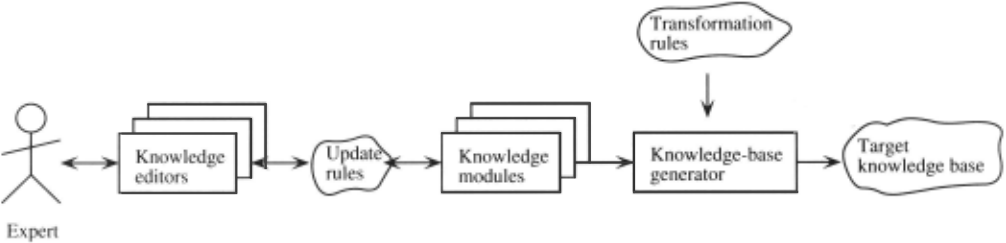
are defined as follows:
- Knowledge editors: The knowledge editors allow ex perts to enter and edit domain knowledge according to the experts' conceptual domain model. Examples of knowledge editors are domain-specific forms and graph editors. The knowledge editors are part of the user interface of the target knowledge-acquisition tool; they operate on the internal knowledge rep resentation in the knowledge-acquisition tool, and provide views of the representation.
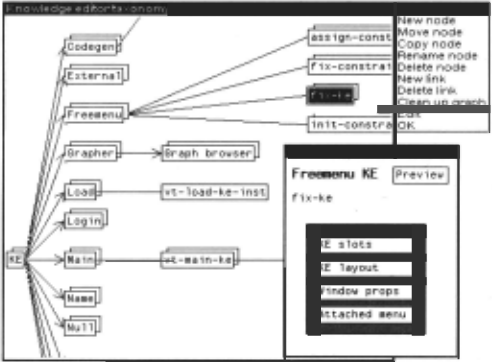
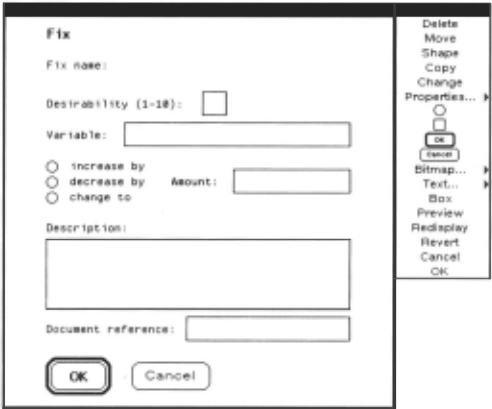
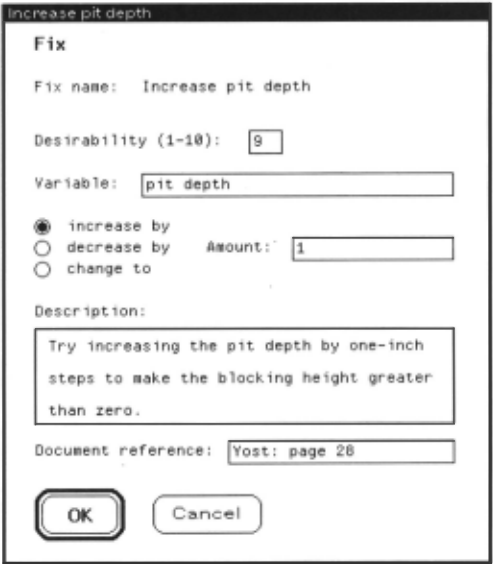
In DOTS, developers can custom tailor the user inter face of target knowledge-acquisition tools by speci fying and refining knowledge editors, such as menu layouts, window-system behavior, and editor prop erties (see Figure 2) . DoTs provides predefined types of knowledge editors for various types of know ledge, and also can allow the introduction of user defined knowledge editors. Figure 3 shows a form layout editor provided by DOTS . Developers use this tool to design layouts for form-based knowledge ed itors. The resulting form-based knowledge editor is shown in Figure 4. Note that this example is con sistent with the fixes in the Sisyphus VT task. 2
- Knowledge modules: The knowledge modules pro vide encapsulation and manipulation of the internal knowledge representation of the target knowledge acquisition tools . The information that the expert enters in the knowledge editors is stored in know ledge modules . Furthermore, the knowledge mod ules serve as an intermediate representation in the transformation of the knowledge acquired into the target knowledge base (see Figure 1).
- Update rules: Update rules preserve consistency among the knowledge editors and the knowledge modules in the target knowledge-acquisition tools.
2 The Sisyphus experiment is an attempt by the knowledge-acquisition community to provide a set of stan dard problems that researchers can use to compare their ap proaches to knowledge acquisition and problem solving. The Sisyphus VT task is based on the VT system for elevator con figuration [Marcus et al., 1988] .
The specification of the update rules defines the mapping between the knowledge presented and edited in the knowledge editors and the knowledge modules.
- Transformation rules: The knowledge-base genera tor of the target knowledge-acquisition tool gener ates the knowledge bases. In the DOTS approach, the knowledge-base generator is based on trans formation rules that map knowledge represented by the knowledge modules into the appropriate knowledge-base structures (e.g., classes, instances, and rules). Generally, the rule preconditions of the transformation rules refer to the contents of know ledge modules, whereas the rule conclusions refer to structures in target knowledge bases. In other words, the transformation rules define the denota-
tiona! semantics for the knowledge that the target knowledge-acquisition tools acquire, because, cur rently, the knowledge-acquisition tools do not inter pret the knowledge modules.
We have found the concepts of knowledge editors, know ledge modules, update rules, and transformation rules to be sufficient building blocks for interactive knowledge acquisition tools based on graphical knowledge edit ing. Other types of knowledge-acquisition tools, such as interview-oriented tools that elicit knowledge through a textual dialog with the expert, might require other sets of components [Kawaguchi et al., 1991].
3.2 Generation of Target Tools from DOTS
The DOTS code generator takes as input the user's spec ification of the target knowledge-acquisition tool and produces code for the target knowledge-acquisition tool. The code generator is based on a set of transforma tion rules that maps abstract-architecture specifications (e.g., components descriptions) into constructs consti tuting the target knowledge-acquisition tool. The trans formation rules are similar to those used by the tar get knowledge-acquisition tools for knowledge-base gen eration. The code generated is intended to run with a run-time library consisting of core functions required by the target knowledge-acquisition tool-for example, functions for window management, internal bookkeep ing, persistent storage, and knowledge-base generation.
3.3 Generation of Knowledge Bases from Target Tools
The generic knowledge-base generator is an important component of the target knowledge-acquisition tools. We shall provide an example that illustrates how tar get knowledge bases are generated from the contents of knowledge modules. This example is loosely based on the Sisyphus VT task. Suppose that we want to gener ate rules from the information entered in the fix form (Figure 4) . We assume that the developer has already defined the knowledge editor and the appropriate know ledge module for representing the information acquired. The task of the knowledge-base generator is to produce appropriate rules from such knowledge modules. For the form shown in Figure 4, we wish to generate an instance of the fix class for the knowledge base, in this example:
(definstance increase_pit_depthl of fix (desirability 9) (variable pit_depth) (action increase) (amount 1) (description "Try increasing ... "))In DOTS, transformation rules map the knowledge modules to the target knowledge base. Figure 5 shows a sample transformation rule (generate-1) that pro duces target instances from the knowledge modules. The clause ($km :whichis fix-km) states that the trans formation rule is applicable to all knowledge modules of type fix-km, and that the variable $km is bound to a knowledge-module instance during the generation pro cess (i.e., \lx where x E fix-km) . The precondition of the transformation rule tests whether the user has filled in
(define-transformation-rule generate-1 ($km :vhichis fix-km) IF (not-empty (get-value $km variable)) THEN (build-instance :name (target-id $km) :class 'fix :initargs '((desirability ,(get-value $km desirability)) (variable ,(get-value $km variable)) (action ,(get-value $km action)) (amount ,(get-value $ka amount)) (description ,(get-value $km description)))))the variable field in the fix form (Figure 4). If the precon dition issatisfied, the conclusion of the transformation rule builds an instance of the class fix in the target know ledge base. If the expert has entered several fix-km into the knowledge-acquisition tool, several instances of the generate-1 transformation rule may generate multiple target instances. The purpose of the build-instance clause is to provide a convenient syntax for instance gen eration, and to allow the knowledge-acquisition tool to maintain the target knowledge base as the knowledge modules change, by adding and deleting rules from the knowledge base.
An alternative to using instances of the fix class to rep resent fixes in the knowledge base, is to use production rules to represent the fixes. In this case, the produc tion rules would implement fix operations (e.g., increase a state variable) . By using a build-rule clause, we can define readily a transformation rule that generates production rules from the contents of the fix-km know ledge module. In this approach, the user interface of the knowledge-acquisition tool and the fix form {Figure 4) would remain the same after we modified the transfor mation rule. By using this technique, we can defer de sign decisions about the knowledge representation in the knowledge base until we have acquired a significant body of knowledge.
4 Related Work
The principal work with which the abstract-architecture approach and its implementation in DOTS should be com pared is PROTEm~ [Musen, 1989]. PROTEGE implements a metaview that is based on a generic problem-solving method: skeletal-plan refinement [Tu et al., 1989] . How ever, this method-oriented view is restricted to a sin gle problem-solving method. A subsequent project, PROTEGE-II, generalizes PROTEGE, and removes some of these restrictions [Puerta et al., 1992]. Spark, Burn, and FireFighter (sBF) [Marques et al., 1992] form a set of tools designed to make programming easier by provid ing reusable programming constructs, or mechanisms. Spark helps the developer to identify and combine relevant mechanisms from a library. In the SBF approach, each mechanism in the library is supported by a corre spondin~ knowledge-acquisition tool. Sis [Kawaguchi et a/., 1991] is a metatool that supports a metaview similar to the abstract-architecture view. SIS, however, gener ates knowledge-acquisition tools that interview experts through a textual question-and-answer .dialog.
PROTEGE, SBF, and other metatools that support method-oriented views require less modeling than DOTS does, because the former metatools draw their power from assumptions on knowledge acquisition for the problem-solving method supported, and because these metatools use a priori knowledge-acquisition tool de signs. Compared to PROTEGE and SBF, DOTS trades supportive power for generality, and requires the devel oper to perform a knowledge-acquisition analysis that results in an overall tool design. DoTS differs from toolboxes that support programmers in the implementa tion of knowledge-acquisition tools in conventional pro gramming languages [Gappa, 1991] by providing an ab stract and coherent architectural view, which hides from the developer the details of the run-time library of the knowledge-acquisition tools.
5 Summary and Discussion
Although domain-oriented knowledge-acquisition tools provide effective support for the development of knowledge-based systems, the task of implementing such domain-oriented tools is laborious [Eriksson, 1991; Gale, 1987; Musen et a/., 1987]. Previous approaches to automatic generation of knowledge-acquisition tools, such as PROTEGE, have relied mainly on method-oriented views for the specification, which, unfortunately, make the metatools specific to the problem-solving methods of the target knowledge-based systems. The abstract architecture view and DOTS contribute to knowledge ac quisition by enabling developers to construct domain oriented knowledge-acquisition tools.
The DOTS project demonstrated that the abstract architecture view can be used for method-independent specification of knowledge-acquisition tools, and that the tools generated automatically from such specifica tions are comparable to hand-crafted tools. For instance, we have used DOTS to generate a basic knowledge acquisition tool for the Sisyphus VT task. Given a do main ontology, the development time for this knowledge acquisition tool was about 9 hours. Because the prob lem definition is based on the VT system and the associ ated domain, the knowledge-acquisition tool generated performs a knowledge-acquisition task similar to that of SALT [Marcus and McDermott, 1989], a knowledge acquisition tool developed for the original VT system [Marcus et al., 1988].
Another general conclusion is that the abstract architecture view is sufficient for specification of graphi cal knowledge-acquisition tools that provide knowledge editing support for domain experts. In our approach, a generic knowledge-base generator, which is parame terized by transformation rules, provides flexibility in terms of output knowledge bases from the knowledge acquisition tools.
Although we can remove most domain and method restrictions by using the abstract-architecture view, this approach uncovers other obstacles. Although DOTS is method independent, it is restricted in terms of the types of knowledge-acquisition tools that it can gener ate. In DOTS, the design space of the target knowledge acquisition tools is restricted to knowledge-acquisition tools with a common basic architecture. DoTS can not generate easily other knowledge-acquisition tools, such as repertory-grid based tools and machine-learning tools. However, this restriction has not been a se vere hindrance in practical development, because we are mainly interested in generating domain-oriented knowledge-acquisition tools that support the experts' do main models.
We have applied DOTS to several domain tasks. For instance, we have used DOTS to develop a knowledge acquisition tool for a knowledge-based system that trou bleshoots DNA sequencing machines 3 [Eriksson and Larses, 1992]. Also, we are currently formulating metaviews that bridge the PROTEm~ and DOTS ap proaches by providing multiple perspectives. We are developing a metatool, DASH, that supports knowledge acquisition analysis, and that helps developers to design target knowledge-acquisition tools from domain ontolo gies (i.e., class definitions).
Acknowledgments
I thank Sture Hagglund, Mark Musen, and Kristian Sandahl for valuable discussions about DOTS, and I am grateful to Lyn Dupre for editorial assistance. The ex amples based on the Sisyphus VT task benefited from discussions with John Gennari and Thomas Rothenfluh.
@inproceedings{ijcai1993p72,
  title     = {Specification and Generation of Custom-Tailored Knowledge-Acquisition Tools},
  author    = {Eriksson, Henrik},
  booktitle = {Proceedings of the Thirteenth International Joint Conference on
               Artificial Intelligence, {IJCAI-93}},
  publisher = {International Joint Conferences on Artificial Intelligence},
  editor    = {Ruzena Bajcsy},
  pages     = {510--517},
  year      = {1993},
  note      = {Knowledge Base Technology},
  url       = {https://ijcai.org/proceedings/1993/72},
}
TY - CPAPER TI - Specification and Generation of Custom-Tailored Knowledge-Acquisition Tools AU - Eriksson, Henrik T2 - Proceedings of the Thirteenth International Joint Conference on Artificial Intelligence, IJCAI-93 PB - International Joint Conferences on Artificial Intelligence PY - 1993 SP - 510 EP - 517 UR - https://ijcai.org/proceedings/1993/72 ER -Copied
Machine-readable versions of this paper, for tools and AI agents:





