
A Domain Theory for Task Oriented Negotiation
Proceedings of the Thirteenth International Joint Conference on Artificial Intelligence. Distributed AI. Pages 416-421.
© 1993 International Joint Conferences on Artificial Intelligence
Abstract
We present a general theory that captures the relationship between certain domains and negotiation mechanisms. The analysis makes it possible to categorize precisely the kinds of domains in which agents find themselves, and to use the category to choose appropriate negotiation mechanisms. The theory presented here both generalizes previous results, and allows agent designers to characterize new domains accurately. The analysis thus serves as a critical step in using the theory of negotiation in realworld applications. We show that in certain Task Oriented Domains, there exist distributed consensus mechanisms with simple and stable strategies that lead to efficient outcomes, even when agents have incomplete information about their environment. We also present additional novel results, in particular that in concave domains using aU-or-nothing deals, no lying by an agent can be beneficial, and that in subadditive domains, there often exist beneficial decoy lies that do not require full information regarding the other agent's goals.
- [Conry et a/., 1988] S. Conry, R. Meyer, and V. Lesser. Multistage negotiation in distributed planning. In A. Bond and L. Gasser, editors, Readings in Dis- tributed Artificial Intelligence, pages 367-384.
- [Durfee, 1988] E. H. Durfee. Coordination of Dis- tributed Problem Solvers. Kluwer Academic Publish- ers, Boston, 1988.
- [Harsanyi, 1977] John C. Harsanyi. Rational Behavior and Bargaining Equilibrium in Games and Social Situ- ations. Cambridge University Press, Cambridge, 1977.
- [Kraus and Wilkenfeld, 1991] S. Kraus and J. Wilken- feld . Negotiations over time in a multi agent envi- ronment: Preliminary report. In Proceedings of the Twelfth International Joint Conference on Artificial Intelligence, pages 56-61, Sydney, August 1991. IJCAI
- [Kreifelts and von Martial, 1990] Thomas Kreifelts and Frank von Martial. A negotiation framework for au- tonomous agents. In Proceedings of the Second Euro- pean Workshop on Modeling Autonomous Agents and Multi-Agent Worlds, pages 169-182, Saint-Quentin en Yvelines, France, August 1990.
- [Kuwahara and Lesser, 1989] Kazuhiro Kuwahara and Victor R. Lesser. Extended protocol for multistage negotiation. In Proceedings of the Ninth Workshop on Distributed Artificial Intelligence, pages 129-161, Rosario, Washington, September 1989.
- [Luce and Raiffa, 1957] R. Duncan Luce and Howard Raiffa. Games and Decisions. John Wiley & Sons, Inc., New York, 1957.
- [Nash, 1950] John F. Nash. The bargaining problem. Econometrica, 28:155-162, 1950.
- [Rosenschein, 1993] J. S. Rosenschein. Consenting agents: Negotiation mechanisms for multi-agent sys- tems. In Proceedings of the Thirteenth International Joint Conference on Artificial Intelligence, Chambery, France, August 1993. IJCAI
- [Roth, 1979] Alvin E. Roth. Axiomatic Models of Bar- gaining. Springer-Verlag, Berlin, 1979.
- [Smith, 1978] Reid G. Smith. A Framework for Problem Solving in a Distributed Processing Environment. PhD thesis, Stanford University, 1978.
- [Sycara, 1988] K. P. Sycara. Resolving goal conflicts via negotiation. In Proceedings of the Seventh National Conference on Artificial Intelligence, pages 245-250, St. Paul, Minnesota, August 1988.
- [Sycara, 1989] K. P. Sycara. Argumentation: Planning other agents' plans. In Proceedings of the Eleventh In- ternational Joint Conference on Artificial Intelligence, pages 517-523, Detroit, August 1989. IJCAI
- [Zeuthen, 1930] Frederik Zeuthen. Problems of Monopoly and Economic Walfare. G. Routledge & Sons, London, 1930.
- [Zlotkin and Rosenschein, 1989] G. Zlotkin and J. S. Rosenschein. Negotiation and task sharing among au- tonomous agents in cooperative domains. In Proceed- ings of the Eleventh International Joint Conference on Artificial Intelligence, pages 912-917, Detroit, Michi- gan, August 1989. IJCAI
- [Zlotkin and Rosenschein, 1990] G. Zlotkin and J. S. Rosenschein. Negotiation and goal relaxation. In Pro- ceedings of The Workshop on Modelling Autonomous Agents in a Multi-Agent World, pages 115-132, Saint- Quentin en Yvelines, France, August 1990.
- [Zlotkin and Rosenschein, 1991a] G. Zlotkin and J . S. Rosenschein. Cooperation and conflict resolution via negotiation among autonomous agents in noncooper- ative domains. IEEE Transactions on Systems, Man , and Cybernetics, 21(6):1317-1324, December 1991.
- [Zlotkin and Rosenschein, 1991b] G. Zlotkin and J. S. Rosenschein. Incomplete information and deception in multi-agent negotiation. In Proceedings of the Twelfth International Joint Conference on Artificial Intelli- gence, pages 225-231, Sydney, Australia, August 1991. IJCAI
- [Zlotkin and Rosenschein, 1992] G. Zlotkin and J . S. Rosenschein. A domain theory for task oriented nego- tiation. Technical Report 92-13, The Leibniz Center, Department of Computer Science, Hebrew University, Jerusalem, Israel, 1992.
References were extracted automatically from the PDF and may contain errors.
Full text extracted automatically from the PDF; figures, tables and equations may differ. The PDF is the version of record.
1 Introduction
Negotiation has been a subject of central interest in Distributed Artificial Intelligence (DAI). The word has been used in a variety of ways, though in general it refers to communication processes that further coordina tion [Smith, 1978; Kuwahara and Lesser, 1989; Conry et al., 1988; Kreifelts and von Martial, 1990]. These nego tiating procedures have included the exchange of Partial Global Plans [Durfee, 1988], the communication of in formation intended to alter other agents' goals [Sycara, 1988; Sycara, 1989], and the use of incremental sugges tions leading to joint plans of action [Kraus and Wilken feld, 1991].
In previous work [Zlotkin and Rosenschein, 1989; Zlotkin and Rosenschein, 1991a; Zlotkin and Rosenschein, 1990; Zlotkin and Rosenschein, 1991b], we have considered various negotiation protocols in different do mains, and examined their properties. The b~ck~round and motivation of this research can be found m lRosen schein, 1993]. Agents were assumed to have a goal that specified a set of acceptable final states. These agents then entered into an iterative process of offers and counter-offers, exploring the possibility of achieving their goals at lower cost, and/or resolving conflicts between their goals. .
'This research has been partially supported by the Leibniz Center for Research in Computer Science, and by the Israeli Ministry of Science and Technology (Grant 032-8284).
The procedure for making offers was formalized in a negotiation mechanism; it also specified the form that the agents' offers could take (deal types). A deal be tween agents was generally a joint plan. The plan was "joint" in the sense that the agents might probabilisti cally share the load, compromise over which agent does which actions, or even compromise over which agent gets which parts of its goal satisfied.
The interaction between agents occurs in two consec utive stages. First the agents negotiate, then they exe cute the entire joint plan that has been agreed upon. No divergence from the agreed deal is allowed. The sharp separation of stages has consequences, in that it .rules out certain negotiation tactics that might be used m an interleaved process.
At each step, both agents simultaneously offer a deal. Our protocol specifies that at no point can an agent de mand more than it did previously-in other words, each offer either repeats the previous offer or concedes by de manding less. The negotiation can end in one of two ways:
Conflict: if neither agent makes a concession at some step, they have by default agreed on the (domain depen dent) "conflict deal";
Agreement: if at some step an agent At, for example, offers agent A2 more than A2 himself asks for, they agree on At's offer, and if both agents overshoot the other 's demands, then a coin toss breaks the symmetry.
The result of these rules is that agents cannot back track, nor can they both simultaneously "stand still" in the negotiation more than once (since it causes them to reach a conflict). Thus the negotiation process is strongly monotonic and ensures convergence to a deal.
Deal types explored in our previous work included pure deals, ali-or-nothing deals, mixed deals, joint plans, mixed joint plans, semi-cooperative deals, and multi-plan deals. Each of these types of agreement proved suitable for solving different kinds of interactions. For example, semi-cooperative deals proved capable of resolving true conflicts between agents, whereas mixed deals did not. Similarly, multi-plan deals are capable of capturing goal relaxation as part of an agreement.
It was also shown that certain other properties were true of some deal types but not of others. In particular, different agent strategies were appropriate ("rational") for different deal types and domains. Agents were shown to have no incentive to lie when certain deal types were used in certain domains, but did have an incentive to lie with other deal type/domain combinations.
The examination of this relationship between the ne gotiation mechanism and the domain made use of two prototypical examples: the Postmen Domain (intro duced in [Zlotkin and Rosenschein, 1989]), and the Slot ted Blocks World (presented in [Zlotkin and Rosen schein, 1991a]). It was clear that these two domains exemplified general classes of multi-agent interactions (e.g., the Postmen Domain was inherently cooperative, the Slotted Blocks World not). It was, however, not clear what attributes of the domains made certain ne gotiation mechanisms appropriate for them. Nor was it clear how other domains might compare with these pro totypes. When presented with a new domain (such as agents querying a common database), which previous re sults were applicable, and which weren't? The research lacked a general theory explaining the relationship be tween domains and negotiation mechanisms.
In this paper, we present the beginnings of such a general theory. The analysis makes it possible both to understand previous results in the Postmen Domain more generally, and to characterize new domains accu rately (i.e., what negotiation mechanisms are appropri ate). The analysis thus serves as a critical step in using the theory of negotiation in real-world applications.
1.1 Criteria for Evaluating Mechanisms
How can we, in general, evaluate alternative interaction mechanisms? We are concerned with several criteria in our design of negotiation mechanisms and strategies:
Symmetric Distribution: no agent is to have a spe cial role in the negotiation mechanism;
Efficiency: the solution arrived at through negotiation should be efficient (e.g., satisfy the criterion of Pareto Optimality);
Stability: the strategy should be stable (e.g., strict Nash equilibrium, where no single agent can benefit by changing strategy, though a group might);
Simplicity: there should be low communication cost to the mechanism, as well as relatively low computational complexity.
Our overall goal is to find distributed consensus mech anisms such that an automated agent can use a simple and stable strategy that will lead to an efficient outcome. In this paper, we show that such mechanisms exist for certain domains.
2 Task Oriented Domains
A Task Oriented Domain (TOD) describes a certain class of scenarios for multi-a~ent encounters. In par ticular, the Postmen Domain lZlotkin and Rosenschein, 1989] is an instance of a TOD (the Slotted Blocks World from [Zlotkin and Rosenschein, 1991a], however, is not a TOD). Intuitively, it is a domain that is cooperative, with no negative interactions among agents' goals. Each agent welcomes the existence of other agents, for they can only benefit from one another (if they can reach agreement about sharing tasks) .
Definition 1 A Task Oriented Domain (TOD) is a tu ple < T, A, c > where:
1. T is the set of all possible tasks;
2. A= {At, A2, ... An} is an ordered list of agents;
9. c is a monotonic function c: [2T] --+ JR+. [2T] stands for all the finite subsets ofT. For each finite set of tasks X ~ T, c(X) is the cost of executing all the tasks in X by a single agent. c is monotonic, i.e., for any two finite subsets X~ Y ~ T, c(X) $ c(Y).
4. c(0) = 0.
Definition 2 An encounter within a TOD < T, A, c > is an ordered list (T1, T2, ... , Tn) such that for all k E { 1 .. . n}, T~c is a finite set of tasks from T that A~c needs to achieve. T~c will also be called A~c 's goal.
According to the definition above, the cost function c takes no parameters other than the task set. In general, c might be defined as having other, global, parameters {like the initial state of the world) . However, the cost of a set of tasks is independent of others' tasks that need to be achieved. An agent in a TOD is certain to be able to achieve his goal at that cost.
3 Attributes and Examples
Here we give several examples of TOD's, which cover a variety of agent interaction situations. Subsequently, we will further classify each of these TOD examples with respect to certain properties.
Postmen Domain:
Description: Agents have to deliver sets of letters to mailboxes, which are arranged on a weighted graph G = G(V, E) . There is no limit to the number of let ters that can fit in a mailbox. After delivering all letters, agents must return to the starting point (the post office) . Agents can exchange letters at no cost while they are at the post office, prior to delivery.
Task Set: The set of all addresses in the graph, namely V. If address x is in an agent's task set, it means that he has at least one Jetter to deliver to x .
Cost Function: The cost of a subset of addresses X C V, i.e., c(X), is the length of the minimal path that starts at the post office, visits all members of X, and ends at the post office.
Database Queries:
Description: Agents have access to a common database, and each has to carry out a set of queries. The result of each query is a set of records. For example, agent At may want the records satisfying the condition "All female employees of company X earning over $40,000 a year," and agent A2 may want the records satisfying the condition "All female employees of company X with more than 10 years of seniority." Agents can exchange results of queries and sub-queries at no cost.
Task Set: All possible queries, expressed in the primi tives of relational database theory, including operators like Join, Projection, Union, Intersection, and Differ ence.
Cost Function: The cost of a set of queries is the minimal number of database operations needed to generate all the records. It is possible to use the result of one query as input to other queries, i.e., the operations are not destructive.
The Fax Domain:
Description: Agents are sending faxes to locations on a telephone network (a weighted graph) . In order to send a fax, an agent must establish a connection with the receiving node; once the connection is established, multiple faxes can be sent . The agents can, at no cost, exchange messages to be faxed.
Task Set: The set of all possible receiving nodes in the network. If node z is in an agent's task set, it means that he has at least one fax to send to z.
Cost Function: There is a cost associated with estab lishing a single connection to any node z . The cost of a set of tasks is the sum of the costs of establishing con nections to all the nodes in the set. Thus, the cost of a dial-up connection to a given node is independent of other nodes in the task set.
Having introduced the TOD's above, we now turn our attention to attributes that these domains exhibit. These attributes strongly affect their relationships tone gotiation mechanisms. We will focus on the attributes of subadditivity, concavity, and modularity (these terms are borrowed from game theory) . The motivation for these definitions are presented in more detail below.
Definition 3 [Subadditivity): TOD < T, A, c > will be called subadditive if for all finite sets of tasks X , Y ~ T , we have c(X U Y) ~ c(X) + c(Y) .
In other words, by combining sets of tasks we may re duce (and can never increase) the total cost, as compared with the cost of achieving the sets alone. All the TOD examples above are subadditive. In this paper, we are mainly concerned with two agent subadditive domains.
Definition 4 [Concavity): TOD < T ,A , c >will be called concave if for all finite sets of tasks X ~ Y, Z ~ T , we have c(Y U Z)- c(Y) ~ c(X U Z)- c(X).
In other words, the cost that arbitrary set of tasks Z adds to set of tasks Y cannot be greater than the cost Z would add to a subset of Y.
Theorem 1 All concave TOD's are also subadditive.
Proof. The proof of this theorem and all other theorems can be found in [Zlotkin and Rosenschein, 1992]. o
The general Postmen Domain is not concave. The other TOD examples (the Fax Domain and the Database Query Domain) are concave.
Theorem 2 The Postmen Domain, restricted to graphs that have a tree topology (no cycles), is concave.
Definition 5 [Modularity): TOD < T, A, c > will be called modular if for all finite sets of tasks X, Y ~ T, we have c(X U Y) = c(X) + c(Y)- c(X n Y).
In other words, the cost of the combination of two sets of tasks is exactly the sum of their individual costs minus the cost of their intersection.
Theorem 3 All modular TOD's are also concave.
Only the Fax Domain from the above TOD examples is modular.
4 Mechanisms for Subadditive TOD's
In this section, we develop the framework for formal izing two agent negotiation mechanisms in subadditive Task Oriented Domains. Similar definitions can be found in our previous work [Zlotkin and Rosenschein, 1989; Zlotkin and Rosenschein, 1991a; Zlotkin and Rosen schein, 1991b].
Definition 6 Given an encounter (Tt, T2) within a two agent TOD < T, {At. A2}, c > we have the following: 1. A Pure Deal is a redistribution of tasks among agents. It is an ordered list ( Dt, D2) such that Dt, D2 ~ T, and Dt U D2 = Tt U T2. The semantics of such a deal is that each agent Ak commits itself to executing all tasks in Dk. The cost of such a deal to Ak is defined to be CostA:(Dt, D2) = c(Dk)·
2. A Mixed Deal is a pure deal ( Dt, D2) and a probability p, 0 ~ p ~ 1. A mixed deal will be denoted by (Dt, D2) : p. The semantics of this deal is that the agents will perform a lottery such that, with probability p, Dt will be assigned to At and D2 will be assigned to A2. With probability 1-p, Dt will be assigned to A2 while D2 will be assigned to At . The cost of such a deal to Ak is defined to be Costl:((Dt, D2):p) = (p)c(Dk) + (1- p)c(Da-A:)·
3. An All-Or-Nothing deal is a mixed deal (Tt UT2, 0):p. Agreeing on such a deal, At has a p chance of executing all the tasks Tt U T2 and has a 1 - p chance of doing nothing.
With the above definitions of three deal types, we now consider utility, the negotiation set, optimal protocols, and stable negotiation strategies.
Definition 7 Given an encounter (Tt, T2) within a TOD < T, {At.A2},c >, we have the following:
1. For any deal fJ (pure, all-or-nothing, or mixed) we will define Utilityl:(fJ) = c(Tk)- Cosh(fJ).
2. The (pure) Deal 9 ::: (Tt, T2) will be called the conflict deal.
e is a conflict because no agent agrees to execute tasks other than its own. Note that for all k, Utilityl:(8) = 0. When the agents fail to agree, i.e., run into a conflict, they by default execute the conflict deal e. Our assump tion is that rational agents are utility maximizers; since they can guarantee themselves utility 0, they will not agree to any deal that gives them negative utility.
Definition 8 For vectors a = ( a1, a2, ... , an) and /3 = (/31, /32, ... , f3n), we will say that a dominates /3 and write a>- /3 if and only ifVk(ak ;::::: fJk), and 31(a, > p,). We will say that a weakly dominates /3 and write at {J if and only ifVk(ak;::::: f3k)·
Definition 9 For deals 6 and 6' (pure, a/l-or-nothing, or mixed), we will say that 6 dominates 6', and write 6 >- 6', if and only if (Utility1 ( 6), Utility2( 6)) > (Utility1(6'),Utility2(6')). We will say that 6 weakly dominates 6', and write 6 t 6', if and only if (Utility1 ( 6), Utility2(6)) t (Utility1 ( 6'), Utility2(6')). We will say that 6 is equivalent to 6', and write 6 = 6' ifVk(Utility" ( 6) = Utility"( 6')).
If 6 >- 6' it means that the deal 6 is better for at least one agent and not worse for the other.
Definition 10 Deal 6 is individual rational if 6 t e.
A simple observation from the above definition and from Definition 7 (of the conflict deal and utility) is that a deal 6 is individual rational if and only if Vk E {1, 2}: Utility"(6);::::: 0.
Definition 11 A deal 6 is called pareto optimal if there does not exist another deal 6' such that 6' >- 6 [Roth, 1979; Luce and Raiffa, 1957; Harsanyi, 1977}.
A pareto optimal deal cannot be improved upon for one agent without lowering the other agent's utility from the deal.
Definition 12 The set of all deals that are individual rational and pareto optimal is called the negotiation set (NS) [H arsanyi, 1977}.
Since agents are by definition indifferent between two deals that give them the same utility, we are interested in negotiation mechanisms that produce pareto optimal deals (i.e., if agent A1 gets the same utility from deals x and y, but A2 prefers y, we don't want them to settle on x). At this point, we are only considering negotiation mechanisms that result in a deal from the NS. These are, in some sense, mechanisms with efficient outcomes.
Theorem 4 For any encounter in a TOD, NS over pure deals is not empty.
Theorem 5 For any encounter within any subadditive TOD, NS over mixed deals is not empty.
Definition 13 An optimal negotiation mechanism over a set of deals is a mechanism that has a negotiation strat egy that is in equilibrium with itself-if all agents use this negotiation strategy, they will agree on a deal in NS that maximizes the product of the agents' utility [Nash, 1950}. If there. is more than one such deal that maximizes the product, the mechanism chooses one arbitrarily, with equal probability.
An optimal negotiation mechanism by definition sat isfies the stability and efficiency criteria mentioned in Section 1.1.
The protocol defined above in Section 1 has an equilib rium strategy for each deal type that yields agreement on a deal in NS that maximizes the product of the agents' utility. Those strategies are based on Zeuthen risk crite ria [Zeuthen, 1930], and were presented in [Zlotkin and Rosenschein, 1989]. Therefore, the above protocol is an example of an optimal negotiation mechanism.
Theorem 6 An optimal negotiation procedure over mixed deals in subadditive two agent TOD's divides the available utility equally between the two agents.
5 Incentive Compatible Mechanisms
Sometimes agents do not have full information about one another's goals. This raises the question of whether agents can benefit from concealing goals, or manufactur ing artificial goals. This lying can either occur explic itly, by declaring false goals, or implicitly, by behaving as if these false goals were true, depending on the spe cific negotiation mechanism. Our work in previous pa pers [Zlotkin and Rosenschein, 1989; Zlotkin and Rosen schein, 199la; Zlotkin and Rosenschein, 1991b] partly focused on combinations of negotiation mechanisms and domains where agents have no incentive to lie. A negoti ation mechanism is called incentive compatible when the strategy of telling the truth (or behaving according to your true goals) is in equilibrium (i.e., when one agent uses the strategy, the best thing the other agent can do is use the same strategy) . In the Postmen Domain [Zlotkin and Rosenschein, 1989], we identified three types of lies: 1. Hiding tasks (e.g., a letter is hidden);
2. Phantom tasks (e.g., the agent claims to have a letter, which is non-existent and cannot be produced by the ly ing agent);
3. Decoy tasks (e.g., the agent claims to have a letter, which is non-existent but can be manufactured on de mand if necessary).
Since certain deals might require the exchange of letters, a phantom lie can be uncovered, while a decoy lie (and of course a hidden lie) cannot. Thus, a phantom lie under certian negotiation mechanisms is "not safe." Different domains differ as to how easy or hard it is to generate decoy tasks.
In this section, we provide a characterization of there lationship between kinds of lies, domain attributes, and deal types. There are three kinds of lies in TOD's, and we have considered three domain attributes (subadditiv ity, concavity, modularity) and three classes of optimal negotiation mechanisms, based on pure, ali-or-nothing, and mixed deals. The resulting three-by-three-by-three matrix is represented in Figure 1. Its notation is described below. '
Consider the entry under Subadditive, AU-or-Nothing deal , Decoy lie (we'll refer to this as entry [a, j, z]). The entry L at that position means that for every optimal negotiation mechanism that is based on ali-or-nothing deals, there exists a subadditive domain and an en counter such that at least one agent has the incentive to lie with a decoy lie (L means lying may be bene ficial). The entry T at position [b, k, z) means that for every concave domain and every encounter within this domain, under any optimal negotiation mechanism based on mixed deals, agents do not have an incentive to lie with decoy lies (T means telling the truth is always beneficial) .
The entries in the table marked T/P (such as [a, j, y])
| Subadditive (a) | |||
|---|---|---|---|
| ~fl. | -~Y) Ph an. | JzJ Dec. | |
| Pure (i) | v" | L.l' | Lot" |
| A-or-N U) | T/ 1 | T/P | L6.u. |
| Mixed (k) | L.l' | T/P~ | L |
| Concave b) | ||
|---|---|---|
| ~fl. | ~y) Ph an. | _!Z) Dec. |
| /L.I' | /Ls> | /L |
| /T/ | T/ | T/ |
| /L.I' | 'f1't/ | ~Til'/ 3 |
In the table, there is a relationship between cells. The fact that entry [a, j, x] is T implies that entry [b, j, x] will also be T (this is denoted by the / single shaft arrow in the first cell, and the / arrow going into the T in cell [b, j, x]) . Similarly, [b, j, x] being T implies that entry [c, j, x] will beT (and is also denoted by arrows). This is because modular domains are concave, and concave domains are subadditive; if there is no incentive to lie even in a subadditive domain, there will certainly be no incentive to lie in concave or modular domains (which are sub-classes of subadditive domains).
Similarly, the L entry in [c, i, x] implies that [b, i, x] will also have an L entry: if a beneficial lie can be found in a modular domain, then it can certainly be found in a concave domain (a superset). These downward influ ences of L are also marked in the table, with / arrows.
There is also a relationship between certain table en tries with the same domain attribute (these relationships are denoted by double shaft arrows like ¢: ) . For exam ple, if there is no incentive to lie in general mixed deals, there is no incentive to lie in all-or-nothing deals (which are a subset) . Thus, the T in cell [b, k, z] implies the T in cell [b, j, z] (it also implies [b, k, y], which in turn implies [b, j , y], .. . ).
To fill out the table, therefore, we need only demon strate a small number of "fixed points," which in turn imply all the other table entries. The fixed points that need to be demonstrated are numbered in the table from 1 to 8. We demonstrate the values for these 8 cells, and present some other theorems that make general state ments about optimal negotiation mechanisms.
5.1 Incentive Compatible Fixed Points
The four incentive compatible fixed points are deter mined by the theorems below.
Theorem 7 (Fixed point 1]: For any encounter in a two agent subadditive TOD, and any optimal negotiation mechanism over a/l-or-nothing deals, every "hiding" lie is not beneficial.
Theorem 8 For any encounter in a two agent subaddi tive TOD, there is always an a/l-or-nothing deal in NS maximizing the product of the utilities.
/Ls> /L /L7 T ¢:T4
| Modular c) | ||
|---|---|---|
| ~fl. | -~y) Phan. | _{z) Dec. |
| /L7 | T | ¢:T4 |
| /T | /T | /'T |
| ,I'Ls | /T | /'T |
Since an all-or-nothing deal is always a candidate agreement, the negotiation mechanism might arbitrar ily choose it. This is the reason that the L in [a, k, z] is implied by the Lin (a, j, z]. If there exists an encounter in which one of the agents has an incentive to lie when the negotiation is over all-or~nothing deals, then in the same encounter the same agents have the same incentive to lie when negotiating over general mixed deals: the agreement can always be an ali-or-nothing deal.
Another consequence is the following theorem.
Theorem 9 (Fixed point 2]: For any encounter in a two agent subadditive TOD, and any optimal negotiation mechanism over mixed deals, every "phantom" lie has a positive probability of being discovered. Therefore, with a sufficiently severe penalty mechanism, telling the truth is the optimal strategy.
Theorem 10 (Fixed point 3]: For any encounter in a two agent· concave TOD, and any optimal negotiation mechanism over mixed deals, every "decoy" lie is not beneficial.
Theorem 11 For any encounter in a two agent con cave TOD, and any optimal negotiation mechanism over a/l-or-nothing deals, every lie {including combinations of hidden, phantom, and decoys) is not beneficial.
Because of the theorem above, it is clear that for con cave domains, agents cannot benefit by lying when all or-nothing deals are in use--i.e., any optimal negotiation procedure over all-or-nothing deals is incentive compat ible. This is also true for modular domains (a subcase). This can be seen in the table, where the entire all-or nothing row is marked T for modular and concave do mams.
Additionally, in a subadditive domain where decoy tasks cannot be generated, an optimal negotiation pro cedure over all-or-nothing deals with a penalty mecha nism for discovered lies is incentive compatible (this was shown, in a different form, in [Zlotkin and Rosenschein, 1989]). This can be seen in the table, where the alt-er nothing row is marked with T and T /P (excluding the decoy column).
Theorem 12' (Fixed point 4]: For any encounter in a two agent modular TOD, and any optimal negotiation mechanism over pure deals, every "decoy" lie is not ben eficial.
5.2 Non-Incentive Compatible Fixed Points
Fixed' Point 5: For an example of a. beneficial phantom lie in a concave domain using a negotiation mechanism over pure deals, consider the following example· in the Postmen Domain restricted to graphs that have a tree topology (this domain is concave, d'ue to Theorem 2)-:
Example of a Phantom Letter:
Consider the graph given on the left of Figure 2 (the length, and thus the cost, of each edge is written next to it). The post office is at the root of the tree; both agents A1 and A2 need to deliver letters to nodes a and b.
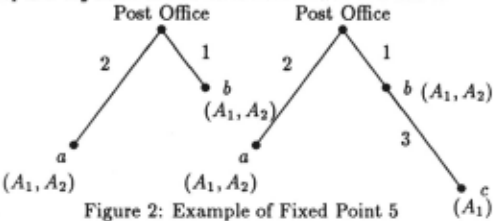
Each agent has a 0.5 chance of delivering the letters to a (Utility = 2) and a 0.5 chance of delivering the letters to b (Utility= 4). The expected utility for both is 3.
What happens when A1 creates a phantom letter, and tells A2 that he has another letter to deliver to node c? See the right side of Figure 2. The cost for A1 of delivering his letters plus the phantom letter is now 12. It would not be individual rational for A2 to visit c; A1 will thus have to visit c, and he could deliver A2 's letter to bon his way. So they will agree on a deal where A1 delivers the letters to band c (with apparent utility of 4, and actual utility of 4). Thus, A1 's utility has risen from 3 to 4 by creating this phantom letter. This lie is also a "safe" lie, since A2 cannot verify whether the phantom letter was actually delivered.
Fixed Point 6: For an example of a beneficial decoy lie in a subadditive domain (e.g., the Postmen Domain with an unrestricted graph topology) using a negotia tion mechanism over ali-or-nothing deals, consider the following example.
Example: Let the graph be as in Figure 3. Every edge between nodes has cost 1.
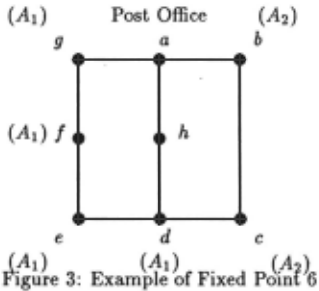
Agent A1 needs to deliver letters to nodes d, e, /, and g, with a total cost of 6. Agent A2 needs to de liver letters to nodes b and c, with a total cost of 4. If A1 tells the truth, both utilities will be 1.5 (A1 will do the whole cycle with probability ) 9 4 ). After A1 lies with producible decoy letter to node h, his apparent cost is still 6. Delivery of the entire set of letters, however, now (apparently) costs 9. They will agree on the deal that gives both agents apparent utility of .5. Agent A2 will do the entire delivery, including the decoy letter, with probability t 8 ), in fact getting utility of .5. Agent A1.
however, will simply do the cycle (i.e., without the decoy letter), with probability ~!,getting an actual utility of 1. 72. Lying is thus beneficial for A1 : telling the truth gives him a real utilitY of 1.5, while lying gives him a real utility of 1.72.
The example above is an instance of a more general case. It turns out that if an agent knows the relation ship between his and his opponent's total costs in an ali-or-nothing negotiation, it is possible for him to reli ably generate a beneficial "default" lie that is made up of decoy tasks. In a subadditive domain, like the Postmen Domain, he can generate extra decoy tasks "along the way" (i.e., that don't increase his stand-alone cost), but which improve his position in the final agreement. This can only be done by A1 when the cost of T1 is greater than the cost of T2 · The example above is an instance of this situation. The important result here is that the lie can be generated reliably without having full infor mation about the other agent's set of tasks.
Theorem 13 For any encounter in a two agent sub additive TOD, and any optimal negotiation mechanism over ali-or-nothing deals, if agent A1 knows that the cost o/T1 is greater than the cost o/T2, he can generate a de fault decoy lie that may benefit him, and will never harm him.
To demonstrate fixed points 7 and 8, we bring two examples from the Postmen Domain that have as their topology that of a star; this is a modular TOD, and represented in Figure 4. The post office is in the center of the star, and the length of the lines represent the distances from the post office. (A A )
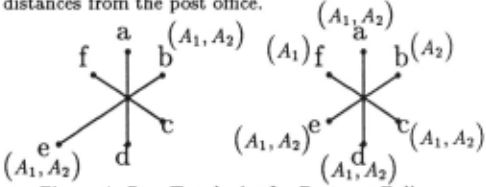
Fixed Point 7: Consider the left example in Figure 4. Both agents have to deliver letters to nodes b (at a distance of 1) and e (at a distance of 2) . Note that c(TI) = c(T2) = c(T1 U T2) = 6. If both agents tell the truth the negotiation mechanism will arbitrarily send one to node b and one to node e. If agent A1 hides his letter to node b, then the only pure deal that maximizes the product of the agents' utilities is the one that sends agent A1 to node b (!) and agent A2 to node e. Thus, agent A1 benefits from his lie.
Fixed Point 8: Consider the right example in Figure 4. Agent A1 has to deliver a set of letters that includes ones to nodes a, c, d, e, and f. Agent A2 has to deliver a set of letters that includes ones to nodes a, b, c, d, and e. Note that c(T1) = c(T2) = 10, and c(T1 U T2) = 12.
If 1 hides his letter to node a, then let Tt be his appar ent set of tasks (without node a). Note that c(Tt) = 8, and c(Ti U T2 ) = 12. They can agree on a mixed deal (X, Y):p s~~h th~t X =.{a, f},Y = { ~· c, d, e)! an.d p = 4. Utihty ul = u2 = 3. But Al s real utihty IS
10- ~4 - ~ 10 = 4.5 which is greater than 4, the utility he would have gotten if he had told the truth.
The ali-or-nothing deal is not beneficial for A1 because the agents would agree on the probability p = 1 5 2 , which would give agent A1 a real utility of 10 - 1 5 2 12- 1 5 2 2 = 3~ < 4. However, the expected payoff for the lying agent is 4~, i.e., still over 4, even when the negotiation mech anism sometimes chooses the ali-or-nothing deal, so the lying agent benefits.
6 Conclusions
We have presented a general domain theory to use in an alyzing negotiation protocols. In order to use negotiation protocols for automated agents in real-world domains, it is necessary to have a clear understanding of when dif ferent protocols are appropriate. In this paper, we have characterized Task Oriented Domains (TOD's), which cover an important set of multi-agent interactions.
We have presented several examples of TOD's, and examined three attributes that these domains can ex hibit, namely subadditivity, concavity, and modularity. We have then enumerated the relationship between deal types, domain attributes, and types of deception, focus ing on whether an agent in a TOD with a given attribute and deal type is motivated to always tell the truth. In particular, we have shown that in concave TOD's, there is no benefit to an agent's lying when ali-or-nothing deals are in use. In a general subadditive domain, however, when agents are able to generate decoy tasks, even ali or-nothing deals are not sufficient to create stability (dis courage lies). In addition, we demonstrated that in sub additive domains, there often exist beneficial decoy lies that do not require full information regarding the other agent's goals.
@inproceedings{ijcai1993p59,
  title     = {A Domain Theory for Task Oriented Negotiation},
  author    = {Zlotkin, Gilad and Rosenschein, Jeffrey S.},
  booktitle = {Proceedings of the Thirteenth International Joint Conference on
               Artificial Intelligence, {IJCAI-93}},
  publisher = {International Joint Conferences on Artificial Intelligence},
  editor    = {Ruzena Bajcsy},
  pages     = {416--421},
  year      = {1993},
  note      = {Distributed AI},
  url       = {https://ijcai.org/proceedings/1993/59},
}
TY - CPAPER TI - A Domain Theory for Task Oriented Negotiation AU - Zlotkin, Gilad AU - Rosenschein, Jeffrey S. T2 - Proceedings of the Thirteenth International Joint Conference on Artificial Intelligence, IJCAI-93 PB - International Joint Conferences on Artificial Intelligence PY - 1993 SP - 416 EP - 421 UR - https://ijcai.org/proceedings/1993/59 ER -Copied
Machine-readable versions of this paper, for tools and AI agents:





