
Enhancing Performance of Cooperating Agents in Real-Time Diagnostic Systems
Proceedings of the Thirteenth International Joint Conference on Artificial Intelligence. Distributed AI. Pages 332-336.
© 1993 International Joint Conferences on Artificial Intelligence
Abstract
We present a data-driven protocol and a supporting architecture for communication among cooperating intelligent agents in real-time diagnostic systems. The system architecture and the exchange of information among agents are based on simplicity of agents, hierarchical organization of agents, and modular non-overlapping division of the problem domain. These features combine to enable efficient diagnosis of complex system failures in real-time environments with high data volumes and moderate failure rates. Preliminary results of the realworld application of this work to the monitoring and diagnosis of complex systems are discussed in the context of NASA's interplanetary mission operations.
- [Bratman et al., 1988] M. E. Bratman, D. J. Israel, M. L. Pollack. Plans and Resource-Bounded Practical Reasoning. Computer Intelligence 4, 349-355. 1988.
- [D'Ambrosio, 1990] B. D'Ambrosio. Constrained Rational Agency. IEEE Transactions on Systems, Man, and Cybernetics. 1990.
- [Durfee et al., 1987] E. H. Durfee, V. R. Lesser, D. D. Corkill . Coherent Cooperation Among Communicating Problem Solvers. IEEE Transactions on Computers, C- 36:1275-1291, 1987
- [Durfee, 1988] Cooperation through Communication in a Distributed Problem Solving Network, in Distributed Artifi- cial Intelligence, Vol.
- [Gasser et al., 1987] L. Gasser, C. Braganza, and N. Herman. MACE: A Aexible Testbed for Distributed AI Research. Distributed Artificial Intelligence, M. N. Huhns, Ed., Pit- man/Morgan Kaufman, 1987.
- [Hayes-Roth et al., 1988] F. A. Hayes-Roth, L. Erman, S. Fouse, J. Lark and J. Davidson. ABE: A Cooperative Oper- ating System And Development Environment. AI Tools & Techniques, Ed M. Richer, Ablex. 1988.
- [Howe et al., 1990] A. E. Howe, D. M. Hart, and P.R. Cohen. Addressing Real-time Constraints in the Design of Autono- mous Agents. COINS Technical Report 90-06. University of Massachusetts at Amherst. 1990.
- [Jennings and Mamdani, 1992] N. R. Jennings and E. H. Mamdani. Using Joint Responsibility to Coordinate Collab- orative Problem Solving in Dynamic Environments . In Proceedings of the Tenth National Conference on Artificial Intelligence, San Jose, California. 269-275.
- [Lesser and Corkill, 1988] V. R. Lesser and D. D. Corkill. The Distributed Vehicle Monitoring Testbed: A Tool for In- vestigating Distributed Problem Solving Networks. AI Mag- azine 4(3): 15-33.
- [Schwuttke et al., 1992] U. M. Schwuttke, A. G. Quan, R. Angelino, C. L. Childs, J. R. Veregge, R. Yeung, and M. B. Rivera. MARVEL: A Distributed Real-time Monitoring and Analysis Application, in Innovative Applications of Artificial Intelligence 4, MIT Press, 1992.
References were extracted automatically from the PDF and may contain errors.
Full text extracted automatically from the PDF; figures, tables and equations may differ. The PDF is the version of record.
Enhancing Performance of Cooperating Agents in Real-time Diagnostic Systems
U. M. Schwuttke and A. G. Quan
Jet Propulsion Laboratory California Institute of Technology 4800 Oak Grove Drive Pasadena, CA 91109 818-354-1414
urns @puente.jpl.nasa.gov alan @puente.jpl.nasa.gov
ABSTRACT
We present a data-driven protocol and a supporting ar chitecture for communication among cooperating intel ligent agents in real-time diagnostic systems. The system architecture and the exchange of information among agents are based on simplicity of agents, hierarchical or ganization of agents, and modular non-overlapping division of the problem domain. These features combine to enable efficient diagnosis of complex system failures in real-time environments with high data volumes and moderate failure rates. Preliminary results of the real world application of this work to the monitoring and di agnosis of complex systems are discussed in the context of NASA's interplanetary mission operations.
1.0 INTRODUCTION
The interaction and coordination of multiple agents in dis tributed problem-solving systems have been of interest for a variety of domains whose complexity exceeds the practical capability of monolithic solutions. Examples of domains in which distributed systems have been explored include moni toring [Lesser and Corkill, 1988], planning [Howe et al., 1990], [Bratman et at., 1988], and diagnosis [D'Ambrosio, 1990]. These and other approaches [Durfee et al., 1987], [Gasser et al., 1987], [Hayes-Roth et at., 1988] emphasize some form of iterative exchange of partial information among nodes for the purpose of eventual convergence on complete solutions.
Recently, the need for mechanisms of cooperation that are sufficiently robust for real-world applications has been addressed [Jennings and Mamdani, 1992] as part of GRATE*, an implementation effort targeted at monitoring. GRATE* makes contributions toward a clearer and more easily implementable interaction of agents during collabora tive problem solving. GRATE* addresses a problem domain in which events occur unpredictably and decisions may be based on incomplete or imprecise data. Toward this end, the notion of joint responsibility is proposed as an alternative to the more conventional notion of agents acting in self-interest. The potential for large communication overhead is a possible disadvantage of the GRATE* system, particularly for appli cations with time critical analysis. The protocol and archi tecture described in this paper builds on the notion of joint responsibility and uses modular problem decomposition and data-driven reasoning in order to minimize communication between agents. This approach has been applied to the MAR VEL system [Schwuttke et al., 1992] for automated moni toring and diagnosis of Voyager spacecraft telemetry and has been shown to achieve robust and coherent behavior for com plex, real-time diagnostic agents embedded in a conventional (algorithmic) monitoring system.
The research described in this paper was carried out by the Jet Propulsion Laboratory, California Institute of Technology under a contract with the National Aeronautics and Space Administration. The authors wish to acknowledge support from JPL's Director's Discretionary Fund.
2.0 THE CHARACTERISTICS OF AGENTS IN MARVEL
Agents are embedded diagnosticians.
Rule-based diagnostic modules are embedded in effi cient algorithmic code. The algorithmic code performs all functions that do not explicitly require reasoning capability, so that the use of the less efficient reasoning modules is lim ited to those functions for which it is essential.
Diagnosis is data-driven.
Forward-chaining demons are used to represent domain knowledge. Reasoning is activated by the appearance of data that requires diagnosis. The initial determination that diag nosis is required is made by algorithmic monitoring code, which detects potential anomalies algorithmically and passes the anomalous data to an appropriate diagnostician. In the absence of anomalous data within its domain, an agent is idle.
The domain of individual agents is constrained.
An agent is responsible for a small, clearly partitionable domain of expertise. Partitioning is governed by the natural decomposition of the system being diagnosed. This helps overcome disadvantages associated with rule-based systems for which, typically, implementation can be intractable, exe cution is non-deterministic and relatively slow, and verifica tion can be difficult. Small, modular knowledge-bases enable developers to handle more easily definable subproblems. Smaller knowledge bases execute more efficiently, because less time is spent in search. Finally, smaller knowledge-bases are easier to verify.
The domain of individual agents is nonoverlapping.
A particular domain of expertise is assigned only to one agent to avoid redundant reasoning.
Agents carry individual responsibility for problems entirely within their domain.
Agents have sufficient knowledge to be fully account able for diagnoses within their areas and have no knowledge of other domains. This requires that accountability for locally detectable failures must be local.
Failure domains may not map directly to agent domains.
Diagnosis requires more than one agent when the symp toms manifest themselves in more than one domain.
Meta-knowledge enables agents to instigate cooperation for diagnosis beyond their domain.
Agents have meta-knowledge to identify symptoms of failures that could possibly extend beyond their domain. Meta-knowledge is contained in a set of rules in each knowledge-base, and is associated with the occurrence of events whose analysis may require the cooperation of other agents.
Agents report all problems that extend beyond their domain.
Meta-knowledge enables an agent to determine which symptoms from its domain may portend problems beyond its domain. The meta-knowledge also includes the specific agent(s) to which the information should be forwarded.
A hierarchy of agents provides coordination.
An agent forwards all known information pertaining to failures beyond its domain to another agent at the next higher level in the hierarchy. The underlying assumption on for warded messages is "better safe than sorry"; it is up to the agent receiving the information to determine whether a fault requiring a diagnostic message and an alarm has occurred or whether the anomalous data has some other explanation. This agent may also receive messages from other lower-level agents. Agents at the higher level are also implemented ac cording to the principles outlined here; thus reasoning at the higher level of the hierarchy is also data driven. The agents at the higher level are activated by messages from lower-level agents, just as the lowest level agents were activated by mes sages of symptoms detected by algorithmic code. Messages are directed with meta-knowledge to the relevant agent(s) in order to complete the final analysis of the anomalous data and provide diagnosis of any associated failures.
Agents share responsibility for diagnosis of problems that overlap domains.
Joint responsibility exists in that the lower-level agents are responsible for reporting appropriate symptoms upward in the hierarchy and the higher-level agent(s) are responsible for correctly determining whether failures have occurred and providing appropriate diagnosis. This differs from the "self interest" model of communication [Durfee, 1988] and is similar to the joint responsibility model [Jennings and Mam dani, 1992] in which agents must temper their self-interest with consideration to a group. These models have parallels in social organizations, with the first being more representa tive of an unstructured society and the second paralleling the actions of individuals who are dedicated (perhaps for reasons of self-interest) to fulfilling a successful role in a structured organization such as a corporation. In the latter case, inde pendent agents work together with appropriate (and hierar chical) division of responsibility towards fulfilling a com mon goal. Real-world applications can be sufficiently complex that only this second type of organization may en able timely, robust, and coherent behavior.
3.0 COOPERATING AGENTS IN A DISTRIBUTED ARCIDTECTURE
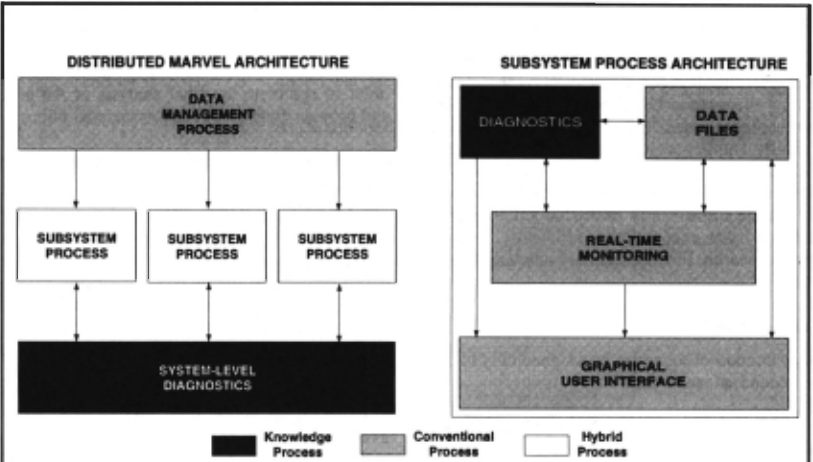
The distributed architecture shown in Figure 1 is based on a central message routing scheme that is not shown in the figure. The various agents are allocated among a configura tion of UNIX workstations. The data management module receives data from a source (in the case of our current appli cation, the data is spacecraft telemetry received from JPL's ground data system) and allocates it to the appropriate sub system monitor based on identification of data type. (Our system is partitioned according to the partitioning of the spacecraft itself, with one subsystem monitor for every spacecraft subsystem covered by MARVEL. Spacecraft sub systems include command and data, attitude and articulation control, propulsion, telecommunications, thermal, and power. Such a partitioning reflects the natural partitioning of the system being monitored, which is desirable for real-time diagnostic architectures.) Each of the subsystem monitors provides algorithmic functions such as validation of teleme try, detection of anomalies, trend analysis and automatic reporting. These functions, while not in themselves of inter est in AI or computer science research, are vital components of a real-world diagnostic system. They are implemented here in conventional C code for performance reasons. In ad dition, each subsystem process provides diagnosis of failures based on anomalous data, and recommendation of corrective actions. The latter two functions are provided by knowledge based agents that are embedded within each of the individual subsystem monitors. The remaining modules include the graphical user interface and display processes for each of the subsystem monitors, and the system-level diagnostic agent for handling failures that manifest themselves across multi ple subsystems (and therefore cannot be completely analyzed by any one subsystem alone).The interconnectivity of the distributed system is provided by a TCP/IP central router program and a set of messaging routines that are linked into the subsystem processes. All processes are connected to the central router by UNIX sockets. The basic measurement of performance for the distributed system is the speed-up S(N), defined as the sequential execution time divided by the exe cution time on N processors. The current implementation of MARVEL has six basic agents: a data management module, four subsystem modules, and a system-level diagnostician. It has not been possible to measure a unique value S(N) be cause of the heterogeneous nature of the agents. This heter ogeneity arises because the processing loads of the six agents are not identical. Our alternative to this measurement is the lowest speedup of the individual modules. With a four processor implementation, a speedup of 3.6, or 0.9N was observed. This result indicates that MARVEL is a highly efficient distributed system. Two factors contribute to these results. The first is the modularity inherent in the application (and in many other complex applications). The second factor is a distributed design that effectively minimizes the need for interprocess communication.
4.0 APPLICATION TO MONITORING AND DIAGNOSIS OF A REAL PROBLEM
In this section we provide an example of cooperation be tween multiple hierarchical agents in an actual real-time system, as shown in Figure 2. This figure depicts four knowledge-based agents (shown in black), each of which has expertise in a different domain of the engineering subsystems of the Voyager spacecraft. Two of these agents are responsi ble for diagnosing anomalies in specific spacecraft sub systems: Computer Command Subsystem (CCS), and Attitude and Articulation Control Subsystem (AACS). A third agent, the System Level knowledge agent, is at a higher level in the agent hierarchy and is responsible for diagnosing anomalies that cannot be fully analyzed in any single sub system domain. A fourth agent provides data quality infor mation to the other agents based on data from the Telecom munications Subsystem (Telecom), so that when data quality is poor, alarms resulting from the diagnostic activity of the other agents (based upon the faulty data) can be suppressed. Any diagnostic communication between agents is coordinat ed by the System Level agent. All data quality message communication is handled by the Data Quality Management Process, an algorithmic module that also communicates with the graphical user interface. There is no direct communica tion between subsystem agents. As explained in the previous section, each agent has an algorithmic telemetry monitor pro cess associated with it.
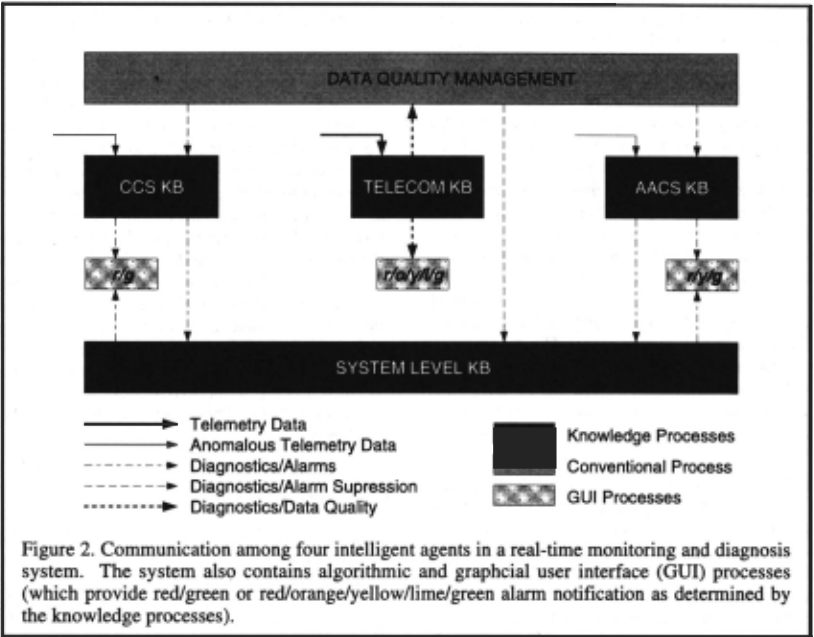
The Telecom agent differs from the other two subsystem agents in that its purpose is to determine the quality of the telemetry data being received from the spacecraft, rather than diagnose subsystem anomalies that occur on the spacecraft. The data quality level is passed to the Data Quality Manage ment process, which in turn sends this information to the various telemetry monitor processes. If the data quality is determined to be very poor, the reporting of anomalies is par tially suppressed (as explained below) since the telemetry that led to the anomaly diagnosis is probably not reliable.
Our example begins with the arrival of telemetry from the CCS subsystem which indicates an abnormally high com puter event count. The CCS event count is incremented each time an event is initiated by the spacecraft computer. One type of event is fault-protection, which attempts to automati cally correct a fault that has been detected, or protect against harmful consequences of such a fault. Thus, an abnormally high event count could indicate entry into fault protection sequences. The CCS telemetry monitor compares the telem etry event count to the predicted event count and finds that they are not equal. Since this is an anomaly, the monitor passes the event count to the CCS knowledge agent for fur ther analysis. The CCS agent finds that the telemetry event count exceeds the expected event count by 56. A difference of 56 in the event count may indicate that a ''heartbeat fail ure" has occurred on the spacecraft. The CCS "heartbeat" is a signal (called a "power code" ) sent every ten seconds from the AACS subsystem to the CCS subsystem on board the spacecraft. If the signal is received at the end of the expected time interval, the CCS spacecraft subsystem assumes that the AACS subsystem is functioning normally. If on the other hand the CCS fails to receive the heartbeat signal twice in a single hour ("heartbeat failure"), the CCS assumes that the AACS has failed in some way, and it issues a series of commands to switch to redundant back-up components in the AACS, in an effort to correct the problem.
However, a difference of 56 between the actual event count and expected event count is not enough evidence in it self to conclude that a heartbeat failure has occurred. There may have been other events not related to the heartbeat that happened to increase the event count by 56. Furthermore, there is no way to confirm the occurrence of a heartbeat fail ure from any of the CCS telemetry. The CCS agent knows that a complete diagnosis of the problem is beyond its do main and so in this case it passes on the heartbeat failure evidence to the higher level System Level agent for further analysis and possible confirmation by other agents.
Like the subsystem agents, the System Level agent is data-driven. Upon receipt of the message from the CCS agent, the System Level agent asserts a fact into its local knowledge base indicating that a possible heartbeat failure was detected by the CCS. This fact matches half of the an tecedent of a data-driven rule in the System Level KB, but this is not sufficient to fire the rule. The heartbeat failure anomaly can be confirmed by diagnostic rules in the AACS agent, but at this point no other messages have been received at the System Level, so nothing is reported to the user. The System Level returns control to the telemetry monitor process.
The next telemetry to arrive is a status word from the AACS subsystem. The AACS telemetry monitor compares the telemetry status word to the expected status word value and finds that they are not equal. It then passes the status word to the AACS knowledge agent. The agent analyzes the status word bits and determines that several AACS compo nents have been swapped off-line and their redundant back up units have been activated. Based on this pattern of events it concludes that a possible heartbeat failure has occurred. But this information by itself is not enough to be certain that a heartbeat failure has actually taken place. The AACS agent knows that a complete diagnosis of the problem is beyond its domain and will require information from one or more other agents. So it sends a message to the System Level agent no tifying it of the possible heartbeat failure.
When the System Level agent receives the heartbeat fail ure message from the AACS agent, it asserts a fact into its local knowledge base indicating that a possible heartbeat fail ure was detected by the AACS. At this point the previously asserted fact from the CCS agent combined with the new fact from the AACS agent match the complete antecedent of a data-driven rule in the System Level knowledge base, and the rule fires . The consequent of the rule causes an anomaly message to be sent to the subsystem monitors that were in volved in detecting the anomaly, for display to the user. However, before this message is displayed, the subsystem monitor checks the current data quality as determined by the Telecom agent. If the data quality is in the range of marginal to error free, the monitor displays both the anomaly message and the data quality level in the output window, and turns the output window color to red. If on the other ~and the data quality is poor, meaning excessively noisy, then the teleme try that led to the anomaly diagnosis was probably corrupted during transmission, and the resulting conclusion is probably incorrect. In the latter case the anomaly message is still out put to the user, but the alarm is not sounded and the output window color is not changed. In addition, the data quality is displayed along with the anomaly message so that the user is informed that the anomaly diagnosis was probably due to data corruption.
This example illustrates the cooperation and communi cation between four different knowledge agents in a hierar chical organization. Information from all the agents is required in order to provide a complete diagnosis of the anomaly condition. These agents illustrate the principles out lined in section 2. Each agent is a data-driven diagnostician responsible for a constrained non-overlapping domain. Each of the subsystem agents has meta-knowledge that allows it to identify symptoms that may indicate problems beyond its do main, and it reports these symptoms to a higher level agent for cooperative multi-agent analysis.
5. PRELIMINARY RESULTS
The distributed architecture described in this paper has been applied to the MARVEL system for real-time spacecraft diagnostics. It has been recently developed, as a follow-on to a uniprocessor version that could accommodate only one of the three subsystem agents on any one installation. Prelimi nary tests have demonstrated that the distributed system can process up to 1500 telemetry values per minute. Individual subsystem agents can successfully diagnose anywhere from 2 to 220 anomalies per minute, depending on the complexity of reasoning that is required. The System Level agent can process up to 300 anomalies per minute. For anomalies that require analysis from multiple agents (e.g., heartbeat failure), the maximum number of anomalies that can be processed in a given period of time is equal to the speed of the slowest agent involved in the analysis (assuming all agents execute concurrently), plus approximately 115 second for System Level inferencing. This is well within acceptable limits for real life mission operations demands.
6. CONCLUSIONS
The MARVEL distributed architecture demonstrates the suc cessful implementation of multiple cooperating agents in a complex real-time diagnostic system. We have designed an architecture that facilitates concurrent and cooperative pro cessing by multiple agents in a hierarchical organization. These agents adhere to the concepts of data-driven embedded diagnosis, constrained but complete non-overlapping do mains, meta-knowledge of global consequences of anoma lous data, hierarchical reporting of problems that extend beyond an agent's domain, and shared responsibility for problems that overlap domains.
The MARVEL architecture is simple and well suited for real-time telemetry analysis. Conventional processing is used wherever possible in order to facilitate performance. The knowledge-based agents are embedded within the algo rithmic code, and are invoked only when necessary for diagnostic reasoning. Distribution of telemetry monitoring and agent processes across workstations provides significant improvement in performance. These qualities allow for effi cient real-time diagnosis of anomalies occurring in a com plex system.
7. REFERENCES
[Bratman et al., 1988] M. E. Bratman, D. J. Israel, M. L. Pollack. Plans and Resource-Bounded Practical Reasoning. Computer Intelligence 4, 349-355. 1988.
[D'Ambrosio, 1990] B. D'Ambrosio. Constrained Rational Agency. IEEE Transactions on Systems, Man, and Cybernetics. 1990.
[Durfee et al., 1987] E. H. Durfee, V. R. Lesser, D. D. Corkill . Coherent Cooperation Among Communicating Problem Solvers. IEEE Transactions on Computers, C36:1275-1291, 1987
[Durfee, 1988] Cooperation through Communication in a Distributed Problem Solving Network, in Distributed Artifi cial Intelligence, Vol. 2. Pitman Publishing, 1988.
[Gasser et al., 1987] L. Gasser, C. Braganza, and N. Herman. MACE: A Aexible Testbed for Distributed AI Research. Distributed Artificial Intelligence, M. N. Huhns, Ed., Pit man/Morgan Kaufman, 1987.
[Hayes-Roth et al., 1988] F. A. Hayes-Roth, L. Erman, S. Fouse, J. Lark and J. Davidson. ABE: A Cooperative Oper ating System And Development Environment. AI Tools & Techniques, Ed M. Richer, Ablex. 1988.
[Howe et al., 1990] A. E. Howe, D. M. Hart, and P.R. Cohen. Addressing Real-time Constraints in the Design of Autono mous Agents. COINS Technical Report 90-06. University of Massachusetts at Amherst. 1990.
[Jennings and Mamdani, 1992] N. R. Jennings and E. H. Mamdani. Using Joint Responsibility to Coordinate Collab orative Problem Solving in Dynamic Environments . In Proceedings of the Tenth National Conference on Artificial Intelligence, San Jose, California. 269-275.
[Lesser and Corkill, 1988] V. R. Lesser and D. D. Corkill. The Distributed Vehicle Monitoring Testbed: A Tool for In vestigating Distributed Problem Solving Networks. AI Mag azine 4(3): 15-33.
[Schwuttke et al., 1992] U. M. Schwuttke, A. G. Quan, R. Angelino, C. L. Childs, J. R. Veregge, R. Yeung, and M. B. Rivera. MARVEL: A Distributed Real-time Monitoring and Analysis Application, in Innovative Applications of Artificial Intelligence 4, MIT Press, 1992.
@inproceedings{ijcai1993p47,
  title     = {Enhancing Performance of Cooperating Agents in Real-Time Diagnostic Systems},
  author    = {Schwuttke, Ursula M. and Quan, Alan G.},
  booktitle = {Proceedings of the Thirteenth International Joint Conference on
               Artificial Intelligence, {IJCAI-93}},
  publisher = {International Joint Conferences on Artificial Intelligence},
  editor    = {Ruzena Bajcsy},
  pages     = {332--336},
  year      = {1993},
  note      = {Distributed AI},
  url       = {https://ijcai.org/proceedings/1993/47},
}
TY - CPAPER TI - Enhancing Performance of Cooperating Agents in Real-Time Diagnostic Systems AU - Schwuttke, Ursula M. AU - Quan, Alan G. T2 - Proceedings of the Thirteenth International Joint Conference on Artificial Intelligence, IJCAI-93 PB - International Joint Conferences on Artificial Intelligence PY - 1993 SP - 332 EP - 336 UR - https://ijcai.org/proceedings/1993/47 ER -Copied
Machine-readable versions of this paper, for tools and AI agents:





