
Dynamic Memories: Analysis of an Integrated Comprehension and Episodic Memory Retrieval Model
Proceedings of the Thirteenth International Joint Conference on Artificial Intelligence. Cognitive Modeling. Pages 208-215.
© 1993 International Joint Conferences on Artificial Intelligence
Abstract
Most AI simulations have modeled memory retrieval separately from comprehension, even though both activities seem to use many of the same processes. We have developed REMIND, a model that performs both episodic memory retrieval and language understanding with a single spreading-activation mechanism. This approach has a number of advantages over retrieval-only models. First, because the comprehension process makes inferences about actors' plans and goals, REMIND is able to get abstract remindings that would not be possible without an integrated model. It also allows a more psychologically-plausible model of reminding than previous approaches, since all aspects of a text's interpretation affect what is retrieved through the spreading-activation process, as in human reminding. An inferencing-based retrieval model such as REMIND also has several computational advantages over pure retrieval models. The effects of the understanding process eliminate the need for the separate, purely structural comparisons used in most analogical retrieval models. Further, it potentially explains how the explicit indexing of case-based reasoning models can be eliminated, while retaining its benefits as an emergent property of the comprehension process.
- Gentner, D., & Forbus, K. (1991). MAC/FAC: A model of similari- ty-based retrieval. Proceedings of 13th Conf. of Cognitive Science.
- Hammond, K. (1989). Case-Based Planning. Academic Press.
- Lange, T., and Dyer, M. (1989). High-level inferencing in a connec- tionist network. Connection Science, 1:181-217.
- Lange, T., & Wharton, C. (in press). REMIND: Retrieval from epi- sodic memory by inferencing and disambiguation. In Bamden and Holyoak (eds.), Advances in Connectionist and Neural Computa- tion Theory, Vol. 2: Analogical Connections. Norwood, NJ: Ablex.
- Owens, C. (1989). Integrating feature extraction and memory search. Proceedings of the 11th Conf. of Cognitive Science Society.
- Riesbeck, C. and Martin, C. (1986). Direct memory access parsing.
- In J. Kolodner and C. Riesbeck (eds). Experience, Memory, and Reasoning, 209-226.
- Riesbeck, C., & Schank, R. (1989). Inside Case-Based Reasoning. Hillsdale, NJ: Lawrence Erlbaum.
- Schank, R. (1982). Dynamic Memory. New York: Cambridge Press.
- Seifert, C., McKoon, G., Abelson, R. & Ratcliff, R. (1986). Memory connections between thematically similar episodes. Journal of Exp. Psychology: Human Learning and Memory, 12, 220-231.
- Thagard, P., Holyoak, K., Nelson, G., & Gochfeld, D. (1990). Ana- log retrieval by constraint satisfaction. Artificial Intelligence 46:259-310.
- Wharton, C., Holyoak, K, Downing, P., Lange, T., Wickens, T. & Melz, E. (in press). Below the surface: Analogical similarity and retrieval competition in reminding. Cognitive Psychology
References were extracted automatically from the PDF and may contain errors.
Full text extracted automatically from the PDF; figures, tables and equations may differ. The PDF is the version of record.
1 Introduction
The most parsimonious account of comprehension and re minding is that they "amount to different views of the same mechanism" [Schank, 1982]. However, most AI models that perform memory retrieval do so in isolation from the lan guage under~tanding process. Different retrieval models ap proach varymg aspects of the retrieval problem and have different goals, but nearly all are given fully hand-coded rep resentations of the memory episodes (or cases) they use.
Most psychological models of memory retrieval simulate empirical results showing that reminding is based on both surface feature similarities (e.g., shared words) and analogi cal similarities (e.g., shared inferences and themes) [Wharton et al., in press]. Systems such as ARCS [Thagard et al., 1990] and MAC/FAC [Gentner & Forbus, 1991] model this with two-stage retrieval processes that first search for all episodes ~baring surface features with the cue. They then select the ep Isode that shares the most surface and analogical similarities by mechanisms that explicitly calculate structural isomor phism (or analogical similarity) between the cue and targets.
Charles M. Wharton
Department of Psychology University of California, Los Angeles Los Angeles, CA 90024
Case-based reasoning (CBR) models (cf. [Riesbeck & ~chank, 1989; Owens, 1989]) recognize pragmatically-useful mdex patterns that allow retrieval of episodes (or cases) like ly to aid their current task. CBR models generally simulate reasoning of experts within a given domain, rather than gen eral human reminding. As in general reminding models, most CBR models use hand-coded cases and operate separately from the comprehension process, though a few do some rule based reasoning to make explanations (cf. [Hammond, 1989]). Most CBR models instead focus on deciding which particular abstract indices (or features) are most useful for re trieval of useful cases in different problem-solving tasks.
Although separating memory retrieval from the language understanding process makes accounts of the phenomena more manageable, it is undeniable that real-world retrieval re sults from comprehension processes. We have developed RE MIND (Retrieval from Episodic Memory through INferencing and Disambiguation) [Lange & Wharton, in press], a model that integrates language understandino and memory retrieval in a single structured spreading-acth~ation mechanism. This approach has several computational advan tag~s over retri~val-only models and provides a more psycho logtcally-plaustble model of reminding. This paper shows several simulations that illustrate some of these advantaoes, contrasting it with retrieval-only and CBR approaches. .,
2 Overview of REMIND
REMIND is initially given a syntactic representation of a short text as a cue. Using general knowledge stored in its long-term memory, REMIND constructs an elaborated inter pretation of the cue and retrieves the episode that is most sim ilar to the surface and inferred features of that representation.
REMIND's structured spreading-activation networks en code world knowledge about concepts and general knowl edge rules for inferencing in the same way as ROBIN [Lange & Dyer: 1989], ~ struct~red connectionist model that per forms htgh-level mferencmg and disambiguation for natural language understanding. Structured connectionist models seem to be particularly well-suited to language understanding because their constraint satisfaction abilities are ideal for in tegrating contextual evidence to perform disambiguation and primi~g, while their network structure allows for the repre sentatiOn of complex knowledge and parallel inferencing.
~EMIND' s networks also contain representations of prior eptsodes, such as Fred put his car in the car wash before his date with Wilma (Car Wash) and Billy put his Playboy under the bed so his mother wouldn't see it and spank him (Dirty Magazine). The representations used are the actual plan/goal analysis (or interpretation) that was inferred by REMIND when input for them was ftrst presented to the network. These prior episodes are indexed into the semantic comprehension network through connections with all the knowledge struc tures with which they were understood. To perform retrieval, REMIND is given a short text passage to understand and use as a cue. This understanding process often requires disambig uation and for a number of inferences to be made. Consider:
John put the pot inside the dishwasher because the police were coming. (Hiding Pot).
Although it initially appears that John is cleaning a cooking pot, this sentence is disambiguated and interpreted to mean John was hiding marijuana from the police to avoid being ar rested. To understand such cues, units in the network repre senting the cue and its syntactic bindings are clamped to high levels of activation. Activation is then spread through the net work. By propagating signature activation patterns [Lange & Dyer, 1989], the network makes the different possible infer ences explaining the input in a manner similar to marker passing systems (cf. [Riesbeck & Martin, 1986]). For exam ple, one of the multiple interpretation paths that gets inferred (and activated) as a possible explanation for Hiding Pot is the interpretation that John was trying to hide the pot from the po lice to satisfy his goal of avoiding arrest. Other interpretations concurrently activated include the possibilities that he was trying to clean the pot or store it. Activation spreads until the network settles.The units with the most activation represent the most plausible set of inferences and the network's disam biguated plan/goal interpretation of the cue.
Because units representing long-term memory episodes are connected within the network, episodes having concepts re lated to the elaborated cue also become highly activated. This includes episodes only superficially-related to the cue be cause of surface feature overlap (e.g., episodes involving po lice or illegal drugs) and episodes related abstractly because they share similar inferred plans and goals (e.g. episodes sharing the inferences that a person was trying to Avoid-De tection of something to avoid a Punishment). After the net work settles, the episode receiving the most activation from the cue's interpretation becomes the most highly activated, and is retrieved as the best match for the cue.
Thus, in REMIND, a single mechanism drives both lan guage understanding and memory retrieval processes. The same spreading-activation mechanism that infers a single co herent interpretation of a cue also activates episodes retrieved from memory. Episodic activation results from both the sur face semantics of the input (i.e., different possible word and phrase meanings) and the deeper thematic inferences made from the input. Accordingly, recalled episodes depend on both surface and analogical similarities with the cue. Because both inferencing and memory retrieval occur within a single integrated network, the context in which interpretations are formed affects the episodes that are retrieved, which in tum influences the context in which disambiguation and interpre tation of input takes place. Thus, text comprehension and memory retrieval processes are tightly coupled.
3 Cue Understanding in REMIND
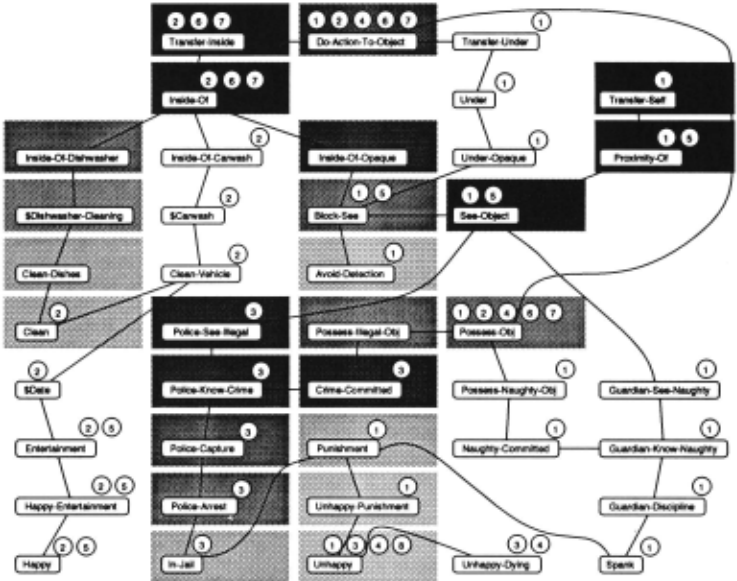
As with ROBIN, REMIND uses structured networks of sim ple connectionist units to encode semantic networks of frames and rules representing world knowledge, such as the scripts, plans, and goals [Schank, 1982] necessary for under standing stories in a limited domain. Figure 1 shows a partial overview of a REMIND network and the knowledge given to it (by hand, as in most structured models). However, it is giv en no specific information about episodes it will understand.
Knowledge given to REMIND is used to construct the ac tual structure of the network before any processing begins. As with other structured connectionist models, nodes in the net work represent particular frames or roles. Relations between concepts are represented by weighted connections between nodes. Activation on concept nodes is evidential, correspond ing to the amount of evidence available in the current context. The network also has additional structure to solve connec tionist networks' variable binding problem by propagating signature activation patterns representing bound concepts [Lange & Dyer, 1989]. The network makes inferences in par allel by propagating signature bindings (such as of John, Marijuana, and Cooking-Pot) over connections between binding units that represent general knowledge rules.
As an example, consider how Hiding Pot is understood by the network. To represent John put the pot inside the dish washer, Transfer-Inside is clamped to a high level of evi dential activation (black box in Figure 1). The binding units of its roles (not shown) are clamped to the signature activa tions of its bindings (John for its Actor, Cooking-Pot or Marijuana for its Object, and Dishwasher for its Location). These signature bindings then propagate, as activation, over connections to the corresponding roles of neighboring frames. This propagation allows the network to infer that the pot is Inside-Of the dishwasher and that it was done either because it was going to be cleaned (Inside-Of-Dishwasher and following frames) or because it would be blocked from sight (Inside-Of-Opaque and following frames).
As signatures propagate to perform inferencing, evidential activation spreads and accumulates along conceptual nodes to disambiguate between competing inferences. Initially the Inside-Of-Dishwasher path receives the most activation be cause of feedback between its strong stereotypical connec tions to Cooking-Pot and Dishwasher. However, activation feedback between Inside-Of-Opaque and inferences from the police corning (Transfer-Self ... Biock-See) and the Po lice-Capture frames causes Inside-Of-Opaque to end up with more activation than Inside-Of-Dishwasher and Mari juana with more activation than Cooking-Pot.
The network's final interpretation of Hiding Pot includes the most highly-activated path of frames in Figure 1 and their network signature bindings. This interpretation includes the inferences that (a) Marijuana is inside of an opaque dish washer (Inside-Of-Opaque) and is blocked from sight (Block-See), (b) John possesses illegal marijuana (Pos sess-lllegai-Obj), and (c) John is in danger of being arrested by the police (Police-Arrest). Note that alternative interpre tation paths retain activation for possible reinterpretation, since REMIND uses inhibition that normalizes activations rather than driving losers to zero. See Lange & Dyer [1989] for further details on how the network performs such infer encing and disambiguation for Hiding Pot and other inputs.
R t · 1 spank him) is processed and encoded as a memory episode. 4 Memory e r1eva . · d d · tat. · . . . First, input for Its phrases ts clampe an an mterpre 10n ~~- In REMIND, memory retnevalts a stde-effect of _the spreadferred. As in Hiding Pot, the network infers that somebody IS ing-activation unders~ding process. Represen~attons of pre- hiding something (Avoid-Detection) and th~t it is bl~cked viously-understood episodes are connecte~ ?·rectly to the from sight (Block-See). Here, however, the mferred signasemantic network that understood them o~gmally. Kn_owl-tures show that it is Billy hiding a Playboy-Magazine rather edge structures activated when u~derstandmg a cue _activa~ than John hiding Marijuana. Several other knowledge strucsimilar episodes that were stored m t~e network earher. Thts tures involved in Hiding Pot (e.g. Proximity-Of, Possessdirect form ?f ~'in?~xin( causes eptsodes that s~are m~y Obj, Punishment) are also activated by Dirty Magazine. conceptual stmtlartties wtth the cue to become active dunng However there are a number of differences, e.g. frames of the interpretation. The most active episode is retrieved. �uardia~-Discipline structure are part of Dirty Magazine's interpretation, but the Police-Capture fram~s are not..
4.1 Network Encoding of Episodes
Whereas REMIND uses hand-coded general world knowl edge, it is not given any information about the particular epi sodes it processes and stores in long-term memory. Target episode representations are created entirely by REMIND's spreading-activation understanding pr<?Ces_s. Input ~or each episode is presented to the network, wht~h m~ers ~ mt~rpre tation by the spread of signature and evtdenttal activation as described before. Next, units and connections are added to store the episode's entire resulting interpretation in the net work. Thus, each episode's representation includes all as pects of its interpretation, from its disambiguated surface features (such as the actors and objects in the story) to the plans and goals the network inferred the actors were using.
For example, consider how Dirty Magazine (Billy put the Playboy under his bed so his mother wouldn't see it and Once an interpretation is formed of an eptsode, umts and connections are added to the network (by hand) to represent all of its instantiated frames and elements. [Lange & Whar ton, in press] describes the actual units and conn~ctions added to do this; the important part is that the added umts represent ing each instantiated frame (such as a particular instance of Avoid-Detection where Billy was hiding a Playboy-Maga zine) are added locally to its semantic network frame and that their connections encode their bindings. The new instance units are also all connected to an episode unit that groups all of the episode's elements. An overview of the final result is shown in Figure 1, with the nodes having a circled "1" above them representing the frames inferred and encoded as part of Dirty Magazine's representation. Other circled numbers rep resent elements of other stored episodes' interpretations.
4.2 The Retrieval Process
With episodes understood and stored in the network, retrieval is performed simply by presenting an input cue to the network to be understood. Because instance units representing epi sodes are connected directly to the normal semantic units, they become activated by the inferencing spread of activa tion. The more similarities an episode shares with the inferred interpretation of a cue, the more of its instances become ac tive and the more activation its episode unit receives.
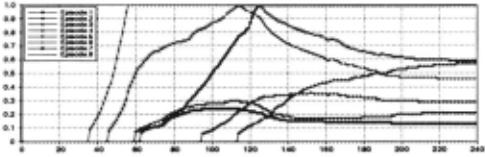
Figure 2 shows activations of the eight episodes from Fig ure 1 during understanding of Hiding Pot. Episode.6 (Bar ney put the flower in the pot, and then watered it) initially becomes highly active because it shares a number of surface features -e.g. both involve a Transfer-Inside, and Plant ing-Pot gets activation from pot. Similarly, Episode.2 and episodes having varying degrees of shared features become active. However, as time goes on, the hiding and punishment frames are inferred and become active. Episode.1 (Dirty Magazine)'s activation thus climbs and eventually wins, be cause it shares the most surface and abstract features of any episode with Hiding Pot's interpretation (see Figure 1). It is therefore retrieved as the episode most similar to Hiding Pot.
5 Experiments
REMIND has been tested with a knowledge base having 206 conceptual frames and 333 inference rules. It has understood and retrieved the examples here and a number of other epi sodes of similar complexity. Here we briefly describe three additional simulations that illustrate (I) the importance of in ferences and disambiguation on retrieval, (2) the strong influ ence of superficial feature similarities on retrieval, and (3) the effect of episodic recall on the understanding process.
5.1 Importance of Inferencing
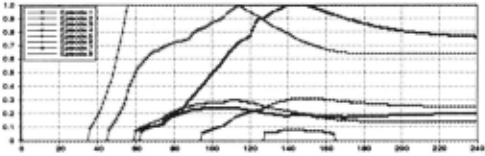
An example of how strongly the inferencing and disambigu ation of the model affects retrieval is shown in Figure 3, which shows activations after presentation of input for John put the pot inside the dishwasher because company was com ing (Dinner Party). Note that although this cue differs from Hiding Pot by only a single word (company instead of po lice), the interpretation REMIND reaches is completely dif ferent (i.e. that he was cleaning a cooking pot to prepare for a dinner party). This causes a different episode to be recalled, Episode.2 (Car Wash), which shares the goals of cleaning something to prepare for an entertainment event.
5.2 Superficial Similarities
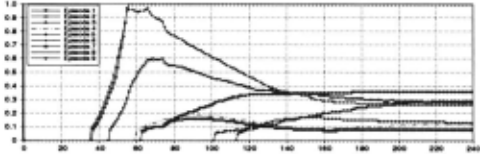
As in human reminding, REMIND often retrieves superficial ly similar episodes to a cue even when a better analogy exists. As an example, Figure 4, shows the episode activations after Hiding Pot is presented to a network having the eight epi sodes of Figure 1 and an additional superficially similar epi sode, Cheech put the grass inside the bong because Chong was coming (Episode.9). Notice that the activation of this new episode quickly dominates the others because of the sur face features it shares with Hiding Pot. This superficially similar, but thematically dissimilar episode is therefore re trieved even though Dirty Magazine is a better analogy.
5.3 Effect of Reminding on Interpretation
REMIND's integration of the reminding and understanding processes has pragmatically interesting and useful effects on the understanding process. Episodes that become active while inferencing feed activation back into the comprehension part of the network. This can prime and bias the interpretation RE MIND settles on for a given input. Consider:
The star loved the plumber, but he was shot by a thief Then the astronomer proposed to her. She started to cry. (Astronomer Proposal).
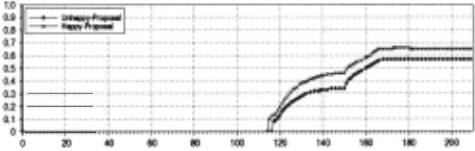
Two possible reasons for the movie star starting to cry are that the proposal either made her extremely happy (Happy Proposal) or extremely sad (Unhappy-Proposal). Perhaps the most likely reason for her crying was that the proposal re minded her of murdered lover, therefore making her sad. RE MIND, however, does not have the complex knowledge about memories and how they affect people's emotions that would be necessary to make that interpretation. As shown in Figure 5, REMIND therefore ends up interpreting the star's crying in Astronomer Proposal as a Happy-Proposal, be cause of its weights' strong biases that marriages are happy. As Astronomer Proposal illustrates, REMIND often arrives at counter-intuitive interpretations of stories when the biases of its connection weights are too strong or when it does not have enough knowledge to make the needed inferences for the right interpretation. However, when there is a highly analogous episode (or case) in memory, the influence of epi sodic retrieval upon text understanding can lead REMIND to a correct interpretation of its input. For example, consider:
Suzie loved George, but he died. Then Bill proposed to her. She became sad. (Sad Proposal)
Sad Proposal is similar to Astronomer Proposal, but ex plicitly states that Suzie became Unhappy after the proposal.
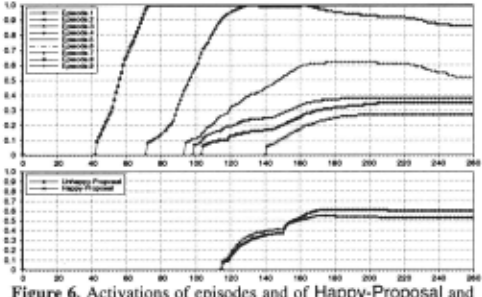
This leads the network to make the correct interpretation, that the Marriage-Proposal after the death of her lover was an Unhappy-Proposal. This interpretation, including the infe~ ence Unhappy-ProposaLS, is stored in memory as Ep1sode.8 in Figure I. Figure 6 shows the activations of Sad Proposal (Episode.S) and the other episodes as Astrono mer Proposal is then understood by REMIND. As expected, Sad Proposal quickly dominates the other episodes because it is so similar to Astronomer Proposal. Episode.3 be comes temporarily active because it also involves a shooting. However, Sad Proposal eventually wins and is retrieved.
The most interesting result in Figure 6 is the activation lev els of the competing Happy-Proposal and Unhappy-Pro posal frames. As when Astronomer Proposal was presented to the network without any episodes in memory, Happy-Pro posal initially has more activation than Unhappy-Proposal. In this case, however, Episode.S is highly active, and with it Unhappy-ProposaLS. Since active episode instances feed activation back into their concepts in the understanding net work, Unhappy-Proposal gets significant activation from Unhappy-ProposaLS. This added evidence allows its acti vation to climb over Happy-Proposal, which gets no added evidence from memory episodes. Unhappy-Proposal there fore ends up with more activation than Happy-Proposal, so REMIND's interpretation is that the proposal made the movie star unhappy. The network therefore selects the correct inter pretation of Astronomer Proposal because of activation feedback from an analogous case in memory, Sad Proposal.
REMIND's use of one spreading-activation mechanism for both comprehension and memory retrieval shows how recall can subtly affect interpretation. When stored episodes are similar to a cue that REMIND is interpreting, they feed acti vation back into the inferencing network. This feedback can bias REMIND's interpretation to be consistent with the active episodes, a limited form of case-based reasoning.
6 Comparison to General Reminding Models
REMIND is most directly comparable to ARCS [Thagard et at., 1990] andMAC/FAC [Gentner& Forbus, 1991], two oth er models of general, non-expert reminding. All three take into account psychological evidence showing that memory retrieval is strongly influenced by both surface and thematic similarities between a cue and episodes in memory. In con trast to REMIND, ARCS and MAC/FAC do not model the language understanding process, concentrating solely on re trieval of hand-coded targets. This allows them to retrieve more complicated episodes than REMIND can currently un derstand. On the other hand, REMIND's inferencing-based theory of retrieval has two significant advantages over re trieval-only models: (1) it shows how understanding andre minding can be modelled with a single spreading-activation mechanism, and (2) that this integration eliminates the need for the separate structural comparison mechanisms used to by ARCS and MAC/FACto allow analogical retrieval .
A major criticism of ARCS and MAC/FAC is that neither model specifies how the representation of its input cues and episodes is formed or what kinds of knowledge those repre sentations should generally include. Should the cue represen tations include only the surface propositions directly stated in a cue's text? Or should they include a fully elaborated inter pretation of the cue, including a complete causal plan/goal analysis of the text and any abstract themes it involves, as in REMIND? Memory retrieval often cannot be performed without such inferences, as illustrated by examples in this pa per and in CBR models. However, even if retrieval-only mod els such as ARCS and MAC/FAC were given fully elaborated cues, we believe that not modeling the process by which these representations are formed misses important features of re minding. Understanding of text varies depending on whether it is simply being skimmed or is being read carefully for its deeper ramifications. Thus, when the comprehension process is not modeled, there is no way to simulate the specific cir cumstances under which understanders infer and can use planning or thematic information in probing memory (cf. [Se ifert et at., 1986]). In contrast, REMIND explicitly models the cue interpretation process, and so can potentially explain when elaborated inferences are available to affect reminding.
REMIND is fundamentally different from ARCS and MAC/FAC in how it models the influence of analogical sim ilarity on retrieval. Both ARCS and MAC/FAC model ana logical reminding by explicitly factoring in the degree of structural isomorphism (or relational consistency) between the cue and targets into their best match computation. Isomor phism can best be explained by an example from [Thagard et at., 1990] for the cue The dog bit the boy and the boy ran away from the dog (Boy Run). Compare this to the analogs Fido bit John and John ran away from Fido (John Run) and Rover bit Fred and Rover ran away from Fred (Rover Run). John Run is structurally isomorphic with Boy Run, because mapped objects play the same roles in mapped predicates. In both cases, the dog did the biting and the person it bit did the running. In Rover Run, however, it was the dog that ran from the person it bit. John Run is more isomorphic to Boy Run than is Rover Run, and is therefore a better analog.
Analogical similarity is hypothesized by ARCS and MAC/ FACto exert its effect on memory retrieval as a direct result of a specifically computed degree of syntactic isomorphism between cues and memory episodes. REMIND, in contrast, never explicitly computes the degree of isomorphism. In stead, relationally consistent targets are retrieved over rela tionally inconsistent targets only indirectly, when the different syntactic structure of each input leads to different in ferences . For example, if presented with John Run, RE MIND would infer that the boy ran away because he was afraid that dog would continue its attack. However, if present ed with Rover Run, REMIND would infer that the dog ran away because it feared retaliation from the boy. Because of these different interpretations of the two episodes, REMIND would also retrieve John Run when presented with Boy Run as a cue. Unlike ARCS and MAC/FAC, however, REMIND does so without having to go through a separate stage to ex plicitly compute the degree of syntactic isomorphism.
We believe that the effects of syntactic isomorphism and relational consistency on memory retrieval can be fully ex plained by the understanding process. Relationally consistent episodes tend to have more similar inferences, interpreta tions, and themes than relationally inconsistent episodes. In REMIND, explicit measures of syntactic isomorphism are unnecessary, since analogical reminding occurs as a natural side-effect of interpreting and disambiguating an input text.
7 CBR Models and Indexing
Most case-based reasoning models are meant to be models of expert reminding and problem-solving in given domains. Un like REMINb, they are not meant to be models of general, non-expert human reminding. An advantage of case-based reasoning models over REMIND is that their use of symbolic processing abilities allows them to handle longer and more complex episodes than REMIND (and connectionist models in general) can currently handle. On the other hand, as a mod el of comprehension and general reminding, REMIND is bet ter able to explain psychological results such as the relatively high prevalence of remindings based on superficial similari ties and on how the reminding and language understanding processes interact and effect each other.
There are many similarities between retrieval of episodes in CBR models and in REMIND. One of the major goals of CBR researchers is to find the indices that will enable retriev al of the cases most likely to help their current task (the index ing problem). Pragmatically useful indices usually include features such as abstract plans, goals, themes, explanations, and anomalous situations, depending upon the problem being solved. Although REMIND does not currently recognize all these types of indices, all are features that an ideal model would have to recognize and that would therefore be used for comprehension and retrieval in future versions of REMIND.
One of the advantages of REMIND's approach to storing episodes is that it avoids CBR models' indexing problem. Be cause episodes are simply stored (indexed) under all of the features that played a part in understanding them, there is no need for a separate computation stage to determine precisely which features they should be indexed under for best retriev al. The network's massively-parallel comprehension process eliminates the need to limit the number of indices used in or der to constrain search time. Further, this approach has the advantage of allowing episodes to be retrieved in contexts and situations other than those the problem-solver (or index evaluator) originally considered useful.
Many of the desirable features of CBR indexing methods emerge from the dynamics of the spreading-activation pro cess and how episodes are learned over time. For example, one important feature of a useful index is how unique it is. Al though REMIND indexes its episodes under all of their fea tures, relatively unique features affect retrieval more than common ones simply because they activate fewer episodes (compare Possess-Obj to the more abstract Avoid-Detec tion and Punishment frames in Figure I). Another important aspect of the spreading-activation process is that particularly salient features receive the most activation and therefore au tomatically act as stronger retrieval indices. While it does not currently approach the problem-solving of many CBR mod els, an extension of REMIND that did so would also focus ac tivation on the types of problems and failures being examined, therefore naturally emphasizing useful indices. Such a model might show how the benefits of explicit index ing in CBR models can fall out of the comprehension process.
8 Conclusions
REMIND's use of a single spreading-activation mechanism to perform both comprehension and retrieval ensures that the features inferred from a cue during understanding will access episodes in memory that share similar inferences. This inte gration of comprehension and retrieval is a more psycholog ically-plausible way of producing analogical reminding than previous models. It also has several computational advantag es. Because the inferencing process activates abstract plans and themes, the explicit structural isomorphism computations needed to allow retrieval of analogies in retrieval-only mod els such ARCS and MAC/FAC are unnecessary. REMIND's massively-parallel approach to comprehension and encoding also potentially explains how the explicit indexing of CBR models can be eliminated, while retaining its benefits as an emergent property of the comprehension process
@inproceedings{ijcai1993p30,
  title     = {Dynamic Memories: Analysis of an Integrated Comprehension and Episodic Memory Retrieval Model},
  author    = {Lange, Trent E. and Wharton, Charles M.},
  booktitle = {Proceedings of the Thirteenth International Joint Conference on
               Artificial Intelligence, {IJCAI-93}},
  publisher = {International Joint Conferences on Artificial Intelligence},
  editor    = {Ruzena Bajcsy},
  pages     = {208--215},
  year      = {1993},
  note      = {Cognitive Modeling},
  url       = {https://ijcai.org/proceedings/1993/30},
}
TY - CPAPER TI - Dynamic Memories: Analysis of an Integrated Comprehension and Episodic Memory Retrieval Model AU - Lange, Trent E. AU - Wharton, Charles M. T2 - Proceedings of the Thirteenth International Joint Conference on Artificial Intelligence, IJCAI-93 PB - International Joint Conferences on Artificial Intelligence PY - 1993 SP - 208 EP - 215 UR - https://ijcai.org/proceedings/1993/30 ER -Copied
Machine-readable versions of this paper, for tools and AI agents:





