
Using the Affective Reasoner to Support Social Simulations
Proceedings of the Thirteenth International Joint Conference on Artificial Intelligence. Cognitive Modeling. Pages 194-200.
© 1993 International Joint Conferences on Artificial Intelligence
Abstract
This paper is in two parts. In the first part, the outline of an emotion reasoning architecture, embodied in a simulation program called the Affective Reasoner, is presented, and a rudimentary personality representation for simulated agents is introduced. In the second part, an exercise is reviewed in which the Affective Reasoner is given the task of representing agents with different personality types in such a way as to allow the user to engage in a simulated interaction with them . Representational issues pertaining to the unique appraisal and behavioral styles of the different personality types are addressed. Conclusions are drawn about the usefulness of the Affective Reasoner in such a paradigm.
- [Bareiss, 1989] Ray Bareiss. Exemplar-Ba.Jed Knowledge Ac- qui.Jition, A Unified Approach to Concept Repre.Jentation, Clauification, and Learning. Academic Press, Inc., 1989. 200 Cognitive Modeling [Bates et al., 1992]
- Joseph Bates, A. Bryan Loyall, and W . Scott Reilly. Integrating reactivity, goals, and emotion in a broad agent. In Proceeding., of the Fourteenth Annual Conference of the Cognitive Science Society, Bloomington, IN, August 1992. Cognitive Science Society.
- [Clore, 1992] Gerald Clore. Cognitive phenomenology: Feel- ings and the construction of judgment. In L. L. Martin and A. Tesser, editors, The Con.Jtruction of Social Judgment.J. Lawrence Erlbaum Associates, 1992. To appear.
- [Collins, 1992] Allan Collins, April 1992. Personal commu- nication.
- [Digman, 1990] John Digman. Personality structure: Emer- gence of the five-factor model. Annual Review of P.Jychol- ogy, 41:417-440, 1990.
- [Elliott and Ortony, 1992] Clark Elliott and Andrew Ortony. Point of view: Reasoning about the concerns of others. In Proceeding., of the Fourteenth Annual Conference of the Cognitive Science Society, Bloomington, IN, August 1992. Cognitive Science Society.
- [Elliott and Siegle, 1993] Clark Elliott and Greg Siegle. Vari- ables affecting the intensity of simulated affective states. In Note.J for the AAAI Spring Sympo.Jium on Rea.Joning about Mental State.J: Formal Theorie.J and Applicatioru. Ameri- can Association for Artificial Intelligence, 1993. Palo Alto, CA. To appear as AAAI technical report.
- [Elliott, 1992] Clark Elliott. The Affective Rea.Joner: A Pro- ceu Model of Emotion.J in a Multi-agent Sy.Jtem. PhD thesis, Northwestern University, May 1992 . The Institute for the Learning Sciences, Technical Report No. 32. [Frijda and Swagerman, 1987] Nico Frijda and Jaap Swager- man. Can computers feel? theory and design of an emo- tional system. Cognition and Emotion, 1(3):235-257, 1987.
- [Frijda et al., 1992] Nico H. Frijda, Andrew Ortony, Joep Sonnemans, and Gerald L. Clore. The complexity of inten- sity: Issues concerning the structure of emotion intensity. In M . Clark, editor, Emotion: Review of Per.Jonality and Social P.Jychology, volume 13. Sage, Newbury Park, CA, 1992.
- [Gilboa and Ortony, 1991] Eva Gilboa and Andrew Ortony. The structure of emotion response tendencies. Work in progress, 1991.
- Gilboa et al.,] Eva Gilboa, Andrew Ortony, and William Revelle. Personality and the structure of emotional re- sponses. In S. Van Goozen, N. E. Van de Poll, and J. A. Sargent, editors, Emotion.J: Euay.J on Emotion Theory. Lawrence Erlbaum Associates. in press.
- [Kass et al., 1992] Alex Kass, Robin Burke, Eli Blevis, and Mary Williamson. The GuSS project: Integrating instruc- tion and practice through guided social simulation. Tech- nical Report 34, The Institute for the Learning Sciences, Northwestern University, May 1992.
- [O'Rorke and Ortony, 1992] Paul O'Rorke and Andrew Ortony. Explaining emotions. Submitted for publication, 1992.
- [Ortony et al., 1988] Andrew Ortony, Gerald L. Clore , and Allan Collins. The Cognitive Structure of Emotions. Cam- bridge University Press, 1988.
References were extracted automatically from the PDF and may contain errors.
Full text extracted automatically from the PDF; figures, tables and equations may differ. The PDF is the version of record.
1 Introduction
A central assumption of this paper is that simulations of social interactions between agents should incorporate models of individual affect and personality. Most human interaction revolves around people's individual needs and goals. These lead to idiosyncratic, internally motivated behavior, and to emotional responses to situations that arise. If these aspects of mental life are not captured in simulations of interpersonal interactions, then simu lated agents will be at best bland, lifeless, and unrealis tic. This problem has been largely ignored in AI. 1
This paper describes a general emotion reasoning ar chitecture, embodied in a program called the Affective Reasoner, which has been used as a basis for simulating such interpersonal interactions. Also discussed are the results of using this architecture to solve the problem of representing four distinct client types in an interactive simulation designed to teach selling.
*Preparation of this article was supported in part by An dersen Consulting through Northwestern University's Insti tute for the Learning Sciences.
1 But see [Bates et al., 1992) and [Frijda and Swagerman, 1987) for interesting approaches to related problems.
2 The Affective Reasoner
The Affective Reasoner (hereafter AR} is a simula tion platform that embraces a wide range of emotion reasoning issues. In the current research, various worlds are simulated, and populated with agents capable of par ticipating in emotional episodes based on their concerns. Agents are given unique dispositions modeled as a hi erarchical set of appraisal frames. These frames repre sent their individual goals, principles, preferences, and moods. Combinations of the appraisal frames are used to interpret situations that unfold in the simulation. The interpretations, in turn, are characterized in terms of the way they may or may not meet the eliciting conditions for emotions. In some cases emotions result, which then may be expressed, through a set of selectively activated behavioral channels, in ways that are observable by other agents, and as new simulation events which might per turb future situations. Additionally, agents use a case based heuristic classification system to reason about the emotions of other agents, and to build representations of those other agents' personalities that will help them to predict and explain future emotion episodes involving those observed agents.
2.1 The emotion eliciting condition theory
Embodied in the AR is a set of rules for mapping from emotion eliciting conditions into emotion types, based on the work of Ortony, Clore, and Collins [Ortony et al., 1988]. Their theory has been adapted for the simula tion and extended from twenty-two to twenty-four cat egories of valenced reactions to situations, as outlined in figure 1. Each of the twenty-four emotion types has a set of eliciting conditions. When the eliciting condi tions are met, and various thresholds have been crossed, corresponding emotions result. A key element ofthe the ory is that the way an emotion-eliciting situation maps into eliciting conditions depends on how an individual agent interprets that situation. For example, suppose that a captain heroically /foolishly goes down with his ship, while trying to salvage it. On the one hand, his fellow seamen might see this as praiseworthy, since he has upheld the principle of dedication to maritime ser vice. On the other hand his wife might perceive it as blameworthy, since she sees him as having violated the principle of putting the needs of his family foremost. In both cases the act is the same; it is only the construal of the situation which is different.
Emotion-eliciting conditions leading to emotions fall into four major categories: those rooted in the effect of events on the goals of an agent, those rooted in the stan dards and principles invoked by an act of some agent, those rooted in tastes and preferences with respect to objects (including other agents treated as objects), and lastly, selected combinations of these three categories. Another way to view these categories is that they are rooted in an agent's assessment of the desirability of some event, the praiseworthineu or blameworthineu of some act , the attractiveness of some object, or selected com binations of these assessments.
This theory was used as an organizing principle for the appraisal mechanisms of agents. Added to the im plementation of the theory are components for actually mapping from situations into the eliciting conditions, an expressive component for generating actions, and a com ponent for reasoning about the emotions of other agents. In addition, extensions to permit the representation of mood and emotional intensity are under development [Elliott and Siegle, 1993]. In the sections that follow, overviews of the three main components of the AR are given. Complexities such as those that arise in the imple mentation of ezpectations, multiple and conflicting emo tions, relationships between agents, and so forth, are not discussed here, but are given a full treatment in [Elliott, 1992).2
2.2 Generating "emotions"
Emotion-eliciting situations may arise in the course of the simulation. These situations may or may not be of concern to one or more agents. If they are, then varied interpretations of the situation may be made, depending upon the makeup of the relevant appraisal frames in each agent's interpretive personality component. These inter pretations are reduced to Emotion Eliciting Condition Relations (EECRs), which in turn are used to generate instantiated emotion templates. Figure 2.2 illustrates the different sources for these emotion templates. Below are annotations for the steps illustrated in the figure:
2 For example, mood representation alone affects both the appraisal mechanisms and the expressive components of sim ulated agents; it affects both the intensity and duration of subsequent affective states; and, it may require as many variables to adequately represent .[Elliott and Siegle, 1993; Frijda et al., 1992; Gilboa et al., ; Clore, 1992].
| Group | Specification | Name and Emotion Type |
|---|---|---|
| Well- Being | appraisal of a situation as an event | Joy: pleased about an event distress: displeased |
| Fortunes of Others | presumed value of a a situation as an event affecting another | about an event happy-for: pleased about an event desirable for another gloating: pleased about an event undesirable for another resentment: dis- pleased about an event desirable for another sorry-for: displeased about an event undesirable for another |
| Prospect based | appraisal of a situation as a prospective event | hope: pleased about a prospective desirable event fear: displeased about a prospective undesirable event |
| Confir- mation | appraisal of a situation as confirming or disconfirming an expec- tation | satisfactiOn: pleased about a confirmed desirable event relief: pleased about a disconfirmed undesirable event fears-confirmed: displeased about a confirmed undesirable event disappointment: displeased about a disconfirmed desirable event |
| Attrib- ution | appraisal of a situation as an account- able act of some agent | pnde: approving of one's own act admiration: approving of another's act shame: disapproving of one's own act reproach: disapproving of another's act |
| Attractior | appraisal of a situation as containing an attractive or unattractive object | liking: finding an object appealing disliking: finding an object unappealing |
| Well- being I Attrib- ution | compound emotions | gratitude: admiration + joy anger: reproach + distress gratification: pride + joy remorse: shame + distress |
| Attractior I Attrib- ution | compound emotion extensions | love: admiration + liking hate: reproach + disliking |
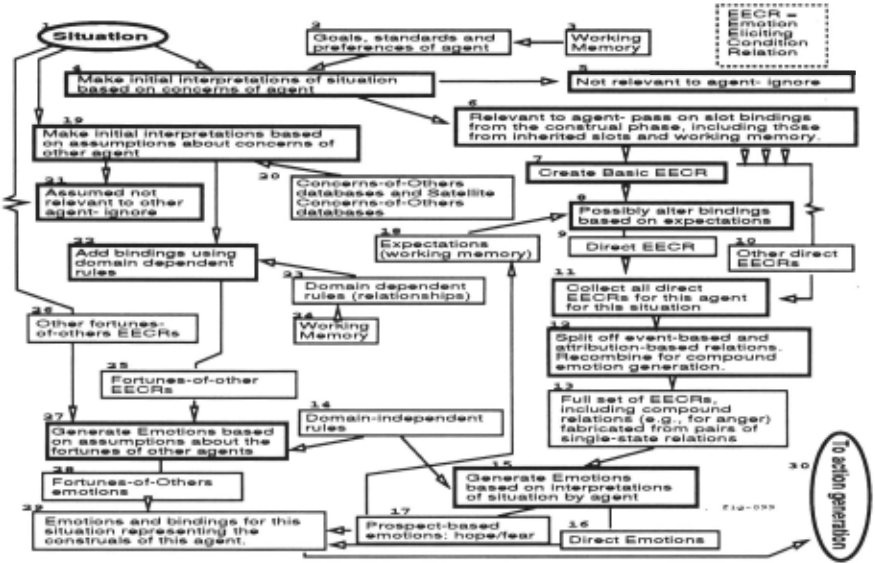
1. A situation is created when a simulation event is popped off the queue and the state of the simulated world is altered in a way that might be of concern to one or more agents.
- 2, 3, 4, 5. The con.Jtrual frames representing the goals, principles, and preferences of some agent are matched against the eliciting situation frame. Working memory is attached to slots in the construal frames and can al ter the success of the match, as well as the resultant bindings that are generated. Working memory is also used to implement that portion of mood which affects the appraisals of agents [Elliott and Siegle, 1993]. When a match succeeds for some construal frame (and its in herited properties) then the situation is considered to be relevant to the agent's concerns. Since an agent may simultaneously have more than one different construal of the same situation, multiple interpretations of that situation may result. When all matches fail, the situa tion is not considered relevant to the agent's concerns and is ignored.
- If the situation is relevant to the concerns of the agent, bindings will have been created during the match process. In addition to those bindings created when slots in the situation frame are unified with pattern matching variables in slots of the construal frame (in cluding inherited slots), additional bindings may come from attached procedures and from working memory.
- A basic Emotion Eliciting Condition Relation (EECR) is created for each construal of the situation.
8, 9 . The .Jtatu.J attribute of the EECR may be changed to confirmed or di.Jconfirmed if the situation is relevant to a stored expected outcome.
10, 11. Since there may be multiple construals there may be multiple EECRs. These are collected together before further processing.
- 12, 13. The event-based construals and attribution based construals are split off into two (non-intersecting) sets. They are recombined, as applicable, to form the compound-emotions EECRs, subsuming the component EECRs. 3 When recombination is not applicable the original EECRs are passed along instead. (For exam ple, there is no compound emotion that corresponds to the eliciting conditions arising when a blameworthy act helps the appraising agent to achieve a goal.) See fig ure 1.
14. The domain-independent rules contain the back bone of the emotion eliciting condition theory. All emo tions are generated using these rules. When a completed EECR matches the left-hand side of one of these rules, an emotion instance is generated.
15, 16, 17, 18. Those·emotions not about the fortunes· of others are the direct emotions. A subclass of these is the prospe.ct-based emotions of hope and fear. These latter emotions stem from unconfirmed events and· so generate expectation frames. These frames are stored, and may be used to interpret future situations.
19, 20, 21. For· each other agent involved im the situ ation, the observing agent maintains representations of their concerns in Concern.J-of-Other.J databases. These representations are used to interpret the situation in ways presumed to be of concern to other agents, us ing steps similar to 2, 3 and 4. In addition, Satellite Concerns-of-Others databases, and presumed relation ships of others, allow agents to interpret situations with respect to second and third party agents [Elliott and Ortony, 1992] .
3 Allan Collins p9ints out that this subsumption is a mat ter of debate.[Collins, 199~] This implementation was arbi trarily chosen.
22, 23, 24. If the situation is determined (partly by assumption) to be of concern to the other agent, then the domain-dependent rules are used to determine the meaning for the target agent. Is the agent pleased about the outcome for the other agent? Relationships between the agents are stored in working memory and may be altered as the simulation progresses.
25, 26, 27, 28. Each of the resulting fortunes-of other EECRs results in an emotion using the domain independent rules.
29, 30. The direct and fortune.J-of-others emotions are all collected into a group and passed to the action generation module. Included in each emotion instance is a set of bindings from both the original match and the intermediate processing.
2.3 Expressing emotions
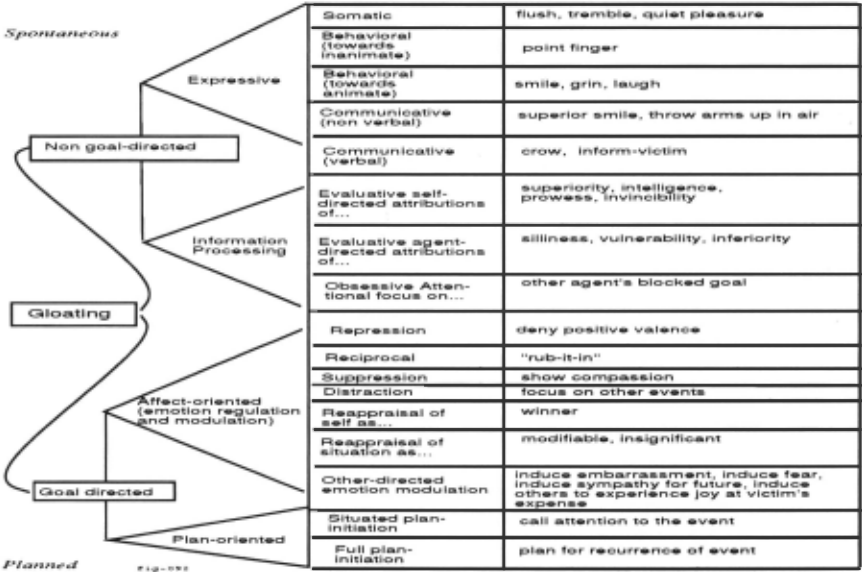
Once emotional states have been generated for agents in re sponse to eliciting situations, agents manifest these states according to their unique temperament traits. For example, when one agent is angry she might tend to shout , whereas an other might smile and deny that anything is wrong. Actions having nothing to do with emotional states are not covered by this mechanism.. Actions that do stem from emotional states, however, may be classified into one of the four high-level categories, expreuive, information-proceuing, affect-oriented (emotion regulation and modulation), and plan-oriented.· Figure 3 gives a breakdown of the action response categories and their theoretical groupings for the emotion gloating.
The high-level categories are arranged, as far as possi ble, from the more spontaneous to the more planned (e.g, expreuive actions tend to be less planned than those for emotion regulation and modulation) . Within these high-level categories the particular action response categories are simi larly arranged (e.g., .Jomatic expressive responses tend to be more spontaneous than communicative-verbal expressive re sponses). Lastly, within the action sets themselves the tokens (and inini-plans) are arranged from the least intense to the most intense (e.g., .Jmiling as a non goal-directed, expreuive behavioral-toward-animate expression of gloating is less in tense than is laughing). In all cases, these are at best partial orderings. 6
Once an action has been selected, it is instantiated us ing the set of variable bindings generated from the original match between the construal frame(s) and the eliciting situa tion frame. For example, the variable ?·other-agent might be bound during the original match process, which could then be used to instantiate the action response template <laugh at ?other-agent>.
· The high-level categories are not presently used for ac tion generation. One possible use of the theory underlying these categories·, however, might be as a basis for a func tional representation of emotions as initiators of purposeful, motivated actions. In this regard, the information proceuing actions, for example, might be seen as representing aspects of an agent's attempts to "understand what is going on."
6 This is not an at,tempt to list action wor.d" that might be associated with a particular emotion. While this might be interesting with respect to understanding or generating text, it is not relevant to the goal of characterizing psychological states.
From figure 3 we can see that 1uperior 1mile and throwing arm1 up in the air are two ways of non-verbally communicat ing gloating, and that inducing embarraument and inducing other1 to experience joy at the victim'"' expen1e are two ways of modulating the emotion1 of other1. The expressive com ponent is closely related to the domain in which the AR is being used, so only those expressive actions which do not fur ther perturb the system (i.e., are not expressed as relevant simulation events) are directly portable from one application to another. The largest implementation, TaxiWorld [Elliott, 1992], used about 1000 different action paths. Multiple ac tions may simultaneously express a single emotion instance. 8
2.4 Observing and modeling other agents
The AR has mechanisms whereby simulated agents may rea son a.bout the emotions, a.nd the persona.lity ma.keup, of other agents. To do this, fea.tures derived from a.n observed eliciting situa.tion, a.nd the observed a.gent's response to the situa.tion, a.re forma.tted as a. ca1e for a. slightly modified version of Pro tos [Ba.reiss, 1989], a. heuristic classification system. Once a.n observing a.gent has classified the case as belonging to a.n insta.nce of one of the 24 emotion types, the agent stores this knowledge as pa.rt of its internal representa.tion of the other a.gent. For exa.mple, one a.gent might observe a.nother frown and spea.k rudely when kept waiting. From prior expe rience the observing a.gent knows tha.t its counterpa.rt often expresses a.nger by spea.king rudely a.nd frowning. Using this knowledge to a.bduce a.nger it then looks for interpretations of the eliciting situa.tion tha.t would lead to anger. Once a suit a.ble expla.na.tion is found (such as the violation of a principle tha.t one 1hould not be kept waiting, a.nd the thwa.rting of a. time-dependent goal) it upda.tes its internal representa.tion of the other a.gent so tha.t those concerns are included.
Several levels of defa.ults a.re required to implement this mechanism. Searches might have to be ma.de through the representa.tion of the current presumed concerns of the other agent, through defa.ults for the role of the a.gent_, through de faults for a.gents that a.re "simila.r" in na.ture, a.nd through the system catalog of "what might explain" the response. 7 Also necessa.ry a.re 1atellite concerns-of-other"' knowledge bases used in conjunction with a. representation of the pre1umed relation1hips-of-other1 since observed agents may have emo tional responses based on the fortunes of third-party agents as well [Elliott and Ortony, 1992].
6 0ther issues that have had to be addressed include de termining the dimensions along which to tune a particular agent's tempera.ment traits (e.g., a.n agent who grows quiet when under the influence of negative emotions, or a.n a.gent who is task-oriented, and vocal, with respect to standards based emotions), the interplay and consistency of multiple ma.nifesta.tions of a.n emotion (e.g., some a.gent might deny anger when she is angry, or might shout about it, but will not do both a.t the same time) , dynamic changes in the a.gent 's temperament (e.g., tending toward low energy before meal times), a.nd so forth.
7 1t is worth mentioning that versions of the AR ha.ve been run which focus almost entirely on these aspects. In one, the system itself, as a.n automated agent, reasons a.bout the emotions of the user within a constrained format. Although this idea. has not been developed, it suggests at least the possibility of a simple form of affective user modeling.
3 Social simulation using the Affective Reasoner
The AR has been used as a basis for constructing a social simulations. In this environment, users interact with one or more simula.ted a.gents via the computer keyboa.rd a.nd mouse. Users get feedback through simulated facial expressions for the agents, and through formalized text describing what is ta.king pla.ce in the simulated world. In this scheme, users take pa.rt in the simula.tion by ma.king decisions for one of the a.gents. The other agents respond to the situations that a.rise in the course of the simula.tion, including those tha.t come a.bout as a. result of the user's input. Simula.ted a.gents represent individuals with emotional depth and their own idiosyncra.tic ways of expressing their feelings. A user's task is to identify the concerns of the other agents so tha.t he or she can interact with them in wa.ys tha.t successfully bring a.bout some best-case outcome.
During the course of the simulation, agents are continually appraising situations that arise in their world. Some of these are of concern to them, and lead to emotional states. Once such a. state has been established, expressions of it may be manifested within the simulation. For example, the displa.yed fa.ce of the agent might change, working memory representing the tolera.nce level of the agent for further similar situa.tions might change, the level of a.ttentional focus for the agent might cha.nge, or the agent might be described, in text, as laughing or turning red.
Rudimentary persona.lity types are configured before the simulation is run, either by defa.ult, or through user-selection of attributes. In this pa.per , four statically pre-determined persona.lities will be discussed. In general, however, the ap praisal frames a.nd expression pa.ths represented in the knowl edge base may be combined as desired, creating a. wide variety of persona.lities. The role of a.n a.gent in the simulation de termines which situa.tions tha.t a.gent will be involved in, a.nd thus which situa.tions might be subject to interpreta.tion. For exa.mple, supposing tha.t we a.re simula.ting a. sales situa.tion, a 1ecretary a.gent might not be concerned with situations a.ris ing during the clo1e, but might be concerned with situations a.rising during the initial greeting phase of the salesperson's visit .
As in real social situations, the state of an agent changes over time. For example, a client might gradually become bored, especially attentive, warm, or hostile. Users must re spond in quasi-real time to the situations that a.rise. If a. user does nothing, or responds too slowly, then a.gents might ta.ke the initia.tive, because their concerns are not being a.ddressed.
4 The problem
4.1 Problem summary
For the work reported in this pa.per, the a.ttempt was ma.de to model a. set of four client types identified as pa.rt of a. training program designed to teach novice a.ccount execu tives how to sell telephone-book a.dvertising ( cf. [Kass et al., 1992]). These four types, here referred to as dominant, polit ical, 1teady, a.nd wary, were used to cha.racterize the typical sorts of clients one might expect to encounter in the field . The definitions were both practical and operational: they were described in a ma.nner congenial to use in training sys tems, ra.ther tha.n as set of formal psychological dimensions , a.nd they were partly defined by the the way in which such client types might be expected to respond to pa.rticula.r ac tions of a salesperson.
Descriptions were given in two ways. First, the client types were partially described by a. set of rules prescribing wha.t the salesperson should and should not do in sales situations with different kinds of clients. One rule, for example, says that if one "takes charge" with a dominant client, then one should expect to succeed only in making the client angry. Approx imately 21 such rules were given for each client type. Sec ond, the personality types were described in terms of their observable behavioral styles (e.g., laconic or talkative) Ap proximately 14 such style characteristics were given for each client type.
The given task was not to build a full sales-training sys tem, but rather to explore the representational power of the theory-based architecture in a practical domain. For this rea son no attempt was made to model those processes that had nothing to do with either personality or the generation or expression of affective states. Additionally, the exercise was further constrained by using only a very simple conceptual ization of negotiation.
4.2 Representing situations and agents
For this exercise, a sales episode was broken down into seven steps: (1) The greeting, (2) the fact-gathering sessions, (3) the making of the proposal, (4) support for the client's deci sion, (5) the client's agreement or disagreement, (6) the nego tiation process, and (7) the parting. Each of these steps was represented as one or more simulation events. Step (5) had four different instantiations depending on whether or not the client agreed with the proposal, and on whether the salesper son wished to modify the client's stance. In some instances it caused a loop back to step (3).
The four client types represented were: ( 1) Dom, a domi nant personality who prefers logical, rapid decisions, (2) Pol , a political personality who likes to socialize and is very status conscious, (3) Pa8, a passive personality who does not express objections, but who might act on them, and (4) War , a wary personality who often tends to be anxious about anything unfamiliar.
To illustrate these different client types, let us consider how each of the them might be expected to appraise the salesperson's style at the opening of the interview. Dom holds a principle that the salesperson should be brief, specific and to the point. Rambling will waste her time, violating that principle and interfering with her goals, thus, ultimately, incurring anger. Pol has a preference for social niceties. He has a goal of defining roles in the social structure. To rush immediately into the business at hand thwarts this goal and will not please him. Pas is not comfortable with rushing into business either, but, unlike Pol, he is primarily seeking to establish that the salesman has a genuine interest in his needs and preferences. War, like Dom, prefers getting right to business. Unlike Dom, however, she wants all the steps laid out methodically. In War's case, the introduction is especially important in setting the tone for the session. War tends to imagine the negative consequences of suggested courses of action, and it is important that the opening of the interview set her at ease.
The simulated agents also tend to express their emotions differently. Dom, for example, had activated action paths for evaluative 8elf-directed attribution$ tending towards su periority, competence, intelligence, an obseuive attentional focus on goal8, and so forth. By contrast, War had paths emphasizing evaluative 8elf-directed attribution$ tending to ward inferiority and powerleuneu , tendencies to reappraise a situation in a negative light, and so on.
4.2.1 User choices
The user, taking the role of the salesperson, affects the course of the simulation. At each stage during the simulated interview the user has menu choices for what to do next. Once the user selects an option, a frame representing the features of the user's choice is posted to the simulation queue and executed. These and other simulation events give rise to situations to which the simulated agents respond in accordance with their concerns.
New situations, and the agents' responses to them, arise as a result of the user's choices (e.g., attempting to "close" too soon might lead to anger on the part of Dom, but anxiety on the part of War), in response to actions on the part of the simulated agents (e.g., when Dom is angry she might terminate the interview), or by default (e.g., if the user does nothing Pas grows uncomfortable, and Dom gets angry).
In addition to the user choices that arise at the different stages in the course of the interview, there are also addi tional user choices representing the overall 8tyle of the sales person. For example, the user might set pacing (moder ate, slow-tutorial, fast-hyped), tone (friendly, cool), attitude (deferential, take-charge) , 8tyle (brief-summary, anecdotal, extremely-detailed), and so forth, which also can affect the course of the interview. The style of the salesperson is dy namically configurable as the simulation progresses.
4.3 Conclusions
On the overall representational task there were mixed results. The approach was successful in giving agents the ability to appraise situations so that their concerns led to emotions consistent with their intended personalities. Eighty-six rules specifying "what to do" and "what not to do" were success fully represented within the simulation. The rules could all be directly related, for each of the client types, to appraisals of situations that arose in the course of the simulation. This was the most effective component in the AR, with respect to the constrained representational task.
To account for the content of the 86 sales domain rules, each was first analyzed with respect to the way in which it uniquely characterized the associated personality type. For each rule, typical emotions such as anger, joy, fear , and so forth , could be inferred from the clients' stated or implied reactions to the salesperson's initiatives. Working back from these emotions, it was possible to determine high-level frames for goals, principles, and preferences which would lead to the associated emotion types. From there, lower-level appraisal frames suitable for interpreting the actual emotion-eliciting situations within the simulation could be identified. These were then used as the basis for building the interpretive per sonality for that particular client type. For example, from the rule that says never talk down to Pol (the political client type) we might infer that Pol could grow angry when treated this way. Within the constraints of the theory, this would be true if his personal goals involved maintaining a certain status within interpersonal relationships, and his principles said that salespeople should be aware of this .
By contrast, there was less success in representing the given behavioral styles of the client types within the AR. The man ifest ations of these styles fell into three groups. The first group contained those characteristics that suggested certain actions . For example, harsh might suggest that , when angry, a client might be blunt, or shout . The second group con tained those behavioral styles directly related to appraisals, such as judgmental, perfectionist, and excitable . The third group contained those behavioral styles that were ubiquitous in the client types' respective dispositional manners. For ex ample, clients were described as dependable and persistent .
The first group was somewhat amenable to representation, but an interpretation of the data had to made. For exam ple, the concept of a manipulative behavioral style is generally comprehensible by people without further specification. However, it seems likely that the AR's representation of this trait as a tendency toward other-directed emotion modulation falls short of the mark. One might argue that manipulative people behave as they do quite independently of their emo tions.
The second group of behavioral styles was readily repre sented as part of the interpretive personalities of the agents. For example, for an agent to be judgmental simply meant that either the thresholds for invoking standards leading to neg ative emotions were lowered, or that more appraisal frames leading to those emotions were in place.
The manifestations of behavioral style in the third group were not amenable to representation in this architecture. For example, being .dow to make deci.Jion.J probably does not routinely have an affective origin. The best the AR could do was to represent those emotional reactions an agent might have, for example, when under pressure to make a decision quickly.
As illustrated above, because the AR's expressive compo nent is designed strictly as a set of categorical responses to simulated emotions, it is not well suited for representing dis positional behaviors rooted in more cognitive motivations. A better solution would have to additionally integrate some representation of individuals' long term planning .and survival strategies.
Another problem was in making the personality types ac cessible to the casual user. The intuitive grouping of ap praisal frames into sets that form identifiable components of complete interpretive personality types is a hard problem on which little progress was made. Standard personality distinc tions from personality theory in psychology (e.g., [Digman, 1990]) were felt to be unhelpful because the constructs they employ are not likely to be generally accessible to most users. In addition, attempting to use them to identify the types of rudimentary personalities represented in the AR seems point less because there is so much about a realistic characteriza tion of personality for which no attempt at modeling was made. It would be difficult, for example, to adequately char acterize the relationship between sociability, or extraversion, and the interpretation of a salesman's greeting,
From this modest exercise the following conclusions may be drawn: (1) the Affective Reasoner is well suited for rep resenting the interpretive disposition of simulated agents in social simulations, (2) it is capable of representing some as pects of the intended behavioral styles of such agents, (3) it is awkward at best, in its current form, for representing the numerous commonly understood behavioral style character istics which have little to do with emotional states, and ( 4) it is capable of creating many internally consistent rudimentary personality types, but that subcomponents of these types are difficult to characterize in a way meaningful to users.
Acknowledgments
I would like to thank Greg Siegle, and Robin Burke for their editorial comments on this paper. I would especially like to thank Andrew Ortony for not only his editorial com ments, but also for his support and advice throughout the development of this research project.
@inproceedings{ijcai1993p28,
  title     = {Using the Affective Reasoner to Support Social Simulations},
  author    = {Elliott, Clark},
  booktitle = {Proceedings of the Thirteenth International Joint Conference on
               Artificial Intelligence, {IJCAI-93}},
  publisher = {International Joint Conferences on Artificial Intelligence},
  editor    = {Ruzena Bajcsy},
  pages     = {194--200},
  year      = {1993},
  note      = {Cognitive Modeling},
  url       = {https://ijcai.org/proceedings/1993/28},
}
TY - CPAPER TI - Using the Affective Reasoner to Support Social Simulations AU - Elliott, Clark T2 - Proceedings of the Thirteenth International Joint Conference on Artificial Intelligence, IJCAI-93 PB - International Joint Conferences on Artificial Intelligence PY - 1993 SP - 194 EP - 200 UR - https://ijcai.org/proceedings/1993/28 ER -Copied
Machine-readable versions of this paper, for tools and AI agents:





