
Dialogue Cohesion Sharing and Adjusting in an Enhanced Multimodal Environment
Proceedings of the Thirteenth International Joint Conference on Artificial Intelligence. Natural Language. Pages 1230-1235.
© 1993 International Joint Conferences on Artificial Intelligence
Abstract
Multimodality is a powerful concept for dealing with dialogue cohesion in a Human-Computer NL-centered system. This work is a little step in better exploiting the potential large bandwidth of communication provided by this situation. Light cognitive load feedback and direct manipulation are proposed so that user and system can cooperate in mutually conveying the cohesion of the ong?ing dialogue. Main points are: (i) use of an appropriate dialogue structure to constrain inference in the anaphor resolution process; (ii) use of a graphical representation of the structure, to limit the problem of opacity; (iii) allow the possibility of direct manipulation on this representation, to avoid the necessity of operating linguistically at the meta-level. The context of the work is within a NL-centered multimodal information access system, in which basic entities are pairs (most commonly question and answer). A dialogue model simple enough to be shown in an intuitivereading way on the screen, and powerful and accurate enough is provided by a modified version of the centering model.
- Brennan et al. 1987]
- Susan E.Brennan, Marilyn W .Friedman, Carl J.Pollard, "A Centering Approach to Pronouns", Proceedings of the 25th Annual Meeting of the Association for Computational Linguistics., Stanford, Cal., 1987.
- Carter 1987
- David Carter, "Interpreting Anaphors in Natural Language Texts", Ellis Horwood Limited, 1987.
- Cohen 1984]
- Philip Cohen, "The Pragmatic of Referring and the Modality of Communication" , Computational Linguistics, 10(4), 1984.
- Cohen 1991]
- Philip Cohen, "The Role of Natural Language in a Multimodal Interface", Technical Note 514, SRI International, Menlo Park CA, November 1991.
- Cohen et al. 1989]
- P.R.Cohen, M.Dalrymple, D.B.Moran, F.C.N.Pereira, J.W.Sullivan, R.A.Gargan Jr, J.L.Schlossberg, S.W.Tyler, "Synergistic Use of Direct Manipulation and Natural Language", CH/'89 Proceedings, May 1989.
- Grosz et al. 1983]
- Barbara Grosz, Aravind K. Joshi, Scou Weinstein, "Providing a Unified Account of Definite Noun Phrases in Discourse", Proceedings of the 21st Annual Meeting of the Association for Computational Linguistics, 1983.
- Guindon 1985]
- Raymonde Guindon, "Anaphor Resolution: Short-Term Memory and Focusing", Proceedings of the 23rd Annual Meeting of the Association for Computational Linguistics, 1985.
- Aravind K.Joshi, Steve Kuhn, "Centered Logic: the Role of Entity Centered Sentence Representation in Natural Language Inferencing", Proceedings of International Joint Conference on Artificial Intelligence, Tokio 1979. IJCAI
- Joshi et al. 1981]
- Aravind K. Joshi, Scott Weinstein,"Control of Inference: Role of Some Aspects of Discourse Structure -Centering", Proceedings of the International Joint Conference on Artificiallntelligence, Vancouver 1981. IJCAI
- Kameyama 1986]
- Megumi Kameyama, "A Property-Sharing Constraint in Centering". Proceedings of the 24th Annual Meeting of the Association for Computational Linguistics, 1986.
- to appear] Mark Maybury (ed.) "Intelligent Multimedia Interfaces", AAAl Press, Menlo Park, Ca.
- Passonneau 1991
- Rebecca J.Passonneau, "Some Facts about Centers, Indexicals, and Demostratives", Proceedings of the 29th Annual Meeting of the Association for Computational Linguistics, 1991.
- Stock 1991]0liviero Stock, "Natural Language and Exploration on Information Space: the ALFresco Interactive System", Proceedings of International Joint Conference of Artificial Intelligence, Sidney 1991.
- Stock 1992]0liviero Stock, "A Third Modality of Natural Language?", Proceedings of the lOth European Conference on Artificial Intelligence, invited talk, Vienna 1992.
- Waterworth et al. 1991]
- John A. Waterworth, Mark H. Chignell, "A Model for Information Exploration", HYPERMEDIA vo/.3 no.l , 1991.
References were extracted automatically from the PDF and may contain errors.
Full text extracted automatically from the PDF; figures, tables and equations may differ. The PDF is the version of record.
1. Introduction
Extending the bandwidth of communication between human and computer. as in the case of multimodal systems, can open new scenarios in dialogue processing. The focus of our attention here will not be on the integration of a deictic ~ontext and visual presentations of domain entities, (see for mstance [Maybury to appear], and [Stock 1992]), but on a different point: synthetic feedback and direct manipulation so that user and system can cooperate in mutually conveying the cohesion of the on-going dialogue. In general. the perspective envisioned in multimodality is one in which the balance of responsibilities in dialogue can be altered from the natural one. For some cases, in this connection, the active role of the hearer should be enhanced [Stock 1992], but in the case presented here something is added to the speaker's part to make the hearer's part easier.
In natural dialogues, while the use of pronouns is very convenient for the speaker, the hearer has a much more difficult task in identifying the desired reference; and of course the more so for an artificial NLP system. The problem bounces to the original speaker if there is no confmnation that the hearer has found the intended reference. Often, a solution provided by question-answering systems alternatives is appropriate that provides at a glance the right basic coherence relation. If approved by the speaker, this gives rise to the completely different interpretation.
If the system really is absolutely not able to get at what the usez meant, there is a higher level of burden shared among the participants: in case of, say, a wrong resolution of an anaphor by the system, the user can point to the intended referent to force the right interpretation, with the system only providing the syntactically and semantically relevant candidates.
Among the other complex aspects, metacommunicative expressions like "let us go back to my previous question ... " and references of all kinds can be seen in a new light, in the w<lic presented here.
An idea along the same direction is presented in [Cohen 1991] and has been integrated in the Shoptalk system [Cohen et al. 1989]. Shoptalk was probably the frrst system in which multimodality was used to resolve meta-level problems: anaphor is transformed into a problem of pointing with the use of windows for managing different focus spaces. Here, the difference between communication and metacommunication is explicit. At the level of metacommunication, Cohen's principle of synergicity [Cohen 1991]: "to use the strengths of one modality to overcome weaknesses of another" is applied to good advantage. Natural use of anaphors is not substituted, nor does the user have all the burden of explicitly relating things. The system understands, feeds back in a cognitively light manner and communication may be adjusted with little effort by the user.
The ideas presented here have been exploited for the purpose of a dialogue module for the "concierge" (an automatic infonnation access system for a visitor concerned with the organization and scientific production of IRST) of the MAlA system, that includes also a porter-robot and an electronic librarian. Figure 1 shows how the dialogue module is integrated in the system.
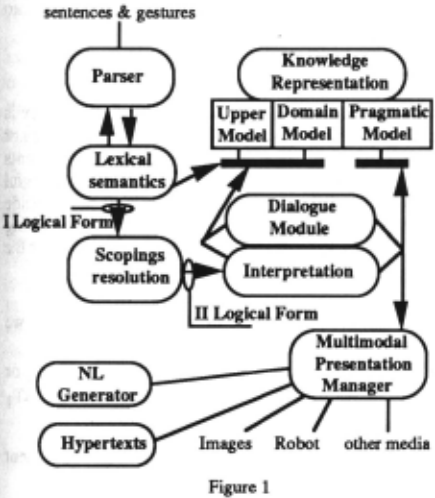
The main features of the design of this module are:
- (i) use of an appropriate dialogue structure to constrain inference in the anaphor resolution process;
- (ii) use of a graphical representation of the structure, to limit the problem of opacity;
- (iii) allow the possibility of direct manipulation on this representation, to avoid the necessity of operating linguistically at the meta-level.
To do this, a dialogue model simple enough to be shown in an intuitive-reading way on the screen, and powerful and accurate enough was needed. Here the centering model [Joshi et al. 1979], [Joshi et al. 1981], [Grosz et al. 1983], [Brennan et al. 1987], [Kameyama 1986] was revisited and modified for adaptation to a Q/A-system.
The next section briefly explains the basis of the modified centering model. Anaphor resolution will then be discussed; in the rest of the paper multimodality will be introduced.
2. The modified centering model
The centering model, frrst proposed by [Joshi et al. 1979], is based on the assumption that "in a natural language sentence in discourse [ ... ] one or more entities [ ... ] are singled out" [Joshi et al. 1981]. These entities, called centers are used to formally define the notion of discourse and to control the inference in the process of natural language understanding. This model was then refined by various authors (among the others [Grosz et al. 1983], [Brennan et al. 1987], [Kameyama 1986]) and used to resolve the problem of anaphor resolution. [Brennan et al. 1987], quoting a preliminary draft of Grosz, Joshi and Weinstein, proposes a set of typology of transitions to one utterance to the next to model the discourse structure and to resolve anaphoric expressions. The basic idea of this model is that to every utterance Un a list of forward looking centers, Cf(Un), made up of all entities realized or directly realized ([Grosz et al. 1983]) in the utterance is associated. Ranking of elements in this list is crucial. In [Brennan et al. 1987] obliqueness of grammatical relations of the subcategorized functions of the main verb is proposed: subject, object, object2, then the other subcategorized functions and finally the adjuncts. Actually, for freer word order languages than English, like Italian, the position (in the surface structure of the sentence) of the subject with respect to the verb, or other syntactically marked constructions (topicalization, dislocation, ... ) must be taken into account
The frrst element of the Cf(Un) is called preferred center, Cp(Un)· It is the element for which is largest the likelihood of being the primary focus of the subsequent discourse.
Un is "about" only one entity at a time, the backward looking center, Cb(Un)· This is always the confrrmation of an already mentioned entity.
Cb(Un) is used to link Un to the preceding discourse, while Cf(Un) provides a set of entities to which the succeeding discourse may be linked [Grosz et al. 1983].
The model of centering was developed in a framework of discourse analysis. For the case of dialogues and especially Query/Answer dialogues these notions seem not to be directly usable. The (implicit) assumptions of the centering model are that utterances are mainly declarative and the purpose of the discourse is to explain facts. This is not true in a Q/A system in which half of the utterances are questions or commands and the purpose of the communicative scenario is to get some information about one or more subjects.
The version modified for use in a QJ A system, with the purposes outlined in the introduction, follows.
The minimal unit is considered not the utterance but the tum (i.e. the adjacency pairs Question/Answer and Request/Response). Centers are now properties of turns, not of utterances.
As before, Cb(T n> is used to link the tum T n with a preceding one, and Cf(Tn) to link it to the following ones. Among the forward-looking centers we choose one to be the Cp(T n>· It is "the most significative" NP of the turn (i.e. the item realized by it), usually the wh-focus for wh-questions and the "thing about which we ask" in the other cases (cfr. paragraph 2.1).
We can informally think of a segment as a coherent chain of turns. In a QJ A dialogue we can imagine that a question is coherent with the preceding dialogue when it is a follow-up of a preceding turn. This is not the only case of coherence, of course, but it is a good starting point.
There are at least two ways in which a question may be a follow-up of a turn, either it is about the same subject of the question of that turn, or it is about the same subject of its answer. We call a-coherence the former and ~-coherence the latter (a-coh and ~-coh respectively, for short). The ambiguity found in the example in the introduction is precisely between these two coherence relations.
Formally:
lfTt and T2 are turns:
T2 is a-coh with T1 <T2aT1} ill Cb(T2)=Cb(T1) T2 is fJ-coh with T1 (T2/JTt) iffCb(T2)--cp(T1) T2 is coherent with T 1 .iff T2a T 1 or T2fJ T 1Now, a segment can be formally defmed as
a totally ordered set of turns among which some cob-relation holds.
(i.e. turns are totally ordered regarding the moment of their occwrence)
2.1. How to determine the centers of a turn
It is well established that in order to determine the centers syntactic considerations only are not enough [Grosz et al. 1983], but different criteria have not been agreed upon. In our case, with a specific applied situation, it has been possible to fmd reasonable strategies.
All items that are referred to by an NP in the sentence uttered by the user are used as centers. Some heuristics are then used to pick out the backward and the preferred center. These heuristics are very complex, and here the way they work is only outlined.
To determine the preferred center, it seems to be a good heuristics to consider the variable of the outmost quantifier in the logical form of the user's sentence. For example in the sentence
Who manages IRST?
(who ?x (person ?x) (manage ?x irst))
we choose the person identified by the variable ?x (centen are properties of turns, not of sentences, thus when the tum is closed the variable will be bound to an item in the knowledge base). This heuristics corresponds to choose tbe wh-focus. A problem with this strategy arises in the case of non-quantified sentences, for example
Show me the office of Stock?
(show (ref-term ?x (and (office ?xXis-property~f?x stock)))) In this case we suppose to be "stock" the Cb and the particular office the Cp.
Also for quantified formulas there are some problems, in particular with sentences with verb "to be" used is sense of IS-A and with the quantifier "where".
As an example for the first case, consider:
What is the organization of IRST?
(what ?x (thing ?x)
(isa ?x (ref-term ?y (and (organigram ?y)
(organigram~f ?x irst)))))
?x and ?y are bound to the same entity but it is better to choose ?y as Cp because it has a stronger restriction (organigrarn vs thing). For "where", the problem lies in the semantics of this quantifier. For example
Where is the director's office? (which ?x (place ?x) (has-place (ref-term ?y (and (office ?y) (is-place-of-person ?y (ref-term ?z (director ?z)))))
?x))
here, the wh-focus is the place, but it is not linguistically realized; the heuristics is to choose the term including the place, here the office described by the variable ?y.
As far as the backward center is concerned, there are two cases, whether the current tum is at the beginning of the segment or not. In the first case, the only candidates are constants and definite NP used in Russellian sense (iota· terms), otherwise pronouns, anaphoric demonstratives, definite NP and deictic demonstratives in this order, are sought. Actually, many peculiar cases are taken into consideration.
3. Anaphor resolution
One of the purposes of a discourse (or dialogue) structure is to limit the inference required to the process of anaphor resolution. The key idea is to consider the referents introduced in the preceding dialogue that could be meaningful at a certain time, only on the basis of their position inside the segment. The set of these referents is used as a starting point for the application of other criteria in order to select the correct ones.
Given two turns T1 and T2 belonging to a segmentS, we say that
T1 is accessible from T2 iff T2 is coherent with T1 or exists a chain of turns Tk 1 ... Tkn where Tt 1 =T2, Tkn=T1 and for every i Tki is coherent with Tki+l (ki > ki+i)
As an example, consider the tree in Figure 2 for segment S=<Tt,T2,T3,T4>.
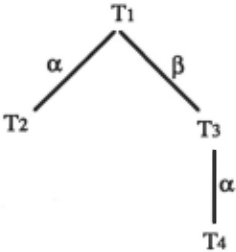
T 1 is accessible from all the other turns, but, for example T2 is not accessible from T4.
1fT is a turn belonging to a segment S:
The Strong Referents Set ofT (TsRS) is the set: u{Cb(M),Cp(M)), VM such that M is a tum
accessible from T
The Weak Referents Set ofT (TWRs) is the set:
uC(M), VM such that M is a turn accessible from T (where C(M) is the set of all centers ofT)
Clearly, it is always true that TsRS !';.;; TWRS·
WRS and SRS are used as focus spaces in the process of anaphor resolution. Following the principle of factor cumulation 1 , heuristics operating on these focus spaces are divided into two classes, Propose Filters (PFs) and Cut Filters (CFs).
PFs are applied for each type of anaphor (personal pronouns, definite NPs, demonstrative adjectives and pronouns). Using either Referents Set, depending on the kind of expression, the set of all possible candidates is proposed for each anaphor. Then, the set of all possible assignments of anaphors in the sentence is produced and the CFs are applied, cutting inconsistent assignments.
The reason for CFs to operate on the set of tuples is that the possibility for an entity to be the referent of an anaphor may depend also on the assignment made to other anaphors of the sentence, as seen in:
She gave her the permission to go home Supposed that the results of the PFs are she= {boss, secretary) bez={boss, secretary) there are four possible assignments <She, her>={ <boss,secretary>,<boss,boSS>,
<secretary ,secretary>' <secretary ,boss>)
1 ''various clues from a given text work together in supporting a certain hypotheses about a possible antecedent for an anaphor and finally the correct hypotheses, indicating the intended antecedent, outweighs the other ones" [Carter 1987]
but, clearly, only the first is acceptable. The last is refuted because of world knowledge, the other two because of a well known syntactic constraint.
4. Direct manipulation of the structure
Using such a simple model of dialogue structure, it is possible to build what stated in the introduction as points (ii) and (iii).
It is self-evident, by the formation rules, that the structure is a graph with labelled arcs: nodes are turns, an arc between two nodes signals a cob-relation between the corresponding turns, the arc label indicates the type of the relation (i.e. a. cob or p-coh).
Since turns are totally ordered with respect to the moment of their occurrence, the formation of circuits in the graph is impossible. From the rules it is clear that every node in the graph has one and only one parent, except the one corresponding to the first tum of the segment. Therefore the graph is a tree.
To improve readability on the screen, instead of having labels, arcs are graphically characterized in different ways to show the kind of relation they represent. Labels are used to show the centers that have established the relation (i.e. backward for a.-coh and preferred for P-ooh).
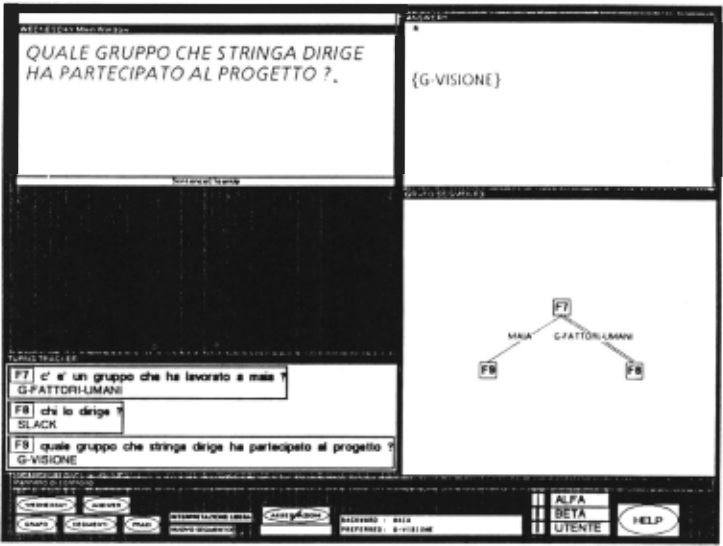
Figure 3 displays a snapshot of a dialogue with MAlA. At the bottom of the screen the control panel is seen. On the left, there are five buttons to control the windows (for parser, answer, structure and turns tracker). These windows are controlled both by the system and by the user. A button to impose free interpretation ("interpretazione Iibera") and another one to impose the opening of a new segment ("nuovo segmento") are visible. A final button allows the system to provide more alternative structural interpretations ("assegnazioni"); in the snapshot, it is barred to signal that there aren't any more. Cb and Cp of the current tum are also shown. Here is a translation of the utterances on the left of the screen together with their Cb's and Cp's:
Q: Is there a group that took part in MAlA ?
A: The Human Factors group.
[Cb=(MAIA, maia) ; Cp=(group, human-factors g.)] Q: Who manages it ? A: Slack.
[Cb=(it, human-factors g.) ; Cp=(person, Slack)]
Q: Which group, managed by Stringa, took part in the project?
A: The Vision Group.
[Cb=(project, maia) ; Cp=(group, vision g.)]
Both the second and the third turns are follow-up questions of the first one. The second tum established a p-coh while the third one an a-coh.
A series of snapshots displayed in the appendix may give an idea of the use of the system.
As far as possibilities of direct manipulation of the structure are concerned, the following features have been implemented:
- Closure of a segment. The next utterance will be interpreted as if it were the flCSt one of the dialogue.
- Visualization of an old segment.
The system shows the tree and the corresponding linguistic realization of the segment (i.e. the questions/commands by the user and the corresponding answers by the system).
- Swap of the current segment with an older one.
The older segment becomes the current one, thus the next utterance will be interpreted as if it were uttered
- there.
- Visualization of the point at which the user starts to travel through an hypertext.
An icon is automatically set every time the user chooses to follow an hypertextual link. This signals a momentary interruption of the flow of the dialogue.
- Check of alternative interpretations of the utterance, and choice of one of them.
If, at the end of the process of anaphor resolution, there are more than one assignment, the user has an immediate perception of the system's interpretations, by overlooking the simple structure. If this is in contrast to what he meant, he explores different alternatives, and may give the impulse to a complete interpretation with the new bindings.
- Build a new interpretation by imposing anaphoric resolution.
If none of the assignments proposed by the system is the one intended by the user, he may choose a new interpretation imposing "by hand" the resolution of anaphors. The resolution is guided by the system, highlighting the items that on the basis of selectional restrictions could be appropriate referents.
5. Taking into account the multimodal context
We have studied other "linguistic" coherence relations beside those introduced above (for example those induced by elliptical constructions, renominalizations and so forth) but will not talk about this at any length here.
A related problem is the role of a deictic context in establishing coherence in a dialogue. A sequence of turns may be coherent even without any form of linguistic cohesion, just because utterances "talk" about the same situation. In this paragraph we explain how the modified centering model has been expanded to cover some of these cases.
In MAlA the deictic context is always established as an answer to a question. We mark these turns as context creator's (CC). Whether a tum is a context creator is a matter of choices depending upon pragmatics; anyhow at a given time there can be only one active context creator turn in the dialogue. Our claim is that every reference to the context could be dealt with, for coherence matters, as a reference to the current context creator turn.
For CC turns all the entities referenceable in the context they establish are added to their centers. This list is called Cd (for deictic centers) and a new relation, named o-coh is defired.
Let T m a CC tum, and T n a non-CC tum following T m in the dialogue:
A natural refinement to the above definition is to specialize it into two relations, depending on which of the centers of Tn, either Cb or Cp, establishes the relation.
With respect to the graphical usage of the structure as a on-linguistic feedback, it may be appropriate to "collapse" ome relations in order to maintain the property of intuitive eading and light cognitive load For example, ~a-cob could be shown graphically just as a-cob and ~p-coh as p-coh. We find that a better solution is to impose the same graphical form but different colours to those pairs.
As far as direct manipulation of the structure is concerned, lher possibilities could be added to the above, exploiting the new cob-relations. For example, even if at a given time only one turn is the current CC, two CC turns can well occur in the same segment (the last being the active one). Returning to the preceding context (and thus making active the former CC turn) is a meta-level operation, very complex to perform in NL. Using direct manipulation, instead, it can be sufficient to point to the corresponding CC turn on the representation of the dialogue structure.
6. Further research
Many other territories are to be explored in this area. Among tbese, we are particularly interested in the evolution of the notion of coherence in a multimodal environment for information access in which the user shifts between goal ooented NL dialogue and hypertextual navigation (see also [Stock 1991]). As noted by [Waterworth et al 1991] browsing is opposed to querying along the dimension of target orientation. These could be seen as two different modalities to which the principle of synergistic use applies. In this context our effort may also lead to better overall cooperation between system and user in minimizing the exploratory phase.
From a behavioural point of view experiments need to be performed to evaluate both the use of linguistic resources in the user and the overall user's task execution when using a multi-level synergistic interface [see also Stock 1992] as described here. This work is a modest step in that direction. It aims to exploit better the large potential that computers offer for NL communication. For certain aspects we think this direction may result in something different from what we are used to in human-human communication, both face to-face or at a distance (telex, telephone, text) [Cohen 1984], but still well tuned to our cognitive and linguistic capacity.
Acknowledgements
We would like to thank all the members of the Natural Languge group at lrst for many useful discussions.
@inproceedings{ijcai1993p170,
  title     = {Dialogue Cohesion Sharing and Adjusting in an Enhanced Multimodal Environment},
  author    = {Zancanaro, Massimo and Stock, Oliviero and Strapparava, Carlo},
  booktitle = {Proceedings of the Thirteenth International Joint Conference on
               Artificial Intelligence, {IJCAI-93}},
  publisher = {International Joint Conferences on Artificial Intelligence},
  editor    = {Ruzena Bajcsy},
  pages     = {1230--1235},
  year      = {1993},
  note      = {Natural Language},
  url       = {https://ijcai.org/proceedings/1993/170},
}
TY - CPAPER TI - Dialogue Cohesion Sharing and Adjusting in an Enhanced Multimodal Environment AU - Zancanaro, Massimo AU - Stock, Oliviero AU - Strapparava, Carlo T2 - Proceedings of the Thirteenth International Joint Conference on Artificial Intelligence, IJCAI-93 PB - International Joint Conferences on Artificial Intelligence PY - 1993 SP - 1230 EP - 1235 UR - https://ijcai.org/proceedings/1993/170 ER -Copied
Machine-readable versions of this paper, for tools and AI agents:





