
Conditional Causal Logic: A Formal Theory of the Meaning Generating Processes in a Cognitive System
Proceedings of the Thirteenth International Joint Conference on Artificial Intelligence. Logic Programming. Pages 845-850.
© 1993 International Joint Conferences on Artificial Intelligence
Abstract
The purpose of Conditional Causal Logic (CCL) is to constitute a formal theory of the process by which the representation of the world emerges in a cognitive system. CCL is presented as a two-level language; this article concerns the first, called the u-language. This u-language is a formal theory for the determination process by which a cognitive system constructs its objective knowledge. The internal dynamics of this construction do not belong to the world of the u-language, but to the £-language which constitutes the second level of CCL. This £-language is still being developed and it will only be referred to briefly in this article. The u-language in itself offers some original features such as the notions of identity and distinction by determination and also a type of negation, functional negation, which has no equivalent in other models of conventional logic or nonstandard 'logic. In conclusion, some words will be said about design of a connexionist system founded on this theory of u-language.
- [Rumelhardt et aL,1986] D.E-.Rumelhardt, G.E.Hinton, and J.L.McQelland. A General Framework for Parallel Dis- tributed Processing. In Parallel Distributed Processing, I, pages 45-109. MIT Press. Cambridge, Massachussets, London, England. 1986.
- [Rumelhardt et al.,1986] D.E.Rumelhardt, G.E.Hinton, and J.L.McQelland. PDP Models and General Issue in Cog- nitive Science. In Parallel Distributed Processing, I, pages 110-146. MIT Press. Cambridge, Massachussets, London, England. 1986.
- [Searle,1990] John Searle. Is the Brain's Mind a Computer Program, Scientific American, 262: 20-25, January,1990.
- [Shastri et aL,1989] LokendraShastri, and Venkat Ajjanagad- de. From simple Associations to Systematic Reasoning: a Connectionist Representation of Rules, Variables and Dynamic Bindings. Technical Report: MS-CIS-90-05 IJNC Lab 162. University of Pennsylvania. Philadel- phia, PA 19104. December,1989.
- [Smolensky,1990] Paul Smolensky. Tensor Product Variable Binding and the Representation of Symbolic Stuctures in Connectionist Systems, Artificial Intelligence, 46 (1-2): 159-216, November,1990.
- [Winograd et aL,1986] Terry Winograd and Fernando Flores. Understanding Computers and Cognition: a New Foun- dation for Design. Ablex Publishing Corporation. Nor- wood, New Jersey. 1986.
References were extracted automatically from the PDF and may contain errors.
Full text extracted automatically from the PDF; figures, tables and equations may differ. The PDF is the version of record.
1 Foreword: Brief of Conditional Causal Logic
How are names given to things? How does a cognitive system develop its representation of the world ? Conditional Causal Logic- CCL for short- is an attempt to reply to this double question. The objective of CCL is to construct a formal theory describing the process by which object concepts are developed by a cognitive system, that is, the manner in which a cognitive system associates conceptual representations with all of its perceptions.
In order to be consistent with its objective, this logic of the generating process must provide a means for description of the knowledge creation process that is of a very different type to the means for processing the objects of its yields. This objective shall be achieved on the basis of two main principles:
- Revision of the object concept. This implies that this logic theory can no longer consider the object, in the usual empirical sense of the term, as the basic reference, as opposed to the theory of sets for which this concept is fundamental. This object concept is yielded by a cognitive construction in CCL, which is particularly concerned with the creation process, or the genesis process of meanings.
- Revision of causality taken as the relation between an object-cause and an object-effect. For CCL, causality is an a posteriori description rather than a real production pro cess on the basis of an objective cause since, in accordance with the first principle, the objects have no real substance.
In order to achieve these objectives, CCL will eventually be in the form of a logic theory composed of two levels: u language and £-language.
- u-language - This is the name I give to a type of meta language whose object is the universe composed of everything that exists as a symbol with a signification. The idea was to create a formalized language that, in a certain manner, is a formal expression of all possible languages and all forms of expression. Naturally, this can only be achieved by remain ing at a sufficiently abstract level where all possible means of expression can be envisaged as a sequence of universal sym bols; it will be seen how CCL takes into account the concepts of the particularity and unicity of objects.
- £-language- The unique feature of this u-language logic is the fact that the universe of representations that it is concerned with is based entirely on a parameter that I call efficiency. This element constitutes, so to speak, CCL's driving force, which, in the most general case, is an element situated outside the universe of representations, and outside the scope of the u language. Efficiency cannot be formulated in representation language; from the u-language point of view, it is only per ceivable as a break in the continuity of this universe's con stitution. In fact the u-language must handle a knowledge universe that is not defined for once and for all, but an evolv ing universe that develops layer by layer, where efficiency is
the very essence of this dynamism. But this efficiency can no longer be handled by the IT-language logic, and the world of efficiency is no longer that of constituted semantic units but a world of non-differentiated entities and of potentialities of representation. This environment's logic is that of the € language. It is not based on either the principle of identity nor on contradiction since, in order to be able to speak of a sym bol's identity, the symbol must have a fixed determination or, in other words, it must be identified as the representation of a thing. However, in the area that concerns us here (i.e. the complete CCL) there are no longer things but only potential ities of things whose connection engenders stable properties that can be identified within the universe of determinate ob jects. The formalization of this c-language is still being de veloped.
Therefore this publication is concerned only with the first level of CCL, i.e. the IT-language. The IT-language, as we shall see, can be presented as a formal theory of knowledge representation based on an unspecified internal parameter that provides a basis for its complete structure and its approach. It is on this basis that the IT-language acquires its originality that distinguishes it from other types of formal logic. It is not possible to provide an exhaustive presentation of this formal IT-language in this paper. This text aims to simply explain in natural language - the fundamental concepts and key ideas of this IT-language as well as its philosophical foundations. Some indications of the syntax of the IT-language shall also be given below.
2 Determination
From the CCL point of view, therefore, there are not things, or objects, but rather a dynamic process for elaboration of these things. I call this process determination. A determinate object is something that is designated by by a significant value: determination is the operation whereby correspondence is established between a bare thing and the significant value of a concept <A>. The semantic field of the IT-language is the universe of determinate objects. We proceed by the following:
- the concepts or general ideas, i.e.: tree, cat, house, car, ... ;
- their functionalities, which can be considered as the con cept's potentiality - this word will be explained later - to designate and represent the things;
- the efficiency, which is the process whereby this potential ity is updated: correspondence is established between a concept and a bare, indeterminate thing if and only if the functionality of the concept in question becomes (in a man ner of speaking) "active" or, in IT-language, if it becomes efficient or has efficiency.
This cOrrespondence between the represented thing and the representing concept is called an inscription of a concept. In the IT-language, a determinate object is called a IT-ity. There fore determinate objects include concepts, which are also IT ities, and the IT-ities resulting from the inscriptions of these concepts.
The collection of inscriptions of a concept constitutes the universe of this concept. Thus universe :E is the collection of all that is determinate; it can be considered as the universe of the inscriptions of the <Determination> concept.
As a general rule, a universe is not a set or a class, except in the particular case where efficiency is replaced by a deter minate process; in this case, the notion of a universe can be considered to correspond to the notion of a set or a class.
The idea that governs this operational distinction between concept and its functionality is the will to take into account this fact of a common experience: the conceptual represen tation of a perception does not exhaust the real contents of this experience. Thus the tree representation does not exhaust the reality of the experience - in terms of sight, smell, touch and emotion - involved in the perception of a tree. This cor responds to the fact that a IT-language universe is not totally complete but open; in classical theory, a thing exists as soon as it is defined, while in CCL it only exists as a result of the op eration called determination by efficiency. The represented object/representing-object dichotomy is not initially given, it is constituted operationally. Therefore the IT-language will distinguish two types of universe: open universes, where in scriptions of the corresponding concepts are produced by ef ficiency; and closed universes, where these inscriptions result from the application of logic rules defined with the concepts. The functionality of these concepts is a determinate function ality or a IT-fonctionnality.
But, before a thing can be determined, at the moment of efficiency, as being a given thing (viz. a cat, a tree, a table, a fruit etc.), i.e. before one-to-one mapping can be established between the indeterminate thing and a given concept and none other, there must be an existing selection function that, in the IT-language, is called the determinant or list of determinant conditions. This term refers to any determinate structure that figures as a knowledge development context. Thus, for example, the fact that visual perception can be identified (or let us say determinate)- e.g. it is a tree- implies determinant conditions such as the nature of the surrounding environment - e.g. the fact of being in a garden - and then the process of learning (by the cognitive system) what a tree is or what this notion implies, memorizing this notion and the possibility to associate it with a perceptive experience.
In brief, it is its determinant conditions that constitute the unicity of a determinate object - i.e. the fact that it has a specific difference that distinguishes it from all other objects in a unique manner, including those of the same type.
Thus each object is associated with its universe and :E
includes the universes of all possible concepts. But this is not enough to characterize E, since these universes are not taken as classes of objects, but they are associated by relations that u-language calls correlations between universes. It has been seen these universes are collections of occurrences of concepts that are used to designate the events in the life of a system. However, there are correspondences, or relations, between the concepts that are not isolated idealities but are interlinked. These correlations structure the E universe by establishing structural correspondences between determinate objects; thus, for example, the concept <Free> is correlated to the concepts <Leaves>, <Trunk>, <Bud>, <Fruit> etc. In fact, it will be shown that no determinate object exists without correlation to other determinate objects.
Concepts
<A>,<Aj>, <Tree>
Indeterminate functionality A[]
Concept inscription
<<A>[x]>
Universe of concept <A>
GUA
Universe of determinate things E
Correlation ofl.LA with GUe GUA: <<K>[ ]>:Glle
3 The Paradox of Determination
This could be formulated as follows: if everything handled by the u-language comes under the concept of determination, since, from the CCL point of view, the statement it exists is an equivalent expression to is determinate, then how is determination determined?
This is another form of the famous paradoxes, such as the set of all sets.
CCL incorporates the determination paradox into its own dynamics. In fact, determination, or the universe of the deter minate, is perpetually approaching total completion without ever being able to attain it to the same extent as E. This is be cause of the very existence of this paradox in which the resolu tion process leads to the organization of E not as a whole that is complete as soon as it is defined, but as a dynamic universe that is always open and evolving from state to state. Accord ing to a theorem of the u-language, the sequence of states of E has no first or last terms.
The change from one state of E to another is called a transition.
The universe E is therefore composed of a series of states separated by a radical discontinuity called transition which is the domain of efficiency. Indeed:
- 1 this transition is not determinate, and does not belong toE;
- 1 this transition has a generative role in that it always implies a new determination.
It should be noted that determination by efficiency is more a process of emergence from an indeterminate environment.
We could try to use an application model to illustrate what we want to formulate by this idea of discontinuity of the universe E. As we shall see below, this universe can represent a given cognitive system, or rather the state of knowledge of this system. We can therefore already see how to interpret the non-exhaustive nature of E: for a given system, everything that it has accumulated - by learning or by experience - is determined. We can place innate acquired knowledge under the heading of this notion, inasmuch as we would model the operation of a system on the basis of a theory of the acquired knowledge. But, for the system in question, the external world, full of non-updated possibilities, is indeterminate. The state transition can be interpreted as a process of acquisition of new knowledge and a repeated experience, irrespective of whether it is receptive or active; an acquisition that will enhance the system's knowledge base and facts base.
Thus, that which was indeterminate has been incorporated into the system as a new determinate object. At the same time, the system undergoes change represented by the notion of state transition. This is integrated as an event described by a conceptual representation. This notion of an event emerging at each transition, to which the determination process then joins a conceptual representation, is designated by the term punctor in CCL.
To sum up, in an operation of determination by efficiency, the punctor is the particular thing; the concept is the general or generic object. Determination of the punctor, or inscrip tion of a concept, is the creation, in E, of a correspondence between a concept and the state transition punctor. The in scription of <A> is the establishment of correspondence be tween any punctor (e.g. <x>) and the concept <A>, let be <<A>[x]>. In this expression, the role of element xis purely that of an index: it formalizes the application of a concept to the designation of a particular object this tree. The correspon dence that determines this particular object <X>, or «A>[ x] >, is provided by efficiency. The £-language will be the mathe matical formalization of this efficiency, and it is in this sense that it will be a logic of the genesis of particular objects.
| Punctors | <X>, <ai> |
| States ofE | Ei, Ei, Ei+l, ... |
| States 'transition | Ei ~--+ Ei or i ~--+ i |
4 Identities and Distinctions
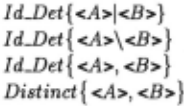
In this language there are several possible definitions of iden tity. This section discusses the identity of determination: an object of the u-language exists because it is determinate. This existence, in the logic sense of the term, is conditioned by what I previously called the determinant conditions. For two given determinate objects, e.g. A and B, there are a number of possibilities that we shall explore:
- Object A and object B are determined by a set of common conditions. Thus A and B have an identity of partial determination.
- All determinant conditions of A determine B without the converse being true. Thus there is an identity of inclusive determination of A by B or inclusion of A by B.
- All determinant conditions of A determine B and vice versa. Thus there is an identity of total determination of A and B or identity of A and B.
- There is no determinant condition common to A and to B.
Following examples can be situated in this kind of total de termination identity: Napoleon and "emperor of France", or Venus and the "morning star". In the identity of inclusive de termination, there is a sort of idea of additional determination of the including term in relation to the included idea. There are numerous possible examples, but I will just mention one: the inclusive determination identity of the flower object by the rose object. This means that a rose is indeed a flower and that it has all the characteristics of a flower, but the converse is not true: not all flowers are roses! The same plant example illus trates determination partiality: "rose is a flower" and "violet is a flower". These two objects have certain characteristics in common, which means that they are both flower objects.
From identity we move on to distinction, which is again based on the notion of determination. The u-language takes two types of distinction into consideration:
- Punctorial distinction, or simply distinction, between the various different inscriptions of a single concept.
- Specific distinction between concepts or between objects in universes of distinct concepts.
The first type of distinction is that practised in natural lan guage between individuals of a single generic object. Thus the name rose designates a generic object. There are numerous specific objects that correspond to this concept; the distinction corresponds to an operation of our language that establishes selection between "this rose" and "that rose", or between rose number 1, rose number 2 etc.
But specific distinction is practised between general ob jects, e.g. a rose and a violet, an animal and a plant. Thus it is possible to observe some overlapping - deliberately in tended in the u-language -of identity and distinction. These notions are both based on determination. They are not ab solute opposites; rather, there is a continual shift from one towards the other in both directions. Thus two occurrences of the <Rose> concept are clearly distinct but they are also linked by a determination identity relation since they have the common determination of being a rose. There is a specific dis tinction between an inscription of the <Rose> concept (or a specific rose) and an inscription of the <Violet> concept (or a specific violet); nevertheless, there is a determination identity because of the fact that they are both flowers, i.e. inscriptions of the <Flower> concept. Therefore, to a certain extent, their specific distinction could gradually dissolve, leaving a single plain distinction between two occurrences of the <Flower>
concept.
Similarly, concepts such as <Animal> and <Plant> can be found to have the common determination of being "cellular organisms".
Of course, the fourth possibility mentioned above - ac cording to which two objects, A and B, could have no com mon determination - could be found to be purely theoretical, since it is always possible to find something in common be tween two objects.
Important note: identity and distinction are only circumstan tial notions that vary according to determinant conditions. The notion of identity certainly characterizes determinate ob jects but the identity a = a is not initially given: it results from the determination process.
Identity of total determination Identity of inclusive determination Identity of partial determination Distinction
5 The Notion of Negation in the u-Language
This paragraph could be called : "the logical operators in u language". A logical operator - not, or, and, imply, etc. - is, from the CCL point of view, a meaning which acts on another meaning, or relates two meanings. Therefore, any logical operator is a determinate object into a state of universe E.
In u-language any logical models - classical, intuitionist, fuzy, and so on - will be regarded as a structure in relation with a particular state of E: the u-language is a sort of meta logic.
Now, in all states of E, exist two sorts of negation; they follow straight from identity and distinction of determination previously defined.
- Punctorial negation which applies to individuals of the same concept. For instance a particular rose is an object of the universe ~o.e; that excludes not only all other flowers but also all other roses except "this rose".
- Specific negation places the concept <A> in opposition with the concept <non-A>. However, in classical pred icate logic, when VxA(x) means any object that does not possess the quality of being A. In the u-language, <non-Rose> is a determinate concept and its determi nant conditions could include the fact that <non-Rose> is nevertheless an object of the <Flower> universe. So, if <Violet> is a <non-Rose>, nevertheless there is between <Rose> and <Violet> an identity of determination, that both to be objects of the universe of <Flower>.
However the u-language has a specific negation operator:
functional negation, which concerns the functionality of con cepts and not the concepts themselves. This functional nega tion will be used in defining the potentiality of concepts: the potentiality of <A> is formalized as the functional negation of <non-A>. In the next paragraph you will see an application of functional negation.
Punctorial negation
Specific negation
Functional negation
«A>[x]>
<<if>[x]>
<<A>0[]>
6 Conditional Causal Logic
It bas been seen above that, because it is impossible to resolve the paradox of the <Determination> concept within E, its own universe, E has an evolutionary structure. Since this evo lutionary and dynamic nature of E causes the determination of a new object at each transition, I will now define a method for resolving this determination paradox. This method will clar ify this concept of determination. That is, it will describe how the determination process takes place, why the state transition leads to the punctor-event being determined as that thing and nothing else; why it is this <Tree> concept that determines this punctor and not <Table> or any other concept.
From the CCL viewpoint, there is no innate one-to-one mapping between the external world and our representations. And that this correspondence is constructed in the cognitive system and according to its past experience, its knowledge base, its personal history and - going further - the history of its surrounding environment.
Now let us try to describe the process of determination by causes and conditions that is responsible, among other things, for the denomination Causal Conditional Logic. This process is based on three terms: efficiency, determinant conditions, and causes.
Efficiency-This is not nece.ssarily the efficiency of something or some concept. If so, this would imply that the virtualities that arise from efficiency in the form of determinate objects would have the character of precoded entities.
Determinant conditions- I will illustrate the relationship be tween E and efficiency by the following metaphor: efficiency is to the universe E as the arctic ocean is to the numerous ice bergs floating on its surface; where the determinate objects of E are, so to speak, the "solidification" of efficiency. The im age stops here but it still true that an object of E is produced by limiting efficiency on the basis of determinant conditions. The determination conditions realize the potentiality of de termination for a given situation by excluding all that cannot happen in this situation. For example, if the state of E rep resents the following space-time situation: "it is 8 o'clock, Sunday 27 January; John is in his bedroom", such a context would exclude all possibilities relative to the following situa tion: "it is 8 o'clock, Sunday 27 January; John is in his office".
In 0'-language this is formalized as the functional negation of everything that is other than the current situation. In other words, in a given situation, the potentiality of <A> would be defined as the functional negation of the possibility of inscrip tion of all things other than <A>, i.e. the functional negation of «if>[)>.
The causes - The combination of efficiency and determinant conditions leads to the determination of the state transition by inscription of a concept. Such a concept is called an efficient cause, or simply a cause. But one must bear in mind that such a concept is not predetermined to become an efficient cause. Let us take a current state of E, which we will call E;, and the determinant conditions of this state. It is the limitation of efficiency by the power of determinant conditions that will manifest itself in Ei+ 1 as the cause <A>.
Within this perspective, CCL constitutes a sub-version of the ordinary sense of causality, since here the causes are not considered upstream as producers of the phenomenon, but downstream as representations of the punctor-event. In brief:
- the transition is the bare thing to be determined;
- the causes are the agents of this determination;
- the determinant conditions act as a medium for this deter mination by performing selection from all possible causes;
- efficiency is the driving force behind this process.
The theory of determination by causes and conditions can be summarized as follows:
A concept appears as a determinant cause by the action of efficiency in certain conditions.
But we can go further in this expression of determination by causes and conditions, by showing that if I can determine a punctor by the causes <Tree>, <Leaves>, <Trunk> etc., then these same objects that constitute the causes of determi nation are also products of determinations. Take a state of determinant initial conditions representing a set of data such as leaves, trunk, bark, bud etc. In such a context, efficiency will result in the inscription of something that can only be the concept <Tree>: therefore we will say that <Tree> consti tutes a determinant efficient cause. Let us then suppose that the description of this plant world does not undergo any mod ification, i.e. that in all previous states of E, there will be a list of identities and of distinctions of determinant conditions that will select the presence of a tree object by excluding all other possibilities of the manifestation or emergence of an other type of event. Therefore the evolution of the system will reproduce itself identically, from state to state, with <Tree> as the only efficient cause. This sort of evolution of E en ables us to formalize a common empirical notion, that of the duration and relative permanence of objects in our everyday experience. Therefore we shall refer to a causal system, that is, a cause whose efficiency perpetuates itself identically from state to state. Using the 0'-language, we can define initial and final determinant conditions of this process; in this way, we can formalize notions of beginning, of lifetime and of end of a causal system.
Now we have linked the notion of universe E to the for mal representation of a causal system. We can generalize and deduce the possibility of a multitude of E universes corre sponding to as many causal systems. From this we can define a conjunction of causal systems which expresses the possibil ity of interaction between two causal systems-or many more, of course. To continue the previous example: on the one hand we have this <I'ree> causal system, and on the other, we have a <.John> causal system representative of the life and activity of a person. This system has its own evolution according to the determinant conditions that guide this evolution. Let us suppose that a modification of the <John> system allows its perceptive interaction with the <Tree> causal system. CCL will then say that there is conjunction of these two systems, which is will treat as a new system representing the following situation: "John-perceiving-tree".
Some words about CCL's philosophy; it is not absolute de terminism, as might be suggested by the notion of inscription of a cause by an exclusion programmed on the basis of deter minant conditions. In fact, to use another image, the evolution of the causal system resembles the situation of a chess player: during a game he is free to choose his move, but his choice is limited by the state of the game, i.e. all the moves that have been made by both himself and his opponent. He chooses a move and then makes it, and this new move will then consti tute a further determinant condition for all later moves in the game.
Causes
<John>, <Tree>
Causal Conjonction <John< : See : <I'ree>
Determination of <a;> <<John< : See : <Tree>[ a;]>
7 Conclusion: Designing a Conditional Causal Network
In the meantime, the u-language could act as a basis for defin ing a connexionist system capable of symbolic processing. The main idea of such a "Conditional Causal Network" (CCN) rests on a representation of meanings by means of non-linear waves which propagate in a physical network. A system that the physicists call the Zakharov system, viz.:
is associated to any given meaning, e.g. John, tree, rose, book, etc.. In other words, a meaning is like a quantum particle which will be called a connecton; ~.its wave-function, col lapses into a potential well itself resulting from all information amassed earlier in CCN. Therefore, this is a physical model in which you can again find main ideas of CCL, i.e.:
- potential "0 shows determinant conditions;
- ~ wave, which collapses in this potential, is a cause;
- efficiency is enetgy which allows collapse of this ~.
- For instance, take an area of CCN where a lot of meanings, each represented by a wave, are amassed : "to be a boy", "to be a student", "21 years old", and so on. A person, John for instance, will be represented by a wave ~John for which a stationary state is reached in the potential well founded by previous meanings. Then, ~John and other waves such as ~Mary, ~book can become parts of a new potential for representation of a new situation "John gives a book to Mary".
This process is strictly parallel whatever the number of meanings forming a potential. Moreover, this CCN is rela tively autonomous because the creation of the preceding situa tion instantaneously brings consequences such as "Mary owns this book" and "John does not own this book"; in other words such a CCN can revise situations.
@inproceedings{ijcai1993p116,
  title     = {Conditional Causal Logic: A Formal Theory of the Meaning Generating Processes in a Cognitive System},
  author    = {Basso, Pierre},
  booktitle = {Proceedings of the Thirteenth International Joint Conference on
               Artificial Intelligence, {IJCAI-93}},
  publisher = {International Joint Conferences on Artificial Intelligence},
  editor    = {Ruzena Bajcsy},
  pages     = {845--850},
  year      = {1993},
  note      = {Logic Programming},
  url       = {https://ijcai.org/proceedings/1993/116},
}
TY - CPAPER TI - Conditional Causal Logic: A Formal Theory of the Meaning Generating Processes in a Cognitive System AU - Basso, Pierre T2 - Proceedings of the Thirteenth International Joint Conference on Artificial Intelligence, IJCAI-93 PB - International Joint Conferences on Artificial Intelligence PY - 1993 SP - 845 EP - 850 UR - https://ijcai.org/proceedings/1993/116 ER -Copied
Machine-readable versions of this paper, for tools and AI agents:





