
Index Transformation Techniques for Facilitating Creative Use of Multiple Cases
Proceedings of the Twelfth International Joint Conference on Artificial Intelligence. Cognitive Modeling. Pages 347-351.
© 1991 International Joint Conferences on Artificial Intelligence
Abstract
Using cases to find innovative solutions to problems is mainly the result of two processes: (1) cross-contextual remindings, and (2) composition of multiple cases or case parts. Although the ability to use cases taken from across contextual boundaries is desirable, there is a tension between representing and accessing cases across contexts and in.using parts of multiple cases to synthesize a solution. One way of alleviating this difficulty is through index transformation. In this paper, we represent two index transformation techniques that facilitate both cross-contextual remindings and the access of multiple appropriate case parts. The mechanisms are general and principled (based on a qualitative calculus). They are also behaviorpreserving, a needed requirement for case synthesis in many domains of interest. The transformation techniques have been implemented in CADET, a case-based problem solver that operates in the domain of mechanical design.
- Goel & Chandrasekaran 89]
- Goel A., B. Chandrasekaran, "Integrating Model-based Reasoning and Case-Based Reasoning for Design Problem Solving," Proceedings of the AMI Design Workshop, Expected in 1989.
- Gordon WJ., Synectics: The development of Creative Capacity, Harper & Row, Publishers, NY, 1961.
- Koestler, A., The act of creation, McMillan Publication Co., 1964.
- Kolodner.Simpson.Sycara 85
- Kolodner, J.L., Simpson, R.L., and Sycara-Cyranski, K., "A Process Model of Case-Based Reasoning in Problem Solving," Proceedings of the Ninth Joint International Conference on Artificial Intelligence (IJCAI-85), Los Angeles, CA, 1985, pp. 284-290.
- Navinchandra, D., Exploring for In- novative Designs by Relaxing Criteria and reasoning from Precedent-Based Knowledge, PhD dissertation, M.I.T., 1987.
- Navinchandra, D., Exploration and In- novation in Design: Towards a Computational Model, Springer-Verlag series on Symbolic Computation, 1991. [Navinchandra et.al. 91
- Navinchandra D., K.P. Sycara, S. Narasimhan, "Behavioral Synthesis in CADET, A Case-Based Design Tool," Proceedings of the Seventh Conference on Artificial Intelligence Applications, IEEE, Miami, Florida, Feb, 1991.
- Owens, C., "Domain-Independent Prototype Cases for Planning," Proceedings of the 1988 Case- Based Reasoning Workshop, Clearwater, Fla., 1988, pp. 302-311.
- Redmond, M., "Distributed Cases for Case- Based Reasoning; Facilitating Use of Multiple Cases," Proceedings of the Eigth National Conference on Artifi- ciallntelligence,AMI-90, 1990, pp. 304-309.
- Schank, R.C., Dynamic Memory, Cambridge University Press, Cambridge, 1982.
- Simoudis & Miller 90]
- Simoudis, E., J. Miller, "Validated Retrieval in Case-Based Reasoning," Proceedings of the Eigth National Conference on Artificial Intelligence, AMI-90, 1990, pp. 310-315.
- Sycara, K., Resolving Adversarial Conflicts: An Approach Integrating Case-Based and Analytic Methods, PhD dissertation, School of Information and Computer Science Georgia Institute of Technology, 1987.
- & Navinchandra 89
- Sycara, K, D. Navinchandra, ''A Process Model of Case Based Design,'' Proceedings of the Cognitive Science Society Conference, Ann Arbor, Michigan, 1989.
- Williams, B., "Interaction-Based Invention: Designing Novel Devices from First Principles,'' Proceedings of AMI-90, Boston, MA, 1990, pp. 349-356.
References were extracted automatically from the PDF and may contain errors.
Full text extracted automatically from the PDF; figures, tables and equations may differ. The PDF is the version of record.
1. Introduction
Case based reasoning [Kolodner.Simpson.Sycara 85] is the method of using previous cases to guide solving of new probl~ms. �i~en a new problem solving situation, ap prop~ate previous cas~ are retrieved from memory, the best IS selected, and differences as well as similarities be tween the previous and current case are identified. These similarities and differences are used to adapt the retrieved case to fit current circumstances. At the end of problem solving, the solved case is stored as a new case to be used in the future.
Using cases to find innovative solutions to problems is mainly the result of two processes: (1) cross-contextual remindings [Gordon 61], and (2) composition of multiple cases or case parts [Koestler 64]. Each one of these processes imposes requirements on case. representation, memory organization, and indexing. The work presented in this paper focuses on the issue of indexing, in terms both of a domain-independent indexing vocabulary and index trans f?rmation techniques to facilitate the access and composi tiOn of cases and case pieces. We illustrate our claims in the domain of mechanical ·design. The abstract index representation and transformation techniques presented in this paper have been implemented in CADET, a case-based design problem solver [Sycara & Navinchandra 89, Navinchandra et.al. 91].
This research is being supported by DARPA and AFOSR under cootract number: F49620-90-C-0003.
A memory that allows retrieval based on similarity is an important component of a case-based system [Schank 82] . The natural way to implement similarity recognition and retrieval based on similarity, is to index memory such that similar cases share common indices and can consequently be retrieved together. But what kind of similarity should this process use? Although surface features have been used successfully to retrieve cases in some CBR systems (e.g., [Simoudis & Miller 90]), it is clearly more useful to index cases in terms of abstract features so that the solution in dexed with a particular case is applicable to other cases that share those abstract features, and may share few, if any, surface features. If a case is to have broad applicability, the indexing vocabulary must be at an appropriate level of generality and must reflect some thematic abstraction [Owens 88]. We advocate the use of qualitative influences as an appropriate vocabulary for expressing thematic abstractions.
Qualitative influences express abstract causal interactions among problem variables. An influence is a qualitative differential (partial or total) relation between two variables one of which is a dependent variable and the other an inde pendent variable. We use graphs of these influences to represent the behavior of physical artifacts. Behavioral descriptions are good thematic abstractions that result in interesting and useful cross-contextual remindings. For ex ample, an electronic sensing device could be used to sense water level in the design of a flush tank. This is a cross contextual reminding (electronic device used in a hydraulic domain) that results in an innovative solution.
Retrieving cases from different domains make it difficult to access case parts that could be used in the composition. Useful parts may be buried in the case where subpart boun daries may be difficult to identify. One approach for ad dressing the difficulty of indexing and accessing ap propriate case parts is to use index transformation. Our earlier work on the PERSUADER [Sycara 87] and CYCLOPS [Navinchandra 87, Navinchandra 91] used pieces from multiple previous cases to come up with a proposed new solution. Redmond's [Redmond 90] work on diagnosis uses pieces from multiple cases, where conven tional subgoaling is used to indicate the appropriate snip pets. The snippets are indexed under their corresponding subgoals.
By contrast, in engineering design, a subgoal decomposi tion that would facilitate snippet indexing and retrieval can not be identified a priori. This is a consequence of the fact that there is no one to one correspondence between device components and desired device subfunctions. In addition, since design goals change during problem solving, the cases in memory may not always be compatible with the current goal. Therefore, it becomes necessary to transform the goal during problem solving. This is done in CADET through index transformation techniques that are behavior preserv ing. In the design domain, a stringent constraint on the retrieved case parts is that their combined behavior must be equivalent to the original behavioral specification of the desired artifact. In this paper, we present two index trans formation techniques that allow such behavior-preserving retrieval of case parts.
2. CBR in Design
Design is the act of devising an artifact that satisfies a useful need, in other words, performs some function. It is an interesting domain for conducting research in Case Based Problem Solving because: designs are often syn thesized by combining several parts of different design cases taken from different contexts, where each part delivers a portion of the overall behavior of the final artifact. A design, hence, can contain parts taken from design cases that are, on the surface, functionally dissimilar to the current design problem.
For example, consider the design of a device which con trols the flow of water into a flush tank. The behavior can be specified as follows: as the depth of water (D) in the tank increases, the rate of flow of water into the tank (Q) should decrease. This specification may be used as a set of indices to find relevant cases in memory. If there are no cases that directly match the specifications, then it would be useful to consider using parts of several cases. In this in stance, an analogically relevant case is a hot-cold water faucet shown in Figure 2-1. The faucet is specified as a device that allows for the independent control of the tem perature and flow rate of water by appropriately mixing the hot and cold water streams. By extracting portions of the faucet, such as the see-saw part, it is possible to design the flush tank device as shown in in Figure 2-2.
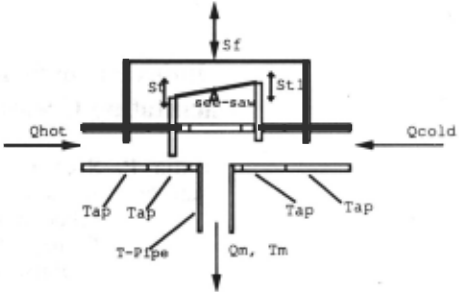
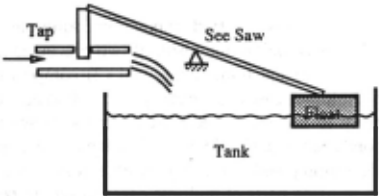
The relevance of the faucet case to the design of the flush tank would not have been possible to recognize because: (a) the functional descriptions of the two devices are com pletely different, and (b) the whole faucet is not relevant to the target problem. The relevance recognition process has two parts: similarity recognition and sub-behavior match ing. First. the goal specification is elaborated by applying transformation operators. This process, in essence, generates several alternative behavior descriptions that are equivalent to the original goal. These alternatives are then matched against the cases in memory. The matching process tries to find entire cases or parts of cases that share common "sub-behaviors" with the elaborated goal.
We present an approach to accomplish recognition of shared "sub-behaviors" based on behavior preserving trans formations that uses qualitative reasoning methods. The transformation is done in two ways: (a) If it is known what physical laws and principles are going to govern the solu tion, then the given goal is transformed by relying on the laws to achieve certain sub-behaviors. (b) If, however, the relevant laws are not known a priori, sub-behaviors are hypothesized and the case memory is searched to find ways in which the required behavior may be achieved. This is in contrast to other approaches that assume a priori knowledge of the domain laws and models that will be part of the solution [Williams 90]. If CADET cannot complete a design because it is not given the relevant physical laws, it hypothesizes new behaviors and looks for cases which em body those behaviors. The approach has the following ad vantages: (1) the system at each point in the search, is aware of what behavior it is trying to achieve, (2) because cases embody design opumtzations, the accessed com ponents correspond to already optimized physical struc tures, (3) solutions may involve the use of principles out side the current domain, that have been successful in a prior design, (4) the problem solver does not have to re-solve every problem from scratch.
3. Behavior Representation in the Cases
Device behavior is represented as a collection of in fluences organized in the form of a graph. The notion of influence graphs is a very general one. It applies to any domain in which behavior can be characterized as a set of quantities that relate to one-another. Given such an in fluence graph, it is possible to predict possible outcomes of given perturbations [Sycara 87].
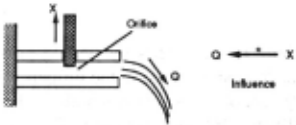
Consider, .for example, a gated water tap that has two inputs: a water source and a signal to regulate the rate of flow of water (Figure 3-1). The flow rate is given by Q and the position of the gate is given by X. The position of the gate controls the flow rate. This behavior is represented as an influence Q ~X. which is read as follows: "The flow rate (Q) increases ( +) monotonically with an increase in the signal (X)". This influence represents the "tap" principle.
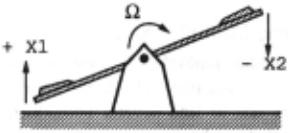
Sets of q~litative influences can be combined to capture the behavior of more complex devices. The see-saw shown in Figure 3-2 has three major behavioral parameters: n, the angular position of the see-saw and the positions of the two ends of the see-saw (XI and X2). The main influences are + . . - XI ~n , X2 ~ and X2 f--Xl . These influences form a directed graph.
3.1. Influence Graphs and Components
The various components of a design work together to deliver its composite behavior. The influence graph that describes the overall behavior has sub-graphs that cor respond to individual components. This provides a map ping between behavior and the structure of the case.
Let's re-consider the hot-cold water faucet (Figure 2-1). The behavior of this device can be represented as shown below (Figure 3-3). Two input signals Stand Sf control the mix temperature and the mix flow-rate. When St is increased, then the total quantity of hot water Qh increases. At the same time, due to the see-saw principle, the signal Stl decreases, causing the total quantity of cold water Qc to proportionately decrease.
Note also, that single and multi-influence subgraphs of the faucet's influence graph corresponds to the various components of the faucet. This information serves as handles for snippet (component) identification and extrac tion.
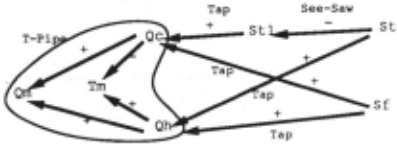
When this behavior representation is incorporated in a device case base, it becomes possible to retrieve cases which match given behavior specifications. If retrieval using the design specification fails to retrieve relevant cases, the system should be able to recognize how a com bination of component behaviors could produce the re quired effect This is done by transforming the indices. In the next section we will cover case indexing and retrieval, followed by a section on index transformation.
4. Case Retrieval
Most CBR systems retrieve cases using indices that match specific attributes about cases. In engineering design, the case matching problem includes matching graphs of influences. Behavior matching for case retrieval is carried out in several ways:
4.1. Abstract Matching
The nodes in the influences are matched using object and concept hierarchies. For example, the simple tap is described by the influence Q ~X. The node Q which is a flow of water is abstracted to be a liquid-flow, a material flow, and finally a design-parameter. The quantity X is a translatory-signal, a physical-signal, a signal, and fmally a design-parameter. Every design parameter is entered in such a hierarchy.
4.2. Matching a sub-part of a larger case
Design cases are often composed of many other cases (or parts thereof). Each part is indexed separately. For ex ample, the faucet is composed of a see-saw, a rigid-body, four gated-taps, and a right angle t-pipe. All these cases are indexed in an abstraction hierarchy. The gated-tap's abstractions are: a tap, a flow-control device, a hydro mechanical device, and finally a device. In addition to this hierarchy, each influence in the case's behavior graph is indexed in an Influence Hierarchy.
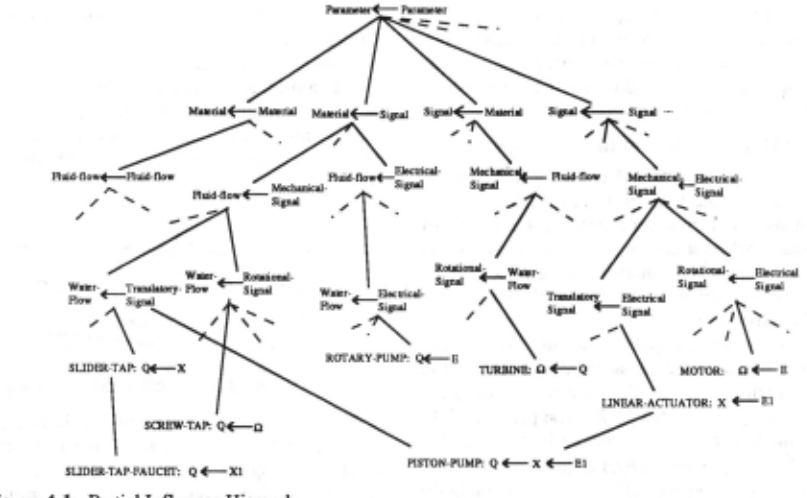
The root of the influence hierarchy is the most generic influence: Parameter~ Parameter. The parameters can be either materials, energy, or signals. This gives us nine possible influences. This hierarchy is expanded all the way down to the influences in the cases, thus providing a direct access into the innards of a case. A part of the influence hierarchy is shown below. The lowest level in the hierar chy points to actual cases or components inside cases. For example, the influence Qh ~Xl corresponds to the case: SLIDER-TAP-FAUCET which is a slider-tap inside the faucet case. Note that this is different from the general SLIDER-TAP case because the tap in the faucet has been modified to interface with other components in the faucet The behavior may look the same, but the cases are physi cally different. We will see, later, why this distinction is important to maintain.
When CADET is given an influence as a goal, it can retrieve all cases that contain the goal. This can include all cases that match an abstraction of the goal. For example, the influence Q ~ Y, can be abstracted to the influence Water-flow ~ranslatory-Signal. In this way, CADET is able to find components of larger cases that match a given goal specification, making it possible to find all "taps" in the case base, even if they are embedded in larger cases.
4.3. Multiple Influences in the Goal
The goal may consist of several influences arranged in the form of a graph. The aim of case matching is to fmd cases that have behaviors which correspond to the in fluences in the given goal.
The matching process starts by finding prior cases that contain the nodes (parameters) in the influence graph. This returns a large set of cases for each node in the goal graph. Next, the Influence Hierarchy is used. For each individual influence in the goal statement, the hierarchy is used to identify all the cases that contain that influence. An inter section of the sets of cases that match each influence and each node yields a smaller set of cases that contain the goal influences. This does not, however, guarantee that the topology of the influences in the cases will match that of the goal. The final step involves checking each of the retrieved cases for the goal graph. If the entire graph is matched, then the corresponding components in the case is extracted.
4.4. Matching Multiple cases
When a goal has multiple influences, it may not be pos sible to find one case that satisfies the entire goal. In this situation, one has to find several components (from dif ferent cases) that can be synthesized to yield a final design. The process is as follows: For each influence, we first iden tify sets of cases that contain that influence. These sets can be viewed as possible colors that can be assigned to the various links in the goal graph. The next step is to select a case for each influence, such that a minimum number of cases are required to cover all the influences in the goal. A heuristic, polynomial-time, algorithm is used to find par titions of the influence graph. The algorithm works as fol lows: first, the largest contiguous set of influences that share a common case name is identified; next, the set is removed from the graph; and finally, the process is repeated till no unassigned influences are left.
Reconsider the flush tank design problem. The overall goal is to achieve: Q f---D. Instead of this goal, assume we are given the following elaboration of subgoals: Q ~Mechanical-Signal ~echanical-Signal ~D. Each influence in the graph is used to identify relevant cases. In this instance, the influence: 9 ~Mechanical-Signal will match a regular tap, the tap m the faucet, and a pump. The next influence: Mechanical-Signal ~echanical-Signal would match a regular see-saw, the see-saw in the faucet, a pulley, and a wedge. The remaining influence will match a simple float. The only case that is common for the first two influences is the faucet. The resulting design (Figure 2-2) is composed of the tap and see-saw combination taken from the faucet, and a float.
4.5. Exploiting Novel Combinations
A question that is often asked about the Case Based Problem Solving approach is: "If design problems can be solved by finding and synthesizing components such as taps, levers, and gears; then why should be keep larger cases in memory? The component hierarchy should be suf ficient, why should the system have to find components embedded in the cases?"
In the mechanical design domain, cases provide useful sub-assembly "packages" of components. These sub assemblies can reflect good design principles. For example, components are often made to share functions and may in corporate decisions that take advantage of, or compensate for incidental components interactions. The components in a prior design are often coupled efficiently to work as a sub-assembly of the larger design. These components are structurally modified to appropriately mesh with one another. In addition, special connectors and fixtures may be used to interface the components. When a new design calls for the combination of two components behaviors, the modifications and interfaces need not be re-determined from scratch if relevant cases can be identified.
5. Index Transformation
In the example above, we said that the flush tank's goal behavior is given by a set of influences. If, however, we were only given the original influence Q ~. then it would not have been possible to recognize that the gated tap, the see-saw, and the float can be combined to solve the problem.
In our domain, it often happens that the goal description does not correspond to the appropriate cases in memory. A deliberate attempt has to be made to recognize what sub behaviors can achieve the goal and how these sub-behaviors can be physically realized. We approach this problem in two steps: (1) If the goal description fails to retrieve cases from memory; then the goal is elaborated using certain be havior preserving transformations. (2) The elaborated goal is then used as indices to find relevant cases. Index trans formation is a way to change the given salient features of the current problem to match the indices under which pre vious cases have been stored, thus making accessible to the problem solver previously inaccessible cases. The transfor mation technique described here is applicable to any domain in which behavior can be modeled as a graph of influences.
We will now examine two rules which are used to trans form given goals into more elaborate sets of influences that are behaviorally equivalent to the goal. The hypothesis is that, if one cannot find a case relevant to a given goal, then it might be possible to find several cases or parts of cases that are relevant to elaborations of the given goal.
Design Rule 1. If the goal is to have x influence z, and if it is known a priori that u influences z, then the goal could be achieved by making x influence u.
Design Rule 2. If the ·goal is to have x influence z and if it is known a priori that some two quantities p and q influence z then, the goal could be achieved by making x influence p or q, or both.
The two design rules transform a given influence into a more detailed set of influences that are behaviorally equiv alent to the original influence. In CADET, the transfor mation is done in two ways: (1) by using domain laws and, (2) by hypothesizing new variables.
5.1. Elaboration Using Domain Laws
The influences implied by domain laws may be used to elaborate given goals. For example, assume it is our goal to achieve the influence: z ~x. also assume that there are no known designs that can achieve this effect directly. If, however, there is some domain principle which states that some quantity u influences z, then the goal may be achieved by having x influence u. The goal is hence elaborated to: z ~ ~x. This new influence graph is used as a new index into the case base. If cases or part of cases with influences that match the goal are found, they are retrieved and used.
5.2. Elaboration by Hypothesizing new variables
If the given domain laws are unable to find elaborations that can be realized by the cases in memory, one can try to hypothesize variables. The idea is to hypothesize new in fluences and then find cases which may be used to achieve those influences. For example, the goal z ~x may be elaborated to z ~ar1 ~x using design rule 1. A new variable Var1 is hypothesized as an intermediary. The elaboration is then used to find cases in memory. This time however, the system looks for two influences which match the goal and bind the unknown variable V ar 1.
As new variables are introduced, corresponding new in fluences are hypothesized. In addition, as influences are all supposed to be based on physical laws or principles, the introduction of new variables implies that laws or prin ciples, unknown to CADET, are being hypothesized. After hypothesizing influences, the case base is used to find prior designs which may embody some physical law or principle that matches the hypothesized influence. With this approach, one often retrieves cases from outside the current design domain that are analogically related to the current design problem. It is for this reason that CADET's solu tions are innovative. Through the process of influence hypothesis and matching, the system is able to use physical laws and principles embedded in prior design cases to achieve its current goals.
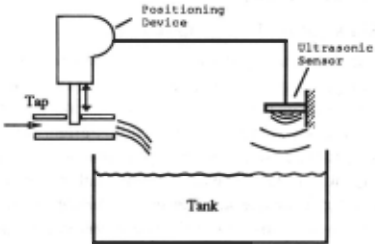
Let's return to the flush tank example. Another possible elaboration of the original influence for the flush tank is: Q~Var2~Var1~. The first influence Var1 ~D. says that as the water level increases, some quantity Var1 decreases. An ultrasonic distance measuring device, held over the water surface, could provide this be havior. The output of this device is an electrical signal. Let's call it Sig and bind it to Varl. The influence Q ~ Var2 matches a basic tap by binding Var2 to X (which is a linear movement). Finally, we are left with the influence X ~Sig which says that when an electrical sig nal increases a body moves linearly in the X direction. A positioning device with a linear ratchet and motor can provide this function. The resulting design is shown in Figure 5-1.
6. Conclusions
We have presented an approach to the conceptual design of mechanical systems using a case base of previous designs that realize subfunctions of the desired artifact. The process consists of applying behavior-preserving transfor mations, based on a qualitative calculus, to an abstract description of the desired behavior until a description is found that closely corresponds to some collection of relevant cases. The major benefits of the approach are: (a) it allows for retrieval of relevant cases and case parts based on behavioral thematic abstractions that enable use of cases from contexts other than hydraulics (e.g., electrical, electronic. chemical), (b) it does not impose a predeter mined decomposition of the design, (c) it is a generative approach that utilizes knowledge of design principles, such as simplicity, and behavioral constraints to reason from design goals to possible solution structures, (d) it can iden tify "missing" cases, necessary for completion of the design, and (e) the resulting transformations are guaranteed to be behaviorally equivalent to the original specification.
@inproceedings{ijcai1991p52,
  title     = {Index Transformation Techniques for Facilitating Creative Use of Multiple Cases},
  author    = {Sycara, Katia P. and Navinchandra, Dundee},
  booktitle = {Proceedings of the Twelfth International Joint Conference on
               Artificial Intelligence, {IJCAI-91}},
  publisher = {International Joint Conferences on Artificial Intelligence},
  editor    = {John Mylopoulos and Ray Reiter},
  pages     = {347--351},
  year      = {1991},
  month     = {8},
  note      = {Cognitive Modeling},
  url       = {https://ijcai.org/proceedings/1991/52},
}
TY - CPAPER TI - Index Transformation Techniques for Facilitating Creative Use of Multiple Cases AU - Sycara, Katia P. AU - Navinchandra, Dundee T2 - Proceedings of the Twelfth International Joint Conference on Artificial Intelligence, IJCAI-91 PB - International Joint Conferences on Artificial Intelligence PY - 1991 SP - 347 EP - 351 UR - https://ijcai.org/proceedings/1991/52 ER -Copied
Machine-readable versions of this paper, for tools and AI agents:





