
Learning to Classify Observed Motor Behavior
Proceedings of the Twelfth International Joint Conference on Artificial Intelligence. Learning Be Knowledge Acquisition. Pages 732-737.
© 1991 International Joint Conferences on Artificial Intelligence
Abstract
We present a representational format for observed movements The representation has a temporal structure relating components of a single complex movement. We also present OxBow, an unsupervised learning system, which constructs classes of these movements. Empirical results indicate that the system builds abstract movement concepts with appropriate component structure allowing it to predict the latter portions of a partially observed movement.
- Fisher, D. H. (1987). Knowledge acquisition via incre- mental conceptual clustering. Machine Learning, 2, 139-172.
- Fisher, D. H., & Langley, P. (1990). The structure and formation of natural categories. In G. H. Bower (Ed.), The psychology of learning and motivation: Advances in research and theory (Vol. 26). Cam- bridge, MA: Academic Press.
- Fisher, D. H., & Pazzani, M. (Eds.) (in press). Concept formation: Knowledge and experience in unsuper- vised learning. San Mateo, CA: Morgan Kaufmann.
- Gennari, J. H. (1990). An experimental study of con- cept formation. Doctoral dissertation, Department of Information & Computer Science, University of California, Irvine.
- Gluck, M. A., & Corter, J. E. (1985). Information, uncertainty, and the utility of categories. Proceed- ings of the Seventh Annual Conference of the Cog- nitive Science Society (pp. 283-287).
- Iba, W., & Gennari, J. H .. (in press). Learning to rec- ognize movements. In D. H. Fisher & M. Pazzani (Eds.), Concept formation: Knowledge and expe- rience in unsupervised learning. San Mateo, CA: Morgan Kaufmann.
- Iba, W., & Langley, P. (1987). A computational theory of motor learning. Computational Intelligence, 9, 338-350.
- Laird, J. E., Hucka, M., Yager, E. S., & Thck, C. M. (1990). Correcting and extending domain knowl- edge using outside guidance. Proceedings of the Sev- enth International Conference on Machine Learning (pp. 235-243).
- Mason, M. T., Christiansen, A. D., & Mitchell, T. M. (1989). Experiments in robot learning. Proceed- ings of the Sixth International Workshop on Ma- chine Learning (pp. 141-145). Ithica, NY: Morgan Kaufmann.
- Moore, A. W. (1990). Acquisition of dynamic control knowledge for a robot manipulator. Proceedings of the Seventh International Conference on Machine Learning (pp. 235-243).
- Rubin, J. M., & Richards, W. A. (1985). Boundaries of visual motion (MIT-AI Memo 835). Cambridge, MA: Massachusetts Institute of Technology.
- Smith, E. E., & Medin, D. L. (1981). Categories and con- cepts. Cambridge, MA: Harvard University Press.
References were extracted automatically from the PDF and may contain errors.
Full text extracted automatically from the PDF; figures, tables and equations may differ. The PDF is the version of record.
1 Introduction
Motor control is a necessary facet of an intelligent agent's interaction with the environment. Until recently, this topic has been largely ignored. We are encouraged by the interest demonstrated by a number of recent efforts aimed at learning sequences of operators that can control effectors external to the learning agent (Laird, Hucka, Yager, & Thck, 1990; Mason, Christiansen, & Mitchell, 1989; Moore, 1990). However, we believe that a general phenomenon in human motor behavior is that genera tion is limited by understanding; that skilled movement behavior must be understood or recognized before it can be generated. In this paper we present OXBOW, a sys tem that acquires knowledge structures that facilitate the recognition of observed movements. This system is the recognition component of MlEANDER, a larger model of motor-skill learning that also involves the generation of movements (Iba & Langley, 1987).
We view OXBOW within the paradigm of concept for mation (Fisher & Pazzani, in press), in that it is re quired to construct "concepts" for particular classes of movements it has experienced. The current work is a descendent of Gennari's CLASSIT (1990) and, in turn, of Fisher's COBWEB (1987). CL~SSIT extended CoB WEB to deal with attributes having continuous values and OXBOW extends CLASSIT to deal with structured objects with differing numbers of components. The com mon thread in OXBOW, CLASSIT, and COBWEB is the control structure of the learning algorithms and the op erators used to modify the knowledge structures. Also, they all use conditional probabilities in calculating the category utility function (Gluck & Corter, 1985). This paradigm assumes that storing the probabilities for a the arm. The sequence of state descriptions comprising a motor schema is temporally ordered according to the time values in each state description.
· Also affiliated with RECOM Technologies.
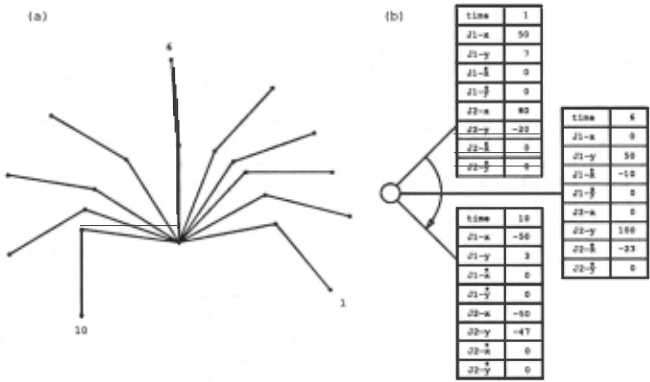
Figure 1 shows a pictorial rendition of a movement observed in the environment along with a corresponding motor schema. The positions of the arm in Figure 1(a) are sampled from equal time slices during the course of the movement. Note that the movement shows the po sition of the arm at every time step. In contrast, motor schemas specify arm positions only at a few time steps for a given movement. Thus, the schema shown in Figure 1(b) represents the movement shown in Figure 1(a), but only specifies information for the arm at three times. In our framework, movements and schemas are closely re lated. Although movements occur in the environment, OXBOW classifies and stores the parsed form of move ments - motor schemas.
When motor schemas are combined to form abstrac tions or generalizations, we think of the resulting struc tures as concepts. One way to represent concepts in this type of model is to use probabilities (Smith & Medin, 1981). A generalized motor schema includes a probabil ity distribution for each attribute describing the state of the arm, as well as a probability for each entire state. That is, OXBOW stores the conditional probability dis tribution of an attribute given a particular state descrip tion, and stores the conditional probability of each state description given a particular schema concept.
Given this format for representing motor schemas, these structures must be organized to allow retrieval of stored schemas. In OXBOW, motor schemas are orga nized into an IS-A hierarchy. Nodes in this hierarchy are partially ordered according to their generality, with concepts lower in the hierarchy being more specific than their ancestors. Thus, the root node summarizes all in stances that have ever been observed, terminal nodes often correspond to single instances, and intermediate nodes summarize clusters of observations. Fisher and Langley (1990) review arguments for organizing proba bilist ic concepts in such a hierarchy.
It is important to note that our representation of mo tor schemas as a sequence of state descriptions implies a structure on schema concepts. Each state description is viewed as "part of" the entire motor schema. This sig nificantly complicates the concept formation task. As a further complicating factor, two motor schemas will of ten have a different number of states. In partial response to this problem, OXBOW stores and organizes state de scriptions in an internal hierarchy of state descriptions within each schema node. Thus, each node in the schema hierarchy has its own private state hierarchy. The top level of this hierarchy represents the PART-OF relations between the multiple states and the schema as a whole. That is, the classes of states at the top level ~f the state hierarchy are the state descriptions comprising the mo tor schema and are ordered according to the values for the time attribute in each respective state description.
Figure 2 shows a possible hierarchy of baseball pitching schemas. The leaf nodes of the tree represent the motor schemas from specific observed pitches. The node labeled as "overhand" represents a generalization of the three specific throws stored below it in the hierarchy. This generalization is also a motor schema, but instead of specific values, the generalization stores means and vari ances for each of the attributes in its state descriptions. Looking more closely at the OVERHAND schema in Fig ure 2, we see the internal state hierarchy that captures the structure of the abstract schema. We also show the first state of this generalized motor schema where means and standard deviations have been stored for each of the attributes. These values summarize the states that have been classified together. Now, let us turn to a descrip tion of how these structures are constructed and modi fied based upon experience.
2.2 Forming movement concepts
The performance task stated above is closely related to OXBOW's learning task: given an experienced movement, modify the current knowledge base according to the re sulting classification. Movements are observed sequenfast-ball curve-ball fork-ball tially and are not labeled; this corresponds to an in cremental, unsupervised learning task. The distinction between performance and learning in OXBOW (and sim ilar systems) is slight and only serves to clarify a means for evaluating the overall system's ability to acquire and organize movement information. We will return to this in Section 3; here we focus on the learning method.
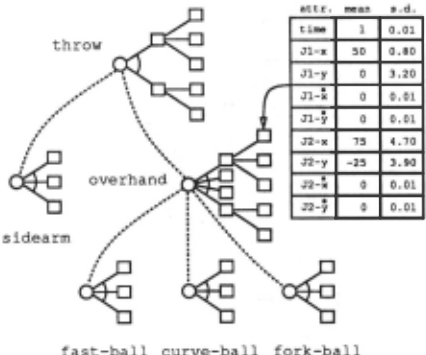
Figure 2. A hierarchy of motor schemas for baseball pitches, with one node shown in detail.
2.2.1 The classification mechanism
Table 1 presents the basic OXBOW learning algorithm; at this level of description it is functionally equivalent to that used in Fisher's (1987) COBWEB and Gennari's (1990) CLASSIT. In these concept formation systems, the classification and hierarchy formation processes are tightly coupled. Upon encountering a new instance I, the system starts at the root and sorts the instance down the hierarchy, using an evaluation function (described below) to decide which action to take at each level. This recursive algorithm terminates when the instance has been recognized. This occurs either when the current node is a leaf (has no children), or when the evaluation function already has a sufficiently high value that fur ther efforts are deemed unnecessary. 2 When an instance has been recognized, the current node is returned as the classification value for the instance.
At a given node N where the instance I is still un recognized, the algorithm decides among four options. First, the instance is temporarily incorporated into a child of N, one at a time. The resulting partitions are evaluated and the best is selected. Second, the instance is placed in a new singleton class and this new partition is also selected. The third and fourth candidates gen erated by the merge and split operators are intended to allow the system to recover from poor hierarchies that may result from peculiar training orders; Fisher (1987) gives details on these operators. The algorithm uses its evaluation function to determine which of the resulting four partitions is "best", and then either continues by recursively classifying the chosen best, or stopping and Table 1. The OXBOW algorithm.
2 This decision is based upon the recognition criterion de scribed in Gennari (1990) .
Function Oxbov(instance, concept), if leaf?(concept) or recognized?(instance,concept) then stop and return(concept) else for each child of concept compute score for Incorporate(instance,child) let best be the child vith the best score let second be similarly the second best compare best vith the evaluations of: self create nev child vith instance and call it merge(best, second) split(best) let selected-child be the best respective evaluation if selected-child · self then stop and return(concept) else call oxbov(instance, selected-child)returning the current node as the classification whenever the instance is placed in a new child.
2.2.2 The evaluation function
We have mentioned that OXBOW uses an evaluation function to determine the appropriate branch to sort new instances down during classification. Since a major goal of concept formation is to let the agent categorize new experience and make predictions, the system employs category utility - an evaluation function that attempts to maximize predictive ability. Gluck and Corter (1985) originally derived this measure from both game theory and information theory in order to predict basic-level effects in psychological experiments, and Fisher (1987) adapted it for use in his COBWEB model of concept for mation. The measure assumes that concept descriptions are probabilistic in nature, and it favors clusterings that maximize a tradeoff between intra-class similarity and inter-class differences. Initially formulated for nominally valued domains, Gennari (1990) extended the equation to handle attributes with continuous values. In turn, we have extended the equation to handle representations where objects consist of differing numbers of compo nents. This version of category utility for real-valued attributes and structured objects can be stated as
where P(C~c) is the probability of class C, K is the num ?er of classes at the current level of the hierarchy, P(Skj) 1s the p~obability of the jth state description in C~c , P(Spm) 1s the probability of the mth state description in the parent of the current partition, Ukij is the standard deviation of attribute i in the jth state of the kth class and Upmi is the standard deviation for attribute i in th~ mth state of the parent node. 3
3 The value of 1/u is undefined for a single instance with zero variance so an acuity parameter serves as the minim urn variance. Gennari (1990) presents an empirical study of the this parameter's impact on performance.
2.2.3 Incorporating motor schemas
Every concept formation system must address the is sue of how to create an abstraction from two items - in this case a new instance and an existing class. The abstraction, or the result of incorporating a number of instances, allows useful predictions to be made in the future. Because CoBWEB assumed that every instance had values for every attribute, incorporating a new in stance was a simple matter of incrementing appropri ate attribute-value counts in the concept node according to the values in the instance. CLASSIT extended this to allow objects made up of multiple components, but each had to have the same number. That is, there was a single structure for the objects in every class. The problem for OXBOW is that motor schemas may have differing numbers of components, and neither COBWEB or CLASSIT have satisfactory mechanisms for handling this variation of the task. In this situation, there is not necessarily a one-to-one correspondence between states from one schema to the next. Therefore, it is not pos sible to uniquely associate the attributes (at the state description level) from one schema to another.
OXBOW's solution to this correspondence problem uses category utility to form a hierarchy of state descrip tions based only on the time attribute. By treating each state in a schema instance separately in this fashion, an effective mapping is established between states in the in stance and states stored in memory. This mapping may be many-to-one or one-to-none. 4
Thus, the system classifies both schemas and states, using the same algorithm given in Table 1, but with two important caveats. First, if the instance is a schema, then each of its states is incorporated in the hierarchy of state descriptions associated with the current schema node. But if the instance is a state, then there is no cor respondence problem and the incorporation is done the same as in CLASSIT or COBWEB. The second distinc tion is that if the instance is a state, then the evaluation function used in the algorithm is simplified. Because we are interested in capturing the temporal structure that is present in the schema instances, only the time attribute is considered instead of summing over all the attributes to determine the score. However, all of the attributes that describe a state are updated when a new state is incorporated.
Since schemas are made up of the top-level nodes in the state hierarchy, we may think of the first level of this hierarchy as capturing the PART-OF structure for the schema. The PART-OF relation refers to an outer context, in this case the entire motor schema. Because OXBOW's motor schemas are presented as parsed structures that are related temporally, it can break the schema into its parts, treat the parts separately, and then pop back up to the context of the schema where the work of matching the parts has already been done.
'A one-to-none mapping occurs when a state in the in stance does not correspond to any existing states in the con cept and a new state is added to the schema concept.
3 The Performance of OXBOW
OXBOW provides a method for representing jointed limb movements and for acquiring a concept hierarchy of movement concepts. Naturally, before we can make con clusions about the usefulness of such a system we need to know how well the system operates and improves on some performance task. In this section we present our performance measure and several experiments demon strating that OXBOW can recognize (and improve its recognition of) observed movements.
The performance task for OXBOW is to classify a newly presented movement given some existing concept hierar chy. As discussed above in the context of learning, this involves associating the new instance with a node in the hierarchy representing previously observed movements that are most similar to the new movement. In hu mans, classification and learning occur simultaneously. However, we have implemented OXBOW to allow classi fication without modifications to the concept hierarchy. That is, we use a trimmed version of the learning algo rithm which does not consider tree modification opera tors and which does not alter the contents of the nodes in the tree.
We evaluate the system's performance on the above task by comparing a test instance to the movement de scribed at the node of the schema hierarchy where the test instance is classified. This comparison is performed by finding the Euclidian distance between correspond ing joints of the arm at a given time. We average over the joints of the arm and over the testing movement pe riod. The error scores we report in the following exper iments reflect this averaging over joints and simulated time slices. The units are for an arm with two joints operating in a reachable workspace of 100 unit radius.
3.1 Experiment 1: Learning single movement concepts
Recall that OxBow's representation of movements (as schemas) consists of parts (states) and the temporal re lationships among them. The learning algorithm consid ers schemas first as a set of individual states at the state hierarchy level and then as a sequence at the schema hi erarchy level. One of the first things we should verify is that the inner treatment - the determination of the PART-OF structure for the movement concept at large - is behaving appropriately. Therefore, in our first exper iment we trained the system on instances from a single concept, so as to control for possible confusions between movements of different types. This should also let us determine how sensitive the system is to variance in the observed data.
To this end, we created four artificial movements that correspond to a slap, a throw, a wave, and a salute. Ob served movements in this experiment (and those follow ing) were produced by motor schemas instantiated from the templates. The time, position, and velocity values in a motor schema used for training were drawn from normal distributions given in a template. We adjusted the variance of the distributions by a scalar to produce data sets with different levels of variability.
In this experiment, a single run tested one movement type over 20 blocks with 15 learning trials in each block. We repeated runs at four different levels of variation for each of the four movement types and measured the sys tem's performance after every other learning triaL The performance metric compares the prototype with the schema stored at the root node of the schema hierarchy. Because there is only one movement type presented in a run, and the root represents the summary over all the observed instances, this comparison lets us control for possible retrieval problems. The results indicated that error decreased as a function additional movement ob servations for each of the schema types at all levels of variation. However, we note that the asymptotic levels increase as a function of variability. These results in dicate that OXBOW has trouble finding the central ten dency in domains with high variance. Because the data comes from a single prototype, we would expect that the prototype would be recoverable. This could either be due to problems determining the values within the states of the learned motor schemas, finding the correct structure of states themselves, or a combination of both.
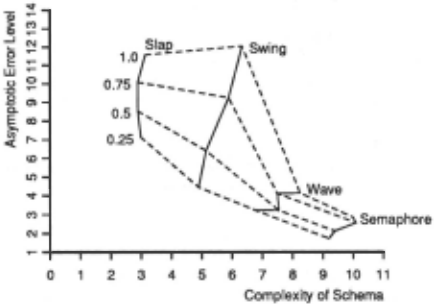
To help clarify this issue, Figure 3 shows the asymp totic error levels for each movement type as a function of the structural complexity inherent in the data. Ad ditionally, it shows how the asymptote and complexity changes for the different levels of variation in the data. We define complexity as the number of states in a parsed description of an observed movement. For a given move ment type and a single level of noise, we computed the average complexity over 20 randomly generated move ment instances.
From this graph we see that changing the variability in the generated movements does not cause large changes in the structure of the parsed movements. We can conclude that the increased asymptote levels as a function of in creased variation are not a result of a failure to determine the appropriate PART-OF structure for the movement concept. but rather to problems determining the cor rect values within the states. We are looking at ways to improve this situation. However, this figure also reveals an unexpected result - that increasing complexity tends to decrease asymptotic error leveL This non-intuitive result is not without precedent; for instance, VlSlon re searchers found that more complexity in the environ ment made things easier to disambiguate. This would suggest that OXBOW could scale up to more complex environments and movements. We are currently consid ering these issues further to determine where to assign credit and blame, and how extensible our methods are.
Overall, this experiment indicates that OXBOW is able to capture the PART-OF structure found in observed movements when faced with only a single type, but that its ability to form accurate state descriptions is influ enced by variability. Now let us turn to the larger prob lem of acquiring movement concepts from observed data when presented with instances of more than one type.
3.2 Experiment 2: Learning multiple movement concepts
If we had first tested OxBow on acquiring multiple con cepts simultaneously, we would not have known whether performance errors were caused by confusions between categories when classifying an observed movement, by problems identifying the appropriate PART-OF structure for a particular node in the hierarchy, or both. The pre vious study established a baseline for comparison. We can expect that errors above and beyond those reported in the previous section are a result of classification errors.
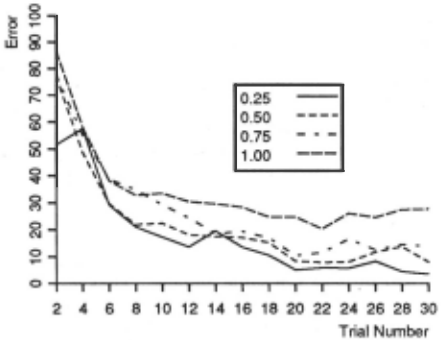
To study such errors, we ran a second experiment in which OXBOW observed movements from all four of the classes, each with an equal likelihood. We presented 30 training instances, from which the system constructed its hierarchy of movement concepts. After every other training instance, we stopped learning and tested the system's performance as d~scribed above. We repeated this experiment at the same four levels of variation in the movement generators. Figure 4 shows the average error (over the four movement types), again as a function of experience and variance leveL The errors are averaged over ten blocks of 30 training instances with random or ders of the movement types.
The figure gives some indication of how well OXBOW is distinguishing between observed movements of differ ent types, even though after 30 training instances the system has only seen (on average) one fourth that many training instances of each type. Table 2 shows a com parison between the performance after 30 training in stances from Figure 4, under mixed training, and the performance level after seven training instances in Fig ure 3, under separate training. This reveals an inter action between the training method (mixed/separate) and the variability in the domain; increased variability has a much greater impact on error when learning mul tiple concepts than when learning single concepts. In Experiment 1, we were able to control for retrieval er rors because only a single movement type was given. In this experiment, we relied on OxBow's retrieval mecha nism and therefore increased errors could be attributable to misclassifications during either training, retrieval, or both. One option to clarify this would be to repeat Ex periment 1 and rely on OXBOW's retrieval mechanism, but another option is to evaluate the retrieval mechanism in isolation as we report in the next section.
| Variability level | ||||
|---|---|---|---|---|
| 1.0 | 2.0 | 3.0 | 4.0 | |
| Separate Training | 4.20 | 5.48 | 6.74 | 8.04 |
| Mixed Training | 3.46 | 8.03 | 13.88 | 26.20 |
3.3 Experiment 3: Predicting unseen movement
In the previous experiments, the performance measure corresponded to what has been termed recognition in the psychological literature. That is, the complete pro totype of a particular movement class was classified and a comparison was made across the entire duration of the movement. In real life, one would more likely observe a partial movement and need to predict the continuation of the movement. Furthermore, this puts a strain only on the retrieval mechanism, allowing an assessment of its performance.
Thus, in a third experiment, we trained OXBOW as described before, but we altered the performance mech anism slightly. When testing, we presented only a por tion of the prototype movement and we measured er ror over the remaining unobserved movement. Because we average over time when determining error, we can compare errors among different ratios of observed move ment to predicted movement , even though the number of predictions changes. Any differences in errors will be attributable to classification problems during retrieval because the knowledge base is the same for each level of observation at a given point in training.
This formulation of the task suggests a prediction: as less of the movement is observed, classification should become more difficult and mistakes should lead to greater measured error. Simply stated, the more one is able to observe, the less uncertainty there should be about succeeding movement. Figure 5 shows the learn ing curves from an experiment in which we varied the portion of the movement to be predicted. We fixed the variation level at 0.5 and averaged the results over ten blocks of 30 training instances each.
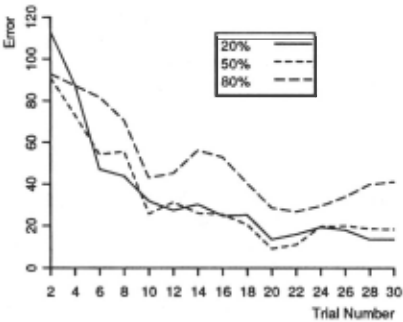
The figure shows that when OXBOW is predicting 80% of the movement (observing only the first 20% of the movement) the errors are consistently the highest (ex cept very early in training, when not all the movement types have yet been seen). However, there is little differ ence between observing 50% of the movement and ob serving 80%. This result suggests that the system is not adversely affected by having less information avail able for classification except in extreme cases like the 80% condition. This leads to another prediction: as the training data becomes more variable, the system should require larger portions of the test movement in order to prevent the error from increasing. We intend to test this prediction in future work.
More important, this experiment holds other factors constant while varying the amount of information in the test movement, thus indicating the sensitivity of the classification process during retrieval. The results sug gest that OXBOW is not readily making misclassifications when given partial structures in the input. Again, this points towards problems with the mechanism for storing state descriptions when learning from new experience. We are pursuing avenues to clearly establish and to im prove this situation.
4 Discussion
We designed the OXBOW system to address issues in both concept formation and the recognition of motor be haviors. With respect to the first area, we must conclude that although OXBOW presents a novel approach to ac quiring structured concepts, it has two drawbacks. Al though the system shows significant improvement when learning multiple concepts, the interaction effect in Ex periment 2 shows that OXBOW has difficulties forming generalized motor schemas from schemas having signifi cant variation among them. Second, the natural exten sion to objects with multiple levels of structure would require prohibitive amounts of memory and processing. However, we believe that the significant structural as pect of representing movements is timing information, so that only a single level of components is necessary in this domain. With respect to motor behavior, OXBOW
represents the first system that specifically addresses the recognition of movements, so it is difficult to asses its weaknesses in this area. However, the current implemen tation is sensitive to the values in the state descriptions with respect to scale and rotation of the observed action. We have several ideas on a normalization mechanism to address these problems and do not view them as funda mental flaws.
In addition to extending the implementation to nor malize the representation of movements for differences in scale and rotation, we plan to apply OXBOW, as a movement recognition system, to the task of signa ture recognition. Because our approach is intimately tied to movements and not to static pattern recognition, we think there are potential advances in this direction. There also is a direct application of movement recogni tion in domains where humans and robots are working together; the artificial agent should be able to infer goals and plans held by the human from observing and recog nizing her actions. Following on our efforts at modeling human motor behavior (Iba & Langley, 1987), we seek to connect OXBOW's predictions about movement recog nition to the psychological literature on this subject. As a method for concept formation, OXBOW suggests a con nection between IS-A and PART-OF relations by using a concept formation mechanism to extract the structure of a composite concept. We want to analyze this connec tion to determine its implications for concept formation in domains with more complex structure. As part of the ongoing experimentation mentioned in the previous section, we also intend to compare OXBOW with other approaches to forming structured concepts.
In closing, OXBOW makes an important contribution to the area of concept formation; it provides an interest ing approach to the problem of acquiring concepts from objects composed of parts. The experiments indicated that the system was able to extract appropriate PART-OF structures, but it was not immune to confusions in do mains with high variability. More important, as a motor skill system, OXBOW provides an approach to represent ing, recognizing, and organizing motor skills that are observed by an agent. In addition, the method is flexi ble with respect to environmental characteristics such as the number of joints in an arm or the number of arms operating in concert. Furthermore, the system's repre sentation and organization carries over smoothly from recognition to generation of motor skills (Iba & Lang ley, 1987). We hope that this effort will contribute to the growing interest in motor control, but also that it will spark new interest in treating motor behavior as a broader two-part process - recognition and control.
Acknowledgements
We thank J. Allen, J. Gennari, P. Langley, K. Thompson, J. Bresina, P. Friedland, and G. Iba; each contributed by one or more of: (a) participating in discussions that led to many of the ideas here, (b) commenting on an earlier draft, and (c) providing assistance formatting the figures and tables.
@inproceedings{ijcai1991p107,
  title     = {Learning to Classify Observed Motor Behavior},
  author    = {Iba, Wayne},
  booktitle = {Proceedings of the Twelfth International Joint Conference on
               Artificial Intelligence, {IJCAI-91}},
  publisher = {International Joint Conferences on Artificial Intelligence},
  editor    = {John Mylopoulos and Ray Reiter},
  pages     = {732--737},
  year      = {1991},
  month     = {8},
  note      = {Learning Be Knowledge Acquisition},
  url       = {https://ijcai.org/proceedings/1991/107},
}
TY - CPAPER TI - Learning to Classify Observed Motor Behavior AU - Iba, Wayne T2 - Proceedings of the Twelfth International Joint Conference on Artificial Intelligence, IJCAI-91 PB - International Joint Conferences on Artificial Intelligence PY - 1991 SP - 732 EP - 737 UR - https://ijcai.org/proceedings/1991/107 ER -Copied
Machine-readable versions of this paper, for tools and AI agents:





