
Automated Synthesis of Constrained Generators
Proceedings of the Eleventh International Joint Conference on Artificial Intelligence. Machine Learning. Pages 583-588.
© 1989 International Joint Conferences on Artificial Intelligence
Abstract
Knowledge compilation is an emerging research area that focuses on "compiling" a problem solver's inefficient, explicit knowledge representation into more efficient, implicit forms. This paper presents a technique that transforms a declarative problem description (specifying the problem but not how to solve it) into a reasonably efficient, generate-and-test problem solver. Our technique performs constraint incorporation, modifying the parameter generators so they only generate values that satisfy the problem constraints. Successful constraint incorporation depends upon choosing the right solution representation (i.e., the set of parameters). Having expressed a constraint in terms of a particular set of parameters, incorporation fails if the constraint is not factorable into constraints on the individual parameter generators . RICK, a Refinement-based constraint Incorporator for Compiling Knowledge, is a prototype program that compiles a problem specification into a problem solver using least commitment, topdown refinement to achieve constraint incorporation. RICK refines an abstract solution representation to avoid premature commitment to representations that hinder constraint incorporation. RICK is able to incorporate local constraints that constrain relatively small portions of the entire solution. We have tested these ideas by having RICK automatically construct a house floor planning problem solver.
- [Braudaway, 1988] W. Braudaway. Constraint incorpo- ration using constrained reformulation . Technical re- port LCSR-TR-100, Dept. of Computer Science, Rut- gers Univ., April 1988. thesis proposal.
- [Cohen, 1986] D. Cohen . Automatic compilation oflog- ical specifications into efficient programs. In Proc. of AAAI-86, pages 20-25, Philadelphia, PA., August 1986. AAAI.
- [Dietterich and Bennett, 1986] T . Dietterich and J. Bennett. The test incorporation theory of prob- lem solving (preliminary report). In Proceedings of the Workshop on Knowledge Compilation, pages 145-161, Oregon State Univ., September 1986. AAAI, Oregon State Univ.
- [Dietterich (ed.), 1986] T. Dietterich (ed .) . In Proceed- ings of the Workshop on Knowledge Compilation. AAAI, Oregon State Univ., September 1986.
- [Korf, 1980] R. Korf. Toward a model of representation changes. Artificial Intelligence, 14(1):41-78, 1980.
- [Mostow, 1988] J. Mostow. A preliminary report on clio- genes: Progress towards semi-automatic design of spe- cialized heuristic search algorithms. In Proceedings of the Workshop on Automated Software Design, St.
- Paul, MN. , August 1988. AAAI.
- [Smith, 1988] D . Smith. Kids : a knowledge-based soft- ware development system. In Proceedings of the Work- IJhop on Automated Software Design, St . Paul, MN ., August 1988. AAAI.
- [Steier and Kant, 1985] D. Steier and E. Kant. The roles of execution and analysis in algorithm design . IEEE Transactions on Software Engineering, SE- 11(11) :1375-1386, November 1985.
- [Tappe!, 1980] S. Tappel. Some algorithm design meth- ods. In Proc. of AAAI-80, pages 64-67, Stanford Univ., August 1980. AAAI.
- [Tong, 1986] C. Tong. KBSDE: An environment for de- veloping knowledge-based design tools. In T. Diet- terich, editor, Proceedings of the Workshop on Knowl- edge Compilation, pages 127-138, Oregon State Univ., September 1986.
- [Van Baalen, 1988] J. Van Baalen. Overview of an ap- proach to representation design . In Proc . of the AAAI-88, pages 392-397, St.
- Paul, MN. , August 1988.
- A A AI. [Voigt, 1989]
- K . Voigt. Automa ting the construction of patchers that satisfy global constrain ts . In Proc. of IJCAI-89, Detroit, MI., August 198 9.
References were extracted automatically from the PDF and may contain errors.
Full text extracted automatically from the PDF; figures, tables and equations may differ. The PDF is the version of record.
1 Introduction
Many AI systems perform run time evaluation of ez plicitly represented domain knowledge to find a solution to a problem. Such systems make a particular tradeoff between the "explicitness of the representation and the efficiency of the computation" [Dietterich (ed.), 1986]. Explicitly represented knowledge is easier to gather, but more costly to evaluate. This observation has spawned a research area called knowledge compilation, which in cludes methods for "compiling" an inefficient, explicit knowledge representation into more efficient, implicit forms. T_he. work described in this paper is bein9 con ducted w1thm the context of the KBSDE project lTong, 1986]. The purpose of the project is to develop compila tion techniques whose input is a declarative problem de scription that does not specify how to solve the problem. The problem description includes a set of problem con straints that must be satisfied by a solution. The compi lation techniques we are developing produce a generate and-test problem solver. Such a problem solver must generate a solution that passes a set of tests, one for each problem constraint. We have attempted to develop a compilation method that places as few requirements as possible on the domain, so that the method is broadly applicable. Thus, we have made the very weak require ment that the problem be solvable using a generate-and test algorithm. In addition to insisting that our compiler be general, we have also required that it produce reason ably efficient algorithms.
Like computer language compilers, knowledge compil ers can use optimization techniques to improve the per formance of the resulting problem-solving system. One optimization technique for a generate-and-test architec ture is test incorporation [Dietterich and Bennett, 1986]. Test incorporation involves test movement, constraint in corporation, or both. Test movement regresses tests back into the generator process to achieve early pruning with out affecting the correctness of the problem solver. Con straint incorporation [Tappel, 1980] modifies the gener ator so that it enumerates only those values which sat isfy a particular problem constraint; we will call such a generator a constrained generator. The test correspond ing to the incorporated constraint can be removed from the generate-and-test problem solver . Constraint incor poration reduces the size of the problem solver's search space and results in a more efficient problem solver. Constraint incorporation makes use of explicitly represented domain knowledge (e.g., specifications for system com ponents), thus distinguishing it from more conventional code optimization approaches which rely solely on syn tactic knowledge (e.g., data dependencies among system components).
This paper focuses on constructing constrained gen erators of hierarchical solutions, i.e., solutions that have parts (e.g., a house with rooms). Hierarchical solutions can be generated using correspondingly hierarchical gen erators (e.g., Figure 3). That is, solution parts are gen erated by sub-generators, and primitive solution param eters are assigned values by parameter generators. A particular &olution repre&entation is defined by a set of primitive parameters. To incorporate a constraint into a hierarchical generator requires that it be localizable to and incorporated in one or more of the (primitive) pa rameter generators. Incorporating constraints is difficult when the solution representation is "inappropriate". A constraint expressed in terms of a particular solution rep resentation can have a structure that does not "match" that of the generator; that is, the constraint may not be factorable into constraints on the individual parame ter generators . We will call this difficulty the structure mismatch problem. This paper demonstrates a system which incorporates the constraints while avoiding this structure mismatch problem. RICK, a Refinement-based constraint Incorporator for Compiling Knowledge, is a prototype program that compiles a problem solver using least commitment, top-down refinement to achieve con straint incorporation. The least commitment approach helps to avoid a premature commitment to a representa tion that may lead to the structure mismatch problem.
Section 2 of this paper defines the class of domains for which our method applies and illustrates an example from this class: the house floor planning domain. Sec tion 3 illustrates the structure mismatch problem in the house floor planning domain. The fourth section dis cusses the concepts behind our approach and illustrates their implementation in RICK. We compare our work with related research in Section 5. Finally, Section 6 summarizes the paper and some of the limitations of our approach.
2 The problem domain
Parameter instantiation design problems. The KBSDE project has focused on design domains where the problem solver constructs an artifact that satisfies a set of problem constraints. Many design problems can be viewed as parameter instantiation problems. The hierar chical &tructure of the artifact is usually pre-determined for a class of parameter instantiation problems; for in stance, all house floor plans consist of rectangular rooms, which, in turn, consist of sides and corners . The de sign task remaining for the problem solver is to "fill in" and "interconnect" the structure by assigning values to the unspecified artifact parameters in a way that is con sistent with the problem constraints. RICK constructs a problem solver for parameter instantiation problems whose solutions are composite objects (e.g., house floor plans) . The problem constraints are presumed to be
- SCI. SIDE MAGNITUDE. Each side of a room must have a minimum magnitude of 4 feet.
- SC2. INSIDE HOUSE. Each room must be inside the house.
- SCJ. SIDE ADJACENCY. Each room must share a side with a house side.
- SC4. NON-OVERLAPPING. No two rooms may overlap.
- SC5. FILL HOUSE. The set of rooms must fill the house.
Figure 2: Constraints defining acceptable floor plan so lutions.
hard constraints that define feasible solutions (rather than soft constraints that define the relative optimality of feasible solutions). We also presume that the design problem is not over-constrained: a solution that satisfies all the constraints can be found.
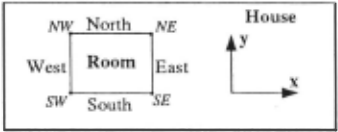
A house floor planning domain. To illustrate our ideas, we will use the parameter instantiation problem of constructing "house floor plans". A house floor plan is a two-dimensional, rectangular house placed at the origin of an x-y grid and having rectangular rooms as parts; such a floor plan is abstractly depicted in Figure 1. All lengths and coordinates are multiples of 1 foot. The solu tion is a floor plan that contains a problem-specific num ber of rooms, and satisfies all of the problem constraints shown in Figure 2. Constraints SCI, SC2 and SC3 are "local" constraints since they constrain each individual room. Constraints SC4 and SC5 are more "global," con straining pairs ofrooms, and all rooms, respectively. Our examples will focus on the incorporation of the local con straints.
3 Constraint incorporation and representation shift
A simple but inefficient generate-and-test. A sim ple, hierarchical, generate-and-test problem solver for the floor planning domain is shown in Figure 3. The generator creates a candidate solution containing de scriptions for each of the n rooms specified by a par ticular problem. Each room is generated by assigning values to its parameters using the initial representation: {z,y) (location of the SW room corner), l (length in the z direction), and w (width in the y direction). The generators are invoked in a particular sequence (e.g., z -+ y -+ l -+ w) . After all the generators have been invoked, the testers evaluate the candidate solution for satisfaction of the problem constraints. A failure of any test results in chronological backtracking through the generator sequence so a new candidate solution can be generated.
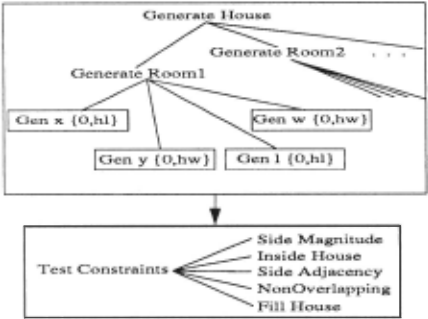
For a 9x9 foot house with 4 rooms, this problem solver (Figure 3) has a generation space containing 10 16 candi date solutions ( 4 rooms, each having 4 parameters that each range over 10 values). Only a small number of these are acceptable solutions (that satisfy constraints SC1SC5). In a solution for this problem, each room is in a house corner; One room has 4 possible sizes (l = 4 I 5 and w = 4 I 5); its two adjacent rooms have only two possible sizes ( w = 4 I 5 for one, l = 4 I 5 for the other); the final room fills the remaining area. Thus there are 16 = 4 x 2 x 2 x 1 different room configura tions. These rooms can be labelled R1, ... ,R4 in 4! differ ent ways. Thus the total number of acceptable solutions is 16 x 4! = 384.
Assuming a uniform distribution of acceptable solu tions in the space of candidate solutions, the generate and-test problem solver will generate roughly 10 16 + 384 = 2.6 * 10 14 candidates before finding a solution. This problem solver is very inefficient.
The structure mismatch problem. We use con straint incorporation to improve the efficiency of the problem solver. For example, constraint SC1 is easily incorporated by changing the lower bounds of the length and width generators from 0 to 4. The candidate solu tions that violate SC1 will not be generated; this leaves a search space of roughly size 1.7 x 10 14 candidate solu tions ( 4 rooms, each having 4 parameters, 2 ranging over 10 values, and 2 ranging over 6 values).
Unfortunately, incorporating a constraint can be diffi cult when the problem constraint on the entire solution cannot be partitioned into constraints on individual pa rameter generators, as we have just done. This case can occur when an inappropriate solution representation is chosen. For example, representing rooms by the four parameters < z, y, l, w >hinders incorporation of the "Side Adjacency" constraint (SC3) that "all rooms share a side with a house side:"
1 The hl (the house length value in the x direction) and h w (house width value in the y direction) are parameters whose values are problem-specific.
Assuming the "Inside House" constraint (SC2) has al ready been incorporated, the "Side Adjacency" con straint simplifies to:
This constraint implies that a room must either have its west side on the west side of the house, or its north side on the north side of the house, etc. Because this constraint refers to all the room parameters, and is a disjunction (when expressed using this room representa tion), there is no easy way to factor it into constraints on the individual room parameters. Because of the struc ture mismatch problem in this case, incorporation fails.
Constraint incorporation as representation shift. Note, however, that the constraint refers to the containment (segmentof) of a room side within a house side. A more appropriate solution representation would have represented a room rectangle by two perpendicular "side objects" (each "side object", in turn, having a loca tion and a length). Given this representation, we could incorporate the "Side Adjacency" constraint by simply modifying the generator of one room side so as to place it along one of the four house sides.
Our example suggests an obvious method for incor porating a constraint: shift the representation of either the constraint, the generator or both, until incorporation succeeds. Unfortunately, the space of alternative repre sentations is rather large. Also, the need to incorporate multiple constraints into a single generator means that the method must find a single representation that en ables incorporation of all the constraints. Problem refor mulation is a difficult research problem with many unre solved issues [Korf, 1980]. In the next section, we present an alternative approach for knowledge compilation that reduces the combinatorial explosion when searching a space of representations.
4 Knowledge Compilation as Incremental Constraint Incorporation
4.1 Viewing Constraints as Generators of Partial Solutions
Construction of the inefficient, generate-and-test prob lem solver depicted in Figure 3 was based on viewing a problem constraint as a test on complete solutions. In contrast, our constraint incorporation approach (imple mented in the RICK program) is based on viewing a constraint as a constrained generator of partial solutions. For example, the "Side Adjacency" constraint (SC3):
can be re-expressed as a partial room generator Gp(SC3) 2 that constructs only a single room side (on the house boundary):
Select a House Side, HS, from {W, N, E, S} Generate a Room Side, RS, from {W, N, E, S} n SidesParallelTo(HS) with Corners E Points(HS)
In contrast, a generator of complete :rooms would con struct complete 4-sided rooms. Generator Gp(SC3) is con.!trained since it only generates (partial) solutions that satisfy the Side Adjacency constraint.
Generator Gp(SC3) is expressed in terms of abstract objects such as room sides and house sides, instead of primitive parameters such as x, y, l, or w. This formu lation of the generator is motivated by the constraint itself, which only specifies these abstract objects, and makes no commitment to their primitive parameter rep resentation. Several representation alternatives are usu ally possible; to unnecessarily commit to a particular one might make incorporation of other constraints difficult or impossible (due to the structure mismatch problem).
In short, to facilitate a least commitment approach, the constraint should be re-expressed as a "partial solu tion generator" that is:
- partial. It only generates those parts of the (hierar chical) solution specified in the constraint.
- abstract. The generated parts are expressed in terms of abstract objects.
Which constraints can be re-expressed in this way? Almost by definition, in order for a constraint to be re expressible as a generator of partial solutions, it must be a "local" constraint; that is, it must constrain only a part of the solution. This paper summarizes how RICK incorporates the three constraints SC1-SC3 (Figure 2) that are local to individual :rooms.
4.2 Extending this Idea into a Complete Method
The following observations will help motivate the exten sion of this idea into a complete method:
- (PARTIAL) By construction, the partial solution generator Gp( C) only generates solutions that sat isfy the constraint C.
- (EXTEND) Any consistent extension of Gp( C) into a generator of complete solutions will also only gen erate solutions that satisfy C, thereby completely incorporating the constraint. In a similar manner, if a constrained generator of partial solutions is guar anteed to satisfy a set of constraints, then so will any consistent extension.
We will call such extensions refinements of the partial solution generator. For instance, the "single room side" generator Gp(SC3) generates room sides on the house boundary (thus creating partial rooms that satisfy SC3) .
2 The notation Gp( C) specifies a partial solution generator whose generated values always satisfy the constraint C.
Gp(SC3) can be extended into a complete :room gener ator that generates rooms with (at least) one side adja cent to the house boundary. Thus the "Side Adjacency" constraint SC3 is still guaranteed to be satisfied.
To represent the hierarchical structure of the artifact (e .g., a house with rooms), RICK uses an object hierar chy to organize the knowledge needed for constructing partial solution generators and their refinements. The hierarchy contains two types of relations between ob jects: "subclass" ( "isa") and "part-of''. The hierarchy economically (and modularly) represents an entire set of alternative solution representations, at differing levels of abstraction. This hierarchy also contains the rele vant structural constraints common to rectangular ob jects (e.g., the West room side is perpendicular to the North room side.)
We have described the first and third steps of a com plete method for incorporating constraints by refine ment. The three steps are:
STEPl. Re-express each constraint C as a partial solu tion generator Gp(C) (see PARTIAL) .
- STEP2. Merge each partial solution generator into a single solution generator Gm({C;}) which is guaranteed to satisfy the set of constraint s {C;}.
STEP3. Refine generator Gm({C;}) into a generator of complete solutions (expressed in terms of pr im itive parameters) (see EXTEND).
For a more complete description of the method, refer to (Braudaway, 1988].
By representing partial solution generators, we have fulfilled the major requirement of a least commitment approach for designing constrained generators. That is, when RICK incrementally constructs the generator, it only adds more detail when necessary. Since RICK constructs a partial solution generator from the prob lem constraint (achieving incorporation during const ruc tion), it avoids the structure mismatch problem de scribed in Section 3. We have replaced the structure mismatch problem with the new problem of merging sev eral partial solution generators into a single consistent solution generator.
4.3 Merging Partial Solution Generators
In our floor planning example, RICK creates three par tial solution generators, one for each of the local con straints SC1-SC3 (Figure 2) . From constraints SCI and SC3, RICK produces two "room side" generators, and from constraint SC2 it produces a generator pair for the diagonally opposed room corners, SW and NE. Merg ing these partial solution generators is complicated by the interactions that occur between them. For example, each room must both be inside the house (SC2) and have at least one side on the house boundary (SC3).
When "simulated", a partial solution generator cre ates "values" that are either abstract objects from the object hierarchy (e.g., corners SW and NE for a room R), computable functions on such abstract objects (e.g., corner SW E Points(left house boundary)), or both. To say that generators interact means that at least one com bination of generatable values is inconjijtent.
This suggests a simple approach for solving the inter action problem:
- Systematically generate all combinations of values of partial solution generators, testing each combina tion (an abstract, partial solution) for consistency.
- Construct the merged generator by caching only the consistent solutions.
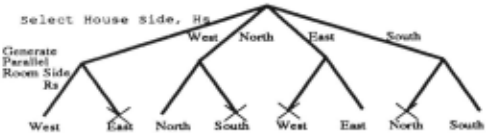
Figure 4 illustrates RICK's applicatio~ of ~his method t_o t he floor planning domain. Each combmatlon of values IS depicted as a different path in a search tree. For example, t he left most path in the tree is constructed when the partial solution generators produce values: [HS=House West Side, RS=Room West Side); the _next left most path corresponds to [HS=House West S1de, RS=Room East Side); etc.
After generating a particular path in the search tree (a particular value combination), a corr~spo_ndi~g set of constraints, implied by the value combmatwn 1s col lected. For example, the value combination [HS=House West Side, RS = Room East Side) implies that the East room side must be placed on the West house side:
Xcoord(SEcorner(RS)) = Xcoord(SWcorner(HS)).
Because all the constraints in this domain are linear, algebraic constraints, RICK uses a linear program (the Simplex method) to determine their consistency (i.e., the existence of a feasible solution . to these constraints). 3
The linear program discovers that the above con straint is inconsistent with (SC2), the "Inside House" constraint:
Xcoord(SWcorner(HS)) ~ Xcoord(SWcorner(RS)), and a constraint associated with rectangles in general: Xcoord(SWcorner(RS)) < Xcoord~SEcorner(RS)). . The inconsistency of these constramts follows by transl t i vity. Int uitively, this indicates that the abstract solu tion has forced the SW room corner outside the house.
If an abstract solution is consistent, RICK cachej it into a unified generator description. As illustrated in Figure 4, four out of eight abstract solutions are found to be consistent (the ones in the figure that have not been crossed out), and are cached into a single, unified generator description:
3 We realize in retrospect that we should use an integer programming method to guarantee the soundness of the an swer. We can also extend this approach by using routines that check the consistency of other classes of (nonlinear) con straints. Note that this floor planner cannot be implemented as a linear program, primarily because some of the constraints SCI-SC5 are expressed as disjunctions.
Select a House Side HS, from {W, N, E, S} Generate a Room Side, RS, from {W, N, E, S} n SidesCorrespondingTo( HS) 4 with Corners E Points(HS)
The merge process has thus resolved the interaction between the "Side Adjacency" (SC3) and the "Inside House" (SC2) constraints.
By using a "good" abstraction hierarchy, only rela tively abstract value combinations need to be tested. Furthermore, there are a relatively small number of these abstract solutions . The pruning of inconsistent abstract solution candidates removes entire equivalence classes of inconsistent solution candidates produced by a complete solution generator.
4.4 Refining into Primitive Representations
After merging the partial solution generators (STEP2), the resulting unified generator must be refined into a complete generator, which consists of a set of primi tive parameter generators. Constraint incorporation has been completed in the merging step. Thus all complete generators refined from the merged generator (STEP3) will have the same generation space (even though it will be represented differently). Since RICK only dis tinguishes between alternative algorithms based on the size of their constrained generation spaces, it views all of the refinements as equally "good", and constructs all of them. In the floor planning example, these alterna tive refinements correspond to the various alternatives for representing a rectangle in terms of primitive param eters (e.g., < z, y, l, w > ).
In actuality, the alternative problem solvers are not equally good; differences in data and program structures cause differences in space and time complexity. Ideally, selection should be based on criteria for data and pro gram structure optimization. In the current prototype system, the user selects the "best" alternative, which is then translated into LISP.
When applied to the floor planning example, our method incorporates the three local floor planning con straints SC1-SC3 (Figure 2) . The resulting problem solver (Figure 5) generates each room by picking a room location (X,Y) from a point on a house side. The room specification is completed by generating length and width values (starting from the required minimums) that place the room inside the house with respect to the room's location (X,Y).
This problem solver generates roughly 6 x 10 10 candi date solutions for a 9x9 house with 4 rooms (see Figure 5). For each of the 4 rooms, there are 4 ways to pick a house side, HS; for each of these cases, there are 21 ways to pick a room side that is a subsegment of that house side; also, there are 6 ways to pick the perpen dicular magnitude. Thus the total number of candidate solutions is (21 x 6 x 4) 4 ·
This is a reduction in complexity of 6 orders of mag nitude from the inefficient, generate-and-test problem
4 A mapping that associates West room side with West house side, North room side with North house side, etc.
(GENERATE-OBJECT ROOM NUMBER-OF-ROOMS ;basic loop. (ENUMERATE HS ;Enumerate house side range from: (W N E S)) ((GENERATE I ;Generator room I location range from: (CASE HS (W ·O) ;place room on house west side. (N [0 (- hl 4)]) (E hl) (S [0 (- hl 4)]))) (GENERATE Y (CASE HS (W [0 (- hw 4)]) (N hw) (E [4 hw]) (S '0))) (GENERATE L ;Length in I direction (CASE HS (W [4 hl]) (N [4 (- hl I)]) (E [ (- hl) -4] ) (S [4 (- hl I)]))) (GENERATE W ;Width in Y direction (CASE HS (W [4 (- hw Y)]) (N [(- hw) -4]) (E [ (- Y) -4]) (S [4 hw])))))solver previously shown. Further research will attempt to extend RICK, allowing it to also incorporate neces sary constraints. A "necessary constraint" that is not satisfied by a partial solution will not be satisfied by any extension of the partial solution. For example, the con straint that "no rooms overlap" is a necessary constraint in the floor planning domain, since, if rooms overlap in a partial solution, they continue to overlap in all exten sions of that partial solution. The problem solver re sulting from incorporation of this constraint will have a generation space of 1008 candidates (384 of which are solutions) for this 9x9 example.
5 Related Work
Knowledge compilation as a design process. To facilitate the comparison of our work with related work in knowledge compilation, it is useful to view knowledge compilation as a de6ign proce66 that designs a problem solver from the specification for a class of problems. We contrast three approaches according to their model of the de6ign proceu and the manner in which domain knowl edge is used to produce reasonably efficient algorithms.
Knowled~e compilation as iterative re-design. Tappe! [1980j defines test and constraint incorporation as modifications to a data-flow graph representing the components of the algorithm to be synthesized. A test refers to certain solution components; hence these solu tion components must be generated before the test can be run. Tappel's approach moves a test backwards in the algorithm's data-flow graph until it is placed just after the generators of these referenced solution compo nents. An attempt is also made to modify the generator so only values that satisfy the test will be enumerated.
Tappel's approach takes a generate-and-test algorithm as input and iteratively re-designs it by incorporating constraints.
The strategy used by DIOGENES [Mostow, 1988] is similar to Tappel's but uses a transformational ap proach to modify an initial generate-and-test algorithm (for possibly over-constrained problems) into a more ef ficient heuristic search algorithm. This approach uses domain knowledge that has been procedurally embed ded in some or all of the transformations. However , the design knowledge for controlling the compilation process is supplied by the user of the DIOGENES system (who selects among applicable transformations). The model of design used by both of these strategies is essentially hill climbing that iteratively re-designs a problem solver to improve its efficiency (though some steps do not directly improve efficiency but have the purpose of enabling other optimization steps).
Knowledge compilation as schema instantia tion. KIDS [Smith, 1988] focuses on mapping declar ative knowledge into a global 6earch algorithm. A global search algorithm splits a set defining all candidate solu tions of a problem into subsets and extracts solutions from the subsets when possible. This approach uses declarative domain knowledge in the form of procedural schemas. For example, one global search schema enumer ates all bounded sequences over a finite set. The method finds the domain-specific schema that best matches the problem domain, and then instantiates it into an effi cient algorithm (using information drawn from the prob lem specification). Constraints are formulated and incor porated during instantiation of the procedural schema. KIDS is able to reason about problem specifications that include functional constraints (constraints on 1/0 behav ior) and optimality criteria.
Knowledge compilation as top-down refine ment. RICK constructs constrained generators of so lutions whose feasibility is defined by problem con straints. In contrast with the iterative re-design ap proaches, which incorporate constraints after a complete problem solver has been created, RICK refines the prob lem constraints into partial solution generators (which are then merged), thus simultaneously designing the problem solver and incorporating constraints. In con trast with KIDS, RICK designs the problem solver by refining the problem description into a correct data rep resentation (i.e., a representation of the generated solu tion) rather than choosing the proper procedural repre sentation for the problem. By using a least commitment approach for representation selection, RICK decouples the issues of incorporating constraints and representing generated solutions.
Difficulties in designing a representation. Ex pressed in terms of a particular solution representation, some constraints are local, constraining relatively small portions of the entire solution, while others may be global, constraining the entire solution or interrelating several parts of the solution. Therefore, whether a constraint is local or global is a function of the solution representation. To incorporate as many constraints as possible into a more constrained problem solver, RICK must use a representation which maximizes the number of local constraints (the type of constraints RICK can incorporate during compilation). However, the odds are that no single representation language exists in which all the constraints are local. In other words, not all problem constraints can be incorporated using the method de scribed in this paper. Another research effort within the KBSDE project [Voigt, 1989] focuses on the problem of procedurally embedding the "left over" (unincorporated) global constraints.
5 The CASE statement defines a conditional generator range that depends on the value of HS. [A B] is the gen eration sequence from A to B, incremented by 1.
Other work. Other related work includes the discus sion by Steier and Kant [1985] on "developmental evalua tion", a framework which could be said to include our ab stract, symbolic simulation approach; Cohen's program [1986], which translates a declarative specification into a ~enerate-and-test algorithm; and Van Baalen's program l1988], which iteratively designs useful, analogical prob lem representations (for solving verbal reasoning prob lems such as those found on college admissions tests) built from a library of standard data structures.
6 Conclusions
Complete incorporation of a constraint into a genera tor is a difficult task, especially when the constraint (expressed in terms of the generated parameters) has a structure that is not factorable into constraints on t he individual parameter generators. This paper has described and illustrated the results of the RICK pro gram which avoids this structure mismatch problem by viewing problem constraints as generators of partial so lutions. RICK incorporates a problem constraint by re fining it into a generator of partial solutions that are guaranteed to satisfy the constraint. These partial so lution generators are then merged into a single abstract generator. During merging, interactions between partial solution generators are resolved by "simulating" the gen erators and caching only those generated combinations of values that are proven to be consistent. Since the constraints are fully incorporated into the merged gen erator, further refinement of the merged generator into a complete generator of primitive parameters will not create a structure mismatch problem. RICK produces problem solvers that solve parameter instantiation prob lems for design domains. Thus, RICK incorporates con straints defining structural relationships, but does not currently incorporate constraints that restrict I/0 be havior, or specify optimization criteria. In particular, RICK currently incorporates local constraints that are linear, algebraic constraints on composite objects.
Further work will attempt to extend the type of con straints that RICK can incorporate, and to extend the structural representation of the hierarchical solution. T his includes generalizing RICK to handle a hierar chical solution containing multiple objects and neces sary constraints on multiple objects (i.e., some global cons t raints) . Experiments are being conducted to test whether RICK is insensitive to changes in the object hierarchy representation and constraint predicate definitions . The goal of this study is to determine the power and generality of this approach to algorithm synthesis.
Acknowledgernents
We would like to thank the members of the KBSDE group and the Knowledge Compilation Seminar. We are also grateful to the members of the Rutgers AI/Design Project for the stimulating environment they provide .
@inproceedings{ijcai1989p93,
  title     = {Automated Synthesis of Constrained Generators},
  author    = {Braudaway, Wesley and Tong, Chris},
  booktitle = {Proceedings of the Eleventh International Joint Conference on
               Artificial Intelligence, {IJCAI-89}},
  publisher = {International Joint Conferences on Artificial Intelligence},
  editor    = {N. S. Sridharan},
  pages     = {583--588},
  year      = {1989},
  month     = {8},
  note      = {Machine Learning},
  url       = {https://ijcai.org/proceedings/1989/93},
}
TY - CPAPER TI - Automated Synthesis of Constrained Generators AU - Braudaway, Wesley AU - Tong, Chris T2 - Proceedings of the Eleventh International Joint Conference on Artificial Intelligence, IJCAI-89 PB - International Joint Conferences on Artificial Intelligence PY - 1989 SP - 583 EP - 588 UR - https://ijcai.org/proceedings/1989/93 ER -Copied
Machine-readable versions of this paper, for tools and AI agents:





