
Neural-Net Implementation of Complex Symbol-Processing in a Mental Model Approach to Syllogistic Reasoning
Proceedings of the Eleventh International Joint Conference on Artificial Intelligence. Cognitive Models. Pages 568-572.
© 1989 International Joint Conferences on Artificial Intelligence
Abstract
A neural net system called "Conposit" is described. Conposit performs rule-based manipulation of very short term, complex symbolic data structures. This paper concentrates on a simulated version of Conposit that embodies core aspects of JohnsonLaird's mental model theory of syllogistic reasoning. This Conposit version is not intended to be a psychological theory, but rather to act as a test and demonstration of the power and flexibility of Conposit's unusual connectionist techniques for encoding the structure of data.
- Bamden, J.A. (1984). On short-term information pro- cessing in connectionist theories. Cognition and Brain Theory, 7 (1), pp.25-59.
- Bamden, J.A. (1988a). The right of free association: relative-position encoding for connectionist data structures. Procs. lOth Annual Conf of the Cogni- tive Science Soc.
- Hillsdale, N.J.: Lawrence Erl- baum.
- Bamden, J.A. (1988b). Conposit, a neural net system for high-level symbolic processing: the register- machine level. Memoranda in Computer and Cog- mttve Science, MCCS-88-145, Computing Research Laboratory, New Mexico State Univer- sity. Modified version to appear in J.A. Bamden & J.B. Pollack (Eds), Advances in Connectionist and Neural Computation Theory, Vol. 1, Norwood, N.J.: Ablex.
- Fodor, J.A. & Pylyshyn, Z.W. (1988). Connectionism and cognitive architecture: a critical analysis. In S. Pinker & J. Mehler (Eds.), Connections and sym- bols, Cambridge, Mass.: MIT Press.
- Johnson-Laird, P.N. & Bara, B.G. (1984). Syllogistic inference. Cognition, 16 (1), pp.l-61.
- Shastri, L. & Ajjanagadde, V. (1989). A connectionist system for rule-based reasoning with multi-place predicates and variables. Report MS-CIS-8905, Computer and Information Science Dept, Univer- sity of Pennsylvania.
- Srinivas, K. & Bamden, J.A. (1989). Temporal-winner- take-all networks for arbitrary selection in connec- tionist and neural networks. Manuscript for poster at 1st Int. Joint Conf on Neural Networks, 1989.
- Touretzky, D.S. & Hinton, G.E. (1988). A distributed connectionist production system. Cognitive Sci- ence, 12 (3), pp.423-466.
References were extracted automatically from the PDF and may contain errors.
Full text extracted automatically from the PDF; figures, tables and equations may differ. The PDF is the version of record.
1 Introduction
The challenge presented to connectionism and neural networks studies by high-level cognitive processing - which includes commonsense reasoning, planning, and some aspects of natural language understanding - is gaining increasing recognition. The main technical difficulties are discussed in Barnden (1984), Fodor & Pylyshyn (1988) and elsewhere in the connectionist literature, and include the well-known variable-binding problem and the problem of accounting for complex, temporary, novel structures of short-term information. Conposit is a neural net system that is aimed at high level cognitive processing and is able to manipulate neural-net implementations of traditional, complex, symbolic data structures by means of production rules implemented as neural subnetworks [Barnden l988a,b, and elsewhere]. Conposit, in its current simulated ver sions, is therefore an exercise in "implementational con nectionism". See Barnden [1988b] for a discussion of the value this type of connectionist research. Currently simulated versions of Conposit are concerned only with short-term processing: they have no adaptive learning capability, and long-term memory consists entirely of the fixed set of production rules.
* This research is being supported in part by USAF grant Af-OSR-88-0215, by supercomputer facilities through NASA's MPP Working Group, and by grant NAGW-1592 under the In novative Research Program of the NASA Office of Space Science and Applications.
In this paper I describe Conposit-3, a version of Conposit that engages in commonsense syllogistic rea soning, by embodying some core aspects of the Johnson-Laird's "mental model" theory [Johnson-Laird & Bara 1984]. This theory requires complex symbolic structures to be manipulated in a variety of ways. The production of a connectionist/neural-net psychological theory is not, however, an immediate goal of Conposit research. The purpose of applying Conposit to an exist ing psychological theory was to provide a more objective test of the flexibility and generality of Conposit 's symbol-processing techniques, which were originally developed for other symbol processing tasks. The mental-model implementation has been straightforward and natural, and has required no ad hoc representational or processing techniques. The implementation also sug gests that Conposit could, in the future, be a route by which to map complex psychological symbol-processing theories down to the neural network level. Conposit is, in fact, intended as a highly tentative, partial and ideal ized model of how biological neural networks in human cortex could effect symbolic information process ing, hut this biological aspect is beyond the scope of this paper.
Section 2 summarizes Johnson-Laird's aprroach. Sections 3 and 4 outline Conposit-3's embodiment of it , at an abstract level of description in which Conrosit-3 is viewed as a machine manipulating the symbolic contents of registers. Section 5 sketches the neural-net imple mentation of this register machine. Section 6 concludes. It is impossible in a paper of this length to describe a system of the complexity of Conposit in detail. Further information can be found in Barnden (1988b) and Srinivas & Barnden (1989).
2 Syllogisms and Mental Models
Consider the syllogism
Some athletes are beekeepers. All beekeepers are chemist'i. Therefore, some athletes are chemists.
Johnson-Laird maintains that we make such a syllogistic inference by constructing one or more "mental models" conforming to the premises, and then try to read a con clusion off a mental model. A mental model is an abstract data structure made up of atomic tokens and identity links between tokens. For our example, there are arbitrarily selected number of tokens standing for ath letes, beekeepers, or chemists. An arbitrarily selected proper non-empty subset of the athlete tokens are related by identity links to some beekeeper tokens, and all bee keeper tokens are so linked to chemist tokens. Some tokens may be marked as being optional, a practice which cuts down the number of models that needs to be considered. The conclusion that some athletes are chem ists arises from noticing that some athlete tokens are linked by chains of identity links to chemist tokens. The mental model serves as a sort of internalized, highly abstract "example situation" conforming to the premises of the English syllogism. Naturally, the "conclusion" read off from a mental model might merely be an artifact of the particular example it embodies, and therefore be invalid. In response to this, Johnson-Laird postulates that the system attempts to construct several different mental models conforming to the premises, in an attempt to falsify any particular putative conclusion. The attempted-falsification process will fail in the present case, but would have succeeded if the above syllogism had contained "some beekeepers" rather than "all bee keepers".
3 Mental Models in Conposit
Conposit-3 straightforwardly represents the Johnson Laird mental models, and constructs them from symbolic data structures (fragments of semantic network) that encode syllogism premises. Conposit-3 does not yet address the following aspects of Johnson-Laird's approach: (i) the understanding or generation of natural language; (ii) a thorough attempted-falsification process - Conposit-3 is given the conclusion, and merely checks its validity with a single model randomly gen erated from the premises; or (iii) negative premises and conclusions ("no X are Y" and "some X are not Y"). The correction of the last two deficiencies is not difficult, however, and will be described elsewhere.
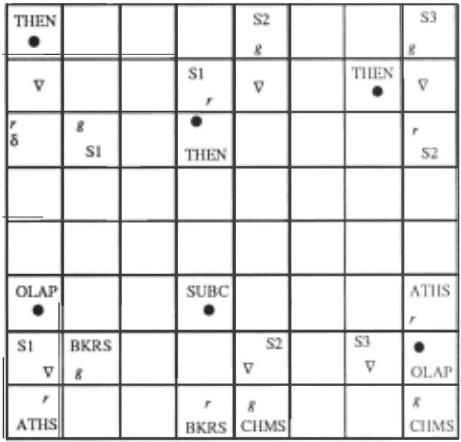
Conposit-3's representation of the above example syllogism is illustrated in Figure 1. What this shows is the starting state of an 8x8 region within a 32x32 array of registers called the configuration matrix (CM) of Conposit-3. The CM is Conposit-3's working memory holding the short-term data structures on which produc tion rules act. Each square in the figure illustrates a register. The values in registers may change rapidly as a result of symbol processing. A register's state consists abstractly of a symbol and a vector of binary highlight ing flag values (each is ON or OFF). The following shows what the various items in a square in the Figures signify as regards the current state of the register illus trated by the square:
capitalized word or letter: occurrence of (non-null) symbol
- V: ON value of "white" highlighting Hag
- ·: ON value of "black" highlighting Hag
- r, g: ON value of "red", "green" Hags rcsp.
- o: ON value of highlighting Hag named " done".
A square not showing any symbol illustrates a register containing a special "null" symbol. If a square docs not show an ON value for a highlighting Hag, then that fl ag is OFF in the register. When , say, the black highlighting flag is ON in a register, we say that the reg ister is highlighted in black.
A non-null symbol may have a specific representa tional function, such as denoting a particular object or class of objects in the world, or a particular type of rela tionship among things. For instance, the ATHS, BKRS. and CHMS symbols in the Figure denote the classes of all conceivable athletes, beekeepers and chemists respec tively. The OLAP and SUBC symbols denote the classes of all conceivable class-overlap situations and subclass situations respectively. The S I , 52 and S3 sym bols will be discussed below. (None of the symbols mentioned is dedicated to syllogistic reasoning.) A reg is ter containing a non-null symbol is thought of as currently denoting whatever that symbol denotes. For instance, in the figure there are registers that - tem porarily - denote the athlete class and the class of con ceivable class-overlap situations.
The group of squares at the bottom middle of Fig ure 1 illustrates a possible "subconfiguration" of register states that acts as a representation of the second premise of the syllogism, namely that all beekeepers are chem ists. Conposit-3 takes a white-highlighted register to denote a member of the class denoted by any adjacent black-highlighted register. Therefore the whitehighlighted register in the bottom middle subconfiguration denotes some class-inclusion situation. Further, if a register denotes a class-inclusion situation, then Conposit-3 takes any adjacent red-highlighted register (here, the one containing BKRS) to denote the included class, and any adjacent green-highlighted regis ter (here, the one containing CHMS) to denote the including class.
The bottom left and right subconfigurations in Fig ure I are very similar to the middle one, and encode the syllogism's first premise and the conclusion respectively. The Sl, S2 and S3 symbols are arbitrary, distinct, variable-like unassigned symbols. Unassigned symbols have no permanent denotation, but can be viewed as attaining temporary denotations by virtue of their appear ance within data structures in the CM. For example, since the register at the bottom left containing S 1 denotes the athletes-overlap-beekeepers situation, the symbol S 1 is taken to denote this temporarily. Now, Conposit takes all registers containing the same non-null symbol to denote the same thing; so, by this symbol-sharing princi ple, the two registers in the upper half of the Figure containing S I also denote the athletes-overlap-beekeepers situation. The registers containing S2 and S3 are analo gously interpreted.
Note that the absolute positions of the symbols and highlighting states are irrelevant, as are the directions of the adjacency relationships. Moreover, a subconfiguration such as the ones mentioned can be split up into pieces by means of symbol sharing [Barnden 1988b], so that the predecessor and successor role fillers could be specified at widely separated positions in the CM.
The three subconfigurations in the upper half of Figure I specify the order in which the situations represented in the bottom half should be considered, corresponding to the order of the statements in the syllo gism. (The Johnson-Laird theory respects this order.) For instance, the upper middle subconfiguration states that the situation denoted by S 1 is to be considered before the situation denoted by S2. The interpretation of the upper three subconfigurations is analogous to that of the lower three: the symbol THEN denotes the class of possible processing-ordering situations, and, for such situations, red and green highlighting mark the predeces sor and successor respectively. (As a special case, the left-hand upper subconfiguration states that the S 1 si tua tion is the first to be considered. The purpose of the 8 sign will be explained later.)
In a way to be described below, production rules that fire in response to ordering and premise subconfigurations shown in Figure 1 create the substate shown in Figure 2, which illustrates a different region of the CM. Actually, the new data structures in that Figure could be spread around randomly over the CM, but they are shown in a regimented arrangement for illustrative clarity.
| • ATHS | v Xl | v Xl | • BKRS | ||
| v XI | • CIIMS | ||||
| • ATHS | v X2 | v X2 | • BKRS | ||
| v X2 | • CIIMS | ||||
| • ATHS | v s X3 | s v X5 | • BKRS | ||
| s <;7 X5 | • CIIMS | ||||
| • ATHS | v s X4 | ||||
| s <;7 X6 | • CIIMS |
The Xl to X6 are distinct unassigned symbols. Each Johnson-Laird token for a class of persons is impl e mented as a pair of adjacent CM registers, one of which (the black one) temporarily represents a class of person, and the other of which (the white one, containing an Xi symbol) therefore represents a particular though indefinite member of the class. Each Xi symbol is thereby considered to denote a person for the time being. The function of Johnson-Laird's identity links is taken over by symbol-sharing, since symbol-sharing registers represent the same thing. In the Figure an 's' indicates special highlighting signifying that the token is optional. (Optionality could also be indicated by a more elaborate data structure.)
The construction of the mental model has two main phases. First, a production rule called "Rule_Some" detects the subconfiguration for the first premise (Figure 1, bottom left), and construcL<>, in ran dom positions in the CM, the athlete and beekeeper tokens in Figure 2. It creates randomly many athlete tokens, six on average, then constructs beekeeper tokens using the same unassigned symbols as in a random sub set of the athlete tokens, and, finally, randomly con structs three extra beekeeper tokens on average. Secondly, another, similar, rule called "Rule_AII" detects the subconfiguration for the second premise and constructs some chemist tokens with the same unas signed symbols as in the beekeeper tokens, and then con structs some extra chemist tokens.
To check the conclusion, Rule_Some comes into play again by detecting the conclusion subconfiguration (Figure 1, bottom right) and checking that there is at least one athlete token and chemist token sharing a sym bol. In cases where the conclusion of a syllogism is invalid, Conposit-3 sometimes does and sometimes does not construct a mental model consistent with the conclu sion, because of the randomness. It would be trivial to get Conposit-3 to repeat the whole process in an attempt to alight randomly on a falsifying model.
Rule_Some, Rule_All and the remaining rule, Note_Next (see below), work with any classes in syllo gisms, not just the athlete, beekeeper and chemist classes. There is no replication of rule circuitry for the different classes.
4 Conposit-3's Production Rules
A Conposit-3 rule consists of a condition part and an action part. At any time, only one action part can be executing, but the CM state detection implied by condi tion parts is done in parallel across all rules. Conflict resolution among simultaneously satisfied rules is based on a fixed total priority ordering, but this will be relaxed in later Conposit versions.
The condition part of a rule tests for the presence or absence of specific sorts of CM state configuration, by means of a highly parallel detection mechanism that will be sketched in a moment. The action part manipulates CM data structures by changing the symbol and/or highlighting states of registers. The registers subjected to these changes are chosen "associatively" on the basis only of their current highlighting/symbol states, and the states of their immediate neighbors. An action part is an arbitrarily complex flowchart, possibly involving branch ing and looping, each node of which sends a command signal that causes a group of elementary changes at some CM registers.
The following will describe the subconfiguration detection and state-change mechanisms in the context mainly of "Note_Next", the simplest of the three rules in Conposit-3. Its condition part detects the presence of a THEN subconfiguration (see top of Figure 1) whose predecessor register (the red one) has been marked by ONness of the "done" highlighting flag (8). (In the ini tial state of the CM in simulation runs, the "done" highlighting is at the predecessor register of the "first"
THEN subconfiguration.) The goal of Note_Nex t is to place "now" highlighting at the successor register R (the green one) in the detected THEN subconfiguration, and to spread this now-highlighting also to all registers having the same symbol as R. In Figure 1, the effect of a Note_Next execution is to mark with "now" highlight ing the two registers both containing the S 1 symbol, or both containing the S2 symbol, or both containing the S3 symbol. This serves to mark the class-overlap or sub class situation that should now be attended to; the now highlighting contributes to the firing of "Rule_Somc" or "Rule_AU" as appropriate.
Note_Next's detection mechanism is as follows , at the register-machine level of description. The mechan ism relies on register arrays, called location matrices (LMs), that are isomorphic to the CM. A location matrix register has one of two states, ON or OFF. An ON value at a register in a particular LM indicates the presence of a particular sort of subconfiguration based at the corresponding register in the CM. For the purpose of Note_Next, the LMs are ones called LM::TIIEN, LM::member_THEN and LM::done_pred. The first acquires an ON value at every position corresponding to a CM register containing the THEN symbol. The second LM acquires an ON value at every position correspond ing to a CM register that is white-highlighted and is adjacent to a black-highlighted register containing the THEN symbol. Recall that a white register of this son denotes a member of the class of possible succession situations. The LM also acquires ON values at the posi tions where CM registers contain the same symbol as a white one of the sort just described. That is, ON values in this (and every other) LM are "spread by symbol sharing". The third LM, LM::done_pred, acquires an ON value at the positions of "done-predecessor" CM registers: CM registers that are done-highlighted and arc acting as the predecessor register of a THEN subconfiguration. In fact, therefore, LM::done _pred acquires an ON value at every position that is adjacent to the position of an ON register in LM: :member _Til EN and that corresponds to a CM register that is both done highlighted and red-highlighted. Also, ONness is spread by symbol-sharing in this LM as in any other.
The starting node of the action-part flowchart of Note_Next is stimulated into action if there is an ON value anywhere in LM::done _pred. The action part is a linear flowchart with four nodes. The starting node sends a command signal to LM::done_pred, telling every register in it that is ON to send a signal to its corresponding CM register. The CM registers receiving such a signal tum their "detected" highlighting llags ON. Thus, the effect is to mark every "done predeces sor" register in the CM with "detected" highlighting. Once this effect is complete, the second llowchart node is activated, and sends a command signal to the CM, tel ling every white register that has a neighbor highlighted i~ b?th . red and "detected" to tum its "moving" h1ghhghtmg flag ON. The signal also tells the CM to add "moving" highlighting to every register having the same symbol as one that is already "moving" highlighted. (This is "spreading by symbol-sharing" of changes within the CM.) Then, the third flowchart node is activated, and sends a command signal to the CM tel ling every green register that has a moving-highlighted neighbor to tum its "now" flag ON. Again, the signal also causes spreading of the now-highlighting by symbol sharing. Finally, the fourth flowchart node sends a com mand signal to the CM telling every register to tum OFF its "done" and "moving" highlighting flags.
A full description of Rule_Some or Rule_All would be too long to be included here, but they work analogously to Note_Next on the basis of LMs and com mand signals very like those used in Note_Next. How ever, ~eir action parts are more complex, involving branc~mg and looping, both of which are controlled by detect·on of ON values in certain LMs or specific highlighting states in the CM. Rule Some detects the P!ese?ce _of a now-highlighted OL-AP (i.e. overlap) sltual.lon m the CM. If mental model tokens of both classes involved already exist, as will be the case if Rule_Some is operating on the bottom right OLAP situa tion in Figure 1, then the rule merely checks for the existe~ce of a token of one the classes that shares a sym bol w1th a token of the other class. In more detail, the rule marks all the white registers in athlete and chemist tokens (as in Figure 2) with special highlighting flags '_'member_of_classl" and "member_of_class2" respec tively. Part of this marking process is to spread such highlighting by symbol-sharing. All that is left to do is to detect the presence of some register marked with both "member_of_classl" and "member of class2". We ~ave here a traditional marker passing pr~ess, but work mg over highly temporary data structures. When tokens of both classes do not already exist, Rule_Some creates randomly many tokens of one or both classes, as appropriate, establishing sharing of some symbols Xi between some tokens of one class an some tokens of the other. Rule_All is very similar to Rule_Some.
A rule operates on the CM in a fashion that is highly, but not completely, SIMD-like, register-local, and parallel. Each command signal sent to the CM or to an LM is identically distributed to all the registers in the matrix. As we have seen, different registers react dif ferently, according to their own current states and (in the CM case) those of their immediate neighbors. Often, a command signal sent to the CM requires the CM to confine its initial reaction to just one, arbitrarily selected, register. Arbitrary selection is used, for instance, in register recruitment during data structure building. How ever, even when arbitrary selection is in operation, the command signal can require every register that has the same symbol as one that is already chosen as reactive to react also. This is "spreading by symbol-sharing" . Alternatively, the reaction required from reacting regis ters can include the broadcasting of their (assumed idcnL ical) symbols to all registers in the CM; the next com mand signal can then predicate reaction on whether registers' symbols equal the one broadcast at the prcvi· ous step. Apart from the sequencing implicit in spread ing by symbol-sharing, reacting registers work in paral lel.
5 Neural-Net Implementation of Conposit
This section briefly sketches a simple neural net imple mentation of the Conposit register machine. As stated earlier, each CM register is implemented as a neural sub network. Part of this carries the symbol and highlight ing states of the register, which are just temporary activa tion patterns. For each highlighting flag there is a small cyclic subnetwork that can maintain one of two swtcs of recurrent activity. A symbol can be thought of a a bit vector, each bit being carried by a similar cyclic subnet work.
The rest of the circuitry in the register is concerned with the register's reaction to command signals. Each CM register subnetwork is connected to the subnct works for immediately neighboring registers, in order to service the sensitivity to neighboring-register state required by many command signals. Each register subnetwork is also connected to the so-called parallel distributor (PD) for the CM. The PD is what directly receives command signals from rule action part flowchart nodes, and one or its main functions is to distribute each signal ident ically to all the CM registers. Command signals arc conveyed on cables of connections, each connection in a cable con veying a binary or ternary value. Connections in a cable serve purposes such as providing new values for symbol bits or highlighting flags, specifying ON/OFF/don 't-carc highlighting-flag values for the purpose of selection of reacting registers, and specifying whether the command signal requires arbitrary selection, spreading by symbol sharing, or symbol broadcasting.
A second important function of the PD is to per form the arbitrary selection, when required, among regis ters satisfying the symbol/highlighting conditions specified in a command signal. (A succession of arbitrary-selection steps is also used to serialize the sym bol broadcastings needed in the spreading-by-symbol· sharing option.) Arbitrary-selection is performed by a temporal winner-take-all contention-resolution mechan ism in the PD [Srinivas & Bamden 1989]. This mechan ism receives "ready" signals on special connections from all registers among which selection is to wkc place. The mechanism has the effect of detecting the first such signal to arrive and telling the register that sent it that it has been chosen. However, if the first ready signal is followed within a certain time window by another ready signal, all the sending registers are told to try again. The mechanism relies on small random differences in the times taken by CM registers to decide to send a ready signal, and on differences between the travel times of signals on different connections. Thus, Conposit at the implementational level brings in relative timing of sig nals in an important way, and is therefore different from most other connectionist systems.
LM registers are implemented similarly to CM registers, and each LM also has a PD very like the CM's. LMs are connected together, and to the CM, in a simple way to reflect the functional dependencies described ear lier. Each LM register receives input connections only from the corresponding and neighboring registers in the CM and/or other LMs. Simple AND/OR logic, imple mented in neural units acting as logic gates, is then all that is required for introducing ON values into LMs.
Rule flowcharts map easily onto neural networks, each node being realized as a small subnetwork. Each node receives enablement connections from its predeces sor flowchart nodes, and/or connections conveying infor mation about the presence of highlighting values values (anywhere) in the CM and/or ON values (anywhere) in some LMs. Each non-starting node also receives an enablement connection from the CM's PD, so that a node only becomes activated when the previously activated node's work has been completed.
6 Conclusion
Conposit-3 is a connectionist/neural-network system with the ability to manipulate complex symbolic data struc tures, based on those proposed in an existing, sophisti cated psychological theory. Also, Conposit could easily effect straightforward deduction of a syllogism conclu sion from the premises, without going through mental models. Conposit versions reported elsewhere extend the demonstration of its powers. Its ability to do constrained variable binding is shown by a version that embodies the rule: if A loves B, B loves C, and C is not A, then A is jealous of C [Bamden 1988b]. Also, a type of variable binding is implicit in Conposit-3, in that the rules do not involve different pieces of circuitry to cope with different combinations of classes in syllogisms.
Although the symbolic manipulations in running Conposit simulations have been simple from the point of view of traditional AI, they are readily extensible to much more complex cases. Further, very few other fully connectionist systems can even come near to what Con posit does, the systems of Shastri & Ajjanagadde (1989) and Touretzky & Hinton (1988) being two important exceptions. Conposit's data structuring flexibility comes from its use of registers, and from its relative-position encoding (RPE) and pattern-similarity association (PSA) techniques. In Conposit, PSA takes the form of symbol-sharing: the use of several occurrences of the same symbol in different registers to achieve a linking power similar to that of linking by associative addressing in computers. RPE appeals to the idea that one can put things into association with each other rapidly and flexi bly by putting them next to each other (cf. the sequential-allocation method used for data structuring in computers.) The relatively computer-like appearance of Conposit makes it unusual as a connectionist/neural-net system. However, RPE and PSA have loose but reason ably clear connections to techniques used in other con nectionist systems [Bamden 1988a,b], and there arc many aspects of future Conposit versions that ally it to more traditional connectionist/neural systems [Barndcn 1988b].
Acknowledgments
I thank K. Srinivas for help with simulation work.
@inproceedings{ijcai1989p91,
  title     = {Neural-Net Implementation of Complex Symbol-Processing in a Mental Model Approach to Syllogistic Reasoning},
  author    = {Barnden, John A.},
  booktitle = {Proceedings of the Eleventh International Joint Conference on
               Artificial Intelligence, {IJCAI-89}},
  publisher = {International Joint Conferences on Artificial Intelligence},
  editor    = {N. S. Sridharan},
  pages     = {568--572},
  year      = {1989},
  month     = {8},
  note      = {Cognitive Models},
  url       = {https://ijcai.org/proceedings/1989/91},
}
TY - CPAPER TI - Neural-Net Implementation of Complex Symbol-Processing in a Mental Model Approach to Syllogistic Reasoning AU - Barnden, John A. T2 - Proceedings of the Eleventh International Joint Conference on Artificial Intelligence, IJCAI-89 PB - International Joint Conferences on Artificial Intelligence PY - 1989 SP - 568 EP - 572 UR - https://ijcai.org/proceedings/1989/91 ER -Copied
Machine-readable versions of this paper, for tools and AI agents:





