
Generating Facts From Opinions with Information Source Models
Proceedings of the Eleventh International Joint Conference on Artificial Intelligence. Cognitive Models. Pages 531-535.
© 1989 International Joint Conferences on Artificial Intelligence
Abstract
This paper describes an attempt to model the method of generating a fact from the opinions of other persons or of institutions as a process which is based on knowledge about these opinion sources. AITechniques of reasoning, such as rule based deduction, require an input of facts with a definite truth value. In domains like economics or administration, decisions are often based on a set of diverging ·subjective opinions when the fact which is needed is not available. The credibility of an opinion is considered dependent on a number of information source attributes producing the opinion as competence and goals. A model of the information source containing these attributes is used as a knowledge structure in a cyclical process of subsequent combination, doubt and reinterpretation of single opinions. Information Source Models can be used like User Models to represent an intelligent system's knowledge about its social context.
- Abelson, 1963)
- R.P. Abelson. Computer simulation of "hot" cognition. In S.S. Tomkins & S. Messick {Eds.), Computer simulation of personality. Frontier of psychological theory (pp. 277-298). New York: John Wiley, 1963.
- Buchanan and Shortliffe, 1984) B.G. Buchanan & E.H. Shortliffe (Ed.). Rule-based expert systems. The MYCIN experiments of the Stanford heuristic programming project. Reading: Addison-Wesley, 1984.
- Carbonell, 1978j J.G. Carbonell. Politics: Automated ideological reasoning. Cognitive Science, 2, 27-51 1 1978.
- Choo, 1964)
- T.-H. Clioo. Communicator credibihcy and communication discrepancy as determinants of opinion change. The Journal of Social Psychology, 64, 65-76, 1964.
- Colby, 19731 K.M. Colby. Simulations of belief systems. In R.C. Scbank & K.M. Colby (Eds.), Computer models of thought and language (pp. 251-2&>). San Francisco: Freeman, 1973.
- Downs, 1967)
- A. Downs. Inside bureaucracy. Boston: Little, Brown & Co. 1967. [Eagly eta/., 1978)
- A.H. Eagly, W. Wood & S. Chaiken. Causal inferences about communicators and their effect on opinion change. Journal of Personality and Social Psychology_, 36 4I4-435, 1978.
- Festinger, 1957)
- L. Festinger. A theof)' of cognitive dissonance. Evanston: Row-Peterson, 1957.
- Hill 1963)
- A.H: Hi}l. Credibili~, dis~repancy an~ latitude of commurucatlon as dimenstons of dtssonance 536 Cognitive Models influencing attitude change. Australian Journal of Psychology, 15(2), 124-132, 1963.
- [Himmelfarb and Anderson, 1975] S. Himmelfarb & N.H. Anderson. Integration theory applied to opinion attribution. Journal of Personality and Social Psychology, 31(6), 1064-1072, 1975.
- Kelley, 1972l 1-l.H. Kelley. Attribution in social interaction. n E.E. Jones, Kanouse, D.E.,Kelley 1 H.H., Nisbett, R.E. & Valins, S., Attribution: perceivmg the causes of behavior (pp. 1-26). Morristown, NJ .:General Learniitg _ Press 1972.
- Koeske and Crano, 1968) G.F. Koeske & W.O . Crano. The effect of congruous and incongi.:uous source- statement combinations upon the iudged credibility of a communication. Journal of &perimenta/ Social Psycholqg)', 4, 384-399, 1968.
- Lowe and Shaw, 1968) EA. Lowe & R.W. Shaw. An analysis of managerial biasing: Evidence from a company's budgeting . process. The Journal of Manarment Studies, 5, 30+315 1968.
- McPee and Edwards, 1975)
- R.W. McPeek & J.D. Edwards. Expectancy disconfrrmation and attitude change. The Journal of Social Psychology, 96, 193-208, 1975.
- [McPeek and Gross, 1975] R.W. McPeek & A.E. Gross. Evaluations of _presidential campaign speakers as a function of similarity and expectanc~ disconfirmation. Journal of Applied Social Psychology, 5(1), 75-85, 1975.
- Newtson and• Czerlinsky, 1974)
- D. N'ewtson & T. Czerlinsky. Adjustment of attitude communications for contrasts by extreme audiences. Journal of Personality and Social Psychology, 30(6). 829-837, 1974.
- O'Reilly III, 1978) CA. O'n.eilly III. The intentional distortion of information in organizational communication: A laboratory and field investigation. Human Relations 31(2), 173-193 1 1978.
- O'Reilly III, 1983) CA. O'Reilly III. The use of information in organizational decision-making. A model and some propositions. Research in Organizational Behavior, 5, 103-139 1983.
- Pettigrew, 1972)
- A.M. Pettigrew. I;Jormation control as a power resource. Sociology, 6_, 187-204 1972.
- [Pettigrew, 1973] A.M. Pettigrew. The politics of mg_anizational decision-making. London: TavistoclC, 1973.
- Pfeffer and Salancik, 1978~J. Pfeffer & G ,R. Salancik. The external control o organizations. A resource dependence perspective. ew York: Harper & Row, 1978.
- Schank and Abelson, 1977) R. Schank & R. Abelson. Scripts, plans, goals and understanding. An inquiry into human knowledge stntctures. Hillsdale: Lawrence Erlbaum, 1977.
- W alster et al., 1966) E. W alster, E. Aronson & D. Abrahams. On increasing the persuasiveness of a low prestige communicator. Journal of Experimental Social Psychology, 2, 325-342, 1966.
- Zimmermann, 1969)
- D.H. Zimmermann. Record- keeping and the intake £!OCess in a public welfare agency. In S. Wheeler {Jc.d.), On record. Files and aossiers in American life _(pp. 319-354). New York: Russell Sage Foundation, 1969.
References were extracted automatically from the PDF and may contain errors.
Full text extracted automatically from the PDF; figures, tables and equations may differ. The PDF is the version of record.
1 Introduction
Programs that simulate humari decision-making normally require an input consisting of a set of facts (e.g. blood temperature) describing the situation at hand before they can use their knowledge to produce inferences. Collecting these facts does not seem to be a problem in technical and scientific fields where reliable methods of observation and measurement are available for that purpose. For many of our everyday decisions, as well as decisions made by professionals in the fields of politics, administration, law, economics etc., however, there are no generally accepted and accurate methods for the gathering of evidence. Instead, we often are forced to combine several pieces of uncertain and sometimes biased information, reflecting opinions of other persons, to form our own judgment about an event which for logical reasons, due to scarce resources or lack of professional competence, we cannot observe and measure by ourselves. Such logical reasons might be that the critical situation has not yet
. This research was supported by the Special Collaborative Research Programme on Public Administration (SFB 221) of the German Science Foundation (DFG).
Generating Facts From Opinions With Information Source Models
Martin Thost ·
Department of Information Science University of Constance P.O. Box 5560 D-7750 Konstanz W. Germany
arisen or no longer exists and can only be judged via verbal reports and forecasts. Scarcity of resources also leads us to prefer newspapers or databases as sources of information. Lack of competence makes us believe the experts.
The combination of multiple evidence of testimony in absence of factual evidence rests on the hypothesis that we can increase the certainty of our judgments by increasing the number of opinions we are aggregating. But there is one problem that arises when we find several experts or several participants of an event with contradictory judgments: Whom would we believe? How are we to combine inconsistent testimonial evidence? People seem to have a standard method for that. They tend to judge the credibility of another person's opinion on the basis of the knowledge they have about her or him. This knowledge normally gained through general experience includes ratings of the person's competence and sincerity. The persons' sincerity may be expected to decline relative to their dependency upon our judgment. This paper describes an attempt to model this "ethnomethod" as a cognitive process and to simulate it on a machine as a knowledge-based program.
When a person voices a doubtful opinion, we tend to explain this behavior in terms of her or his intentions, i.e. as a step in a plan. Recognizing the goals of an information source that will be affected by the outcome of our judgment formation process is probably one of thl most often used heuristics to generate workable facts from other persons' opinions.
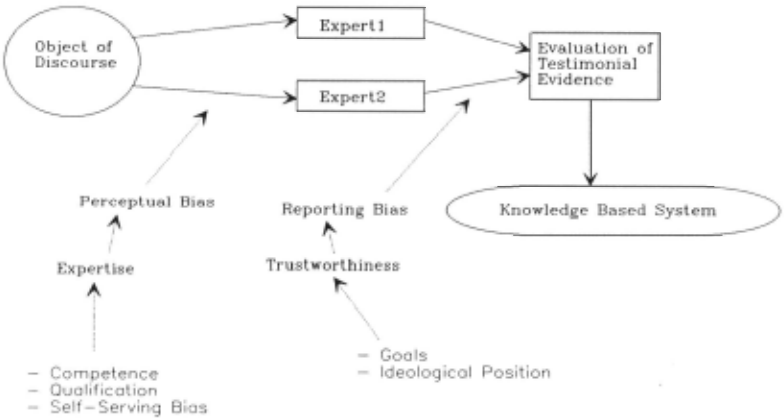
Figure 1 depicts the two biases that would have to be compensated for by knowledge-based evaluation of testimonial evidence [Eagly et a/., 1978). A model of an information source should contain knowledge about the source's expertise, that is its ability to correctly interpret information about the object, as well as about its trustworthiness, meaning the willingness to communicate its interpretation without any distortions caused by hidden motivations [ Kelley, 1972).
~e term "fact· will be used here - like in the field of expert systems - to denote a proposition that is believed by the system with a definite but not necessarily high certainty.
2 Related Work
Modeling subjective interpretation has been attempted in several artificial intelligence programs. Whereas the process considered in this paper proceeds from a set of opinions to a single subjective fact via plan recognition and combination of thus interpreted evidence, the programs of Abelson [1963] - Goldwater-Machine - and Carbonell [1978) - POLITICS - generate opinions (ideological interpretations) from a given fact (event description) using knowledge about goals and plans (ideologies) attributed to the interpreting persons. The process of restoring consistency through transformation of single beliefs in a neurotic belief system is simulated in the work of Colby [1973].
3 The Model
3.1 Flow of Control
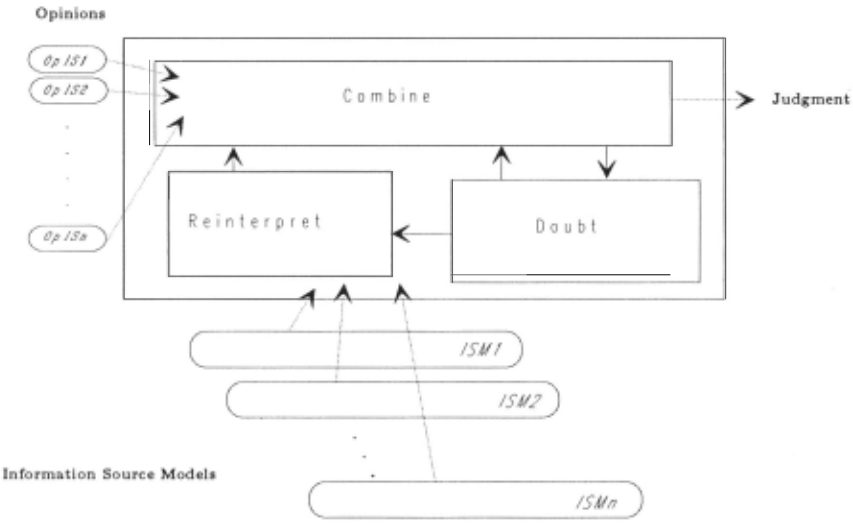
The process by which judgment is formed from multiple testimony evidence integrates a set of opinions into a single judgment. The weight attributed to the individual opinions in the integration process depends on the credibility of the information source producing the opinion. Figure 2 depicts the flow of control and information: The process starts by reading in the available opinions and ends by writing out a judgment. For each opinion's (Op ISn) source there is an Information Source Model (ISMn) containing knowledge about the factors determining its credibility. The process is divided into three subtasks, realized in the three modules COMBINE, DOUBT and REINTERPRET, which all use knowledge from the Information Source Models.
Module COMBINE has several modes. The flow of control depends on the chosen mode of combination. If COMBINE does not succeed in reaching a judgment, which is believed with a certainty passing a preset threshold, another mode may be selected. This cycle will be repeated until COMBINE arrives at a judgment.
This requires some sort of time limit in order not to get caught in an infinite loop where opinions are reinterpreted again and again without increasing the consistency of the overall set. This is a possibility we are all familiar with when we are moving in circles turning opinions up and down until we no longer know what and what not to believe.
3.2 Information Source Models
The concept of an Information Source Model (ISM) is introduced here to describe our idea of an abstract or concrete information source. An ISM contains knowledge about the factors determining source credibility. In evaluating the credibility of an opinion, we have to account for the biases depicted in Figure 1. We thereby use knowledge about several attributes of the source which determine the strength of those biases. For example, the degree of competence a person has in a certain field will determine the certainty of our belief in her or his statements relating to this field. Since we have general conceptions of groups of information sources which are refined when we deal with a concrete instance, that is a member of the group, Information Source Models will be represented in a frame language. Property inheritance can then be used to model abstract as well as refmed information sources.
Typical information sources are organizations or individuals. Members of one organization may have different individual ideas about the motivation of an outside source. We also sometimes trust a person, but not the group she or he is affiliated with, or vice versa. In public administration - as in the case described in the example - office-workers often have to follow an official rating of an outside source's credibility in their judgments although they may have a better understanding of its expertise or trustworthiness, e.g. through personal aquaintance with the source. Figure 3 shows slot names and possible entries of an ISM-Frame in a BNF-like form. It contains a name slot with one entry and the following slots, which can have an arbitrary number of entries:
| Name: Source Identifier |
| Competence: { Topic, Degree of Competence } * |
| Power: { Topic, Degree of Influence } * |
| Goals: { Goal, Goalstrength } * |
| Scripts: { Goal, Plansteps } * |
3.2.1 Competence
A source's competence usually varies over several areas (topics). This is taken into account by enumerating the topics in lists of topic-belief pairs. Competence can range from 0 to 1.
3.2.2 Power
In some cases, power rather than competence has to be used to determine the "credibility" of an opinion, the degree of influence ranging from 0 to 1. The status of a person within an organization plays an important role in weighting her or his opinion. In board decisions, the opinions of external stakeholders have to be considered regardless of their competence. In public administration, formal procedures require procuring opinions from authorized information sources. If there are several opinions, the weight of an opinion is determined by the power of the information source relative to the power of the other sources [Pfeffer and Salancik, 1978].
3.2.3 Goals and Scripts
The motivational factor is described in terms of goals and scripts serving those goals. If another person's goal is dependent upon our judgment we expect her or his opinion to be biased. The strength of her or his goal [Schank and Abelson, 1977) determines the expected degree of bias.
3.3 COMBINE
COMBINE works in the following modes:
Naive Mode. In naive mode, COMBINE aggregates the o_pinions, weighting them by their prior credibility, a function of competence. If the overall evidence reaches a certain threshold, COMBINE succeeds and returns the aggregated judgment. If the threshold is not reached because evidence is too weak or inconsistent COMBINE asks the user whether it should abandon th~ task or try another mode.
Sceptical Mode. In the sceptical mode, considered the st~d~d mode in p~blic a<!ministration, e.g. for deciding eligtbility for public assistance [Zimmerman, 1969), COMBINE does not trust the standard credibilities assigned to the information sources and requires an additional test (administered by modules DOUBT and REINTERPRET) of the credibilities sensitive to the special case situation. For this purpose, control is passed to the modules DOUBT and REINTERPRET.
Political Mode. In the political mode, credibility, normally assumed to depend on competence, is recomputed as a function of power of the information source relative to the total power behind all available opinions.
Outcome-Oriented Mode. In this mode, COMBINE will follow different strategies to arrive at a predetermined judgment outcome. In this way COMBINE may switch to political mode if it cannot favor a decision based simply on competence. Another strategy could be to first follow the political mode and then to attempt to rationalize the obtained decision by using ano.ther mode. Selecting only the evidence supporting the desrred outcome and discarding or explaining away opposing evidence could be another strategy. The theory of cognitive dissonance is of particular importance as it accounts for the behavior of selecting supporting evidence and neglecting or explaining away inconsistent evidence [Festinger, 1957). Research in organizational behavior supports the t~e~is that pe~ple in organizations try to !>olster t~e deciSion alternatives they prefer by seeking information that supports their alternative while neglecting or devaluing opposing evidence through reinterpretation [Downs, 1967, Lowe and Shaw 1968 O'Reilly III, 1978, 1983, Pettigrew 1972, 1973). ' '
3.4 DOUBT
DOUBT's function is to select candidates for successful reinterpretation. DOUBT's strategy is mainly heuristical and also depends on the chosen mode of combination. The following strategies and criteria may be used by DOUBT to select opinions for reinterpretation:
Selecting "suspicious" opinions:
- opinions inconsistent with the set of evidence
- opinions inconsistent with prior opinions held by the same informant on the same topic
- opinions delivered without request
- the source may prefer a certain outcome of the judgment, i.e. matching a goal or a script-step of the source
Selectinif "unsuitable" opinions:
- COM INE is used in an outcome-oriented mode requiring increased support or decreased opposing
evidence
Selectine all opinions:
- COMBINE is sceptical about any opinion.
3.5 REINTERPRET
Module REINTERPRET tries to find what personal motivation leads someone to voice an opinion when there is doubt about its being based on impersonal observation and interpretation. The goal of REINTERPRET is to prove that the supposed information act is in fact an act of convincing or persuading which is part of a plan pursued by the. informfltion source. If the opinion expressed by an information source supports a judgment that favors the information source, e.g. . a positive eval~ation <?f. the fmancial situation leading to improved credit conditiOns, REINTERPRET assumes motivation to produce this favorable picture by following a plan.
REINTERPRET parses the source's plans to fmd a ~ONVINCE planstep which refers to the topic to be judged. When REINTERPRET has thus recognized a potential cause for motivational bias, it has still to determine how strong the motivation to induce a favorable effect by passing a biased opinion might have been. The confidence in an opinion will be decreased and increased respectiyely depending on the strength of the affected goal. It will be decreased if the opinion supports !he goal a~d increased if it ~rev~nts att~g the goal, i.e. if expectations about a motivationally biased opinion are disconfrrmed.
The proces~ of. d~scounting motivational bias in judging other persons oprmo~s has been demonstrated in several experimental studies . People tend to decrease the credibility of an information source if it issues self-serving opinions. On the other hand, credibility will be increased if i~s statements contradict the position initially attributed to It.
The functional distinction between modules DOUBT and REINTERPRET and their sequential execution is not assumed to be as clear in real-life cognitive processes. Reasons mentioned for doubting might be used also for successive reinterpretation. The fact that an information source is making a statement without being asked for - ~ventually spending money on its publication - may in Itself serve as a reason for reinterpretation. Inconsistency may also result in the lowering of confidence.
4 An Example
The prediction of the fmancial situation of a person who is planning to found a business, on which is based the grant of a bank guaranty will serve as an example judgment. Slot entries in the Information Source Models are arbitrary chosen for illustration only, and are not based on real data. In this case the information source obviously most deemed to be biased is the applying person herself. In Figure 4 we see an instantiation of the general model depicted in Figure 2. The case presented shows how the credibility of the applicant's opinion is reduced, because she or he has a strong interest in a favorable judgment about her or his future fmancial resources.
2 (Choo, 1964, Hill, 1963, Himmelfarb and Anderson, 1975, Koeske and Crano, 1968, McPeek and Edwards, 1975, McPeek and Gross, 1975, Newtson and Czerlinsky, 1974, Walster et al., 1966]
applicant will produce sufficient cash-flow to cover his credit. The information sources are more or less confident (.9-.3) about this proposition:
In our example the opinions of four information sources are taken into account. An opinion is the Certainty factor (CF) [Buchanan and Shortliffe, 1984) of the information source's belief in the proposition that the
- -The applicant is quite optimistic about her company (.9). Because her goal is to receive credit, she will probably try to convince the credit guaranty bank that her company's cash-flow will be high.
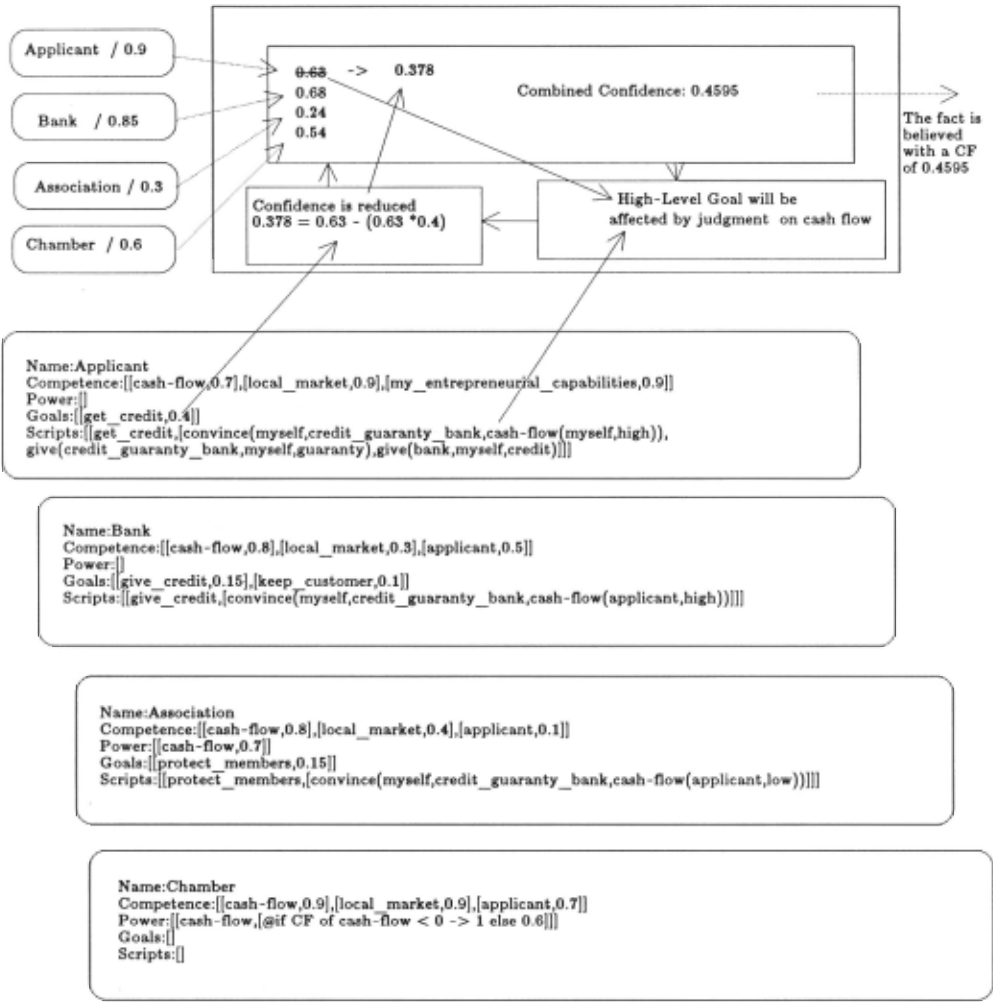
Figure 4: An Example
- -The bank giving the credit usually has an interest in issuing credits and also in keeping its customers. Giving credits can be a subgoal of keeping customers. If a customer's assets are not sufficient to back a requested credit, the bank requires a guaranty by the credit guaranty bank. Therefore, the bank is also interested that the credit guaranty bank believe in high cash-flow of the applicant.
- -In contrast to the applicant and bank, the trade association is expected to understate its belief in the cash-flow of the applicant, since its goal is to protect its members from new competitors.
- -The chamber of industry and commerce has the strongest influence on the outcome of the cash-flow judgment. If it believes that the cash-flow will not be sufficient ( CF < 0), then the credit guaranty bank is bound to follow this opinion, because in this case the weight of its influence (power) becomes too strong to be overridden by other opinions.
The process begins by multiplying the source beliefs by the sources' credibility-factors, which is the competence factor for the respective topic. Since we are in a situation where money is involved, we are proceeding in sceptical mode. So DOUBT is searching for motivation to influence the judgment and fmds a CONVINCE act in the applicant's script in the first cycle which refers to the cash-flow topic under consideration.
The act is part of a script with the goal GET_ CREDIT. Assuming a bias of .4 caused by this goal, the confidence in her belief is reduced by a factor of .4. The combined confidence is calculated by computing the average. In further cycles not shown here, the bank's confidence would also be reduced because of its goal to give credits. The confidence of the trade association representing the applicant's industry would be raised, because it might understate the outlook for a new competitor's business.
@inproceedings{ijcai1989p85,
  title     = {Generating Facts From Opinions with Information Source Models},
  author    = {Thost, Martin},
  booktitle = {Proceedings of the Eleventh International Joint Conference on
               Artificial Intelligence, {IJCAI-89}},
  publisher = {International Joint Conferences on Artificial Intelligence},
  editor    = {N. S. Sridharan},
  pages     = {531--535},
  year      = {1989},
  month     = {8},
  note      = {Cognitive Models},
  url       = {https://ijcai.org/proceedings/1989/85},
}
TY - CPAPER TI - Generating Facts From Opinions with Information Source Models AU - Thost, Martin T2 - Proceedings of the Eleventh International Joint Conference on Artificial Intelligence, IJCAI-89 PB - International Joint Conferences on Artificial Intelligence PY - 1989 SP - 531 EP - 535 UR - https://ijcai.org/proceedings/1989/85 ER -Copied
Machine-readable versions of this paper, for tools and AI agents:





