
Structuring Computer Generated Proofs
Proceedings of the Eleventh International Joint Conference on Artificial Intelligence. Automated Deduction. Pages 378-382.
© 1989 International Joint Conferences on Artificial Intelligence
Abstract
One of the main disadvantages of computer generated proofs of mathematical theorems is their complexity and incomprehensibility. Proof transformation procedures have been designed in order to state these proofs in a formalism that is more familiar to a human mathematician. But usually the essential idea of a proof is still not easily visible. We describe a procedure to transform proofs represented as abstract refutation graphs into natural deduction proofs. During this process topological properties of the refutation graphs can be exploited in order to obtain structured proofs.
- [Andrews, 1980] Peter B. Andrews, Transforming Matings into Natural Deduction Proofs, Lecture Notes in Comp. Sci. 87 (CADE 1980), 281-292
- [Chester, 1975] David Chester, The Translation of Formal Proofs into English, AI 7 (1976), 261-278
- [Davis, 1981] Martin Davis, Obvious Logical Inferences, Proceedings of the 7th UCAI, Vancouver 1981 IJCAI
- [Eisinger, 1988] Norbert Eisinger, Completeness, Conflu- ence, and Related Properties of Clause Graph Resolution, PhD Thesis, Uni Kaiserslautem, 1988, SR-88-07
- [Huang, 1989] Xiaorong Huang, A Human Proof Presenta- tion Model and Proof Transformation, SEKI-Report, Uni Kaiserslautem, to appear [Eisinger and Ohlbach, 1986]
- Norbert Eisinger, Hans J. Ohlbach, The Markgraf Karl Refutation Procedure, Lecture Notes in Camp. Sci. 230 (CADE 1986), 682f. IJCAI
- [Lingenfelder, 1986] Christoph Lingenfelder, Transformation of Refutation Graphs into Natural Deduction Proofs, SR-86-10, Uni Kaiserslautem [
- [Lingenfelder, 1988] Chr. Lingenfelder, Structuring Com- puter Generated Proofs, SR-88-19, Uni Kaiserslautem
- [Lehr, 1988] Siegfried Lehr, Transformation von Resolu- tionsbeweisen des MKRP, Studienarbeit Uni Kaisers- lautem, 1988
- [Miller, 1983] Dale Miller, Proofs in Higher Order Logic, Ph.D. Thesis, Carnegie Mellon University (1983)
- [Posegga, 1985] Joachim Posegga, Using Deduction Graphs as a Representation for Resolution Proofs, Diploma The- sis, Uni Kaiserslautem, 1986
- [Pelletier and Rudnicki, 1986] Francis I. Pelletier, Piotr Rudnicki, Non-Obviousness, AAR Newsletter 6(1986)
- [Pfenning, 1987] Frank Pfenning, Proof Transformation in Higher-Order Logic, PhD Thesis, Carnegie Mellon Uni- versity, 1987
- [Shostak, 1976] Robert E. Shostak, Refutation Graphs, AI 7 (1976), 51-64
- [Shostak, 1979] Robert E. Shostak, A Graph Theoretic View of Resolution Theorem-Proving, Report SRI Inter- national, Menlo Park, CA (1979)
References were extracted automatically from the PDF and may contain errors.
Full text extracted automatically from the PDF; figures, tables and equations may differ. The PDF is the version of record.
1 Introduction
A problem for the acceptance of Automated Deduction Sy stems has been the difficulty to understand proofs that are automatically generated. If this has been an obstacle for ma thematicians to accept automatic help, when proving tech nical lemmata, or trying to find proofs interactively, it has even more hindered the explanation of results in other knowledge based systems. The transformation of these proofs into a natural deduction formulation has solved some of the problems, see [Andrews, 1980, Miller, 1983, Lin genfelder, 1986, Pfenning, 1987]. but by and large the in creasing length and complexity of the transformed proofs adds to their incomprehensibility rather than to reduce it. It is therefore paramount to be able to state the proofs in a hierarchically structured way, as mathematicians do, formu lating subgoals and lemmata. It should also be avoided to overload the proofs with trivial steps, thus hiding its main interesting ideas.
We aim to simplify and transform proofs that are found automatically into that subset of natural language a math ematician might use. This shall be done in several steps. In a first step the automatically constructed proof is trans formed into a natural deduction proof, which is still formal but more human-oriented than most other formats. During this process the proof is already structured by the intro duction of lemmata and subgoals. Then the proof lines are arranged in a graph representing their dependencies, which allows grouping of lines and a gradual linearization of the natural deduction proof in accordance with its logical struc ture. Finally a simplified version of this natural deduction proof is to be transformed into an intermediate representa tion, upon which structural, and stylistic procedures operate in order to find a "human like" proof style and to transform it into mathematical natural language.
2 Definitions
This chapter explains the proof representation formalisms needed in this paper. Exact definitions can be found in Shostak [1976], Lingenfelder [1986]. or Eisinger [1988].
2 .1 Clause Graphs
Definition: A clause graph consists of a set of literal nodes, that are partitioned into clause nodes. Each literal node is labelled with a literal, the distinction between the li teral nodes and the literals themselves is needed because the same literal may be attached to several literal nodes. Finally the links of the clause graph connect sets of literal nodes, such that for all links the following conditions hold:
- (1t1) All the literal nodes in a link are labelled with literals with unifiable atoms.
- (~ A link must connect at least one positive and one ne gative literal.
Each link A has two opposite shores, a positive shore s+(A), and a negative shore s·(A), constituted by the literal nodes with positive and negative literals, respectively. Lite ral nodes belonging to no link at all are called pure.
A clause graph r' is called a sub graph of a clause graph r, if it can be obtained from r by any number of the following actions:
- (s1) Remove literal nodes from a link. If the resulting set of literal nodes no longer fulfils condition 1t2, the complete link is removed from the graph.
- (Sz) Remove clause nodes from the graph. At the same time all its literal nodes must be removed from their respective links according to (s1).
Below you find an example of a clause graph. Literal nodes are drawn as boxes with the appropriate literals inside. It can be seen that the same literal may belong to several literal nodes. Therefore literal nodes cannot be identified by their literals and the labelling outside of the boxes is for their identification. The example contains six clause nodes, built up by bordering literal nodes, and four links: {Lt> L3}. { L4, 4. L7, Lto}. {Lg, Lu}. and {L9, Lt2· L13}. They are drawn as lines with a little dot, which branch on each side to connect the different literal nodes of the opposite shores. The literal nodes L2 and LS are pure.
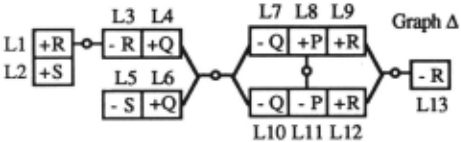
Definition: A walk in a clause graph r is an alternating sequence Cof11C1 ... C,.1Il,C, (n~1) of clause nodes and links such that for every pair of clause nodes ~-l· C; one of them contains a literal node of the positive shore of the connecting link IT; and the other contains a literal node of its negative shore.
A link is separating r, if there exist two clause nodes C and D connected by a walk in r, that are no longer connected when the link is removed. In the example all links except { Lg, Lu} are separating. A trail in a clause graph r is a walk, where all the links used are distinct. A cycle is a trail, whose start and end clause nodes coincide. A deduction graph is an acyclic clause graph. A refutation graph is a deduction graph without pure literal nodes. The example graph 11 is a deduction graph; it could be extended to a refutation graph by inserting an additional link {~. Ls}.
A refutation graph represents a proof for the unsatis fiability of the set of its clauses, while a deduction graph represents a derivation for the disjunction of its pure literals. As an example we give a refutation graph for a theorem known as (part of) the subgroup criterion:
Main Example: Let G be a group, and let S(;;G. If for all elements x, y in S the element xcry- 1 is also in S, then for every x in S its inverse rl is also in S.
This theorem must be formulated in first order logic for the automatic theorem prover. Here Pxyz means xoy=z in a group, Sx means xeS, a subset of the group, and the function i calculates the inverse of the group elements:
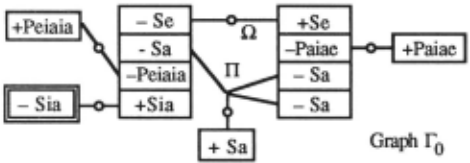
The refutation graph r 0 was. generated automatically by our theorem prover MKRP, [Eisinger and Ohlbach, 1986]. For the purpose of this paper, we assume that it is given.
2. 2 Natural Deduction Proofs
Definition: A proof line of natural deduction consists of a_ finite, IJ?SSibly empty set of formulae, called the assump t~ons, a smgle formula, called conclusion, and a justifica tiOn. A proof line with assumptions J'I, conclusion F and justification 9t is written J'I 1-- F 9t . Sometimes comm~nts are_ given to make the proof easier to read, they are wntten as 1f they were proof lines. A finite sequence S of proof lines is a Natural Deduction Proof (NDP) of a formula F, if
- (a) F is the conclusion of the last line of S,
- the set of assumptions of this last line is empty,
- (y) every line in S is justified by one of the rules of na tural deduction. A complete set of such rules is de scribed by Andrews [1980].
The construction of natural deduction proofs, by humans and computers alike, is conducted in single steps. To prove any valid formula F one always starts with a line 1- F. Such a line is obviously no proof, because it is not correctly justified. Now the proof is constructed by deriving subgoals until the proof is completed. In the intermediate states, called proof outlines by Andrews [1980], one may find completed subproofs, but also others that are not yet done. To formalize the procedure of the search for such a natural deduction proof, we use Generalized Natural Deduction Proofs (GNDPs). They differ from natural deduction proofs only in point (y). This allows lines not correctly justified within the calculus, but it is assumed that these lines are "correct", in the sense that a proof exists for (/\premises=> conclusion) in an arbitrary formalism, for instance as a refutation graph. Such lines are called external lines, lines justified within the calculus are called internal. When no external lines are present in a GNDP, it is an ordinary NDP.
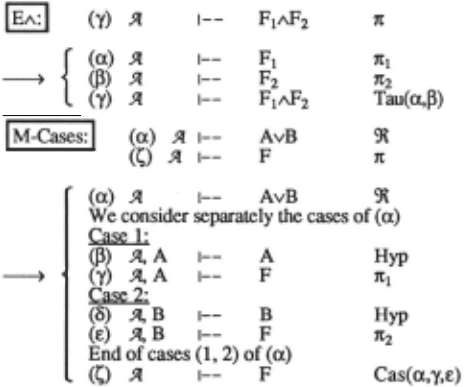
A GNDP consisting of just one line, which is an external line without premises and with conclusion F, is called the trivial GNDP for F. In order to fmd a natural deduction proof for a formula F, for which a proof 1t is known, a finite sequence of GNDPs can be constructed, whose first element is the trivial GNDP, and whose last element is an NDP for F. The transition between consecutive GNDPs is governed by the set of rules described in [Lingenfelder, 1986]. As an example, here are two of the rules:
Example: In the description of the transformation rules, J'I is a list of assumption formulae, capital letters indicate single formulae, small greek letters are used as labels for the lines, the justification 9t stands for an arbitrary rule of the natural deduction calculus, and the justifications 1t, 1t1, and 1t2 represent proofs of the respective lines. In any case one must make sure that the proofs 1t1 and 1t2 can be constructed from 1t or are otherwise known.
where r 0 is the refutation graph of our earlier example, we reach an intermediate GNDP after some applications of transformation rules. Lines 1 and 2 introduce new assump tions, which are in turn removed in lines 14 and 16. Line 13 is not correctly justified within the natural deduction forma lism, but by the refutation graph proving the theorem, therefore the proof is a GNDP rather than an NDP.
3 The Structure of Proofs Inherent in Topological Properties of Refutation Graphs
3 .1 Trivial Sub proofs
In the following subsections, subgraphs of the orginal refutation graph will be viewed as deduction graphs representing lemmata in a larger proof. This only makes sense, when the deduction graph in question is complex enough to warrant the introduction of a lemma. Otherwise it may be better to repeat a trivial argument instead of using a lemma. It is of course not straightforward to decide whether a deduction graph is trivial. To make a decision we use a heuristic approach taking into account several properties of the graphs involved.
It is indeed not easy to find objective criteria to decide when a proof is trivial. Davis [1981] proposes that "an infe rence is obvious, precisely when a Herbrand proof of its correctness can be given involving no more than one substitution instance of each clause". Pelletier and Rudnicki [1986] argue along the same lines, but point out that in ge neral it may be difficult to decide if any proof of a given fact is non-obvious because this requires to check a property of all possible proofs. This doesn't pertain to our case, how ever, since we are only concerned with the question if a gi ven proof is trivial as opposed to the question whether an obvious proof can be found for a given theorem.
So Davis' approach seems to be a good starting point, however there is an additional complication. We have to fi gure out whether a given proof (deduction graph) is a sub stantial part of a larger proof. When this is the case, it is normally desirable to use the subgraph as a lemma or as an intermediate step in the overall proof. Therefore we must check, if the rest of the proof - after removing the proof for the lemma- has become "easier". According to Davis this will be the case when the subgraph contains an instance of a clause, of which a different instance appears somewhere else in the rest of the proof. It may even be the case that both resulting proofs are obvious although the total proof wasn't.
But that's what dividing large proofs into steps is all about.
Finally, when it comes to make someone understand a proof, other non-logical properties must also be considered. For example its absolute length and the length in relation to the total proof must be taken into account. When the sub proof is relatively long, it will always pay to prove it sepa rately as a lemma. If this lemma is already known to the reader one may later dispense with its proof altogether. Doing this intelligently requires a database of known lem mata and a model of the reader's knowledge about the field of mathematics in case. When a freshman uses the system as an explanation for a proof one should not omit arguments which a graduate student might consider trivial. Conversely, it may obscure the idea of a complex proof to mention all the applications of lemmata that have been thoroughly un derstood long before. As one never knows, however, who will read the proof later, it is useful to postpone this deci sion as long as possible. At this stage it is not yet necessary to take a user model into account, this will only be done when the natural deduction proof is finally brought into a well-structured linear form.
3. 2 Shared Subgraphs as Lemmata
Now we assume that a proof for a formula cp has already been found by an automated deduction system. We will fur ther assume that this proof is represented as a refutation graph r, a form that can easily be constructed from a resol ution proof, see [Posegga, 1985, Lehr, 1988]. This means, however, that the equivalent problem of proving the unsat isfiability of the negated formula in a special normal form has been solved. In addition to the refutation graph, we therefore need a correspondence between the literal nodes of r and the atom occurrences in cp. Full details of the material presented in this chapter can be found in [Lingenfelder, 1988].
An initial "trivial" generalized natural deduction proof can now be constructed to start a transformation process as described in [Lingenfelder, 1986]. After each application of a transformation rule a number of tasks need to be performed in order to guarantee a smooth transformation process.
- The relation between literal nodes of the refutation graph and atom occurrences of the conclusion formula of every proof line must be established.
- The refutation graph is changed or divided according to the rule applied.
- Additional parts of the refutation graph may become positively polarized; a clause node is positively pola rized, when each of its literal nodes corresponds to an atom occurrence of an axiom or a current assumption. This neatly reflects the general idea of natural deduc tion proofs, where new assumptions are introduced during the proof process.
Some of the transformation rules, EA for instance, lead to new external lines, and as a consequence to a division of the refutation graph. In the simplest case the refutation graph proving F1AF2 is "cut" through the clause [-F1 -F2], such that the two resulting components are refutation graphs for F1 and for F2· In general these graphs may have a non-empty intersection, and this is similarly the case for other rules leading to a division of the refutation graph.
If this intersection is comparatively small, it may easily be duplicated and then used twice in the two subproofs. If it is relatively large, however, it may be sensible to prove a lemma first and then use it in both proofs. In order to formalize such a procedure, a new transformation rule E-Lemma is introduced.
This rule must of course be used with discretion, i.e. only when an appropriate formula G could be found, which sim plifies the proof of the formulae F;. In particular it may only be used, when all the literal nodes in the refutation graph 1to are positively polarized, so that it is possible to prove G from axioms and current assumptions only. It goes without saying, that 1t0 must be a common subgraph of all the graphs 1t;. In constructing the graphs 1t';; one is entitled to use the formula G as an additional axiom. The case n=l may also be meaningful, when a lemma is introduced as a subgoal, see section 3.3.
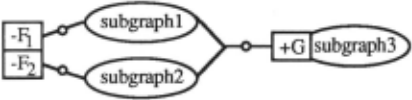
Let us consider for a moment what these shared subgraphs may look like. We always assume that a cut is being made in order to apply EA. In the simplest case the lemma con sists of just one atom G. Then the graph has the form
The case where G is a conjunction G1AG2 is almost as simple. There are now two independently shared parts.
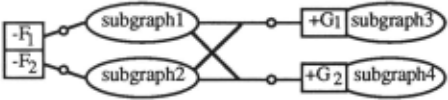
When G is a disjunction G1 vG2, however, things are no longer as easy. One might think that it suffices to introduce a link between the two subgraphs of the previous case. It is true that we could now prove the disjunction, but a cycle is introduced into the graph, which therefore ceases to be a re futation graph. In fact, a shared subgraph representing a dis junction canonly occur, when the theorem F1AF2 appears more than once in the graph, as in the next example.
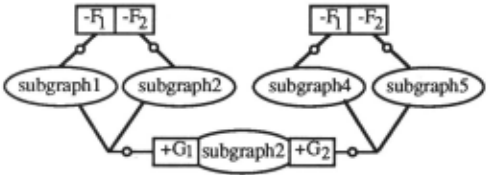
After cutting through both clauses [-F1 -Fil the graph contains refutation subgraphs for F 1 and F 2 sharing subgraph3. In both cases the proof can be done by cases after the lemma G1vG2 has been introduced.
Already Shostak [1979] mentioned, that unsatisfiable ground clause sets exist, for which every refutation graph contains at least one of its clauses twice. But in this case one can inhibit the duplication of any specific clause.
Lemma: For every unsatisfiable ground clause set S containing a clause C, one can construct a refutation graph, which contains C only once. ·
If one chooses the theorem clause [-F1 -F2] to appear only once, the graph of the last example takes the form shown below. Now the subgraph proving G1vG2 is no lon ger shared, but two copies of it exist in the refutation graph.
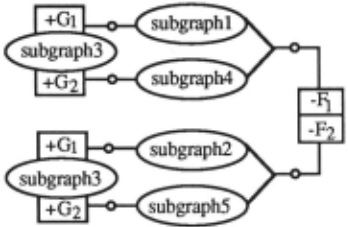
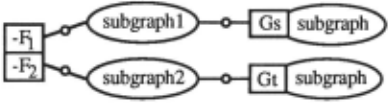
So in general one has to search for isomorphic subgraphs that are complex enough to warrant the introduction of a lemma. In addition to an isomorphic graph structure corre sponding literal nodes must represent identical literals and must be related to the same atom occurrences in the original formula. This condition may, however, be relaxed for term arguments of the free (lemma) literals, if they correspond to variables, that need not be instantiated in the subgraph. In this case the lemma becomes a quantified formula used more than once in different instantiations.
Such a lemma corresponds to a resolvent used more than once during the resolution proof. Thus, if the refutation graph was originally constructed from a resolution proof, one should keep this information in order to obviate the search for that kind of lemma. An example can easily be constructed by slightly altering the above graph.
3. 3 Separating Links that Define Subgoals
In the previous chapter, the main incentive for the intro duction of a lemma was to avoid unnecessary duplication in the proof. But this is not the only reason, why mathema ticians use lemmata. Often they are used purely to structure the proof, so that its main ideas become better visible.
In an automatic proof transformation it is obviously dif ficult to find meaningful lemmata. And it is here again that the topological structure of the refutation graph may suc cessfully be exploited. The task is to find parts of the refu tation graph that are sufficiently complex in order to justify the introduction of a lemma, while they should at the same time be easily separable from the rest of the graph. Besides, all the parts belonging to the proposed lemma must have become positively polarized before. If it were possible to find a link or a small set of links separating the refutation graph, and fulfilling these requirements, one might use the positively polarized part as a lemma. The search for such links is performed by the following algorithm:
Algorithm:
- Starting with a non-trivial refutation graph r (cf. sec tion 3.1), we want to compute a set 'I' of candidate links for a lemma. Start with '1':= {}.
- Compute the set 'I' 8 of the links separating the graph. The removal of a given Ae 'I' 8 from r results in two deduction graphs r + (A) and r_ (A).
- Compute '1'0:=(AE '1'8 I exactly one of r+(A) and r_ (A) is trivial}. These are useless, since they can only lead to trivial lemmata.
- Let 'I':='I'U{'I's\'l'o).
- For each Ae 'I' 0 duplicate the trivial subgraph r tr (A), if A is branching on the non-trivial side. Note that r is changed by this operation. In particular it may now have a set 'I' s of additional separating links.
- If '1'5 is non-empty, go to 3, else continue with 7.
- Now 'I' is the set of candidates for lemma purposes.
Main Example (cont'd): We will now resume our example. In constructing the current GNDP only transfor mation rules were applied not using, or changing, the refutation graph at all. As this is no longer possible at this stage, we try to detect separating links applying our algo rithm to the graph r 0·
All the links except n are separating a trivial part from the rest of the graph. Therefore IT is now broken up and the clause [Sa] is triplicated. After that Q is separating; the clause node [-Sia] in double bars is the only negatively po larized one. So one part of r 0 without n is all positive, and each part is trivial in itself. Using Davis' definition of ob viousness, one has to check that the literal nodes of all clause nodes correspond to different atom occurrences of the original formula. In the complete graph the two clauses [-Sa -Sa -Paiae Se] and [-Se -Sa -Peiaia Sia] are different instances of the same formula occurrence. Thus n represents the lemma Se. Note that this lemma really has an inter esting meaning, namely that the neutral element of the group is contained in the subset S. The two graphs r 2 and r 3 below result from cutting the graph at n, representing proofs for Se and Sia (using Se) respectively.
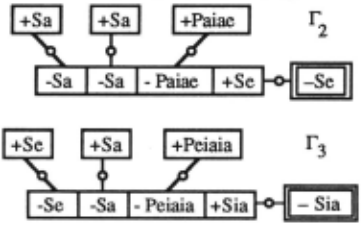
Now one proceeds to the next GNDP using the trans formation rule E-Lemma:

Let a be an arbitrary constant
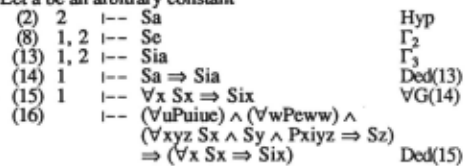
In order to prove Se we ftrSt work on r 2, then we continue with r 3 until the natural deduction proof is completed.
Unless the set 'I' of candidate links for the construction of a lemma is a singleton, as in the example above, we must define an actual lemma by selecting one or several of these links. In order to do this, we must try to isolate parts of the graph containing only positively polarized clause nodes, which are connected to the rest of the graph only via '1' links. The following algorithm describes, how this is done.
Algorithm:
- For all negatively polarized clause nodes c- compute I:'I'(C-), the maximal connected subgraph, which includes c- but does not contain any Ae '1'. These graphs are deduction graphs, all of whose pure literal nodes were connected to the rest of r with '1'-links.
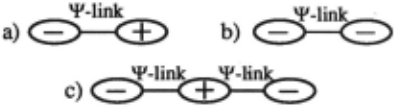
- For all positively polarized clause nodes c+, not be longing to any of the ~(C-), compute l:'I'{C+). Now the graph is divided into "positive" and "negative" subgraphs in one of three basically different ways. In all three cases, variations may occur due to separating links that are branching.
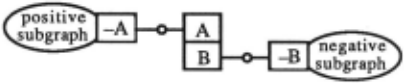
- If there is only one ~(c-), the set of '1'-links attached to its pure literal nodes is used as a lemma, which can be derived from the positive rest of the graph, i.e. directly from axiom formulae and current assumptions. In this case the lemma is the conjunction of the literal nodes in the opposite shores of the pure literal nodes.
- If two of the ~(c-) are adjacent, then the proof is se parated into cases.
- If there is a l:'I'(C+) between two of the ~(C-), then one has to check, if the positive part is trivial, in which case one proceeds as in b). Otherwise the posi tive subgraph defines a disjunctive lemma, which will then be used to perform a proof by case analysis.
3. 4 Structuring Proofs by Case Analysis
One of the transformation rules defined by Lingenfelder [1986], called M-Cases, leads to a division of the refutation graph. It can always be applied, when a disjunction has been derived earlier. An application is however undesirable in most cases, as can be seen from the following examples:
- If only one of the resulting components contains ne gatively polarized literal nodes, then an extra and un necessary proof by contradiction must be performed.
- If the two resulting parts overlap widely, including negatively polarized literal nodes, then large parts of the proof will be duplicated in both cases.
A good case for the application of M-Cases appears, when both of the resulting components contain parts of the theorem, and their overlap is either small or restricted to po sitively polarized parts, in which case a lemma can be de fined to avoid the duplication, cf. cases 3b and 3c above.
The most important case for the rule M-Cases comes up, when an existentially quantified formula cannot be proven constructively. In the refutation graph, this fact is reflected by the existence of several copies of the theorem clauses. M-Cases can now be applied, if all the resulting components contain just one of these copies.
4 Final Remarks
After the transformation process from a refutation graph into a natural deduction formalism the proof must now be ordered in accordance with its logical structure. A first algorithm to structure natural dedcution proofs has been proposed by Chester [1975]. He starts his transformation process from a given, completely unstructured natural deduction proof, ha ving no information of how it was constructed. However, if an NDP was constructed by the method described above, one already knows about lemmata from the topological structure of the refutation graph as described before in section 3.
When the natural deduction graph has been ordered, some further steps are required to make the proof really under standable. The main drawback of natural deduction proofs is their length and the difficulty in seeing the important steps. One has to distinguish therefore between trivial proof steps and more important steps, which is not straightforward, as the answer depends on the context of the proof as well as on the intended reader. After all, a mathematician will consider a lot of proof steps trivial, that inexperienced readers might not find easy at all. This raises the question how this di stinction can be made automatically.
A first approach will group several steps, especially when only propositional reasoning is involved. But it may also be indicated to combine propositional steps with an in stantiation. If it is known, however, that the proof will ap pear in a text book immediately after the proof of some lemma, or that an expert will read the proof, a complete subproof may be omitted. In order to achieve this sort of reader dependent simplification of the proof it will be neces sary to have a model. The development of user models is a well known research problem in AI, especially in the field of natural language processing and computer interfaces.
Summary: In this paper we have seen, that we can ex ploit the topological structure of computer generated proofs, in order to break them up into smaller lemmata. In particular this may avoid the need to prove a subformula more than once, when it is shared by different branches of the proof. In addition the information implicit in the topological proper ties of refutation graphs is used to structure the proof. This is done by dividing the graph into disjoint parts to be proved separately, either sequentially, as a lemma cited later in the proof, or as a proof by case analysis. In order to do this, the algorithm for the transformation of refutation graphs into natural deduction proofs had to be extended.
The same information also facilitates the process of orde ring the natural deduction proof. The parts to be brought into a meaningful order are much smaller, thus reducing the number of arbitrary decisions that have to be made to choose an actual sequence of proof lines. In fact one has to solve several smaller linearization problems instead of a single large one; of course one also has to find a sequence of the lemmata in the end.
The final ordered version of the natural deduction proof is then used as a starting point for removing trivial steps from the proof. In general this can only be done with the help of a user model. When all of this has been done one can tackle the problem to state this formal proof in mathematical natural language, which is the topic of our current research interest, see [Huang, 1989].
@inproceedings{ijcai1989p60,
  title     = {Structuring Computer Generated Proofs},
  author    = {Lingenfelder, Christoph},
  booktitle = {Proceedings of the Eleventh International Joint Conference on
               Artificial Intelligence, {IJCAI-89}},
  publisher = {International Joint Conferences on Artificial Intelligence},
  editor    = {N. S. Sridharan},
  pages     = {378--382},
  year      = {1989},
  month     = {8},
  note      = {Automated Deduction},
  url       = {https://ijcai.org/proceedings/1989/60},
}
TY - CPAPER TI - Structuring Computer Generated Proofs AU - Lingenfelder, Christoph T2 - Proceedings of the Eleventh International Joint Conference on Artificial Intelligence, IJCAI-89 PB - International Joint Conferences on Artificial Intelligence PY - 1989 SP - 378 EP - 382 UR - https://ijcai.org/proceedings/1989/60 ER -Copied
Machine-readable versions of this paper, for tools and AI agents:





