
A Rational Reconstruction and Extension of Recursion Analysis
Proceedings of the Eleventh International Joint Conference on Artificial Intelligence. Automated Deduction. Pages 359-364.
© 1989 International Joint Conferences on Artificial Intelligence
Abstract
The focus of this paper is the technique of recursion analysis. Recursion analysis is used by the Boyer-Moore Theorem Prover to choose an appropriate induction schema and variable to prove theorems by mathematical induction. A rational reconstruction of recursion analysis is outlined, using the technique of proof plans. This rational reconstruction suggests an extension of recursion analysis which frees the induction suggestion from the forms of recursion found in the conjecture. Preliminary results are reported of the automation of this rational reconstruction and extension using the CLAMOyster system.
- [Boyer and Moore, 1979] R.S. Boyer and J.S. Moore. A Computational Logic. Academic Press, 1979. ACM monograph series.
- [Bundy et al., 1988] A. Bundy, F. van Harmelen, J. Hes- keth, and A. Smaill. Experiments with proof plans for induction. Research Paper 413, Dept. of Artificial In- telligence, Edinburgh, 1988. Submitted to JAR.
- [Bundy, 1988] A. Bundy. The use of explicit plans to guide inductive proofs. In 9th Conference on Au- tomated Deduction, pages 111-120. Springer-Verlag, 1988. Longer version available as DAI Research Pa- per No. 349.
- [Constable et al., 1986] R.L. Constable, S.F. Allen, H.M. Bromley, et al. Implementing Mathematics with the Nuprl Proof Development System. Prentice Hall, 1986.
- [Horn, 1988] C. Horn. The Nurprl proof development system. Working paper 214, Dept. of Artificial Intel- ligence, Edinburgh, 1988. The Edinburgh version of Nurprl has been renamed Oyster.
- [Stevens, 1988] A. Stevens. A rational reconstruction of Boyer and Moore's technique for constructing induc- tion formulas. In Y. Kodratoff, editor, The Proceed- ings of ECAI-88, pages 565-570. European Confer- ence on Artificial Intelligence, 1988. Also available as DAI Research Paper No. 360.
References were extracted automatically from the PDF and may contain errors.
Full text extracted automatically from the PDF; figures, tables and equations may differ. The PDF is the version of record.
1 Introduction
The work described in this paper is part of a project to explore the use of proof plans for the automatic guidanc.e of mathematical proofs. In particular, we are developing proof plans for the proofs by mathematical induction that are required in the automatic synthesis of computer programs from their specifications. Given a conjecture, the CLAM plan formation program constructs a proof plan to solve it from existing proof tactics. This proof plan is then used to guide the Oyster proof development system, [Horn, 19881, in a proof of the conjecture. Oyster is a Prolog re-implementation of Nuprl, [Constable et al., 1986]. They are both proof checkers for Intuitionistic Type Theory, a logic based on the work of Martin-Lof.
Oyster reasons backwards from the conjecture it is try ing to prove, using a sequent calculus formalism which includes rules of inference for mathematical induction. The search for a proof must be guided either by a hu man user or by a Prolog program called a tactic. The Oyster search space is very big, even by theorem prov ing standards: There are hundreds of rules of inference, many of which have an infinite branching rate. So care ful search is very important i[a combinatorial explosion is to be a voided.
"The research reported in this paper was supported by SERC grant GR/E/44598, Alvey/SERC grant GR/D/44270, an SERC Senior Fellowship to the first author and an SERC postgraduate studentship to the last author. We are grateful to the other members of the mathematical reasoning group at Edinburgh for many useful discussions and to an anonymous IJCAI- 89 referee for extensive feedback.
Our aim is to develop a collection of powerfu~ heuris tic tactics that will guide as much of the search for a proof as possible, thus relieving the human user of a te dious and complex burden. These tactics need to be applied flexibly in order to maximise Oyster's chances of proving each theorem. Proof plans provide this O.ex ible application. Each tactic is partially specified by a method, which is a description, in a meta-logic, of the preconditions and effects of the tactic. CLAM reasons with these methods to build proof plans. A proof plan for a conjecture defines a tactic tailor-made to generate a proof of that conjecture.
The state of the art in inductive theorem proving is the Boyer-Moore Theorem Prover, [Boyer and Moore, 1979] (henceforth BMTP). It is, thus, natural for us to try and represent the heuristics embedded in the BMTP as Oyster tactics. [Bundy, 1988] contains an analysis of some of these heuristics. We have used this analysis to implement a number of Oyster tactics for inductive proofs and have successfully tested them on some simple theorems drawn from the literature, [Bundy et al., 1988].
2 Recursion Analysis
Recursion analysis is the name we have given to the process, embedded in BMTP, of analysing the recursive structure of a conjecture and deciding what form of in duction to use to prove it. This choice is critical to the success of the proof attempt. Recursion analysis picks one out of several induction suggestions. An induction suggestion consists of an induction schema and some in duction variables 1 . The form of the recursive functions contained in the conjecture is used to construct raw in duction suggestions. These are then combined together into a final induction suggestion, which is the one used in the proof. In this section we will explain the rational reconstruction of recursion analysis given in [Stevens, 1988!. In later. sections we will see how to realise this rational reconstruction within proof plans and how to extend it.
We can best explain how recursion analysis works by example. Consider the conjecture:
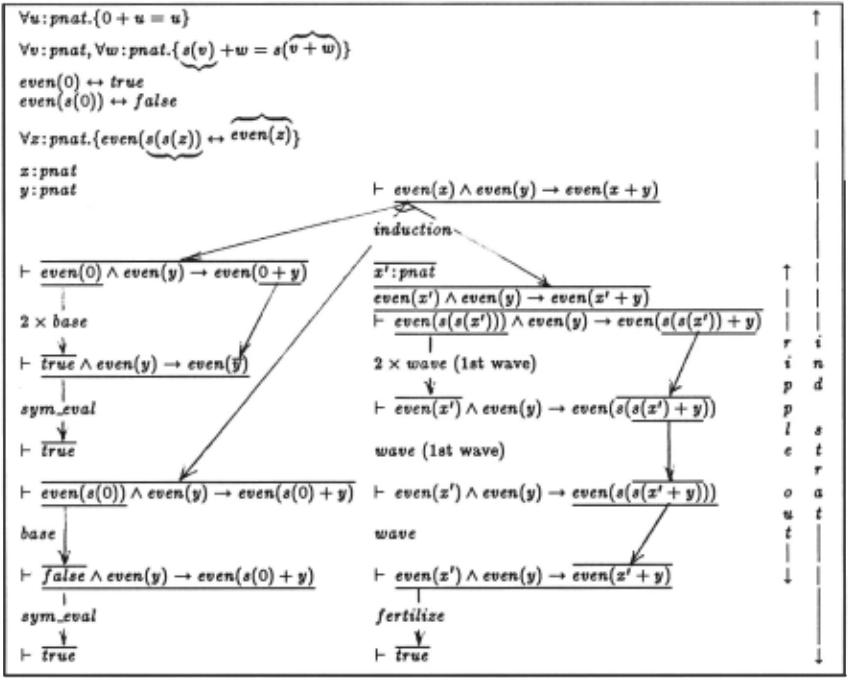
where the recursive definitions of + and even are given in the top left hand corner of figure 1. Formulae of the form X: T are to be read as "X is of type T", and pnat is the type of Peano natural numbers. Note that the definition of + steps down in single steps, whereas the definition of even steps down in double steps. The num ber of steps is determined by the term occurring in the recursive argument position in the head of the step for mula of the definition. These terms are emphasised with an underbrace in the definitions of + and even in fig ure 1. We will call them recursion terms. The recursive function in the body of the definition is emphasised by an overbrace.
1 However, in subsequent sections we will restrict ourselves to single variable inductions.
To each recursion schema there corresponds a dual induction schema. For instance, the induction schema dual to 1 step recursion is:
where P(x) ranges schematically over formulae which contain x 2 · To emphasise the duality between induc tion and recursion, the induction terms of each schema are also underbraced. Note that we have renamed the induction variable, x, to x' in the induction hypothesis and conclusion, cf. the renaming of x to x' in figure 1. This renaming is necessary for soundness, since r may contain x .
Recursion analysis locates the recursive functions in the conjecture. Each occurrence of a recursive function, F 3 , with a variable, X, in its recursive argument posi tion, gives rise to a raw induction suggestion. The in duction variable suggested is X. The induction schema suggested is the one dual to the form of recursion used to define F. Applied to the conjecture 1 this produces the raw induction suggestions given in table 1.
| X | F | Scliema | RecursiOn Term | Status |
|---|---|---|---|---|
| X | even | 2 step | S S X | |
| y | even | 2 step | s s y | |
| X | + | 1 step | S X | subsumed |
Note that each occurrence of x gives rise to a raw in duction suggestion. Unfortunately, the two occurrences suggest two different induction schemata: a 2 step and 1 step schema. Fortunately, the 2 step schema subsumes the 1 step schema. This is because the recursion term of the 2 step schema consists of repeated nestings of the recursion term of the 1 step schema. Thus the 2 step, x schema is adopted as the single schema for x, replacing both itself and the 1 step, x schema. In general, there may not be an already suggested schema for a variable that subsumes all the others, but it may be possible to find a new schema that does. Stevens' recursion anal ysis, [Stevens, 1988], finds such all-subsuming schemata by merging one or more raw induction suggestions. For instance, a 2 step and 3 step induction would be merged to give a 6 step schema that subsumed both 4 ·
2 But it may also contain other variables, a·nd is not nec essarily unary.
3 F is a meta-variable ranging over object-level functions. We use the conventions that: object-level variables are rep resented as meta-level constants, only meta-level variables start with an upper case letter, and the word 'function' is used in the lambda calculus sense to include predicates and connectives.
The end result of merging is a set of suggestions cover ing every distinct (i.e. non-subsumed) induction schema that can be derived from the raw induction schemata. In our example we would have a 2 step schema for x and a 2 step schema for y. All that remains is to choose which one should become the final induction suggestion. Note that the 2 step, x schema will produce an induc tion conclusion with the term s(s(x')) replacing each oc currence of x, and that, by design, a recursive defini tion will match the term immediately dominating each of these occurrences in the induction conclusion, namely even(s(s(x'))) and s(s(x')) + y. The same is not true of the 2 step, y schema. The second occurrence of y did not play a role in formation of this induction suggestion, and no recursive definition will match the term x + s(s(y')) which it gives rise to in the induction conclusion. The replacement of the second occurrence of y with s(s(y')) is regarded as unsuitable. Boyer and Moore classify such suggestions as fio.wed 5 · Flawed suggestions are rejected if any unflawed ones remain, so that in the example above, the 2 step, x suggestion is the one that is finally chosen. In the event of a tie the induction subsuming the largest number of raw suggestions is chosen.
BMTP and [Stevens, 1988] use recursion analysis to construct induction schemata at run time, and hence must prove them well-founded after construction. We have not reconstructed this aspect of recursion analysis, and so do not discuss it further here. Our induction sug gestions must be formed from those schemata for which Oyster currently has induction rules of inference.
The BMTP only uses the final induction suggestion generated by recursion analysis. Note that this makes its choice dependent on the forms of recursion found in the conjecture. For instance, it could not prove the clas sic version of the prime factorisation theorem 6 · This uses a form of induction in which the induction term is p X x', where pis a prime number. No p X x' recursion occurs in the theorem itself; or can be constructed by merging recursions in the theorem.
Nevertheless, recursion analysis is extraordinarily suc cessful. For many simple theorems, the final form of induction it sugge5ts leads to a proof. Why is this?
'The original BMTP deals with subsumption as a situ ation distinct from (as opposed to subsumed by) merging. One consequence is that it is unable to deal with the 2/3 step situation and others like it.
6 See [Boyer and Moore, 1979] or [Stevens, 1988] for a full definition of unsuitable replacements and fiawed suggestions.
6 BMTP does prove a non-classic, 'verification' version of this theorem which, in the place of an existentially quanti fied variable, includes a function, defined by p x x' recursion, which returns the prime factors of a natural number. In the classic version (see §7 below) these factors are merely asserted to exist. Because the classic version includes an existential quantifier, it cannot even be stated in the BMTP logic.
3 A Proof Plan for Inductive Proofs
We believe that the BMTP succeeds so often because many inductive proofs have the same overall shape. The BMTP heuristics combine to produce proofs of this over all shape. In particular, the final induction suggestions of recursion analysis initiate proofs of this type and gen erate subgoals that the other heuristics are designed to solve. We believe that proof plans provide a good no tation for describing this overall shape and accounting for the way that the heuristics combine together, !Bundy, 1988]. Proof plans can be used to predict and account for the successes and failures of the BMTP. They also suggest ways of improving and extending the BMTP heuristics. In particular, we will show how to use proof plans to ac count for the success of recursion analysis, and to extend it to make it independent of the forms of recursion found in the conjecture.
We can best explain the overall shape of BMTP proofs by example. Figure 1 is an outline of the proof of conjec ture {1) which is generated by our Oyster program using our rational reconstruction of the BMTP heuristics. The Oyster notation has been slightly simplified for exposi tory reasons.
Each formula is a sequent of the form H 1- G, where ! separates the list of hypotheses, H, from the goal, G. The first sequent is a statement of the conjecture. Each suc cessive sequent is obtained by rewriting a subexpression in the one above it. The subexpression to be rewrit ten is underlined and the subexpression which replaces it is overlined. Only newly introduced hypotheses are actually written in successive sequents; sequents are to be understood as inheriting all those hypotheses above them in the proof. In the spaces between the sequents are the names of the tactics which invoke the rewriting.
The proof is by backwards reasoning from the state ment of the conjecture. The induction tactic applies the 2 step induction schema to the conjecture: replacing x by 0 and s(O) in the two base cases, and by x' in the induction hypothesis and s(s(x')) in the induction con clusion of the step case. The base and step tactics then rewrite the base cases and the step case, respectively, using the base and step formulae of the recursive defini tions of+ and even. The two applications of base rewrite both the base cases to tautologies, which the sym..eval tactic reduces to true. The four applications of step raise the occurrences of the successor function, s, from their innermost positions around the x's until they are ab sorbed by the application of the step formula of even. The induction conclusion is then identical to the induc tion hypothesis. The fertilize tactic uses the latter to deduce the former.
ripple_out is a super-tactic which is responsible for the repeated application of step to the induction conclusion -raising the recursion terms. ind..,strat, which is an abbreviation of induction &trategy, is a super-super-tactic for guiding the whole of this proof, apart from the two sym..eval applications. It is defined by combining the sub-tactics induction, base, ripple..out and fertilize in the order suggested by the proof in figure 1. &ym..eval, which is an abbreviation of &ymbolic evaluation, puts ex pressions in normal form by unpacking definitions, elim inating quantifiers, applying reflexivity and recognising tautologies. It is also a super-tactic which repeatedly ap plies step, base, identity, intro and tautology. A large number of inductive proofs can be understood as a com bination of ind_strat and sym..eval, although not always in the combination illustrated in figure 1. For instance, there are often several nested applications of ind....strat before sym..eval is used to finish off the proof.
Note how ripple_out acts as a bridge between the induction and fertilise tactics. induction makes the induction conclusion differ from the induction hypoth esis by the insertion of induction terms for the induc tion variable. These induction terms form a barrier to fertilize's use of the induction hypothesis to prove the induction conclusion. ripple_out removes this barrier with a series of steps which raise the induction terms out of their inner-most positions. Recursion analysis en sures that the induction terms inserted will have just the right form for the first wave of steps 1 to succeed, i.e. those steps that raise the induction terms past the inner most functions that dominates them. The raw induction suggestion made by each recursive function occurrence proposes an induction term which is a syntactic vari ant of that recursive function's recursion term. So if this induction term is inserted then step is guaranteed to suc ceed on this occurrence. If the final induction suggestion is unflawed and subsumes all the raw suggestions, then step is guaranteed to succeed on all the occurrences, al though repeated steps may be required to completely lift the final induction term. This is the reason for choosing an induction schema based on the recursive schemata used to define the functions in the conjecture. These conditions only guarantee the success of this first wave of steps, not the whole ripple..out tactic.
4 Fitting Proof Plans to Conjectures
We have implemented each of the tactics illustrated above by a Prolog program which can guide the Oys ter proof checker to make the appropriate logical steps. Furthermore, we have specified each of these tactics with a method. CLAM uses these methods to build a tactic tailor-made to prove the whole of each conjecture.
A method is represented as a frame of 6 slots which between them describe the conditions under which its tactic is applicable and the effect if this application is successful.
All that will concern us in this paper are the input formula slot and the preconditions slot of the ind_strat method. Consider the preconditions of the version of the ind_strat method described in an early version of our program. With some minor generalisations, these were:
7 In figure 1 the first wave of steps are marked.
where Conj is the input formula, X ranges over object level variables, FTerm ranges over object-level terms, RTerm ranges over object-level recursion terms, N is a natural number and Posn is a position. These meta variables are all universally quantified · globallys to the method. A position is a list of argument numbers, e.g. [1,2,3] would represent the 1st argument of .the 2nd argument of the 3rd argument of an expressiOn. exp..at(Exp, Po&n) = SubExp means that SubExp is the subexpression found at position Posn in expression Exp. recursive(FTerm, X, RTerm) means FTerm is a term whose dominent function is recursively defined with the variable, X, in its recursive argument and with recursion term, RTerm, e.g. the information that even is defined recursively with recursive term s(s(U)) is represented by the meta-assertion recursive(even(U), U,s(s(U))} 9 · Re cursion terms contain the crucial information that CLAM needs to pick an induction schema from those available to Oyster. The final induction suggestion will consist of an recursion term and a recursion argument. CLAM picks an induction schema with an induction term that matches this recursion term. Induction schemata are in dexed by their induction terms.
Part of the process of planning involves fitting meth ods to the current conjectUre. To fit a method, the input formula is matched to the conjecture and then the pre conditions are checked to see if they are satisfied and to instantiate their meta-variables. For instance, fitting these preconditions to the conjecture, (1), above, pro duces the variable instantiations given in table 2. Com parison of these with table 1 will show that what this method fitting process does is to generate the raw in duction suggestions.
| X | FTerm | Posn | RTerm |
|---|---|---|---|
| X | even x | 1, 1, 1,1 | S S X |
| y | even y | 2, 1, 1,1 | s s y |
| X | x+y | 1, 2, 1,1 | S X |
5 Extending Plan Fitting to Perform Recursion Analysis
Two questions arise naturally.
- The preconditions, (3), above only guarantee the success of one application of the step tactic for one occurrence of X. Can they be extended to at least guarantee the success of the first wave of steps?
- The fitting of the preconditions, (3), above only gen erates raw induction suggestions. Can they be ex tended to do recursion analysis, i.e. to generate final induction suggestions?
8 So the quantifiers do not appear within the preconditions slot, (3), above.
0 Note the use of the meta-variable U ranging over object level variables, which will be instantiated to whatever X is instantiated to when recursive(FTerm, X, RTerm) and recursive( even(U), U, s(s(U))) are unified.
The answer to both these questions is yes. The beau tiful part of these answers is that the same extensions to the preconditions suffice in each case, i.e. in extending the preconditions to guarantee the success of later parts of the plan, the processes of flaw checking, subsumption checking and merging are generated naturally as a side effect. Their presence and success in BMTP is thereby explained.
The extended preconditions are:
where subsumes(RTerm, RTerm')' means that RTerm subsumes RTerm', e.g. subsumes(s(s(x)), s(x)). Only those meta-variables whose scope is restricted to the preconditions are quantified within them. The others, e.g. RTerm, are universally quantified globally to the method.
These revised preconditions extend the original pre conditions to every occurrence of every variable, X, in the conjecture, Conj. They check firstly that each such occurrence is at the recursive argument position of a recursive function and secondly that there is a term, RTerm, that subsumes all the recursion terms of these recursive functions. The instantiations of RTerm and X constitute the final induction suggestions and the instan tiations of RTerm' and X the raw induction suggestions. Care has been taken in our implementation so to define subsumes that attempts to satisfy it, with its second argument instantiated and its first argument uninstanti ated, efficiently produce minimal subsuming schemata.
Fitting these preconditions to the conjecture 1 above, produces the variable instantiations given in table 3. The first line of this table is the required final induction sug gestion.
The second line of the table is a suggestion that ac tually fails the preconditions, (4). We have included it and the Status column for the sake of the following dis cussion. An induction suggestion that meets all the pre conditions may not always be available, e.g. both x and y are flawed in x + y = y + x. In such cases we may want to follow BMTP and settle for the suggestion that meets most of them. We can classify the variables in the con jecture as follows. Those variables which occur only in recursive positions will be called unflawed and those that occur in non-recursive positions will be called flawed 10 · Those variables for which there is a schema that sub sumes all the schemata of its recursive occurrences will be called compatible and the rest will be called incom patible. Thus only unflawed-compatible variables com pletely meet the preconditions (4). Note that an instan tiation of RTerm can only be given for compatible vari ables. Suggestions are preferred in the order: unflawed compatible, flawed-compatible, unflawed-incompatible, flawed-incompatible. Ideally, our method fitting process would be flexible and accept partially fitting methods if fully fitting ones are not available. However, in the current implementation we have adopted the short term expedient of building this flexibility into the precondi tions themselves. See [Bundy et al., 1988] for details.
6 The Use of Lemmas in Rippling-Out
The step tactic, which is restricted to using rewrite rules based on the step formula of recursive definitions, is not always strong enough to enable ripple....out to succeed. Consider the following expression:
where X is defined by:
step applies to this once, to produce the expression:
but the argument of even is not of the form s(s( .. . )), so step will not apply a second time; ripple_out will fail What would permit another ripple, moving even adja cent to x X y, is the application of theorem (1) as a rewrite rule 11 , i.e. applying:
produces the expression:
which contains even(x x y) as required.
In general, we want to extend step to a new tactic wave, which uses rewrite rules of the form:
where U ranges over object-level variables, F ranges over object-level functions and B and C range over object level terms. We will call rewrite rules of the form (6) wave rules, where F(U) is the wave function, U is the wave argument and B(U) is the wave term by analogy to recursive function, recursion argument and recursion term, respectively. The wave terms in wave rules are underbraced and the wave functions are overbraced. The braces in rule (5) above show that it is a wave rule in two ways: one for each occurrence of the wave function on the right hand side of the rule. The wave tactic allows us to ripple out through non-recursive functions, non-recursive argument positions of recursive functions, and recursive argument positions that do not contain the appropriate constructor functions.
10 This definition of flawing corresponds in spirit to the Boyer-Moore definition, but differs from it in minor ways.
11 Reca.ll that the proof is constructed by backwards rea soning, so that a.n implication of the form P--> Q should be used a.s a. rewrite rule Q => P.
Step formulae of recursive definitions are usually wave rules. In addition, each theorem that Oyster proves can be tested to see if it has the right form and, if so, it can be stored as a wave rule for future use.
1 Extending Recursion Analysis
Now that we have generalised ripple_out beyond the use of step formulae of recursive definitions, it is natural to consider generalising the preconditions of the ind...strat method to meet the new opportunities this provides.
The key observation is that the induction term does not have to be derived from just the recursion terms of recursive functions in the conjecture. More generally, it can be derived from some wave rules' wave terms. We require only that its insertion would cause those wave rules to match subexpressions of the induction conclu sion. The recursion terms of recursive functions are can didates, but they are not the only ones.
To illustrate this, consider the conjecture that ev ery natural number can be factorized into a product of primes. We will formalise this as:
where prod is defined by:
Note that this definition is not based on a pxx' recursion. Now consider the rewrite rule: ,_...._.._
As indicated by the braces, it is a wave rule whose wave function is prod(tl) = u and whose wave term is hd Xu. prod(xl) = x in the conjecture (7) matches this wave function and has a variable, x, m the wave argument position. If induction used the induction term, p x x', suggested by this wave term then the wave rule would ripple the induction term out one wave. This suggests a form of induction that substitutes pX x' for x, in which x' is the induction variable. The p x x' form of induction:
has just this property. The only other raw induction suggestion that CLAM can extract by matching available wave rules to this occurrence of x, is the very similar, and also successful, x' x x" schema. There are no other occurrences of x in conjecture (7), so no other raw in duction suggestions to consider.
Using this p x x' induction the first wave of rippling out is done with the wave rule (8), as expected. There maining rippling out is done with some standard logical manipulation rules. The induction conclusion is then identical to the induction hypothesis, so fertilize fin ishes the proof of the step case.
The generalisation of the preconditions, (4), of ind...strat required in order to use wave rules to suggest inductions is:
where wave_rule(FTerm', X, B') means that there is a wave rule with wave function, FTerm', wave argument, X, and wave term, B', e.g. since (8) is a wave rule with wave function prod(UL) = U, wave argument U and wave term Hd X U, then wave..rule(prod(UL) = U,U,Hdx U) (cf. recursive(even(U),U,s(s(U)))).
These preconditions check that each occurrence of X is in the an argument position of a function for which there is a matching wave rule, and that there is a term, B, that subsumes each of the wave terms, B', of these rules. B then determines the induction schema and X is the induction variable.
If the only wave rules known to CLAM are step cases of recursive definitions then preconditions (9) generate exactly the same final induction suggestions as precon ditions (9). If CLAM-Oyster proves theorems that have the form of wave rules and if the existence of these rules is recorded by wave ..rule meta-assertions then additional induction suggestions are possible. However, in practice, the probability that a wave rule will match each conjec ture is quite low, so only a few final induction suggestions will be made even when a large number of wave rules and induction schemata are available. Several of these few suggestions may succeed - leading to different proofs of the conjecture - so that some of the increase in search space is benign. Our experience so far is that the new preconditions substantially increase the number of con jectures for which CLAM can find proof plans, without substantially increasing the size of the search space 12 . This situation may change as the number of wave rules increases, but there is no reason at present to suppose that it will.
8 Implementation and Results
The ideas discussed in this paper have been implemented in and tested on the CLAM-Oyster system. This required the following modifications.
- The only primitive induction schemata provided in Oyster are 1 step schemata for natural numbers,
12 Although search time does increase, since non-matching wave rules must be tried and rejected.
integers and lists, i.e. the s(x'), s(x')&- x', and [hdlx'] schemata. We have added a number of new induction schemata, including s(s(x)), px x', x' X x" and x' + x" schemata. To ensure the soundness of each new schema it was proved interactively as a higher order theorem in Oyster. This theorem was then available as a lemma for subsequent use by the induction tactic. For instance, in order to be able to use the s(s(x')) schema, (2), we had first to prove the theorem:
- The Oyster tactics and methods have been up graded to use these more general forms of induction. The step tactic and method have been replaced with the wave ones.
- We have added a new tactic, existential, for in stantiating existentially quantified variables. It sub stitutes a meta-variable for the existential variable when eliminating the existential quantifier during the planning process. Unification then instantiates this to an appropriate object-level term as the plan ning process progresses, e.g. during rippling-out. When the ind_strat tactic is applied this object-level term is substituted for the existential variable at the time of existential quantifier elimination.
- The preconditions of the ind_strat method have been upgraded to those given in meta-formula (9) above, but with modifications to permit partial fit ting where total fitting is not possible.
- Plans and proofs for the even+ theorem, (1), and the prime factorization theorem, (7), have been au tomatically generated. Fitting the new precondi tions of the ind_strat generates the recursion analy sis described above for each of these two examples.
- The improvements in the methods and tactics has enabled simpler proofs to be found for some theo rems. For instance, the proof of the commutativity of times, x X y = y X x, which previously required 7 nested applications of s(x) induction, now only re quires 3 nested inductions, 2 of which are x' + x" inductions.
9 Conclusion
We have analysed recursion analysis by showing how the inductive proofs obtained by the Boyer-Moore Theorem Prover have .a common overall shape, and how recur sion analysis selects an induction schema and variable that increases the chances that a proof of this shape will be found. We have shown how to describe this overall shape using the technique of proof plans and, hence, both how to rationally reconstruct recursion analysis within proof plans and how to explain its success formally. Our analysis has suggested a natural extension to recursion analysis which frees the choice of induction schema from the forms of recu.rsion present in the original conjecture. In fact, recursion need not be present at all for induc tion to be used. This is vital if we are to specify pro grams without making any premature procedural com mittment, e.g. by anticipating the form of recursion to be used in the program, and yet have this procedural commitment made during the synthesis process.
The importance of this rational reconstruction of re cursion analysis is illustrated by the following points.
- The neat way that it relates flaw checking, subsump tion checking and merging as different aspects of fitting the same preconditions.
- The way in which it suggests an interesting ex tension of recursion analysis, enabling our theorem prover to find proofs that are beyond the capacity of BMTP.
We have implemented a theorem proving system, CLAM-Oyster, based on our rational reconstruction and shown that this system can find proofs which are beyond the ability of BMTP. Whether this success is brought at the price of an unacceptable increase of the planning search space it is not possible to tell without further em J>irical testing. The initial empirical results reported in [Bundy et al., 1988] are very encouraging, however. The planning search space on simple examples is several or ders of magnitude smaller than the object-level search space, and the ratio improves with more complex theo rems.
The research reported above is in the context of re cursive functions with a single recursion variable and a single step formula. This has served to simplify the dis cussion but the underlying ideas are not limited to such functions. We plan to extend the tactics and methods to more general recursive functions. Only then will we be able to test CLAM-Oyster on the full list of conjectures proved by the BMTP and similar theorem provers.
@inproceedings{ijcai1989p57,
  title     = {A Rational Reconstruction and Extension of Recursion Analysis},
  author    = {Bundy, Alan and van Harmelen, Frank and Hesketh, Jane and Smaill, Alan and Stevens, Andrew},
  booktitle = {Proceedings of the Eleventh International Joint Conference on
               Artificial Intelligence, {IJCAI-89}},
  publisher = {International Joint Conferences on Artificial Intelligence},
  editor    = {N. S. Sridharan},
  pages     = {359--364},
  year      = {1989},
  month     = {8},
  note      = {Automated Deduction},
  url       = {https://ijcai.org/proceedings/1989/57},
}
TY - CPAPER TI - A Rational Reconstruction and Extension of Recursion Analysis AU - Bundy, Alan AU - van Harmelen, Frank AU - Hesketh, Jane AU - Smaill, Alan AU - Stevens, Andrew T2 - Proceedings of the Eleventh International Joint Conference on Artificial Intelligence, IJCAI-89 PB - International Joint Conferences on Artificial Intelligence PY - 1989 SP - 359 EP - 364 UR - https://ijcai.org/proceedings/1989/57 ER -Copied
Machine-readable versions of this paper, for tools and AI agents:





