
Using Generic Knowledge in Analysis of Aerial Scenes: A Case Study
Proceedings of the Eleventh International Joint Conference on Artificial Intelligence. Vision and Robotics. Pages 1642-1647.
© 1989 International Joint Conferences on Artificial Intelligence
Abstract
Our goal is to produce high-quality symbolic descriptions from aerial scenes. We have chosen to work in the domain of large commercial airport complexes. Such scenes have a variety offeatures such as the transportation network, building structures, and mobile objects. This paper concentrates on detection and description of the transportation network (runways and taxiways). We illustrate the complexities of this problem and how it can be solved by using geometrical context and generic airport domain knowledge.
- [Ashford and Wright, 1984] N. Ashford and P.H. Wright. Airport Engineering, 2nd Ed. Wiley and Sons, 1984.
- [Canny, 1986] J. Canny . A Computational Approach to Edge Detection. IEEE Transactions on Pattern Analysis and Machine Intelligence, Vol. 8, November 1986, pp. 679-698.
- [FAA, 1980] Marking Paved Areas on Airports FAA Ad- visory Circular AC 150/5340-JE, November 4, 1980.
- [Huertas and Nevatia, 1988] A. Huertas and R. Nevatia. Detecting Buildings in Aerial Images. Computer Vi- sion, Graphics and Image Processing, Vol. 41, number 2, February 1988, pp 131-152.
- [Huertas et al., 1987] A. Huertas, W. Cole and R. Neva- tia. Detecting Runways in Aerial Images. Proceedings of the DARPA Image Understanding Worshop, Los Angeles, California, February 1987.
- [Mohan and Nevatia, 1988] R. Mohan and R. Nevatia. Perceptual Groupings for the Detection and Descrip- tion of Structures in Aerial images Proceedings of the DARPA Image Understanding Workshop, Boston, Massachusetts, April 1988.
- [Nevatia and Babu, 1980] R. Nevatia and R. Babu. Lin- ear Feature Extraction and Description. Computer Vision, Graphics and Image Processing, Vol. 13, 1980, pp. 257-269. IJCAI
- [McKeown and Harvey, 1987] D.M. McKeown, and W .A. Harvey. Automatic Knowledge Acquisition for Aerial Image Interpretation. Proceed- ings DARPA Image Understanding Workshop, Vol. 1, February 1987,pp. 205-226.
- [McKeown et al., 1985] D.M. McKeown, W.A. Harvey and J. McDermott J. Rule-Based Interpretation of Aerial Imagery. IEEE Transactions on Pattern Anal- ysis and Machine Intelligence, Vol. 7, September 1985, pp. 570-585.
References were extracted automatically from the PDF and may contain errors.
Full text extracted automatically from the PDF; figures, tables and equations may differ. The PDF is the version of record.
1 Introduction
Automatic analysis of complex aerial images is an im portant and challenging problem. Our aim is to compute rich, symbolic descriptions from an image which may be used for a variety of tasks such as making a cartographic map, change detection and guidance.
Aerial images are highly complex as they contain a large number {possibly hundreds) of both man-made and natural objects of a large variety, only some of which may be of interest. The image is also very complex, from a signal point of view, and sophisticated processing tech niques are necessary. But, the scene can not be analyzed in terms of signal alone; we must also use our cultural and world knowledge to reduce the ambiguities inherent in images. The interesting issue, then, is what kind of knowledge is to be used and how.
We have chosen major commercial airport complexes as a test domain. Airports contain a variety of objects, such as the transportation network (runways, taxiways, and roads), building structures {hangars, terminals, stor age warehouses, fuel storage farms), and mobile objects (automobiles, aircraft, humans). The airport complexes are under continual changes, usually due to expansion. The images themselves are rather complex due to the large number of objects present in them. However, a variety of such images are available with only moderate effort.
*This research was supported by the Defense Advanced Research Projects Agency, monitored by the Air Force Wright Aeronautical Laboratories under contract F33615-87C-1436
In our analysis, we do not assume specific knowledge of the scene, such as would be given by a detailed, current map of the specific airport complex. Instead, we only have generic information that the scene being viewed is an airport complex. We do have, and use, the knowledge about airports and the structures contained in them.
Our approach in the design of the system is that it must be modular and that the modules interact mostly at high, symbolic levels. In airports, for example the modules may be for detecting and describing the trans portation network, the buildings and the mobile objects. Detection of one type of object, such as a taxiway, may aid in increasing the confidence of a structure believed to be a passenger terminal (and vice-versa). However, we believe that such interaction takes place at a high level, after symbolic, object level hypotheses have been formed. This process can be considered to be hierar chical; each module has sub-modules that operate in a similar way. Thus, the transportation network module may consist of runway, taxiway and road modules; each of which operates somewhat independently but uses con text provided by the detection of other structures. Some structures may be more prominent and easier to detect, for example, runways are easier to detect than taxiways. In that case, the former provides the context for detec tion of the latter.
In this paper, we will concentrate on the problem of detecting and describing the transportation network in an airport complex, specifically the runways and taxi ways, to illustrate our methodology. (We have also developed methods of detecting and describing three dimensional structures such as buildings [Huertas and Nevatia, 1988, Mohan and Nevatia, 1988] however, we will not discuss those here due to lack of space). The runways and taxiways may appear to be rather obvious and prominent features to us, modeled easily as long, thin rectangular strips of uniform brightness. However, such is not the case. Runways and taxiways contain a number of surface markings: some to aid a pilot and oth ers caused by dirt, oil spots, exhaust fumes etc. Surface composition is not always uniform when runways and taxiways are extended or repaired. Presence of other ob jects, such as vehicles and airplanes, on or in the vicinity of the taxiways and runways further violates the simple model. Due to these and other reasons, the low-level segmentation of such scenes turns out to be highly fragmented with a very large number of low-level features detected, only a small number of which are relevant to our goal. Our task now is to use the generic knowledge ofrunways and taxiways to extract them from this mass of confusing data.
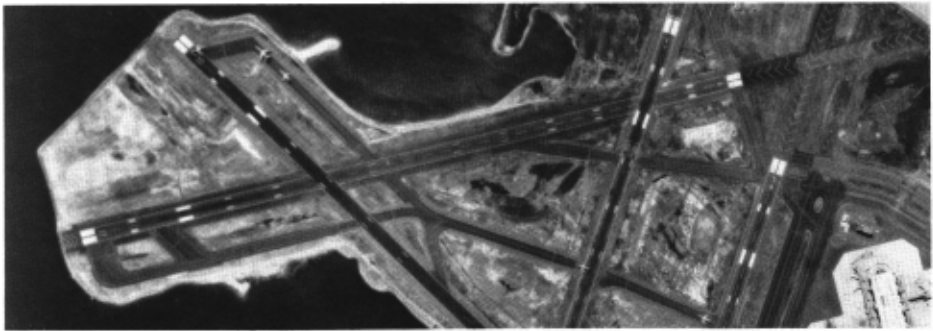
Our approach is basically one of "hypothesize and verify". Various grouping operations relying on geom etry, object shape and context form hypotheses that are then verified according to some desired attributes. Our system detects runways first, as they are more promi nent and can provide the needed context for detection of taxiways (and many other objects in the scene). Run way hypotheses are formed by utilizing grouping oper ations of continuity, collinearity, parallelism and sym metry. Verification consists of finding the appropriate markings (such as cente~ lines, "threshold" marks etc.) that are expected on the runways in a major airport. Once some of the marks are found, the context provided by them can be used to look for additional marks that may be too faint to find otherwise.
Detection of taxiways is somewhat similar to that of runways, however, the taxiways are much less con strained in shape and appearance and the context of al ready detected runways helps in detection and verifica tion of taxiways. The converse is also true, i.e. finding taxiways connected to a runway can help increase the confidence of the detected runway.
We describe our technique for runways detection briefly in section 2; further details of earlier work are given in (Huertas et al., 1987]. Detection of taxiways and junctions are described in more detail in sections 3 and 4.
There have been relatively few efforts in recent years to analyze complex, cultural aerial scenes. McKeown and his associates [McKeown et al., 1985, McKeown and Harvey, 1987] at CMU represent an exception. Our work is related to theirs, but is largely complementary. The major difference is perhaps in the way domain knowledge is used. We believe that our approach is much more modular and the use of domain knowledge in our system is at much higher levels, with the lower levels relying on much more complex geometrical knowledge.
2 Detection of Runways
Runways are perhaps the most prominent structure in an airport scene. In our system, no external context (from other objects) is available for detecting runways, though this module use geometrical context internally.
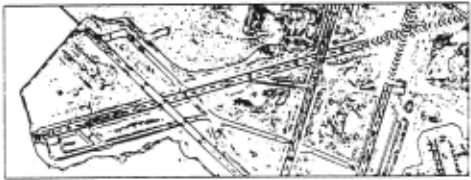
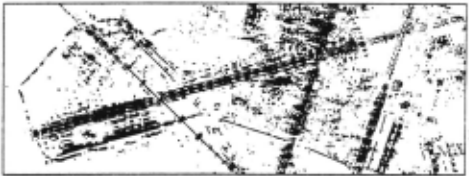
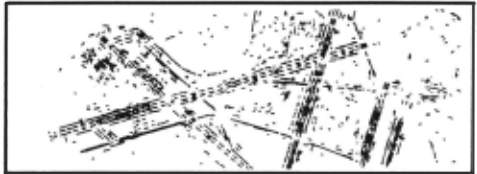
Figure 1 shows a portion (LOGAN:800 x 2200 res olution) of Logan International Airport in Boston. We first use our LINEAR software [Nevatia and Babu, 1980, Canny, 1986] to compute line segments (figure 2} and "anti-parallels" (parallel lines of opposite contrast, we will call them apars) (figure 3). We estimate the dom inant apar orientations and widths (focus of attention) by length-weighted histograms. We then extract and join potential runway fragments into runway hypothe ses by a number of grouping steps using continuity and collinearity. These hypotheses are verified by looking for the markings that they are supposed to have [FAA, 1980]. We look for centerlines, sidestripes, threshold markings, touchdown markings, large distance markings, small distance markings, and blast pad markings (fig ure 4). Our system uses a feedback mechanism to allow further search for evidence of centerlines and blastpad markings, using the previously detected markings as con text. Runways are described in terms of position, length, width and orientation, and associated markings.
3 Detection of Taxiways
Taxiways are much more complex objects than runways, as they can have a wider range in their geometrical parameters (see figure 1); they can be short or long, have a variety of widths, be straight or curved, and connect a variety of airport components. However, besides generic knowledge we make use of the context provided by the detected runways to help detect the taxiways. Our mod ule first finds the "long" straight portions of taxiways and then, it attempts to extend these portions also based on context.
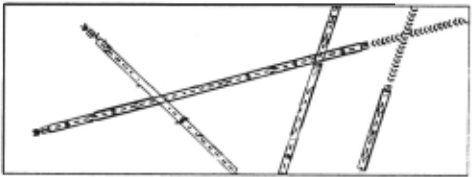
Taxiways are verified by looking for two types of sur face markings: the continuous sidestripes that bound them, and the continuous centerline down the middle of the roadway. Although our method to detect taxiways is similar to that for runway detection, below we give details of the method as this module is new and has not been published elsewhere.
3.1 Hypotheses Formation
As mentioned above, this process is aided by the de scriptions of previously detected runways, and also by knowledge on the constraints imposed by airport design procedures [Ashford and Wright, 1984]. We know for instance, the minimum acceptable distance between a taxiway and a runway if they are parallel, or the mini mum angle that a taxiway may form with a runway. We also know that taxiways do not cross but join runways. Taxiway crossings however, are allowed.
The first step in detecting taxiways is to find long frag ments which may correspond to fragments of taxiways. The apars representing these fragments (figure 5) are selected from the apars shown in figure 3 in a manner analogous to the selection of potential runway fragments (see [Huertas et al., 1987]}: they have a range of widths, and either are parallel to a runway or, form an angle greater than 25° with a runway. If the distance between an apar and the runway is greater than the allowed dis tance between parallel runways and taxiways, the angle constraint is not applied.
Next, the selected apars are joined on continuity along anti-parallel segments, and then they are joined on collinearity (figure 6) .
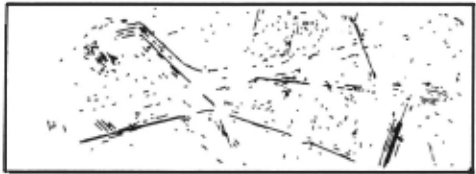
Figure 6: A pars joined on collinearity in LOGAN
The second step attempts .to extend long portions of taxiway fragments. It is known that the purpose of taxi ways is to facilitate aircraft moving from one section of the airport to another, thus taxiways do not arbitrarily end as do runways. We attempt to extend these taxiway fragments by invoking the following context dependent processes:
- Extension based on Aircraft Support: A large air craft on a taxiway will cause the taxiway hypothesis to fragment, thus to extend the taxiway fragments, we first try to detect aircraft by looking for symme tries due to the aircraft wings and fuselage at each fragment end. If an aircraft is detected, the taxiway is extended the length of the aircraft .
- Extension based on Runway Context: We attempt to extend or discard taxiway hypotheses fragments based on their spatial relationships to verified run ways in the scene. The following steps are taken:
- (a) Fragment intersects runway: The taxiway hypothesis fragments are extended until they in tersect a runway. If the intersection angle is greater than the minimum intersection angle and the distance between the taxiway hypoth esis fragment and the runway intersection point is small, we look for additional evidence to extend the fragment into the runway. This evidence includes checking for shorter apars collinear to the taxiway in this region and, fail ing this, the detection of aircraft in this region. If we find sufficient evidence, the taxiway hy pothesis is extended into the runway.
- (b) Fragment is parallel to runway: If the taxiway fragments are parallel to one of the verified run ways, we look for small wide apars joining the end of the taxiway fragment to the runway in dicating the presence of a taxiway apron.
- (c) Extension based on Taxiway Intersection: (see next section)
- (d) Extension based on Resegmentation: It is pos sible that a material change in the taxiway caused problems for the initial grouping pro cesses. We attempt to extend the taxiway frag ments by resegmenting image windows extend ing beyond the fragments' ends, and looking for evidence of taxiway continuation. This process is continued until no further evidence is found. At this point, we repeat steps (a) and (b).
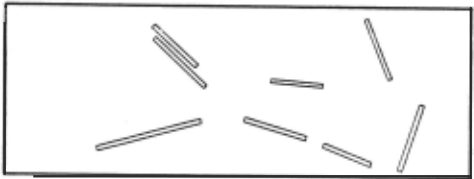
The a pars representing hypotheses of straight portions oftaxiways are shown in figure 7. In this result, only pro cess 1 above was applied. Extension of taxiways based on intersections (process 2c) is described below.
3.2 Hypotheses Verification
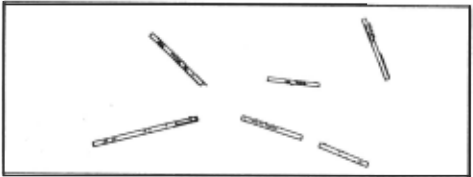
We verify taxiway hypotheses by looking for evidence of markings along the roadway. We expect to find sidestripes and a continuous centerline, indicating the allowed pathways. We look for evidence of markings in the set of thin bright apars. As with the runways, a resegmentation step can be applied to locate further ev idence of markings. The verified taxiway hypotheses are shown in figure 8.
4 Description of Junctions and Connections
The use of context is essential in this task. The net work of runways and taxiways in a major commercial airport can be very complex. This module attemps to describe the junctions among them by explicitly locating the boundaries, or portions of the boundaries, of the sec tions of roadways that connect the previously detected runways and straight portions of taxiways.
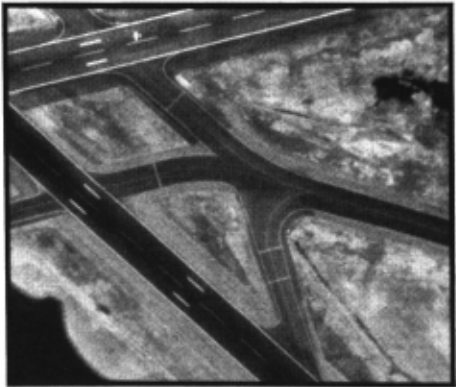
The accurate description of the junctions between pathways also help determine their function. Some are used as holding aprons (usually wide and normal to run way); some are exit ramps (the closer to the end of the runway, the smaller the angle between them. The an gle itself determines the allowed exit speed.); some are merely connecting pathways; the continuous centerline determines the "legal" turns and paths, and so on.
Junctions among taxiways and between taxiways and runways can vary widely in their complexity and config urations. The image in figure 9, a portion of the image previously shown in figure 1, shows the intersection of four taxiways, and connections between taxiways and runways when these are not parallel to each other. An example of another configuration is given later.
To process these complex junctions we rely on the con tezt: The previously detected runways and taxiways pro vide a very rich set of geometric constraints. The search for junction boundaries - straight or curved - thus, is facilitated by the geometric interrelationships among the nearby elements (position, length, width, and orien tation of nearby runways and taxiways), as well as by the geometric constraints imposed by airport design proce dures. Details are given below, as these module is new and has not been described elsewhere.
In our method we first form junction hypotheses by looking at the underlying intensity edges for evidence of portions of boundaries. The valid connections are then determined by looking for evidence of markings (center line) associated with taxiways.
4.1 Hypotheses Formation
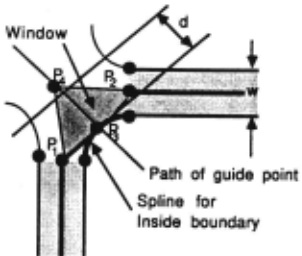
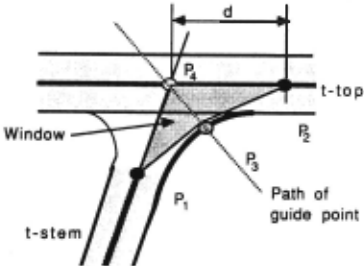
Each pair of elements (runways or taxiways) determines two search windows where we look for the junction boundaries. The shape of the window is constrained by the available context, that is, the previously detected runways and taxiways. Our method distinguishes two types of junctions: !-junctions (typically among taxi ways), and t-junctions (typically between taxiways and runways). More complex junctions are viewed as overis the middle point between PI and P2. P4 is the intersection of the apars representing the two ele ments. For a t-junction (figure I3) P2 is computed on the t-top element, at a distance d from P4. The distance dis proportional to the width of the t-stem element.
- Look for marking boundary: The search process is similar to that of searching for inside boundaries. We compute a series of splines using the anchor points and varying the guide point. In addition, we look for the certerline along the straight path from PI and P4.
4.3 Results
We now present results for two examples. The first deals with the intersection of taxiways shown previously in figure 9. Figure I4 shows the original, thresholded un derlying edges, the taxiway and runway context (shaded areas), and all possible connections among the taxiways. These correspond to the splines intersecting the largest number of underlying edges within each window searched for potential inside and outside boundaries.
Figure I5 shows the connections that meet the hy potheses criteria discussed above. Figure I6 shows the resegmented edges, the inside boundaries, and the ev idence of centerlines, and thus, the verified hypotheses and alowed paths.
The image in figure I7 shows the connecting paths between a taxiway and a runway when they are parallel lapping !-junctions. Note that there are no junctions between crossing runways; they overlap.
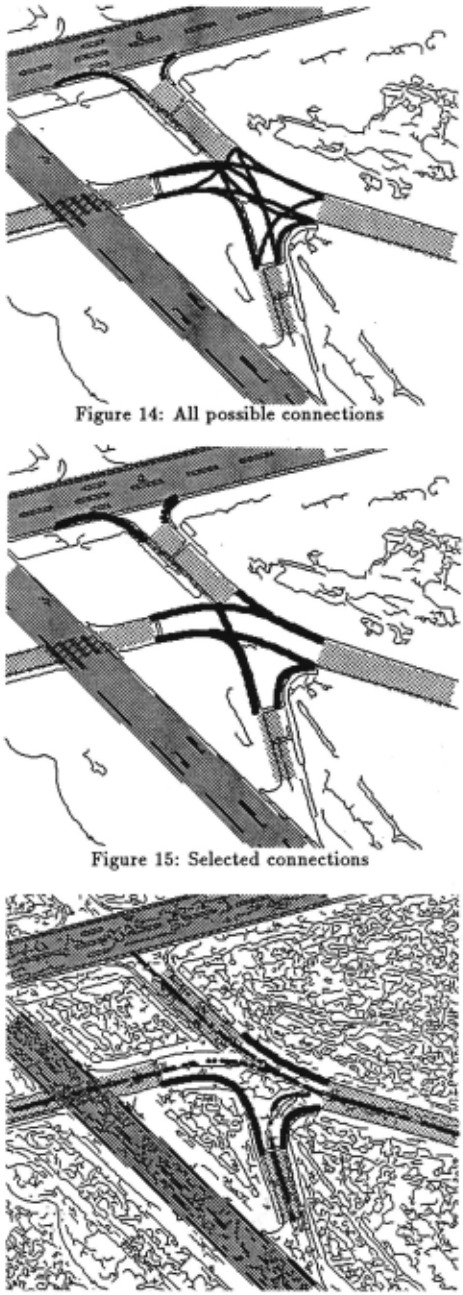
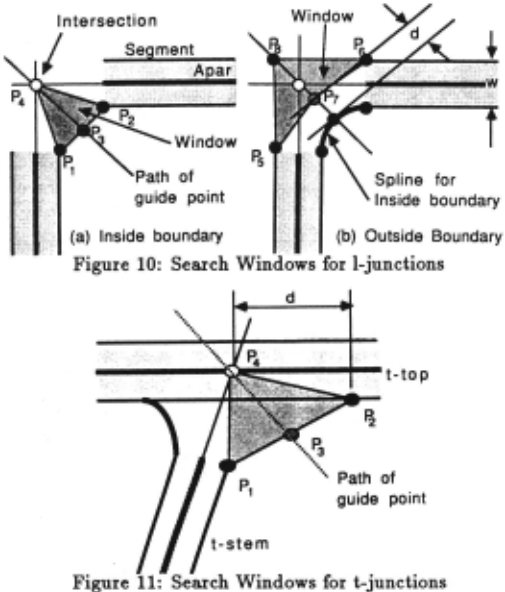
Figure IO shows an 1-junction. For each pair of po tential "joinable" fragments we distinguish an "inside" and an "outside" boundary. The inside boundary, if it exits, would be found on the side where we measure the smaller angle between the two elements. On the other hand, t-junctions are considered to have two "inside" boundaries. The search windo'w for one of these bound aries is shown in figure 11.
A second classification involves the boundaries them selves. Some are curved while others are straight. The curved boundaries - in airport design - actually con sist of circular or parabolic sections. However, to deal with imperfect segmentation of boundaries, we model the straight boundaries as two straight lines, and the curved boundaries by means of cubic splines. For each boundary we apply both models and then the choose the better fit (see below).
We look first for the inside boundary, and then for the outside boundary. (there is always an inside boundary. At complex intersections however, there may not be an outside boundary). If there is no evidence of an inside boundary, we do not look for an outside boundary. The method is as follows:
- Collect context information: We use the intensity edges used above to find runways and taxiways, and the apars corresponding to verified runways and taxiways. These are shown shaded in the figures be low.
- Compute search window for inside boundary: De-
termine the points PI, P2, P3, and P4. For an }-junction (figure IO, PI and P2 are located at the ends of the two elements. P3 is the middle point be tween PI and P2. P4 is the intersection of the apars representing the two elements. For at-junction (fig ure 11) P2 is computed on the t-stem inside bound ary at a distance d from P4. The distance dis pro portional to the average width of the two apars.
- Look for inside boundary: We compute a series of splines using three points: two anchors and a guide point. The anchor points are PI and P2. The guide point varies from P3 to P4. For each spline, we com pute the intersection of the spline with the under lying intensity edges. The spline that returns the highest number of edges is taken as a hypotheses (possible inside boundary) if the following criteria are met:
- (a) The length of the underlying boundary (or boundary fragments) is at least one half of the length of the spline. On other words, allow 50% boundary fragmentation and/or partial spline to-boundary fit.
- (b) The "junction" between the spline and the ele ment boundaries (at PI and P2) is smooth (15° tolerance). That is, the tangent to the spline at the anchor points is similar to the direction of the edge.
- Compute search window for outside boundary: De termine the points P5, P6, P7, and P8. P5 and P6 are located at the ends of the two elements. P7 is computed to be along the line joining the guide point of the inside spline and P8, at a distance d from the guide point. dis one half the average of the withds of the two apar elements. P8 is the intersec tion of the outside boundaries of the two elements.
- Look for outside boundary: Similar process as for inside boundaries. The anchor points are P5 and P5, and the guide point varies from P7 to P8. As above, we compute the intersection of each the spline with the underlying intensity edges. The spline that returns the highest number of edges is taken as a hypotheses (possible outside boundary) if similar criteria are met.
4.2 Hypotheses Verification
As before, verification consists of finding the markings we expect. Our method looks for the centerlines associ ated with taxiways.
- Resegment and collect context information: We re segment the image to include all intensity edges in the neighborhood of the junction. For context we use the apars corresponding to verified runways and taxiways, and a description of the hypothesized junction inside boundary (the guide point for the spline or a pair of straight lines). See figure I2.
- Compute search window for centerline boundary: Determine the points PI, P2, P3, and P4. For an l-junction (figure IO) PI and P2, the anchor points, are located at the ends of the two elements. P3
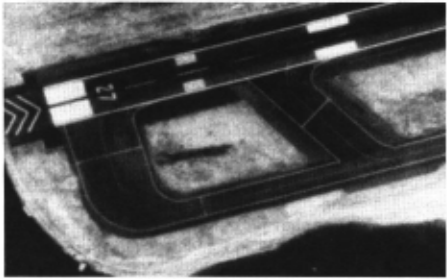
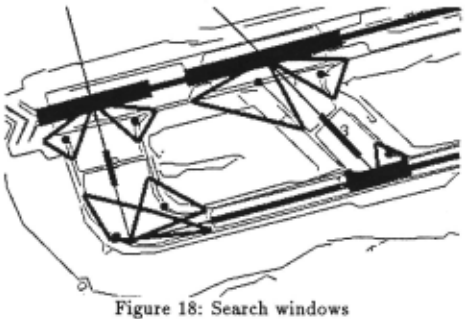
to each other. The underlying edges and the runway and apar context are shown in figure 18. We also show in this figure the extent of the search windows. The boundary hypotheses are shown in figure 19, and the detected evidence of markings in figure 20.
5 Conclusion
We have described our method for detecting and describ ing runways and taxiways in a major, commercial airport scene. We believe that this is an important application in itself. However, we hope that it has also served to illustrate how geometrical context can be used to aid in a difficult image understanding task, without requiring complete and specific a priori knowledge of the scene being viewed.
@inproceedings{ijcai1989p261,
  title     = {Using Generic Knowledge in Analysis of Aerial Scenes: A Case Study},
  author    = {Huertas, Andres and Cole, William and Nevatia, Ramakant},
  booktitle = {Proceedings of the Eleventh International Joint Conference on
               Artificial Intelligence, {IJCAI-89}},
  publisher = {International Joint Conferences on Artificial Intelligence},
  editor    = {N. S. Sridharan},
  pages     = {1642--1647},
  year      = {1989},
  month     = {8},
  note      = {Vision and Robotics},
  url       = {https://ijcai.org/proceedings/1989/261},
}
TY - CPAPER TI - Using Generic Knowledge in Analysis of Aerial Scenes: A Case Study AU - Huertas, Andres AU - Cole, William AU - Nevatia, Ramakant T2 - Proceedings of the Eleventh International Joint Conference on Artificial Intelligence, IJCAI-89 PB - International Joint Conferences on Artificial Intelligence PY - 1989 SP - 1642 EP - 1647 UR - https://ijcai.org/proceedings/1989/261 ER -Copied
Machine-readable versions of this paper, for tools and AI agents:





