
Objective Functions for Feature Discrimination
Proceedings of the Eleventh International Joint Conference on Artificial Intelligence. Vision and Robotics. Pages 1596-1601.
© 1989 International Joint Conferences on Artificial Intelligence
Abstract
We propose and evaluate a class of objective functions that rank hypotheses for featu re labels. Our approach takes into account the representation cost alid quality of the shapes themselves, and balances the geometric requirements against the photometric evidence. This balance is essential for any system using underconstrained or generic feature models. We introduce examples of specific models allowing the actual computation of the terms in the objective function, and show how this framework leads naturally to control param eters that have a clear semantic meaning . We illustrate the properties of our objective functions on synthetic and real images.
- [Binford, 1982] T.O. Binford. Survey of model-based image analysis systems. The International Journal of Robotics Research, 1{1):18-64, Spring 1982.
- [Bolles and Horaud, 1986] R.C. Bolles and R. Horaud. 3dpo, a three-dimensional part orientation system. International Journal of Robotics Research, 5:3-26, 1986. IJCAI
- [Brooks, 1981] R.A . Brooks. Symbolic reasoning among 3-d models and 2-d images. A rtificia/ Intelligence Journal, 16, 1981.
- [Canny, 1986] J. Canny. A computational approach to edge detection. IEEE Trans . PAM!, 8:679-698, 1986.
- [Feldman and Yakimovsky, 1974] J .A. Feldman and Y . Yakimovsky. Decision theory and artificial intelligence: I. a semantics-based region analyzer . Artificial Intelligence , 5:349-371, 1974 .
- [Fischler eta/., 1981] M.A. Fischler, J.M. Tenenbaum, and H.C. Wolf. Detection of roads and linear struc- tures in low-resolution aerial imagery using a multi- source knowledge integration technique . Computer Graphics and Imag e Processing, 15:201 -223, 1981.
- [Fua and Hanson, 1989] P. Fua and A.J . Hanson. Ob- jective functions for feature discrimination : Appli- cation to semiautomated and automated feature ex- traction . In Proceedings of the Image Understanding Workshop, Palo Alto, CA, May 1989.
- [Georgeff and Wallace, 1984] M.P. Georgeff and C.S. Wallace. A general selection criterion for inductive inference. In T. O'Shea, editor, Proceedings of Ad- vances in A rtificia/ Intelligence, Pis a, Italy, Amster- dam, September 1984. North Holland.
- [Hamming, 1985] R.W. Hamming. Coding and Informa- tion Theory. Prentice Hall, New Jersey, 1985.
- [Haralick, 1984] R.M. Haralick. Digital step edges from zero crossings of second directional derivatives. IEEE Trans. PAM!, 6:58-68, 1984.
- [Huertas and Nevatia, 1988] A. Huertas and R . Neva- tia. Detecting buildings in aerial imagery. Computer Vision, Graphics and Imag e Processing, 41:131-152, 1988.
- [Leclerc, 1989] Y.G. Leclerc . Image partitioning as con- structing simple stable descriptions . International Journal of Computer Vision, 1989. in press.
- [McKeown and Denlinger, 1984] D.M. McKeown and J .L. Denlinger . Map-guided feature extraction from aerial imagery. In Proc. 2nd.IEEE Workshop on Com- puter Vision, pages 205-213, May 1984 .
- [Ohta et a/., 1979] Y. Ohta, T. Kanade, and T. Sakai . A production system for region analysis. In Proc . 6th In- ter. Joint Conf. on Artif. Intel/., pages 684-686, 1979. IJCAI
- [Rissanen, 1983] J . Rissanen . A universal prior for inte- gers and estimation by minimum description length. The Annals of Statistics, 2:416-431, 1983.
- [Rissanen, 1987] J . Rissanen. Minimum-description- length principle. Encyclopedia of Statistical Sciences, 5:523-527, 1987.
- [Rosenfeld, 1970] A. Rosenfeld . A nonlinear edge de- tection technique. In Proc. IEEE, volume 58, pages 814-816, 1970.
- [Schwarz, 1978] G. Schwarz. Estimating the dimension of a model. The Annals of Statistics, 6:461-464, 1978.
- [Shannon, 1948] C .E . Shannon. A mathematical theory of communication. Bells Systems Tech J., 27 :623-656, 1948.
- [Shneier et a/., 1986] M.O . Shneier, R. Lumia, and E.W. Kent. Model-based strategies for high-level robot vi- sion . Computer Vision, Graphics and Image Process- ing, 33:293-306, 1986.
References were extracted automatically from the PDF and may contain errors.
Full text extracted automatically from the PDF; figures, tables and equations may differ. The PDF is the version of record.
1 Introduction
All approaches to the problem of extracting features from images can in principle be phrased in terms of de cision theory; however, the concepts of decision theory are very hard to put into practice because of the diffi culty of evaluating the required probability measures . Therefore, most practical approaches to model-based vision for both specific models, e.g., [Binford , 1982, Bolles and Horaud, 1986, Brooks, 1981, Shneier et al., 1986], and generic models, e.g., [Fischler et al., 1981, Ohta et al., 1979, McKeown and Denlinger, 1984, I-luer tas and Nevatia, 1988), rely on heuristic measures to select among competing scene parses. These methods, although they may be effective in the context for which they were designed, are extremely hard to extend and require the use of many parameters whose significance is not clearly understood.
On the other hand, approaches such as those of Feldman and Yakimovsky [1974], Georgeff and Wallace [1984], and Rissanen [1983, 1987] provide a sound theo retical basis for the decision problem but offer few prac tical computational methods for dealing with complex scenes in real images.
In this paper, we focus on an objective function ap proach to the task of ranking scene-labeling hypotheses.
·This research was supported in part by the Defense Advanced Research Projects Agency under Contract Nos. MDA903-86-C-0084 and DACA 76-85-C-0004.
For brevity, we omit discussion of the related problem of hypothesis-generation, and refer the reader to [Fua and Hanson, 1989]. We define a class of objective func tions based upon theoretical arguments similar to those of Georgeff, Wallace and Rissanen, and show that the required probability estimates can actually be computed in the context of a few natural assumptions .
Our formulation has many desirable features , but is not by itself a complete solution to the feature extrac tion problem. To be effective it must be coupled with a robust hypothesis generation mechanism and an efficient optimization procedure. Furthermore, one would like to have models for geometric quality analysis much more complex than those presented here. It should come as no surprise that discovering good models and hypothesis generation strategies are the most difficult tasks in the development of a system attempting to perform shape perception . The strength of our approach is that it pro vides a unified framework that clearly exposes the criti cal components and characteristics of model-based vision systems.
2 Derivation of the Objective Function
The goal of feature extraction is to parse a scene in terms of objects conforming to particular models. To discriminate among competing parses, an objective func tion must be able to measure the goodness of fit to feature models that include such characteristics as area photometry, edge photometry, shape, and semantic re lationships . In this section, we define a basic class of models, discuss the parameters we expect to control our objective functions, derive the theoretical forms of the objective functions themselves, and provide an interpre tation of the resulting functions in terms of information theory.
2.1 Object Modeling
For the purposes of this work, we define a model to be a geometric description of an object in the world charac terized by its geometric constraints and its photometric signature; we define the evidence for such objects in dig ital images to be a collection of delineated areas corre sponding to major object parts, together with associated quantities directly derivable from the pixel values in such areas.
\Ve interpret the photometric signature of any ob ject model in terms of the expected signal from an ideal object model plus a noise model [Rissanen, 1983, Rissanen, 1987, Leclerc, 1989]. The object 's evidence can then be encoded in terms of these models. '"'e will use length of the shortest encoding to measure the qual ity of the fit between the data and the model.
2.2 Essential Parameters of the Objective Function
Our approach introduces two fundamental parameters, the scale and the shape coefficient:
Scale. The scale is interpretable as the unavoidable dimensional factor that converts dimensional quantities such as area or length into dimensionless probabilities. Area units are thus scaled down by two powers of the dimensional unit, while length terms such as edges are scaled down by a single power. The scale parameter thus controls whether the area. signature dominates edge signature.
The scale parameter may also be understood by ob serving that when an image is resampled or zoomed, the area A of a patch will change, but the complex ity of the patch, as reflected in its minimal encoding, should remain invariant. Thus there should be some in trinsic zoom factor s that relates the area A to the area Ao = A/ s 2 in the zoomed image that has exactly the res olution needed to encode the model complexity without oversa.mpling. The formulas presented later in the paper may thus be alternatively interpreted as expressing the patch encoding cost in terms of the sampling-invariant quantity A0 instead of A itself.
Shape Coefficient. An objective function with a shape quality term alone will retain any candidate model instance with the appropriate geometry, even if it does not fit the image data. On the other hand, an objec tive function with only a photometric model will make the same class of errors as a segmentation algorithm. The shape coefficient balances the possibly conflicting requirements of the geometry and photometry; the point where this balance lies must be determined by the con text of the application.
The scale and shape coefficients characterize the fun damental balance of influences that must be semanti cally specified for each application. Within a particular model domain, it seems possible in principle to estimate the scale by using measures of local complexity. Our ap proach to feature-hypothesis evaluation provides a clear way to justify and understand the essential role of these two parameters in feature extraction, regardless of the other details of a particular system.
2.3 The Probability of a Scene Parse
We choose to describe the problem of determining the best image interpretation as the need to maximize the probability P = p(moml ... mniel ... en) that, given the evidence E = { e;; i = 1 . . . n}, parsing the scene in terms of a particular set of model instances M = { m;; i =
1 .. . n} and a back round m.0 is in fact. correct 1 Each m.; is taken to be a. geometric model instance, while e; is the measurable evidence for the obj ect, typically a. collection of associated pixel intensities. Since we are interested in feature extract ion , we do not explicitly represent the background and coll ect no ev idence for it.
It is essentially impossible t.o evaluate the conditional probability P in its most general form, so we make a crucial independence assumption: the probability of a particular model hypothesis is influenced only by its cor responding body of evidence and the other model in stances . For example, in an aerial image, whether or not a patch of pixels can be identified as a road may depend on its own photometry and on the presence or absence of neighboring houses, but not on the particular photometry of those houses.
Formally, this assumption can be written as follows: If I, J, I< denote sets of indi ces referring to model in stances and their correspond ing bodies of evidence, we assume VI , J, J{ such that J n I = 0 and J n I< = 0, P(m.Jei<i ei) = P(mJeK), and VI , J, P(m.Jimiei) = P(mJim1 ) .
The assumption may break down when one object's expected photometry is strongly modified by another ob ject, as when a superstructure or a separate building oc cludes or casts a. shadow on a roof. In practice, one can partially compensate for such phenomena by discounting small anomalies.
Combining our assumption with Bayes' rule, it is straightforward to express the probability of the parse as:
This expression clearly separates the contribution of the photometry, in the evidence-dependent terms, from the abstract contribution of the geometric and semantic component in p(m0m1 . .. m,) under the stated assump tion. \Ve further expand this term as:
where p(m1 ... mn) is the probability that these n mod els appear in the scene, and Po is the probability that no other models appear. Since we do not take the back ground explicitly into account in this work, we consider Po to be constant.
2A Minimal Encoding Length and Model Effectiveness
We choose to express the quality of a parse as the (base 2) logarithm 2 of Eq. (1) . Classical information theory [Shannon, 1948, Hamming, 1985] leads us to interpret the resulting score Sin terms of encoding length:
1 For example, in terms of a human analyst's perception, or in terms of ground truth.
2 All logarithms in this paper are base 2 logarithms.
where we defi ne
Here F is what we call the encoding-effectiveness of the set of models. The first term in F is the number of bits needed to describe the evidence in the absence of the model, while the second term gives the number of bits needed to describe the evidence in terms ofthe model. The term effectiveness is thus motivated by the fact that F represents the number of bits saved by representing the evidence using the model, and the fact that F increases as the fit improves.
G is the number of bits needed to encode the evidence free model representation information, and quantifies the elegance of the chosen set of model instances as well as their dependencies.
2.5 Remarks
Feature Extraction Viewed as an Optimization Problem. The problem of finding the best parse of a scene can now be rephrased as the problem of optimiz ing over sets of hypotheses evaluated by Eq. (3). Global opt.imization corresponds to a blind search procedure, which searches all possibilities without attempting to determine which candidates are more likely than oth ers. In practice, the search space may be far too large for this type of search. Since intelligent heuristics can overcome this drawback, a natural way to design an ap plication system is to incorporate hypothesis-generation algorithms that project from the space of all possible hy potheses onto a subspace of very likely hypotheses. Such projections have the side effect of reducing the discrimi natory burden placed upon the objective function.
Generic Models Require Photometric/Geometric Balance. When a model's geometry is completely de termined beforehand, as it is for template-matching ap proaches to automatic shape recognition, there is no need for the geometric information component of the objec tive function, since it is constant and maximum like lihood analysis alone will do. The geometric terms in the objective function begin to play a critical role when we utilize models defined by a set of general geometric constraints in place of a specific shape template. Such generic models, with arbitrarily large numbers of param eters, require objective functions like ours that balance their geometric aspects against their photometry.
3 Photometry: Computing F
Two of the main characteristics of an object in an im age are its interior photometry and its contrast with the background, which produces edges. Here we explore sim ple models for the area and for the edges of an object that have proven useful in analyzing imagery. When working with stereo pairs of images, we also incorporate a stereoscopic model, and compute the depth parameters of an object in the scene by optimizing the corresponding stereo effectiveness.
We have seen tha t. t.he effectiveness F is computed a.<; -logp(e) + logp(elm) where e represents the grey level values of the pixels that are enclosed by the contour m. For the sake of exposition, let us distinguish the evidence eA relative to the interior of the patch and the evidence ee relative to the boundary. Formally, we can write:
We assume that contrast with the background can be measured by using local image derivatives, while ignor ing the grey levels of the boundary pixels. This contrast depends on the grey level of background pixels that do not appear in the object descriptions, and can therefore be considered as independent of the interior object pho tometry. Thus we write F; in Eq. (4) as the sum of area and edge components:
This prescription must be modified when dealing with objects that share edges, since the contrast of the shared edges is completely determined by the photometry of the regions on both sides of the edge. In this case, the shared boundaries do not contribute to the edge effectiveness term.
When additional images are available and m is a three dimensional model, additional evidence es can be gath ered using the projection of m onto each image. We write:
In the case of a pair of stereo images, e is the evidence measured in the left image and es the corresponding ev idence in the right image relative to the model projected into that image. For a stereo pair, we therefore add to the effectiveness a stereo effectiveness term,
3.1 Area Model for Homogeneous Regions
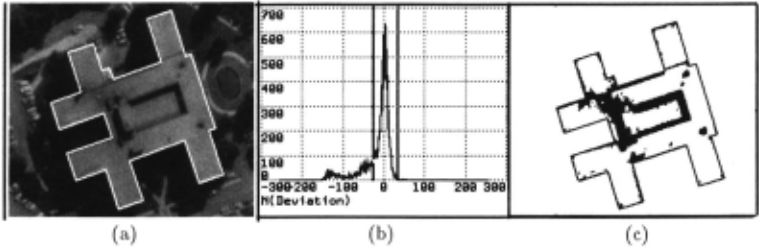
We model the interior intensities of an image region by a smooth intensity surface with a Gaussian distribution of deviations from the surface. Since objects in real images typically have anomalies which do not lie on the smooth surface, we encode such anomalous pixels as outliers. As we shall see later, this can critically enhance the discrim inatory power of the area-encoding effectiveness.
In the application of our approach to aerial imagery, we take the intensity surface to be a plane. In Figure 1, we show: (a) An image and a delineated model instance. (b) The histogram of deviations from the planar fit to the intensity surface. (c) The solid white area indicating the location of the pixels within the main Gaussian peak. Black areas within the model outline lie outside the peak and are considered anomalous.
In an 8-bit image, it would take 8A bits to encode the pixel values if we did not take advantage of depen dencies among pixels. Similarly, it would take kAA bits to encode the same information using our region model, where
Here n(log u +c) is the cost of H uffmann-encoding [Ham ming, 1985] the pixels in a Gaussian peak, 8n is the cost of encoding the outliers, and
is the entropy, i.e., the cost of specifying whether a pixel is or is not anomalous. u is the variance of the Gaussian distribution, n is the number of pixels in the Gaussian, n = A-n, and c = (1/2) log(2;re). Note that in the computation of the encoding cost, we have not included the cost of encoding the six internal parameters of the model : 3 for the plane, 2 for the Gaussian, and one for the probability nj A that a pixel lies in the main peak. It can be shown [Rissanen, 1983, Schwarz, 1978] that these costs are approximately equal to (1/2) log A bits per internal parameter of the statistical distribution, and are therefore negligibl~r small compared to kAA·
We weight all areas and lengths using the scale pa rameter s (see section 2.2) so .that the area-encoding ef fectiveness becomes:
Optimization of this score is intuitively appropriate be cause it finds the best compromise among the following :
- large area A,
- low standard deviation u,
- small number of anomalies n.
Effect of Anomaly Discounting. In the graphs on the left in Figure 2, we plot the area-encoding effective ness FA as a function of the radius of a square patch centered at the center of the images shown in the left column: a good but noisy synthetic image of a square, the same image with gross area anomalies, and an image of a similar but distorted square. When we compare the results obtained after discounting anomalies (solid lines) with those results found without anomaly discounting (dotted lines), we see that anomaly discounting must be included to make the objective function reliably select the same shape a human observer perceives. This is po tentially a critical factor in the practical application of this approach because, as we see in Figure 1, real images nearly always have significant anomalous components.
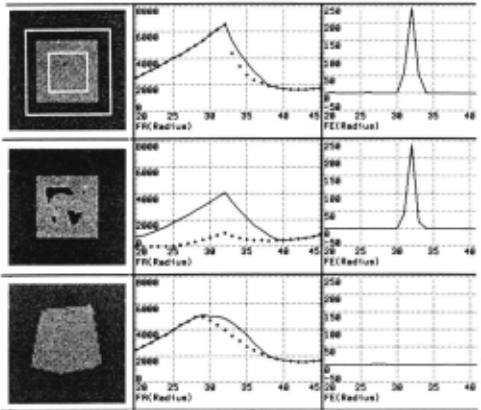
Note that we only have local maxima of the area encoding effectiveness appearing in Figure 1; for large radii, a better parse of the scene would be in terms of two model hypotheses, one square and one square shaped ring covering the rest of the image, rather than one square plus random background. From this example, we see that high score alone is not an adequate criterion; we must also require local maximality when dealing with a partial description of the scene as opposed to a global one. For this reason it is important in practice to mea sure whether a candidate object passes this maximality test. Experimentally, we have found that high edge qual ity enforces this requirement; we now turn to the explicit form of the edge term used.
3.2 Edge Model
We adopt the definit.ion [Rosenfeld, 1970, Haralick, 1984, Canny, 1986] of edge pixels as maxima of the local image derivative, and we classify edges according to whether or not an edge boundary pixel conforms to this definition. In the absence of a model , it would take 1 bit per pixel to encode this information. If we now use the !-parameter model that takes into account the proportion of maxi mal edge pixels, the most efficient Huffmann [Hamming, 1985] code for t.his information would require
bits per boundary pixel, where L is the length of patch boundary in pixels, n is the number of boundary pixels that are maxima of the local image gradient, and n = L-n.
We then weight all lengths by the scale factor s and estimate the edge-encoding effectiveness to be
As in the case of the area term, we have neglected the (1/2) log(L/ s) bits required to encode the one internal parameter of the model [Rissanen, 1983, Schwarz, 1978].
As shown in the right column of Figure 2, this edge score is maximal when all boundary pixels conform to our edge model, and degrades as the proportion of such pixels diminishes. This model has proven effective in our application of these techniques to aerial images because it provides a measure of edge-quality that does not in clude an image-dependent threshold on edge strength.
We have also experimented with an edge model that requires the gradient direction be normal to the object outline, and computes the encoding cost of deviations from the normal vector. Both models yield similar rank mgs.
3.3 Stereography
The simplest stereo model assumes that corresponding pixels have the same grey-levels in both images. In prac tice, to compute the stereo effectiveness of Eq. (6), we determine the number of bits required to encode the pro jected patch in the second image, while knowing its pho tometry in the first . We compute the deviations of the intensities from their predicted values and encode them using the same Gaussian model with anomalies that we used for the area term. The anomaly discounting is re quired because of the possibility of occlusions. We also take into account the edge quality of the contour in the second image and its edge-encoding effectiveness.
The stereographic effectiveness term Fs is therefore the sum of an edge and an area term:
where A2 is the area of the projected patch in the second image, L2 is its boundary length, and kA, and kE, are the corresponding model encoding costs.
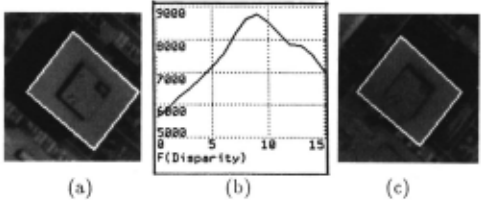
We can use the effectiveness measure (12) to opti mize the elevation parameters of a. two-dimensional de lineation found in the first image. The search space is ex tremely constrained since the projected shape is known and the only degree of freedom is epipolar motion in the second image.
Let us consider the stereo pair of images in Figure 3(a,c). Assuming that the roof is horizontal, we plot in Figure 3(b) the value of Fs as a function of the assumed disparity between the candidate outline in the left image (a) and the projected outline in the right image. We note that Fs has a sharp peak for the correct match outlined in (c).
4 Geometry: Computing G.
The geometric cost G defined by Eq. (5) is a measure of quality of a set of object hypotheses. The simplest way to handle dependencies among objects is to require that there be no conflicts within a particular set of hypothe ses; formally we write:
It follows that G can be expressed as
where G; ex: -logp(m;) is a model quality measure that increases as the shape degrades, and 1 is the arbitrary shape coefficient.
Now we can deduce a mechanism for deciding whether or not the addition of one more feature object is advan tageous or detrimental to the overall parse. If we write the overall score in the form
we conclude that we should accept only model instances with (F; - 1G;) > 0, since these are the only ones that improve the likelihood of the full scene parse.
The simplest effective model for Gi is the sum of the cost of chain-encoding the boundary of the object's area plus a constant. cost for introducing a new object; this gives a geometric cost
plication , we use an hypothesis generator that carries out the following steps: (1) extract linked edges; (2) find edges obeying geometric constraints (such as recti linearity) that. define enclosed regions in the image; (3) compute the score of each enclosed area using the objec tive function; ( 4) find the subset of nonconflicting shape candidates maximizing the total score. One may also optimize each candidate shape with respect to the ob jective fun ction before the final ranking.
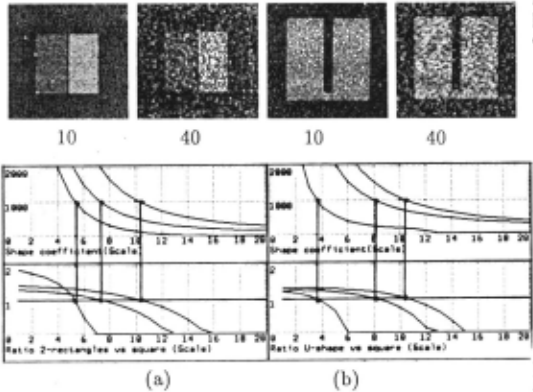
In Figure 4(a), we show how the length term (14), which gives preference to compact objects, influences the parse when a split square is interpreted alternately as a single compact square or two adjacent rectangles. The bottom graph takes three images, with noise vari ance 40, 20 and 10, and plots the ratios (two-rectangle score)/ (square score) as a function of scale for fixed 1 = 1. Note that increasing the scale in this example amounts to looking at a subsampled image in which fine details are no longer visible. The interesting value of the scale is that for which the scores are equal, i.e., the ratio is one. Thus we plot in the upper graphs the locus of points where the ratio is unity as a function of 1 as well as scale. In Figure 4(b), we carry out a similar plot for an image of a: square with a missing portion that makes it "U"-shaped. We see that the ratio ("U" score)/(square score) behaves so that the square interpretation is pre ferred at a large scale in the best image, and at a much lower scale in the noisier images.
5 Examples
We have applied the principle of objective-function opti mization to operator-initiated shape extraction and to automated extraction of generic cartographic features such as buildings from aerial imagery, described else where [Fua and Hanson, 1989]. In the automated ap- The objective function plays a crucial role in this ap plication because the hypothesis generator will always produce confli cting sets of candidates, and a means of distinguishing among these is absolutely essential.
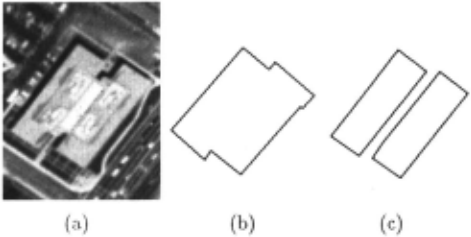
For example, for Figure 5(a), the system produces two conflicting interpretations: one in terms of a single poly gon enclosing both wings as in Figure 5(b) the other in terms of two polygons , one for each wing as in Figure 5(c) . At low scale the latter will be preferred because of its better fit to the photometric data, while at high scale the former will dominate due to its lower geometric cost.
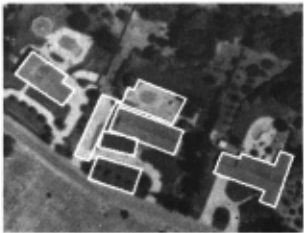
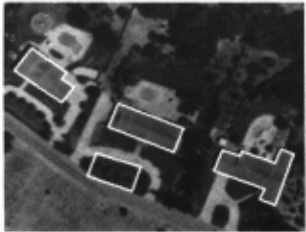
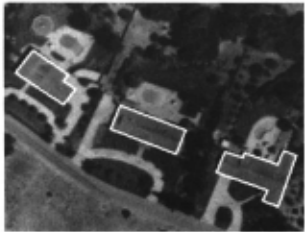
In Figure 6, we show the hypotheses generated and retained by the system for scale values of 6, 7 and 8, with fixed shape coefficient; for this scene, scale 8 clearly gives the best parse.
From the examples shown in this section, we can form an intuitive understanding of the scale parameter: s tunes the scale not of the physical size of the object, but the scale of its quality. Objects with close fits to the strict model are selected first as we ramp the scale down from a high value.
6 Conclusion
In this work, we have shown how an information the oretic approach to the feature extraction problem can be formulated in such a way as to permit realistic com putational techniques for the required probability esti mates . Our approach provides a firm theoretical basis for understanding complex feature extraction problems that require a balance between photometric evidence and geometric quality. Of course, the objective function ap proach given here cannot by itself lead to good solutions to the feature extraction problem, but must be teamed with a competent {human or automated) hypothesis gen erator [Fua and Hanson, 1989]. Among the goals of fu ture work will be the extension of the range of our models and the treatment of complex semantic dependencies in terms of their information-theoretic context.
@inproceedings{ijcai1989p254,
  title     = {Objective Functions for Feature Discrimination},
  author    = {Fua, Pascal and Hanson, Andrew J.},
  booktitle = {Proceedings of the Eleventh International Joint Conference on
               Artificial Intelligence, {IJCAI-89}},
  publisher = {International Joint Conferences on Artificial Intelligence},
  editor    = {N. S. Sridharan},
  pages     = {1596--1601},
  year      = {1989},
  month     = {8},
  note      = {Vision and Robotics},
  url       = {https://ijcai.org/proceedings/1989/254},
}
TY - CPAPER TI - Objective Functions for Feature Discrimination AU - Fua, Pascal AU - Hanson, Andrew J. T2 - Proceedings of the Eleventh International Joint Conference on Artificial Intelligence, IJCAI-89 PB - International Joint Conferences on Artificial Intelligence PY - 1989 SP - 1596 EP - 1601 UR - https://ijcai.org/proceedings/1989/254 ER -Copied
Machine-readable versions of this paper, for tools and AI agents:





