
Computer-Aided Grammar Acquisition in the Chinese Understanding System CUSAGA
Proceedings of the Eleventh International Joint Conference on Artificial Intelligence. Speech and Natural Language. Pages 1550-1554.
© 1989 International Joint Conferences on Artificial Intelligence
Abstract
CALAS is a subsystem for acqumng semantic grammars to be used in CUSAGA which can understand technical Chinese texts and extract knowledge from them . The semantic grammar is acquired in a semi-automatic way under the guidance of the user. CUSAGA is implemented on UV68000 with about 12000 PASCAL lines. This paper gives a short overview on the architecture and· functions of CUSAGA and a more detailed discussion about the working principles and techniques adopted by CALAS is presented.
- Inference. Information and Control, 7:1 -22, 224-254.
- [Feldman, 1972] Feldman J. Some Decidability Results on Gram- matical Inference and Complexity. Information and Control, 20:244-262
- [Horning, 1971] Horning J. J. A Procedure for Grammatical Infer- ence. In Proc. IFIP Congress , Ljubljana.
- [Knobe and Knobe, 1976] Knobe B. and Knobe K . A Method for Inferring Context-free Grammars. Information and Control, 31 :129-146.
- [Berwick, 1979] Berwick R. Learning Structural Descriptions of Grammar Rule from Example. In Proceedings of the Sixth Inter- national Conference on Artificial Intelligence.
- [Berwick, 1985] Berwick R. The Acquisition of Syntactic Knowledge. The MIT Press, 1985.
- [Angluin, 1983] D . Angluin and C. Smith. Inductive Inference: The- ory and Methods. ACM Computing Surveys, 15:237-269.
- [fianshun, 1985] Yao Tianshun. A Chinese query language for data base interfaces. T .R. Northeastern Institute ofTechnology.
- [Zao, 1987] Zao Zhenxi. Knowledge-based hierarchical Chinese understanding and its knowledge representation . T.R . China University of Science and Technology.
- [Xie, 1988] Xie Shiming. A hybrid Chinese-English language under- standing and generation system. M .S. thesis, Institute of Mathe- matics, Academia Sinica.
- [Guo, 1985] Guo Yuanxin. A Recursive Model for Chinese Syntax .
- [Wang, 1983] Wang Xilong. A System for Understanding Chinese. In proceedings of the international conference on Chinese infor- mation processing.
- [Wang, 1987] Wang Yeyu. A Mathematical Model for Chinese Natural Language. M .S. thesis, Institute of Mathematics, Academia Sinica.
- [Bai, 1985] Bai Shuo. Computer-aided Discover of Chinese Syntax. M.S thesis, Department of Computer Science, Beijing University.
References were extracted automatically from the PDF and may contain errors.
Full text extracted automatically from the PDF; figures, tables and equations may differ. The PDF is the version of record.
COMPUTER-AIDED GRAMMAR UNDERSTANDING ACQUISITION IN THE SYSYTEM CUSAGA · CHINESE
Lu Ruqian Liu Yinghui Li Xiaobin Institute of Mathematics, Academia Sinica, Beijing
ABSTRACT
CALAS is a subsystem for acqumng semantic grammars to be used in CUSAGA which can understand tech nical Chinese texts and extract knowledge from them. The semantic grammar is acquired in a semi-automatic way under the guidance of the user. CUSAGA is implemented on UV68000 with about 12000 PASCAL lines. This paper gives a short overview on the architec ture and· functions of CUSAGA and a more detailed discussion about the working principles and techniques adopted by CALAS is presented.
INTRODUCTION
Chinese is different from Western languages in pronunciation, written form, vocabulary and grammar. In Chinese, the logical relationship between character and character, or word and word or sentence and sentence, depends on their order, their mea;ing and some function words. Chinese words have no inflection, no matter in what positions they appear in the sentence. A written Chinese sentence is a line of consecutive Chinese characters which contains no marks helping to seg· ment words and phrases. All these peculiarities have made Chinese very difficult for computer processing.
Research works on computer-aided Chinese unders· tanding were very rare until the beginning of seventies. During last I 0 years, more and more Chinese computer scientists became interested in this topic. One of the most important goals has been the development of Chinese understanding interfaces, see [Yao, 1985], [Zhao, 1987), [Xie, 1988]. At the same time,several theoretical models for understanding Chinese were proposed, e.g., [Gao, 1985], [Wang, 1983],[Wang,1987]. One shortcoming we found among these research works is that complicated models are usually not implemented, and most of the implemented systems use relative simple models. Another problem is that almost all of the implemented systems are qu· ery interfaces,or small systems only for demonstration purpose. In this paper,we introduce a Chinese understanding system, CUSAGA, which can understand technical Chinese texts and acquire knowledge from them. To facilitate the understanding process, CUSAGA can acquire a semantic grammar of the technical field,from which the Chinese texts are selected,in a
semi-automatic way under the guidance of the user.
· Supported by the TWAS grant G R 86 I 91.
2 THE OVERALL STRUCTURE OF CUSAGA
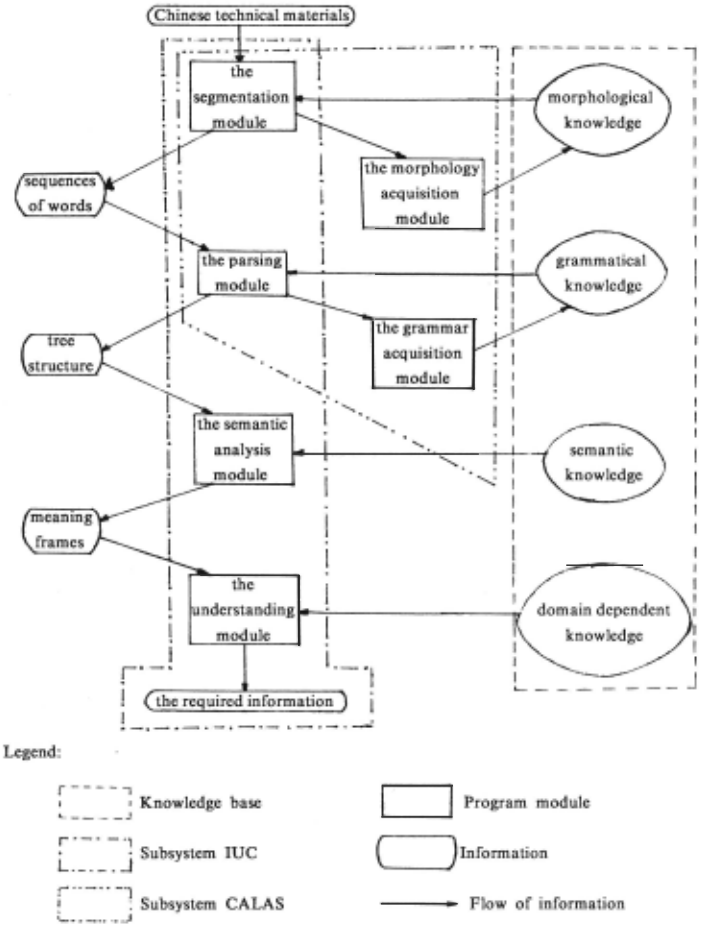
The major components of CUSAGA are two subsystems: rue and CALAS. rue is composed of the modules for segmenting, parsing, semantic analysis and understanding. With some ini· tial knowledge stored in the knowledge base of CUSAGA, IUC is capable of accepting Chinese technical materials, pars ing them and doing semantic analysis to create internal repre sentations. The subsystem CALAS is composed of the modules for segmenting,parsing,learning morphology and learning gra mmar. Guided by the user, CALAS can acquire morphological and grammar rules from a set of legal Chinese sentences and put them into the knowledge base of CUSAGA, which will then be used by rue. The two subsystems share some com mon submodules and are linked up by the knowledge base of CUSAGA. Since IUC will be explained in more detail in another future paper, it is only briefly described here and the major part of the present paper is dedicated to CALAS.
The overall structure ofCUSAGA is shown in appendix A.
3 THE KNOWLEDGE BASE OF CUSAGA
Due to the characteristics of Chinese, technical Chinese in par ticular, CUSAGA processes a Chinese text through differ ent levels and divides the knowledge base into several parts.
The first part is the knowledge at morphology level. It contains a lexicon, the knowledge about how the Chinese char acters constitute a word, and the ·context knowledge dealing with the ambiguity problem in segmenting words.
The second part is the knowledge at syntax level. It con tains a semantic grammar, which is domain dependent and can be changed when the application domain is changed. At pres ent, the semantic grammar being used is diagnosis oriented and has semantic classes like <person>,< time>, <feeling>, <symptom>, <disease>, and so on. It describes phrases and clauses in terms of these semantic categories.
The third part is the knowledge related to the deep struc ture of sentences. It contains some semantic patterns. The information in a semantic pattern shows which case slots can occur in this pattern and gives semantic restrictions for filling them.
The fourth part contains some domain-dependent knowle dge. Technical Chinese allows ellipis of which the meaning can be figured out only if additional knowledge about the domain is provided. In addition, the required information is often not stated explicitely in these materials. Without the help of such knowledge, it is impossible to decide the referents for pro nouns and abbreviations and to extract the required informa tion.
The partition of knowledge base makes the possible change of application domain more easy.
4 THE CHINESE UNDERSTANDING SUBSYSTEM rue
IUC is supported by CALAS. The morphological knowledge and grammar learned by CALAS form the major part of the knowledge base of IUC. The following subsections discuss four separate phases ofiUC in detail. ·
4.1 The Segmentation of Sentences
The segmentation of sentences is performed by the segmentation module in the following way: Any sentence, as a sequence of charac ters, is scanned from left to right. The segmentation information of the characters is used to recognize a sequence of reasonable words. If the segmentation information is not enough, then the lexicon will be used to look up words. If ambiguity occurs (i .e., more than one word is selected), then context dependent and domain dependent knowledge will be used. The segmentation of sentences in IUC is ef ficient, because multiple knowledge sources are used. For example, the Chinese sentence "ti: -t!1!1L~~~l*" can be segmented into a sequence of words: ti: (left), 1!1!1L~ (optic),~~ (color), 1* (dark).
4.2 Parsing
Each time· when a sentence is to be parsed, the lexicon is first searched for semantic parameters of all words in this sentence (each semantic parameter represents a category of words), then some heuristic information will be used to reduce the search space of ap propriate rules. The rules are used in a recursive manner until a complete sentence structure is built up. top-down processing and depth-first search with backtracking is required for parsing.
The tree structure built by the parser not only describes the syntax structure of the sentence but also implies semantic informa tion. This reduces the problem of ambiguity, makes the semantic analysis more efficient, and makes an efficient matching strategy for resolving ellipsis possible. For example, a derivation tree of the sen tence mentioned above looks like follows: S( BZU (ff (cb02), b (bk04)), MC (c (cOOl), f (dgr3))) . Here, the grammar rules (S:: =BZU MC, BZU::=ff b, MC:: =c f, ff: :={cb02 ... }, b:: ={bk04 ... }, c::={cOOl...}, f::={dgr3 ... }) are used and cb02, bk04, cOOl, dgr3 are the semantic parameters of the words ti:, 1!1!1L ~.~~and 1*.
4.3 Semantic Analysis
The semantic analysis is a recursive process for choosing appropri ate components from the tree structure built by the parser and fit ting them into the meaning frame of the sentence.This meaning frame is an improved version of Fillmore's case frame. The case slots in this frame are not filled directly with words of the sentence. Instead, they arc filled with semantic parameters of these words to unify the representation of different phrases or sentences of the same meaning. Since predicates in Chinese are not only verbs, but also can be adjectives and nouns, we have set up different sorts of case frames for verbs, adjectives and nouns respectively. There are some special meaning frames: phrase frames, sentence frames and text frames which are not associated with a predicate.
The semantic analysis begins at the top level of the tree struc ture of the sentence and then goes down to other levels of this tree in turn. With help of the semantic patterns in the knowledge base, each level of the tree structure will be examined to look for predi cates, then the semantic patterns of these predicates will be used to set up the meaning frame of the sentence. The derivation tree can be transformed into the meaning frame: dgr3 (Agent: cOOl; Location: PF( Direction: cb02; Eye: bk04)). Here, dgr3 is a predicate of the case frame, PF indicates a phrase frame.
4.4 Understanding Chinese Text
There are some problems when extracting the required information based on the meaning frames of the sentences. There may be certain pronouns and abbreviations in a Chinese text. Some slots of the meaning frames may have no actual values at all so that these frames can not express the meanings of the sentences clearly. In ad dition, much information needed by the user is often implied in a set of the meaning frames of the text and can not be discovered directly. This module is designed for solving these problems. The knowledge about the context and the application domain is applied in this process. For example, an information list can be got by extracting information based on the meaning frames of a patient record:
| I) Personal State(sex): I. male | 2. female | Answer: | |
| 2) Eye( direction): | I. left | 2. right | Answer: |
| 3) Optic( color): | I. light 3. dark | 2. moderate | Answer: |
5 THE LEARNING APPRENTICE CALAS
Our experience with rue showed that the bottleneck in the process of Chinese understanding using IUC is the building of a appropriate semantic grammar by the user himself. This work is very time con suming. Therefore we started the second subproject of CUSAGA, namely CALAS, to solve this problem by computer-aided grammatical inference. For natural languages, especially as complicated as Chinese, there exist a lot of serious difficulties at present time in designing fully automatic grammatical inference systems. So the computer-aided inference is a reasonable approach.
CALAS's final target is to learn a .semantic grammar from a set of Chinese technical materials. The learning process is divided into two major stages. The first stage learns morphological knowledge and the second one learns the grammar itself.
Several researchers have achieved significant advances in this area. [Gold, 1967] and [Solomonoff, 1964] did some early work. [Feldman, 1972] defined the grammatical inference problem and proved some decidability results about it. [Horning 1974] developed a procedure for grammatical inference. [K.nobe, 1976] mentioned a method for inferring context-free grammars. Until recent years [Berwick, 1979, 1985] still works on this area. A good survey of in ference research can be found in [Angluin and Smith, 1983]. [Bai, 1987] described a discoverer of Chinese grammar based on distribu tion analysis.
CALAS borrows many ideas from the results mentioned above. For example, its replacement operation is an improved ver sion of the techniques used by Knobe. But CALAS distinguishes it self in many aspects, e.g., its learning process is incremental and can be performed under the guidance of an ordinary user without any special knowledge. Together with the increase of the knowledge base of CALAS, less and less guidance is needed from the user. CALAS will finally acquire the ability to distinguish between grammatical and ungrammatical Chinese sentences in the related fields.
5.1 Learning Morphological Knowledge
In CALAS the morphological knowledge is not provided a priori. It is learned by CALAS during segmentation process with some help from users. The first sentence is always segmented by the user him self. This information serves as the initial morphological knowledge for the machine. Starting from the second sentence, the segmentation module does the work on its own by using this initial knowledge. If the segmentation is not reasonable (this is usually unavoidable, especially at the beginning of the learning process), the user corrects it. At this moment, through observing what the user does CALAS learns knowledge from the user's behavior. It extends the lexicon by adding into it some new words and acquires some new segmentation information. It can also ac quire context dependent knowledge by observing how the user segments a sentence when ambiguity occurs. In this way, the segmentation module is getting more and more capable of segmenting a sentence.
5.2 Learning Grammatical Knowledge
Learning of a grammar is generalization based. The learning component consists of an informant (a teacher), a rule base (the grammar rules, RB for short) and a learning algorithm (for generalizing rules) . The teacher introduces positive samples (legal sentences) to CALAS one at a time. CALAS enriches its RB while processing the input sentences. No negative samples are used.
CALAS generalizes grammar rules on the basis of its category base, current grammar and current sentence. A few number of categories are provided initially. The category base is then built step by step by adding new categories into it, learned from new input sentences.
The initial grammar can be empty,then the category strings corresponding to the word strings of the first input sentence will become the only rule of the initial RB. We'll assume that the teacher always knows whether or not a word string is grammatical but he needn't to know the concrete grammar rules.
The main problem of learning grammar rules is that the learning algorithm must be able to update the RB with the help of the user, when the current sample is not yet in the language the current grammar can generate. The updates might involve the modification and I or the deletion of existing rules, or the addition of new rules.
5.2.1 Basic Concepts of the Learning Algorithm
This section will discuss some formal concepts used by the learning algorithm.
A The Representation of Grammar Rules
The representation of grammar rules is based on the BNF notation. For instance, A::=Al A2 ... An, is a rule, where A is a nonterminal, A 1, A2, ... An are n strings of terminals and I or non terminals.
B Partial Parse
Given any sentence T=Al A2 ... An, it is trivial to fmd a production which will add T to the language, namely,
where S is the start symbol of the grammar. But productions of this form may be much too specific. There may be some hierarchical structure in the A's. That is, there is probably a string Bl B2 ... Bm where some of the B's are nonterminals, such that adding the production S:: =Bl B2···Bm to the grammar adds T to the language.
If D=Dl D2 ... Dn is a string of terminals and nonterminals and the sample sentence is derivable from D, then the production
will add the ·sample to the language. We shall call such a string a partial parse, and call (3) partial parse rule.
C Structural Ambiguity
Because of the complexity of Chinese, there are often more than one hierarchical structures corresponding to a same phrase or sentence. We call such situations structural ambiguity. For example, the simple sentence 'Jijj .Ill{ Jfn. 1f j£ # "'( retina vascular normal), has at least two different hierarchical structures: ( ((retina) (vascular)) (normal) ) and ( (retina) ( (vascular) (normal)) ).
D Key Words
Any sentence describes some objects or events. We defme these objects or events as key words of the sentence. For instance, in the sentence 6 ti JCiJ .Ill{ iE# .. ( right retina normal), the word Jij]Jil{ is the key word of the sentence.
E Basic Structures
We already noticed that a same sentence may have more than one structures, but some word strings appear often as a whole in the sentences and thus have the characterization of being 'grouped'. We introduce the concept of basic structures for such minimum 'grouped' characterizations. The kernel of a basic structure is its kernel word. We also call a basic structure whose kernel word is a key word, a key phrase. In general, the grammatical function of a key phrase as a whole is consistent with its kernel word.
For instance, in the sentence: Htr_ t!ll.:11.:!k {g~ ~ 6 ( left optic color dark), the phrase, ti. t!ll. :11. :!k, is a basic structure and its kernel is t!\l.:1l:!k.
F Matching Strings
We say that we have a match of two rules (one of which is a partial parse rule) if:
where X is a terminal symbol, AI, A2, PI, P2, Ql, Q2, R, Bl and B2 are strings of terminals and I or nonterminals, rule (4) is a par tial parse rule.
(2) PI and P2 are nonempty. PI is the key word o.r the key phrase of the partial parse.
(3) (PI= P2) or (PI is the kernel of P2) or (P2 is the kernel of PI).
(4) R is nonempty orR, BI and B2 are all empty.
(5) Ql and Q2 are nonempty. We shall refer to these corre sponding nonempty strings as matching strings. And we shall say that Ql and Q2 appear in similar contexts and call them a pair of similar strings.
Note that there may be several matches between two rules.
G The Main Strategies of the Inductive Learning
(2)
The basic operation of replacement has two options:
(1) Disjunction: For a pair of matching strings, t1 and t2, which appear on right-hand sides of rules, build new rules D:: = t1 and D: : = t2 and add them to the grammar, where D is a non terminal. Every occurrence of the strings t1 and t2 in existing rules is replaced by D.
Each time CALAS fmds a pair of similar strings, it tries to build a common grammatical construct for these two strings. Note that only when t1 and t2 embody a common grammatical construct, can CALAS apply disjunction. The determination of key words and basic structures is just for fmding as quickly as possible the match ing strings embodying a common grammatical construct.
(2) Shorthand substitution: When a string, t, appears on right-hand sides of more than one rules, it is often good to create a new non terminal, A, replacing all occurrences oft and add the rule A::= t to the grammar.
Also note that only when t can be looked as a whole, can CALAS apply shorthand substitution.
5.2.2 Overview of the Learning Algorithm
A Abstract the Sample Sentences to Grammar Rules ·
Assume that CALAS has already processed a few samples, and has learned a partial grammar. Let the current input sentence be:
(6)
which is already correctly segmented by the segmentation module.
Each word belongs to some categories. The first thing the algorithm must do is to determine the categories of all words in the current sentence.
We assume that CALAS already has the following categories in its category base:
b: : = fJij] .IISt(retina),:t!l\~~(optic),··· },
f:: = fiE'Iit(normal),~(dark),··· },
c: : = f~if(color),··· },
IT:: = f;ti(right),ti:(left),··· } ......
Then the string of categories corresponding to the input sentence is the following
Rewrite (7) in the form of a rule:
Evidently (8) is a partial parse rule. For the moment, this rule is not added to RB. Assume that the following rules exist in RB, where each rule is produced by the sample phrase to the right of it.
In fact, what the rule learner does is to find out matching strings embodying common grammatical constructs from the cur rent partial parse rule and rules in RB, and then to replace them by non terminals.
Since the match operation is based on key words and basic structures, CALAS must search them out before performing match operation.
B Determine Key Words and Basic Structures in the Input Sentence
In (6), both of :t!l'.~~ and ~if are key words. By using star · to indicate key words or key phrases, (8) is replaced by the follow ing partial parse rule:
Some grammatical inference systems try to determine the complcte hierarchical structure of a sentence. But in fact, it is not easy to determine this structure, and even if it is possible, this structure is often not unique. In CALAS, the user only needs to point out basic structures in the sample rather than to provide the complete hierachical structure of it. So we can avoid structural ambiguity. The phrase, 1r.. :t!l'. 'L ~ , in ( 6) is a basic structure. So the corre sponding rule produced by CALAS is
(13)
We can note that (13) already exists in the rule base, thus it dose not modify the old rules.
Now the partial parse rule (12) is replaced by the rule
(14)
where the kernel of the key phrase, BZU, is b.
Now the current construct of (6) is: (((left) (optic)) (color) (dark)).
c Inductive Learning on the Rule Base
After the basic structure is determined as above, CALAS per forms match operation. It searches out matching strings, and sug gests some grammatical structures to the user. Once they are con firmed by the user the rule learner can apply disjunction and short hand substitution to generalize and simplify the RB.
C.l Search for Matching Strings
The search is done from right to left of the partial parse rule. Thus a string which can match 'f' in (14) is looked for in the current RB. But none of the rules in the RB contains a string which can match 'f'. Therefore CALAS tries to find out a string which can match 'c f' in (14). This time it docs lind such a string, namely 'f' in (11 ), which appears in a context similar to that of 'c r in (14). Hence a pair of similar strings, 'f' and 'c r, is found.
C.2 Interactive Induction Strategies
Early in 1967, GOLD proved that if a program is only given an infinite sequence of positive samples the program can not determine a grammar for the context-free language within any finite time.
Fortunately, in most concrete situations, additional infor mation (eg. an informant) is available which can help to limit the number of alternatives in the learning process so that the grammar of a reasonable language can be learned.
In CALAS, when the current partial grammar can not accept the current sample, CALAS will automatically create some new rules to try to accept it and produce some clauses to be used for checking whether these new rules are gram matical or not.
In our example, after having found the pair' of similar strings, 'f' and 'c f', CALAS will produce word strings, pi= iE# and p2= ~if~ and their relative contexts, c1=;£i lijJ JISt iE 'lit and c2 = 1r.. :t!l'. ~ ~ ~ if ~ respectively. If the user agrees that both p1 and p2 are descriptions of the cate gory b and are valid grammatical strings, then he can give a name, MC, as an indication of such a description. So the rule learner can automatically add the new rules
to RB, replace both f in (11) and c f in (14) by MC, and obtain rules
and S::=BZU · MC
(14')
It can be seen that the (11') can do all (14') can do, therefore (14') can be deleted. Now the current grammar can accept (6).
So far the construct of (6) is: (((left) (optic)) ((color) (dark))).
D Complete the Grammar After Processing the Sample
The grammar rules now look like as follows:
| 1: BZU::=ff b | ( ;t:Jjijj .Ill) |
| 2: BZU:: =b | ( jij]Jil) |
| 3: S::=BZU MC | (e.g.,;t:Jjij]JiliE#) |
| 4: MC::=c f | (~~~) |
| 5: MC::=f | ( iE'iit) |
In another word, in the course of the grammatical inference and with the increase of samples the knowledge base is modified and enlarged.
6 THE IMPLEMENTATION OF CUSAGA
The system CUSAGA is implemented with about 12000 lines of PASCAL code and is running on the system UV68000.
Now, CUSAGA has been applied to understand patient re cords of glaucoma written in Chinese and to acquire knowledge for constructing the knowledge base of an expert system in glaucoma. We have made two experiments. In the first one, the semantic grammar used by IUC was summarized by one of the authors after reviewing a set of patient records. In the second one, it was acquired with the help of CALAS.
The following data illustrate the results of the two experiments, where'number of patient records' is called npre for short.
| npre | increase | num her-of-rules | increase | |
|---|---|---|---|---|
| 1st | 1 5 15 | 4 10 | 26 61 94 | 26 35 33 |
| 25 | 10 | 110 | 16 | |
| 40 | 15 | 119 | 9 | |
| 1 | 26 | 26 | ||
| 3 | 2 | 79 | 53 | |
| 2nd | 5 | 2 | 93 | 14 |
| 7 | 2 | 101 | 8 | |
| 8 | 1 | 103 | 2 | |
| 43 | 35 | 116 | 13 |
Note that CALAS acquires nearly 90% of the rules (103) with only less than 1 I 5 of the records (8), while the human-being needs to review about 5 I 8 of the records (25) in order to get to the same level (110). This shows the rapid convergence of the semantic grammar acquired by CALAS. Another important advantage of CALAS is the saving of time to review the records by human-being.
We must point out that the approaches of CALAS are not limited to acquiring semantic grammar, but can also be used for other grammar forms. Nor is CUSAGA limited to be used in certain technical field, by changing the background knowledge base, it can be switched to other domains easily.
REFERENCE
[Gold, 1967]M.Gold. Language Identification in the Limit. lnfor- . mation and Contra!, 10:p447.
[Solomonoff, 1964] Solomonoff, R. A Formal Theory oflnductive Inference. Information and Control, 7:1-22, 224-254.
- [Feldman, 1972] Feldman J. Some Decidability Results on Grammatical Inference and Complexity. Information and Control, 20:244-262
- [Horning, 1971] Horning J. J. A Procedure for Grammatical Infer ence. In Proc. IFIP Congress , Ljubljana.
- [Knobe and Knobe, 1976] Knobe B. and Knobe K. A Method for Inferring Context-free Grammars. Information and Control, 31 :129-146.
[Berwick, 1979] Berwick R. Learning Structural Descriptions of Grammar Rule from Example. In Proceedings of the Sixth Inter national Conference on Artificial Intelligence.
- [Berwick, 1985] Berwick R. The Acquisition of Syntactic Knowledge. The MIT Press, 1985.
- [Angluin, 1983] D. Angluin and C. Smith. Inductive Inference: The ory and Methods. ACM Computing Surveys, 15:237-269.
- [fianshun, 1985] Yao Tianshun. A Chinese query language for data base interfaces. T.R. Northeastern Institute ofTechnology.
[Zao, 1987] Zao Zhenxi. Knowledge-based hierarchical Chinese understanding and its knowledge representation. T.R. China University of Science and Technology.
[Xie, 1988] Xie Shiming. A hybrid Chinese-English language under standing and generation system. M.S. thesis, Institute of Mathe matics, Academia Sinica.
- [Guo, 1985]Guo Yuanxin. A Recursive Model for Chinese Syntax. M.S.thesis, Qinghua University.
- [Wang, 1983] Wang Xilong. A System for Understanding Chinese. In proceedings of the international conference on Chinese infor mation processing.
- [Wang, 1987] Wang Yeyu. A Mathematical Model for Chinese Natural Language. M.S. thesis, Institute of Mathematics, Academia Sinica.
[Bai, 1985] Bai Shuo. Computer-aided Discover of Chinese Syntax. M.S thesis, Department of Computer Science, Beijing University.
APPENDIX A
·-··- ······'
@inproceedings{ijcai1989p247,
  title     = {Computer-Aided Grammar Acquisition in the Chinese Understanding System CUSAGA},
  author    = {Lu, Ruqian and Yinghui, Liu and Li, Xiaobin},
  booktitle = {Proceedings of the Eleventh International Joint Conference on
               Artificial Intelligence, {IJCAI-89}},
  publisher = {International Joint Conferences on Artificial Intelligence},
  editor    = {N. S. Sridharan},
  pages     = {1550--1554},
  year      = {1989},
  month     = {8},
  note      = {Speech and Natural Language},
  url       = {https://ijcai.org/proceedings/1989/247},
}
TY - CPAPER TI - Computer-Aided Grammar Acquisition in the Chinese Understanding System CUSAGA AU - Lu, Ruqian AU - Yinghui, Liu AU - Li, Xiaobin T2 - Proceedings of the Eleventh International Joint Conference on Artificial Intelligence, IJCAI-89 PB - International Joint Conferences on Artificial Intelligence PY - 1989 SP - 1550 EP - 1554 UR - https://ijcai.org/proceedings/1989/247 ER -Copied
Machine-readable versions of this paper, for tools and AI agents:





