
Integration of Semantic and Syntactic Constraints for Structural Noun Phrase Disambiguation
Proceedings of the Eleventh International Joint Conference on Artificial Intelligence. Speech and Natural Language. Pages 1486-1490.
© 1989 International Joint Conferences on Artificial Intelligence
Abstract
A fundamental problem in Natural Language Processing is the integration of syntactic and semantic constraints. In this paper we describe a new approach for the integration of syntactic and semantic constraints which takes advantage of a learned memory model. Our model combines localist representations for the integration of constraints and distributed representations for learning semantic constraints. We apply this model to the problem of structural disambiguation of noun phrases and show that a learned connectionist model can scale up the underlying memory of a Natural Language Processing system.
- Bookman L.A. 1987. A microfeature based scheme for modelling semantics. Proceeding! of the /JCAI IJCAI
- Cottrell G .W. 1988. A Model of Lexical Access of ambiguous words. In: Small, S.I., Cottrell,G.W., Tanenhaus,M.K. Lezical Ambiguity Ruolution 3. Cosic C., Munro P. 1988. Learning to represent and understand locative prepositional phrases. Proceed- ing! of the Tenth. Annual Conference of the Cogni- tive Science Society.
- Dahlgren K., McDowell J. 1986. Using Com- monsense Knowledge to disambiguate Prepositional Phrase Modifiers. Proceeding! of the AAAI.
- Feldman J.A., Ballard D.H. 1982. Connectionist Models and their properties. Cognitive Science 6
- Herskovits A. 1986. Language and 6patial cognition. Cambridge University Press.
- Kimball J. 1973. Seven principles of surface struc- ture parsing in natural language. Cognition £.
- Lehnert W.G. 1987. Learning to integrate syntax and semantics. Proceeding6 of the Fourth Interna- tional Work6hop on Machine Learning.
- Lehnert W.G. 1989. Symbolic/Subsymbolic Sen- tence Analysis: Exploiting the Best of Two Worlds. In: Barnden,J ., Pollack,J .: Advance6 in Con- nectioni6t and Neural Computation Theory Vol 1, Ablex Publishers, in press (also available as COINS Technical Report 88-99, Department of Computer and Information Science, University of Massachusetts, Amherst, MA)
- McClelland J .L., Kawamoto A.H. 1986. Mecha- nisms of Sentence Processing: Assigning Roles to Constituents. In: McClelland,J .L., Rumelhart,D.E. (Ed.) Parallel Di6tributed Proce66ing Vol £. MIT Press.
- Rumelhart D.E., Hinton G.E., Williams R.J. 1886. Learning Internal Representations by Error Propa- gation. In: McClelland,J.L., Rumelhart,D.E. (Ed.) Parallel Di6tributed Proce66ing Volt. MIT Press.
- Schubert L.K . 1986. Are there preference tradeoffs in Attachment decisions? Proceeding6 of AAAI.
- Sparck-Jones K., Van Rijsbergen C.J. 1976. Progress in Documentation. Journal of Documen- tation, vol 3£, no 1
- St. John M.F., McClelland J .L. 1988. Applying contextual constraints in sentence comprehension. Proc. of the Tenth Annual Conference of the Cog- nitive Science Society.
- Tait J .1. 1983. Semantic parsing and syntactic con- straints (Mark IV). In: Sparck Jones K., Wilks Y.: Automated natural language proce66ing. Ellis Hor- wood Limited. .
- Waltz D.L., Pollack J.B. 1985. Massively Parallel Parsing: A strongly interactive model of natural language interpretation. Cognitive Science 9
- Wermter S., Lehnert W.G. 1989. Noun phrase anal- ysis with connectionist networks. In: Sharkey N ., Reilly R.: Connectioni6t Approache6 to Language Proceuing. (in press).
- Wilks Y., Huang X., Fass D. 1985. Syntax, Pref- erence and Right Attachment. Proceeding6 of the IJCAI. IJCAI
References were extracted automatically from the PDF and may contain errors.
Full text extracted automatically from the PDF; figures, tables and equations may differ. The PDF is the version of record.
1 Introduction
The structural and semantic understanding of noun phrases and prepositional phrases is one of the most im portant tasks for natural language processing systems. Lately issues of prepositional phrase attachment have been addressed in different systems for sentence under standing (e.g. [Wilks et al. 85], [Schubert 86], [Dahlgren and McDowell 86], (McClelland and Kawamoto 86], (St. John and McClelland 88]). These systems focus on de ciding whether a prepositional phrase attaches to a verb phrase or a noun phrase, for instance [Wilks et al. 85]:
The woman wanted the dress on the rack.
The woman positioned the dress on the rack.
In the first example "on the rack" attaches to the noun phrase "the dress", in the second example to the verb "positioned" .
All these referenced systems emphasize preposi tional phrase attachment in sentences of the form <S><VP><NP><PP>, and concentrate on the at tachment of a single prepositional phrase based on predictive verbal knowledge. However, attachment deci sions for multiple prepositional phrases have to rely on syntactic and semantic knowledge associated with nouns and prepositions as well. The importance of this knowl edge about nouns and prepositions is very obvious for the attachment decisions in isolated noun phrases, as for example in titles of scientific articles. In this paper we restrict our efforts to prepositional attachment in noun phrases using a corpus of titles and scientific articles from the physical sciences, for instance:
·This research was supported by the Advanced Research Projects Agency of the Department of Defense, monitored by the Office of Naval Research under contract #N0001487-K-0238, the Office of Naval Research, under a Univer sity Research Initiative Grant, Contract #N00014-86-K-0764 and NSF Presidential Young Investigators Award NSFIST8351863.
Forces on charged particles of a plasma in a cavity res onator.
Irregularities in the drag effects on sputniks.
We describe a two-level architecture for integrating syntactic and semantic constraints to disambiguate PP attachment in noun phrases. The bottom level consists of backpropagation networks using distributed represen tations for the semantic relationships between nouns and prepositions. The backpropagation networks are trained with examples of these prepositional relationships for each preposition, so that the backpropagation networks learn the underlying semantic constraints. The top level consists of a relaxation network using localist represen tations for the integration of syntactic constraints with the learned semantic constraints. This approach allows the disambiguation of noun phrases which the system has not been trained on.
2 Noun Features for Prepositional Relationships
Prepositional relationships depend on domain-specific features of the involved nouns. The noun phrases for our experiments were taken from the NPL corpus [Sparck Jones 76) which contains article titles for scientific and technical domains. Typical examples in the corpus are:
Pulse techniques for probe measurements in gas dis charges.
The influence of the radiation intensity on discharges in the Van-Alien-belt.
For each of the 10 most frequent prepositions in the corpus, 100 noun phrases were extracted which contained the specific preposition. The typical structure of the considered noun phrases is a sequence of up to five noun groups each separated by a preposition. The head noun in the noun group was characterized with semantic fea tures. We found the following 16 features useful as a basic representation for the noun groups in this domain (see Figure 1).
'
| Fceturel | Eumplca |
|---|---|
| MEAS~EVEHT otANGING-EVENr SC1ENT1AC'-FIELD PROI'Bn'Y MEOIANISM aK11UCOBJIIC1' PHYSICALOBIECI' RELAT'ION ORGAMZAnON-I'OitM GAS SPAllAL-LOCAnON T1ME INiW3Y MATEIUAI. ABS11tACI' -«.EfftESS!HH' AT'ION 9G'I'Y | Obaer•etion Amphftcalion Mcch•nica lntcnaity Eapcrin,cnt Tranaiator Eonh c .. oc Leycr Air Antarctic . l•nc Jhdiation AluJRiai•• Note Cnlty |
Most nouns have a clear preference for one of the 16 features, for example "June" for TIME. Although prepo sitional relationships could be defined with one feature class [Herskovits 86), nouns can have more than one fea ture, for example "radiation" can be a form of ENERGY, and a CHANGING-EVENT. To account for these mul tiple features of single nouns each noun is represented as a binary vector of length 16.
3 The Structural Disambiguation of Noun Phrases
The disambiguation of noun phrases relies on two types of knowledge: first, semantic, domain-dependent con straints for the plausibility of prepositional relationships and second, syntactic, domain-independent constraints for crossing dependencies and locality.
3.1 The Bottom Level: Learning Semantic Constraints with Backpropagation Networks
Semantic constraints based on the plausibility of prepo sitional relationships determine how different preposi tional phrases in a noun phrase can attach to one an other. In many systems semantic constraints are for mulated as rules (e.g. [Wilks et al. 85] [Dahlgren and McDowell 86]). We describe a different approach for learning the semantic constraints in prepositionai rela tionships.
Learning prepositional relationships for different prepositions is defined as learning to differentiate be tween plausible prepositional relationships and implau sible prepositional relationships. Plausible preposi tional relationships are relationships which can be true. For instance, the prepositional relationship "radi ation in atmosphere" is plausible. Implausible prepo sitional relationships are relationships which violate semantic restrictions. For instance, the prepositional re lationship "symposium in ionosphere" violates semantic restrictions because meetings are not supposed to take place in the upper atmosphere.
Back propagation networks are useful to learn the plau sibility of prepositional relationships between two nouns and to generalize the regularities for the plausibility of pairs of nouns with which the network has not been trained. We used the backpropagation algorithm as de scribed in [Rumelhart et. al 86]. One backpropagation network is used for representing the prepositional rela tionships for one preposition. Each network consists of 32 input units, 12 hidden units and one output unit (see figure 2). The input units represent the binary features of the two nouns. The output unit is a real value between 0 and 1 representing the plausibility of the prepositional relationship between two nouns. The hidden units rep resent the learned mapping between the noun features and the plausibility value.
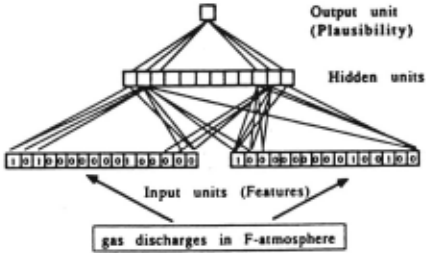
The backpropagation networks were trained by pre senting about 200 training examples for each specific preposition. A training example consisted of the fea ture representations for the two nouns together with the plausibility value "1" for "plausible" or "0" for "implau sible". After the backpropagation networks were trained for 1600 epochs with the training set, each network was tested with the training set and a testing set. The test ing set consisted of 30 examples of prepositional rela tionships (each characterized by 32 features) which the network had not been trained on. A prepositional rela tionship was considered correct on a scale from 0 to 1 if the value of the output unit was higher. than 0.5 for a desired plausible relationship and smaller than 0.5 for a desired implausible relationship. The testing results for three examined prepositions [Wermter 89] showed that the backpropagation networks learned almost all prepo sitional relationships in the training set and most of the relationships in the testing set. For instance, the network for the preposition "in" got 93% of the 248 training ex amples correct and 83% of 30 unknown testing examples.
3.2 The Bottom Level: Representing Syntactic Constraints
The first form of syntactic knowledge considered for noun phrase disambiguation is the locality constraint. The Locality constraint models the heuristic that a prepo sitional phrase in a noun phrase is more likely to attach to a close preceding noun than to a distant preceding noun. For instance in a noun phrase like "techniques for measurements in discharges" the prepositional phrase "in discharges" tends to attach to "measurements", al though "in discharges" could attach to "techniques" as well. The locality constraint can be interpreted as a generalisation of Right Association [Kimball 73]. While Right Association for a noun phras~ states that a prepo sitional phrase attaches to the directly preceding noun, the locality constraint claims that there is only a strong tendency for a local attachment to directly preceding nouns. This tendency decreases with the distance be tween noun and prepositional phrase.
The second form of syntactic knowledge is the No crossing constraint. The no-crossing constraint states that the prepositional phrase attachment in a noun phrase does not show crossing branches (see e.g. [Tait 83]). The following constructed example illustrates a vi olated no-crossing constraint. Although "influence on electrons" and "temperatures in Fahrenheit" are plausi ble prepositional relationships, this structural interpre tation is considered wrong due to the crossing attach ment.

3.3 The Top Level: Integrating Syntactic and Semantic Constraints in a Relaxation Network
The semantic constraints for the prepositional relation ships and the syntactic constraints for no-crossing and lo cality are integrated in a relaxation network to allow par allel interactions between these different constraints. In the past, relaxation networks have been shown to be suc cessful for integrating different constraints in a variety of natural language tasks like sentence processing [Waltz and Pollack 85], word sense disambiguation [Bookman 87], attachment decisions [Lehnert 89] and lexical access [Cottrell 88). These approaches depend on the initial ization of the input nodes with suitable values but this decision is not based on a memory model. In our new approach we demonstrate that (I) trained backpropaga tion networks supply a more powerful underlying model for the input of a relaxation network and (2) relaxation networks are extremely useful for integrating different constraints for structural noun phrase disambiguation.
First we will describe the interface between our two levels, then we will outline the overall architecture of the relaxation network at the top level. This description is illustrated with an example of a noun phrase with three prepositions:
The influence of the radiation intensity on discharges in the Van-Alien-belt.
3.3.1 The Interface between the Top and Bottom Levels
The interface between the two levels is represented with three types of nodes: semantic nodes, locality nodes, and no-crossing nodes (see figure 3). In our exam ple there are six Semantic nodes representing the se mantic constraints for the six possible prepositional rela tionships: influence of intensity, influence on discharges, influence in Van-Alien-belt, intensity on discharges, in tensity in Van-Alien-belt, discharges in Van-Allen-belt.
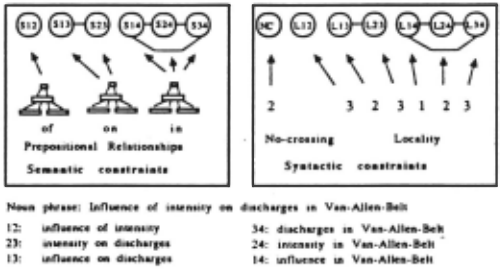
The input potential for the six semantic nodes in the relaxation network is based on the output units of the backpropagation networks described in section 3.1. The semantic nodes representing "influence of intensity", "in fluence on discharges", "influence in Van-Allen-belt", "intensity in Van-Allen-belt", and "discharges in Van Allen-belt" get high input potential, because these rela tionships are plausible. The semantic node for "intensity on discharges" gets a low input potential, because that relationship is implausible.
In addition to the semantic nodes there are seven syn tactic nodes representing the syntactic constraints for locality and crossing dependencies. The potential of the six Locality nodes reflects the distance between the nouns of a prepositional relationship: the closer the nouns of a prepositional relationship in the noun phrase, the higher the potential of the node. For instance, "in fluence of intensity" gets a higher value than "influence in Van-Allen-belt" because the nouns in the first prepo sitional relationship are closer. The one No-crossing node prevents crossing attachments, so that in noun phrases with three prepositions the third noun cannot attach to the first noun while the fourth noun attaches to the second. The connections of all nodes are described in the next section.
· 3.3.2 The Top Level: Architecture of the Relaxation Network
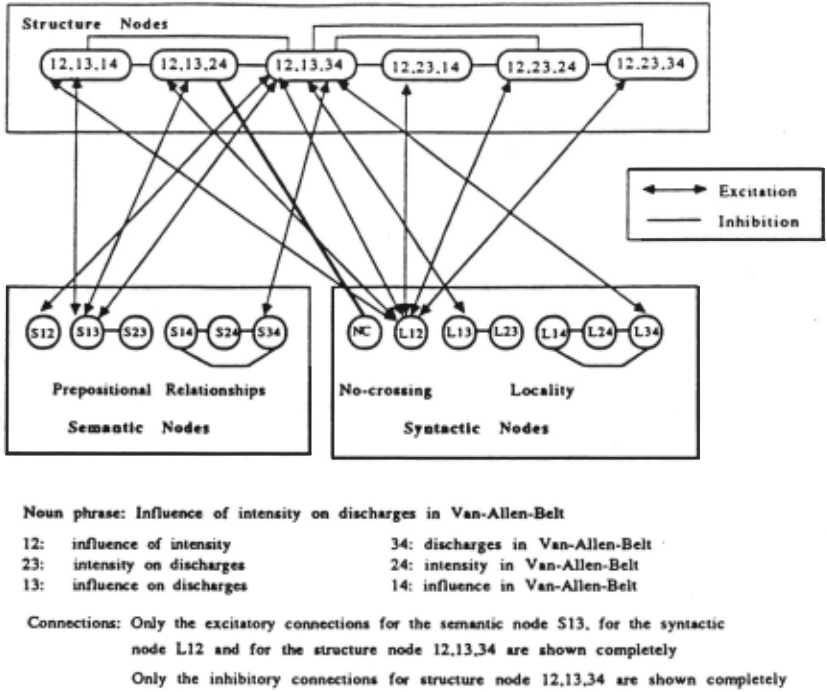
The relaxation network (see figure 4) consists of nodes connected via inhibitory and excitatory connections and can be generated for noun phrases with different lengths. For noun phrases with three prepositions there are 13 input nodes and six output nodes. The input nodes for the semantic constraints and locality constraints are connnected via inhibitory connections if the two prepo sitional relationships have the same noun in the second position of the prepositional relationship and a different noun in the first position. For example "influence on discharges" and "intensity on discharges" are connected via inhibitory connections, because "influence" competes with "intensity" for "discharges".
The output nodes represent the six possible structural interpretations of the noun phrase. Therefore the out put nodes will be referred to as Structure nodes. One structure node can be described as a triple of number pairs. Each number stands for the position of a noun in a noun phrase, for instance the triple "1-2,2-3,3-4" is the representation for "influences of intensity", "inten sity on discharges" and "discharges in Van-Alien-belt". All structure nodes are in competition and connected via inhibitory connections.
The semantic nodes and the locality nodes are con nected with the structure nodes via excitatory connec tions if the prepositional relationship of the input node occurs in the structure node. The no-crossing node is in hibitorily connected to the structure node "1-2, 1-3,2-4" which represents crossing dependencies.
3.3.3 Processing in the Relaxation Network
The nodes in the relaxation network are initialized with a potential between 0 and 10. The semantic nodes receive input based on the output of the backpropaga tion networks. They obtain a high start potential of 10 for a plausible prepositional relationship and a low start potential of 2 for an implausible prepositional rela tionship. The initialization values of the locality nodes depend on the distance between nouns in a noun phrase. For instance, if the attachment is over 1 preposition we initialize with 3, for attachment over 2 prepositions with 2, and for attachment over 3 prepostions with 1. This ensures that local attachment gets more reinforcement than distant attachment. The rest of the nodes, the no-crossing node and the structure nodes, are initialized with low values of 2.
Once the relaxation algorithm [Feldman and Ballard 82] is started, nodes update their potential. Incoming excitatory connections increase the potential of a node, incoming inhibitory connections decrease the potential. One cycle consists of updating every node once. Al though our implementation of this process is sequential, the actions within one cycle could be processed in par allel. After about 30 cycles the network converges to a stable state in which the potentials do not change any more. The structure node with the highest potential represents the preferred structural interpretation of the noun phrase.
In our example "The influence of the radiation inten sity on discharges in the Van-Alien-belt" the following structure node had the highest potential of 8.9 at the end of the relaxation (the other structure nodes had val ues around 0.9):
Influence of intensity Influence on discharges Discharges in Van-Alien-belt
The network integrated the syntactic and semantic constraints: the semantic constraint "intensity on dis charges" is implausible and therefore the semantic con straint "influence on discharges" is found as the preferred attachment for "discharges", although the syntactic lo cality constraint prefers the local attachment "intensity on discharges" compared to "infuence on discharges". This example shows how semantic constraints can over rule locality constraints.
Looking at the noun "Van-Alien-belt" we notice the syntactic influence. "Van-Alien-belt" could attach to all three preceding nouns, because all these prepositional re lationships are plausible. At the same time the locality constraint imposes a preference for a local attachment, so that "discharges in Van-Alien-belt" is preferred to "in fluence in Van-Alien-belt" and "intensity in Van-Alien belt".
4 Discussion
We use two different mechanisms at two levels for the task of structural noun phrase disambiguation. At the domain-dependent bottom level we use distributed representations and backpropagation networks for each preposition to learn the semantic relationships. At the domain-independent top level we use localist represen tations and a relaxation network to integrate syntactic and semantic constraints. Although work on related re laxation networks has to rely on some initial setting of the start activation (e.g. [Waltz and Pollack 85], [Book man 87], [Lehnert 87], [Cottrell 88]), our model bases its initialization on learned memory. While other work on PP-attachment has mostly concentrated on the attach ment of single prepositional phrases in sentences ([Wilks et al. 85], [Schubert 86], [Dahlgren and McDowell 86], [McClelland and Kawamoto 86], [St. John and McClel land 88]) we have concentrated on the attachment of multiple prepositional phrases in noun phrases.
Our approach demonstrates progress over related con nectionist work [Cosic and Munro 88] by using dis tributed representations for nouns, by integrating se mantic and syntactic constraints and by allowing for noun phrases with arbitrary length. We must also point out that our underlying memory model of prepositional relationships can be used as part of a full sentence analy1er as well. For example, the sentence analyser CIR CUS [Lehnert 89} can combine our semantic memory model with predictive knowledge during sentence pro cessing.
5 Conclusions
We have described an approach for learning and inte grating semantic and syntactic constraints. Backpropa gation networks and distributed representations are used to learn the plausibility of semantic relationships and to generalise the learned regularities to semantic con straints. Relaxation networks and localist representa tions are used to integrate these semantic constraints with syntactic constraints. We have demonstrated that a connectionist model supplies a powerful memory model for the learning and integration of constraints for struc tural noun phrase disambiguation. Since the problem of learning and integrating constraints occurs in many other language tasks like word sense disambiguation or compound noun interpretation, our memory model is of importance for many Natural Language Processing prob lems.
Acknowledgements
I would like to thank Wendy Lehnert, Andy Barto, Steven Bradtke, David Lewis and the NLP group for discussions and comments on earlier drafts of this pa per.
@inproceedings{ijcai1989p237,
  title     = {Integration of Semantic and Syntactic Constraints for Structural Noun Phrase Disambiguation},
  author    = {Wermter, Stefan},
  booktitle = {Proceedings of the Eleventh International Joint Conference on
               Artificial Intelligence, {IJCAI-89}},
  publisher = {International Joint Conferences on Artificial Intelligence},
  editor    = {N. S. Sridharan},
  pages     = {1486--1490},
  year      = {1989},
  month     = {8},
  note      = {Speech and Natural Language},
  url       = {https://ijcai.org/proceedings/1989/237},
}
TY - CPAPER TI - Integration of Semantic and Syntactic Constraints for Structural Noun Phrase Disambiguation AU - Wermter, Stefan T2 - Proceedings of the Eleventh International Joint Conference on Artificial Intelligence, IJCAI-89 PB - International Joint Conferences on Artificial Intelligence PY - 1989 SP - 1486 EP - 1490 UR - https://ijcai.org/proceedings/1989/237 ER -Copied
Machine-readable versions of this paper, for tools and AI agents:





