
Vivid Knowledge and Tractable Reasoning
Proceedings of the Eleventh International Joint Conference on Artificial Intelligence. Commonsense Reasoning. Pages 1146-1151.
© 1989 International Joint Conferences on Artificial Intelligence
Abstract
Mundane, everyday, reasoning is fast. Given the inherent complexity of sound and complete reasoning with representations expressive enough to capture what people seem to know, commonsense reasoning must require shortcuts and assumptions. Some means of simplifying the retrieval of the inferential consequences of a set of facts is obviously required. Instead of looking, as others have, at limited inference or syntactic restrictions on the representation, we explore the use of "vivid" forms for knowledge, in which determining the truth of a sentence is on the order of a database retrieval. In order to base a reasoning system on vivid knowledge, we consider ways to construct a vivid KB-a complete database of ground, atomic facts-given facts that may be presented in a more expressive language that allows incompleteness (e.g., first-order logic). Besides offering an architecture for examining these problems, our results show that some forms of incomplete knowledge can still be handled efficiently if we extend a vivid KB in a natural way. Most interesting is the way that this approach trades accuracy for speed.
- Agrawal, R., Borgida, A., and Jagadish, H. V. [1989], "Efficient Management of Transitive Relationships in Large Data and Knowledge Bases", Proc. ACM- SIGMOD-89, Portland, OR, May 1989.
- Borgida, A., and Etherington, D. W. [1989], "Hierarch- ical Knowledge Bases and Tractable Disjunction", Proc. First International Conference on Knowledge Representation and Reasoning, Toronto, Canada, May, 1989, 33-43.
- Borgida, A., Brachman, R. J., McGuinness, D. L., and Resnick, L. A., "CLASSIC: A Structural Data Model for Objects", Proc. ACM-SIGMOD-89, Portland, OR, May, 1989.
- Codd, E. F. [1979], "Extending the Database Relational Model to Capture More Meaning", A CM Trans. on Database Systems 4( 4), December, 1979, 397-434.
- Etherington, D. W. [1988], Reasoning with Incomplete Information, Pitman Research Notes in Artificial Intelligence, Pitman (London)/Morgan Kaufmann (Los Altos), 1988.
- Frisch, A.M. [1988], Knowledge Retrieval as Specialized Inference, Technical Report UIUCDCS-R-88-1404, Department of Computer Science, University of Illi- nois at Urbana-Champaign, February, 1988.
- Grice, H. P. [1975], "Logic and Conversation", in Syntax and Semantics, Vol 3: Speech Acts, Cole, P. and Morgan, J. L. (eds.), Academic Press, 1975.
- Imielinski, T. [1988], "Incomplete Deductive Data- bases", submitted for publication, 1988.
- Johnson-Laird, P. N. [1983], Mental Models, Harvard University Press, Cambridge, MA, 1983.
- Kautz, H., and Selman, B. [1989], "Hard Problems for Simple Default. Logics", Proc. First International 1152 Commonsense Reasoning Conference on Knowledge Representation and Rea- soning, Toronto, Canada, May, 1989, 189-197.
- Levesque, H. J. [1986], "Making Believers out of Com- puters", Artificial Intelligence 30, October 1986, 81-108. (Originally given as the "Computers and Thought" lecture at IJCAI-85.)
- Lipski, W. Jr. [1979], "On Semantic Issues Connected with Incomplete Information Databases" ; A CM Trans. on Database Systems 4, 1979, 262-296.
- McCarthy, J. [1977], "Epistemological Problems of Ar- tificial Intelligence", Proc. Fifth International Joint Conf. on Artificial Intelligence, Cambridge, MA, 1977, 1038-1044. IJCAI
- Minker, J. [1982], "On Indefinite Databa.Ses and the Closed-World Assumption", Proc. Sixth Con f. on Automated Deduction, New York, June, 1982, Springer-Verlag, NY.
- Patel-Schneider, P. F. [1984], "Small can be Beautiful in Knowledge Representation", Proc. IEEE Workshop on Principles of Knowledge-Based Systems, Denver, December, 1984, 11-16.
- Patel-Schneider, P. F. [1989], "A Four-Valued Seman- tics for Terminological Logics", Artificial Intelli- gence 38, 1989, 319-351.
- Reiter, R. [1978], "On Closed-World Data Bases", in Gallaire, H. and Minker, J. (eds), Logic and Data Bases, Plenum Press, 1978, 55-76.
- Reiter, R. [1984], "A Logical Reconstruction of Rela- tional Database Theory", in Brodie, M. L., My- lopoulos, J., and Schmidt, J. W. (eds), On Con- ceptual Mode/ling, Springer-Verlag, 1984, 191-233.
- Selman, B. and Kautz, H. [1988], "The Complexity of Model-Preference Default Theories", Proc. Cana- dian Soc. for Computational Studies of Intelligence- 88, Edmonton, Alberta, June, 1988, 102~109.
- Thomason, R., Horty, J., and Touretzky, D. [1987], "A Calculus for Inheritance in Monotonic Seman- tic Nets", in Methodologies for Intelligent Systems, Ras, Z. and Zemankova, .M., eds., North-Holland, Amsterdam, 1987, 280-287.
References were extracted automatically from the PDF and may contain errors.
Full text extracted automatically from the PDF; figures, tables and equations may differ. The PDF is the version of record.
1 Introduction
People perform quickly and competently in most ev eryday situations-despite an overwhelming barrage of information that nonetheless does not unambiguously characterize the state of the world. In contrast, com puter problem-solvers-especially those with clear, for mal foundations-are extremely slow in most circum stances, even when presented with little information.
Consider a problem-solver that relies on a knowledge representation {KR) system to answer queries about what follows from a knowledge base. Although there are many factors that contribute to the overall performance of the problem-solver, clearly the efficiency of the KR system is important. Recent attempts to deal with the intractability of such systems have generally fallen under two headings: limited languages (e.g., [Patel-Schneider 1984, Borgida et a/ 1989]), and limited inference {e.g., [Frisch 1988, Patel-Schneider 1989]). In the former, what Ronald J. Brachman Henry Kautz AT&T Bell Laboratories Murray Hill, NJ 07974-2070
can be expressed in the knowledge base {KB) is restricted (sometimes severely) to guarantee that queries can be answered in more or less reasonable time. In the lat ter, restrictions like avoiding chaining or four-valued in terpretations yield limited conclusions, albeit from rela tively expressive KB's.
We conjecture that a key to efficient problem-solving lies in a notion of commonsense reasoning-the kind of reasoning that people engage in all the time without re course to "paper and pencil", reasoning by cases, back tracking, or particularly deep thought. 1 Commonsense reasoning is fast: if it were a problem-solver's normal mode of reasoning, then the problem-solver would be fast. Paradoxically, studies of commonsense reasoning in AI (e.g., nonmonotonic logics) have frequently led to mechanisms that are even less tractable than logical de duction.
This paper describes an attempt to bridge the gulf be tween principled theories of inference and practical infer ence systems. We discuss some components that might combine to support fast reasoning, and a uniform ar chitecture that incorporates them. Obviously, common sense reasoning is inherently approximate and fallible. Our architecture lets us move towards commonsense per formance, and yet still say something substantive about the system's relationship to "ideal competence".
2 Vivid Reasoning
What would be a good basis on which to build a fast reasoner? (Given the massive amounts of infor mation agents are faced with, we cannot even inter pret "fast" as "polynomial-time"-we really need per formance sublinear in the total size of the KB for simple queries.) The natural candidate from Computer Science is something like a relational database, where query answering/reasoning is merely look-up for the kinds of simple questions that we expect to be frequently asked of the KB.
Analyses such as Levesque's [1986] and Reiter's [1984] suggest that a crucial factor in the efficiency of databases is the assumption that the database has a complete and accurate view of the world. Generalizing from this, we conjecture that the proper basis for commonsense rea soning is some "vivid" representation of knowledge-one that bears a strong and direct resemblance to the world it represents. A vivid representation has symbols that stand in a one-to-one correspondence to objects of inter est in the world, with connections between those symbols corresponding to relationships of concern. For example [Levesque 1986], a KB containing the sentences "Dan drank 7 ounces of gin" and "Jack drank 6 ounces of gin" would be vivid, with respect to the amount Jack and Dan drank individually, while one containing "Jack and Dan together polished off 13 ounces of gin" and "Dan had one more 1-ounce drink than Jack" would not, de spite the fact that the same information follows from both KB's.
1 We call reasoning that does not fit this description puzzle-mode reasoning, after logic puzzles of the form "The man who owns the camel lives next to the orange-juice drinker ... ".
The notion of vivid representations is appealing for reasons beyond supporting reasoning as database-style lookup: it corresponds well to the kind of information expressed in pictures; thus, it is reasonable to think that much of the information we gain (i.e., percep tually) occurs naturally in vivid form. Also, various psychologically-oriented explanations of cognition sug gest that people often seem to reason directly from "men tal models" [Johnson-Laird 1983], rather than by syntac tic manipulation of sentential constructs.
Of course, not all information we obtain about the world is in vivid form: linguistic communication, for ex ample, may yield disjunctive or otherwise incomplete or general input (e.g., "Joe doesn't have his Ph.D. yet." or "Everyone in the department has an advanced de gree.") . Fortunately, much of this information can be coerced into a vivid form in a principled way.
3 System Architecture
What is needed is an appropriate architecture that would allow an AI system to fall back on more general reason ing (e.g., first-order logic) when necessary, but would depend primarily on efficient, vivid reasoning. The ap proach of standard "hybrid". reasoners, which delegate questions to submodules that can handle them efficiently will not suffice. We need a much more active approach, in which incoming information is processed to augment and maintain a vivid view of the world. We have been investigating an architecture that exemplifies this view (see Fig. 1): first-order facts are "vivified" into a knowl edge base of a special form (the VKB). 2 This vivifica tion may lose information, since the VKB cannot ex plicitly represent disjunction, negation, or any form of incompleteness. This makes it important to determine the relationship between the answers that a complete theorem-prover would return when queried, given the KB, and the answers that would be retrieved from the vivid knowledge in the VKB-i.e., between a and a' in the figure. This relationship can be thought of as the de gree of soundness and completeness of the VKB. Vivid reasoning will not be very useful if a' is too small a subset of, or bears no understandable relationship to, a.
2 We distinguish below between the KB- the knowledge given to the system-and the VKB- the system's vivid rep resentation of that knowledge.
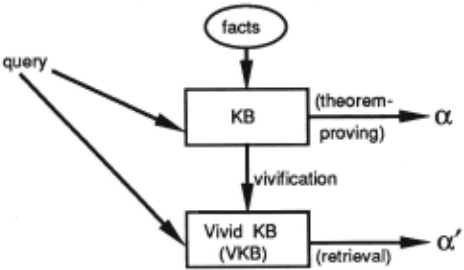
Because not all reasoning fits our commonsense rea soning paradigm, we propose a hybrid system that re tains the original information to supplement, as nec essary, the vivid form. We attempt to answer queries by simple retrieval directly from the vivid KB. If that provides inadequate answers, general or special-purpose reasoning with the original KB may be tried, perhaps depending on the importance of the query. Ultimately, one measure of success will be the proportion of reason ing that can be delegated to the VKB.
I Vivid
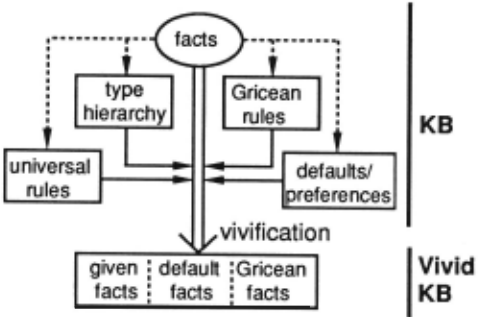
Figure 2: A more general architecture.
A generalization of the architecture of Fig. 1, and a more realistic view, is illustrated in Fig. 2. Notice first the influence of a variety of components on the vivifica tion of the original facts. Universal rules affect vivifica tion simply and directly (see below). However, where the available knowledge is incomplete, we can often do better than simply leaving the information in non-vivid form. It may be possible, for example, to eliminate the ambiguity of the given disjunction in favour of definite facts-facts not strictly equivalent, but sufficient for the purposes of the system. For example, defaults or preferences 3
3 At the moment, we assume the defaults are presented to the system in the same declarative way as other facts; eventually, defaults should be created by inspecting the VKB (i.e., from experience) .
can be used to capture the contribution of previous ex perience, "Gricean" communication conventions (Grice 1975], 4 and linguistic context effects in forming mental models. In other cases, abstraction provides a powerful tool. In some circumstances, it may even suffice to make arbitrary choices, as suggested in Levesque's Computers and Thought lecture. Thus, the information in the VKB may be the consensus of multiple knowledge sources, as suggested by Fig. 2.
It also seems useful to separate out parts of the orig inal KB that are essentially taxonomic. As we show below, taxonomies provide another form of disjunctive information that can be used efficiently in vivification and retrieval. 5
4 Constructing a Vivid Knowledge Base
A vivification process for the sim~lest case-that of non-disjunctive, positive (possibly universally quanti fied) sentences-is easy to imagine. All that is necessary is to take the set of instances of the universally-quantified formulae over the set of known individuals and store the result as a collection of positive, ground, atomic pred icates (e.g., a relational database). However, we also intend to take information that would appear suitable only for the KB, and use it in vivification and/or in con junction with the VKB in query-answering.
The architecture described above trades effort and space as knowledge is added to the system in favour of rapid query-answering. Although there are fall-back po sitions that make vivification less demanding, some of which are discussed below and in (Borgida & Ethering ton 1989], it is useful to ignore the cost of vivification at first, to make some of the underlying theoretical is sues more apparent. Notice, however, that vivification is not the same as computing all consequences of the KB: only ground atomic consequences are developed. Fur thermore, any ground consequences that can be obtained by database techniques (e.g., membership in defined re lations) need not be computed.
Disjunctive and negative information do not fit read ily into the database world-view, and are major contrib utors to the complexity of logical reasoning. We address disjunction and negation piecemeal, distinguishing sev eral different forms and treating each differently. Above all, we strive to avoid reasoning by cases. We hypothe size that commonsense reasoning achieves its efficiency, in part, by not resorting to case analysis, and we treat problems that absolutely require reasoning by cases as puzzle-mode problems.
Perhaps the best way to discuss the various versions of vivification is to consider progressively weaker restric tions on the forms of negative and disjunctive informa tion that can be vivified, and consider how each new class of facts can be converted into vivid form. 6
· For example, when someone says, "Some of the chemists are beekeepers," they typically mean to imply that some of them are not [Johnson-Laird 1983).
6 Interestingly, mathematicians and computer scientists have independently studied "vivid" representations of partial orders, where transitive relationships can be directly "read off" the representation (viz (Agrawal et al1989]) .
4.1 A Simple Case
The simplest extension beyond ground and universally quantified atoms is to allow disjunctions of the form Vx. -,A(x) V B(x) (equivalently, simple implications like those found in inheritance hierarchies). The vivification algorithm treats these by asserting B (a) when ever A( a) is entered into the VKB. The VKB is then queried as a normal relational database, with negation determined by the closed-world assumption (CWA) (Reiter 1978].
For example, vivifying the KB, {Man( Socrates), Woman(Ophelia), Vx. Man(x) :::> Mortal(x)}, re sults in the VKB, {Man(Socrates), Woman(Ophelia), M ortal(Socrates)}. The query M ortal(Socrcdes) is an swered by lookup in the VKB, and returns 'Yes'. The query M ortal(Ophe/ia) fails in the VKB, so the CWA sanctions the answer 'No'.
The KB's considered so far correspond to definite databases, i.e., databases of clauses each containing ex actly one positive literal. Reiter (1978] shows that the CWA is always consistent with definite databases. We have proved that the answers returned by closed-world querying of the VKB are identical to those returned by closed-world querying of the original knowledge base under the "domain-closure assumption" (DCA) (Reiter 1978]. 7
Because negative information is not explicitly repre sented in the vivid KB, it is not necessary to consider the contrapositive forms of the disjunctive rules; any rule not instantiated by the vivification process will be cor rectly instantiated by the CWA during query-answering. This ensures that the computational complexity of the vivification process does not get out of hand. In par ticular, it is not necessary to reason by cases, since the negative case can never be explicitly asserted in the KB. Any technology suitable for reasoning with monotonic semantic networks (e.g., (Thomason et a/ 1987]) can be used to vivify the KB. Of course, the system described so far is not significantly more useful than a monotonic semantic network. In the following sections, we discuss extensions that move in the direction of a useful com monsense reasoning system.
4.2 A Slightly More Complicated Case
The knowledge presented to a system sometimes con tains bona fide alternatives and provides no means for deciding amongst them. It is sometimes possible to trade the given ambiguity for vagueness and thereby avoid disjunction. That is, a list of alternatives concerning an individual can sometimes be replaced by a less-fine grained, but atomic, description that subsumes the al ternatives. For example, if we are told only that Joe is
6 To simplify the rest of our discussion of vivification, we restrict ourselves to monadic predicates. In some cases, this hides only messy details. In others, some details remain to be worked out. Readers are welcome to make whichever assumption their credulity allows.
7 The DCA, which says that the individuals mentioned by the theory constitute the entire set of individuals, is used in database theory to facilitate handling quantified queries.
52 or 53, we might represent the fact that Joe is in his early 50's.
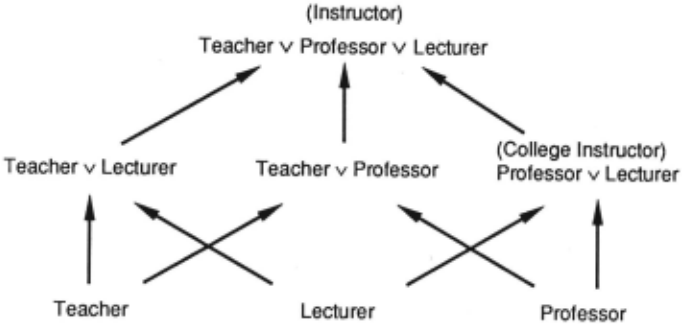
To substitute vagueness for ambiguity, we assume that the given KB provides certain subsumption information. This may range from the extreme of a complete upper semilattice containing a subsuming predicate for every subset of the set of predicates (e.g., Fig. 3), through more natural taxonomic hierarchies (e.g., Fig. 4), to the trivial case where everything is subsumed only by Thing.
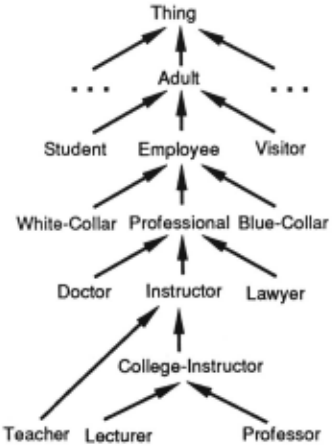
In the simplest case amenable to substitution, the given information asserts that a particular individual is a member of one of n classes (i.e., has one of n prop erties), without specifying which (e.g., Teacher(Joe) V Professor(J oe)). If the information available in the KB provides a class that subsumes all the mentioned classes, vivification simply asserts membership in the subsuming class, and discards the alternatives, thus obtaining an atomic fact that can be stored in the VKB (e.g., using Fig. 4, Instructor( Joe)).
The price of this substitution depends on the density of the available subsumption information. If the sub sumption hierarchy is complete, no information is lost: anything deducible from the KB will follow from the VKB. In what we expect to be the more common case of a relatively sparse hierarchy, a certain amount of pre cision may be lost. Exactly how much will depend on how "natural" the given disjunction is. 8 Disjunctions that are useful for commonsense reasoning will often be subsumed by predicates nearby in the hierarchy. Less natural disjunctions-requiring reasoning closer to puz zle mode-would be subsumed only by much more gen eral concepts-concepts that also subsume many other concepts not represented in the original disjunction.
For example, think again of the hierarchy in Fig. 4. The information that Joe is a professor or a doctor would be vivified by asserting Professional(J oe), allowing the possibility that he is a teacher, a lecturer or a lawyer. Being told that he is a professor or a student would yield Adult(Joe), losing (among other things) the fact that he is not a visitor. Learning that Joe is a lawyer or a shark might give rise only to Thing(Joe).
"Unnatural" disjunctions do not slow vivification down appreciably, but uselessly vague answers can be expected concerning the subjects of these disjunctions. This coincides with our intention that the vivid reason ing component should not be expected to handle puzzle mode problems well.
We have not said exactly how the VKB should han dle negation in this extended representation scheme. In particular, since the KB is no longer definite, it is in appropriate simply to use the CWA, which may in troduce inconsistency. For example, if Teacher( Joe )v Professor(J oe) is made vivid by representing only Instructor(Joe), then the CWA would justify both -,Teacher(Joe) and -,Professor(Joe), since neither fol lows from Instructor( Joe).
8 We realize, of course, that "natural" is not a well-defined term. In this context, however, we can define a disjunction as natural if its elements are subsumed by a predicate nearby in the abstraction hierarchy. We can justify this name by begging the question: we assume that those responsible for building the KB will include nodes for natural disjunctions of concepts, and not for unnatural ones!
One solution is not to make the CWA at all; then fail ure to find a fact in the VKB would simply mean that the VKB didn't know the fact to hold. This solution seems a bit radical, however. While avoiding overcom mitment when given vague knowledge, it prevents mak ing the CWA even for things not even represented in the KB. This would make the VKB much less vivid. Fortu nately, there is a less drastic solution.
For KBs of the form we are considering, the appropri ate form of the CWA is the Generalized CWA (GCWA) [Minker 1982], which is much like the CWA, except that it avoids asserting the negation of terms involved in ir reducible disjunctions. It turns out to be straightfor ward to augment the representation mechanism used in the VKB to allow it to distinguish "unknown by virtue of no information" from "unknown by virtue of vague ness". The CWA can then be applied in the extended representation to infer the negations of terms for which no information is available. We have shown [Borgida & Etherington 1989] that this approach yields the same re sults as the GCWA applied to the original KB, assuming a complete subsumption hierarchy. A sparse hierarchy, of course, may result in weaker statements, due to the loss of precision in the construction of the VKB.
The representation and algorithms we have developed are particularly attractive because they have the prop erty that their accuracy degrades gracefully as their effi ciency improves, and does not degrade for unambiguous information. Thus the retrieval algorithms are sound and complete in cases where the hierarchy is complete or where the given knowledge either is atomic or corre sponds to concepts directly representable in the hierar chy. In exchange for the loss of representational fidelity in other cases, we achieve significant performance im provements: assuming the hierarchy has O(p) predicates, where p is the number of primitive predicates, query answering is sublinear in the number of facts told to the KB, and linear in the size of the query. Complete query answering, on the other hand, is at least 0( n log n) in the size of the query, and linear in the size of the KB. We can also achieve significant improvements in the com plexity of telling the KB facts: the NP-complete problem of converting inputs to conjunctive normal form suitable for vivification can be approximated, without additional loss of information, in polynomial time.
4.3 A Still More Complicated Case
Another natural-seeming form of disjunction involves al ternation of the same predicate over more than one in dividual, e.g., Teacher(Joe) V Teacher(Bill). We treat these using a technique similar to that discussed in the previous section, abstracting a set of individuals to a type containing them. In this case, a disjunction is viv ified by introducing a Skolem constant (a null value, in database terminology) to represent whichever individual satisfies the predication. We assert that the predicate holds of the null, and that the null is a member of the appropriate type. 9 As in the predicate case, the information lost by vivifying this way is proportional to the density of the type hierarchy. The empirical question of whether there will generally be types available that cover enough of the disjunctions over small sets of individuals (especially sets of two) that occur in commonsense rea soning remains open. We can construct intuitively plau sible arguments that there will be no problem, but we have not yet compiled data.
9 The same techniques can be applied directly to range-limited existentially-quantified statements, such as 3x/Teacher. Salary(x) > $40,000.
It is possible that the hierarchy will be too sparse, in which case some combination of the above technique with another we are studying may be necessary. This second approach maintains a list of constraints on which individuals may replace the null. These constraints can be used in a variety of ways to provide answers of vary ing detail. In the limit case, a general-purpose equality reasoner can be applied to recover all the information inherent in the original problem statement. At the other extreme, it is possible to manipulate a unification al gorithm in such a way thatit provides maximally op timistic or pessimistic views of the effects of the con straints on answers to queries, while performing only a fraction of the work necessary to determine the "correct" (maximally informative) answer. This allows the system to quickly provide upper and lower bounds [Lipski 1979] on the answers to queries while avoiding the effort nec essary to determine the maximally-informative answer.
Again, the approximations (which are motivated by the structure imposed on the_ world by the hierarchy) made in vivifying the KB result in gratifying perfor mance gains like those discussed in the previous section, while retaining soundness and completeness where pos sible. In this case, the gains are even more significant, since the general query problem for the class of formu lae treated here is NP-complete in the size of the query [Imielinski 1988]. Our algorithms can approximate an swers in polynomial time.
4.4 Negation
The major deficiency in the system as it stands is that it provides no mechanism for explicitly telling the VKB negative information. For many applications, however, this is not a particular problem, since the system has the GCWA to provide implicit negation. In fact, this is no less than is provided by many AI knowledge representation systems (e.g., PROLOG). Occasionally, however, it would be useful to have explicit negation. While we are still working out the details, it appears to be simple to add capabilities for representing sim ple ground atomic negative facts, and perhaps uniformly negative ground disjunctive facts like the uniformly posi tive disjunctions discussed above (e.g., ·Teacher( Joe) V ·Professor(Joe)). Such an extension would allow the system to distinguish between "definitely false", "false by the CWA", and "unknown", in some cases.
4.5 Life in the Space/Time Continuum
In describing our vivification algorithm, we have been profligate with the space and, to a lesser extent, time required to represent knowledge, in an effort to achieve optimal performance for query-answering. Depending on the availability of storage and the relative frequencies of update and query, it may be desirable to retreat from the extreme position of a totally vivid representation. Since the architecture of our hybrid system assumes that the original KB is available for the use of the problem solver, it is not particularly difficult to beat this retreat.
The hierarchies that we use are exception-free, and support efficient computation. Provided certain conven tions are followed during vivification (and update), it is easy to eliminate some of the worst space consump tion. In particular, the transitive closure of the inheri tance hierarchy need not be computed in advance, and the distinction between "unknown" and "assumed false" can be determined as required to answer queries, rather than explicitly stored.
5 Knowing, More or Less?
The techniques we have described for vivifying a KB re sult in the system knowing less (at least no more) than it was told. Reasoning by cases is avoided by only rep resenting versions of the input that can be made unam biguous. Levesque [1986] suggests that people sometimes avoid the expense inherent in disjunctive information by simply picking one disjunct. He argues that a tremen dous amount of vague and ambiguous information is pre sented to an agent all the time and it is often sufficient (or even necessary) to disambiguate it either arbitrarily or according to some default principles, in effect coming to "know" more than was told. 10
Research on default reasoning has concentrated on developing default theories that are epistemically ade quate, but has ignored computational complexity. Con versely, we are interested in using defaults to support fast vivid problem solving-including problems that could be solved more slowly without defaults-and are centrally concerned with processing the default rules quickly.
To see how defaults might be used in vivification, sup pose a partial description of a room is input to an agent's KB. Some items are precisely specified (e.g., the coor dinates of the door), but others are missing (e.g., the width of the fireplace opening). Geometric-level vivifica tion might fill in the missing information with typical or random values. For instance, fireplaces are typically 30" wide, and the windows could be assigned random posi tions along the exterior walls. Finally, suppose an agent is told that there is a stack of 24"-long firewood outside, and is instructed to build a fire in the fireplace. She can create a simple plan to carry some firewood indoors and place it in the fireplace because she has made the default assumption that the fireplace opening is larger than the wood. Lacking this belief, she would need to generate a conditional plan: measure the fireplace; if it is less than 24", then cut the firewood into suitably-sized pieces.
The utility of defaults does not depend on a coord inate-level view of the world. For example, suppose an agent is driving a car when a tire goes flat. Her vivid model of the car has a good inflated tire and a jack in the trunk. This belief, together with the goal of replacing the flat tire, generate the obvious plan: open the trunk, remove the spare tire and jack, raise the car, and replace the flat tire with the spare. She does not create a plan that considers the possibility that there is no spare in the trunk and conditionally sends her off in search of one.
10 See [Etherington 1988) for a discussion of the pervasive ness of default reasoning in intelligent behaviour.
Vivid reasoners never need to generate conditional plans, or reason about the possible ways the world could be. The vivid model forms the basis for a direct solution to the problem at hand. If the solution fails because the default assumptions are incorrect, then the vivid model is revised: the blatantly erroneous assumptions are re placed by new observations, the KB is re-vivified, and problem-solving is repeated. 11
This use of defaults for vivification is closely related to the "qualification problem" in planning [McCarthy 1977]. In many domains the list of circumstances that would require different solutions to a planning problem is infinite, so that it is impossible even in principle to solve the problem by reasoning by cases.
We have begun the task of integrating defaults into a vivid reasoner by analyzing the complexity of simple default systems. Selman and Kautz [1988] report our analysis of "model preference default rules", which en force a simple preference relation over the space of mod els of a theory (which corresponds to the space of vivid models). While finding a most-preferred model is, in general, NP-hard, one can be found in polynomial time if the preference rules are acyclic. Kautz and Selman [1989] extend this analysis to restricted versions of Re iter's default logic. It is almost always difficult to de termine whether a fact holds in any or all "extensions" (roughly, the vivid models) of a theory. Fortunately, however, there is a broad class of theories for which one can find some extension in polynomial time. These re sults show that while default reasoning can be surpris ingly complex, there is strong hope for finding tractable default vivification algorithms for limited cases.
6 Directions for Future Work
There are many open problems that we intend to ex plore. Among these are questions about the effects of closed-world reasoning concerning the hierarchies. In particular, we are interested in providing mechanisms for indicating mutual exclusion and exhaustive partitions of classes.
We are also considering the effects of different assump tions when vivifying existentially-quantified formulae. Alternatives include assuming the existentially-specified individual is none of those known to satisfy the specified properties (this corresponds to the G ricean assumption that, since there is no point in telling someone some thing they already know, seemingly redundant inputs should be assumed to contain new information), com pletely ignoring existential formulae entailed by what is known, and making domain-closure assumptions vis-a vis existential quantifiers (assuming their referents are among the known individuals). We suspect that it may be necessary to allow knowledge sources to control such aspects of vivification explicitly, presumably augmented by suitable default choices, much as relational database technology provides for a variety of kinds of null-values to express fine shades of interpretation [Codd 1979].
11 Obviously, there are situations in which the problem solver might choose a more conservative (and expensive) approach.
7 Conclusions
We have outlined an architecture for a KR system that supports efficient treatment of commonsense reasoning problems. The essential idea is to use an array of tech niques to transform information about the world, which may be incomplete, into a vivid representation in which inference approaches simple inspection of the represen tation. By trading representational fidelity for speed, we are able to achieve attractive performance in certain situations. In any case, the loss of accuracy can be mo tivated, predicted, and controlled by decisions made as knowledge is presented to the system.
Acknowledgements
We are grateful to Hector Levesque and Bart Selman for their contributions to the work described here.
@inproceedings{ijcai1989p184,
  title     = {Vivid Knowledge and Tractable Reasoning},
  author    = {Etherington, David W. and Borgida, Alexander and Brachman, Ronald J. and Kautz, Henry A.},
  booktitle = {Proceedings of the Eleventh International Joint Conference on
               Artificial Intelligence, {IJCAI-89}},
  publisher = {International Joint Conferences on Artificial Intelligence},
  editor    = {N. S. Sridharan},
  pages     = {1146--1151},
  year      = {1989},
  month     = {8},
  note      = {Commonsense Reasoning},
  url       = {https://ijcai.org/proceedings/1989/184},
}
TY - CPAPER TI - Vivid Knowledge and Tractable Reasoning AU - Etherington, David W. AU - Borgida, Alexander AU - Brachman, Ronald J. AU - Kautz, Henry A. T2 - Proceedings of the Eleventh International Joint Conference on Artificial Intelligence, IJCAI-89 PB - International Joint Conferences on Artificial Intelligence PY - 1989 SP - 1146 EP - 1151 UR - https://ijcai.org/proceedings/1989/184 ER -Copied
Machine-readable versions of this paper, for tools and AI agents:





