
Time for Action: On the Relation Between Time, Knowledge and Action
Proceedings of the Eleventh International Joint Conference on Artificial Intelligence. Planning, Scheduling, Reasoning About Actions. Pages 954-958.
© 1989 International Joint Conferences on Artificial Intelligence
Abstract
We consider the role played by the concept of action in AI. We first briefly summarize the advantages and limitations of past approaches to taking the concept as primitive, as embodied in the situation calculus and dynamic logic. We also b_riefty summarize the alternative, namely ~doptmg a temporal framework, and point out Its complementary advantages and limitations. We then propose a framework that retains the advantages of both viewpoints, and that ties the notion of action closely to that of knowledge. Specifically, we propose starting with the notion of time lines, and defining the notion of action as the ability to make certain choices among sets of time lines. Our definitions shed new light on the connection between time ac-. , t10n, knowledge and ignorance, choice-making, feasibility, and simultaneous reasoning about the same events at different levels of detail.
Full text extracted automatically from the PDF; figures, tables and equations may differ. The PDF is the version of record.
1 Introduction
~ne has strong intuitions about the concept of action m AI, and about its importance in common sense rea soning. Indeed, some formal systems take the concept of acti_on as primitive. Most notable among them in the sit uatiOn calculus [McCarthy and Hayes, 1981]. As is well known, the situation calculus views the world as consist ing of states which are not only connected, but in fact defined, by actions. Specifically, all states are defined by the sequence of actions that led to them from the initial state. For example, given an initial state in which the car engine is off, the action of starting the car defines a new state in which the motor is running.
This view of the world is not an AI idiosyncracy. For exa~ple, i_t is exactly the view of the world within dy namiC logic [Pratt, 1976], although there actions are called programs. Indeed, this approach has much in tuitive appeal. It captures our intuition that there are agents who can choo!e to act in one way or another, and the wa_y. we reason about the world is by making, hy pothesiZing or observing these decisions, and computing their ramifications. For example, it is natural to view tum-camera-head as an action, since we can make the fact that the camera head turned true by simply deciding so.
·The author was supported by NSF grant IRI-8721701, IBM grant 1220042, and a gift from DEC Corporation.
Along with its advantages, however, this action-based approach has severe limitations. In [Shoham and Goyal 1988] we discussed the general limitations of what wer~ ~er~ed c~ange~bcued !y!teTn$, those that adopt a 'change md1cator (action, program) as primitive and have no notion of time _ot~er than th~t implicit in the sequencing of the change mdtcators. Bnefiy, the limitations include the inability to represent duration and dates, to repre sen~ the e~ect of ~oncurrent actions (which may bear ~o m~erestmg relatiOn to the effect of any one action in Isolatton), to represent more complex temporal relations between actions such as overlapping, and to represent effects that do not follow the action immediately or that last only a bounded amount of time. These limitations ~re the primary reason dynamic logic has not had a last mg effect on computer science, even though it is a most elegant formalism and attracted much attention initially. ~ro_m ~he ~I poi~t o~ _view, _perhaps the most striking hmttatton lS the mability to mtegrate the notion of ac tion with that of naturally-occurring processes such as chemical reactions or the behavior of physical devices a capability clearly needed in, e.g., planning applicatio~s.
The alternative is to explicitly introduce the concept of time. One starts with a temporal structure, and only then states what is the case at different times within that structure. There is sometimes in AI the misconception that this necessarily makes temporal logics inherently complex. However, the structure of time may be very simple (for example time can be assumed to be isomor phic to the integers), in which case the logic is no more complex than, e.g, the situation calculus. The important point is that one fir!t lays out the structure of time, and only then describes the world within that structure.
. ~sis discussed in [Shoham and Goyal, 1988], the tran sttion to such temporal logics solves the expressiveness problems associated with the change-based approach. Since one can speak about time, it is easy to represent overlapping events, deadlines, delayed effects, and so on. !his is the main reason that temporal logics, which were mtroduced to computer science one year after dynamic logic was [Pnueli, 1977], have spawned a tremendous in dustry since the initial publication. It is arguably als<
the reason that we, people, have the mythical notion of time ingrained so deeply into our conceptualization of the world, even though it is change that our perceptual apparatus is sensitive to (witness for example our abil ity to detect motion in the periphery of our visual field where we cannot see motionless objects, or our ability to detect a change in pitch even though we may be very bad at identifying any single given pitch).
However, while the move to a temporal framework solves the representational problems with the action based view, it also loses the very advantage of the latter . We no longer capture the intuition that there are agents in the world that may influence the course of events; all we have is a lackluster flow of history.
Our loss is best illustrated when we try to justify keep ing the notion of action in our vocabulary. In the change based framework its role is clear: as was discussed, ac tions define future states. In a temporal logic action is not needed for that purpose, since we start with a tem poral structure in which the future is already defined, even before have said anything about what is true and false in it.
It is tempting to say that the role of actions is to de termine what is true in that future : if I perform the action of turning the ignition key at time t , then at time t + f the engine is running. Indeed, several logics in AI (such asMcDermott's [McDermott, 1982], Allen's [Allen, 1984], Georgeff and Lansky's [Georgeff and Lan sky, 1985], and Kowalski and Sergot's [Kowalski and Ser got, 1986]) have notions of action along these lines.
The point to realize is that this view of action, as something that merely takes place in time and that im plies something about the future, makes the very con cept of action unnecessary. One can replace an action by a proposition representing the same fact , and replace the notion of an action having effects by standard im plication. For example, to capture the fact that turning the ignition key has the effect of the motor being on, it is sufficient to write the implication TRUE(t, turn-key) :> TRUE( t+f, engine-runn:irlg) in a suitable temporal logic. Since such implications are needed in the language anyway, why add a seperate notion of action? 1
Clearly, if the notion of action buys us nothing, parsi mony dictates that we drop it . Yet one has strong intu itions that the concept of action is important in AI, even if so far that importance has not been formally captured. In the following I propose a formal role for action in a temporal setting, which, surprisingly, ties it closely to the notions of knowledge and ignorance. To explain this connection I start in the next section with some general thoughts on action, and then go on to fill in the details.
2 Conceptual preliminaries: action
It was mentioned in the previous section that an attrac tion of the action-based approach has to do with the connection between action and choice making. In partic ular, one has the intuition that an agent's taking an action is associated with his making a certain choice among several courses of events. Of course, one can easily get into controversial cases in which agents might be said to take an action even if they really cannot help it (see, e.g., [Goldman, 1970]), but we need not do that in this preliminary discussion. What is important is that , al though its precise nature is still imperfectly understood, in prototypical cases there does seem to be a connection between action and choice making. Furthermore, this choice seems inherently asymmetric in time - whether or not an action is possible depends only on the past, and it can affect only the future.
1 This is not an argument against the merit of the above mentioned logics, but about the contribution of the notion of action to that merit .
There is another property of action that is related to its "free will" aspect, which is perhaps less obvious. Con sider an animal performing a simple action such as rais ing its leg. Suppose now that modern neuroscience has advanced to a point where we can completely map the neuromusculal activity leading the contraction of the leg muscles . In fact, suppose it is U! who supplied the stimu lus that resulted in the raising ofthe leg in the first place. In such a situation we would no longer be inclined to say that the animal performed an action.
The reader may recognize here Dennett's argument in [Dennett, 1984] that "free will is in the mind of the beholder" : We do not ascribe free will to an agent if we can invariably predict his behavior. Carrying the idea slightly further, I claim that action too is in the mind of the beholder - what one observer might call an action, another more knowledgeable observer might describe as an agentless process.
This subjective view of action may seem at first a bit radical, but really there is much evidence for it. Con sider, for example, Piaget's theory how children's expla nations of the physical world evolve over time [Piaget, 1951]. Without arguing about whether it makes sense to identify precisely seventeen stages of development, it is clear from his data that at first children make much use of the notion of action and actors when explaining the world, until the age of about nine when they know enough to use standard physical explanations. Thus be fore they get to the age at which they say that it is the wind that causes the clouds to move, they go through an animistic stage at which they report that clouds are agents that follow people around.
This is an example of a single phenomenon (movement of clouds) explained differently by observers with vary ing degrees of knowledge. It is also easy to come up with examples in which a single observer reasons about phe nomena about which she has different degrees of knowl edge. Consider our reasoning about a light switch and our reasoning about our dog. For all intents and pur poses, we understand the workings of the light switch completely. We therefore view it as governed by a fixed transition function, "causal rules" if you will, rather than as a agent who receives our request to transfer current and decides to grant it.
In the case of the dog, on the other hand, we are in a much more ignorant situation. We know only a fraction of the rules governing the dog's behavior: his transition function is just too complex. Some are tempted to say that indeed no such transition function exists , since the dog has a certain amount of "free will." As Dennett ob serves, the distinction between a transition function that is too immense to fathom, and ttte lack of a deterministic function in the first place, is not an illuminating one.
Our robots fall somewhere in between dogs and light switches. On the one hand we understand well the work ings of their individual components; after all, we built them. On the other hand, the entire robot's behavior is a complex composition of the function of the individual components, a global behavior that is extremely hard to describe succintly or to control.
One therefore finds both views on robots. Some, typically those closer to the hardware side and work ing on very circumscribed applications, have no use for the concept of action, but instead use the machinery that describes aspects of the transition function such as electronic circuits and control theory. Others, typically those working in more abstract settings and on very am bitions applications such as general planning, use the concept of action quite heavily.
It is clearly important to reconcile these two views of our robots. For that we must explicate the information hidden in the notion of action. I have already given the intuition behind the two main properties of of action: a choice among possibilities, and the perspective of ob servers. The question now is how these properties can be captured naturally in our notation.
3 Notational preliminaries: choice-making and knowledge
Let us start by considering choice making. The need for representing choice immediately suggests using a branching-time framework.
3.1 Branching time
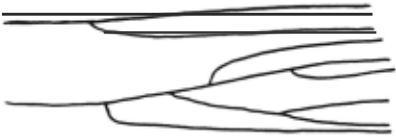
One of the more influential temporal logics in AI, due to McDermott, is indeed based on a future-branching structure [McDermott, 1982]. Time lines (or, as they are called there, chronicle&) may diverge into the future. Once they do split, two chronicles never meet again. This induces a forest-like structure of the form shown in Figure 1.
However, McDermott's motivation for adopting future branching is different from ours. For him the branching represents true indeterminacy in the world, having noth ing to do with actions of agents; Actions of agents are associated with intervals within a time line, and not with the branching aspect of the structure. As I have already said, the resulting definition of action does not capture our intuition, and makes the concept unnecessary from the technical point of view.
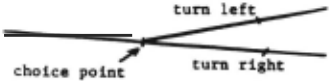
We get closer to our goal if we retain the branch ing structure, but associate actions with the branching points. Specifically, we may assume that at every point in the structure, each agent may may select certain sub sets among the set of all futures.
For example, consider the simple structure in Figure 2. The two future branches differ on whether the robot turned left or right at the branching point. We can view the robot as having control over his movements, and thus being able to select among these possibilities. The action of "turning left" is defined to be a selection of the branch in which the robot indeed turned left. Notice, however, that the different branches are "synchronized" - they do not describe time differently, only what is true and false in it. I will therefore make the distinction between date1, which are common to all paths, and point1 or 1ituation1, which make up the different paths.
Here we described the selection as resulting in a single branch, but in general it may result in some subset of the available futures. Thus there exist actions that can only be carried out jointly by several agents. Consider, for example, the action of playing tennis. Each of the two agents can restrict the set of futures to those in which he runs around and hits tennis balls, if any balls come his way. It is only the intersection of those two subsets of futures that yields a tennis game.
This view of action does not prohibit backward branching. Indeed, in many cases it is useful to allow different courses of events to lead to identical situations. I will therefore allow this possibility. I will not, how ever, allow paths that diverge into the future to meet later on (although for some applications even this would be a sensible thing to allow). The resulting topology is illustrated in Figure 3.
It remains to be explained what the difference is be tween the future branching and past branching. At first it might seem that an agent can only reduce the fu ture branching. However, in a certain sense, he can also reduce the backward branching. This is exactly what an experiment is about: before the experiment there are several possible pasts, for example one in which the tested substance is (and has been) an acid and another in which it is a base, and after the experiment only one past remains. Of course, the action did not change the At first glance, this view of action might appear trou blesome. After all, if every action is taken in a particular time line, the future is already determined, and the ac tion cannot really influence it. However, a small shift in perspective takes care of this worry. It relies on the observation that when all is said and done, there will in deed have been a single time line. The actions of agents "reveal" to us the time line we will have been in. What in our view is the "free will" of agents, is simply our belief that there could be no one able to predict the time line in advance. A small step for the philosopher, no doubt, but a giant leap for the notational engineer: we are now able to represent both action taking and knowledge in the same framework.
4 Formal treatment
The previous section can be viewed as documentation for the formal construction in this section. The fol lowing definitions will explain the distinction between action and mere augmentation of knowledge, the time asymmetry of action, and the different viewpoints of ob servers.
Definition 1 Time is a pair (T, <), where T is a set of time points, and < i4 a total order on T which is unbounded in both directions.
For our purposes other properties of time, such as density or discreteness, are not important. In the following we assume Time, T and <. We also assume a propositional language of discourse .C. with primitive propositions it) (the discussion extends trivially to the first order case).
Definition 2 A time-line structure S (overT,<, L, M and i!)j i4 a pair (L,M) where
L is a set of time lines, and
M is a meaning functio'lt M : L x T -+ 2+.
We represent the fact that p E M(l, t) by M, l F TRU E(t, p), that p E M(l, t) and p' E M(l, t') by M, l F TRU E(t, p) 1\ T RU E(t', p'), and so on. If M, l' F cp for all l' then we say that cp is known in M, and denote it by M F Kcp.
As has been discussed, a time-line structure defines the observer's knowledge of the world in a given situation. Next we define the evolution of this knowledge.
Definition 3 A time structure S = (L, M) i4 no more ignorant than another time structure S' = (L', M') if L C L', and M is th.e restriction of M' to L. If L C L' we-say that S i4 less ignorant that S'.
In the following, let TS be the set of time structures.
Definition 4 An evolving time-line structure (ETS) (over T, <, L, M, it) and TS) i4 a pair (10 , F) where l0 E L is the "real time line", and F is a function F : T-+ TS, such that a. if (L, M) E F(t) then lo E L, and b. if t < t', then F(t') u no more ignorant than F(t) .
An ETS describes the evolution of the observer's knowl edge about the real world.
It will be useful to define two operations on ETS's.
Definition 5 Let A and B be two ETS's as above that differ only on the F function. Let the two functions be FA and Fn. The intersection of A and B is a structure C = (lo, Fe), where Fe : T-+ TS is such that Fe(t) = FA(t) n Fn(t) . The union of A and B is a structure C = (l0 , Fe), where Fe : T -+ TS is such that Fe(t) = FA(t) u Fn(t).
The reader may verify the following:
Proposition 1 The intersection of two ETS's is a third ETS, which is no more ignorant of either of the first two . The union of two ETS 's is a third ETS, of which the first two are no more ignorant.
Actions of agents may add to an observer's knowledge of the real world. This is defined as follows.
Definition 6 An action system {overT,<, L, M, it) and TS} i4 a tuple (l0 ,CA,AA), where
C A is a capability function C F = A1 , . .. , A.., where each Ai defines the actions that are available to an agent i under different conditions. Specifically, it is a collection of pairs (cp1, 'P2), where 'Pi E it). {If ( <p1 , 'P2) E Ai then we say that "Agent i can do <p1 under condition <p2 . ") We require that that (true, true) E Ai for all i (the null action) .
AA u a list a 1 , .. . , a,. of actual actions taken by the agents. Specifically, ~ is a function ~ : T -+ Ai . We require that if ai(t) = (<p11 'P2), then M, lo F TRUE(t,<p1 ) and M,lo F TRUE(t,<p2).
In this definition we assumed that actions depend on what is true, but not on the agent's knowledge. It is possible to capture that too, but since the essence of our proposal does not hinge on that, we ignore the issue here for the sake of understandability.
The last definition relates action to knowledge:
Definition 7 Let AS be an action structure as above. The induced structure of AS i4 the pair (10 , F), where F: T-+ TS i4 such if F(t) = (L',M'), then for alll, l ft. L' iff there ezut i, t', <p, cp' such that a. t' < t, b. M, l F TRU E(t', cp), and c. ~(t') = (--.'P, cp').
It is not hard to verify the following:
Proposition 2 An induced structure of an action struc ture i4 an ETS.
From Propositions 1 and 2 we get trivially:
Corollary 3 The intersection of an ETS with the struc ture induced by an action structure is an ETS, no more ignorant than either.
We can thus view the observer's evolution of knowledge about the world as defined by his a priori knowledge, some ETS, combined with the knowledge about the ac tions of agents, knowledge which is gained at the time of action.
5 From single observer to multiple observers
The discussion so far accounts nicely for the choice making aspect of action. However, our definitions ex tend naturally to representing different perspectives of observers with varying detail of knowledge.
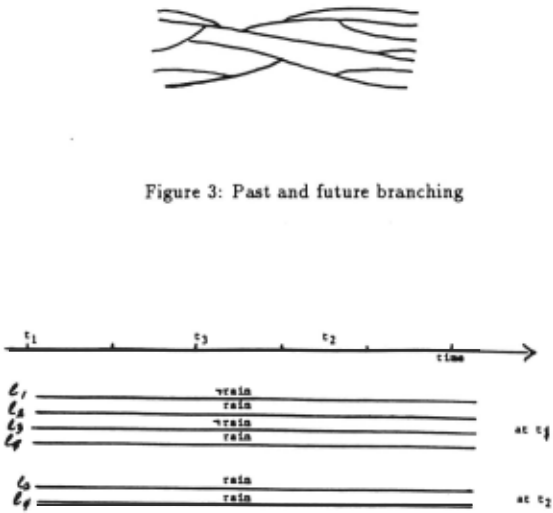
past, only our knowledge of it. To pursue this issue fur ther, we now turn to the notion of knowledge and its conection to time.
3.2 Knowledge and time
Following the now-standard approach, we will equate knowledge with truth in all possible worlds. For us, how ever, possible worlds have specific forms: they are each an independent time line. At each point in time, an agent considers some set of time lines possible: the greater his knowledge , the less time lines are possible. This is the standard 55 possible worlds account of knowledge (see, e.g., Halpern and Moses' survey in [Halpern and Moses, 1985]). In our particular case, at each time point an agent considers not only what the possible presents are, but also the possible pasts and futures.
An example is given in Figure 4, where an agent's state of knowledge at two different times, t 1 < t2, is represented. At t 1 he does not know whether it will rain at time t3, where h < t3 < t2, since from each world there exist some accessible worlds in which it rains and some in which it does not . At time t2, presumably having the benefit of hindsight, he knows that it in fact rained at t 3 .
In general, the set of possible time lines may change wildly over time, allowing arbitrary learning and forget ting. In pratice we will impose a strong restriction on how the set changes, and assume that no forgetting oc curs: What an agent knows at one time, he knows later

on too. This means, for example, that if the robot knows at 5 that at that time his batteries are full, he know also at 8 that at 5 his batteries were full; it does not imply that he knows at 8 that at that time (8) his batteries are full. 2 3
3.3 Integrating knowledge and choice-making
We now have two mechanisms, a branching structure for choice making, and parallel time lines for knowledge. We note, however, that they are very similar, each describing alternative courses of events. In particular, we note that in the branching structure, every set of branches that meet at a point can be expanded into a set of parallel time lines. In principle, if we have n incoming pasts and m outgoing futures, we simply generate n x m parallel time lines. Figure 5 decribes a simple case in which n = m= 2.
We now have a uniform structure, a set of parallel time lines. The observer, who might be in any of these time lines, at every point considers some set of time lines possible. We assume that this set includes the actual time line of the observer, and, as before, that as time progresses the set of time lines considered by the observer can only shrink, never expand. Some of this shrinking is "natural" acquisition of knowledge, such as the exclusion at time t of all time lines in which there is no house near the robot at time t, when at that time the observer happens to see a house near the robot. Other change in knowledge is more deliberate, and reflects the ability of agents to prune certain time lines at will. For example, in the view of some observer, the robot may "decide" to prune all time lines in which at time t the robot did not turn left.
2 The treatment here depends on agents having some form of memory. Our requirement of perfect memory, however, may be unnecessarily strong.
3 This construction. borrows from a more detailed and gen eral construction in [Lin et al., 1987], where we do not nec essarily assume no forgetting, and where we consider belief rather than knowledge. There we provide a logic to accom pany this semantic construction, along with a complete axiom system. The basis is a standard interval logic, with atomic propositions such as TRUE(t1 , t2 ,p) We then use n modal operators indexed by time, so that K!TRUE( t1 , t2 ,p) states that agent i knows (knew, will know) at timet that the propo sition pis (was, will be) true at the interval (tt, t2 ). Since these syntactic considerations are not the focus of this article, I will not pursue the issue further here.
| sonar | turn left | ||
|---|---|---|---|
| sonar | turn left | ·uqnar | tU!] left |
| .,sonar | ·uurn left | sonar | .,turn left |
| .,sonar | ,turn left | ||
| + "the robot | vill decide" | ||
| LOLEV | HII.E"Y |
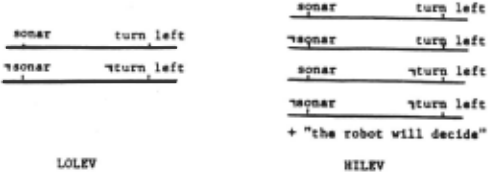
Figure 6: The LoLev and HiLev views of the robot's behavior
We start with intuition. Consider two observers, LoLev and Hi Lev, 4 such that LoLev is more knowledge able than HiLev. Specifically, assume that at every point at which LoLev considers some set of time lines L, HiLev considers a larger set of possible time lines L' :::> L, and in addition postulates a possible action of an agent (or a set of such) which eliminates from L' those futures in L'-L. If nothing is added to the calculus, LoLev clearly has greater predictive power, since he can predict ahead of time the set L. Hi Lev can only predict the set L', and say that the fate of the futures in L' - L depends on the action of the agent. Figure 6 describes HiLev and LoLev view of the behavior of the same robot.
It is wrong, however, to view HiLev as necessarily in ferior to LoLev:
- Sometimes actions are indeed a poor man's physics, as can be seen in the above r.obot example, or the Piagetian example from Section 2.
- On the other hand, it is often advantageous to delib erately lose some information and reason in terms of action, since the complete information is too rich to contend with. If for example the robot's turning left is the result of 232 factors rather than two, treating it as an action might be the only computationally viable option. We do not even necessarily lose pre dictive power that way.
- One reason that we may not lose knowledge is be cause we ourselves are the agents. If we are the ones "making the decisions," we can always compensate for indeterminacy in our a priori knowledge by de ciding.
- Even when others are the ones "making the deci sions," we are not left clueless as to their future ac tions. We can often predict their "decisions" quite reliably, and for that purpose have invented a whole slew of related terms, such as "knowledge," "be lief," "goals," "plans," "rationality," and other in tensional terms. For example, we might predict that
*The terms 'LoLev' and 'HiLev' were already used in the Stanford/SRI / Rockwell ICA project for the same general purpose, though not in the specific sense used here.
a "~;ational" robot will "choose" to turn left when he "believes" that an object is about to collide with it from the right. Indeed, there is considerable re search on the calculus of intensional terms such as belief, knowledge, goals, intentions, desires, and ra tionality (see, e.g., [Cohen and Levesque , 1987]), al though much more remains to be done.
Thus, important information resides at different lev els of abstraction, and it is useful to be able to tap on all of it. For example, it is useful to integrate our knowledge of rational behavior with our understanding of the robot 's sonar system. This view is compatible with the !ituated automata approach, in which internal states of the robot are correlated with external condi tions, and intensional terms such as knowledge describe this correlation.[Rosenschein and Kaelbling, 1986]
As was said, it is very easy to extend the treatment to accommodate multiple perspectives in our framework. Again, the formal details will appear in the full version of the paper (and some are given in the Appendix). The highlight of is the definition of an ETS-system as a col lection of ETS's, and noting that those form a natural lattice with the ETS intersection and union operations.
6 Formal treatment (cont.)
It is very easy to extend the formal treatment to accom modate multiple perspectives in our framework. In fact , we already have a special case of multiple perspectives: the ETS of the observer, and the induced structure of his postulated action structure. As we saw, the two in tersected to yield a new ETS. We now simply generalize the picture.
Definition 8 An ETS system (overT,<, L, M, ~ and TS} u a pair (10 , F} , where l0 E L, and F = F1, . .. , F,. i! a !et of fv.nction& !uch that (lo, Fi} are all ETS '., {over T, <,L,M,~ andTS).
The following is immediate from the earlier propositions: Corollary 4 An ETS -'11-'tem define! a lattice, with the nodu being the ETS'.,, and the join and meet operation! being inter!ection and union of ETS'-'·
7 Summary and Discussion
I started by pointing out that taking actions as primi tive and ignoring time is problematic, and that taking time as primitive and ignoring action is problematic in a complementary way. I then developed an approach to reta.i.D.ing the best of both worlds. I first identified two notions that seem closely related to action: choice making, and relativity to observer.
(Continued a! an appendiz to the article "Belief a! Defea!ible Knowledge" in the!e proceedings.)
@inproceedings{ijcai1989p153,
  title     = {Time for Action: On the Relation Between Time, Knowledge and Action},
  author    = {Shoham, Yoav},
  booktitle = {Proceedings of the Eleventh International Joint Conference on
               Artificial Intelligence, {IJCAI-89}},
  publisher = {International Joint Conferences on Artificial Intelligence},
  editor    = {N. S. Sridharan},
  pages     = {954--958},
  year      = {1989},
  month     = {8},
  note      = {Planning, Scheduling, Reasoning About Actions},
  url       = {https://ijcai.org/proceedings/1989/153},
}
TY - CPAPER TI - Time for Action: On the Relation Between Time, Knowledge and Action AU - Shoham, Yoav T2 - Proceedings of the Eleventh International Joint Conference on Artificial Intelligence, IJCAI-89 PB - International Joint Conferences on Artificial Intelligence PY - 1989 SP - 954 EP - 958 UR - https://ijcai.org/proceedings/1989/153 ER -Copied
Machine-readable versions of this paper, for tools and AI agents:





