
Chemical Analogies: Two Kinds of Explanation
Proceedings of the Eleventh International Joint Conference on Artificial Intelligence. Machine Learning. Pages 819-823.
© 1989 International Joint Conferences on Artificial Intelligence
Abstract
Analogies are often used to help provide explanations of unfamiliar phenomena by comparing them to familiar phenomena. Analogical explanations are of two kinds: ones that provide systematic clarification, and ones that give a causal account of why something happened. We describe a theory and implementation of analogical mapping that applies to both kinds of explanation. The theory says that the elements of one analog are mapped onto the elements of another on the basis of structural, semantic, and pragmatic constraints. Our program ACME (Analogical Constraint Mapping Engine) uses localist networks of units representing mapping hypotheses to determine the correspondences between analogs. This paper describes ACME's application to eight analogies that have been used by chemistry teachers.
- Anderson, J., and Thompson, R. [1989] Use of analogy in a production system architecture. In S. Vosniadou and A. Ortony (Eds.), Similarity and analogical reason- ing. Cambridge: Cambridge University Press.
- Burstein, M. [1986] Concept formation by incremental ana- logical reasoning and debugging. In R. Michalski, J. Carbonell, and T. Mitchell, eds., Machine Learning: An Artificial Intelligence Approach, vol. 2. Los Altos: Morgan Kaufman. 351-369.
- Carbonell, J. [1983] Learning by analogy: Formulating and generalizing plans from past experience. In R. Michalski, J. Carbonell, and T. Mitchell. (Eds.), Machine learning: An artificial intelligence approach. Palo Alto: Tioga. 137-161.
- Carbonell, J. [1986] Derivational analogy: A theory of reconstructive problem solving and expertise acquisi- tion. In R. Michalski, J. Carbonell, and T. Mitchell, (Eds.), Machine learning: An artificial intelligence approach, vol. 2. Los Altos: Morgan Kaufman. 371-392.
- Falkenhainer, B., Forbus, K., and Gentner, D. [1986] The structure-mapping engine. Proceedings of the Fifth National Conference on Artificial Intelligence, vol. 1. Los Altos: Morgan Kaufmann. 272-277.
- Falkenhainer, B., Forbus, K., and Gentner, D. [in press] The structure-mapping engine: Algorithm and examples. Artificial Intelligence.
- Gentner, D. [1983] Structure-mapping: A theoretical framework for analogy. Cognitive Science, 7, 155- 170.
- Gentner, D. [1989] The mechanisms of analogical learning. In S. Vosniadou and A. Ortony (Eds.), Similarity and analogical reasoning. Cambridge: Cambridge University Press.
- Grossberg, S. [1978]
- A theory of visual coding, memory, and development. In E. Leeuwenberg and J. Buffart (Eds.), Formal theories of visual perception. New York: Wiley.
- Hall, R. [in press] Computational approaches to analogical reasoning: A comparative analysis. Artificial Intelli- gence.
- Hammond, K. [1986] The use of remindings in planning. Proceedings of the Eighth Annual Conference of the Cognitive Science Society. Hillsdale, N.T: Erlbaum. 442-451.
- Hofstadter, D. R. [1984] The Copycat project: An experi- ment in nondeterminism and creative analogies. A. I. Memo 755. Cambridge, MA: MIT Artificial Intelli- gence Laboratory.
- Holyoak, K. J., and Thagard, P. [1989] A computational model of analogical problem solving. In S. Vosnia- dou and A. Ortony (Eds.), Similarity and analogical reasoning. Cambridge: Cambridge University Press. IJCAI
- Holyoak, K. J. and Thagard, P. [in press] Analogical map- ping by constraint satisfaction. Cognitive Science.
- Kjonaas, R. [1984] An analogy for solubility: Marbles and magnets. Journal of Chemical Education 6I, 765.
- Kolodner, J., and Simpson, R. [1988] The MEDIATOR. A case study of a case-based problem solver. Unpub- lished manuscript, Georgia Institute of Technology.
- Macomber, R. [1984] An analogy for the leveling effect. Journal of Chemical Education 61, 128.
- Richardson, W. [1982] Reactions between chiral molecules: A handy analogy. Journal of Chemical Education 59,649.
- Rocha-Filho, R. [1986] Election results and reactions yields. Journal of Chemical Education 64,248.
- Rumelhart, D. E., McClelland, J. R., and the PDP Research Group. [1986] Parallel distribution processing: Explorations in the microstructure of cognition, 2 volumes. Cambridge, MA: MIT Press
- Schank, R. C. [1982] Dynamic memory. Cambridge: Cam- bridge University Press.
- Starkey, R. [1986] Common chromatography misconcep- tion. Journal of Chemical Education 63,514.
- Thagard, P. [1988] Dimensions of analogy. In D. Helman (Ed.), Analogical reasoning. Dordrecht: Kluwer. 105-124.
- Thagard, P. [in press] Explanatory coherence. Behavioral and Brain Sciences.
- Thagard, P., Holyoak, K. J., Nelson, G., Gochfeld, D. [1989] Analog retrieval by constraint satisfaction. Unpublished manuscript. Cognitive Science Labora- tory, Princeton University.
- Tsaperlis, G. [1984] The chemical bond as an atomic tug of war. Journal of Chemical Education 61,677.
- White, A. [1981a] Be a millionaire -get with the action. Journal of Chemical Education 58, 645.
- White, A. [1981b] Entropy rules in my class too! Journal of Chemical Education 58, 645.
- Winston, P. H. [1980] Learning and reasoning by analogy. Communications of the ACM, 23, 689-703.
- Winston, P. H. [1982] Learning new principles from pre- cedents and exercises. Artificial Intelligence, 19, 321-350.
References were extracted automatically from the PDF and may contain errors.
Full text extracted automatically from the PDF; figures, tables and equations may differ. The PDF is the version of record.
1 Analogy and Explanation
Analogies have numerous functions. In problem solving and decision making, analogies to past cases can be used to suggest solutions to new problems [Holyoak & Tha gard 1989, Hammond 1986, Kolodner and Simpson 1988, Carbonell 1983, 1986.]. Analogical arguments are some times used to reach conclusions, as in the philosophical argument for other minds: since I have a mind, and you are similar to me in numerous respects, I infer that you have a mind also [Thagard 1988]. Analogies have various literary uses, serving to evoke emotions ("Love is a rose"). Finally, analogies can be very valuable in teaching, when an unfami liar phenomenon is explained in terms of something fami liar. For example, we can explain heat flow in terms of water flow, the structure of the atom in terms of the struc ture of the solar system [Gentner 1983], or variables in a programming language in terms of boxes that contain objects [Burstein 1986].
The research reported in this paper was supported by Contract MDA903-86-K-0297 from the Basic Research Office of the U.S. Army Research Institute for Behavioral and Social Sciences.
Keith J. Holyoak Psychology Department UCLA
Analogical explanations are of two different kinds, corresponding to two senses of "explain" distinguished by dictionaries:
- To make plain or clear.
- To give the reason for or cause of.
We shall call the first kind of explanation clarifying, and the second kind why-answering. Consider how one might explain the British parliamentary system to an American ignorant of it. The best strategy, at least initially, would be to point out correspondences between the American system and the British:
President - Prime Minister
Congress - Parliament
House of Representatives - House of Commons
Senate - House of Lords
There are problems with this analogy, for example that the Prime Minister is a member of parliament while the President is not a member of congress, but the analogy would give the American a start at understanding the British system. In this case, the analogy serves to make plain the nature of parliament by displaying its systematic correspon dences with something that is (for the American) more fam iliar. A different kind of explanation would be prompted by questions such as "Why was Margaret Thatcher elected Prime Minister in the last British election?" Such why questions are a request for causal explanations: the ques tioner wants to know what events or situation produced her victory. Sometimes explanations that answer such questions are analogical: Thatcher's victory was like Bush's victory in the 1988 U.S. election, in that the economy was strong and the opposition was not very formidable. The point of this analogy is to suggest how similar phenomena have similar causes.
Both clarifying and why-answering analogical expla nations can be found in an interesting section of the Journal of Chemical Education called "Applications and Analo gies". This feature consists of letters from chemistry teach ers at both high school and college levels who describe analogies that they have found useful in teaching chemistry to their students. For example, one analogy compared flow of energy through molecular motion in a gas to flow of wealth in a population. To learn using the analogies that their teachers give to them, students have to be able to bring the familiar everyday events offered as source analogs into correspondence with the target chemical phenomena. Of thirty-five chemical analogies we have examined, 17 are clarifying analogies and 18 are why-answering.
A crucial stage in learning by analogy is mapping one analog onto another. In order to use a source analog to learn about a target analog, people and machines need to be able to determine what elements in the target correspond to what elements in the source. Holyoak and Thagard [in press] proposed a constraint satisfaction theory of analogi cal mapping that was applied to numerous examples and used to model the results of several psychological experi ments. ACME has now been applied successfully to eight additional analogies selected (as being particularly interest ing) from the Journal of Chemical Education. Several of these analogies are primarily intended to provide the clarify ing kind of explanation, while others have as their primary function explaining why something occurs.
2 A Constraint Satisfaction Theory
Holyoak and Thagard [in press] identified three major kinds of constraints that govern how parts of two analogs can be placed in correspondence with each other: semantic similarity, structural consistency, and pragmatic centrality. These constraints are not absolute requirements on success ful mappings, but rather are pressures that operate to some degree [Hofstadter 1984].
2.1 Structural Consistency
If we represent analogues as sets of interrelated pro positions [Gentner 1983], then structural consistency requires that if a proposition P in the target is in correspon dence with a proposition P* in the source, then the predicate and argument(s) of P must each correspond to the respective predicate and argument(s) of P*. If two propositions are mapped, then their constituent predicates and arguments should also map. Two analogues constitute an isomorphism if the mapping between them is structurally consistent and one-to-one. Sensitivity to structural consistency has been a crucial component in virtually all AI models of analogical mapping [e.g., Carbonell 1983; Falkenhainer, Forbus, & Gentner 1986, in press; Kolodner & Simpson 1988; Thagard & Holyoak 1988; Winston 1980]. Gentner's [1983] "sys tematicity principle" can be interpreted as a special case of structural consistency, in which correspondences between higher-order predicates (those such as "cause", which take propositions as arguments) enforce correspondences involv ing lower-order relations and their arguments.
2.2 Semantic Similarity
More controversially, Holyoak and Thagard [in press] claimed that mappings should also favor correspondences between elements that are semantically similar. For exam ple, dog should tend to map to cat more than it does to house, since cat and dog are both a kind of animal and a kind of pet. Sophisticated judgments of the semantic simi larity of two analogs cannot rely merely on finding identical matches of predicates, but rather require a richer semantics to identify similar concepts. The semantic similarity of con cepts in two analogs appears to depend on numerous seman tic relations, including:
- being represented by the same predicate; and
- being connected by semantic relations such as synonymy or kind and part-whole relations.
2.3 Pragmatic Centrality
The constraint of pragmatic centrality favors map pings that help to accomplish the purposes of the analogy. In why-answering explanations, for example, the purpose is generally to give a causal explanation that answers a ques tion or set of questions, so the elements of the propositions to be explained will be particularly important. Hence a mapping should tend to produce correspondences involving the important elements. Numerous AI theorists have argued that causal relevance to goal accomplishment should influence retrieval [Winston 1980, 1982; Schank 1982; Car bonell 1983, 1986; Hammond 1986; Kolodner & Simpson 1988]. We maintain that causal relevance should be con sidered in mapping between analogs as well as in the pro cess of retrieval. Mapping thus involves the simultaneous satisfaction of structural, semantic, and pragmatic con straints.
3 ACME
3.1 Creating a Network of Mapping Hypotheses
The input to ACME (Analogical Constraint Mapping Engine) consists of predicate-calculus representations of the source and target analogs, plus optional information about semantic similarity and pragmatic importance. We assume that a mapping may be computed either from a target analog to a source or vice versa. When given two structures as input, ACME automatically generates a network in accord with the constraints postulated by the theory. The first step in building a mapping network is to construct mapping units corresponding to each possible hypothesis about pairings between elements. To limit the number of units formed, correspondences are only allowed between elements of the same basic type: propositions to propositions, n-place predi cates to n-place predicates, and objects to objects. ACME constructs units to represent all possible pairings of ele ments of the same type.
As the units are established, links are formed between them to implement the constraint of structural consistency. All links are symmetrical, with the same weight regardless of direction. All excitatory links have a default excitation weight given by parameter e. For predicates that take more than one argument, the argument mappings support each other. Links are also created between predicate-mapping units and their corresponding argument-mapping units. Each potential correspondence between propositions thus generates an interconnected subnetwork of mutually con sistent correspondences between elements of the proposi tions. After all the units have been formed, inhibitory links with weights equal to a parameter i are formed to connect all units that represent alternative mappings for the same element.
In addition to the units representing mapping hypotheses, the network includes two special units. The semantic unit is used to convey information about the system's prior assessment of the degree of semantic similar ity between each pair of meaningful concepts in the target and source, and the pragmatic unit similarly is used to con vey information about the pragmatic importance of possible correspondences. The semantic-similarity constraint is enforced by placing excitatory links from the semantic unit to all units representing mappings between predicates. The weights on these links are made proportional to the degree of semantic similarity between the mapped concepts. Simi larly, the pragmatic-centrality constraint is represented by weights on links connecting the pragmatic unit to relevant mapping units. Section 4.2 and Figure 1 below provide an example, and a full statement of the algorithms used can be found in Holyoak and Thagard [in press].
3.2 Running the Network
The manner in which the network is run to arrive at a solution is a straightforward application of constraint satisfaction methods that have been investigated extensively in other applications [see Rumelhart and McClelland 1986]. To initialize the network, the activation levels of the seman tic and pragmatic units are fixed at 1 and the activations of all other units are set to 0. On each cycle of activity, all units (except the semantic and pragmatic units) have their activation levels updated on the basis of the activation levels and weights associated with neighboring units and links. The updating procedure is based on that suggested by Grossberg [1978]. The activation level of unit j on cycle t+ 1 is given by:
Here d is a decay parameter, enet. is the net excitatory input, and inet. is the net inhibir'ory input (a negative number), with fuinimum activation min=-1 and maximum activation max= 1. Inputs are determined by the equations:
In equations 2 and 3, o/t) is the output on cycle t of unit i, set by:
Updating continues until all units have reached asymptote, that is, a cycle is reached at which the activation change of each unit is less than a specified value, typically .001.
3.3 Comparison With Other Models of Analogy
As we noted earlier, many previous simulation models of analogical mapping have been proposed [see Hall, in press; Thagard, 1988]. Other models have included structural, semantic, and pragmatic constraints on mapping, but no single model has integrated these constraints as ACME does. The most closely related previous simulation is the SME program, which was developed as an implemen tation of Gentner's structure-mapping theory [Falkenhainer et al., 1986; Gentner, 1983, 1989]. 1 ACME and SME have several important similarities. Both models derive a global ''best'' mapping from a set of constituent hypotheses about element correspondences (the mapping units of ACME and the "match hypotheses" of SME). Both programs operate on predicate-calculus representations of analogs, and both emphasize the role of proposition mappings in enforcing mappings between corresponding elements of the proposi tions.
ACME follows SME in using constraints of structural consistency and one-to-one mapping, but there are notable differences. Whereas SME insists on mappings that are one-to-one, ACME operates with pressures that prefer but need not necessarily produce such mappings. ACME treats isomorphism as a separate constraint from semantic similar ity: Whereas SME requires multi-place relations to be identical in order to be mapped, ACME allows mappings between relations with no similarity beyond having the same number of arguments. More generally, ACME includes semantic and pragmatic constraints on the mapping component, as well as purely structural constraints. ACME prefers mappings between elements that are semantically similar, whereas SME excludes such information as relevant only to stages of analogy outside mapping. To implement the constraint of pragmatic centrality, ACME allows prefer ences for "presumed" mappings and for mappings involving "important" elements.
Mapping is at least implicitly part of every analogy program, but space restrictions prevent us from comparing ACME with models that have been proposed by, for exam ple, Winston [1980, 1982], Hofstadter [1984], Anderson and Thompson [1989], Kolodner and Simpson [1988], Ham mond [1986], Carbonell [1982, 1983], and Burstein [1986]. For analogies restricted to a single domain in which the same predicates and arguments tum up in both structures to be mapped, mapping becomes a simple special case of the more complex processes used by ACME and SME for cross-domain analogies.
4 Application of ACME to Chemical Analogies
4.1 Eight Analogies
ACME has been successfully applied to a total of eight analogies from the Journal of Chemical Education. A
1 SME runs in several different modes. Our com parison here is with SME running in the mode that im plements Gentner's structure-mapping theory.
few of these were quite simple, whereas others involved numerous propositions and complicated mappings. Here is a list of the analogies with a brief description of each. The first 5 are why-answering analogies, whereas the last 3 are clarifying.
(1) Leveling effect of solvents and opening jars [Macomber 1984]. Students have difficulty understanding how the basicity of a solvent can affect the apparent acidity of a compound. This analogy compares strongly and weakly basic solvents to a father and son who differ in their abilities to open stuck jars: the father can open some jars that are too tightly stuck for the son to open, just as a strongly basic solvent can dissociate weaker acids (that have protons bound tightly) than can a weakly basic solvent.
(2) Chemical bonds and tug of war [Tsaperlis 1984]. This is intended to help students understand how atoms are held together. Atoms with bonds between them are com pared to two people playing tug of war with a rope. The atoms are bonded together because they compete for elec trons, just as the people are held together because they com pete for the rope.
(3) Gas chromatography and store escalators [Star key 1986]. Students have the misconception that the separation of a mixture of compounds in a gas chromatogra phy column involves different lengths of time that each compound spends in the mobile (gas) phase, whereas the difference really comes in the stationary (liquid) phase. The gas column is compared to a store with escalators, where shoppers enter at the first floor and make their way up eight floors to the top. The different length of time it takes them to get to the top does not depend on the amount of time they spend in transit on the escalators, but only on how much time they spend shopping on the floors.
(4) Distribution of molecular velocities and distribu tion of wealth [White 1981a]. This analogy compares the distribution of molecular velocities to the distribution of money. Just as a series of financial gains can lead a mil lionaire to have an action-filled life, so a series of collisions can cause a molecule to gain enough energy to react.
(5) Soluble vs. insoluble mixtures and marble/magnet mixtures [Kjonaas 1984]. Mixing polar molecules such as water and non-polar molecules such as oil produces an inso luble mixture, just as putting marbles and magnets together fails to produce a homogeneous mixture because the mag nets stick together.
(6) Chiral molecules and people's hands [Richard son 1982]. How chiral molecules react to one another is compared to how people are more easily able to shake the right hands of other people with their right hands than with their left hands. There is no attempt here to explain why molecules have these relationships, only to point out sys tematic correspondences with human hands.
(7) Entropy as degree of disorder and classroom attire [White 1981b]. In order to convey an understanding of entropy, this analogy considers a classroom in which every member owns a pair of blue jeans and a white shirt or blouse, as well as other clothes. It is highly improbable that the class will end up in a uniform state with all of them wearing the same color jeans and shirt on a given day. No explanation is given of why order and disorder arise in chemical phenomena.
(8) Reactions yields and voter turnout [Rocha-Filho 1986]. Just as in an election only some of the members of the electorate actually vote, so in a chemical reaction the actual yield is often less than the theoretical yield. No explanation is given of why the theoretical yield is less; the point of the analogy is merely to clarify the discrepancy in reactions by relating it to the more familiar discrepancy in elections.
In order to apply ACME to them, each of these analo gies was formalized in predicate calculus. The resulting representations were then used by ACME to generate con straint networks. Table 1 gives information about the results of running each analogy. It displays for each anal ogy the total number of propositions used to represent each pair of analogs, the number of units created by the network, the number of links set up, the number of cycles of updating it took before ACME came up with the correct mapping
| Table 1: Chemical Analogies | |||||||
|---|---|---|---|---|---|---|---|
| analogy | propositions | units | links | cycles to settle | cycles to success | excitation ceiling | inhibition floor |
| (1) Solvents/jars | 36 | 274 | 3119 | 50 | 8 | .07 | -.08 |
| (2) Bonds/tug of war | 26 | 126 | 964 | 43 | 5 | .1 | -.09 |
| (3) Gas/escalators | 16 | 88 | 551 | 47 | 5 | .16 | -.05 |
| (4) Molecules/wealth | 30 | 207 | 1778 | 47 | 5 | .09 | -.05 |
| (5) Soluble/magnet | 24 | 137 | 1127 | 77 | 14 | .18 | -.06 |
| (6) Molecules/hands | 24 | 176 | 1903 | 45 | 9 | .1 | -.12 |
| (7) Entropy/attire | 16 | 18 | 50 | 63 | 4 | .5 | -.03 |
| (8) Reaction/election | 6 | 15 | 35 | 64 | 3 | .4 | -.01 |
(when the unit representing the correct mapping for each predicate had higher activation than competing units), the number of cycles it took the network to settle (when every unit had reached asymptote), and two sensitivity measures explained in section 4.3.
4.2 A Sample Network
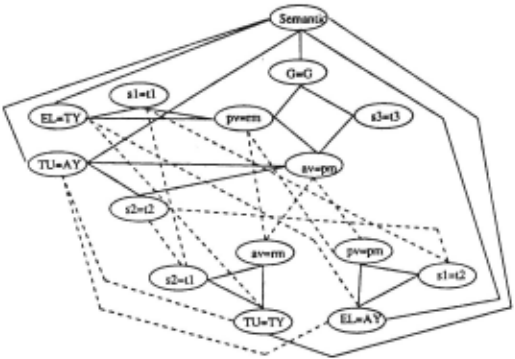
Most of the networks produced in these examples are too complex to show in a one-page figure, but Figure 1 shows the network produced for analogy (8) which was by far the simplest, requiring only 15 units and 35 links. The input for this analogy consisted of only 3 propositions per structure:
Election
(electorate (number-possible-voters) s1)
(turnout (number-actual-voters) s2)
(greater (number -possible-voters num her -actual-voters) s3)
Reaction
(theoretical-yield (number-reactant-molecules) t1)
(actual-yield (number-product-molecules) t2 )
(greater (number-reactant-molecules number-productmolecules) t3)
In this case, but not in all the others, the structures are iso morphic. The last element in the list is the name of the pro position. For conciseness, Figure 1 uses the abbreviations EL, TU, G, TY, and AY for the predicates above, and pv, av, rm, and pm for the objects. For example, EL=TY is the unit that represents the hypothesis that electorate corresponds to theoretical-yield. Excitatory links are shown by solid lines, while inhibitory links are shown by dotted lines.
4.3 Sensitivity Analyses
All of the simulations reported here have used the same parameter values: .05 for excitation. -.2 for inhibition, and .1 for decay. In general, lowering excitation and mak ing inhibition closer to 0 tends to prolong settling time. Increasing decay tends to flatten the activation curves, both positive and negative, keeping them closer to 0. Varying excitation and inhibition systematically reveals that there is a critical value for each. Table 2 lists excitation ceilings and inhibition floors for the four major examples. The exci tation ceilings are the maximum values that excitation can have without the networks requiring more than 100 cycles to settle; inhibition here is constant at the default value of -.2. The inhibition floors are the minimum values that inhi bition must have to de-activate units representing inferior hypotheses; excitation here is constant at the default value of .05. The excitation ceiling and the inhibition floor indi cate the most important respects in which quantitative parameter changes in ACME have qualitative effects.
Analogical mapping is highly sensitive to representa tional matters, but ACME's success on the chemical analo gies does not depend on our particular encodings. To test the representational sensitivity of our inputs, we amal gamated the solvents/jars analogy with the bonds/tug of war analogy and mapped a combined solvents + bonds structure with a combined jars + tug of war structure. The resulting network had 700 units and 11,788 links, but settled in 52 cycles, only slightly more slowly than the networks used in the original analogies. ACME found the same mappings for the solvents and bonds predicates that it did in the original runs, showing that the additional representations did not impede its ability to find correct mappings. 2
5 Conclusion
In sum, the 8 chemical analogies have provided interesting additional applications of the constraint satisfac tion theory of analogical mapping. There are more than twenty analogies in the Journal of Chemical Education that we have not yet attempted to model. It will be interesting to see if they highlight additional extensions needed to our theory and program. The most important future work planned for ACME is to integrate it with ARCS, a program for modeling the retrieval of analogs [Thagard, Holyoak, Nelson, & Gochfeld, 1989]. Retrieval of a source analog from a target has also proven understandable in terms of satisfaction of a variety of constraints. The psychological evidence suggests, however, that retrieval depends more on semantic similarity and less on structural consistency than does mapping, so ARCS differs from ACME in giving a much bigger role to semantics.
2 Holyoak and Thagard [in press] show that the space complexity of ACME is 0(n 4 ), considering number of links created as a function of number of propositions in the input representations. Experiments have shown that cycles to settle does not tend to in crease with size of network.
@inproceedings{ijcai1989p131,
  title     = {Chemical Analogies: Two Kinds of Explanation},
  author    = {Thagard, Paul and Cohen, Dawn M. and Holyoak, Keith J.},
  booktitle = {Proceedings of the Eleventh International Joint Conference on
               Artificial Intelligence, {IJCAI-89}},
  publisher = {International Joint Conferences on Artificial Intelligence},
  editor    = {N. S. Sridharan},
  pages     = {819--823},
  year      = {1989},
  month     = {8},
  note      = {Machine Learning},
  url       = {https://ijcai.org/proceedings/1989/131},
}
TY - CPAPER TI - Chemical Analogies: Two Kinds of Explanation AU - Thagard, Paul AU - Cohen, Dawn M. AU - Holyoak, Keith J. T2 - Proceedings of the Eleventh International Joint Conference on Artificial Intelligence, IJCAI-89 PB - International Joint Conferences on Artificial Intelligence PY - 1989 SP - 819 EP - 823 UR - https://ijcai.org/proceedings/1989/131 ER -Copied
Machine-readable versions of this paper, for tools and AI agents:





