
An Empirical Comparison of ID3 and Back-propagation
Proceedings of the Eleventh International Joint Conference on Artificial Intelligence. Machine Learning. Pages 788-792.
© 1989 International Joint Conferences on Artificial Intelligence
Abstract
AI and connectionist approaches to learning from examples differ in knowledge-base representation and inductive mechanisms. To explore these differences we experiment with a system from each paradigm: ID3 and back-propagation. We compare the systems on the basis of both prediction accuracy and length of training . The systems show distinct performance differences across a variety of domains. We identify aspects of each system that may account for these performance differences. Finally, we suggest paths for cross-paradigm interaction.
- Fisher, D. (1987) . Knowledge Acquisition Via Incre- mental Conceptual Clustering. Machine Learning, 2, 139-172.
- Fisher, D., McKusick, K., Mooney, R., Shavlik, J. & Towell, G. (1989). Processing Issues in Compar- isons of Symbolic and Connectionist Learning Sys- tems. Proceedings of the Sixth International Ma - chine Learning Workshop. Ithaca, NY: Morgan Kaufmann .
- Hinton , G. (in press) . Connectionist Learning Proce- dures. Artificial Intelligence .
- Hampson, S. & Volper, D. (1987) . Disjunctive models of Boolean Category Learning . Biological Cybernet- ics, 56, 121-137.
- McClelland, J. & Rumelhart, D. (1988). Explorations in Parallel Distributed Processing, MIT Press, Cam- bridge, MA.
- Quinlan , J. R. (1986) . Induction of Decision Trees . Ma- chine Learning, 1.
- Quinlan, J. R. (1988) . Proceedings of the Fifth Inter- national Machine Learning Conference , (135-141), Ann Arbor, MI: Morgan Kaufmann.
- Rumelhart, D. , Hinton , G. , & Williams , J. (1986). Learning Internal Representations by Error Prop- agation . In Parallel Distributed Processing, Vol.
- Schlimmer, J. & Fisher, D. (1986). A Case Study of Incremental Concept Learning. Proceedings of the Fifth National Conference on Artificial Intelligence.
- Philadelphia, P A: Morgan Kaufmann.
- Schlimmer, J. & Granger, R. (1986) . Incremental Learning from Noisy Data. Machine Learning, 1, 317-334.
- Sejnowski, T. & Rosenberg, C. (1987). Parallel Net- works that Learn to Pronounce English Text . Com- plex Systems, 1.
- Shavlik, J ., Mooney, R., & Towell, G. (1989). Symbolic and Neural Net Learning Algorithms : An Experi- mental Comparison. Technical Report, University of Wisconsin, Madison.
- Smith, E . & Medin, D. (1981) . Categories and Con- cepts, Cambridge, MA : Harvard University Press.
- Stepp, R. (1984). Conjunctive Conceptual Cluster- ing: A Methodology and Experimentation. Doc- toral dissertation. University of Illinois, Urbana- Champaign , IL.
- Utgoff, P. (1988a). IDS: An Incremental ID3. Proceed- ings of the Fifth International Machine Learning Conference, (107-120), Ann Arbor , Ml: Morgan- Kaufmann .
- Utgoff, P. (1988b). Percetron Trees: A Case Study in Hybrid Concept Representations . Proceedings of the Seventh National Conference on Artificial Intel- ligence, St. Paul, MN: Morgan Kaufmann.
References were extracted automatically from the PDF and may contain errors.
Full text extracted automatically from the PDF; figures, tables and equations may differ. The PDF is the version of record.
1 Introduction
Research in machine learning has grown rapidly in re cent years. A primary focus of study has been methods of learning from examples: a system accepts object descrip tions (e.g., patient case histories) that are preclassified (e.g., hypothyroid disease) . Based on this training, the system forms a knowledge base that can accurately clas sify new objects. Historically, the dominant approach in AI assumes that the knowledge base is a flat or tree structured set of concept descriptions. Typically, each concept is a logical rule that defines class membership .
In contrast, connectionist methods (Hinton, in press ; McClelland & Rumelhart, 1988) assume a knowledge base of interconnected nodes, each of which computes a weighted sum of its inputs. External inputs (i .e., ob ject features) are arithmetically combined and propa gated through the network. This process terminates with the computation of external outputs that represent an object's classification. Learning alters weights so that classification correctness is improved.
AI and connectionist approaches typically differ in ob ject and knowledge-base representation, as well as the inductive mechanisms employed. This paper explores some implications of these differences by experiment ing with a system from each paradigm: ID3 and back propagation. Sections 2 and 3 describe ID3 and backlinked to every node at the next layer via weighted inter connections. The total activation of a node is a weighted sum of its inputs. We encode nominal attributes using a set of input units, one dedicated to each value. For a particular object description, one of these units (e.g., 'red') will be 1.0 and the rest (e.g., 'blue', 'green') will be 0.0, representing feature presence and absence respec tively. A set of such input units is allocated for each at tribute. This representation has been used by Sejnowski and Rosenberg (1988) and has advantages for nominal attribute encodings. Our convention is that each output node corresponds to one class; the object is classified by the class whose output node has the highest activation. Ideally, for any particular object the activation of one output node should be 1.0 and the others should be 0.0.
·This work was supported by a grant from the Vanderbilt Uni versity Research Council.
Back-propagation (Rumelhart, Hinton, & Williams, 1986; McClelland & Rumelhart, 1988) adjusts weights so as to improve the match between actual and ideal output. If there are 4 classes (output units) and an ob ject belongs to class 1, then the ideal output is (1 0 0 0) . If the actual output is (0.3 0.2 0.5 0.3) then the error for each output unit (0.7 -0.2 -0.5 -0.3) is back propagated through the network. Weight adjustment is proportional to the size (and sign) of the error, and the degree to which the lower-level node contributed to the output node's node's activation error. A user-supplied parameter of 'learning rate' is used to vary weight ad justment.
With 'sufficient' hidden units, back-propagation can converge on perfect classification (assuming no noise), but this number will vary with domain. When no hidden units are present, linearly separable classes are recogniz able, which properly include 'X of N' functions: for a selected subset of the input features (where the subset is of size N), at least X must be present in order to qualify for class membership. Logical conjunction and inclu sive disjunction are special cases of the X of N function: X=N and X=1 represent the conjunctive case where all features must be present and the disjunctive case where only one feature need be present .
4 Experimental Comparisons
This section describes empirical comparisons between ID3 and back-propagation. Comparisons of any kind, whether cross-paradigmatic or not, require that we jus tify system-dependent parameter settings, choose do mains and encodings that are fair to both systems, and accept that systems may be designed for disparate ap plications. Even if we agree on domains that allow the approximation of fair comparison, we must realize that systems may be superior along different dimensions (e.g., cost versus correctness). This section compares the be havior of two systems. Hopefully, we and the reader can avoid unfounded generalizations with respect to the paradigms more generally. Section 5 analyzes system performance in light of paradigm-wide assumptions in order to qualify our comparative results and to suggest paths for cross-paradigm fertilization.
4.1 Experimental Design
ID3 and back-propagation were tested in the natural do mains of thyroid disease case histories, soybean disease case histories (Stepp, 1984), and congressional voting records. In addition to the basic domains, we systemat ically introduce noise to each domain. Finally, we test each system in a number of artificial domains, including exclusive-or which is not linearly separable, but which may be described by a simple logical expression.
For each domain, back-propagation was tested with varying numbers of hidden units (0, 10, 20) and learning rates (0.05, 0.10, 0.20). Of these, we report results with 10 hidden units and a learning rate of 0.05, which con sistently optimizes or comes close to optimal asymptotic prediction accuracy and learning speed over all domains. ID3 was tested with varying confidence levels (0%, 90%, 95%, 99%) . In general, 90% confidence does as well as others for domains, training schedules, and noise levels that we are investigating. 1
All features were nominal and were given a binary en coding for back-propagation as described in Section 3. Class membership was similarly encoded for outputs. In all of the natural domains, back-propagation required far more object 'presentations' to converge on asymptotic accuracy than there were unique objects. Thus, training objects were drawn randomly (with replacement) from a fixed pool of objects. For ID3 and back-propagation a disjoint object subset was reserved to test (but not up date) the knowledge base at intermittent points in train ing. Back-propagation is incremental; after each testing point, learning resumes with the network weights derived by previous training. In contrast, ID3 is nonincremen tal; at each testing point ID3 is constructed anew with the training set used previously, plus newly presented objects. ID3 may see each object at most once for any particular trial.
4.2 Natural Domains
The graphs of Figure 1 show the 'learning curves' of ID3 and back-propagation in the congressional and thyroid domains. In the congressional domain ID3 achieves and maintains 94% accuracy after approximately 200 objects, while back-propagation asymptotes at 97% accuracy af ter 1000 objects. In the thyroid domain , ID3 requires 135 objects to attain 88% accuracy. Back-propagation reaches and maintains 91% accuracy after 1000 object presentations. In the soybean domain ID3 averaged 99%
1 However, we report exceptions to these findings when they significantly improve performance (e.g., O% versus 90% confidence; 0 versus 10 hidden units).
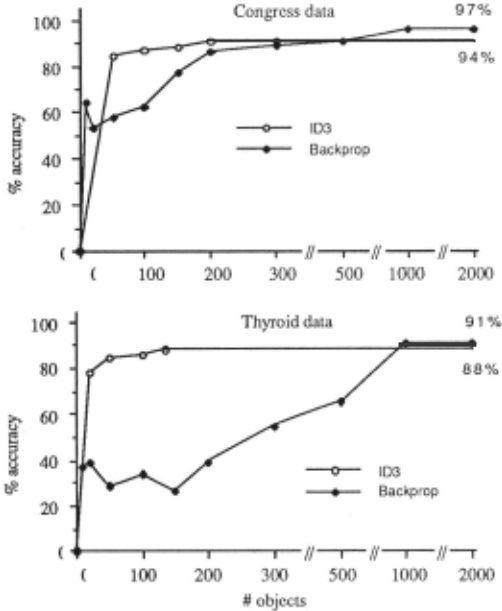
accuracy over the test set. Back-propagation reached perfect accuracy after 500 object presentations.
In these domains back-propagation reaches slightly higher accuracy levels, but not significantly so. More over, back-propagation requires many more training pre sentations. Another difference relates to the shape of the 'learning curves': ID3 quickly achieves high levels of accuracy (e.g., after 10 training objects or so) and then gradually converges on its asymptotic value. In contrast, the slope of back-propagation's curve is more gradual and uniform.
Our training conventions for back-propagation assume that an object presentation is the primary unit of cost . In contrast to our incremental approach, Shavlik, Mooney, and Towell (1989) assume that the training objects are repeatedly presented until the network converges to near perfect prediction of this set. Only then is the test set presented for classification. This batch convention assumes that each object (regardless of the number of times that it is repeated) is the basic unit of cost. Their finding is that approximately the same number of ob jects are required to achieve similar accuracy levels. We (Fisher, McKusick, Mooney, Shavlik, & Towell, 1989) have reconciled these conventions and found them basi cally equivalent. In the incremental approach the cost per presentation (observation) is inexpensive, but many observations are needed. In the batch approach the cost per observation is more expensive, but fewer observa tions are needed. In either case the empirically-observed time until convergence for back-propagation is up to sev eral orders of magnitude greater than ID3, a property that our graphs reflect.
4.3 Noise
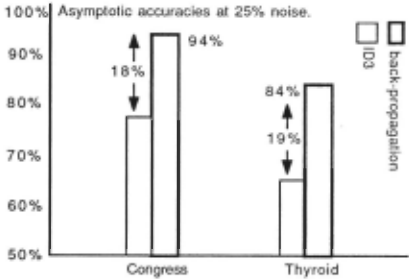
The effect of noise was also explored. In a manner sug gested by Quinlan (1986) attribute values were randomly replaced according to a probability (e .g., 25%) that re flected the noise level. Asymptotic accuracy for the con gressional and thyroid domains under conditions of 25% noise are graphed in Figure 2. Regardless of noise level (i.e., 25% or 50%) or domain, back-propagation always attained accuracy levels greater than ID3 . However , back-propagation again requires significantly more ob servations to achieve these results (but this is not re vealed by the bar graphs). The 'learning curves' are similar in shape to those of Figure 1: ID3 rapidly peaks and levels off, while back-propagation rises more slowly and uniformly.
4.4 Artificial Domains
Artificial domains were constructed so that comparisons could be made under controlled circumstances. Our ex periments systematically vary the degree that attribute values are sufficient and necessary for class member ship: [4.4.1] individual values are necessary and suf ficient; [4.4.2] values are necessary, but not sufficient; [4.4.3] values are not individually necessary or sufficient (X of N); [4.4.4] the necessity of a value's presence or ab sence is conditioned on the presence of other attributes (exclusive-or) , in which no set of values are necessary or sufficient.
4.4.1 Sufficiency
Each of four ( 4) artificial domains contained three (3) classes of objects. Objects were described over 10 at tributes. Each class was describable as a conjunction of attribute values that were unique to that class. Each such value was singly sufficient to distinguish the class. Each of the four domains varied in the number of singly sufficient values (i .e., domain 1: 10 of 10 attributes were individually sufficient; domain 2: 6 of 10 were sufficient; domain 3: 4 of 10 were sufficient; domain 4: 1 of 10 were sufficient). Values of those attributes that were not suffi cient were generated randomly, and thus were irrelevant to classification.
ID3 uniformly reached perfect performance by 10 ob jects, regardless of the number of individually-sufficient values. Back-propagation is more sensitive to the num ber of sufficient values. When all attributes distinguish membership, convergence to perfect prediction required 200 objects, but when no hidden units were used only 10 objects were required . When 4 attributes were suffi cient, 300 objects were required for perfect performance (100 objects were required with no hidden units) . When only 1 attribute was sufficient (and thus necessary too) 500 observations were required. As the number of suffi cient values decreased, back-propagation required more observations to reach asymptotic accuracy.
4.4.2 Necessity
Domains in the second set of experiments added to the complexity of the 'sufficiency' domains. Each class was still describable as a conjunction of attribute values, but the values were not unique to that class: no value was singly sufficient to distinguish class membership. 2 Rather, only the entire conjunctive expression was suffi cient (and necessary) to distinguish membership. Once again, the size of the conjunctive expression varied from 1 to 9.
Neither ID3 or back-propagation averaged perfect per formance in all domains for the maximum allotted train ing. Back-propagation remained just below perfect pre diction (about 98.5%) for conjunctions of size 4 and 6; ID3 reached perfect accuracy, but required 150 training objects. Back-propagation achieved perfect prediction after 500 objects for the conjunction of size 9; ID3 aver aged 95% asymptotic accuracy. As the size of the con junctive target concept grew, it became more difficult for ID3 to spot; each attribute individually transmitted less information.
2 Except in the case where the conjunction is of size 1; note that this extreme is identical t o the lone sufficient (and necessary) condition of 4.4.1.
4.4.3 X of N
In these experiments there was no conjunctive descrip tion for any class. Rather , a class was defined by an X of N function. More specifically, each domain contained only two classes (C and -.C). Cis associated with 10 'preferred' values (one for each attribute); an object was a class member iff it contained at least X of the 10 values . In contrast to 4.4.2, our 'X of N' experiments disallow any single value set to be necessary. The size of X was varied between 1 and 9.
ID3 consistently attained accuracy levels in the vicin ity of 85% to 90% after 200 objects, but about 75% ac curacy was achieved after 10 objects. Back-propagation reached average levels of 99% to 100% within 2000 ob servations.
4.4.4 Exclusive-Or
A final set of artificial domains insists that two attributes exhibit the exclusive-or relation (one and only one of two selected values are present). Exclusive-or, like X of N, has no values or value combinations that are necessary for membership. However, 'X of N' allows X or more selected values to be present, but exclusive-or requires exactly X values to be present. As such, exclusive-or is not linearly separable.
The version of ID3 that we used (Quinlan, 1986) was not capable of learning this function, averaging between 50% and 75% accuracy depending on our confidence threshold. However, Section 5 describes a new ID3 de scendent (Quinlan, 1988) that can undoubtedly reach perfect prediction in this domain. Exclusive or also presents problems to back-propagation: it can not be learned without hidden units. With 10 hidden units, it required approximately 5000 observations to achieve 100% accuracy (approximately 50% accuracy after 1000 observations.)
5 Discussion
Experiments indicate that back-propagation achieves higher asymptotic accuracy levels under noisy conditions and selected artificial domains, but requires considerably more object presentations. This section identifies several principles of each system that may account for perfor mance differences. To the extent possible, we tie our discussion to distinctions between AI and connectionist paradigms more generally. This discussion qualifies our results as they might apply to paradigm-wide compar isons and encourages the exploration of AI and connec tionist hybrid learning systems. 3
3 In particular, we avoid the symbolic/subsymbolic distinction. This has proved an unhelpful distinction in that it does not pro mote short-term progress. This distinction artificially segregates research programs because it is often conveyed as a prescrip tive (and unknown) boundary that each paradigm must observe. Rather, we believe that useful distinctions are descriptive and pro-
5.1 Representation and Bias
Differences between ID3 and back-propagation may be attributable to the size and form of the search space ex plored by each system. The primitive evidence combina tion function of back-propagation (i.e., X of N) general izes ID3's primitive logical combinators (conjunction and inclusive disjunction). Finer granularity enables back propagation to converge on logical concepts and others with less hardware, but each primitive must be special ized, which requires greater training. The DNF equiva lent of X of N (for arbitrary X) is quite complex. The course primitives of ID3 also suggests that it takes big ger steps in a uniform search space: it approximates the final solution more quickly, but it may accept less than optimal solutions because it 'oversteps' or 'understeps' the optimum.
The subsumtion relation between representation lan guages suggests that logical descriptions can be ha_r nessed as a sort of 'admissible' heuristic that allow rapid approximation followed by slower refinement. This ap proach is taken by Utgoff 's ( 1988b) perceptron trees, a hybrid of decision trees with linear threshold units as leaves. The decision tree brings about large cuts in the search space, with final convergence left to the leaves. Evaluation of this particular approach must await fur ther experimentation, but nonetheless it represents an important conceptual advance towards the development of hybrid systems.
5.2 Probabilistic versus Logical Classification
A recent trend in machine concept learning is towards probabilistic representations (Smith & Medin , 1981) . Probabilistic concepts typically classify observations by a summation of evidence, just as do connectionist network nodes. For example, Fisher 's (1987) COBWEB can be viewed as constructing a 'decision' tree of evidence sum mation units (nonlinear) with a variable threshold (i.e., an object is placed in the node with the highest summa tion). Arithmetic evidence combination has tradition ally distinguished AI and connectionist learning meth ods but COBWEB illustrates that this should not be ' taken as a prescriptive difference .
5.3 Monothetic versus Polythetic Classification
A weakness of ID3 is that it is monothetic: learning con siders the utility of a single attribute at a time. The predictive merits of attribute value combinations are not explicit ly consider, presumably to the detriment of pre diction accuracy. This seems evident in the comparisons of 4.4.2 and 4.4.4. In contrast, back-propagation is poly thetic, in that the values of multiple attributes are simul taneously considered (summed) . However , the mono thetic property of ID3 is not a general assumption of the
mote interaction.
field. Traditionally, AI concept learning methods have been search intensive precisely because they simultane ously consider the utility of many attributes. Recently, Quinlan (1988) has introduced a polythetic ext~nsion to ID3 that builds a monothetic decision tree (without using confidence measures to terminate decomposition), and then converts it to a set of production rules . Each rule is a polythetic concept that is 'massaged' in order to improve its accuracy. That this extension was prompted by Quinlan's comparison of ID3 and a genetic classifier (which shares certain characteristics with c~nnecti~n ist nets), adds impetus to continued compansons With this extension. Quinlan's comparisons only occurred 111 an artificial domain similar to our exclusive-or function. Our methodology promises to characterize the ID3 ex tension across a wide range of domains. A determination of whether logic-based, but polythetic learning systems can overcome problems of granularity discussed in 5.1 must await experimentation. However, polythetic classi fication in AI learning systems need not preclude prob abilistic representations as noted in 5.2.
5.4 Incremental versus N onincremental Process ing
ID3 assumes that all observations are simultaneously available for processing, while back propagation pro cesses observations as they become available. This dis tinction is somewhat true of the two paradigms more generally. However, ID3 has recently spawned two in cremental variants, ID4 (Schlimmer & Fisher , 1986) and ID5 (Utgoff, 1988a). Incremental learning more gener ally is becoming popular in AI learning research. The common thread in these systems (including connection ist methods and COBWEB) is the use of 'probabilistic' representations. Finer granularity allows more conserva tive steps through a search space. This conservatism is necessary; early in training, many observations are in consistent with the evolving concept description. No ob servation should irrevocably impact the incomplete con cept description.
5.5 Constructive versus Convergent Search
Perhaps the most overt distinction between AI and con nectionist systems is the manner in which they explore their respective search spaces. AI systems typically re construct the space upon demand, which is only defined implicitly by operators and an initial state to begin with. In contrast, most connectionist systems preenumerate a subset of the space, which is implicit in the number and interconnections between nodes. Problems arise if too much (e.g., slow convergence) or too little (e.g., the con cept cannot be learned) of the space is preenumerated. Important steps in reconciling these strategies have been explored by Schlimmer & Granger (1986) and Hampson & Volper (1987). Schlimmer & Granger's STAGGER
system adapts connectionist evidence combination pro cedures to the 'constructive' (upon demand) approach: the emphasis is on technology transfer to AI systems . In contrast, Hampson & Volper stress transfer to con nectionist research: specialized disjunctive nodes can be enumerated and integrated on demand, thus facilitating rapid convergence. Picking up on the discussion of 5.1, AI systems appear well suited to enumerating an appro priate subspace that may then be refined.
6 Concluding Remarks
Empirical comparisons have uncovered advantages and disadvantages of two specific learning systems. That these systems are from different paradigms is impetus for interaction. Research of this ilk is being pursued by several researchers, some of whom we have discussed. In addition, future comparisons must increase the scope of our study to other learning systems and learning strate gies. Currently, we (Fisher, McKusick, Mooney, Shav lik, & Towell , 1989) are exploring an alternative training strategy for back-propagation that combines the incre mental and batch approaches: small batches of training objects are incrementally presented and are processed until convergence (on the subbatch). Our initial results suggest that using very small batch sizes (1 to 4) sig nificantly reduces the total number of presentations re quired until asymptotic accuracy is achieved. We are pursuing these experiments and hope to flesh out an ex planation of the phenomena in terms AI concepts; most notably, can we view this process as simulating case based reasoning and/ or a specific to general search for the best classifier? Either interpretation is a departure from the usual training strategy of moving from general (indiscriminate) towards greater specialization. Hope fully, these explorations will. improve back-propagation training time without detrimentally impacting accuracy.
Acknowledgements
We thank Ray Mooney, J ude Shavlik, and Geoff Towell for influential discussions and debates . Comments by Richard Sutton improved the correctness and clarity of discussion, as did comments by IJ CAl reviewers.
@inproceedings{ijcai1989p126,
  title     = {An Empirical Comparison of ID3 and Back-propagation},
  author    = {Fisher, Douglas H. and McKusick, Kathleen B.},
  booktitle = {Proceedings of the Eleventh International Joint Conference on
               Artificial Intelligence, {IJCAI-89}},
  publisher = {International Joint Conferences on Artificial Intelligence},
  editor    = {N. S. Sridharan},
  pages     = {788--792},
  year      = {1989},
  month     = {8},
  note      = {Machine Learning},
  url       = {https://ijcai.org/proceedings/1989/126},
}
TY - CPAPER TI - An Empirical Comparison of ID3 and Back-propagation AU - Fisher, Douglas H. AU - McKusick, Kathleen B. T2 - Proceedings of the Eleventh International Joint Conference on Artificial Intelligence, IJCAI-89 PB - International Joint Conferences on Artificial Intelligence PY - 1989 SP - 788 EP - 792 UR - https://ijcai.org/proceedings/1989/126 ER -Copied
Machine-readable versions of this paper, for tools and AI agents:





