
On the Road to Automatic Knowledge Engineering
Proceedings of the Eleventh International Joint Conference on Artificial Intelligence. Machine Learning. Pages 628-631.
© 1989 International Joint Conferences on Artificial Intelligence
Abstract
The paper presents a scheme for categorizing knowledge engineering tools. The classification of knowledge acquisition systems has revealed some interesting facts about these systems. It seems that systems which are able to work on multiple tasks produce very shallow (i .e., not of expert-level) knowledge bases. On the other hand, systems which produce expert-level knowledge bases function on a single task. These insights have led to the design of ASKE, a knowledge acquisition system which can be used to build expert-level knowledge bases in several domains and for different task-types. The knowledge acquisition process is based on the notion of templates, the knowledge-bearing units of ASKE. Templates provide a convenient way of representing domain knowledge.
- [Bennet, 1983] Bennet, J. ROGET: a knowledge-based consultant for acquiring the conceptual structure of an expert system. Stanford Heuristic Programming Project, Memo HPP-83-24, October 1983.
- [Boose, 1984] Boose, J. Personal construct theory and the transfer of human expertise. In Proceedin~s of the National Conference on Artificial Intelligence, Austin, Texas, 1984.
- [Clancey, 1985] Clancey, W. Heuristic classification. Artificial Intelligence, 27, 1985.
- [Eshelman & McDermott, 1987] Eshelman, L. and McDermott, J. MOLE: a knowledge acquisition tool that uses its head. Proceedjn~s of the Tenth International Joint Conference on Artificial Intelligence, 1987.
- [Klinker et al., 1987] Klinker, G., Boyd, c. Genetet, G. and McDermott, J. A KNACK for knowledge acquisition. In Proceedings of the National Conference on Artificial Intelli ~ence, Seattle, W A, 1987.
- [Motta et al., 1989] Motta, E., Rajan, T. and Eisenstadt, M. Knowledge acquisition as a process of model refinement. In International Journal of Man-Machine Studies, 1989. (forthcoming)
- [Musen, 1988] Musen, M. An editor for the conceptual models of interactive knowledge acquisition tools. In Proceedin~s of the Third Knowledge Acquisition for Knowledge Based Systems Workshop, Banff, Canada, 1988.
- Patel 1988]
- Patel, J. ASKE: an automated knowledge acquisition system. HCRL Technical Report No. 36, The Open University, Milton Keynes, UK, October 1988.
References were extracted automatically from the PDF and may contain errors.
Full text extracted automatically from the PDF; figures, tables and equations may differ. The PDF is the version of record.
ON THE ROAD TO AUTOMATIC KNOWLEDGE ENGINEERING
Jitu Patel
Human Cognition Research Laboratory The Open University Milton Keynes, MK7 6AA, UK
ABSTRACT
The paper presents a scheme for categorizing knowledge engineering tools. The classification of knowledge acquisition systems has revealed some interesting facts about these systems. It seems that systems which are able to work on multiple tasks produce very shallow (i.e., not of expert-level) knowledge bases. On the other hand, systems which produce expert-level knowledge bases function on a single task. These insights have led to the design of ASKE, a knowledge acquisition system which can be used to build expert-level knowledge bases in several domains and for different task-types. The knowledge acquisition process is based on the notion of templates, the knowledge-bearing units of ASKE. Templates provide a convenient way of representing domain knowledge.
I INTRODUCTION
In the last few years there has been a growing amount of research on knowledge acquisition (KA). In general, this process, which includes the transfer of problem-solving knowledge from a domain expert to a computer program, is carried out by knowledge engineers. However, there exist a number of KA systems, for example, ROGET (Bennet, 1983), ETS (Boose, 1984) and MOLE (Eshelman and McDermott, 1987), which build knowledge bases by directly interacting with the domain expert.
The paper has two objectives. First, to present a scheme for classifying KA systems. Second, to present ASKE (Automatic System for Knowledge Engineering). In ASKE, we have attempted to automate the knowledge acquisition process. The aim is to produce a system that can be used by domain experts from different disciplines to build expert-level knowledge bases in their respective domains. The lessons learned from the classification exercise has been the motivation for the development of ASKE.
Section 2 presents a scheme for categonz1ng knowledge-engineering tools. The discussion is centred on classifying existing KA systems. In section 3, we will look at the central features of ASKE. A description of how ASKE processes information is given in section 4.
II A CLASSIFICATION OF KA TOOLS
Our classification of knowledge engineering tools is shown in figure 1. The KA systems are distinguished from other tools by the fact that they interact directly with domain experts, and automatically acquire and generate knowledge bases. Depending on how they extract knowledge, KA systems can be divided into two groups: induction-based and interview based. Induction systems use inductive learning techniques to extract knowledge from experts. Typically, an induction-based system induces rules from training instances (i.e., positive and negative examples) provided by a domain expert. Interview-based systems extract knowledge by carrying out an interactive, system-driven dialogue with a domain expert (or domain experts). They differ from inductive systems in that they do not have a learning algorithm, but rather, the interrogation of the expert is guided by use of domain-specific knowledge and/or of psychological techniques for eliciting knowledge.
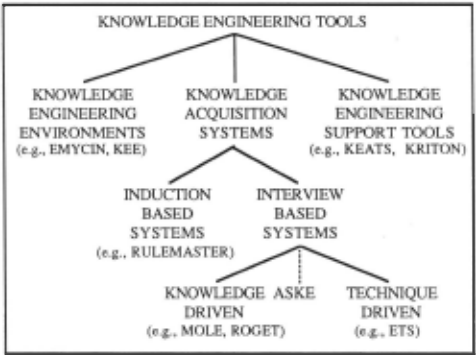
On the basis of the type of heuristic the system employs to drive the interviewing process, we can classify interview-based systems as either knowledge-driven or technique-driven. Knowledge-driven systems (e.g., ROGET, MOLE) contain task models which assist in the identification and classification of new knowledge. The technique-driven systems (e.g., ETS), on the other hand, rely on formal methodology, which is often rooted in some psychological theory (e.g., Personal Construct Theory) to elicit domain knowledge from the expert.
| Scope | Knowled2e | |
|---|---|---|
| Knowledge-Driven | Single Task | Specific Knowledge |
| Technique-Driven | Multiple Tasks | General Knowledge |
Figure 2 summarizes the strengths and weaknesses of the two approaches to interview-based KA. The technique driven approach, which is based on domain-independent elicitation technique, can be used to produce knowledge bases for performing any task for which solutions can be pre enumerated. The drawback of this method of KA is that the kind of knowledge elicited is usually general domain knowledge. The knowledge thus acquired cannot be used to solve problems at the level the expert normally does.
The knowledge-driven systems use domain-specific strategies to elicit expert knowledge. The strength of this approach is that the end result, after a consultation, is a system which solves problems at the expert-level. However, the scope of such systems is limited, they can only be used to develop knowledge bases for a narrowly defined task area (e.g., diagnostic task where symptoms do not have multiple, interacting causes).
In order to qualify as a truly automatic knowledge engineering system, a system should be applicable over a wide range of domains, and produce expert-level systems. None of the presently known KA systems satisfy this criterion. In the rest of the paper we will describe work in progress towards the development of an automated. KA system which has the general applicability of technique-driven systems and functionality of knowledge-driven systems.
III THE ASKE SYSTEM
ASKE (Patel, 1988) is an interview-based KA system which is both technique-driven and knowledge-driven, (hence it is shown with a dotted line in figure 1). It develops knowledge bases in two stages. In the first stage, a technique-driven method consisting of question-asking strategies is used to acquire an initial task model. This knowledge is then used to elicit problem-solving expertise from the domain expert. Note that this KA strategy, the building and using of task models, is consistent with the Keats methodology (Motta et al, 1989) and is also used by KNACK (Klinker et al., 1987) and PROTEGE (Musen, 1988) KA systems.
ASKE is built around the notion of templates. A template is a framework for representing domain knowledge. ASKE uses question-asking strategies geared towards eliciting knowledge that can be directly mapped onto the domain templates. The template approach to KA is founded on Clancey's ( 1985) classification paradigm. The assumption is that domain knowledge can be represented in classification hierarchies. Furthermore, the heuristics for solving problems are no more than relationships between different concept hierarchies.
| Template | Contents | How Obtained | Use |
|---|---|---|---|
| GTEMP | Knowledge about domain hierarchy | Interaction with the expert | Reference purposes |
| A TEMP | General domain knowledge | Interaction with the expert | Building new knowledge bases |
| RTEMP | Domain-specific knowledge | Extracted from know- ledge base | As a test case on which newkb may be modelled |
| WfEMP | New knowledge base | Interaction with the expert | Holding new knowledge |
ASKE contains four main types of templates, as shown in figure 3. The most basic template is referred to as general template (GTEMP). A GTEMP contains knowledge about domain classification (i.e., information about the main tasks that experts do) and background knowledge such as bibliography and project aims. An acquisition template (A TEMP) contains general domain knowledge which includes main concept types and their inter-relationships. ASKE's interaction with the expert is guided by the ATEMP. The specialist areas for which knowledge bases have been developed, ASKE will have a reference template (RTEMP). An RTEMP consists of domain-specific knowledge which is used as an example of how a new knowledge base may be developed. A working template (WfEMP) is created from the A TEMP at the start of the knowledge elicitation session. This template is subsequently filled up by the new knowledge.
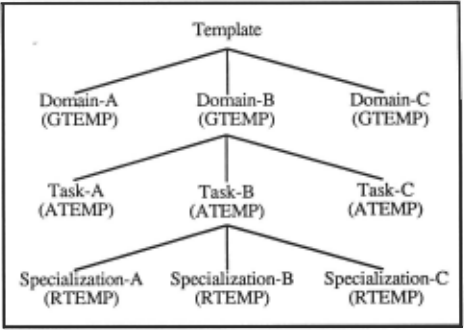
Figure 4 depicts how domain knowledge is represented in ASKE. Templates are arranged in a hierarchy of nodes representing templates linked via an isa relation. The GTEMPs contain information that is not directly relevant for knowledge elicitation purposes. The basic template for acquiring knowledge is the A TEMP, the initial task model. The model includes information on the main concept categories for the task type (of the domain) and how these concepts are related to each other. ASKE uses question-asking strategies to elicit the A TEMP, if one does not exist for the domain. Otherwise, the user is presented with the A TEMP and is given the option of changing it if deemed not appropriate for the proposed application. The knowledge about concept types is used to construct the WTEMP, which is subsequently filled up with the new knowledge.
RTEMPs play a important role in the acquisition of the A TEMPs and also in the main knowledge elicitation session. RTEMPs are extracted from developed knowledge bases. These are subsequently used as exemplars on the basis of which new applications may be developed. This usage of RTEMPs is like the interviewing strategy in ROGET, which used knowledge of existing expert systems to acquire the conceptual structure. The novelty of RTEMPs is that they are selected at run-time.
IV A SCENARIO
In this section we will briefly describe: (1) the steps involved in the extraction of an A TEMP; and (2) how the A TEMP is used to extract problem-solving knowledge from the expert. As an example, we will use the domain of Archaeology.
Archaeological knowledge may be classified as shown in figure 5. Typically, an archaeologist excavates a site. The finds are recorded, classified and interpreted. Of these, only the latter two are conducive to expert system technology. The classification task is normally restricted to classifying of artifacts (i.e., the finds which are man-made). In the interpretation task, the social habits and the organization of past civilizations are inferred from the finds.
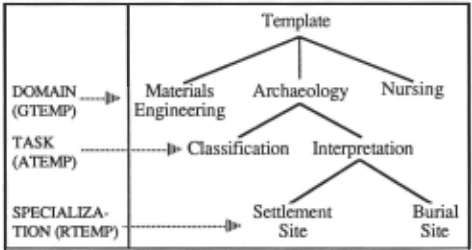
Two of the main areas for which archaeologists do interpretation are settlement and burial sites. These specialist areas differ in detail but not in the kind of reasoning done. Thus, the RTEMP for one can be used as an exemplar for developing the knowledge base of the other. In the scenario, we will assume that a knowledge base for interpreting burial sites has been developed. The example session involves the interpretation of settlement sites. The parenthetical sentence, in bold, following the question is obtained from the RTEMP.
A Extracting General Domain Knowledge
General domain knowledge consists of two kinds of information: how domain knowledge is organized and A TEMPs for the different task types. Both of these can be obtained from sources other than the expert, for example, books or people with a working knowledge of the domain.
The A TEMP for interpreting settlement sites contains the following information:
- Concept category which refers to the observed data. - artifact, ecofact, feature
2. Concept category which refers to final solution (i.e., kind of things that can be inferred).
- activity and cultural profile
3. Information about the relationship between the concept categories.
This information was extracted as follows:
(The type of initial data is identified.)
[1] ASKE: What are the main categories of observed data for interpreting settlement sites? (The main categories of observed data for interpreting burial sites were: artifact, ecofact, feature.)
Archaeologist: artifact, ecofact, feature
(The type of final solution is identified.)
[2] ASKE: What are the main categories of final solution for interpreting settlement sites? (The main categories of final solution for interpreting burial sites were: cultural profile.)
Archaeologist: activity, cultural profile
(Identify relationships. The information is used for the acquisition of heuristics.)
[3] ASKE: Which initial data categories are related to activity?
Archaeologist: artifact, ecofact
[4] ASKE: Which initial data categories are related to cultural profile?
Archaeologist: artifact, ecofact, feature
B Extracting Problem-Solving Expertise
The knowledge elicitation session commences with the creation of a WTEMP from the ATEMP. The WTEMP contains slots relating to the main concept types for the task.
The knowledge elicited from the expert is held as values of respective slots.
For the interpretation of settlement sites, the important facts are the different categories of observed data and solution. The actual expertise in interpreting sites lies in the ability to map data to interpretations. The rules therefore depict transformations from data to interpretation. These rules are of the form:
IF
data and data and .. . .
THEN interpretation and .... .
The following dialogue shows how the A TEMP for interpreting settlement sites is used to interrogate the expert. (NOTE: Most of the interaction, from hereon, between ASKE and the user is through graphical interface.)
(Obtain classification of different data types.)
[5] ASKE: What are the different types of artifact ? (The artifact hierarchy for interpreting burial sites is displayed graphically.)
Expert: pottery, stone, metal
(Obtain claSsification of different solution types.)
[6] ASKE: What are the different types of activity? Expert: cooking, pottery-making, butchering, storage [7] ASKE: What are the different types of cultural
profile?
Expert: exchange contacts, demography, craft specialization, ritual practices
(The attributes of all data types are obtained.)
[8] ASKE: What are the important attributes of pottery that may contribute towards the interpretation of this settlement site?
Expert: (attribute) fabric
(possible values) coarse, fine
(attribute) decoration
(possible values) plain, ornamented
(attribute) blackening
(possible values) yes no
(The relationship between data and solution is identified. This is used to automatically generate rules.)
[9] ASKE: What can you conclude from the fabric of pottery? .
Expert: (activity) cooking, storage
(cultural profile) exchange contacts
[10] ASKE: What can you conclude from the decoration of pottery?
Expert: (activity) cooking
(cultural profile) exchange contacts, ritual practices
From the information supplied by the expert, rules of the following type are generated. The rules are displayed in the rule editor, and the expert is asked to edit them.
IF
artifact is a pottery
and fabric is (coarse, fine)
and decoration is (plain, ornamented)
THEN activity is (cooking, storage)
site profile is (trade contacts, ritual practices)
V CONCLUSION
ASKE is an automated system for knowledge engineering. It is an interview-based KA system that develops knowledge bases by first acquiring general domain knowledge which is then used for acquiring problem-solving knowledge from the expert. The KA process in ASKE is guided by templates, the knowledge-bearing units. ASKE contains four basic types of templates, each of which carries different kind of domain knowledge and serve different functions.
In the notion of a template we have attempted to put forward a general scheme for representing domain knowledge. Indeed, as the classification of KA systems highlighted, it is necessary for any KA system, attempting to automate the knowledge engineering process, to be able to develop knowledge bases in different domains and for different task types. ASKE was designed with this purpose in mind. The template approach has been successfully used for acquiring knowledge in the domains of Archaeology (e.g., interpreting settlement sites), Motor Mechanics (e.g., diagnosing engine problems) and Nursing (e.g., selecting patient care plans).
ACKNOWLEDGEMENTS
I would like to thank Marc Eisenstadt, Enrico Motta, Tim Raj an, Steve Shannon and Arthur Stutt for helpful discussions and comments. This research is supported by an Open University Studentship.
@inproceedings{ijcai1989p100,
  title     = {On the Road to Automatic Knowledge Engineering},
  author    = {Patel, Jitu},
  booktitle = {Proceedings of the Eleventh International Joint Conference on
               Artificial Intelligence, {IJCAI-89}},
  publisher = {International Joint Conferences on Artificial Intelligence},
  editor    = {N. S. Sridharan},
  pages     = {628--631},
  year      = {1989},
  month     = {8},
  note      = {Machine Learning},
  url       = {https://ijcai.org/proceedings/1989/100},
}
TY - CPAPER TI - On the Road to Automatic Knowledge Engineering AU - Patel, Jitu T2 - Proceedings of the Eleventh International Joint Conference on Artificial Intelligence, IJCAI-89 PB - International Joint Conferences on Artificial Intelligence PY - 1989 SP - 628 EP - 631 UR - https://ijcai.org/proceedings/1989/100 ER -Copied
Machine-readable versions of this paper, for tools and AI agents:
 Welcome
 Future Conferences
 AI Journal Division
 IJCAI Proceedings
 About IJCAI
 IJCAI Awards