
Symbols and Subsymbols for Representing Knowledge: A Catalogue Raisonné
Proceedings of the Eleventh International Joint Conference on Artificial Intelligence. Foundations. Pages 3-6.
© 1989 International Joint Conferences on Artificial Intelligence
Abstract
Traditional artificial intelligence studies generally approach the problem of representing knowledge following the so-called knowledge representation hypothesis, as formulated by Brian Smith. More recently the development of the connectionist paradigm has questioned the symbolic approach to the study of the mind bringing about a more articulated view of the problem. This article singles out five possible approaches to the problem of knowledge representation in cognitive science: compositional symbolic approaches, local non-compositional approaches, distributed non compositional approaches, cognitive subsymbolic approaches and "neural" subsymbolic approaches. In particular , in the subsymbolic cognitive approach the e lements that make up the representation system are not symbols with an a~cribed meaning nor do they correspond to anatomic entities at a neurological level; rather they are to be considered as "theoretical constructs '' of a theory of the cognitive level which permit the deduction (in the sense of ''computation") of cognitive behaviours which cannot be otherwise modelled. We consider the development of models of this kind to be essential to a computational approach to the problem of reference without hypothesizing "magical qualities" of the mind (in the sense of assuming a necessary connection between mental symbols and their referents), while remaining within a functionalist vision, in the wider sense, which does not make reference to the specific physical properties of the neural hardware.
- [Brachman and Levesque, 1985] Ronald J. Brachman and Hector J . Levesque (eds.) . Readings in knowledge representation. Morgan Kaufmann, Los Altos, Ca., 1985 [Fodor, 1980]
- Jerry A. Fodor. Methodological solipsism as a research strategy in psychology. Behav. Brain Sciences, 3: 63-73, 1980
- [Fodor and Pylyshyn, 1988] Jerry A. Fodor and Zenon W. Pylyshyn. Connectionism and cognitive architecture: a critical analysis. Cognition, 28 : 3-71, 1988
- [Harman , 1987] Gilbert Harman. (Nonsolipsistic) conceptual role semantics. In Ernest LePore (ed.), New directions in semantics. Academic Press, New York, 1987 [
- [Hinton et at. , 1986] Geoffrey E. Hinton, James L. McClelland, and David E. Rumelhart. Distributed representations. In [McClelland et at., 1986]
- [Hofstadter, 1985] Douglas R. Hofstadter. Waking up from the Boolean dream, or, subcognition as computation. In Douglas R. Hofstadter, Metamagical themas , pp. 631-665. Basic Books (Lakoff, 1986] George Lakoff. Cognitive semantics . Versus, 44-45: 119-154, 1986 [
- [McClelland at at., 1986] James L. McClelland, David E. Rumelhart and the PDP Research Group . Parallel distributed processing. MIT Press, Cambridge, Mass., 1986
- [Newell, 1980] Allen Newell. Physical symbol systems. Cognitive science, 4: 135-183, 1980 [
- Hilary Putnam. Reason, troth and history. Cambridge University Press, Cambridge, 1981 [
- [Rumelhart et at., 1986] David E. Rumelhart, Paul Smolensky, James L. McClelland, and Geoffrey E . Hinton. Schemata and sequential thought processes in PDP models. In [McClelland et at., 1986]
- [Sloman and Cohen, 1986] Aaron Sloman and Jonathan Cohen. What sorts of machines can understand the symbols they use? Proc. Arist. Soc., Suppl., 60 : 61-95, 1986
- [Smith, 1982] Brian C. Smith. Prologue to "Reflection and semantics in a procedural language". In [
- [Smolensky, 1988] Paul Smolensky. On the proper treatment of connectionism. Behav. Brain Sciences, 1988 [Wittgenstein, 1958] Ludwig Wittgenstein. The blue and brown books. Basil Blackwell
References were extracted automatically from the PDF and may contain errors.
Full text extracted automatically from the PDF; figures, tables and equations may differ. The PDF is the version of record.
1 A geography of knowledge representation
"Traditional" approaches to artificial intelligence gener ally adopt . the so-called knowledge representation hypo thesis as formulated by Smith [1982] to tackle the problem
This work was partially supported by a grant of the Italian ~inistry of Education (MPI)
COMPOSITIONAL SYMBOLIC
LOCAL NON COMPOSITIONAL SYMBOLIC
DISTRIBUTED NON COMPOSITIONAL SYMBOLIC
COGNITIVE SUBSYMBOLIC
NEURALSUBSYMBOLIC
Figure 1
- 3. distributed non compositional symbolic approaches
- 4. cognitive subsymbolic approaches
- -5. neural subsymbolic approaches.
Point 1. comprises the approaches in line with Smith's knowledge representation hypothesis. Following Fodor and. Pylyshy~ (1988] we can say they are characterized by the1r . adopuo~ of the principle of compositionality of m_ea~mg: In bnef, the syntax of the representation system d1st1ngutshes between syntactically atomic expressions and complex expressions. Complex expressions can be ~enerated from atomic expressions using recursive syntac tic rules, and the meaning of a complex expression is a function of its syntactic structure and the meaning of the atomic expressions in it. It can be hypothesized that each representation system of this type can be given a model ~heoretic semantics. If, in fact, the representation formal Ism has a syntactic structure which can be characterized in terms of recursive rules, and if the meaning of each con struct is a function of the meaning of its components, then each construct can be interpreted in a set theoretic model by singling out semantic rules parallel to the syntactic rules, whi~h interpret the complex expressions starting from the mterpretation of primitive expressions. Model theoretic semantics has given good results for many for malisms with a compositional structure (examples are the development of Kripke models for intensional logics, Montague semantics, denotational semantics for pro gramming languages). So it may be considered extensible to any well defined representation language of this type.
The approaches covered by point 2. are symbolic, in the sense that every element in the representation system is a symbol, that is an entity with a meaning ascribed, and local (i.e. non-distributed) in the sense that each repre sentation is "localized" in a specific element of the system. However, the composition principle does not apply in this case: there are no syntactic rules which can generate com plex representations, each symbol is, in a certain sense, atomic. These approaches cannot be given a model the oretic semantics except in a fairly banal manner. Without compositional syntactic rules it is impossible to define parall~l semantic rules and every symbol in the repre sentation system should be interpreted separately in the model. ·:Lo_cal connectionist" models, where each concep tual enttty ts represented by a distinct unit in the network are of this type. It is this lack of compositionality tha~ Fodor and Pylyshyn identify as the characteristic that dis tinguishes connectionist models from classical models [Fodor and Pylyshyn, 1988, pp. 15-19).
In a distributed model "each entity is represented by a pattern of activity distributed over many computing ele men~s, and each computing element is involved in repre sentmg many different entities" [Hinton eta/., 1986]. Point 3. comprises connectionist models distributed on micro features, where each node of the network is a symbolic entity, in that it represents a micro-feature and it possesses a distinct semantic interpretation. The "high level" con c~pt~ however are not represented by units, rather they are d1stnbuted on the network as activation patterns. These model~ are subconceptual (in the sense that the repre sentation of a concept may not be localized in a distinct element of the representation system) but not subsymbolic (the _units representing micro-features are given a meanmg).
We shall discuss point 4. later. Point 5. comprises the "neural" connectionist models. In these the repre sentations are distributed on non-symbolic units that are assumed to have exact anatomic and neurophysiological correspondences. Fodor and Pylyshyn (1988] consider this ~ype of approach not relevant at the cognitive level as it mvolves lower levels of mental organisation. Moreover, although this type of model can be theorized, it is difficull to realize in view of the empirical evidence available.
F~nally: as regards point 4., in this approach the subsym bohc umts are not considered as having meaning (for example in the sense of representing micro-features), nor as corresponding to physical entities identifiable at the neurological level. We maintain that they should rather be placed among the ''theoretical constructs" of a theory of the cognitive level, which allow the deduction (in the sense of computation) of cognitive behaviours that cannot be otherwise modelled. This type of model is not considered by Fodor and Pylyshyn [1988], who see the only possible alternatives for a distributed representation in points 3. and 5. However, 4. is the position held by Smolensky [ 1988 J (although his examples are often more suitably identified in point 3.- see for example the distributed representation of different kinds of room in Rumelhart eta!. [1986]) . An analogous position is that of Hofstadter [ 1985), from whom Smolensky says he drew some of his main ideas. Although the type of computation used in the subsymbolic paradigm is "inspired" by neural computation, Smolensky states that: "the fundamental level of the subsymbolic para digm, the subconceptuallevel, lies between the neural and the conceptual levels" [Smolensky, 1988]. Further, ''the subconceptual level seems at present rather close to the conceptual level, while we have little grounds for believing to be close to the neural level" (ibid.) . Again: "subsymbolic models should not be viewed as neural models" (ibid.).
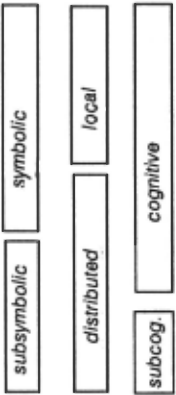
To sum up, the approaches at points 1., 2. and 3. can be characterized as symbolic in a wide sense, as they contrast with the subsymbolic approaches at points 4. and 5. (see Figure 1). Approaches 3., 4. and 5. are to some extent distributed in contrast with the local approaches of points 1. and 2. Lastly, while the approaches of 1. to 4. are at a cognitive level, approach 5. involves subcognitive levels (anatomic).
2 The need for a cognitive subsymbolic level
While recognizing the importance of compositional sym bolic models of cognitive activities (if only because non compositional models have not yet succeeded in offering a plausible alternative in many cases), there are problems which seem to suggest that there are valid theoretical reasons for hypothesizing a "cognitive subsymbolic" level.
Reference is the one case in which a subsymbolic com putation seems necessary also within a compositional sym bolic paradigm. We do not subscribe to Fodor's solipsistic assumptions [Fodor, 1980], that functional relations rele vant to a computational theory of the mind are exclusively those between symbols, and that all semantic concepts, including reference, are not relevant to such a theory. We would tend rather to agree with Harman's statement that "of primary importance are functional relations to the external world in connection with perception, on the one hand, and action, on the other" [Harman, 1987, p. 67). Harman does not specify such relations. Sloman [Sloman and Cohen, 1986) also expresses the need for links in order to anchor reference to symbols. In this paper we suggest that such links or relations could be envisaged in a subsymbolic framework.
We have seen how the semantics of first type repre sentation systems can be characterized using the tools of model theory. Model theoretic semantics does not claim to be an empirically adequate characterization of refer ence as a cognitive process. However, apart from its em pirical inadequacy, it contains certain a priori limits. The empirical inadequacy of model theoretic semantics is re lated to the fact that a human does not establish the reference of complex symbolic expressions (consider the truth value of modal statements) following the rules of model theoretic semantics (in the case of natural language and presumably in the case of expressions of the language of thought) . By a priori limits we mean a type of limit that would also be valid for a hypothetical "non-anthropomor phic" cognitive entity that uses the rules of model theoretic semantics.
The analysis of such a priori limits could clarify the problems that arise in a symbolic representation paradigm in elaborating a model of reference from a cognitive point of view. It is well known that no formal symbol system can univocally determine its own model. In a logical system, sets of meaning postulates can be used to limit the set of admissible models, but they are not sufficient to fix a particular model. In model theoretic semantics the link between a system of symbols and the objects whereon the symbols are interpreted is established via an interpretation function. In a logical language, for example, such a func tion interprets the individual constants on objects (of the appropriate type) in the domain, the one argument predi cate letters are interpreted on subsets of the domain and so on. The interpretation function calculates the value of complex expressions starting from the value of primitive symbols. However in this last case the interpretation func tion is taken as given and, in any case, characterizable only in a purely extensional manner, like a table which associ ates, for example, to each predicate symbol, a subset in the domain. This, from a cognitive viewpoint, is not sufficient since an adequate representation of conceptual entities must take into account the manner in which the reference is established, that is, how the interpretation function is calculated. This function (and its inverse) must be (par tially) computable, and it must be (in a general sense) possible to know "how they are made", that is, it must be possible to identify (in the wide sense, and perhaps in the connectionist sense) an algorithm which calculates them. As we are dealing with functions which map symbols on objects in the world and viceversa, they cannot be defined exclusively in terms of other symbols as this would imply an infinite regression. The interpretation function must therefore be calculated, at least for some symbols in the system (the "primitives") by some subsymbolic device.
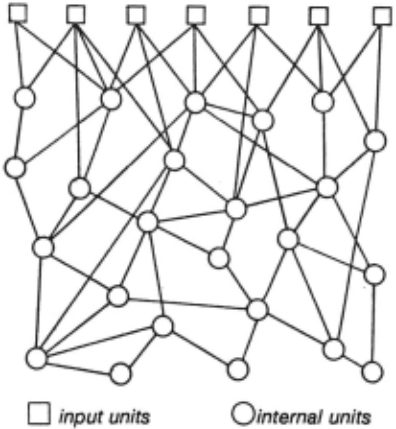
Figure 2 shows the drawing of an over-simplified hypo thetical model of how the reference of symbols directly connected with sensorial inputs could be computed. The input units are connected in a causal, non-symbolic, manner with the world. None of these units is a representation of anything in particular. The internal units are, in turn, non-svmbolic entities and particular activation patterns on th~m correspond to expressions of the representation formalism at the symbolic level. The lack of a subsymbolic layer of this type would mean postulating the existence of symbols which directly "grasp" their referents, thus falling into the category of"magical" reference theories which are discussed below.
Fodor and Pylyshyn state "there are, no doubt, cases where special empirical considerations suggest detailed structure/function correspondences between different le vels of system's organization. For example, the input to the most peripJ!.eral stages of vision ... at these stages it is reasonable to expect an anatomically distributed structure to be reflected by a distributed functional architecture" [Fodor and Pylyshyn, 1988, p. 63). From our point of view however the problem does not lie in the fact that for lower level cognitive functions a greater structure/function correspondence is necessary, and therefore a functional structure corresponding more closely to anatomic struc ture. Strictly speaking it is not even necessary for subsym bolic computation to be in any sense "neural" or inspired to the anatomic structure of the nervous system. The prob lem is a priori and not empirical (and so, much less does it originate from considerations of an anatomic nature): an understanding of the relation of reference of a system of mental symbols cannot exclusively make recourse to other symbols as this would be simply shifting the problem. On the other hand, no symbol in the sense of syntactic object has reference as a result of some intrinsic quality, since there would be a necessary connection between sym bols and referents, and mental symbols do not enjoy any "special status" in this regard. According to Putnam, "what is important to realize is that what goes for physical pic tures also goes for mental images, and for mental repre sentations in general; mental representations no more have a necessary connection with what they represent than physical repres~ntations do. The contrary supposition is a survival of magical thinking" [Putnam, 1981, p. 3]. To explain reference the symbolic level needs to be aban doned and a subsymbolic level as theorized by Smolensky could be adopted to model that non-symbolic activity of the mind which arranges that symbols refer to something. (Note that Putnam's statement, which is inspired by Witt genstein's criticism of the concept of mental image [Witt genstein, 1958), likens mental images to other types of mental representation: from the point of view of refer ence, symbol systems and mental images both fail for the same reasons.)
It is obvious that, in the real world, reference, in symbol systems such as natural language, is an extremely complex phenomenon: symbols use many "hooks" by which they grasp reality. Analogously, we can hypothesize that also the reference of mental symbols comes about by means of different modalities (sensorial, motorial, etc.) variously interrelating, and depends to· a large extent on compo nents of a cultural and therefore of a partly symbolic nature. However, we consider that recourse to a subsym bolic cognitive activity is inescapable.
We do not intend to adopt a "referentialist" position, which reduces the problem of meaning to that of estab lishing the reference of terms denoting material things. However, there is a real problem of reference and it is difficult to imagine meaning without any causal relation with the world.
The situation is even more complex if the assumptions of "ingenuous realism" are not accepted, and a position, which holds that the world is not intrinsically organized according to a fJXed ontology and completely independent of the cognitive activities of the observer, is assumed. (A similar position is that of Lakoff [1986), which he calls experientia/ist in contrast with objectivist positions.) In this case the problem is not only to recognize and label onto logically given entities, but also to impose a categorization on reality. Such categorization must necessarily include a non symbolic component: "before" the categorization is carried out there is no sense in using symbols as there is nothing they can refer to.
Reference is linked to sensorial and motorial activities not onlv in the obvious sense that manv referents are perceiv~d as objects of the senses, but ·also because a symbolic and non symbolic interaction with other members of the community of speakers is fundamental both in learning how to use a system of symbols and in the refer ence of "abstract" terms. Sensorial and motorial aspects are the basis of such interaction. The idea that an intelli gent system can have symbols which refer to numbers, laws or feelings (whatever refer may mean in such a case) is unconceivable without tools which also allow a non-symbolic interaction with the world and with other intelligent systems. A system closed to the world can be only a formal manipulator of tokens, and the fact that in such systems certain tokens or sets of tokens are readable as symbols depend exclusively on the interpretation of an observer outside that system.
Denying that a subsymbolic activity of the mind is rele vant at the cognitive level means, either supposing that mental symbols have a "magical" talent for reference or that the problem of reference has no cognitive relevance and relegating it to a lower level of organisation. To as sume a ''subsymbolic cognitive level", even if at present completely hypothetical, could be the way to tackle the problem of reference without introducing "magical vir tues" of the mind, maintaining a "functionalist" vision, in the wider sense, which does not make specific reference to the physical properties of neural hardware.
Acknowledgements
We thank Diego Marconi, Luisa Montecucco and Carlo Penco for their helpful and insightful comments, and Ed ward Farrants for preparing the English version.
@inproceedings{ijcai1989p1,
  title     = {Symbols and Subsymbols for Representing Knowledge: A Catalogue Raisonné},
  author    = {Frixione, Marcello and Spinelli, Giuseppe and Gaglio, Salvatore},
  booktitle = {Proceedings of the Eleventh International Joint Conference on
               Artificial Intelligence, {IJCAI-89}},
  publisher = {International Joint Conferences on Artificial Intelligence},
  editor    = {N. S. Sridharan},
  pages     = {3--6},
  year      = {1989},
  month     = {8},
  note      = {Foundations},
  url       = {https://ijcai.org/proceedings/1989/1},
}
TY - CPAPER TI - Symbols and Subsymbols for Representing Knowledge: A Catalogue Raisonné AU - Frixione, Marcello AU - Spinelli, Giuseppe AU - Gaglio, Salvatore T2 - Proceedings of the Eleventh International Joint Conference on Artificial Intelligence, IJCAI-89 PB - International Joint Conferences on Artificial Intelligence PY - 1989 SP - 3 EP - 6 UR - https://ijcai.org/proceedings/1989/1 ER -Copied
Machine-readable versions of this paper, for tools and AI agents:





