
The Relevance of Irrelevance
Proceedings of the Tenth International Joint Conference on Artificial Intelligence. Knowledge Representation. Pages 416-421.
© 1987 International Joint Conferences on Artificial Intelligence
Abstract
This research describes the formalization of statements of the form fact f is irrelevant to fact g given theory M. We motivate the need for representing and reasoning with such statements in problem-solving systems, and outline the semantics and properties of statements about irrelevance. We then describe a logic irrelevance that serves as a language for specifying irrelevance claims in the world, and present an associated calculus that allows us to draw new irrelevance conclusions from given ones. The utility of the formalization and the types of inferences it sanctions are demonstrated with examples from data interpretation, representation reformulation and experiment design .
- Amarel, S. "On representation of problems of reason- ing about actions", reprinted in Readings in Artifi- cial Intelligence, edited by Nilsson and Webber, Kauf- mann, 1982.
- Anderson, A. and Belnap, J. Entailment: the logic of relevance and necessity, Princeton University Press, 1975.
- Buchanan, B. G. "Scientific Theory Formation by Com- puter", HPP-74-3. Also in Computer Aided Learning Processes, Nato Advanced Study Institutes Series, Se- ries E: Applied Science, L{, 515, Leyden,• Noordhoff, edited by J .C. Simon, 1976
- Ginsberg, M. L. "Counterfactuals", KSL-84-43 , re- vised October 1985.
- Hobbs, J . "Granularity", in Proc. IJCAI-85, Los An- geles, CA, pp 432-435.
- Quine, W .V.O. From a logical point of view, Harvard University Press, Cambridge, MA, 2nd edition (re- vised) .
- Davies, T . and Russell, S.J. "A logical approach to reasoning by analogy", in Proc. IJCAI-87, Milan. IJCAI
- Subramanian, D. and Feigenbaum , J . "Factorization in Experiment Generation", in Proc. AAAI-86, Philadel- phia, PA, pp 518-522.
- Subramanian, D. "The Relevance of Irrelevance", Logic Group Memo 5, 1986.
References were extracted automatically from the PDF and may contain errors.
Full text extracted automatically from the PDF; figures, tables and equations may differ. The PDF is the version of record.
I Introduction
Often, wisdom is knowing what to ignore. A resource limited agent with a very detailed theory of the world needs to construct a simpler theory that allows it to make pre dictions at the required level of accuracy within the given resource constraints. Such an agent has to identify parts of its theory that are irrelevant to the class of predictions it is designed to make, and weaken its theory to make it computationally tractable.
This paper introduces a class of statements called irrel evance statements and identifies their special role in prob lem solving, both in representing certain types of knowl edge, and in the construction of weaker theories with better computational properties. We present a theoretical frame work for irrelevance and develop a hierarchy of logics that capture different senses of irrelevance. An axiom system for one member of this class is presented along with an irrelevance proof that uses it . Efficient graph-theoretic w~· l..- -"~ · f'nr detecting irr~>lev".!l<'F in 'lpecial cases ;~.rp indi cated.
Informally, a fact f is irrelevant to the fact g in a the ory M, written as I(f,g,M), if there exists a weakening of M that allows us to establish the truth of g without commit ting ourselves on f. A system of logics can be developed by imposing different restrictions on the constructions of these weakenings. These logics permit the specification of domain-specific claims about irrelevance and their axioms
The Relevance of Irrelevance
Devika Subramanian Michael R. Genesereth
Department of Computer Science Stanford University, Stanford, CA 94305
allow the deduction of new claims. An irrelevance state ment is a fact about the relationship between two facts in the theory M. Reasoning about irrelevance is thus a mode of meta-theoretic reasoning.
The paper is organized as follows. Section II motivates the problem of representing and reasoning with statements about irrelevance. The relationships to the notion of rel evance are also outlined here. Section III presents some properties of irrelevance. . Section IV formalizes an intu itive notion of irrelevance. We present the propositional version of two specializations of this definition and indi cate extensions to the first-order case. The utility of this f~rmalization is demonstrated with examples in Section V. Section VI briefly discusses issues in the acquisition of facts about irrelevance. Section VII concludes with a summary of the main points and lists future directions for this re search.
II Motivations
Informally, we address the what is relevant question by considering the complementary question, since in some cases it is far easier to determine and specify what is irrel evant . Also useful classes of such statements focus the construction of weaker and often more computationally tractable theories. Both these points are discussed in some detail below.
An important reason for building the ability to rea son about irrelevance into systems is that we would like to give advice to a problem-solving system (or bias to a learn ing system) in terms of irrelevanee. For the missionaries and cannibals problem, we would like to tell the problem solver that the names of the missionaries and cannibals are irrelevant, and have thE'! l'!vst.Pm dump the missionar ies and cannibals into sets and deal with the cardinalities of these sets. Amarel indicates this sort of reasoning in his well-known 1968 paper[Amarel 1968] . Removing irrel evant facts and objects from a formulation is an important method of changing representations.
Explicitly identifying what to ignore is easier in some frameworks than in others. For instance, in Dendra!, there are two classes of mass spectrograph points that are ignored for the purposes of the structure interpretation task. Scientists have much sharper criteria for the data points to ignore rather than the data points to include. Specifica tion of irrelevance claims is then a valuable complementary mode of expressing knowledge about a domain.
Yet another motivation for reasoning about irrelevance is the need for problem-solving systems to reason flexibly at varying grain sizes [Hobbs 1985]. These systems require the ability to recognize and ignore detail irrelevant to their current goals in order to shift to a bigger grain size where those goals can be achieved more efficiently.
Reasoning about irrelevance can thus be used as a basis for focusing attention in both inductive and deductive tasks. In induction, certain irrelevance daims bias the learner towards the construction of approximate, simpler theories. In deductive tasks, irrelevance statements help. focus search by identifying unfruitful or redundant paths. . They also help restructure the search space by collapsing primitives in a formulation.
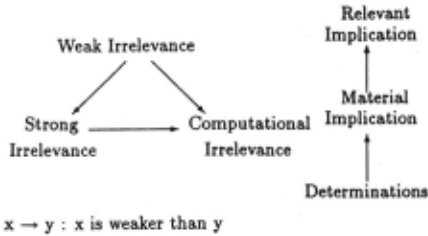
A formal study of irrelevance reveals that there is in teresting substructure in the space of useful irrelevance in ferences. There is a hierarchy of irrelevance logics that is similar to the hierarchy of logics that capture the notion of relevance [Anderson and Belnap 1975],[Davies and Russell 1986] . See Figure 1. These logics are not exact duals of each other; many aspects of the relationship between them remain to be investigated. The statement that f is relevant to g in M conveys the information that knowing f in M re stricts the space of possibilities for g. The statement that f is irrelevant to g in M indicates that the value of g is in """"itiv~ to the value off, in that even iff were changed in M, g would not . In the missionaries and cannibals puzzle, the names ofthe missionaries are irrelevant to the schedul ing of the boat trips. This means that even if the names were changed·, the solution (which does not refer to the missionaries by name) would not. This irrelevance state ment gives us the justification to modify the formulation in which missionaries are named, to the more abstract one that uses the cardinality of the set of missionaries.
· as long as ~hey remain dis~inc~ from each o~her!
The two notions of relevance and irrelevance are com plementary; one expresses a dependence between two facts and the other captures a one-sided lack of dependence (g being not dependent on f). However, the normal use of an irrelevance statement is to modify M while preserving g, the normal use of a relevance statement is to infer restric tions on g given f: thus the inferences they sanction are not duals.
III Properties of Irrelevance
Our notion of irrelevance has the properties of non monotonicity, intransitivity and asymmetry.
A. Non-monotonicity
Irrelevance is non-monotonic in general. If the ad dition of a fact to M causes the truth of g to become contingent on f, then the irrelevance statement ceases to hold. Before Descartes, facts about algebra would have been irrelevant for proving a theorem in plane geometry. Descartes' discovery of analytic geometry connected these two theories together and each has since become relevant to the other.
B. Intransitivity
Irrelevance is not transitive. An example brings this out:
The blight on the tea crop in China is irrelevant to my writing this paper. My writing this paper is irrelevant to the price of tea in China.
Had irrelevance been transitive, we could deduce that :
The blight on the tea crop in China is irrelevant to the price of tea in China.
This makes it difficult to propagate irrelevance conclusions and derive useful irrelevance claims from given ones, except in special cases in Section IV.A.
C. Asymmetry
Irrelevance is also not symmetric in the general case. However, it is symmetric for a certain class of irrel1'v11nce statements I(p,q,M) where p and q are logically indepen dent. Thus knowing p does not help in constraining the possible values of q in the context of M, and knowing q does not help in constraining the possible values of p. The statement My writing this paper is irrelevant to the price of tea in China is an example of a symmetric irrelevance statement. These statements capture independence be tween facts and thus provide a natural way of factoring a formulation. Thus p and q could be put in different parts of the formulation: a change in one part will not have repercussions in the other for any use of the formulation.
IV Theoretical Aspects of Irrelevance
We say that fact f is irrelevant to fact g modulo the set of sentences M, written as I(f,g,M), iff is inessential to the truth of g in M, that is, changing the truth value off in M would not affect the truth of g. One possibility for a formal definition is:
Definition 1: f is irrelevant tog modulo M if Ml= g and ·we can construct a set M' of sentences with the following properties:
- M' is weaker··than M. M => M'
- M' entails g. M' I= g.
- M' is non-committal on f. M'p!: f and M'p!: -,f
Consider this simple propositional example, I and t stand for lightning and thunder respectively.
M1 ={I, t} and M2 ={I, I=> t}.
According to the above definition, .i is irrelevant to t in M1 since we can construct Mt'={t} that has the required ·properties. Also, we can show that I is irrelevant to t in M2 because we can construct M2'={t}. However, we would not like to conclude in the latter case that I is irrel evant tot. This anomaly occurs because we imposed no restrictions on the weakenings ofM. This allowed us to con struct M' that just contains g (since M I= g) and allowed us to conclude everything else in M irrelevant to it. Even though Mt and M2 are identical model-theoretically, the irrelevance judgements were different in the two sets. Thus irrelevance claims are very sensitive toM, which is usually not a closed set of sentences. Irrelevance is an inherently proof-theoretic notion and model theory fails to capture the lack of a dependency between truths of propositions except in the strongest sense, namely independence. For the purposes of this paper, we will adopt the following def inition that constructs weakenings of M by subsetting M. We call this category of irrelevance statements, weak irrel evance statements. Section V.D. examines the case where weakenings of a theory are constructed by collapsing terms in the theory.
Definition 2: f is weakly irrelevant tog modulo M, writ ten as WI(f,g,M) if M I= g and we can construct the set M' with the following properties.
- M' ~ M
- M' is non-committal on f. M'p!: f and M'p!: -,f
- M' is a maximal subset of M with the above two prop erties.
··The set of models of M' are a superset of the set of models of M.
4. M' entails g.
If there are multiple maximal subsets ofM then g must hold in at least one of them. Now, I is no longer irrele vant to t in M2 because we cannot construct the set M2' with these properties. The judgement of irrelevance can be made without imposing the requirement that the subset M' be maximal. However, the maximality condition ensures that the weakening of M constructed is the most conserva tive one; i.e. we weaken M minimally so that it becomes non-committal on f and then show that g still holds in this set. Definition 2 is a specialization of the counterfactual construction proposed in [Ginsberg 1985). This is because irrelevance statements are special cases of counterfactuals.
We investigate the properties of weak irrelevance (Def inition 2) and then define two useful specializations of the definition: strong irrelevance and computational irrel evance.
A. Weak Irrelevance
Iff is weakly irrelevant to g in M, then there exists at least . one proof of g in M that does not use f essentially. This happens when either g is independent of f in M or there are multiple proofs of g in M, ones that use f and ones that don't, so that g can be established without f.
We have WI(f,g,M) and WI(h,g,M), however, we can not conclude that WI(fl\h,g,M). Note that the implication holds in the other direction.
Some properties of this definition are given below. Proofs can be found in [Subramanian 1986).
Observation 1: WI is non-symmetric on its first two ar guments, in general.
Observation 2: WI can be detected by checking if there exists a path to g that does not go through f in the infer ence graph representation of M.
Observation 3: Some axioms of WI are:
- WI(f,g,M):: WI(-. f,g,M)
- WI(fll\f2,g,M) => WI(fl,g,M) V WI(f2,g,M)
- WI(f,gll\g2,M) => WI(f,g1,M) 1\ WI(f,g2,M)
- 4 . ..., WI(f,f,M)
- fl::£'2 => [WI(fl.v.M) => WI(f2,g,M))
- gl::g2 => [WI(f,gl,M) => WI(f,g2,M))
- g E M 1\ f '¥- g => WI(f,g,M)
- S = {p E Mj f => p } 1\ WI(/\pes p,g,M) => WI(f,g,M) when f~ gin M
- S = {p E M I p => g} 1\ WI(f,/\pes p,M) => WI(f,g,M) when g ~fin M
- pEM 1\ Derives-Only(f,p,M) => WI(f,g,M) when Ml=g
Axioms 1 through 6 are straightforward consequences of our definition. Axioms 7 through 10 identify four spe cial cases of redundancy. Axiom 7 says that if g is present in M, then everything except itself is redundant to it. Ax iom 8 states that if all facts that are derivable from fare redundant to g, then f itself is redundant to g in M, un less f directly implies g. Axiom 9 is the dual axiom that shows that f is redundant to g if f is redundant to all facts that derive g, unless g directly implies f. Axiom 10 is a generalization of axiom 7: if p is already in M, then any f that only derives p is redundant tog in M. To complete this axiomatization we need to identify all the base cases for proving redundancy. Since detection of redundancy is semi-decidable, there is good reason to believe that we can not construct a complete axiomatization of WI.
Observation 4: One benefit of proving redundancy of some facts in a theory, is that we can optimize space re quirements by simply removing the redundant facts.
An example of this is in Section VI.B. A proof of redun dancy using the lemmas of WI in the meta-theory of M captures an important property of the proofs of g in M, without exhaustively enumerating them. A problem solver that can prove this redundancy claim at the meta-level can prune a large class of inferences this way. Also if the re dundancy statements were made available to the problem solver, it could compile it into the base level formulation by simply throwing away those facts that cause the redun dancy. This leads to savings in space. To ensure that sav ings in time in proving g result from this pruning, we need to show that the proofs of g that fail as a result are deriva. tionally more complex than the ones that are retained. This is captured in our definition of computational irrele vance. In either case, the deliberation time for. the problem solver will be reduced because the search space of proofs of g in M is reduced by the removal of redundancy.
B. Strong Irrelevance
We say that f is strongly irrelevant to g in M written as SI(f,g,M) if and only iff is not logically necessary for the truth of g and g is not logically necessary for the truth of f. This means that a proof of g in M can be constructed even iff were false and a proof off in M can be constructed . even if g were false.
Example: M = {f, h, h => g} . f is SI tog in M. Syntactic characterization of this relation SI(f,g,M) if and only if WI(f,g,M) 1\ WI(g,f,M) . Using Def inition 2 we can see that M can be split into sub;;.:.~s M1 and M2 with the following properties.
- M = M1 U M2
- M1 is a maximal subset of M such that M1 ~ f and M1 ~ ...,f where M1 F g.
- M2 is a maximal subset of M such that M2 ~ g and M2 ~ ·g where M2 F f.
M1 is the required weakening of M. This definition extends to the first order case straightforwardly. Given the infor mation that g is the only class of queries that need to be answered or the only predicate that needs to be considered for a certain problem solving task, an agent can restrict its attention to M1 alone. An example where this leads to significant computational gain is in Section V.C.
Model-theoretic characterization of a superset of this relation
Consider all models of M, call the set IntM. Project as signments to ffrom IntM: this is the set IntMIJ· Similarly, project out assignments to g from the set of all models of M, call the set IntMig· When f and g are independent of each other in M, the following model-theoretic equation holds.
When the set M can be factored into subsets M1 and M2 as above, the models of M have the Cartesian factorability property. Unfortunately, the converse doesn't hold.
We now describe some properties of this definition.
Observation 1: SI is a special case of Definition 2, i.e. SI(f,g,M) => WI(f,g,M).
Observation 2: The syntactic characterization of SI cap tures a strict subset of the cases covered by the model theoretic definition.
This is because the construction is strongly dependent on the form of M. In order to make the two definitions corre spond, we have to rewrite M in a normalized form.
Observation 3: SI can be detected efficiently by repre senting the sentences of M in an inference graph and check ing that f and g belong to different forests of this graph.
Observation 4: M1 and M2 are computationally bet ter than the combination M for processes whose compu tational complexity is a function f of the size of the set they work on, where f(IMI) > f(IM11) + f(IM21).
One such function is the exponential function. Section V.C. presents an example.
C. Computational Irrelevance
This is a refinement of weak irrelevance where the derivations of g in M are ordered by some measure of com plexity. We say f is computationally irrelevant to g if we can prove gin M without the use off, anrl ~''"' ~hnw that the proof has better complexity characteristics (it might be shorter or be easier to find) . This version of irrelevance leads to the construct.ion of weaker theories with better computational properties.
Syntactic characterization of computational irrele vance
f is CI with respect to g modulo M if we can split M into subsets M1 and M2 such that
- M = M1 U M2
- M1 is the maximal set such that M1 1= f and M1 ~-. f
- M1 I= g
- Deriv-Complexity(g,M1) better-than Deriv-Complexity(g,M2)
M1 is the required weakening of M. This definition extends to the first order case straightforwardly.
Some properties of this definition are:
Observation 1: CI(f,g,M) => WI(f,g,M)
Observation 2: SI(f,g,M) => CI(f,g,M)
The proof uses the fact that the derivational complexity of g in M when M does not entail g is oo.
Observation 3: CI is non-symmetric on its first two ar guments.
Observation 4: CI leads to the construction of computa tionally better subtheories for the class of queries g.
In the missionaries and cannibals problem in which both the individuals and the sets of individuals are present in the formulation, we can show that the existence of the individ uals is CI with respect to the construction of the schedule, since the proof that uses the individuals (as opposed to the set of individuals) is derivationally more complex
V Applications
We show how the data filtering procedure in Dendra! [Buchanan 1974] can be declaratively formulated in our logic. Our logic thus serves as a specification language for the data selection component of a theory formation sys tem. The reasoning required to capture two types of rep resentation reformulation are then presented. The first is an abstraction reformulation for spac~ efficiency in which we identify and minimize redundancy in a problem for mulation. We present a proof of the redundancy of a class of statements in the formulation and show how this ~an be used as a justification for jettisoning that class of facts from the formulation . The next example formalizes Quine's[Quine 1964] notion of indiscernibility of identicals and shows how our irrelevance logic can be modified to sanction inferences that lead to the construction of theo ries of coarser granularity. Our last example explores the role of reasoning about irrelevance in factoring theories and automatic experiment design in learners [Subramanian and Feigenbaum 1986].
A. Data Selection in Dendral
In data interpretation problems, it is useful to declar atively represent heuristics for pruning data points. These heuristics are statements about the computational irrele vance of a certain class of data points with respect to the particular interpretation task at hand. In Dendral they have the following form:
CI(Class of Data points, Structural Theory, Background Theory)
The background theory is the theory of covalent bonding in chemistry as well as the theory of operation of the spec trometer. Isotopic peaks in the mass spectrum are consid ered irrelevant because even if they were taken into account in the construction of the structural theory of the molecule, the predictions obtained from it would not be significantly different from the theory that didn't take these peaks into account. The irrelevance statement is a control heuristic in the search space of all structural theories of the molecule. These theories are ordered by the data points they cover and this heuristic identifies important data points by exclu sion and thus focuses the search in the direction of weaker and simpler theories.
The advantage of specifying these irrelevance claims explicitly is that they have a clearly understood semantics. They can then be derived from other background knowl edge. We can reason about the filtering criteria explicitly and do a comparative sensitivity analysis on them. We can use them in conjunction with other background knowledge to derive new computational irrelevance claims.
B. Reformulation: Removing Redundancy
The formulation of a problem has critical impact on its efficiency. The following example shows how we can use irrelevance reasoning to reformulate a kinship problem to obtain computational efficiency. Figure 2 shows a sim plified family tree representing a set of Father relations. The Ancestor relation is defined as the transitive closure of the Father relation. The goal is to determine whether two people belong to the same family. The defined rel& tion Same-Family is used fo.r this: two people belong to the same family if they have a common ancestor. The time required to compute Same-Family in this formulation is proportional to the height of the family tree. If we are given the extra information that Same-Family is the only relation that will be queried, we could rewrite the family tree information in terms of the Founding-Father relation as in Figure 3. The Founding-Father of an individual is his maximal ancestor in the family tree. The time needed to solve a Same-Family question in the new formulation is a constant: we need to check if the two individuals have the same maximal common ancestor!
Formulation 2. is constructed from Formulation 1 by discarding information that was irrelevant to the compu tation of Same-Family. This is achieved by eliminating the Father relation on grounds of redundancy (captured by weak irrelevance) and then eliminating the intermediate Ancestor links by a computational irrelevance argument. What remains after this theory weakening process are the maximal ancestor links in the family tree.
The redundancy claim can be formally proved:
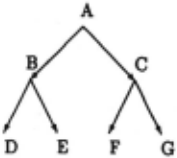
Father{A,B)
Father{A,C)
Father{B,D)
Father(B,E)
Father{C,F)
Father(C,G)
Father{x,y) ~ Ancestor{x,y)
Ancestor(x,z) A Ancestor{z,y) ~ Anceetor(x,y)
Ancestor{z,x) A Ancestor{z,y) ~ SameFamily(x,y)

| FoundingFather(A,B) |
| FoundingFather( A,C) |
| FoundingFather( A ,D) |
| FoundingFather{ A,E) |
| FoundingFather{A,F) |
| FoundingFather( A, G) |
| FoundingFather(z,x) A FoundingFather{z,y) ~ Same |
| Family(x,y) |
A{x,y) E M A Derives-Only(F{x,y), A(x;y), M)
- ~ WI(F{x,y), SF{m,n), M) .
- ~ WI(F(x,y), A(z,m) A A{z,n}, M) by ax. WI6 & ax. M3
- ~ WI(F{x,y), A{z,m), M) A WI(F{x,y), A{z,n), M) by ax. WI3
Each conjunct is true because of ax. WHO.
C. Factoring of theories and experiment design
Strong irrelevance claims allow a theory to be factored into independent subtheories.
M = Mt{Shape) U M2(Colour)
Providing the above irrelevance fact to a blocks-world learner allows it to factor the learning problem into two in dependent subproblems: one for learning shape and one for learning colour. The task of devising informative instances is exponential in the size of M, so that a learner that ac quires information by active experimentation obtains sig nificant computational advantages by this split [Subrama nian and Feigenbaum 1986].
D. Reformulation: Quine's Principle
Quine's maxim of the identification of indiscernibles states that objects indistinguishable from one another in the context of a discourse should be construed as identi cal for that discourse. That is, the references to original objects should be reinterpreted in such a way that indis tinguishable originals give way to the same new object .
The fact that the distinction between two objects is irrelevant for our purposes can be stated in our logic as:
The (perhaps, default) assumption that these 2 distinct terms denote distinct objects is now relaxed. The informal meaning of this is that we would be able to establish Query in a revision of M that did not treat term1 and term2 as distinct.
We call this term irrelevance and define it using fact irrelevance as follows:
Irrelevant(term1 :f term2 , Query, M) = V/.Containl{!, term1) A -.True{flterm 1 Jterm 2 ) ~ W 1{1, Query, M)This says that all facts in M that cause us to infer that the two terms are distinct are irrelevant to the query.
To implement Quine's maxim, we sanction the following inference:
M(term1 , term2), Irrelevant(term1 :f term2, Query, M)
We remove those facts in M that treat the two terms differ ently and then introduce a new term in the coarser theory to stand in interchangeably for two distinct terms in the finer theory.
This leads one to minimize the {objects) primitives in one's theory as opposed to minimizing the conclusions from the theory, which is characteristic of most work in circum scription. Such simplification occurs during the construc tion of Thevenin equivalents in circuits, and in general, in the construction of coarser theories from more detailed ones.
VI Acquisition of Facts about Irrelevance
The three examples above indicate how irrelevance claims can be used for the construction of weaker theories from stronger ones, but leave open the question of how the irrelevance claims are acquired. There· are three principal ways of obtaining such facts
- By being told.
- By deriving them in the meta-theory of M using the calculus of irrelevance.
- By active experimentation in the world.
The computational irrelevance claims in Dendra! were pro vided by the designer. The reformulator in Section VI.B. formally proved the weak irrelevance of the Father relation with respect to the SameFamily relation. The strong ir relevance between shape and colour could be determined empirically by correlation analyses on the values of these two attributes.
VII Conclusions and future directions
This paper introduced the need to represent and rea son explicitly with statements about irrelevance. It identi fied a class of useful irrelevance statements that lead to the construction of logically weaker theories with better com putational properties from stronger, more detailed theo ries. A theoretical framework for the study of irrelevance was proposed that allowed for the specification of irrele vance claims and the deduction of new irrelevance claims from given ones. The kinds of inferences sanctioned by an irrelevance claim were demonstrated by examples: au tomatic factorization of theories; minimization of redun dancy in, as well as restructuring of search spaces for com putational efficiency. We conclude that reasoning about irrelevance is a valuable mode of meta-theoretic reasoning that will enhance the functionality of present-day problem solving systems.
Much remains to be done. We are presently explor ing the mechanization of irrelevance proofs and the de velopment of a better axiomatization for WI and Cl. The characterization of the cases where reasoning about imile vance is useful needs to be generalized. Identifying special purpose methods for detecting SI, WI or CI efficiently will make the use of this kind of reasoning practical. Since ir relevance judgements are made in contexts delimited by relevance reasoning, the interweaving of relevance ana ir relevance reasoning appears to be a fruitful direction to explore. The technical relationship between the logics pre sented here and the logics of relevance [Anderson and Bel nap 1975][Davies and Russell1987][Ginsberg 1985] remains to be fully explained. Certain points in the space of theory weakening operations were identified here: the discovery of useful classes of irrelevance statements that sanction fur ther kinds of theory weakenings with provably better com putational properties is a challenging open problem.
Acknowledgments
We would like to thank Professors Paul Rosenbloom and Bruce Buchanan for their valuable contributions to this work. Chris Fraley, David Smith, Matt Ginsberg, Stu art Russell, David Wilkins, Haym Hirsh, Jane Hsu and Jeff Finger provided technical help and encouragement. The first author is supported by an IBM doctoral fellowship .
@inproceedings{ijcai1987p83,
  title     = {The Relevance of Irrelevance},
  author    = {Subramanian, Devika and Genesereth, Michael R.},
  booktitle = {Proceedings of the Tenth International Joint Conference on
               Artificial Intelligence, {IJCAI-87}},
  publisher = {International Joint Conferences on Artificial Intelligence},
  editor    = {John McDermott},
  pages     = {416--421},
  year      = {1987},
  note      = {Knowledge Representation},
  url       = {https://ijcai.org/proceedings/1987/83},
}
TY - CPAPER TI - The Relevance of Irrelevance AU - Subramanian, Devika AU - Genesereth, Michael R. T2 - Proceedings of the Tenth International Joint Conference on Artificial Intelligence, IJCAI-87 PB - International Joint Conferences on Artificial Intelligence PY - 1987 SP - 416 EP - 421 UR - https://ijcai.org/proceedings/1987/83 ER -Copied
Machine-readable versions of this paper, for tools and AI agents:





