
Constraints in a Hybrid Knowledge Representation System
Proceedings of the Tenth International Joint Conference on Artificial Intelligence. Architectures and Languages. Pages 30-32.
© 1987 International Joint Conferences on Artificial Intelligence
Abstract
In our research group, the hybrid knowledge representation system Babylon has been developed providing formalisms for rules, prolog and frames. Beyond it, we implemented Consat, a system for constraint satisfaction . Since applications of Babylon for process diagnosis, planning etc . required constraints, we integrated Consat into the Babylon environment . The paper describes the integration of Consat into Babylon, regarding two aspects : First , constraints should be available as another Babylon formalism by using the functional interface of Consat . On the other hand, it is important to have constraints implicitly controlling other Babylon formalisms , for instance, in order to keep the system's database consistent. While with respect to the first point, the paper describes work already finished, the second form of integration is work in progress .
- T. Christaller, E. Gross, B.S. Mueller, E. Rome, J. Walther. Soflwareenlwurf und Realisierung des Experlensyslem- Werkzeugs BABYLON mil Hilfe obleklorient!erter Program- mierung. Proceedings of the GI-88, 1986.
- R. Davis. Diagnostic Reasoning Based on Structure and Behavior. Artificial Intelligence 24 (347-410), 1984.
- J . Diederich, I. Ruhmann, M. May. KRITON : A Knowlede;e Acquisition Tool for Expert Systems. Proceedine;s of the AAAI-Workshop: Knowlede;e Acquisition for Knowlede;e Based Systems, 1986.
- Forschungsgruppe Experlensysleme. Referenzhandbuch . GMD, 1985.
- BABYLON- E. C. Freuder. Synthesizing Constraint Expressions. Com- munications of the ACM, Vol.21, No.11 (958-966), 1978.
- H.W. Guesaen. CONSAT -Foundations of a System for Con- straint Satisfaction. GMD, 1986.
- D.R. Harris . A Hybrid Structured Object and Constraint Representation Language . Proceedinas of the AAAI-86 (986-990), 1986 .
- U. Junker. Integration des Constraint-Systems CONSAT In das Werkzeugsyslem BABYLON. GMD, 1986.
- J. deKleer, B.C. Williams. Diaanosina Multiple Faults. Proceedings of the AAAI-86.
- F. diPrimio, G. Brewka . Babylon: Kernel System of an Integrated Environment for Expert Systems Development and Operation. Proceedings of the Fifth International Workshop on Expert Systems and their Applications, Avla- non, 1965.
- F. diPrimio, G. Brewka, K. Willur. Integration of Formalisms in Babylon. GMD , 1986.
- M.H. Richer. An Evaluation of Expert System Development Tools. Expert Systems, Vol.3, No .3, 1986.
- R. M. Stallman, G. J . Sussman . Forward Reasoning and Dependency-Directed Backtracking in a System for Computer-Aided Circuit Analysis. Artificial Intelligence 9 (135-196), 1977.
- G. L. Steele . The Definition and Implementation of a Com- puler Programming Language Based on Constraints. MIT, 1980.
- M. Stefik. Planning with Constraints (MOLGEN: Part 1). Artificial Intelligence 16 (111-140) , 1981.
- A. Voss, H. Voss. A Uniform View on Local Constraint Propa- gation Methods. Proceedings of the KIFS-87, 1967.
- D. L. Waltz. Generating Semantic Descriptions from Draw- ings of Scenes with Shadows. MIT, 1972.
References were extracted automatically from the PDF and may contain errors.
Full text extracted automatically from the PDF; figures, tables and equations may differ. The PDF is the version of record.
1. Introduction
Constraint networks are evolving as another style of knowledge representation beside rules, logic, frames, etc. in many domains such as qualitative rea soning and planning. A hybrid knowledge representa tion system called Babylon pas been developed in our group at GMD Sankt Augustin [Forschungsgruppe Expertensysteme 1985], [diPrimio, Brewka 1985], that - so far - provides rules, prolog, and frames . However, Babylon is open to integrate any other formalisms which can be achieved by simple extensions of the sys tem. Currently, in our group a planning system, a knowledge acquisition system [Diederich et a!. 1986], and a system for process diagnosis are being developed, all of which depend on the availability of some constraint mechanism (cf. Molgen [Stefik 1981] as a planning system using constraints, and [Davis · 1984] and [deK!eer, Williams 1986] as diagnosis sys tems using constraints). Thus, there is an urgent need to extend Babylon to a constraint formalism.
Independently from Babylon but with the pur pose of later integration, a constraint system called Consat (Guesgen 1986] has been developed. Consat allows to define hierarchical networks of domain independent constraints. The variables in a network · can be assigned sets of values that are propagated to compute the maximal locally consistent assignment, the globally consistent assignments, or to detect an inconsistency in the original assignment.
CONSTRAINTS IN A HYBRID KNOWLEDGE REPRESENTATION SYSTEII
H. W. Gu.esgen, U. Ju:nker, A. Voss
Expert Systems Research Group Gesellschaft fuer Mathematik und Datenverarbeitung (GMD) Postfach 1240 D-5205 Sankt Augustin 1, F.R.G.
Due to the open-endedness of Babylon, integra tion of Consat as another formalism was straightfor ward. As a result, rules, prolog goals, frame instances with their slots and behaviors can be used in the definition of constraints. Vice versa, rules, prolog clauses, frames and behaviors can use·constraint net works for the computation of relations or the detec tion of inconsistencies with resprect to some given values.
Apart from having constraints symmetrically to the other formalisms, we would like to use them asym metrically as watching over the other formalisms:
Babylon has a dynamic database containing frame instances, items produced by rules, and facts asserted by prolog. Insofar as these data may be inter preted as values of certain variables, the variables could be identified with the variables in some con straint network. Now if all data changes are implicitly passed to the constraint network, propagated therein, and the results are implicitly returned to the data base, we use the constraint network to watch the data of the other formalisms .
This asymmetric use of constraints saves much explicit programming needed to maintain the con sistency of the database. It is particularly attractive in a hybrid system where very different types of data as produced from the different formalisms have to be maintained consistent.
So far we know only one other hybrid system that provides constraints as a real knowledge representa tion formalism. It is the Socle system that combines constraints with a frame formalism [Harris 1986]. Other systems like ART, KEE, or Knowledge Craft use constraints only limited to the scope of single frame instances in order to express context sensitive res trictions on their slot values (cf. [Richer 1986]).
The integration of Consat in Babylon has been completed with respect to the symmetric case and has been delivered as an experimental feature of Babylon release 2.0 in January '87. Immediately afterwards, we will implement the asymmetric integration for which currently only a restricted prototype with an interface to the frame formalism has been implemented (Junker 1986].
2. Two sylllema as a Blarting point
Before discussing the integration of Consat into Babylon we will consider the two systems separately in some more detail.
2.1. The constraint.IIYAem CoDAl
Consat is a domain-independent constraint satis faction system [Guesgen 1986] allowing to propagate arbitrary symbolic values.
A constraint establishes a relation between cer tain variables. In Consat, the relation may be defined e%tensionalty by enumerating all tuples. The following example is extracted from the description of traffic lights with two fires:
(defconstrainl
(:name inverse-stale) (:type primitive) (:interface fire 1 fire2) (:relation (:tuple (on off)) (:tuple (off on)))),In Consat, constraints can also be defined inten sionally by functional e:epressions for all variables In terms of the other variables as In the following exam ple: (defconstrainl (:name sum) (:type primitive) (:interface addenll addent2 sum) (:relation (:pattern (addentl addent2 (+ addentl addimt2)) :if (conslrained-p addenll addent2)) (:pattern (addentl (·sum addenll) sum) :if (constrained-p addentl sum)) (:pattern((- sum addent2) addenl2 sum) :if (conslrained-p addent2 sum)))).The condition following :if ensures that, e .g., ( + addentl addenl2) is computed only If the arguments are assigned a set of definite values. Thus, the func tional patterns may be conditioned. In extreme cases, the condition may play the role of a characteristic predicate for the relation:
(defconstrainl
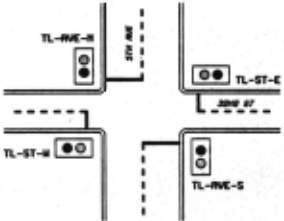
(:name greater) (:type primitive) (:interface x y) (:relation (:pattern (x y) :if ( < x y)))).Constraints can be composed to hierarchical net works of constraints. Figure 1 sketches the traffic lights of the crossing between 5th avenue and 32nd street.
The corresponding constraint network can be defined using eight variables, one for each fire:
(defconstrainl(:name traffic-lights) (:type compound) (:interface ll·ave-n-red ll-ave-n-green ll-ave-s-red ll-ave-s-green li-sl-e-red li-sl-e-green ll·st-w-red ll-st-w-green)(:constraint-expressions (inverse-state ll-ave-n-red ll-ave-n-green) (inverse-stale ll-ave-s-red ll-ave-s-green) (inverse-slate li-sl-e-red li-sl-e-green) (inverse-state ll-st-w-red tl-st-w-green) (same-state tl·ave-n-red tl-ave-s-red) (same-state ll-st-e-red ll·st-w-red) (inverse-state tl-ave-n-red tl-st-e-red))) .Constraints have been used to filter sets of values assigned to the variables (cf. Waltz's filtering in scene analysis [Waltz 1972]), and to compute new values from given ones as, e.g., in electrical circuit analysis [Stallman, Sussman 1977]. Consat supports both aspects by allowing sets of values to propagate in two modes (terminology is taken from [Voss 1987]):
- Given the definition of a constraint network and an initial assignment of value sets to the variables of the network, the system can compute the mazimal locally consistent assignment by local propagation. For example, the expression
This is a unique assignment which describes the situa
(satisfy traffic-lights :locally :with tl-ave-n-green = 'on) evaluates to ((ll-ave-n-red off) (ll-ave-n-green on) (ll-ave-s-red off) (ti-ave-s-green on) (ll-st-n-red on) (ti-st-n-green off) (li-st-s-red on) (tl-st-s-green off)) . tion already shown in figure 1.If one of the variables is assigned the empty set as a result of local propagation, the network is incon sistent with respect to the initial assignment.
- Given a network and an initial assignment to the variables of the network, the system can compute one, a specific number or all globally consistent assignments by local propagation, tentative assump tions and backtracking. If such an assignment does not exist, the initial assignment following the keyword :with has been inconsistent and nil is returned. In the preceding example, the globally consistent solution is identical with the locally consistent solution, because all variables are uniquely determined. In general. a locally consistent assignment is only an approximation containing the globally consistent solution (cf. [Freuder 1978]).
Summarizing, we observe that Consal supports a purely functional view: After computing the final assignments for the variables, all values are forgotten. In contrast to [Steele 1980], there is no way to restrict and propagate values in the network incrementally. As a consequence, no reason maintenance system is needed in Consat. With regard to the integration of Consal in Babylon, we wanted to avoid double work: In Babylon, we can use frame instances to record the state of the network.
2.2. The Babylon philosophy of integration
Babylon is a knowledge representation system that is open to integrate arbitrary knowledge representation formalisms [ diPrimio et al. 1986],[Chri staller et al. 1986]. This open-endedness is achieved by having separate interpreters for each formalism which do not know from one another. Instead they know a meta interpreter that is responsible for all communications.
So far, Babylon provides a frame formalism with multiple inheritance and active values, prolog, and a rule formalism without variables but with optional for ward and backward chaining strategies.
In order to integrate a new formalism like con straints or a database language, we just have to pro vide an interpreter for the new formalism and inform the meta interpreter in a so-called processor mixin about the new types of Babylon expressions to be encountered in the other formalisms .
3. Integration of Consat in Babylon
Planning to integrate constraints in Babylon, there was an obvious solution offered by Babylon's open-endedness to new formalisms. We will first dis cuss this solution of adding constraints as another formalism before we turn to an alternative where we have constraints silently controlling the other formal isms.
3.1. Constraints as another Babylon formalism
According to section 2.2, we can integrate the constraint formalism into Babylon by
- establishing the Consat interpreter as a new language processor,
- introducing satisfy expressions calling Consat's two propagation functions as new types of Babylon expressions.
Now, we can use constraints in rules, prolog clauses, and behaviors of frames . For example, we could write a rule reacting to the inconsistent assign ment detected by the traffic-lights network from sec tion 2.1:
({Sand (not (satisfy traffic-lights :globally :with tl-ave-n-green = 'on tl-st-e-green = 'on)) .. .further conditions ... ) (Sexecute (handle-inconsistency))).The consistency check is a meaningful application of constraints in rules. Besides, in the prolog formal ism we can bind the result of constraint propagation to prolog variables for further processing in that for malism:
(is _va (satisfy traffic-lights :locally :with tl-ave-n-green = 'on) (candidate _va _til = tl-st-e-red _tl2 = li-sl-e-green)In the first clause, the variable _va is bound to the maximal locally consistent assignment, which is used in the candidate clause to assign the elements of the value sets successively to the specified prolog vari ables. In our example, the candidate clause results in binding _t! 1 to on and _t!2 to off. If backtracking occurs, the candidate clause would result in fail, since the maximal locally consistent assignment is unique.
Beside using constraints in other formalisms, we can use the other formalisms in order to define con straints. In particular, we can use slots and behaviors of frames in the functional expressions of the :pattern construct, and prolog goals as conditions following the keyword :if.
3.2. Constraints watching other Babylon formalisms
The integration of constraints as a new Babylon formalism is not satisfactory due to the functional interface of Consat. Thus, it is difficult to impose any constraints on the slot values of a frame instance (as e .g. in ART. KEE, or Knowledge Craft), because these constraints should be attached permanently to the slots and they should be invoked implicitly whenever a slot value is about to change. For example, we would like to define a frame traffic-light with two slots for the fires and the inverse-state constraint keeping them consistent.
We could extend this example to a crossing frame with four slots for the four traffic lights (and another slot to remember the time of the last switch) . To keep the traffic lights consistent, we would like to attach traffic-lights-constraints similar to the traffic-lights constraint in section 2.1 to all instances of the frame .
{defframe traffic-light {slots (red-fire- :possible-values {:one-of on off)) ... further slots ... )) {defframe crossing {slots {tl-ave-n:possible-values {instance-of traffic-light)) ... further slots ... )) (attach-constraints (:name traffic-lights-constraints) (:attachments (:for-all tl = (instances-of traffic-light) (inverse-state (tl red-fire) (tl green-fire))) (:for-all xing = (instances-of crossing) (same-state ((xing tl-ave-n) red-fire) ((xing tl-ave-s) red-fire)) (same-state ((xing tl-st-e) red-fire) ((xing tl-st-w) red-fire)) {inverse-state ((xing tl-ave-n) red-fire) ((xing tl-st-e) red-fire)))))Now, given the crossing 5th-ave-32nd-st from figure 2.1 as an instance of the crossing frame, what do we expect from attaching the traffic-lights constraints? We could write some rules to regulate the traffic lights of the crossing depending on the cars in the street and in the avenue, and depending on the time elapsed since the last switch, for example:
(rule4 (Sand (ear-in-ave 5th-ave-32nd-st) ( car-in-st 5th-ave-32nd-st) (green-phase 5th-ave-32nd-st avenue 1)) (Sexecute ( <- 5th-ave-32nd-st :let-thru 'street)))The rule uses the prolog goals ear-in-ave, car-in st and green-phase, which reftect the situation in the avenue and in the street, respectively. When the rule fires, the expression ( <- 5th-ave-32nd-st :let-thru 'street) is evaluated, executing the behavior :let-thru, which translates its parameter street into the traffic light tl-st-e . If the green fire is not yet on, it is switched, and all other fires are reset to undeter mined, thereby triggering the traffic lights con straints. The new values - on for green-fire of tl-st-e and undetermined for all other fires - are propagated. The result, a definite state on or off for each fire, is assigned implicitly to all fires of all traffic lights in our crossing, so that a new consistent state is obtained.
In the context of Babylon, the idea of using con straints to watch the data of another formalism should be generalized in a way that is open to arbi trary other future formalisms of Babylon. The key of such a generalization is to introduce the new concept of a Babylon variable. A Babylon variable is a con struct in some Babylon formalism that can be mean ingfully associated with a value. For example, a Babylon variable in the rule formalism could be any text like "Peter is sick" that can be asserted or negated in the database and thus can be interpreted as a Boolean variable. A Babylon variable in prolog could be any fact that can or cannot be derived from the current database and thus can also be interpreted as a Boolean variable.
Allowing arbitrary Babylon variables in the attach-constraints construct, we can impose con straints between very different data emerging from the different formalisms .
Having attached a constraint network to certain Babylon variables, demons must be installed for each of them. This task should be left to the interpreters of the variables' formalisms according to the idea that the individual interpreters should not know each other. Whenever a Babylon variable shall be changed, its demon must inform the constraint interpreter- of course via the meta interpreter. The constraint inter preter then must collect the current values of all Babylon variables that are in the same network as the one to be changed. This is again achieved via the meta interpreter. The collected values are propagated to compute the maximal locally consistent assign ment: This assignment determines a set of values for each Babylon variable in the network which is returned - via the meta interpreter - to the inter preters of the variables' formalism. Processing these values is again left to the individual interpreters since different reactions may be meaningful in different for malisms. For example, reactions to an empty assign ment may be to suppress the intended change of values or to ask the Babylon user. Or, if local propaga tion returns not a simple value but a set of definite values, . this set may simply be forgotten or stored in some appropriate place: In the case of frames, the set of values may be stored in the :possible-values pro perty, which is available for each slot.
4. Conclusion
We have presented two systems, the constraint satisfaction system Consat and the hybrid knowledge representation system Babylon. There are two compa tible ways of integrating Consat into Babylon: Firstly, as another knowledge representation formalism beside rules, ·prolo'g, and frames , and secondly, as a mechan ism watching over the other formalisms. The integra tion is realized according to the philosophy of Babylon, so that the next formalism to be added to Babylon - say a database language - can at once use constraint expressions as a special type of Babylon expressions or can be watched by attached constraint networks.
We already mentioned that, so far, we only know of one other hybrid system that provides constraints as another knowledge representation formalism. But in the Socle system [Harris 1966], constraints are combined only with a frame formalism, not with rules or prolog as in Babylon. The constraint component of Socle differs from Consat in having networks with a state so that constraints can be stepwise restricted and retracted. This rises much more problems since both, the state of the network and that of the frame objects, have to be kept consistent. Integrating Consat into Babylon was easier due to the purely functional interface of Consat. On the other hand, being integrated into Babylon, Consat profits from all features offered in Babylon. For example, constraint networks can be made permanent by attaching them to permanent data from other formalisms, in particu lar to frame instances. As another example, a reason maintenance component, which is being planned for Babylon, will also be available for Consat in Babylon.
The integration of Consat in Babylon has already been accomplished for the symmetric case and is available since January 1967 in release 2.0 of Babylon. The asymmetric case has been implemented prototypi cally with an interface to the frame formalism only [Junker 1966). Implementation of the full feature will start in January'67, parallel to the implementation of the process diagnosis system which we consider as a major application test of our integration of con straints in Babylon.
5. Acknowledgements
We thank all members of our group for their con tributions to this paper. Special thanks to Ursula Bernhard who read former versions of the paper.
6. References
- Christaller, E. Gross, B.S. Mueller, E. Rome, J. Walther. Soflwareenlwurf und Realisierung des Experlensyslem Werkzeugs BABYLON mil Hilfe obleklorient!erter Program mierung. Proceedings of the GI-88, 1986.
- Davis. Diagnostic Reasoning Based on Structure and Behavior. Artificial Intelligence 24 (347-410), 1984.
- J . Diederich, I. Ruhmann, M. May. KRITON: A Knowlede;e Acquisition Tool for Expert Systems. Proceedine;s of the AAAI-Workshop: Knowlede;e Acquisition for Knowlede;e Based Systems, 1986.
- C. Freuder. Synthesizing Constraint Expressions. Com munications of the ACM, Vol.21, No.11 (958-966), 1978.
- H.W. Guesaen. CONSAT - Foundations of a System for Con straint Satisfaction. GMD, 1986.
- D.R. Harris . A Hybrid Structured Object and Constraint Representation Language. Proceedinas of the AAAI-86 (986-990), 1986.
- Junker. Integration des Constraint-Systems CONSAT In das Werkzeugsyslem BABYLON. GMD, 1986.
- deKleer, B.C. Williams. Diaanosina Multiple Faults. Proceedings of the AAAI-86.
- diPrimio, G. Brewka. Babylon: Kernel System of an Integrated Environment for Expert Systems Development and Operation. Proceedings of the Fifth International Workshop on Expert Systems and their Applications, Avla non, 1965.
- diPrimio, G. Brewka, K. Willur. Integration of Formalisms in Babylon. GMD, 1986.
- M.H. Richer. An Evaluation of Expert System Development Tools. Expert Systems, Vol.3, No.3, 1986.
- M. Stallman, G. J . Sussman. Forward Reasoning and Dependency-Directed Backtracking in a System for Computer-Aided Circuit Analysis. Artificial Intelligence 9 (135- 196), 1977.
- L. Steele. The Definition and Implementation of a Com puler Programming Language Based on Constraints. MIT, 1980.
- Stefik. Planning with Constraints (MOLGEN: Part 1). Artificial Intelligence 16 (111-140) , 1981.
- Voss, H. Voss. A Uniform View on Local Constraint Propa gation Methods. Proceedings of the KIFS-87, 1967.
- L. Waltz. Generating Semantic Descriptions from Draw ings of Scenes with Shadows. MIT, 1972.
Forschungsgruppe Experlensysleme. Referenzhandbuch. GMD, 1985.
BABYLON-
@inproceedings{ijcai1987p6,
  title     = {Constraints in a Hybrid Knowledge Representation System},
  author    = {Guesgen, Hans W. and Junker, Ulrich and Voß, Angi},
  booktitle = {Proceedings of the Tenth International Joint Conference on
               Artificial Intelligence, {IJCAI-87}},
  publisher = {International Joint Conferences on Artificial Intelligence},
  editor    = {John McDermott},
  pages     = {30--32},
  year      = {1987},
  note      = {Architectures and Languages},
  url       = {https://ijcai.org/proceedings/1987/6},
}
TY - CPAPER TI - Constraints in a Hybrid Knowledge Representation System AU - Guesgen, Hans W. AU - Junker, Ulrich AU - Voß, Angi T2 - Proceedings of the Tenth International Joint Conference on Artificial Intelligence, IJCAI-87 PB - International Joint Conferences on Artificial Intelligence PY - 1987 SP - 30 EP - 32 UR - https://ijcai.org/proceedings/1987/6 ER -Copied
Machine-readable versions of this paper, for tools and AI agents:





