
Marker-Passing and Microfeatures
Proceedings of the Tenth International Joint Conference on Artificial Intelligence. Cognitive Modeling. Pages 151-153.
© 1987 International Joint Conferences on Artificial Intelligence
Abstract
The cognitive modeling community is presently divided between two different approaches to the •pread of activation through networks. One school holds that .ymbolic information mut be procagated, the other that numeric weights are used and activation spreads in a more analog manner . In this paper we describe a mechanism which allows the two processes to be merged via the introduction into the .ymboJic network of a dejininf•C/aGrllcferiftic link which is affects the spread of the .ymbolic information in a manner resembling local connectionist computations . We demonstrate that the combined .ystem is more powerful than either or the separate models alone.
- Anderson, J.R The Architecture of Cognition, Harvard University Press, Massachusetts, 1983.
- Blelloch, O.E. AFL-1: A programming language for mauivelN concurrent computer~ MIT Al Laboratory, Technical Report AJ-TR 918 (forthcoming, 1986).
- Brachman, RJ. A Structural Par•digm For Repreunting Knowledge TR # 3605, Bolt, Baranek, And Newman, Ma. May, 1978.
- Charniak, E.C. "Passing markers: A theory of contextual influence in language comprehension." Cognitive Science 7( 9), July -Sept. 1983.
- Collins. A.M. and Loftus, E.F. A spreading-activation theory of semantic processing Psychological R eview, 6, 1972, 107-128.
- Collins, A.M. and Quillian, M.R Does category size effect categorization time? Journal of Ve rbal Learning and Verbal Behavior, 9, 1970, 192-198.
- Cottrell, G.W. A Conn ect ionist Approach to Word Sens e Disambiguation Doctoral Dissertation, Computer Science Department, University of Rochester, May, 1985.
- Cottrell, G .W Connectionist parsing Proceedings of the Seventh Annual Conference of the Cognitive Science Society, 1985, !101-!111 .
- Fahlman, S.E. NETL: A system for represe nting and using real- world knowledge MIT Press, 1979.
- Feldman, J.A. and Ballard, D.H. Connectionist models and their properties Cognitive S cience, 6, 1982. !105-!154.
- Granger, RH. , Eiselt, K.P . and Holbrook, J.K. Parsing with Par~lle/iom : A Spr eading-Activation Mod el of Inference Processing Durtng Te%1 Under.tanding Artificial Intelligence Project, University of Cahforma, lrvme Technical Report #228, Sept. 1984.
- Hendler, J.A. Integrating Marker-passing and problem-solving: A spreading activation approach to impro ved choice in planning i. Doctoral Dissertation, Brown University , January, 1986. ii . Ablex Publishing Corp., NJ. 1987 (in press).
- Hendler, J.A. Extending Mar K•:r-Passing to Microfeatures: A cautious step towards the subsymbolic. in Advance. in Cognitive Science Vol. liN. Sharkey (ed.) Ablex, N.J. (in press) (1~)
- Hinton, O.E., McClelland, J.L., and Rumelhart,D.E. Distributed Representations, in Rumelhart, D.E . and McClelland, J.L. (eda.) Parallel Didrihted Comp•ting MIT Press, Cambridge, Ma., 1986.
- Hirst. O.J. Semantic Interpretation Againat Ambig•itr Brown University Computer Science Technical Report CS-83-25, Dec . 1983.
- McClelland, J.L., Rumelh&rt,D.E. and Hinton, O.E. The Appeal of Parallel Distributed Computing, in Rumelh&rt, D.E. and McClelland, J.L. (eda.) ParaUel Diatributed Comp•ting MIT Press, Cambridge, Ma., 1986.
- Norvig, P . Recovering Intended Inference~ from Tezt, Doctoral Dissertation, Computer Science Department, University of California at Berkeley, (forthcoming).
- Quillian, M.R. Semantic Memorr, Doctoral Dissertation, Carnegie Institute of Technology (Carnegie-Mellon University), 1966. Published as Report 2, Project 8668, Bolt, Baranek, and Newman Inc., 1966. (2~)
- Tanenhaua, M.K., Leiman, J.M., Seidenberg, M.S. Evidence for multiple •ta&• in the proc-ing of ambiguous words in syntactic contexte /nrrtal of Verbal Learrtirtg artll Varhl Bellnior, 18(4), 1976, 181-681.
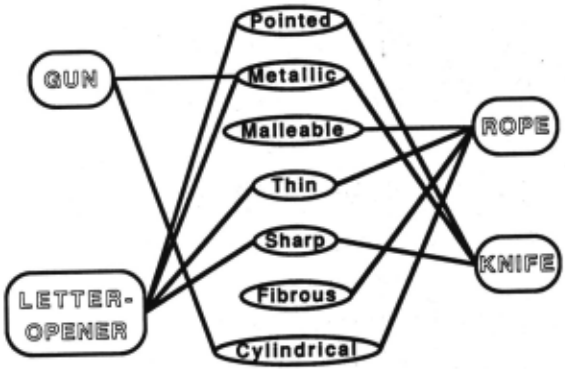
- Touretzlcy, D.S. and Hinton, O.E. Symbols among the neurons: Details of a connectionist inference architecture Proceeding• of tile Nintll Irtternatiortal /oirtt Cortferertce or& Artificial lntelliger&ce, 1985, 198-f.IS. Figure 1: Defining-Characteristic links In a network (19) (20) (21) (22) () 154
- Reggia, J. Virtual inhibition in parallel activation .models .of asaociative memory Proceeding• of tile 1111 /rtterrtahonal lotnt Conference on Artificial Intelligence, 1986, 144-148.
- Rumelhart, D.E. and McClelland, J.L. (eda.) Parallel Diatrihtell Comp•ting MIT Press, Cambridge, Ma., 1986.
- Seidenberg, M.S. The time course of information activation an.d utilization in visual word recognition Ruding Ruurcll: Advan.cu '" Tlteorr and Practice, Vol. 5 (ed.) Boener, Waller, and MacKmnon, Academic Press, New York, 1985, HII-B5B.
- Shastri, L. Evidential Reaaoning in Semantic Networh~ A for~al tlteorv and ita parallel implementation Doctoral Dteaert&tton, Computer Science Department, University of Rochester, Sept., 1985.
- Swinney, D.A. Lexical access during sentence compreh. ension: (Re)Consideration of context effects lo•rnal of Verbal Lecrrttng and Verbal Bellavior, 18, 1979, 645-659.
References were extracted automatically from the PDF and may contain errors.
Full text extracted automatically from the PDF; figures, tables and equations may differ. The PDF is the version of record.
Introduction
Spreading activation, in the form of computer models and cognitive theories, has recently been undergoing a resurgence or interest in the cognitive science and AI communities. Two competing schools of thought have been forming. One technique, that of mGrker·JIGIIinf, is based on the works of Quillian [18] and concentrates on the passing of .ymbolic information through an IIS!OCiative knowledge representation. A second group, holding to the p11rtdlel di·tribvtetl proce··inf[20] or connectioni·t approach, has focused on the passage or numeric information through an IIS!OCiative network.
The primary advantage of the former group is that such systems gracefully interact with traditional AI symbolic processing models for natural language processing [4][11][15][17] and planning [12] and accounting for the psychological results in various experiments (for example [6][21][23][24]). The connectionist approach, however, has proven useful for modeling various types or cognitive performance that the symbolic approach has traditionally had problems with: similarity based reasoning, learning, and categorisation tasks. Both local connectionist models, such as thoee oC [10],[22], and distributed models [14] seem to best account for results from the psychological literature on categorisation (discussed in [1][16]). Both groupe have proposed massively parallel models for these computations. This is a corner stone of the connectionist approach, but various models massively parallel algorithms for performing symbolic marker-passer have been proposed [2][9][12] .
It is our strong contention that neither a purely connectionist scheme nor a marker-passing approach which ignores connectionism is as powerful as a mechanism which combines some of the beat features of each. This paper comparee the connectionist and marker-passing approaches and shows why neither alone seems adequate, describes an implemented mechanism that solves provides integration between these approaches and handles some of thoee problems neither approach is sufficient to solve, and · concludes by describing where this work is heading. 1 .
The need for hybrldt..atlon
To justify the necessity of combinins the competing formulations of activation spreading, we start by examining some 11pecific strengths and weaknesses of each approach.
1- Thia paper ia a brief deeerip~ion of work deaeribed in more do~ail in J!SJ. impJemen~a~ion de~aiJs and fu~ber jUI~iftcaUona can be found ~herein .
Marker-p.-lnl and MlcrofeatUJ'e8
James A. Hendler
Computer Science Dept./Systems Research Center University of Maryland, College Park
The marker-passing approach works in an associative network in which links representing symbolic information (rather than simply link strengths or the like) are present. Information is passed through these links to to find connections between nodes in a "mechanistic" way, as opposed to the approach of using inferencing algorithms consisting of a set of deductive rules. Marker-passing algonthms have been formulated which can pass very simple information [9] or complex marks which include various amounts of control information for use in the marker-passing process [4][12][18] .2
That the marker-pssing approach integrates well with standard AI systems can be seen, for example, in the word sense disambiguation system of Hirst [15] which model approaches ambiguity by setting up a set or frames that put word senses in one to one correspondence with semantic meanings. Each sense of a given word "competes" for recognition based on two criteria: the syntactic information available and the connectedness of the words to each other. This connectedness was found via a marker-passing .ystem.
Hirst's system would handle the word "ball" in a phrase like The rv66er 61111 by using marker-passing to find connections between the various word senses of the words in the phrase. When this phrase was encountered the system would pass markers between rubber and ball and a path such as
RUBBER -+ {lea rubber material) -+ material -+(compoeed-of phy..,bj material)-+ phy..,bJ -+ {lea ·phere phyaobl) -+ ·phere -+ (word-sense ball ·phere) -+ BALL
would be found . This would cause the preference of the sphere meaning of ball over the dance meaning.
By integrating his word sense disambiguator into a syntactic parser Hirst was able to use syntactic clues in performing disambiguation. For example, the word "TIRE" in the sentence Tlae left front tire i· jf11t. can only be a noun, not a verb, and Hirst's system could use this information to ignore the VERB senses.
An alternate approach to word sense disambiguation is th~ or Cottrell [7] which usee a local connectionist system to perform the disambiguation. The correct interpretation of the sentence would be found at the end or a pe~od of numeric computation by examining the nodes remaining activated in a stable configuration.
For Cottrell to produce a parse to provide syntactic information to the disambiguator would require the design or a syntactic parsing scheme within the massively parallel framework. This may not be impossible, in fact Cottrell [8] discusses some steps in exactly such a direction, but at present connectionist schemes are not having tremendous success at producing such results. In fact, a general weakness of connectionist approaches is the generation or sequential behavior which seems to be. an integral part or language processing, planning, etc.
Marker-passing algorithms, too, have limitations, the primary or which is the need for explicit symbolic knowledge connecting the objects being examined. Consider how a system like Hirst's might handle the following two sentences:
John attacked Bill with the knife. John attacked Bill with the letter opener.
The marker-passer would find the path:
ATTACK
- --+ Instrument ot a physical attack Is a weapon
- -+ weapon -+ a knire is a weapon
- --+KNIFE
and thus be able to recognize the first sentence as a physical attack (as opposed to say a heart attack or an attack by satire). Such a path won't be found for the second sentence unless we had specifically encoded the information that a letter-opener can be used as a weapon. Assuming such knowledge was not available, a system such as Hirst's could not use the marker-passer and would need to default to other, more complex mechanisms.
Finding similarities between objects has been a traditional problem for symbolic AI systems in much the way that sequential behavior has been a traditional problem for connectionist systems. While some knowledge representation schemes have a limited ability to do classification, this classification is generally viewed as a separate control process 1 . What we need in this case is a decomposition of an object into components and the categorization of a set of components during the marker-passing phase. Information must be provided to allow a marker to flow from letter opener to knife. We could use a predicate such as
(IS-LIKE LETTER-OPENER KNIFE) to solve this problem, but such a solution is clearly lacking in elegance and, in fact , will not solve the more general case 2 .
What is needed here appears to be some sort of breakdown of the letter-opener into a set of features and a recognition that those features share many similar characteristics with a knife .
Recognizing similar characteristics, a major problem for symbolic systems, is one of the strengths of a connectionist model. A microfcature based analysis, which decomposes a single object into a set of smaller, usually perceptual , features is a technique which has been shown viable in the connectionist framework [14][16] . Activation strengths flowing from an object to a set of microfeatures, or from a set of microfeatures to an object are modeled via numeric weights in a network. Placing activation on one object can cause other similar objects to gain activation. Further, the use of microfeatures appears to be consistent with the results of psychological experimentation (as cited in [16]}.
A hybrid mechanism
In this section we describe a mechanism that combines a marker-passing algorithm with a local connectionist, microfeature based, network. The scheme we propose here consists of two parts: an extension to the knowledge representation, allowing the presence of the microfeature information, and an extension to the marker passer which allows this knowledge to be used. The particular formulation of marker-passing we describe come from a planning mechanism called SCRAPS wherein the marker-passer improves the planning behavior in the presence of external information. The details of the marker-passer used in SCRAPS and a discussion of the cognitive implications of the work can be found in [12] .
To extend the knowledge representation we need to recognize that our letter-opener is comprised of a set of features such as "pointed, metallic, andthin" and that a knife would have these as defining characteristics. It will not be enough, however, to perform a simple match on all these characteristics. The letter-opener will also have features which are not shared by the knife. We must move towards the connectionist notion of using an ensemble of microfeatures and an activation level.
1- For example Bra.chman's JtJ KL-ONE system provides a 41 claaai6er" which can be run to determine what class is the best flt for some particular conftgura.tion or objects. (An example of this use of Bra.chman's classifier is the language parser described in (Br..,bman and Schmolze, 1Q84)).
2- Consider the case or recognizing that some ra.ndom "long, thin, pointed me tal object," (call it OBJECT-27) could not be taken onto the plane. It would seem clearly wrong to assert (IS-LIKE OBJECT-27 KNIFE) without some sort or analysis or the object in terms or its reatures.
Encoding the information about the sets of microfeatures which define a given object is fairly easy in our present framework . We define a set of microfeatures and a special network link called a defining charactcrU.tic.. Thus, each of the objects in our network is linked to a set of microfeatures which "define" it (Figure 1 ).
To handle the extension of the marker-paSser we need to create a situation in which an object's being marked by the symbolic system corresponds to the same object being "activated" . in the connectionist manner. This activation then spreads through the distributed memory causing corresponding activations on the other objects in the network. These activations must then be returned to symbolic marks. In such a system marking LETTER OPENER would cause a large amount of activation on KNIFE with smaller activations on GUN and ROPE. Adding some sort of threshold-like mechanism which would supress marker-passing on the less activated nodes would complete the system.
The implementation of such a mechanism requires blending two significantly different types of information. The symbolic marker-passer is passing discrete symbolic information that needs to propogate through the network, the distributed memory needs an activation strength that spreads via numerical combination. To integrate the two a mechanism must be used which can provide such a numerical activation strength to the distributed memory. It turns out, however, that a mechanism already existing for other purposes in our system can be used for this purpose.
One of the most important features in the design of a marker passer is a mechanism which can limit the number of nodes marked and paths returned. Several such attenuation mechanisms have been proposed, but our marker-passer uses a mechanism which is designed to limit both length and branchout of the paths found without violating the locality constraints needed for massively parallel computing. This is done by using a numerical constant, called zorch, to start marker-passing and dividing it by outbranching as we proceed. If we start at a highly branching no9e, it and all its first set of descendants can be marked, but the zorch runs out quickly. If, however, we hit such a promiscuous node late in processing, its descendants are not marked since we do not have enough zorch left 3 .
The hybrid system works by using the zorch reaching a node as activation energy over the network defined by defining characteristic links. These links are used as a local connectionist network so that activation spreads in an " analog" manner over this subnetwork. As other nodes of this network gain activation they start passing marks with a zorch based on their activation. Marking then proceeds as normal, paths are found, and the path evaluator is invoked as normal.
In our example, letter-opener, appearing in the sentence, would originate marking with an initial zorch. This zorch is then divided among the branches leading out from the node. Some of this zorch goes through symbolic links to the properties of letter-opener causing the marking of the neighbors of this node (for example mail). The rest of the activation is used as the constant starting the flow of activation through the microfeature network. Those nodes sharing microfeatures gain activation proportional to the number of microfeatures shared. The node knife, sharing multiple microfeatures with letter-opener, receives most of the activation. This enables marking to continue from knife with a zorch proportional to the amount of energy it received from letter-opener. Marker passing continues and we find the path:
It turns out that designing the attenuation mechanism in this way has many desirable reatures[l2[ .
ATTACK
- -+ Instrument of a physical attack Ia a weapon
- -+ weapon -+ a knife Ia a weapon
- -+ knife -+ shares activation with -+
- -+ letter-OPENER
which is what we were seeking.
Although the informal description presented so far serves to describe the mechanism, there are still some details we've omitted. In particular, we have glossed over details of how symbolic information is carried through the distributed network.
To this point we have been describing marks as very simple entities. In reality, each marker in our system carri~ information about the origin of marking and the path that led to the node being marked, as well as information about the zorch which must be carried along with the activation energy that traverses the network. In our implementation, as the "strength" of the activation is computed throughout the distributed network, the information that originated the particular marking is carried. This has two major advantages: it allows several sets of activation to proceed through the network at the same time, and it allows the marker-passer to continue as activation at some node is collected (i.e. activation strength is computed without disturbing the symbolic information on the mark).
Allowing the distributed memory to be computing several activations simultaneously is an important feature of our mechanism. One of the goals of our formulation of marker-passing is to let each set of marking happen in parallel. In the example we've been discussing, marks are started from each word more or Ie.ss As these marks flow through the network, they may encounter the microfeature network at any time. When we mark BILL and LETTER-OPENER some entities will gain activation from one, some from the other, and some from both. We must be able to sort out which is which, and our system uses the symbolics information as "tags'' for this purpose . When a node is activated from several microfeatures its activation for each separate tag is computed.
Comparison to Connectionist models
The defining characteristic links described -in this paper function as a form of distributed memory. There are still, however, many differences between this and a standard connectionist system, even a local connectionist system. Primary among these is that our network does not provide weighted links or inhibitory links. Both of these are generally found in connectionist models.
It is possible to add such items to our network - as the zorch is turned into activation strength and passed through the network the computations can be as arbitrarily complex as desired. If weighted links were used the zorch could be divided based on the weights. Inhibition, if desired, can be implemented by adding inhibition links between separate network· nodes, or it can be simulated by using asymmetric weights and a competition based activation scheme [20] .
We are currently working on a model which partially combines the competition-based scheme and our own. If a network, made up of both semantic information and the sorts of distributed information found in our defining characteristic nodes activates all and only the nodes corresponding to paths found by the marker passer, then it becomes possible to integrate the path finding and evaluation functions more directly into the network. We believe that this may be closer to a neurobiologically plausible model of what is happening than the simple model described in this paper.
In Conclusion
In this paper we have demonstrated that a hybrid system allowing both symbolic and numeric spreading activation has advantages over either approach alone sine the strengths and weaknesses of the two approaches are complementary. Connectionist models are stronger at similarity based reasoning (as in finding the commonalities between the knife and the letter opener), but they are particularly weak when it comes to providing control and symbol processing (as, for example , in performing planning). Models have been proposed for performing symbolic manipulations on massively parallel, distributed memories [25] , but even these models have still needed to use a traditional VonNeuman style architecture to control gating and control flow within the system.
Since each style of machine has proven suitable for certain problems, our approach, demonstrated herein, has been to look for a blending. Essentially, the technique described in this paper took a massively parallel algorithm, the "most connectionist" of many of the modem symbolic approaches, and combined it with a local connectionist model, the most "symbolic" of the connectionist approaches. The "buying the letter-opener" example, presented in this paper, is ·an example of a problem in which merging these approaches enables us to deal with a task which neither approach, alone, has yet been able to solve.
We also believe this approach, the hybridization of symbolic and subsymbolic systems, provides an exciting area of exploration. Experiments have shown cognitive evidence for both connectionist and non-connectionist systems. Integration of these-approaches is an important step towards explaining these results. We believe that the work presented in this paper is a start in the correct direction and an indication that progress can be made.
Referencea
- Anderson, J.R The Architecture of Cognition, Harvard University Press, Massachusetts, 1983.
- Blelloch, O.E. AFL-1: A programming language for mauivelN concurrent computer~ MIT Al Laboratory, Technical Report AJ-TR 918 (forthcoming, 1986).
- Brachman, RJ. A Structural Par·digm For Repreunting Knowledge TR # 3605, Bolt, Baranek, And Newman, Ma. May, 1978.
- ( 4) Charniak, E.C. "Passing markers: A theory of contextual influence in language comprehension." Cognitive Science 7( 9), July - Sept. 1983.
- Collins. A.M. and Loftus, E.F. A spreading-activation theory of semantic processing Psychological Review, 6, 1972, 107-128.
- Collins, A.M. and Quillian, M.R Does category size effect categorization time? Journal of Verbal Learning and Verbal Behavior, 9, 1970, 192-198.
- Cottrell, G.W. A Connect ionist Approach to Word Sense Disambiguation Doctoral Dissertation, Computer Science Department, University of Rochester, May, 1985.
- Cottrell, G .W Connectionist parsing Proceedings of the Seventh Annual Conference of the Cognitive Science Society, 1985, !101-!111 .
- Fahlman, S.E. NETL: A system for representing and using real world knowledge MIT Press, 1979.
- Feldman, J.A. and Ballard, D.H. Connectionist models and their properties Cognitive Science, 6, 1982. !105- !154.
- Granger, RH. , Eiselt, K.P. and Holbrook, J.K. Parsing with Par~lle/iom: A Spreading-Activation Model of Inference Processing Durtng Te%1 Under.tanding Artificial Intelligence Project, University of Cahforma, lrvme Technical Report #228, Sept. 1984.
- Hendler, J.A. Integrating Marker-passing and problem-solving: A spreading activation approach to improved choice in planning i . Doctoral Dissertation, Brown University, January, 1986. ii . Ablex Publishing Corp., NJ. 1987 (in press).
- Hendler, J.A. Extending Mar K·:r-Passing to Microfeatures: A cautious step towards the subsymbolic. in Advance. in Cognitive Science Vol. liN. Sharkey (ed.) Ablex, N.J. (in press)
- (1~) Hinton, O.E., McClelland, J.L., and Rumelhart,D.E. Distributed Representations, in Rumelhart, D.E. and McClelland, J.L. (eda.) Parallel Didrihted Comp·ting MIT Press, Cambridge, Ma., 1986.
- Hirst. O.J. Semantic Interpretation Againat Ambig·itr Brown University Computer Science Technical Report CS-83-25, Dec. 1983.
- McClelland, J.L., Rumelh&rt,D.E. and Hinton, O.E. The Appeal of Parallel Distributed Computing, in Rumelh&rt, D.E. and McClelland, J.L. (eda.) ParaUel Diatributed Comp·ting MIT Press, Cambridge, Ma., 1986.
- Norvig, P. Recovering Intended Inference~ from Tezt, Doctoral Dissertation, Computer Science Department, University of California at Berkeley, (forthcoming).
- ( 18) Quillian, M.R. Semantic Memorr, Doctoral Dissertation, Carnegie Institute of Technology (Carnegie-Mellon University), 1966. Published as Report 2, Project 8668, Bolt, Baranek, and Newman Inc., 1966.
- Reggia, J. Virtual inhibition in parallel activation .models .of asaociative memory Proceeding· of tile 1111 /rtterrtahonal lotnt Conference on Artificial Intelligence, 1986, 144-148.
- Rumelhart, D.E. and McClelland, J.L. (eda.) Parallel Diatrihtell Comp·ting MIT Press, Cambridge, Ma., 1986.
- Seidenberg, M.S. The time course of information activation an.d utilization in visual word recognition Ruding Ruurcll: Advan.cu '" Tlteorr and Practice, Vol. 5 (ed.) Boener, Waller, and MacKmnon, Academic Press, New York, 1985, HII-B5B.
- Shastri, L. Evidential Reaaoning in Semantic Networh~ A for~al tlteorv and ita parallel implementation Doctoral Dteaert&tton, Computer Science Department, University of Rochester, Sept., 1985.
- Swinney, D.A. Lexical access during sentence compreh.ension: (Re)Consideration of context effects lo·rnal of Verbal Lecrrttng and Verbal Bellavior, 18, 1979, 645-659.
- (2~) Tanenhaua, M.K., Leiman, J.M., Seidenberg, M.S. Evidence for multiple ·ta&· in the proc-ing of ambiguous words in syntactic contexte /nrrtal of Verbal Learrtirtg artll Varhl Bellnior, 18(4), 1976, 181-681.
- Touretzlcy, D.S. and Hinton, O.E. Symbols among the neurons: Details of a connectionist inference architecture Proceeding· of tile Nintll Irtternatiortal /oirtt Cortferertce or& Artificial lntelliger&ce, 1985, 198-f.IS.
@inproceedings{ijcai1987p29,
  title     = {Marker-Passing and Microfeatures},
  author    = {Hendler, James A.},
  booktitle = {Proceedings of the Tenth International Joint Conference on
               Artificial Intelligence, {IJCAI-87}},
  publisher = {International Joint Conferences on Artificial Intelligence},
  editor    = {John McDermott},
  pages     = {151--153},
  year      = {1987},
  note      = {Cognitive Modeling},
  url       = {https://ijcai.org/proceedings/1987/29},
}
TY - CPAPER TI - Marker-Passing and Microfeatures AU - Hendler, James A. T2 - Proceedings of the Tenth International Joint Conference on Artificial Intelligence, IJCAI-87 PB - International Joint Conferences on Artificial Intelligence PY - 1987 SP - 151 EP - 153 UR - https://ijcai.org/proceedings/1987/29 ER -Copied
Machine-readable versions of this paper, for tools and AI agents:





