
Path Planning Through Time and Space in Dynamic Domains
Proceedings of the Tenth International Joint Conference on Artificial Intelligence. Reasoning. Pages 1067-1069.
© 1987 International Joint Conferences on Artificial Intelligence
Abstract
Realistic robot problems involve navigating the robot through time as well as space. The obstacles that a robot must avoid and the pathways on which it travels are subject to changes throughout time. These changes can occur in a predictable or unpredictable fashion. This paper presents an integrated route planning and spatial representation system that allows paths to be calculated in dynamic domains. The path planner finds the "best route" through a given n-dimensional space. The "best route" is defined as the path through spacetime with the best score as determined by a set of user-defined evaluation functions. The algorithm takes into account the following: Capabilities of the robot executing generated plans, traversability of space, and interactions with both predictable and unpredictable dynamic objects. The route planning algorithm is highly parallel and can be run on an SIMD (Single Instruction Multiple Data) machine in O(p) time, where p is the length of a path. In domains with unpredictable processes, this system may · be run in an incremental fashion, allowing the robot to create real-time routes along the optimal path as described by its current information. This paper will discuss: Spatial representation, an SIMD algorithm for route planning in a dynamic domain, and results from an implementation on a traditional computer architecture.
- Brooks, R. A., Solving the find path problem by a good representation of free space, in Proceedings of AAAI 82, AAAI, pp. 381-386, 1982.
- Charniak, E., A neat theory of marker passing, in Proceedings of AAAI 86, AAAI, pp. 584-588, 1986.
- Chatila, R., Position referencing and consistent world modeling for mobile robots, in Proceedings of the International •conference on Robotics and Automation, IEEE, pp. 138-145, 1985.
- Davis, E., Representing and acquiring geographic knowledge, Technical report 292, Yale University Computer Science Department, 1984.
- Hillis, W. D., The connection machine, MIT press, 1985.
- Laumond, J. P., model structuring and concept recognition: Two aspects of learning for a mobile robot, in Proceedings of the 8th IJCA/, UCAI, pp. 839-841, 1983. IJCAI
- Lozano-Perez83] Lozano-Perez, T., Spatial planning: a configuration space approach, IEEE transactions on computing, c'32, pp. 681-698, 1983.
- McDermott, D. V., Davis, E., Planning routes through uncertain territory, Artificial intelligence, v22, pp. 107-156, 1984.
- McDermott, D. V., The nisp manual, technical report 274, Yale University Computer Science Department, 1983.
- Miller, D. P., A spatial representation system for mobile robots, in Proceedings of the International Conference on Robotics and Automation, IEEE, pp. 122-127, 1985.
- Moravec, H. P., Certainty Grids for Mobile Robots, in Proceedings of ~he Workshop on Spacf! Tele-Robotics, JPL Pasadena California 1987.
- Sanborn, I C., Hendler I. A., Towards Dynamic Planning, technical report 1785, Maryland University Computer Science Department, 1987.
- Thorpe, C. E., Path Relaxation : Path Planning for a Mobile Robot, in Proceedings of AAA/ 84, AAAI, pp. 318-321, 1984.
References were extracted automatically from the PDF and may contain errors.
Full text extracted automatically from the PDF; figures, tables and equations may differ. The PDF is the version of record.
1 - Introduction: Dynamic Domain Route Planning
The ability to represent and plan movements through space is necessary for any autonomous mobile robot. Mechanical error and uncertainty make it impractical to maneuver a robot through a series of complex tasks strictly by dead-reckoning. If dead-reckoning is of limited use, then some navigation capabilities must be brought into play; navigation depends on having some knowledge of the world outside of the robot. Towards this end, a wide variety of spatial repre sentation systems have been developed in recent years.
A variety of techniques have been used to attack different aspects of the spatial representation problem. Topological graphs [Laumond83], [Chatila85] have been used for guiding route planning through a loosely connected set of convex polygons representing free-space areas in an indoor environment. Regions mapped with traversable conduits [McDermott84] have been used successfully for large scale navigation in uncertain environments. Representation of the exteriors of obstacles as the edges of a highly connected graph was used by Davis, allowing detailed knowledge of the environment and its accompanying uncertainty to be captured [Davis84].
Other representations have been used for capturing movement or navigational details necessary for a robot to plan its activities. Configuration space [Lozano-Perez83] provides a computationally tractable approach to calculating the practical steps for moving a robot from one position to another. Using Voronoi diagrams and representations of free space, movements in three-dimensions have been calculated to maintain a robot the maximal possible distance from any
Path Planning Through Time and Space in Dynamic Domains
Marc G. Slack and David P. Miller
Virginia Tech Department of Computer Science Blacksburg, VA 24061
obstacle [Brooks82]. Similar methods, when combined with an analysis of the robot's sensors, can calculate a path that is both relatively safe and easy to navigate [Miller85].
Despite the variety of the techniques mentioned above, all of the systems discussed share some basic limitations. None of the systems takes into account the quality of the surface upon which the robot travels, relying on the surface being either traversable or not. Such a restricted view is continually contradicted by the way people move about. People stray off the sidewalk or jay-walk across a street whenever it is convenient and safe, hence a realistic robot should be able to behave similarly. A further limitation is that all the aforementioned systems are designed to operate under static conditions, where the only aspect of the world that changes is the position of the robot. This is an unrealistic and unacceptable limitation for almost all applications.
In addition to being able to function in a dynamic world, a robot should be able to reason about dynamic processes and how they may affect it. For example, if a robot knows the local train schedule and needs to get to the other side of the train tracks, then it should use that information when planning to get to the other side. If the robot has information predicting that a long freight train will be coming just before it can reach the tracks, then given the choice between a short path that involves crossing the train tracks, and a slightly longer plan to go under the tracks, the robot should choose the latter plan. Similarly, if the robot's task is to rob a train, then the ability to plot a path that will allow the robot to jump onto the moving train is necessary.
Unpredictable dynamic processes must also be taken into account during route planning. A cavalry robot that "fears" an attack by a tribe of Indian robots would be better off planning to get to the fort across the open plain, rather than passing through the narrow passageway of Ambush Canyon. The primary reason for this is an attack in the canyon would more effectively block the robot from its destination, thereby mandating backtracking.
The single property that most distinguishes this work from previous systems is that it models not only space, but time as well. Rather than making a calculation about whether the robot can traverse a particular area independent of time, this system models the ability of the robot to traverse that area at different times. We have accounted for temporal as well as spatial .changes in the environment. The message passing technique used allows time to be considered while allowing the system designer to model qualities of the domain, such as the cost of moving from one position to another and the ease of traversing a particular area of space. The remainder of this paper describes a representation and route planning system for use in unpredictable dynamic domains.
2 - The Algorithm
1 This section will describe a model for temporal and spatial representation. It provides a framework for a message passing algorithm that finds the best path through a predictable ndimensional ~pace. ~e concept of best-path is determined by a set o~ evaluanon funcnons that are used by the message passing algonthm.
2.1 · Spatial Representation
The spatial representation discretizes space into uniformly shaped chunks, called nodes. The volume of the nodes is chosen to be of at least sufficient size to subsume the robot using the system. Figure 1a shows how arbitrarily shaped s~aces .are constructed by the spatial concatenation of n d1mens10nal nodes along common n-1 dimensional surfaces. The discretized representation of space is an approach that has been successfully used by a number of previous route planning systems most notably [Thorpe84].
. To capture the physics of the space each node in the space ~s connected t? .its ~eighbors (2n. possible, diagonals not mcluded) by umdirecnonal commumcations links. In addition, each node is connected to itself by a communication link capturi~g the relation a node has with itself over time. Figure 1 b provtdes an example of how the communication links are set up for a simple two-dimensional space. Each of the links has a cost associated with it that is a function of both time and space (e.g. tra.versability of space) as well as any parameters that relate drrectly to the robot's abilities (such as distance to the nearest power supply). The communications links serve as a means of performing a message passing algorithm that effectively search~s over the space for the lowest cost path between two locations. The costs are used to determine the effectiveness of paths through space-time.
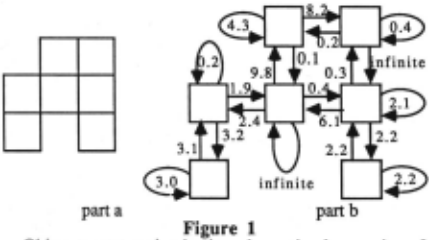
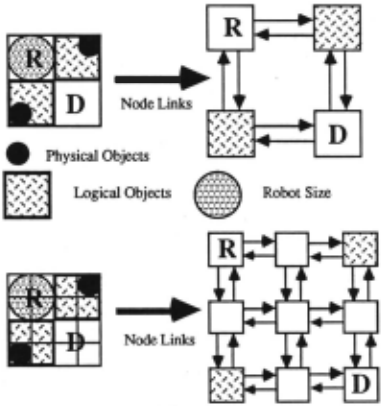
. ~bject r:pre~entation is viewed as a simple mapping of an obJect~ locanon mto a subset of nodes constituting space. The subset. IS define<;~ by ~ose nodes that !he object f~lly or partially occupies at a g1ven time. To effecnvely use this information (i.e. not p~an pat~s t~ugh objects) 11!1 infinite cost is assigned t? all the ~nks gomg mto nodes occupied by an object at a given time. This makes two assumptions. First, that there is some concept ~f time associated with the operation of the algorithm (see Section 2.2). Secondly, that the approximation made in having objects inactivate nodes that they partially occupy does not cause detrimental problems. If fact it does, it causes the algorithm to miss paths that are viable. As it turns out, it does. Consider the top of Figure 2. In it is a situation that shows a robot trying to move f~m the top left corner to the bottom right corner. The problem IS that there are two small objects in the space that invalid.ate all paths from the top left to the bottom nght. To solve this problem the model uses overlapping nodes as depicted in the second part of the figure. Five nodes are ad?~ that represent hal~ moves ~tween each of the previously existing nodes. This effectively resolves the spatial representation by a factor of two. This approach allows the model to find paths that will move the robot from the top left to the bottom right corner of the space.
2.2 · An SIMD Algorithm for Route Planning
The representation of the spatial features and predictable objects ~us far.described provides a basis for an algorithm that can be directly Implemented on an SIMD machine such as that in [Hillis85]. This is accomplished by assigning e~ch node to a processor. Each processor has message communication links to other processors that transcribe directly from the node com!Dunicati<;>~ links. A message represents the value of a possib~e transition from one node to another and the quality of the entire path leading up to that transition. To perform the task of reclaiming the ~en~rated paths from the processors, each processor must mamtam a stack. The stack represents a storage place for logging the history of the activity at the processor. For now, the simplifying assumption will be made that each of the moves made by the robot being simulated will take one unit of time. For example, the time required for the robot to move from one node to an adjacent node, takes one unit of time regardless of the robots previous state. The removal of this assump~on will be discussed later (see section 2.5).
Usmg a synchronous, step-wise process of passing messages from processor to processor, all possible paths that the .robot co?ld tak~ th!ough ti~e and space in attaining the desrred, static destinatiOn locanon can be considered. The process has two phases and a terminating condition.
1}le first phase sets up the initial message set. Using the node m space that represents the current location of the robot a set of messages is created, one message for ea~h communication link associated with the node. Each message has associated with it an energy value that reflects the cost .of moving the ro~t to the space represented by the adjoining node. The particular value of a message's energy is determined by a user-defined evaluation function. The evaluation function considers such things as: the current state of the robot, the cost on the link that the message is to be sent over, the traversability of the node currently being occupied by the robot, etc. The set of messages is then sent to its respective destinations along the communications links of the node.
. The second phase is the operational phase. It is defined by hav~ng each node in ~pace !hat i~ not occupied by an object dunng t.he current Simulation time perform the following pr<>?ess. m a sy~chron?us manner: form the base message by setnng It to the mcommg message with the minimum energy. All other messages can be thrown out because they represent more costly paths that attain the same location in space-time. In a manner similar to that described in the frrst phase, a new set of messages is created. Each message in the new set is assigned an energy that is a function of the base message and the link over which the message is intended to travel. The base message is then tagged with the time and a pointer indicating the node that created it. The base message is then added to the node's stack. Finally, the node sends the newly created list of messages out along their respective communication link. This process is repeated, until the termination condition is met, each repetition representing a subsequent time unit.
The terminating condition is defined as the state of the system when the energy associated with each of the messages currently being processed in the system is greater than the global bound. The global bound is the minimum energy for all the messages that have reached the destination node (similar to zorch decay in [Charniak86]).
After the ending condition is met, the path through space time that has the lowest energy associated with it can be retrieved from the destination node. This is done by locating the message on the destination node's stack with the lowest energy value. Once this is done, the path can be obtained by following the pointers back through space (other processors) and time (the stacks associated with the processors) until the robot's original location in space-time is encountered. The stack allows interprocessor communications to be kept to a minimum.
2.3 · An Example: Operation in a Predictable Space
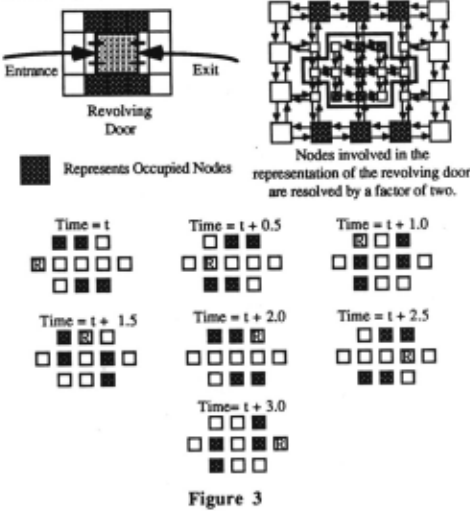
The power of the spatial-temporal representation and the effectiveness of the algorithm are shown in Figure 3 below. The figure shows how the model represents a revolving door by increasing the spatial resolution only in the areas that are affected by the door. The ability to increase the res?lution of the model only in those locations that demand the mcreased detail allows the model to operate more efficiently. The figure also depicts the plan that the model generates in fmding a path for the robot in moving through the door. Notice that the time steps are shortened to half steps. This is a direct result of increasing the resolution of the space by a factor of two. That is, there are now two steps taken where there was only one taken before.
2.4 · Additional Features
Some of the system's most powerful features have been omitted thus far for clarity. Among these features are: The ability to describe the destination as a function of both sp~ce and time, the ability to consider the openness of a node Wtth respect to its spatial location, and the ability to accurately consider the real-time movement capabilities of the robot using the generated plans.
The ability to describe the destination as a function of both time and space allows the system to solve problems involving alternative planning (e.g. if you can't get to the post office by five, go to the drug store for the stamps) and problems involving coordinating actions with dynamic objects (e.g. jumping on a moving train). This ability is incorporated into the system, by ~odify~ng the termination c~ndition .of ~he algorithm to consider a tlme ordered set of possible desnnatJon nodes.
The ability to consider the openness of a node as a spatial relation between it and the nodes surrounding it can be used to generate paths that avoid narrow passages, if possible. Generated plans avoid moving the robot through paths that would become blocked if an unpredictable object were to be encountered during the execution of the plan.
The following gives an example of how an openness function might be defined iteratively for a two-dimensional space. First, assign each node in space a value of one if it is not occupied and a value of zero if it is occupied. Second, have each node send its value along all of its communication links. Third, each node creates a temporary value by summing the values of all incoming information and then integer-dividing them by 1 the first iteration and 2,4,6,8, ... in each subsequent iteration. Lastly, if the temporary value is greater than zero, a new node value is set by multiplying the original node value by the temporary value. Using this scheme, the openness value associated with the nodes will eventually converge to a stable node value pattern. The pattern will be such that the nodes that are in the biggest, most spacious areas will have the highest values, and the nodes in comers or alcoves will have the lowest values. The addition of openness to nodes allows evaluation functions to be written that considers the trade-offs between short path length and increased chance of backtracking due to the chosen route becoming blocked by an unpredictable object.
The ability to effectively represent the time required by a robot to make simulated moves allows plans to be generated that take full advantage of the robot's abilities. For example, moving from rest to another node should take longer than moving from one node to another when the robot is already moving in the desired direction. This is significantly different from the scheme used up to this point, where all moves were considered to take one unit of time. The ability to consider the capabilities of the robot in the generated paths has been incorporated into the model by setting the model to operate in a more asynchronous manner. Asynchrony is accomplished by associating a real-time with each message. The time value of created messages is set by adding to the time in the incoming message the amount of time that is required for the robot to make the move represented by each of the new messages. The ability to effectively predict the performance of the robot is bounded by the precision with which the real-time actions of the robot moving throu~h space-time can be modeled.
3 · Dynamic vs. Unpredictable
Thus far, only the generation of plans that involve predictable objects has been considered. To move autonomous robots in the real world, a route planning system must be able to handle the unpredictability that the real world has to offer as in the case of a robot that must walk across a busy street. The process of incremental route planning has been identified to handle this problem.
Incremental route planning can be viewed as the repeated use of a route planner that executes in a predictable dynamic environment. After each step, the state of the world is tested and updated with any new information, for identification of any unpredictable objects. Incremental route planning is effectively handled by this system because it is structured to operate most efficiently in the incremental form. Unpredictability is handled by the system's ability to rapidly calculate the next best step after every primitive move the robot makes.
By making a simple modification, an incremental version of the algorithm has been constructed from the framework of the previously defined algorithm for predictable domain~. The stack is eliminated from each of the processors by making an addition to the messages being passed around the system. The modification involves the addition of an initial direction header. This change is made because all that is needed is the next best move and not the entire path. The headers, of the messages created in phase one of the algorithm, are set to a v~lue representing the link along which that particular message IS to be sent. The header, of the messages created during phase two, is copied from the header of the incoming message. To identify the next best move, the terminating condition is modified to keep track of the message representing the current global message energy bound. When the system halts, the header of the global message energy bound indicates the direction of the next best move. This represents a significant simplification of the system, as it eliminates concerns involving the potentially unbounded growth of the node stacks.
4 - Implementation
The algorithm, when fully implemented on an SIMD machine, operates in O(p) time, where p is the length of the longest path through space-time that is bounded by the global message energy bound.
A version of the algorithm, written in NISP [McDermott83], is currently up and running on a VAX 11-785. It has been transported onto an Explorer and is running there as well. It functions on the examples given plus others involving unpredictable dynamic environments. The implementation includes software for simulating the SIMD architecture.
5 - Further Research
There are several possible extensions to this model that would increase its representational power. Among the most useful are:
- -Achieving maximal efficiency over a set of destinations: This is similar to the traveling salesman problem.
- -Modeling unpredictable processes: The power of an incremental route planner can be increased for a particular domain with some model of the typical behavior of the unpredictable objects in that domain. For example, the route planner could give more useful advice to a robot crossing a street if the system had a model of the speed, maneuverability, and direction of travel for the autos traveling the road (as in [Sanborn87]).
- -Representation and coordination of multiple robots moving through space-time: For example, getting Huey, Duey and Luey to meet in the garden on the east end of the space ship at 3pm.
- -Implementing the algorithm to operate in a hierarchial fashion similar to that found in [Moravec87]. This will allow time efficient heuristics to be defined that will drastically prune the size of the search space.
This list represents some of the extensions to our model that are currently under investigation. Extensions into more abstract domains, such as general problem solving using state transition graphs, are also under consideration.
6 - Summary and Conclusions
Planning robot movement in dynamic environments demands that the dynamic aspects of the environment be modeled in at least as much detail as the movements of the robot. We have created a representation ·system that allows dynamic aspects of the environment and performance aspects of the robot to be easily modeled. It also integrates this model with a route-planning algorithm. This system has been extended into an incremental route planner which can be used for real-time tactical planning in unpredictable domains. This system has been implemented in an SIMD simulator running on a VAX and an TI Explorer.
This research was supported in part by a grant from the Naval Surface Weapons Center, under co·ntract number N60921-83-G-A165.
7 - Bibliography
- [Brooks82] Brooks, R. A., Solving the find path problem by a good representation of free space, in Proceedings of AAAI 82, AAAI, pp. 381-386, 1982.
- [Charniak86] Charniak, E., A neat theory of marker passing, in Proceedings of AAAI 86, AAAI, pp. 584-588, 1986.
- [Chatila85] Chatila, R., Position referencing and consistent world modeling for mobile robots, in Proceedings of the International ·conference on Robotics and Automation, IEEE, pp. 138-145, 1985.
- [Davis84] Davis, E., Representing and acquiring geographic knowledge, Technical report 292, Yale University Computer Science Department, 1984.
- [Hillis85] Hillis, W. D., The connection machine, MIT press, 1985.
- [Laumond83] Laumond, J. P., model structuring and concept recognition: Two aspects of learning for a mobile robot, in Proceedings of the 8th IJCA/, UCAI, pp. 839-841, 1983.
- [Lozano-Perez83] Lozano-Perez, T., Spatial planning: a configuration space approach, IEEE transactions on computing, c'32, pp. 681-698, 1983.
- [McDermott84] McDermott, D. V., Davis, E., Planning routes through uncertain territory, Artificial intelligence, v22, pp. 107-156, 1984.
- [McDermott83] McDermott, D. V., The nisp manual, technical report 274, Yale University Computer Science Department, 1983.
- [Miller85] Miller, D. P., A spatial representation system for mobile robots, in Proceedings of the International Conference on Robotics and Automation, IEEE, pp. 122-127, 1985.
- [Moravec87] Moravec, H. P., Certainty Grids for Mobile Robots, in Proceedings of ~he Workshop on Spacf! Tele-Robotics, JPL Pasadena California 1987.
- [Sanborn87] Sanborn, I C., Hendler I. A., Towards Dynamic Planning, technical report 1785, Maryland University Computer Science Department, 1987.
- [Thorpe84] Thorpe, C. E., Path Relaxation: Path Planning for a Mobile Robot, in Proceedings of AAA/ 84, AAAI, pp. 318-321, 1984.
@inproceedings{ijcai1987p218,
  title     = {Path Planning Through Time and Space in Dynamic Domains},
  author    = {Slack, Marc G. and Miller, David P.},
  booktitle = {Proceedings of the Tenth International Joint Conference on
               Artificial Intelligence, {IJCAI-87}},
  publisher = {International Joint Conferences on Artificial Intelligence},
  editor    = {John McDermott},
  pages     = {1067--1069},
  year      = {1987},
  note      = {Reasoning},
  url       = {https://ijcai.org/proceedings/1987/218},
}
TY - CPAPER TI - Path Planning Through Time and Space in Dynamic Domains AU - Slack, Marc G. AU - Miller, David P. T2 - Proceedings of the Tenth International Joint Conference on Artificial Intelligence, IJCAI-87 PB - International Joint Conferences on Artificial Intelligence PY - 1987 SP - 1067 EP - 1069 UR - https://ijcai.org/proceedings/1987/218 ER -Copied
Machine-readable versions of this paper, for tools and AI agents:





