
The Abstraction/Implementation Model of Problem Reformulation
Proceedings of the Tenth International Joint Conference on Artificial Intelligence. Reasoning. Pages 1004-1009.
© 1987 International Joint Conferences on Artificial Intelligence
Abstract
A good problem repre,entation incorporate" important problem con,traint, while hiding "uperftuou" detail. This paper presents methods for abstracting a problem representation by making implicit problem properties into explicit properties of the representation. The mathematics of the abstraction search space are given in terms of model theory and universal algebra. The Behavioral Abstraction method uses predefined representation maps to lift a problem representation to an abstract theory. The Behavioral Congruence method generate" abstract theories and representation maps which incorporate problem constraints expressed as Behavioral Equivalences. Two meta-level methods for generating Behavioral Equivalence theorems are given. The STRATA automatic programming system described in this paper is currently being implemented.
- [Amarel, 1968] Saul Amarel. On representations of prob- lems of reasoning about actions. Machine Intelligence 9, 1968.
- [Burstall and Goguen, 1977] Rod M. Burstall and Joseph Goguen. Putting theories together to make specifica- tions. In IJCAI 5, pages 1045-1058, 1977. IJCAI
- [Goguen and Meseguer, 1982] Joseph Goguen and Jose Meseguer. Universal realization, persistent intercon- nection and implementation of abstract modules. In ICALP, Springer Verlag, 1982.
- [Goguen et al., 1978] Joseph Goguen, Jim Thatcher, and Eric Wagner. An initial algebra approach to the spec- ification, correctness, and implementation of abstract data types. In Raymond T. Yeh, editor, Current Trend~ in Programming Methodology, pages 80-149, Prentice-Hall, 1978.
- [Goguen and Bursta.Jl, 1985] Joseph A. Goguen and Rod M. Burstall. In~titutions: Abstract Model Theory for Computer Science. Technical Report CSLI-85-30, CSLI, 1985.
- [Korf, 1980] Richard E. Korf. Towards a model of repre- sentation change. Artificial Intelligence, 14(1), April 1980.
- Michael R. Lowry. Algorithm synthesis through problem reforJVulation. In AAAI-87, July 1987.
- Michael R. Lowry. Algorithm Synthesis through Problem Reformulation. PhD thesis, Stan- ford University, 1987.
- [Mostow, 1983] Jack Mostow. Machine transformation of advice into a heuristic search procedure. In Machine Learning, An Artificial Intelligence Approach, chap- ter 12, Tioga Press, 1983.
- [Smith, 1985] Douglas R. Smith. Top-down synthesis of divide-and-conquer algorithms. Artificial Intelli- gence, 27(1), September 1985.
References were extracted automatically from the PDF and may contain errors.
Full text extracted automatically from the PDF; figures, tables and equations may differ. The PDF is the version of record.
I Introduction
This paper 1 and its companion AAAI87 paper[Lowry, 1987a) present a framework for problem reformulation and algorithm synthesis. In this framework, both specifications and algorithms are viewed as theories, where an algorithm is a theory about a sequence of state changes. Reformu lation is viewed as a representation map between theo ries. The mathematics of theory mappings can be found in Goguen's work on abstract model theory [Goguen and Burstall, 1985). This paper explores reformulation as im plementation maps between theories, while the AAAI87 paper explores reformulation as instantiation maps between parameterized theories.
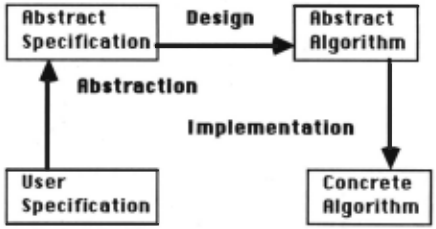
The overall framework is presented in the diagram above. First, STRATA ABSTRACTS the specification in order to remove superfluous distinctions that are found in the user's initial conceptualization of the problem. This step is explained in this paper. Second, STRATA DE SIGNS an abstract algorithm by instantiating algorithm schemas which are formalized as parameterized theories. This step is explained in the companion AAAI87 paper, which illustrates the DESIGN step by using the parame terized theory of local search to derive the simplex algo rithm. Third STRATA IMPLEMENTS the abstract algo rithm using stepwise refinement. Most work in automatic programming addresses this third step.
STRATA uses the RAINBOW directed inference sys tem developed by Douglas Smith[Smith, 1985) for theo rem proving and theorem generation. The third .step of IMPLEMENTATION is carried out by the REFINE™ compiler, which embodies a decade's research in automatic programming done at the Kestrel Institute.
The subject of this paper is specification abstraction. Given a problem specification in a problem domain theory, STRATA finds an equivalent problem specification in a more abstract problem domain theory. Globally, the space of theories and implementation mappings form an asso ciative directed multigraph (i.e. a category). There is no global abstraction ordering on theories. However, with re "pect to each input-output behavior, there is an abstraction ordering on theories. For this reason, this overall process is called Behavioral Ab,traction. The mathematical foun dations for the search space of behavioral abstraction is explained in section 3.
There are two cases to consider for behavioral abstrac tion. In the first case, the multigraph of theories and imple mentation mappings is predefined, and STRATA performs Behavioral Abstraction by proving behavioral theorems and applying inver"e theory maps. A behavioral theorem is a sentence about an important problem property, and is used as an enabling condition for applying an inverse im plementation map. An important subclass of behavioral theorems are behavioral equivalences, that is two objects which behave equivalently with respect to the input-output relation.
When STRATA generates a behavioral theorem which does not correspond to a predefined ·inverse implementa tion map, then STRATA generates a new, more abstract theory and the implementation map between this new the ory and the original theory. This new theory results from incorporating the behavioral theorem into the language and axioms of the new theory. When the behavioral theo rem is a behavioral equivalence, generating the new theory is called behavioral congruence. Behavioral congruence is the main technical result of this paper.
The method of Behavioral Abstraction is given below:
- Behavioral Theorems: Find important problem prop erties.
- Is the Behavioral Theorem an enabling condition for applying a predefined inverse implementation map?
- YES- apply the inverse implementation map to obtain a logically equivalent problem specification in a more abstract theory.
- NO - generate the theory which incorporates the be havioral theorem. For the case of behavioral equiv alences, this is called behavioral congruence. Go to Step 3.
The rest of this paper describes the methods used by STRATA to abstract a problem definition into an equiv alent abstract reformulation that incorporates constraints of the IO-relation. Section 2 describes the abstraction hi erarchy which is searched by behavioral abstraction. In section 3 a simple combinatorial example is introduced to illustrate the abstraction methods. Section 4 describes be havioral equivalence. Section 5 defines the method of be havioral abstraction. Section 6 and 7 contain the main results of behavioral congruence, which is a method for turning a behavioral equivalence in a theory into an equal ity in a more abstract theory. Only when behaviorally equivalent objects are made identical has the equivalence been incorporated into a new representation.
The pioneering work of Amarel[Amarel, 1968]20 years ago showed the potential power of reformulation. About 1980, a number of people began investigating methods for searching the space of logically equivalent problem re formulations. The abstraction space formalized in this model is similar to the homomorphic reformulations de scribed in [Korf, 1980]. Another type of search heuris tic is to find problem reformulations targeted to a par ticular problem solving schema such as Divide and Con quer[Smith, 1985], or Heuristic Search[Mostow, 1983]. In [Lowry, 1987a], problem solving schemas are formalized as parameterized theorie~, and hence generalizes the work cited above. In the literature on abstract data types, [Goguen and Meseguer, 1982] it has been shown that abstraction implementation commutes with problem solving schema instantiation. ·
II Mathematics of the Abstraction Space
This section describes the mathematics of behavioral abstraction from a model theoretic viewpoint in order to understand the behavioral abstraction search space. The model theoretic viewpoint is closely related to the math ematics for the implementation relationship described in [Goguen et al., 1978].
The basic idea behind reformulation is that the class of models for the original problem formulation is isomorphic to the class of models for the reformulated problem defini tion. This key idea is extended for behavioral abstraction to allow merging models of the concrete theory which are identical with respect to the IO-behavior. This merging comes in two flavors. First, a derivor forgets some of the relations and functions which are not directly of interest. For example, the IO-derivor forgets everything except the input/output relation. This is in part how the most ab stract problem formulation will be defined. The second flavor of merging is through equivalences. This is the main subject of this paper. Objects which behave equivalently with respect to the IO-relation are merged together into an identity.
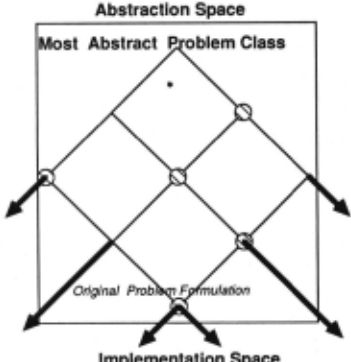
The most abstract class of models for a given prob lem formulation is obtained by first forgetting everything except the io-relation (or io-relations/functions if there is more than one), and then identifying all objects which be have equivalently. This most abstract class is the top of a lattice structure whose bottom is the original problem for mulation. Some of the points in this lattice will not have finite axiomatizations, because taking a derivor does not necessarily preserve finite axiomatizability.
The space of tractable problem abstractions, corre sponding to the classes of models which have finite axiom atizations, have a semi-lattice structure with the original problerr{ formulation at the bottom. [Lowry, 1987b] de scribes this structure in more detail. The objective of be havioral abstraction is to move upwards in this space of tractable problem abstractions. The diagram below shows the space of abstract problem reformulations, the circles denote tractable abstractions. The space of implementa tions is obtained by unwinding the multigraph of imple mentations.
The definition of an implementation link is as a repre sentation map from an abstract theory to a concrete the ory, with an abstraction function for mapping concrete ob jects to abstract objects. The diagram below shows an implementation link between bags and lists, where the ab stract theory of bags and the concrete theories of lists are axiomatized using equational logic.
| Bag Theory | Map | List Theory |
| BagofOperators | -+ | ListofOperators |
| Operators | -+ | Operators |
| NullBag | -+ | Nil |
| MakeBag | -+ | MakeList |
| BagUnion | -+ | Append |
| AddBag | -+ | Cons |
| BagUnion Axioms | Append Axioms | |
| Identity Associativity | Identity | |
| Associativity | ||
| Commutative Abstraction Map from | lists to bags: |
Abs(Nil) = NullBag
Abs(MakeList(x)) = MakeBag(x)
Abs(Append(L1, L2) = BagUnion(Abs(L1), Abs(L2))
In general there are many implementation links be tween two theories, going in both directions. It is assumed that a knowledge base has some of these implementation links predefined. Subsequent sections show how to auto matically use predefined implementation links for behav ioral abstraction when they are available, and also to gen erate new implementation links when given a novel prob lem constraint. The next page has the equational theory for lists. The equational theory for bags is obtained by renaming append to bagunion and making it commuta tive. The equational theory for sets is obtained by renam ing bagunion to setunion and making it idempot~nt (a set unioned with itself yields the same set). A different equa tional theory for sets is obtained by renaming bagunion to symmetric-set-difference and making it self-conjugate (a set differenced with itself yields the null set). This demon-· strate how adding an equality to a theory can generate an abstract theory. These theories will be used in the exam ple.
Equational Theory of Lists
| sorts | example |
| operators | 01 |
| ListsofOperators | (01, 03, 04, 02, 04] |
| functions | example |
| nil | [] |
| MakeList | MakeList(01)-+ (01] |
| Append | Append((01, 03, 04] , (02, 04]) |
| Axiom | -+ (01, 03, 04, 02, 04] Definition |
| identity | Append(nil,L) = L |
| associative | Append(L1, Append(L2, L3)) = Append(Append(L1, L2), L3) |
III A Simple Example
This example will be used to illustrate the methods described in subsequent sections.
| 110100 I 01100 lnooo I .etc. | Start String Operator |
| I non I | Goal String |
The arrow puzzle 2 is a state space search problem where the states are bit strings and the operators are bit strings which are applied by bit-wise XORing with a state to yield a new state. The input sort is a StartString Goal String pair, and the output sort is a list(sequence) of op erators. The input/output relation SOLVE is defined as: SOLVE( {StartString, Goa/String}, OpList) :: Apply( Reduce( X 0 R, OpList ), StartString) = Goal String
Reduce takes a binary operator and a list of argu ments, iteratively applying the operator to the accumu lated result and the next element of the list. Apply takes an operator and bitwise XOR.s it with a bitstring. Re duce and Apply are defined using conditional equations as follows:
if list =null then Reduce(bin~p, list) =identity
if list "# null then
Reduce( binop, list) = car( list)binopReduce( binop, cdr( list))
Apply( operator, BitString) = operator X 0 R BitString
The properties of XOR, denoted ~. assumed to be defined in the knowledge base, are used to reformulate the problem:
Commutative A ~ B = B ~ A
Associative
(A ~ B) ~ C =A ~ (B ~ C)
Identity A ~ 0 =A
SelfConjugate A ~ A= 0
The commutativity and associativity of XOR means that a list of operators can be arbitrarily re-ord~red, which is used to lift the output sort from list of operators to bags of operators. An alternative representation for a bag is an exponential notation, which maps each operator into its number of occurrences in the bag. The self-conjugate property of XOR means that applying an operator twice is equivalent to not applying it at all. In other words, only the even/odd parity of the number of operator occurrences is relevant . Thus the exponential notation is collapsed to the characteristic function for a set by mapping the nat ural numbers to mod2. Si111ilarly, ~tartStx;ing �o~String pairs can be collapsed into a single bit-string by XOR ing them together. This single bit-string represents the class of StartString GoalString pairs that have the same solutions. The following transformations illustrate these abstractions:
Lists to Bags [01 , 03, 04, 02, 04]::} {01, 02, 03, 04, 04}
Exponents { 01, 02, 03, 04, 04} ::} { 01 1 , 02 1 , 03 1 , 04 2 }
2 Korf presented this puzzle with arrows pointed up or down to represent bits. He made additional assumptions about the set of operators which are irrelevant to the abstraction presented here.
Bags to Sets { 01 t, 02 1 , 031, 04 2 } => { 01 1 , 02t, 03 1 , 04/} Pairs to bit-strings < 10111, 00101 >=> 10010
Note that certain choices of operators might not span the space of all possible StartString GoalString pairs. The search will not terminate unless the search space can be made finite. There are an infinite number of possible op erator lists and operator bags. However, there are only a finite (but exponential) number of operator sets; thus the search is guaranteed to terminate for the abstract problem reformulation.
IV Behavioral Equivalence Theorems
The first step in Behavioral Abstraction is to find a problem property which will then be incorporated in a new representation for the problem. Behavioral Equiva lences are an important subclass of problem properties. Two objects are behaviorally equivalent when they behave identically with respect to the 10 relation. In the schema given below, terms of the input sort are prefixed with In, terms of the output sort are prefixed with Out, and the 10 relation is designated R. The first schema is for in put objects that behave identically, the second schema is for output objects that behave identically. 3 (The symbol ~Beh denotes equivalence with respect to the 10-relation). Behavioral Equivalence Schemas
ln1 ~Beh In2 iffVOut R(In1,0ut) +-+ R(In2,0ut) Outl ~Beh Out2 iff Vln R(In, Outl) +-+ R(In, Out2)
Two general meta-level methods for generating behav ioral equivalence theorems, the kernel method and the ho momorphism method, are given in (Lowry, 1987b]. In uni versal algebra, the kernel of a function f whose domain is sort A and whose range is sort B is defined as the equiv alence relation on A of elements which are mapped to the same element in B. A homomorphism is a function f from A to B that maps a function g on A to a function h on B. The kernel of g is mapped to the kernel of h (or a subset of the kernel of h). The generalization of homomorphism to many sorted logics can be found in (Goguen et al. , 1978].
For the arrow puzzle, the kernel method yields a be havioral equivalence· on the input sort, which is a Start ' String GoalString pair. The function XOR maps a pair of · bit-strings to a single bit-string. This defines an equiva lence class on pairs of bit strings. The following behavioral equivalence theorem describes this equivalence class:
{ss1,gs1} ~Beh {ss2,gs2}
For the arrow puzzle, the homomorphism method yields two behavioral equivalences on the output sort, which is a list of operators. The homomorphism function in this case is REDUCE, which maps a list of operators to a single bit string representing the composite operator. The homo morphism maps the properties of XOR, particularly com mutativity and self-conjugate, to behavioral equivalences of append:
3This easily generalizes to the case where the behavior is defined as an arbitrary sublanguage of the problem domain theory(Lowry, 1987b)
append(Lop1,Lop2) ~Beh append(Lop2,Lop1) append(Lop1,Lop1) ~Beh nil
V Behavioral Abstraction
The basic idea of behavioral abstraction is to apply stepwise implementation in reverse. The representation map of an implementation link has all the primitive func tions and relations of the abstract theory as its source and often derived functions and relations in the concrete the ory as its target. Stepwise implementation simply trans lates a complex relation in the abstract theory through the representation map to a complex relation in the concrete theory. In general, the representation map is only par tially invertible, so a problem formulated in the concrete theory cannot always be simply mapped to the abstract theory. For example, in the bag theory to list theory rep resentation map given in section 3, there is no inverse map for CAR or CDR. This is because CAR and CDR are non-determinate when applied to bags.
When a problem formulated in the concrete theory is defined solely in terms of the image of a representation map, then the inverse map can be directly applied to derive an abstract problem reformulation. Often, it is possible to prove that a problem has some abstract property which implies that it can be reformulated in a more abstract the ory even though the problem definition is not in terms of the image of the appropriate representation map. In this case, it is necessary to derive an equivalent problem formu lation stated in terms of the image of the representation map. This is in itself a reformulation or operationalization - the basic inference step is finding an equivalence. Given this equivalent problem formulation and the appropriate predefined implementation link, by applying the inverse representation map the abstract problem reformulation is obtained. Subsequent sections show how to generate a new implementation link when an appropriate one does not al ready exist in the knowledge base.
Abstracting through Predefined Implementation
- Find properties of a problem.
- 2 .. Find an implementation link which uses some of these properties in the abstraction direction.
- Find an equivalent problem formulation stated in terms of the image of the representation map.
- Apply the inverse of the representation map to derive the abstract formulation.
These steps are illustrated with the reformulation of the arrow puzzle from lists of operators to bags of opera tors. In STEP 1, the homomorphism method generates several behavioral equivalence theorems including the com mutativity of append with re~pect to the IO-behavior. SOLVE( {SS, GS},append(Lop1, Lop2))
= SOLVE({SS,GS},append(Lop2,Lop1))
In STEP 2, the knowledge base is searched for an appropriate implementation link which incorporates the problem constraint found in step 1. For behavioral equiv alence constraints, this means finding an implementation link with an abstraction function whose kernel is a subset of the behavioral equivalences found in step 1. The ab straction function for the bag to list implementation that maps bagunion to append is:
abs(append(L1,L2)) = bagunion(abs(Ll),abs(L2))
Since bagunion is append with commutativity, the kernel of the abstraction function contains the behavioral equivalence of commutativity of append.
In STEP 3, the problem is reformulated to an expres sion in the target of the representation map. Since cons is in the target whereas car and cdr are not, the car/ cdr recursion which defines the REDUCE operator is replaced by an existential construction using cons:
if list= null then Reduce(binop, list) =identity if list =/: null then 3x L cons( x, L) = list AND R~duce(binop, list)= x binop Reduce(binop, L)
In STEP 4, this new problem formulation is mapped
through the inverse implementation link: if bag= nullbag then ReduceBag(binop, bag)= identity if bag=/: nullbag then 3x B addbag(x,B) =bag AND Reduce(binop,bag) = x binop Reduce(binop,B) SolveBag( { StartString, Goal String}, OpBag) = Apply( reduceBag( X 0 ROpbag ), Start String) = Goal String
VI Making the World Safe for Equality
When ~ problem property does not correspond to a predefined implementation link, then for behavioral ab straction STRATA must generate a new representation theory which incorporates the property. From a math ematical viewpoint, the central issue·is how to turn an equivalence into an equality. In particular, a behavioral equivalence in the concrete theory is turned into an equal ity in the abstract theory. Equal objects are identical- they can be freely substituted for each other everywhere. Equiv alent objects are not identical; by definition behaviorally equivalent objects can be substituted for each other in the 10-relation, but not necessarily elsewhere. Only when behaviorally equivalent object~ are made identical ha~ the equivalence been incorporated into a new repre~entation. This is illustrated by the theories which are · the abstract data types for lists, bags, and sets.
In order to turn a behavioral equivalence into an equal ity, a new representation language is generated, so that be haviorally equivalent objects are freely substitutable. The requirement of free substitution is the constraint used in the generator of the new representation language. This sec tion discusses some of the conceptual background needed for generating the new representation language, further details can be found in [Lowry, 1987b]. A sort is PRO TECTED against new congruences when a congruence would lead to identifying objects that are not behaviorally equiv alent . A sort is SEPARABLE into separa~e copies for dif ferent functions if the problem definition does not link the different functions. This is the basis of the SPLITTING strategy. Finally, a function is SAFE with respect to a BEHAVIORAL EQUIVALENCE if propagating the equiv alence through the function as an equality does not lead to defining new congruences on PROTECTED sorts. Delet ing UNSAFE functions is the basis of the PROTECTION strategy.
Definition: A sort is PROTECTED iff:
Case 1 It is in the input or output of the 10-relation.
Case 2 It is a free parameter to the problem definition.
In the arrow puzzle, the following sorts are protected by case 1: lists of operators, StartString GoalString pairs. Case 2 protects the sort operators, because the arrow puz zle is defined with respect to any set of operators (bit strings which are XORed·with the states). The basic idea behind a protected sort is that no congruence can be de fined on a prot~cted sort unless it is a behavioral equiva lence with respect to the io-relation.
In general each sort is in the domain or range of many functions. Congruences are propagated through sorts that are in the domain of a function to the sort which is the range of a function. This range sort is in turn the input to other functions, and in this way a congruence is propa gated through the daisy chain of functions in the problem domain theory. However, only some of this daisy chain ing is intrinsic to the axiomatization and definitions of the functions in the problem domain theory. This leads to the definition of a SEPARABLE sort with respect to two functions:
Definition: A sort S is separable with respect to a func tion F1 whose range is S and a function F2 which has an input argument of sort S IFF F1 does not appear as part of a term in an expression whose head is F2 in the definition of the problem domain theory.
The intuition of this definition is that a SEPARABLE sort can be split into two sorts, thus blocking the propa gation of a congruence from F1 to F2. Another viewpoint is that sort S is separable if the problem domain theory could have been given with the output of F1 being sort S1 and the input of F2 being a distinct sort S2 (S1 equal S2, but S1 NOT eq S2). The mathematical machinery for this viewpoint is described at length in [Burstall and Goguen, 1977] and [Goguen and Burstall, 1985].
Definition: A function is SAFE iff:
Case 1 The range i~ the input or output ~ort of the io relation. .Behaviorally equivalent inputs to the func tion result in behaviorally equivalent outputs.
Case 2 The range i~ not the input or output ~ort. Behav iorally equivalent inputs have identical outputs.
CAR and CDR are not SAFE with respect to commu tativity of append, because their respective output sorts, operators and list of operators, are protected. However, CONS is safe because it is covered by case 1.
VII Behavioral Congruence - Protection and Splitting
The protection and splitting methods transform the language of the problem domain theory in minimal ways so that adding the behavioral equivalence theorem as a new equality preserves the problem semantics. The goal is to make the representation map as invertible as possible, so that the problem definition needs to be only minimally re formulated before being lifted to the new abstract problem domain theory. The protection method deletes functions whose range is a protected sort which are not safe. The splitting method makes copies of separable sorts so that functions which would not be safe after propagating the behavioral equivalence as a congruence become safe.
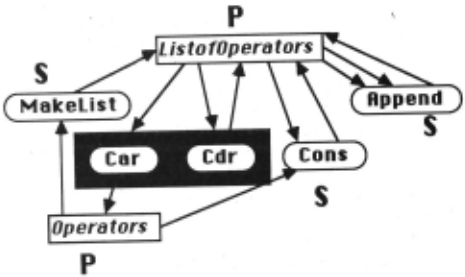
The protection method is illustrated above for the case of transforming the behavioral commutativity of append into an equality. In the diagram, sorts are represented by boxes, and functions are represented by ovals. The inputs and outputs of a function are represented by arrows lead ing from/to the appropriate sorts. The protected sorts are ListofOperators and Operators, labeled with a P . The sort ListofOperators is used to define the behavioral equiv alence theorems of commutativity and self-conjugate, any function which uses this sort as an input argument must be safe. The functions APPEND and CONS are safe, and labeled with an S. In contrast the functions CAR and CDR are not safe and are surrounded by black to indicate that they are deleted by the protection method. The func tion MakeList is safe because its input is the protected sort operators upon which no equality can be defined, as it is a free parameter.
To derive the abstract theory from the concrete theory of lists with the behavioral equivalence of commutativity of append, the protection method renames the behavioral sorts and the safe functions which reference them, copies the axioms and then adds the behavioral equivalence as an equality. The representation map takes a renamed function in the abstract theory into the corresponding function in the original theory. The protection method generates the theory of bags shown in section 2, along with the corre sponding implementation link from bags to lists. Note that behavioral abstraction must still be used to lift the prob lem definition SOLVE into the new theory, as explained in section 5.
The protection method could be applied once again for the behavioral equivalence of self-conjugate of append. Bag-Union (previously append) becomes symmetric set dif ference. Add bag (previously cons) is also transformed to XorAdd, its new action is to delete an element if it already exists, otherwise it adds the element.
An alternative derivation path which uses the behav ioral equivalence of self-conjugate of append is given by the splitting method. In this case, the theory of bags is first isomorphically transformed to exponential notation, as discussed in [Lowry, 1987b]. In this isomorphic the ory given below, equality of bags is defined in terms of bag-member. Bag-member is a function which takes an element and a bag and returns the number of occurrences of the element in the bag.
BagMember(x,NullBag) = 0 BagMember(x,MakeBag(x)) = 1 If y :f; x then BagMember(y, MakeBag(x )) = 0 BagMember(x,BagUnion(Bl,B2)) = BagMember(x,Bl) + BagMember(x, B2) Bl = B2 iffVxBagMember(x,Bl) = BagMember(x, B2)
In this new isomorphic representation, bag equality is defined with the sort natural numbers through the func tion bag-member. In the arrow puzzle, the natural num bers are used both as the range of bag-member and as an index into bit-strings. Propagating the congruence of self-conjugate through the natural numbers causes them to collapse to Mod2 (isomorphic to the booleans). If this were then propagated to the index into bit-strings, it would cause a collapse of bit-strings into the even and odd indices. Unlike the elements of operator-lists, which are protected, the natural numbers are not protected and can be split . This prevents the propagation of the congruence through the range of bag-member to the index of bit-strings.
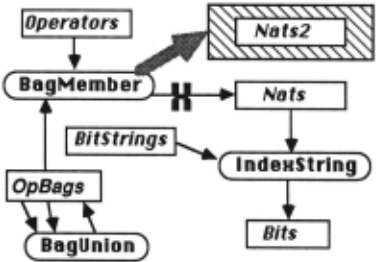
The ~plitting method is illustrated above, by the adc clition of the new sort natural numbers£ as the output of BagMember. The output of BagMember is no longer the same sort as the input to IndexString. The prop agation of the behavioral equivalence of self-conjugate of bag-union through bag-member causes an additional ax iom to be added to the sort natural numbers2, which re sults in a theory which is syntactically identical to the theory for Mod2 or the booleans. The derivation below shows how the additional axiom which defines Mod2 (or the booleans) is obtained by propagating the behavioral equivalence through substitution:
BagUnion(S, S) £:!Beh Nul/Bag
In the new theory BagUnion becomes Symmetric Set Dif ference and the behavioral equivalence of self-conjugate of BagUnion becomes an equality. BagMember becomes SetMember, and the sort naturalnumbers2 becomes the booleans through the addition of the equality Y + Y = 0.
VIII Summary
A good repre~entation incorporates the problem con ~traint~. This paper has presented the abstraction imple mentation model of problem reformulation. The search space of abstract problem reformulations is formalized model theoretically as a lattice structure. Behavioral abstrac tion is a general method for incorporating a problem con straint into an abstract problem reformulation, by revers ing an implementation link. Behavioral congruence is a method for generating new representations which incorpo rate behavioral equivalence constraints. The first step is to transform the representation language through protec tion and splitting so that all functions are safe. Then the behavioral equivalence constraint is made into an equality, and propagated throughout the new representation lan guage to generate new constraints. The kernel method and the homomorphism method are met~-level inference techniques for efficiently generating behavioral equivalence constraints. These methods are being implemented in an automatic programming system called STRATA.
IX Acknowledgment
This paper benefitted from the technical and editing help provided by Joseph Goguen, Laura Jones, and Dou glas Smith. Discussions with the following people have also contributed to the development of these ideas: Phil Agre, Tom Binford, Bruce Buchanan, Raul Duran, Mike Gene sereth, David MacAllester, Patricia Riddle, Jeff Schrager, David Smith, Steve Tappe!, and Daniel Weld.
@inproceedings{ijcai1987p207,
  title     = {The Abstraction/Implementation Model of Problem Reformulation},
  author    = {Lowry, Michael R.},
  booktitle = {Proceedings of the Tenth International Joint Conference on
               Artificial Intelligence, {IJCAI-87}},
  publisher = {International Joint Conferences on Artificial Intelligence},
  editor    = {John McDermott},
  pages     = {1004--1009},
  year      = {1987},
  note      = {Reasoning},
  url       = {https://ijcai.org/proceedings/1987/207},
}
TY - CPAPER TI - The Abstraction/Implementation Model of Problem Reformulation AU - Lowry, Michael R. T2 - Proceedings of the Tenth International Joint Conference on Artificial Intelligence, IJCAI-87 PB - International Joint Conferences on Artificial Intelligence PY - 1987 SP - 1004 EP - 1009 UR - https://ijcai.org/proceedings/1987/207 ER -Copied
Machine-readable versions of this paper, for tools and AI agents:





