
RUM: A Layered Architecture for Reasoning with Uncertainty
Proceedings of the Tenth International Joint Conference on Artificial Intelligence. Reasoning. Pages 891-897.
© 1987 International Joint Conferences on Artificial Intelligence
Abstract
New reasoning techniques for dealing with uncertainty in expert systems have been embedded in RUM, a Reasoning with Uncertainty Module. RUM is an integrated software tool based on a frame system (KEE) that is implemented in an object oriented language. RUM's capabilities are subdivided into three layers: representation, inference, and control. The representation layer is based on frame-like data structures that capture the uncertainty information used in the inference layer and the uncertainty meta-information used in the control layer. Linguistic probabilities are used to describe the lower and upper bounds of the certainty measure attached to a well formed formula. The source and the conditions under which the information was obtained represent the non-numerical meta-information. The inference layer provides the uncertainty calculi with which to perform the intersection, detachment, union, and pooling of information. Five uncertainty calculi, based on their underlying Triangular norms, are used in this layer. The control layer uses the meta-information to select the appropriate calculus for each context and to resolve eventual ignorance or conflict in the information. This layer enables the ·programmer to declaratively express the local (context dependent) meta-knowledge that will substitute for the global assumptions traditionally used in uncertain reasoning. RUM has been tested in a sequence of experiments in both naval and aerial situation assessment, consisting of correlating reports and tracks, locating and classifying platforms, and identifying intents and threats.
- KEE Software Development System User's Manual. ln- tellicorp, Mountain View, CA. 94040-2216, KEE Version 3.0 edition, July 1986. Document Number 3.0-U-1.
- [Beyth-Marom, 1982] R. Beyth-Marom. How probable is probable? a numerical taxonomy translation of verbal probability expressions. Journal of Forecasting, 1:257- 269, 1982.
- [Bonissone, 1982] P.P. Bonissone. A fuzzy sets based linguis- tic approach: theory and applications. In M.M. Gupta and E. Sanchez, editors, Approximate Reasoning in Deci- sionAnalysis, pages 329-339, North Holland, New York, 1982.
- [Bonissone, 1986] P.P. Bonissone. Summarizing and propa- gating uncertain information with triangular norms. In L. S. Baumann, editor, Proceedings of the Expert Sys- tems Workslwp, pages 62-71, Defense Advanced Re- search Projects Agency, April 1986. To appear in the International Journal of Approximate Reasoning, North- Holland, 1987.
- [Bonissone and Decker, 1986] P.P. Bonissone and K.S. Decker. Selecting uncertainty calculi and granularity: an experiment in trading-off precision and complexity. In L . N. Karnak and J. F. Lemmer, editors, Uncertainty in Artificial Intelligence, North Holland, 1986. Also GE Techniqal Report 85-CRD-171.
- [Bonissone eta/., 1987] P.P. Bonissone, J.K. Aragones, and K.S. Decker. Lotta: an object based simulator for rea- soning in antagonistic situations. 1987. GE Corporate Research & Development Working Paper.
- [Bonissone, 1987] P. P. Bonissone. Plausible reasoning: cop- ing with uncertainty in expert systems. In S. C. Shapiro, editor, Encyclopedia of Artificial Intelligence, John Wiley and Sons, 1987. Also GE Technical Report 86-CRD-53.
- [Cohen and Grinberg, 1983a] P.R. Cohen and M.R. Grinberg. A framework for heuristics reasoning about uncertainty. In Proceedings of the Eighth International Joint Confer- ence on Artificial Intelligence (/JCAI-83), pages 355-357, Karlsruhe, West Germany, 1983.
- [Cohen and Grinberg, 1983b] P.R. Cohen and M.R. Grinberg. A theory of heuristics reasoning about uncertainty. AI Magazine, 4(2):17-23, 1983.
- [Doyle, 1983] J. Doyle. Methodological simplicity in expert system construction: the case of judgements and reasoned assumptions. AI Magazine, 4(2):39-43, Summer 1983. 898 REASONING
- [Genesereth, 1982] M.R. Genesereth. An Overview of MRS for AI Experts. memo HPP-82-27, Stanford Heuristic Programming Project, Stanford University, 1982.
- [J.P. Ferranti, 1981] Jr. J.P. Ferranti. Evaluation of the ar- tificial intelligence program STAMMER2 in the tactical situation assessment problem. Technical Report #AD- A101101, National Technical Information Service, March 1981.
- [McCall eta/., 1979] D.C. McCall, P.H. Morris, D.P. Kibler, and R.J. Bechtel. STAMMER2 production system for tactical situation assessment. Technical Report #AD- A084038, National Technical Information Service, Oc- tober 1979.
- [Schweizer and Sklar, 1963] B. Schweizer and A. Sklar. As- sociative functions and abstract semi-groups. Publica- nones Mathematicae Debrecen, 10:69-81, 1963.
- [Shafer, 1976] G. Shafer. A Mathematical Theory of Evi- dence. Princeton University Press, Princeton, New Jer- sey, 1976.
References were extracted automatically from the PDF and may contain errors.
Full text extracted automatically from the PDF; figures, tables and equations may differ. The PDF is the version of record.
I. Introduction
In most realistic situations, the information available to the decision maker is incomplete and uncertain. In automated rea soning systems, these two facets of the information have usu ally been treated independently. Theories and techniques for dealing with incomplete (but precise) information have evolved into the development of non-monotonic logics, truth mainte nance systems (1MS) and reason maintenance systems (RMS).
· This work was partially supported by the Defense Advanced Research Projects Agency (DARPA) under USAF/Rome Air Development Center con ttact F30602-85-C-0033. Views and conclusions contained in this paper are those of the authors and should not be interpreted as representing the official opinion or policy of DARPA or the U.S. Government
Theories and techniques for dealing with uncertain (but com plete) information have either been adapted from other fields such as probability theory, based on unrealistic global assump tions, or proposed as ad hoc solution without formal justifica tions [Bonissone, 1987].
The trend followed by most approaches for reasoning with uncertainty has shown an almost complete disregard for the fundamental issues of automated reasoning, such as the proper representation of the information, the allowable infer ence paradigms suitable for the representation, and the control of such inferences. The majority of the approaches to rea soning with uncertainty do not 'properly cover these issues. Some approaches lack expressiveness in their representation paradigm. Other approaches require unrealistic assumptions to provide uniform combining rules defining the plausible in ferences.
Specifically, the non-numerical approaches [Cohen and Grinberg, 1983b, Cohen and Grinberg, 1983a, Doyle, 1983] are inadequate to represent and summarize measures of uncer tainty. The numerical approaches, on the other hand, generally tend to impose some restrictions upon the type and structure of the information (e.g., mutual exclusiveness of hypotheses, conditional independence of evidence). Most numerical ap proaches represent uncertainty as a precise quantity (scalar or interval) on a given scale. They require the user or expert to provide a precise yet consistent numerical assessment of the uncertainty of the atomic data and of their relations. The output produced by these systems is the result of laborious computations, guided by well-defined calculi, and appears to be equally precise. However, given the difficulty in consis tently eliciting such numerical values from the user, it is clear that these models of uncertainty require an unrealistic level of precision that does not actually represent a real assessment of the uncertainty. ·
With few exceptions, such as MRS [Genesereth, 1982], the control of the inference process in most expert systems has been procedurally embedded in the inference engine, thus preventing any opportunistic and dynamic change in order ing inferences and in aggregating uncertainty. Usually, the same set of aggregation operators (i.e., the same uncertainty calculus) is selected a priori and is used uniformly for any inference made by the expert system. In the few numerical approaches where conflicting information is detected [Shafer, 1976], conflict handling is done in the inference layer, where the conflict resolution procedure is embedded in the same combining rules. This procedure consists of simply removing the conflicting part of the information. The non-conflicting por tion is then normalized and propagated as if the conflict never existed.
It is our claim that the formalism for reasoning with un certainty must exhibit the same structural (layered) decompo sition typical of other automated reasoning methodologies, i.e. , it must address each of the three layers of representation, infer ence, and control. The formalism must also be based on sound theoretical foundations to guarantee its general applicability to a variety of reasoning tasks. The proposed layered approach will be suitable to integration with reason maintenance sys tems that provide a distinction between the object logic theory (inference layer) and the meta logic theory (control layer).
This paper describes the theory, design, implementation, and testing of RUM, a Reasoning with Uncertainty Module, whose layered architecture reflects the above concerns. The next two sections (2 and 3) summarize RUM's underlying the ory and design. The remaining two sections (4 and 5) describe an experiment in situation assessment used to test RUM and present the conclusions of this work.
II. RUM's Underlying Theory
Preliminary theoretical results were presented in two previous publications [Bonissone and Decker, 1986, Bonissone, 1986]. This section summarizes some of those results and provides a unified framework for their interpretation and use in RUM's architecture. A philosophical motivation for the RUM's three layer organization can also be found in [Bonissone, 1987].
A. Term Sets of Linguistic Probabilities
In expert system applications, users and experts must fre quently provide subjective assessments of probability. Due to the difficulty of eliciting precise and consistent numerical certainty values, we have suggested the use of term sets of lin guistic probability. Each term set determines the granularity (the finest level of specificity) of the measure of certainty that the user/expert can consistently provide.
A term set of linguistic probabilities is the set of symbols L = L1, Lz, .. . , Ln. The meaning of each term Li E L is represented by a fuzzy number on the [0,1] interval. A com putationally efficient way to characterize a fuzzy number is to use a parametric representation of its membership function. This parametric representation [Bonissone, 1982, Bonissone and Decker, 1986] is achieved by the 4-tuple (ai, bi,ai ,/3i)· The first two parameters indicate the interval in which the membership value is 1.0; the third and fourth parameters indi cate the left and right width of the distribution. Linear func tions are used to define the slopes. Therefore, the membership function 11- L; (x) is defined as
For compactness of notation, we will denote the meaning of the term set element Li parametrically. Table 1 illustrates one of four default RUM term sets, the nine element L-nine. *
| Index | Symbol | Meaning |
|---|---|---|
| 1 | impossible | (0 0 0 0) |
| 2 | extremely-unlikely | (.01 .02 .01 .05) |
| 3 | very-low-chance | (.1 .18 .06 .05) |
| 4 | small-chance | (.22 .36 .05 .06) |
| 5 | it-may | (.41 .58 .09 .07) |
| 6 | meaningful-chance | (.63 .80 .05 .06) |
| 7 | most-likely | (.78 .92 .06 .05) |
| 8 | extremely-likely | (.98 .99 .05 .01) |
| 9 | certain | (1 1 0 0) |
RUM's representation layer allows the user to character ize the lower and upper bounds of the certainty of a fact, or the sufficiency and necessity of a rule, by using elements of a selected term set.
B. Triangular Norms
Triangular norms (T-norms) and Triangular conorms (T conorms) are the most general families of binary functions that satisfy the requirements of the conjunction and disjunc tion operators, respectively [Bonissone and Decker, 1986]. A T-norm is defined as a mapping T : [0, 1] 2 -+ [0, 1] which is monotonic, commutative, and associative. The boundary con ditions of a T -norm satisfy the truth tables of the logical AND operator. The T-conorms are defined in terms of the T-norms and a negation operator, by using a generalization of DeMor gan's duality. Thus, for a suitable negation operator, such as N(a) = 1- a, the T-conorm S(a, b) is defined as
We have seen that the use of term sets determines the granularity with which the input certainty is described. This granularity limits the ability to differentiate between two sim ilar calculi; only a finite, small subset of the infinite number of calculi that can be generated from a parametrized T -norm family produces notably different results.
This result has been confirmed by an experiment [Bonis sane and Decker, 1986] where eleven different calculi of un certainty, represented by their corresponding T-norms, were analyzed. The experiment showed that five equivalence classes were needed to represent (or reasonably approximate) any T norm. The corresponding five uncertainty calculi were defined by the common negation operator N(a) = 1 -a and the De Morgan pair (Tsc(a, b, p), Sse( a, b, p)) for the following values
· The meanings associated with each element of the term set were derived from the results of psychological experiments on the use of linguistic proba bilities [Beyth-Marom, 1982].
Table 2: Five Uncertainty Calculi
A. The Representation Layer
of p in Table 2:**
RUM's inference layer provides the user with a selection of the five T-norm based calculi described above.
ill. RUM's Layered Architecture
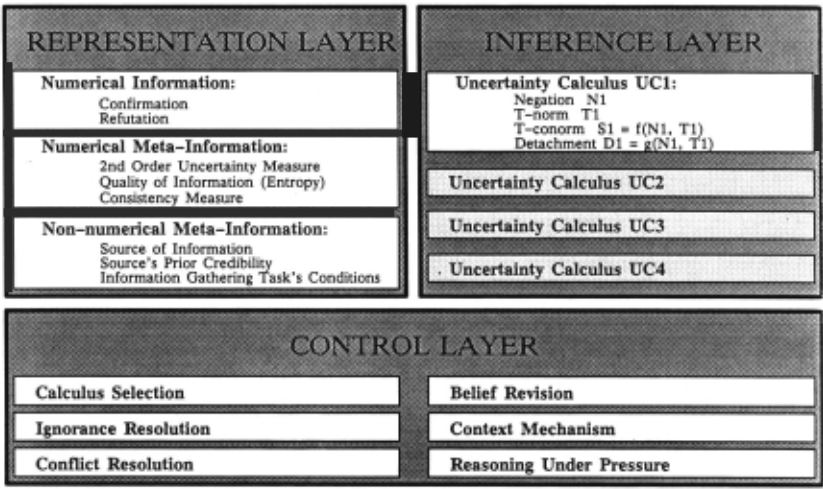
RUM's architecture is based on three layers: representation, inference, and control. The first layer (the representation layer) includes the structure required to capture information used in the inference layer and meta-information used in the control layer. In this structure, linguistic probabilities are used to de scribe the lower and upper bounds of the certainty measure associated with a well-formed formula (wff). Non-numerical meta-information, describing the source and the conditions un der which information was obtained, is represented in this layer along with numerical meta-information describing the amount of ignorance and consistency.
The second layer (the inference layer) includes five un certainty calculi based on their underlying Triangular norms (T-norms). Any operation required by an uncertainty calcu lus can be expressed in terms of its T-norm and a negation operator. Note that T-norm-based calculi have various com putational advantages: they are truth-functional, commutative, and associative. Therefore, if numerical computations to eval uate T-norm-based expressions are carried out at run-time, the above properties ensure that any result can be directly com puted from the individual value of each argument; that the result is independent from the order of the arguments; and that for more than two arguments, the evaluation ofT-norm expressions can be done recursively.
The third layer (the control layer) includes the functions required to select the calculus appropriate for each context and to resolve ignorance or conflict in the information. These func tions rely on local (i.e., context-dependent) knowledge about the information (meta-knowledge). The scope of the calculus selection and ignorance/conflict resolution is limited to the con text (knowledge base subset) for which the meta-knowledge is available. Figure 1 illustrates RUM's architecture. The fol lowing sections describe RUM's functions attached to each of the three layers.
"'Ts 0 (a,b,p) is one of six parametrized families ofT-norms discussed in [Bonissone and Decker, 1986]. It was originally defined by Schweizer and Sklar [Schweizer and Sklar, 1963] and exhibits both complete coverage of the T-nonn space and numerical stability.
1. RUM's Wff System
RUM is an integrated software tool based on a frame sys tem (KEE™) [1986] that is implemented in an object-oriented language. RUM's Wff System modifies KEE's representation of a wjf. RUM's wff is the pair (<unit> <slot>), which is the description of a variable in the problem domain. For each wff, a corresponding certainty unit is created. The unit contains a list of the considered values that the variable may take, .,and for each of these values it maintains the lower and upper bounds of its certainty, an ignorance measure, a consistency measure, and the evidence source. The ignorance measure is computed as the area of the fuzzy interval formed by the lower and up per bounds, while the consistency measure checks to see if the lower and upper bounds have crossed.
RUM's Wff System allows the user to express arbitrary uncertainty granularity by providing the flexibility to mix pre cise and imprecise measures of certainty (crisp numbers or in tervals, fuzzy numbers or intervals, linguistic values) in defin ing both the input certainties and the rule strengths.
2. RUM's Rule System
RUM's Rule System replaces KEE Rule System-3 capa bilities by incorporating uncertainty information in the infer ence scheme. The uncertain information is described in the certainty units of the wjfs, represented in RUM's Wff System, and in the degrees of necessity and sufficiency atta.::hed to each rule. A rule is represented by a frame with several slots. These slots include the name of the rule; the lists of contexts, premises, and conclusions; the rule's sufficiency and neces sity; and the T-norm to be used for aggregation. All slots (except the name, premises, and consequences) have default values. The contexts, premises, and conclusions can comprise values, variables, RUM predicates and arbitrary LISP func tions. Rules with unbound variables are instantiated with the necessary environment to produce rule instances.
The T-norm specified with the rule is used to aggregate the certainties of the rule premises and to perform detachment (which computes the certainty of the conclusion given the suf ficiency and necessity of the rule). It defaults to T3, which is the MIN function. The associated T-conorm is used to aggre gate the certainties of identical conclusions inferred by multi ple rule instances derived from the same rule. These are often subsumptive, and the value defaults to S3, the MAX function. Finally, each seperate consequence of a rule has a specified T-conorm that will be used to aggregate the consequence with identical consequences derived from different rules.
B. The Inference Layer
1. Calculi Operations
For each calculus, four operations are defined in RUM's Rule System: premise evaluation, conclusion detachment, con clusion aggregation, and source consensus. Each operation in a calculus can be completely defined by a Triangular norm and a negation operator (in logic any boolean expression can be rewritten in terms of an intersection and complementation operator). The four operations are defined as follows:
Premise evaluation: The premise evaluation operation de termines the degree to which all the clauses in the rule premise have been satisfied by the matching wffs. Let b; and B; indi cate the lower and upper bounds of the certainty of condition i in the premise of a given rule. Then the aggregated premise certainty range [b, B) is defined as
Conclusion Detachment: The conclusion detachment op eration indicates the certainty with which the conclusion can be asserted, given the strength and appropriateness of the rule. Let s and n be the lower bounds of the degree of sufficiency and necessity, respectively, of the given rule, and let [b, B) be the computed premise certainty range. Then the range [c, C), indicating the lower and upper bound for the certainty of the conclusion inferred by such a rule, is defined as
The degrees of sufficiency and necessity, respectively, indicate the amount of certainty with which the rule premise implies its conclusion and vice versa. The sufficiency degree is used with modus ponens to provide the lower bound of the conclusion. The necessity degree is used with modus to/lens to obtain a lower bound for the complement of the conclu sion (which can be transformed into an upper bound for the conclusion itself).
Conclusion aggregation: The conclusion aggregation op eration determines the consolidated degree to which the con clusion is believed if supported by more than one path in the rule deduction graph, i.e., by more than one rule instance. It is also possible to have various groups of deductive paths, i.e., various sets of rule instances, all supporting the same con clusion. Each group of deductive paths can have a distinct conclusion aggregation operator associated with it. Let the ranges [cj, Cj] indicate the certainty lower and upper bounds of the same conclusion inferred by various rule instances be longing to the same group. Then, for each group of deductive paths, the range [d, D) of the aggregated conclusion is defined as
RUM distinguishes between rule instances generated from the same rule and rule instances derived from different rules. Rule instances generated from the same rule are aggregated first, to take into account the normally large amount of re dundancy that such instances entail. Rule instances derived from different rules are subsequently aggregated taking into account the knowledge about the presence or lack of positive or negative correlation that characterizes the various rules.
Source Consensus: The source consensus operation re flects the fusion of the certainty measures of the same evi dence A provided by different sources. The evidence can be an observed fact, or a deduced fact. In the former case, the fusion occurs before the evidence is used as an input in the deduction process. In the latter case, the fusion occurs after the evidence has been aggregated by each group of deductive paths. The source consensus operation reduces the ignorance about the certainty of A, by producing an interval that is al ways smaller or equal to the smallest interval provided by any of the information sources. If there is an inconsistency among some of the sources, the resulting certainty intervals will be disjoint, thus introducing a conflict into the aggregated re sult. Let [L, (A), U, (A)], [L2(A), U2(A)], ... , [Ln(A), Un(A)] the certainty lower and upper bounds of the same conclu sion provided by different sources of information. The re sult [Ltot(A), Utot(A)], obtained from fusing all the assertions about A, is calculated by taking the intersection of the certainty intervals:
C. The Control Layer
1. Calculi Selection
RUM's Rule System uses a set ofT -norm-based calculi to handle uncertain information. The calculus used by each rule instance is inherited from the rule subclass. The calculus can be modified through KEE's user interface or programmatically (e.g., by an active value or a task, see Section 4.). Class inheritance can also be used to modify the degree of sufficiency and necessity of all the rule members of the same class.
The calculi selection process consists of two assignments. The first assignment indicates the T-norm with which the premise evaluation and the conclusion detachment will be com puted. Such an assignment is made for each rule and is passed (through inheritance) to all rule instances derived from a rule.
The second assignment indicates the T -conorm (repre sented by its dual T-norm) with which the conclusion aggre gation will be computed. This assignment is made for each subset of rule instances generated from different rules that as sert the same conclusion.
The characteristics of aT-norm will determine how it is used. The T-norm assigned to each rule for premise eval uation and conclusion detachment will be a function of the decision maker's attitude toward risk. The ordering of the T-norms, which is identical to the ordering of parameter p in the Schweizer and Sklar family of T -norms, reflects the ordering from a conservative attitude (p = -l or T1) to a non conservative one (p --+ oo or T3). From the definition of the calculi operations, we can see that T1 will generate the small est premise evaluation and the weakest conclusion detachment (i.e., the widest uncertainty interval attached to the rule's con clusion.) T-norms generated by larger values of p will ex hibit less drastic behaviors and will produce nested intervals with their detachment operations. T3 will generate the largest premise evaluation and the strongest conclusion detachment (the smallest certainty interval).
For the second assignment, the T-norm that aggregates the subsets of rule instances (derived from different rules and asserting the same conclusion) will be a function of the lack or presence of positive/negative correlation among the rules in each subset. The ordering of the T-norms reflects the transi tion from the case of extreme negative correlation or mutual exclusiveness (T1 ), through independence (T2), to the case of extreme positive correlation or subsumption (T3).
In all the assignments, a set of selection rules will express the meta-knowledge about the context (i.e, the task's relevance to the decision ffiaker and the subsets of deduction rules used to solve that task, see Section 3.). The selection rules will select the T -norms that better reflect the desired attitude toward risk and the perceived amount of correlation to be used in such a context.
2. Belief Revision
An initial implementation of the belief revision of uncer tain information is available in the control layer of RUM's Rule System. For any conclusion made by a rule, the be lief revision mechanism monitors the changes in the certainty measures of the wjft. that constitute the conclusion's support and the changes in the calculus used to compute the cached conclusion certainty measure. Validity flags are inexpensively propagated through the rule deduction graph, which includes both wffs and rules. Five flag values are used: Good, guar anteeing validity; Bad (level i), indicating unreliability prop agated to the ith level; Inconsistent, indicating conflict; Not Applicable, indicating that the rule context is not active; and Ignorant, indicating that the information is too vague to be useful.
The belief revision system offers both backward and for ward processing. A lazy evaluation, running in backward mode, recomputes the certainty measures of the modified wjft. that are required to answer a given query. This mode (called reasoning under pressure) is used when the system or the user decide that they are dealing with time-critical tasks. Breadth first, forward mode processing recomputes the certainty mea sures of the modified wjft., attempting to restore the integrity of the rule deduction graph. This mode is used by the system when time is not critical.
3. Rule Firing Control via Context Activation
A rule context is defined as a set of conditions that must be satisfied before the rule can be considered for premise eval uation. A user-definable threshold can be attached to each rule context, either by local definition or by inheritance from a rule class. The semantics of a context C attached to an inference rule (establishing the weak logical equivalence between A and B) is given by the following expression:
It is important to note that the inference symbol --+ in the production rule A -!. B is interpreted as a (weak) material implication operator in multiple-valued logics. The value s is the lower bound of the degree of sufficiency of the impli cation. This is different from the idea of conditioning, i.e., s = P(BJA).
The symbol +-+ in the production rule A ~ B is in terpreted as a (weak) logical equivalence operator in multiple valued logics, where s and n are the lower bounds of suffi ciency and necessity, respectively. This (weak) logical equiv alence is an if-and-only-if rule that could be decomposed in the following two rules: A ~ B and B ~ A (equivalent to ·A ~ ·B. RUM's rules are of the type C -+ (A ~B), where C indicates the context of the rule and -+ represents a strong material implication.
The context mechanism provides the following features:
- By activating/deactivating subsets of the KB, it limits the number of rules that will be considered relevant at any given time, thus increasing the overall system efficiency.
- By only considering the rules relevant to a given situa tion, it allows the knowledge engineer to effectively use the necessary conditions in the rule's premise. It is now possible to distinguish between the failure of a necessary test (described in the premise) and the failure of the rule's applicability (traditionally described by other clauses in the same premise and now explicitly represented in the context).
- By using predicates on the control-level wffs, it provides the required programmability for defining flexible con trol strategies, such as causing sequences of rules to be executed, firing default rules, ordering and handling time dependent information, etc.
- By using hierarchical contexts, an organizing principle is created for easing knowledge acquisition.
4. Rule Tracing
A user-definable threshold pair can be attached to each rule, either by local definition or by inheritance from a rule class. The threshold pair defines a lower and upper bound of certainty to be compared with the the certainty interval of the detached conclusion. If either threshold is exceeded, the firing mechanism will execute any user-defined LISP function attached to the rule, before the conclusion is detached. This property will enable the user to build any desired tracing fa cilities, or to create markers for use by the contexts of other rules.
IV. Testing RUM
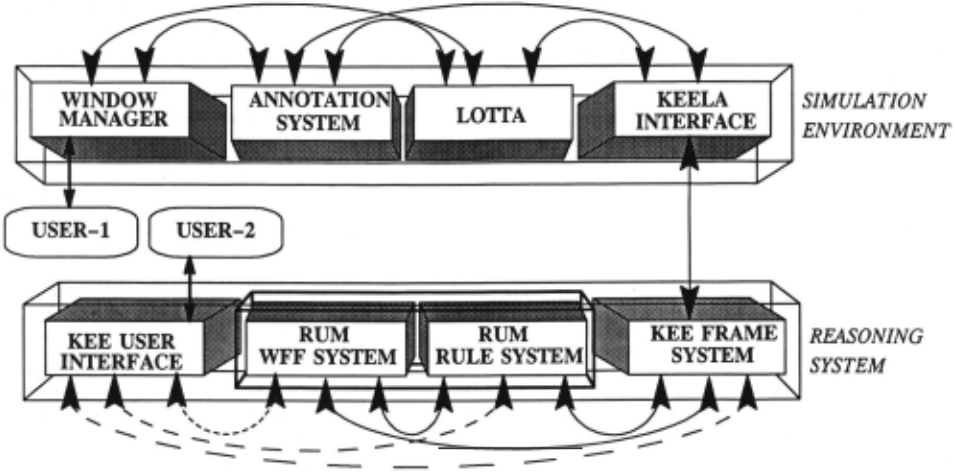
RUM's capabilities were first tested in October 1986, as part of an experiment in simulated naval situation assessment. Fig ure 2 illustrates the configuration of the components used in such experiment.
A. An Object-based Simulation Environment
The simulation of the scenario was implemented in LOTTA, an object-oriented symbolic battle management simulator that maintains time-varying situations in a multi-player antagonis tic game [Bonissone eta/., 1987]. A development environment centered around LOTTA was the testbed used to test the new techniques in reasoning with uncertainty. The development environment is composed of four basic modules: the Window Manager, a map-like window-oriented user interface; the An notation System, an intelligent database for LOTIA; WITA, the simulator that executes commands and maintains internal states; and KEEI.A, (KEE to LottA interface) the link between LOTIA and RUM.
B. Information Fusion and Situation Assessment
The situation assessment problem is composed of several tasks in which uncertainty pervades both the input data and the knowledge bases. Given a platform (aircraft, ship, tank) in a potentially hostile environment, the process of situation as sessment consists of the following tasks:
- Sensor data must be collected from various sources and described as reports ·
- Tune-stamped sensor reports must be consolidated into tracks (each track is the trace of an object followed by a given sensor) ,
- Tracks associated to the same object must be fused into a platform
- The detected platform must be classified and identified (by class and type)
- Node organization (/ormation of the identified platforms), use of special equipment, and maneuvering must be rec ognized
- Using the knowledge of the opponent's doctrines and rules of engagement, the recognized formation and ob served use of special equipment must be explained by a probable intent, which is then translated into a threat assessment.
The first four tasks constitute what is generally known as information fusion, and they define the scope of the simplified example described in the next section.
C. A Simplified Example in Information Fusion
In one experiment, a modified version of the naval situation assessment scenario used by l'iOSC to test SfAMMER and STAMMER2 [McCall eta/., 1979, J.P. Ferranti, 1981] was created. In it, a single missile cruiser faced three platforms that were either patrol hydrofoils or merchant ships. The cruiser's task was to track, correlate, and classify each detected object. Both passive and active sensors on the cruiser were run twice, generating sensor reports which were grouped into tracks for each sensor. Plausible correlations were then made between tracks to group them into detected platforms. Using the RUM knowledge base (see the example in the next section) on this information, the platforms were correctly identified.
1. Example of a RUM rule
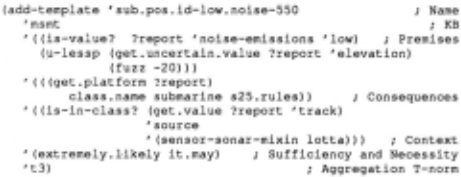
The RUM knowledge base (KB) used in this example is composed of approximately forty rules, each of which can be instantiated by new sensor reports, new tracks, or new plat forms. A representative sample of such a KB is provided by the following rule.
English Version of Rule-550 (identifying submarines): Assuming that sonar was used to generate a sensor report (which together with other reports generated by the same sen sor has been attached to a track associated with a platform), if the detected platform has a low noise emission, and is lo cated at a depth of at least twenty meters, then it is extremely likely that the detected platform is a submarine. Otherwise, the detected platform may not be a submarine.
RUM's Version of the same rule:
V. Remarks and Conclusions
We have implemented a layered architecture for reasoning with uncertainty. In the representation layer we have used frame like data structures attached to each variable. Each frame con tains a list of the values that were considered for the variable.
For each of these values, RUM maintains uncertainty infor mation, such as the lower and upper bounds, and uncertainty meta-information, such as a measure of ignorance, a measure of consistency, and the evidence source.
In the inference layer, we have used T-norm based calculi that are truth functional and associative. The truth function ality of the calculi entails low computational complexity and relatively inexpensive belief revision. The associativity of the calculi entails recursive problem decomposition. The formu lae for detachment have been derived from multiple-valued logics, by interpreting the inference symbol of the production rules as material implication, rather than conditioning. Instead of adopting a unique calculus (based on global assumptions) and uniformly using it in the knowledge base, we can select any of the five T-norm based calculi and locally apply them to any given rule subset.
In the control layer, we have implemented the capabil ities of selecting the appropriate calculus based on the cal culi characteristics (context independent information) and on the available meta-information describing the context and the user's attitude toward risk (context dependent information). We have also implemented a belief revision mechanism that can be frugal for time-critical situations (operating in a depth first backward mode) or exhaustive (operating in a breadth-first forward mode). Rule firing is controlled via a context activa tion mechanism that reduces the number of rules that will be considered relevant at any given time.
Future work on RUM will focus on extensions of the control layer capabilities. Specifically, we will define a meta language for describing the policies (i.e., meta-rules) for cal-
- culus selection, ignorance reduction, and conflict removal; we will also extend the meta-language to enable the use of the context mechanism from the meta-rules. Finally, we will start addressing real-time requirements by incorporating the time liness of information as another constraint in the control of reasoning represented in the control layer.
@inproceedings{ijcai1987p185,
  title     = {RUM: A Layered Architecture for Reasoning with Uncertainty},
  author    = {Bonissone, Piero P. and Gans, Steven S. and Decker, Keith},
  booktitle = {Proceedings of the Tenth International Joint Conference on
               Artificial Intelligence, {IJCAI-87}},
  publisher = {International Joint Conferences on Artificial Intelligence},
  editor    = {John McDermott},
  pages     = {891--897},
  year      = {1987},
  note      = {Reasoning},
  url       = {https://ijcai.org/proceedings/1987/185},
}
TY - CPAPER TI - RUM: A Layered Architecture for Reasoning with Uncertainty AU - Bonissone, Piero P. AU - Gans, Steven S. AU - Decker, Keith T2 - Proceedings of the Tenth International Joint Conference on Artificial Intelligence, IJCAI-87 PB - International Joint Conferences on Artificial Intelligence PY - 1987 SP - 891 EP - 897 UR - https://ijcai.org/proceedings/1987/185 ER -Copied
Machine-readable versions of this paper, for tools and AI agents:





