
Direct Memory Access Translation
Proceedings of the Tenth International Joint Conference on Artificial Intelligence. Natural Language. Pages 722-726.
© 1987 International Joint Conferences on Artificial Intelligence
Abstract
Direct Memory Access Translation (DMTRANS) is a theory of translation developed at CMT of CMU in which translation is viewd as an integrated part of cognitive processing. 1n this paradigm, understanding in source language is a recognition of input in terms of existing knowledge in memory and integration of the input into the memory. Context of sentences are established as what is left in memory after understanding previous sentences (or a preceding part of a sentence). Decisions made during translation are influenced by what is dynamically modified in memory through preceding recognitions. Since knowledge in memory is directly shared with the rest of cognition, during translation other cognitive processes such as inference can dynamically participate in the translation process.
- Becker, J.D. (1975) The phrasal lexicon. In 'Theoretical Issues in Natural Language Processing'.
- Birnbaum, L. A. (1986) Integrated Theory of Under- standing and Planning, Ph.D. thesis Yale University.
- Charniak, E (1986) A neat theory of marker passing. In 'Proceedings of the AAAI-86'.
- Collins, A. and Quillian M.R. (1969) Retrival time from semantic memory. Journal of Verbal Learning and Verbal Behavior.
- Fahlman, S.E. (1983) NEI'L: A system for representing and using real-world knowledge. The MIT Press.
- Hahn, U and Reimer U. (1983) World expert parsing: An approach to text parsing with a distributed lexical grammar. Technical Report, Universitat Konstanz, West Germany.
- Hirst, G and Charniak, E. (1982) Word sense and case slot disambiguation. In 'Proceedings of the AAAI-82'.
- Hovy, Eduard (1986) Ph.D. thesis Yale University. Forth- coming.
- Lytinen Steve. (1984) The organization of knowledge in a multi-lingual, integrated parser. Ph.D. thesis Yale Uni- versity.
- Quillian, M.R. (1969) The teachable language compre- hender. BBN Scientific Report 10.
- Riesbeck, C. and Martin, C. (1985) Direct Memory Ac- cess Parsing. Yale University Report 354.
- Schank, Roger C. (1982) Dynamic Memory. Cambridge University Press.
- Schank, Roger C. (1986) Explanation Patterns. Lawrence Erlbaum Associates.
- Tomita, M. and Carbonell. J. (1987) The Universal Parser Architecture for knowledge-Based Machine Translation. In 'Proceedings of the UCAI-87' . IJCAI
- Wilensky, R. (1981) Knowledge-based approach to lan- guage processing. In 'Proceedings of the UCAI-81 ' .
- Yokoyama, S. and Hanakata, K. (1986) Conceptual Lexi- con Using an Object-Oriented Language. In 'Proceedings of the COLING-86'.
References were extracted automatically from the PDF and may contain errors.
Full text extracted automatically from the PDF; figures, tables and equations may differ. The PDF is the version of record.
I. Introduction
The Direct Memory Access Translation (DMTRANS) is a new approach to machine translation currently researched at the Center for Machine Translation (CMT) of CMU. We claim that every part of cognition dynamically participates in trans lation (as in any other cognitive process) through shared mem ory, and that a translation system aiming at fully-autonomous machine translation should be designed with this in mind. This project is an experimental project currently being de veloped at the CMT as a new generation MT system and should not be confused with the ongoing CMU-MT project (Tomita& Carbonell[ 1987]).
The current implementation of DMTRANS uses the spreading activation model as a simulated parallel memory search 3 to recognize input in terms of the existing knowledge in memory. Similar approaches to understanding languages are found in Quillian[1969], Collins[1969], Fahlman[1979], Riesbeck&Martin[1985]. Related past works in this area in clude Hirst[1982], Hahn[1983], Yokoyama&Hanakata[l986], and Charniak[1986]. We prefer this method, because trans lation is performed directly through the network of mem ory, which makes dynamic interaction with other memory related processes possilble, and because all previously created memory structures can potentially participate in translation. DMTRANS extends and integrates theories of direct mem ory access understanding into translation with consideration of cross-cultural questions that accompany the attempt. We view translation as locating existing memory structures under the source language that the text is referring to and generating text that refers to these memory structures in the target language 4 · Often, a single memory structure is not shared by different languages and in that case, use of similar existing memory structures and explanation by surrounding memory structures replace direct generation from identified memory structures. Currently, the system is developed to translate between English and Japanese and is capable of understanding and generating fairly complex sentences betw~n the two languages.
1 A significant part of this research was done at the Computer Science Department of Yale University as a multi-lingual natural language module of the PROJECT IVY (case-base medical consultation system supported by the National Library of Medicine under Grant No. 5-R01-LM04251).
1 The author is supported by the Fulbright Scholarship under liE Designa tion DGB, No. 15850622.
3 A guided spreading activation is performed directly on the memory net and no modular syntactic analysis (Bimbaum[1986]) is done.
II. Where most MT systems fail
A. Ambiguation- No choice over others
Because most MT systems do not understand what they are translating, they are incapable of making decisions based on the content of the material they are translating. For example, the famous structurally ambiguous examples such as "I saw a man with a telescope" and "The man left by the door rotten" are handled by current systems by representing multiple inter pretations of the input; however, this does not mean these sys tems are capable of handling garden path sentences, since none of these systems are capable of choosing the most correct inter pretation over the others. Since inputs are translated sentence by sentence, virtually no contexual help is availa!Jle during translation. This makes an autonomous translation extremely unlikely, because very often sentences can have multiple in terpretations (most of which, humans are unaware of); with out human assistance, such systems are incapable of selecting one interpretation over otherss. Thus, being able to gener ate all possible interpretations of an input sentence does not automatically mean the system is capable of handling syntac tically ambiguous sentences. We claim that the system should be able to select the correct interpretation (what speaker in tended) in order to claim that it "handles" such a sentence. Unfortunately, most current MT systems fail in this task. By the same token, most MT systems fail in handling semantically ambiguous sentences. Consider the examples: ''The quality of this paper is terrible" and "John gave Mary a punch". In the former example, the interpretation of paper should be different (for example, Japanese for 'thesis' and 'a sheet of paper' is different) according to what has been said before (or perhaps, visual perception of the situation may supply help). In the latter sentence, interpretation should be different again due to the context (Japanese for punch as PROPEL and punch as a drink is different). Again, being able to generate multiple in terpretations of sentences does not mean the system is capable of handling semantically ambiguous sentences. The system instead should be able to choose appropriate interpretations.
· Since understanding is done as accornodating input with already existing knowledge in mem<ry (or past cases) we can also view DMTRANS as a kind of case-based translation theory.
5 This problem is conspicuous when a sentence bas a fairly complex struc ture including conjuncts. Consider "Show me the picture of lung with small cell carcinoma with ntagnification of ten and the brain with squamous cell carcinonta with ntagnification of five".
B. Ellipses, Anaphora, Indirect Speech Act
In most MT systems, ellipsis in a sentence results in either no parse at all or output with missing slots. For example, in trans lating "kouryo suru to ittaga, totemo shinjigatai" ([he] said, [he] will consider [it], but [I] can hardly believe [it]) which is a typical Japanese sentence with missing subjects, most MT systems simply fail in filling in missing information 6 · Another example is "How often does squamous cell carcinoma metas tasize to the brain? Lung? Large cell carcinoma?". Unless MT systems perform some strong inference at run-time, it is beyond their capacity to handle this phenomenon.
Anaphoric expressions are another kind of phenomenon that most MT systems fail to handle. Consider the example of "Musashi threw an arrow at the giant rat. It ate it." Current MT systems are satisfied with translating 'it' as 'it' 7 ; however, this often creates problems: for example, Japanese does not prefer 'sore' (it) for animate objects whereas English refers to both animate and inanimate objects with 'it'. In some languages, the morphology of 'it' changes according to what it is referring to. In this sense, anaphora is another phenomenon most MT systems avoid
Indirect speech acts also cause failure in most MT sys tems. At best, these systems output two possible interpreta tions of the utterance: the primary illocution and the secondary illocution, however, no preference for one over the other is made. A conference interpreter will take "Can you move over a little, your shoulder is blocking the picture" almost undoubt edly to be a request instead of a question. Without knowledge of what is it that the interpreter is translating, such an auto matic choice is impossible.
III. What DMTRANS can do
DMTRANS outperforms most systems in choosing an appro priate interpretation of sentences over others in accordance with contexts. DMTRANS does not even realize many of the unlikely interpretations of the text (just like humans do not realize unlikely interpretations of an input text). This is pos sible because sentences are always recognized in context in DMTRANS, by performing strong predictions based on what has been recognized previously. ·
A. Contexual Recognition of Concepts
First, a brief view of the DMTRANS marker passing mech anism is in order. We have three kinds of markers 8 that are spread around in the memory network: the Activation Marker (A-Marker), the Prediction-Marker (P-marker), and the Context-Marker (C-Marker). The A-Marker is to mark con cepts (and the abstractions) that are being identified with in puts. The P-Marker is used to predict the next likely concept to be recognized, through knowledge of the possible sequence of concepts. The C-Marker is used to mark concepts that are likely to be input under a given context. When a word comes in, the word sends activation to (put an A-Marker on) a concept that the word is attached to and the activation is sent above the abstraction hierarchy in the network. The A-Marker contains the source of activation to indicate which concept originated the activation. The P-Marker contains the origin of prediction of a concept that the P-Marker is put on. Predictions are ini tially made (P-Markers are put) on all the first elements of con cept sequences 9 , and if a predicted concept receives activation (when A-Marker and P-Marker meet) then the next element of the concept sequence is predicted. A concept sequence is a sequence of concepts that represents an order of concepts that is unique to a language and is stored in root concepts 10 · When the last element of a concept sequence is activated, then the concept sequence is accepted and the associated root concept is recognized. When this happens, DMTRANS searches for (or creates if it does not exist yet) some concept underneath the root concept in the abstraction hierarchy that represents the specific input concept sequence 11 and activates that con cept (another spreading activation). The C-Marker is stored in concepts (not necessarily root concepts) that influence the context of the text, and is sent to associated concepts when this concept is activated 12 · When activation is spread upward in the abstraction hierarchy and if more than one route exist (such as two meanings for a word), then the route through the C-Marked concepts are chosen unless the route hits a higher level concept that indicates a contrary preference.
6 Simple heuristics such as "assume the missing subject to be the subject of the former clause' does not wOik here.
7 As long as 'it' is translated as 'it' (perhaps 'sore' in Japanese}, translation is treated as accurate in most systems.
8 A-Marlcer and P-Marker are due to Riesbeck&Martin, which describes a more detailed picture of the way these two marlcers are passed around in memory.
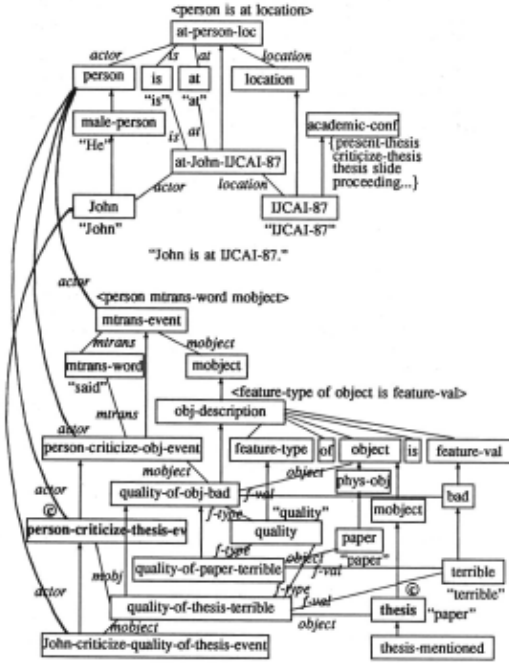
In order to demonstrate this mechanism, let us examine a short translation of a semantically (word-sense) ambiguous sentence: "John is at UCAI-87. He said the quality of the paper is terrible" (Figure 1). Initially, all the first elements of concept sequences (indicated by < ... >) are predicted. The first word "John" comes in and activates the concept 'John' (put A-Marker on it) then the A-Marker is sent upward until it hits the concept 'person' which is predicted by 'at-person-loc' as the first element of the sequence. Then the prediction is sent to 'is' which gets activated by receiving A-Marker from next input word "is". Then 'at' is predicted as the third ele ment of the sequence which meets activation from the input "at". Then the prediction for 'UCAI-87' is made. When the word "IJCAI-87" comes in, and activates 'IJCAI-87' which was predicted as the last element of the concept sequence <per son is at location>, this concept sequence is accepted and the root-concept 'at-person-loc' gets activated. Then the search is performed to find a specific concept under the root con cept that indicates the input 13 , and a concept refinement is conducted to get to 'at-John-IJCAI-87'. If this is not found, DMTRANS creates this concept as a specific episode of 'at person-loc'. At the same time, since 'academic-conference' (activated by 'UCAI-87') is a contexual-root concept it sends C-Markers to 'person-present-thesis', 'person-criticize-thesis', 'thesis', 'proceedings', etc .. When the next word "He" comes in, it sends activation upward and finds that the only male per-
9 We use the term 'concept sequence' to represent some known sequence of concepts such as <feature, physical-()bject> which includes sequence of abstract concepts as in MOP components and also low level phrasal templates such as described by Becker[l975], Wilensky[1981], and Hovy[1986).
10 Root concept is a concept that packages another concept in a structure, ie, MOP in DMTRANS. Verbs in a case-frame based lexicon are comparable structures.
11 This is called 'concept refinement'. Lytinen discusses a rule-based version of this scheme.
12 Concepts that receive the C-Marlcer include: Participants of a MOP, con cepts representing events, explanation-patterns attached to a MOP.
13 Concept refinement in DMTRANS is performed as a search for a node that packages the input recognized concept with linka parallel to the linka from the accepted root node to the elements of the accepted concept sequence.
'printer' respectively 16 · However, since, "ink" and "printer" both come after "UCAI-87" in both cases, 'paper' is prefered over 'thesis' in both cases, and it gets activated. Unless these activations meet contradicting hypotheses elsewhere, 'paper' becomes the contextual interpretation of "paper".
B. Explanatory Generation
We have two different concept sequences stored in each root concept, one for English and one for Japanese. Especially be cause they represent texts from different language families, the sequences are rarely the same; however, the roles are shared, it is because memory structures are independent of languages and the types of roles are inherent in the root concepts, not in the languages. Similar approaches are taken in Lytinen[1984]'s MOPTRANS and CMU's current MT system. Both systems take advantage of shared memory structures for translation, the former using MOPs as the shared structure and the latter using case frames as the shared structure.
Generation begins with the result of memory activation parsing from input in one language. For each concept refined nodes left in memory, we do the following. 1) Check at the lexical node for the refined concept in the target language and ~=::,=t~===~;;~=::S~:;-;::==-----. if a lexical entry is found, generate in accordance with templates stored with the concept and we are done. 2) If not, '---,c----::;';;;.-:;;~:::r::=:;-;fL.:J '-----.,....-----' which is the often the case 1 7, we generate according to the stored concept sequence for the target language. That is to generate from the first element of the concept sequences (go back to 1 with the first element of the concept sequence). 3) Since not all concepts have sequence attached to it, search the abstraction hierarchy upward for abstraction of the refined concept which has concept sequences attached to it. 4) Get the sequence from this abstraction and then instantiate with the roles in the refined-concepts. Then from the first element of the instantiated concepts sequence, repeat from looking up lexical node again. If not found, repeat from the 2 again to explain this concept.
"He said the quality of the paper is terrible."
Figure 1: Concept refinement and context marking
son activated in memory is 'John', and activates 'John' again; 'person' gets re-activated, which is predicted as the first ele ment of 'mtrans-event', then "said" comes in and fits as the second element of the concept sequence attached to 'mtrans event'. Likewise, "The quality of this paper" is accepted, being identified with the sequence <feature-type of object is feature value> attached to 'object-description'. One thing that happens is that when "paper" which is attached both to 'paper' and 'the sis' comes in, only 'thesis' sends activation upward because 'thesis' was C-Marked by 'academic-conference' and 'paper' was not marked. This choice is not challenged when 'mtrans event' is accepted and is concept-refined to 'person-criticize thesis-event', since this concept also supports the contexual interpretation of "paper" 14 · This way, understanding is left as activated memory structures representing 'at-John-UCAI-87' and 'John-criticize-quality-of-thesis-event' that are instances of the refined concepts under accepted root concepts.
Also, if two conflicting choices of a concept are marked by two C-Markers, the C-Marker put by the concept activated more recently gets preference. For example, in "John was writing a letter on a plane to UCAI-87. The ink smeard. He said the quality of this paper is terrible" and in "John was printing a paper for UCAI-87. The printer jammed. He said the quality of this paper is terrible", both 'paper' and 'the sis' are C-Marked by 'UCAI-87' 1 s and 'ink', 'UCAI-87' and One sample short translation is translating the Japanese sentence: "Gionshoja no kane no koe, shogyomujo no hi biki ari" which is translated to be: "The sound of the bell at Gionshoja has the tone of 'shogyomujo' (impermanence of all phenomena in the world)". Note that DMTRANS outputs 'shogyomujo' as 'shogyomujo', and adds the explanation of the word in parentheses. This is because an English lexi cal entry for the concept representing 'shogyomujo' was not found in memory. Since a concept may not be shared across languages, this type of explanation happens often, especially in a cross-cultural context 18 · If a lexical entry for the target language is not found, most MT systems simply halt excution. In contrast, DMTRANS outputs the explanation of the concept in the target language. This is possible through the explana tory generation mechanism described above. Explanation is performed by generation using the surrounding concepts with lexical entries in the target languages.
14 C-Marked by the same contexual root concept as 'thesis'.
15 Actually, C-Marked by 'academic-<:onference' which was activated by
'UCAI-87'.
16 These three concepts trigger (activate) contexual-root concepts.
17 This is the inherent uniqueness of the DMTRANS systent, that the systent dOes not halt even if the lexical entry is not found in the target language; instead DMTRANS tries to explain the concept through surrounding concepts in the mentory network that have lexical entries in the target language.
18 The described explanatory generation mechanism works effectively in translation between English and Japanese, where a one to one match of con cepts is often difficult to find due to the difference in the cultural contexts. Even words such as ''river" and ''kawa" (Japanese for river) which are nor mally substituted for one another without any further consideration, reveal difference in concepts attached to thent, ie, the Japanese word "kawa" is nor mally associated with images of clear rapid streams. What about "kou" in Chinese?
C. Dynamic Interactions with the Rest of Cognition
Since translation is performed by directly accessing the mem ory network, other faculties of cognition can dynamically par ticipate in translation. One example sentence here is "John threw an apple at the giant rat It ate it". Whenever, a pronoun comes in as an input, DMTRANS tries to identify the object that is referred to 19 · In this example, the concept 'animal-ingest-object-event' gets activated by the input "it ate it". 'animal-ingest-object-event' is a MOP structure which is a kind of 'ingest-event'. It has two roles to be filled: Actor and Object. In order to determine the Actor, the inference mechanism is activated and it looks for activated concepts in memory that can be an Actor and finds 'giant-rat' to be a candidate given restrictions set forth by the MOP structure 20 · Then a search is made for concepts previously activated in memory that fit the requirements for Objects and 'apple' is selected to be an acceptable object of 'ingest-event'. This ex ample only requires a minimum amount of work for deciding objects; however, this architecture allows for deeper inferences if necessary, such as utilizing causal relations stored in MOPs and eXplanation Patterns associated with higher level struc tures (Schank[1986]) 21 ·
D. A Translation system that learns
DMTRANS is capable of creating new concepts while trans lating, and is capable of learning new vocabulary for newly c.:reated concepts in a multi-lingual context. When a concept re finement is performed, if a specific concept representing the in put sentence is not found underneath the accepted root concept, a new specialization is created. Also, the user of the system is asked to input the English and Japanese names (words) for the concept (or input phrase can simply be stored as a phrasal lexicon). By the same token, we can simply assert facts to be translated by DMTRANS and the system stores the assertion as well as it translates it as long as it is not incompatible with what it already knows. At the same time, the acquired concept is accessible from different contexts because of the hierarchi cal organization of memory (Schank[1982]) that implements MOP structures. This way DMTRANS implements dynamic memory as its memory network and is capable of learning while translating.
IV. Conclusion
From a practical point of view, DMTRANS may be interesting because a lexically guided spreading activation mechanism is parallel in nature, and recent availability of massively parallel machines makes it an appealing theory for machine translation, utilizing such parallel architectures. However, the impact of this theory is that translation is performed as an integrated part of cognition, cooperating with other faculties through memory. Most MT systems have failed in tackling contexually ambigu ous sentences; however, in DMTRANS, with use of episodic and thematic memory, and also the C-Marker passing, per formance with ambiguous sentences is significantly improved.
1 9This is independent of the question whethezo to translate 'it' as 'it'. Even if we do, it is better to know what is referred by it with the reasons indicated before.
20 If "John" is known to be a name of dog, we ·need more infezoence. Such as check the previously activated memory structure (propel-event) and infer wbel'e the apple is at now, etc ..
21 Actually, the understanding part of DMTRANS was originally designed as an integrated pan of a case-based reasoning system to allow direct inference on input sentences.
Explanatory generation handles culturally sensitive translations more effectively, especially when lexical entries in the target language are not available. Also, the dynamic participation of an inference mechanism contributes in handling phenomena such as anaphora, ellipsis, and indirect speech acts. A future possibility is that we may supplement DMTRANS with other input output channels to make the system's abilities closer to those of human interpreters in handling questions of pragmat ics. In our understanding, memory is shared by all parts of cognition, and any cognitive task including translation should be dynamically assisted by every faculty with direct access to the memory.
Acknowledgments
Thanks are due to members of the PROJECT IVY, ie, Lawrence Hunter and Alain Rostain of Yale AI Project and Dr. Jerry Silbert of West Haven Veterans Administration Hos pital. Dr. Christopher Riesbeck motivated me in the DMA paradigm. Also, many thanks to members of CMT especially to Eric Nyberg for valuable comments, and to Professor Jaim Carbonell and Dr. Masaru Tomita who are providing me an excellent opportunity to devote myself in machine translation research at the Center for Machine Translation.
@inproceedings{ijcai1987p144,
  title     = {Direct Memory Access Translation},
  author    = {Tomabechi, Hideto},
  booktitle = {Proceedings of the Tenth International Joint Conference on
               Artificial Intelligence, {IJCAI-87}},
  publisher = {International Joint Conferences on Artificial Intelligence},
  editor    = {John McDermott},
  pages     = {722--726},
  year      = {1987},
  note      = {Natural Language},
  url       = {https://ijcai.org/proceedings/1987/144},
}
TY - CPAPER TI - Direct Memory Access Translation AU - Tomabechi, Hideto T2 - Proceedings of the Tenth International Joint Conference on Artificial Intelligence, IJCAI-87 PB - International Joint Conferences on Artificial Intelligence PY - 1987 SP - 722 EP - 726 UR - https://ijcai.org/proceedings/1987/144 ER -Copied
Machine-readable versions of this paper, for tools and AI agents:





